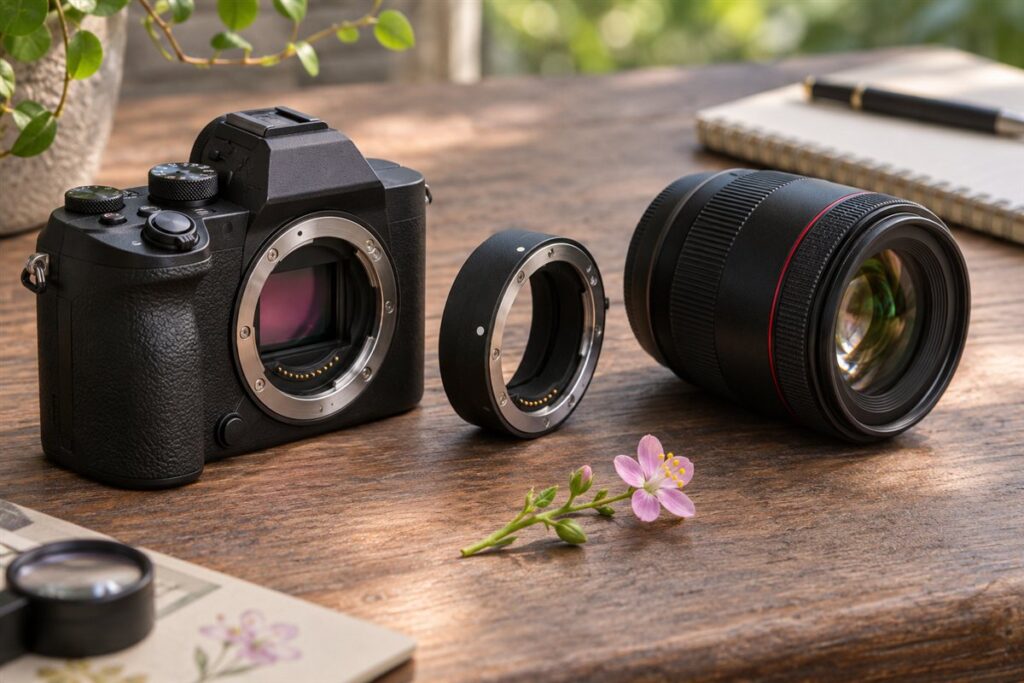
Extension tubes and dedicated macro lenses both help you shoot close-ups, but they work in different ways. Tubes add space between lens and camera; a macro lens is built from day one to focus close. The right option depends on how often you shoot small subjects. This guide compares them, then walks through a close-up session, common cases and fixes.
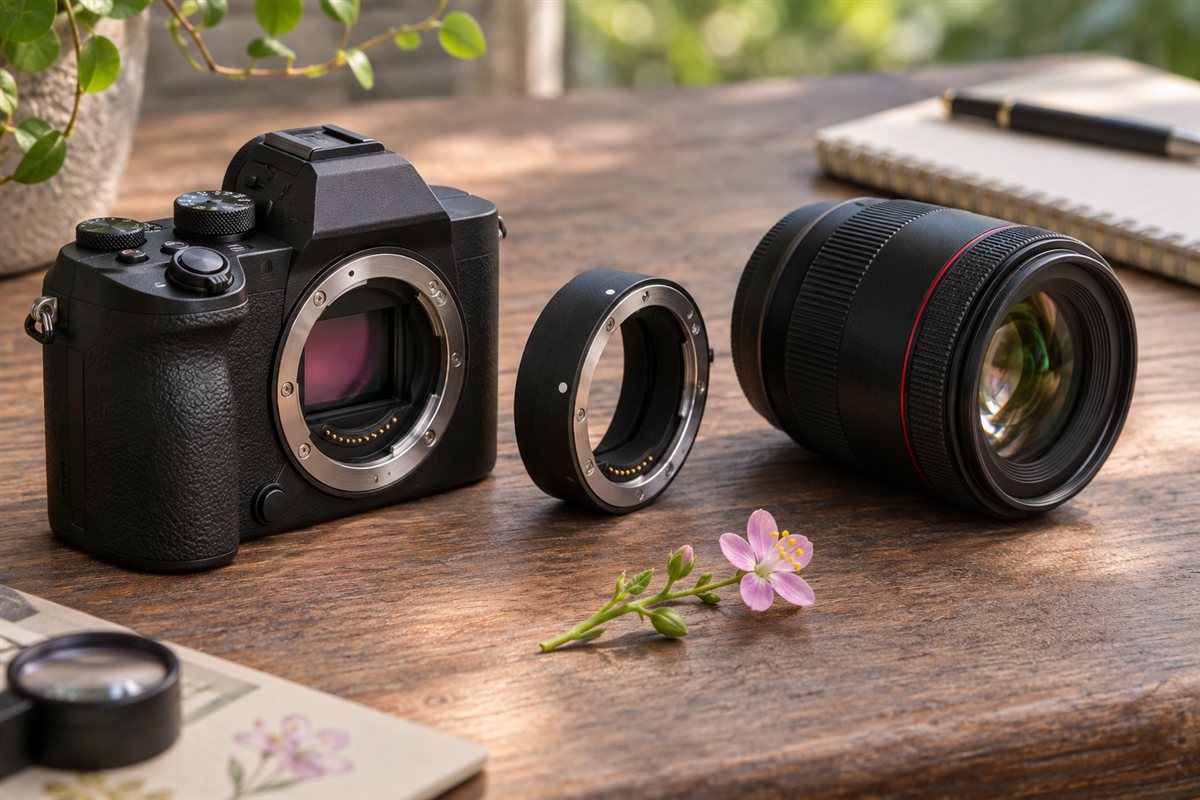
What Each One Is For
An extension tube is a hollow ring that sits between the camera and a lens. By moving the lens farther from the sensor, it lets the lens focus closer than normal and raises magnification. Basic tubes have no glass, so they add no optical elements.
A macro lens is a complete optical design made for close focusing, usually with strong sharpness at short distances and often a focusing range that runs smoothly to infinity.
Key Differences
| Aspect | Extension tubes | Macro lens |
|---|---|---|
| Function | Adds close focus to a lens you own | Dedicated close and normal focus |
| Light loss | Reduces light reaching the sensor | Some loss at high magnification |
| Focus range | Limited, often no infinity | Full range |
| Autofocus | Depends on electronic contacts | Usually supported |
| Size | Small and light | Larger lens |
Understanding Magnification
Magnification compares the size of the subject on the sensor with its real size. A ratio of 1:1 means a small object appears life-size on the sensor, while 1:2 means half life-size. A true macro lens often reaches 1:1, though some lenses sold for close work stop at a lower ratio.
With a tube, the added magnification depends on the tube length and the lens focal length. A general rule is that the extension divided by the focal length gives the extra magnification. A 25mm tube on a 50mm lens adds roughly half a unit of magnification, while the same tube on a 100mm lens adds only about a quarter. Shorter lenses therefore gain more from the same tube.
Practical Notes on Using Tubes
- Switch off the camera before changing parts.
- Attach the tube to the body, then the lens to the tube.
- Set a small aperture for more depth of field.
- Move the camera back and forth to focus, not the focus ring only.
- Use extra light or a tripod, since exposure drops.
Longer or stacked tubes give greater magnification, but also more light loss and tighter focus distance.
Who Should Choose Which
- Choose tubes if you want to try close-ups with a lens you already own and keep weight low.
- Choose a macro lens if you shoot small subjects often and need sharp results with flexible focus.
- Choose both if you are working at extreme magnification with a macro lens and want more.
Lighting is the practical challenge with both tools. At close range the lens can cast a shadow on the subject, and the light drops as magnification rises. A small flash, a reflector or even a desk lamp can solve this. Keep the background simple, use a steady support, and take several frames, because tiny movements make a large difference at high magnification.
Worked Example: A Flower Close-Up with a Tube
- Choose a calm day or shelter the flower from wind, since slight movement ruins focus at high magnification.
- Mount the camera on a tripod, attach the tube to the body, then add a short or medium prime lens.
- Set the lens to its closest focus setting, because tubes work best when the lens begins at minimum distance.
- Choose aperture priority and an aperture near f/8, which balances depth of field with sharpness.
- Move the whole camera slowly toward the flower until the key detail looks sharp on the screen. Use live view zoom to confirm.
- Use a timer or remote release to avoid shake, and add soft light with a reflector on the shaded side.
- Take several frames, shifting focus slightly each time, and keep the sharpest.
Common Scenarios
Jewelry or small collectibles
Both tools work indoors, where you control light and movement. A macro lens saves time if you shoot many items, while tubes suit an occasional job.
Insects outdoors
A macro lens with a longer focal length gives more working distance, so you disturb the subject less. Tubes force you to get very close, which can frighten small creatures.
Travel with limited space
A set of tubes weighs little and fits in a pocket. If luggage space matters and close-ups are an occasional interest, tubes make sense.
Product pictures for a small shop
Regular close detail work benefits from the flexibility of a macro lens, which also handles normal framing of whole items without removing parts.
Mistakes to Avoid
- Using a wide aperture at high magnification. Depth of field becomes razor thin, so most of the subject falls out of focus.
- Choosing a tube that does not match the camera mount. Mismatched tubes will not fit, or will lose communication with the lens.
- Forgetting to hold the tripod steady in wind. Even a gentle breeze blurs a flower at close range.
- Ignoring the lens shadow. The lens barrel can block your own light, so move the lamp or use a side reflector.
- Changing parts with the camera on. It risks static or contact problems, so power down first.
Quick Troubleshooting
| Symptom | Likely cause | What to try |
|---|---|---|
| Autofocus will not work | Tube lacks electronic contacts or lens is not set for close range | Switch to manual focus and move the camera |
| Image is too dark | Light lost through the extra extension | Add light, slow the shutter on a tripod or raise ISO |
| Only a sliver is sharp | Shallow depth of field | Close the aperture or take several frames and merge them |
| Cannot focus on distant things | Tube blocks infinity focus | Remove the tube for normal shots |
| Blur despite a tripod | Shutter press or wind movement | Use a timer or remote and shelter the subject |
Glossary
- Magnification ratio: subject size on the sensor compared with real size.
- Working distance: the space between the front of the lens and the subject.
- Minimum focus distance: the closest distance at which a lens can focus.
- Depth of field: the zone of distance that looks sharp.
- Focus stacking: merging several frames with different focus points into one sharper image.
- Prime lens: a lens with a fixed focal length.
FAQ
Do tubes harm image quality?
Simple tubes add no glass, so they do not add optical flaws on their own. The lens still limits quality, and edges may soften at close range.
Which lens works best with tubes?
Short and medium prime lenses are common choices. Check the maker’s guide for any limits.
Can I stack several tubes?
Yes, many sets are designed to be combined. Each addition raises magnification but reduces light and narrows the focus distance, so you may find manual focus and added light become necessary.
Do I need a tripod for close-ups?
It helps greatly. At high magnification small movements look large, and a tripod lets you use a smaller aperture and slower shutter without blur.
Is a macro lens only for close work?
No. Most macro lenses focus normally too, so they can serve for portraits or general shooting, though they may focus more slowly than ordinary lenses.
Can a tube turn a zoom into a macro lens?
It can allow closer focus, but results vary. Zoom lenses often have a more complicated design, and focus range changes with focal length, so experiment carefully.
The Short Version
Tubes are a light, low-effort way to explore close-ups. A macro lens is the better tool if close work is a regular interest. Match the choice to how often you will use it, and plan for steady support, good light and careful focus whichever you choose.