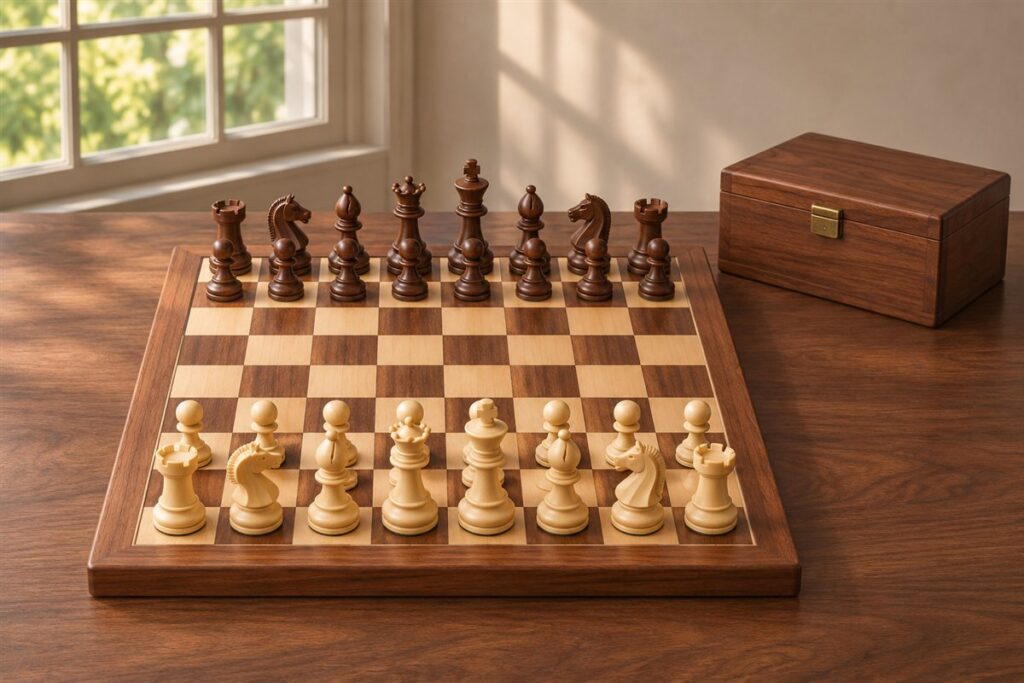
Variants that create constant tactical threats, such as crazyhouse, atomic and antichess, push you to calculate concrete lines quickly. They can be a fun change from standard chess, though they are a supplement to normal games and puzzles, not a replacement.

What Calculation Speed Means
Calculation is the ability to look at a position, pick candidate moves and follow each line a few moves deep without losing track. Speed matters because clocks run out. Variants help when they force you to check forcing moves, such as captures and checks, again and again.
Variants That Demand Calculation
- Crazyhouse: captured pieces can be dropped back onto the board by the capturer, so threats appear from nowhere. You must constantly check what a dropped piece could attack.
- Atomic chess: captures cause explosions that remove nearby pieces. Counting what disappears becomes a core skill, and kings can win by blowing up the enemy king.
- Antichess: captures are compulsory and the goal is to lose all your pieces. Forced sequences are common, so you learn to trace long chains of obligatory moves.
- Three-check: giving check a third time wins, which rewards sharp, forcing play.
- Bughouse: played in teams on two boards, it adds time pressure and quick decisions, though the partner element makes it less pure as training.
Comparing Them by Skill
| Variant | Calculation style | Typical pace |
|---|---|---|
| Crazyhouse | Checking drops and counter-drops | Fast, tactical |
| Atomic | Counting explosions | Short, sharp games |
| Antichess | Following forced captures | Puzzle-like |
| Three-check | Chains of checks | Quick and direct |
How to Use Variants as Practice
- Choose one variant and learn its rules from a major chess site’s rules page.
- Play short time controls, roughly three to five minutes per side, as a general guide.
- Before each move, list every capture and check for both sides; this habit carries over to standard chess.
- After each game, find the move where you missed a forcing reply.
- Return to standard puzzles and games to apply what you noticed.
Limits to Keep in Mind
Variant tactics do not always transfer. Some patterns, like sacrificing material for dropped pieces, simply do not exist in standard chess, and openings differ greatly. The shared skill is the discipline of checking forcing moves and visualizing positions, and that is the part worth taking back to your regular games.
Building a Weekly Training Schedule
Variants are most useful when they fit into a routine rather than replacing everything else. A simple weekly plan keeps your practice balanced and makes progress easier to notice.
A reasonable structure combines three types of work: puzzle solving to sharpen pattern recognition, variant games to build forcing-move habits, and standard games to apply what you learn. The exact split depends on your time and goals, but the idea is to rotate between them. Treat the schedule as a starting point and adjust as you see what helps.
- Begin each session with a short warm-up of tactical puzzles in standard chess, focusing on accuracy over speed.
- Play a handful of variant games at short time controls, concentrating on listing forcing moves before each decision.
- Finish with one or two standard games at a time control long enough to think, and notice whether you are checking captures and checks more consistently.
- Once a week, review your errors from all three, grouping them by type.
Keep sessions short enough that you stay alert. Calculation requires concentration, and tired play reinforces sloppy habits. A few focused sessions each week are better than one long weekend marathon. Write down your goals, such as reducing blunders in forcing lines, and revisit them after a few weeks. If a variant becomes more about winning than learning, take a break from it and return to puzzles.
Candidate Moves and the Forcing-Move Checklist
The core habit that variants can strengthen is a systematic way of choosing moves. Strong calculators do not simply look at everything. They generate a short list of candidate moves, starting with the most forcing ones.
A simple checklist works in any variant, and in standard chess too. Before each move, ask what the opponent threatens, then list your checks, your captures and your direct threats. For each candidate, follow the most forcing reply, and stop when the position becomes quiet. Compare the final positions, and choose the best.
- Checks: in three-check, every check counts toward victory; in other variants, check the consequences of forced replies.
- Captures: in antichess they are mandatory, which narrows options; in atomic, count what each explosion removes.
- Drops: in crazyhouse, imagine where each captured piece could land next move.
- Threats: look for moves that create two threats at once.
- Safety: always check that your own king is not exposed to a forcing sequence.
Practice saying the list in your head until it becomes automatic. When you review your games, ask which step you skipped when you made a mistake. Often it is a simple omission, such as missing a check, not a deep calculation failure. Over time, the checklist speeds up your thinking, since you spend less effort deciding what to examine.
Visualization and Blindfold-Style Exercises
Calculation depends on your ability to hold positions in your mind. Variants help because tactics are dense, but you can also train this skill directly with a few exercises.
One approach is to take a position from a puzzle or game, study it for a short time, then look away and try to play out a line mentally. Start with two or three moves and increase gradually. After each attempt, check the board to see if your mental picture matched the real one. Another approach is to set up a position and name the squares attacked by a piece, without looking at the board.
- Choose a position with a clear tactic and calculate the line without moving the pieces.
- Write the resulting position on paper, then compare it with the actual board.
- Play practice games where you do not touch the pieces until you have decided, if you use a physical board.
- Try solving puzzles with the board hidden for the first moves, if your training site allows it.
- Gradually lengthen the lines you try to see.
Variants add a twist, since the rules about explosions, drops or compulsory captures must be built into your mental picture. That makes them good for stretching visualization. Keep your expectations modest, since this skill grows slowly. Short, regular sessions help more than occasional long ones. Stop if you feel mentally drained, and return fresh.
Time Management and Reducing Blunders
Speed in calculation is not just thinking faster. It is about spending time where it matters and avoiding errors that cost games. Variants are a good laboratory for this because the pace is quick and mistakes are punished immediately.
Notice how you use your clock. Do you spend a long time on early moves and then rush later? Do you freeze in complicated positions? Try assigning rough time budgets, such as using less time on routine moves and saving more for critical decisions. When you reach a position with several forcing options, take a moment to calculate carefully, as these are the points where games are decided.
- Before moving, take a quick look at what the opponent can do in reply, especially with captures and checks.
- If you feel the urge to move instantly, pause for a breath and double-check.
- Avoid premonition moves, played because they look natural, without checking tactics.
- After a loss, mark the exact move where you stopped calculating and ask why.
- Keep a short list of your recurring blunders and review it.
Short time controls can create bad habits if you only rely on instinct. Mix in slightly longer games to practice thinking steps clearly. The goal is to be quick when positions are simple and careful when they are not. Over time you should find that your instinct improves, because you have trained it with accurate calculation.
Choosing Where and How to Play Variants
Many major chess sites offer variants, and the experience differs across platforms. Look for ones that provide clear rules, a rating system for each variant and the ability to review games afterward. Read the rules page for each variant before playing, since small details matter, such as how castling or en passant works in a given version.
Choose opponents of a similar level, so games are challenging but not overwhelming. If ratings are provisional at first, expect some ups and downs. Treat early games as learning, not as a measure of ability. Use analysis tools after each game to see where tactics were missed, if the site offers them for variants.
- Pick one variant and play enough games to feel comfortable with its rules.
- Learn a few typical opening ideas, since variant openings differ greatly from standard theory.
- Read game collections or guides by experienced players for strategic insights.
- Join a community or club that plays the variant, if one is available, for tips and practice partners.
- Limit your sessions so that variant play does not crowd out other chess study.
Be mindful of your motivation. If you enjoy a variant, you will likely play more of it, and enjoyment is part of improvement. If it becomes frustrating, switch to another or return to standard chess for a while. The aim is steady learning, and the best training method is the one you will keep doing.
FAQ
Will variants make me stronger at standard chess?
They can sharpen habits such as checking captures and visualizing lines, but the effect varies from player to player. Mix them with standard play.
Which variant should a beginner try first?
Many players find crazyhouse or three-check approachable because the goals are clear and games are short.
How long should I practice variants each week?
Short, regular sessions work well, such as a few sessions of 20 to 30 minutes. Adjust based on your schedule, and keep standard games and puzzles in the mix.
Are variants good for beginners?
They can be, if you learn the rules first. Some beginners find the quick tactics motivating, but make sure you also learn standard chess basics.
Do ratings in variants matter?
They give a rough guide to your level within that variant but do not translate directly to standard chess. Use them for feedback, not as a goal in themselves.
Can variants hurt my standard chess?
They can if you start relying on variant-only ideas, such as drops, in standard games. Keep regular play in your routine and be mindful of the differences.
What time control is best for calculation practice?
Short controls build speed, while slightly longer ones allow careful thought. Alternate between them, depending on the goal of the session.
Should I review my variant games?
Yes. Look for moments where you missed a forcing move, and note the type of mistake. Review is where most learning happens.
Do I need a coach for this?
No, but feedback helps. A friend, club member or analysis tool can point out missed tactics that you might not notice yourself.
The Short Version
For calculation practice, try crazyhouse, atomic or antichess in short games, and go back over where you missed forcing moves. Keep standard chess in the mix so the habits carry over.