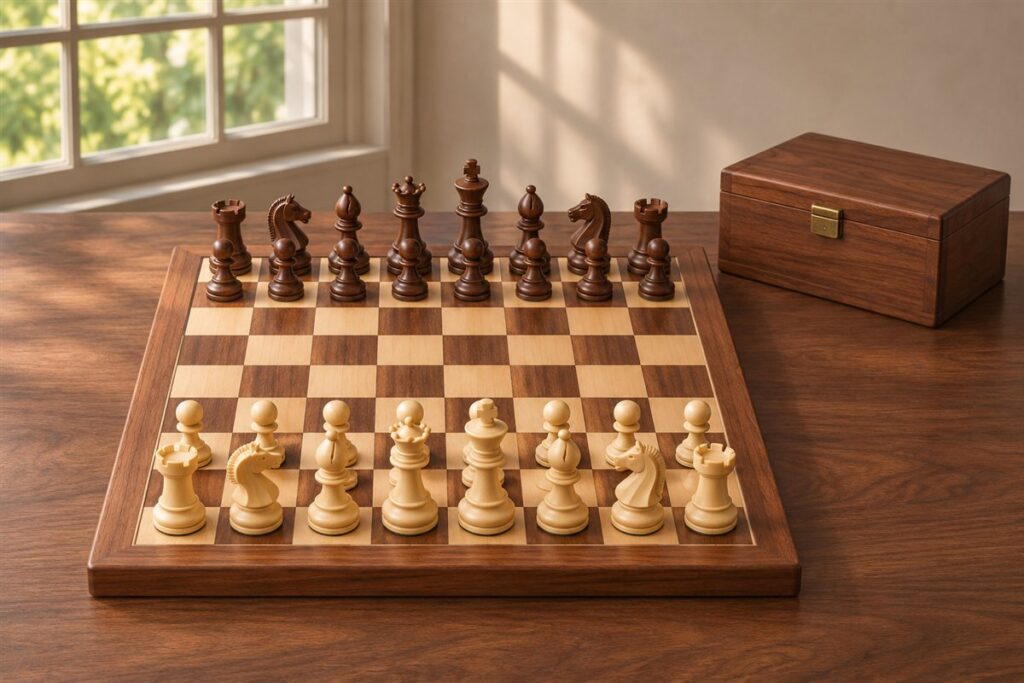
If standard chess feels familiar, these ten variants change one rule and make you think again. Most are free on major chess sites, and each one can be learned in a few minutes.

Variants With New Setups
- Chess960 (Fischer Random): the back rank pieces are shuffled under set rules, so opening memory matters far less.
- Horde: one side has a large mass of pawns and the other has a normal army. The pawns try to break through while the pieces try to capture them all.
- Racing Kings: no checks are allowed, and both kings race to the far side of the board.
Variants With Different Winning Goals
- King of the Hill: you can win by walking your king to the center squares.
- Three-check: giving check three times wins the game, which rewards aggressive play.
- Antichess: captures are forced and the aim is to lose all your pieces.
Variants With New Mechanics
- Crazyhouse: captured pieces change sides and can be dropped back onto the board as your own.
- Atomic: captures cause explosions that remove nearby pieces, so kings must be careful.
- Bughouse: two teams play on two boards, passing captured pieces to a partner.
- Fog of war: you see only the squares your pieces can reach, so hidden information matters.
How to Try Them
- Check the variant menu on large chess servers, where many of these are available.
- Play a few games against bots or friends before judging a variant.
- Read the exact rules first, because details such as castling or promotion can differ by site.
- Expect to lose a few games while you learn. Standard opening knowledge only partly carries over.
Which to Try First
| If you like | Try |
|---|---|
| Fresh openings | Chess960 |
| Fast, tactical games | Crazyhouse or Three-check |
| Team play | Bughouse |
| Puzzle-like rules | Atomic or Antichess |
| Hidden information | Fog of war |
Tips for a Good First Session
Pick one variant and stay with it for several games, since the first few will feel strange. Play a friend who is also new, so the learning curve is shared. Ask yourself what is different about piece value in that variant. In Crazyhouse, for example, a knight in hand is often worth more than it is on the board, and in Atomic a pawn next to the enemy king can be a weapon. Those small insights are where the fun comes from.
Skills That Variants Help You Build
Playing different rule sets can sharpen parts of your game that standard chess exercises more slowly. Crazyhouse and Bughouse push you to calculate forcing sequences and to judge the value of a piece in hand. Three-check teaches you to see checks as resources, and it forces you to think about king safety in new ways. Atomic rewards attention to the squares around your pieces, since a capture changes several squares at once.
Chess960 trains opening principles instead of memory. Because the back rank is shuffled, you must develop pieces sensibly, fight for the center and castle with care. That habit transfers to regular games, particularly when your opponent leaves your preparation early. King of the Hill and Racing Kings train your sense of tempo and king activity.
- Use variants as a break from rating pressure.
- Notice which tactical themes you see more often and look for them in standard games.
Choosing a Variant for Your Group
The best variant depends on who you play with. Two players of similar strength can enjoy Chess960 or King of the Hill with little explanation. A group of friends who like a social game may prefer Bughouse, which needs four players and plenty of talking. A mixed group, such as an adult and a child, may enjoy a variant that evens the match, like a handicap or a rule that gives a clear edge to the weaker player.
Think about the time you have. Some variants, such as Three-check, usually finish fast. Others, like Horde, can drag on if neither side finds a plan. Consider also how many rules you need to learn. A variant with a single rule change is easier to teach than one with hidden information or special piece drops.
Agree on the exact rules before starting, especially for castling, promotion, en passant and draws, since different sources describe them differently.
Setting Up Variants Over the Board
Many variants can be played with an ordinary set, with a few extras. For Crazyhouse, a tray for captured pieces helps both players see what is in hand. For Bughouse, you need two boards and two clocks, and ideally a way for partners to pass pieces without confusion. For Horde, extra pawns are needed, so check that your set has enough or use coins or markers.
Some variants are much easier on a screen. Fog of war requires a referee or software to hide information. Others, like Atomic, need only careful attention to the board. If you are unsure, begin with a variant that needs no extra equipment and add complexity as the group gets comfortable.
For clarity, use a clock when playing quick variants and agree on rules for touch-move and for illegal moves. A written list of rules on a card can prevent arguments.
Common Mistakes When Learning a Variant
Players often carry habits from standard chess that do not fit. In Antichess, for example, protecting your pieces makes little sense, since you want to lose them. In Atomic, capturing next to your own king can blow it up. In Crazyhouse, trading pieces may hand your opponent the means for an attack, because captured pieces can be dropped back.
Another mistake is ignoring the changed value of pieces and tempo. Pawns may be stronger or weaker, and the king may be safer or more exposed. Spend the first games asking what changed, then adjust your plan. Watch how experienced players handle the first moves, and read short guides on opening ideas for the variant.
- Do not rely on standard opening theory without checking whether it applies.
- Look for new tactical motifs, such as piece drops or explosions.
- Review your losses to see where you misjudged the new rules.
Making Variants a Regular Habit
If you enjoy a variant, find a way to keep playing it. Set up a weekly game with a friend, join an online community or add a variant evening to your club schedule. Keep a small record of your games so you can see progress. Some players keep a variant as a relaxing alternative to rated play, and others use it to teach friends who find standard chess intimidating.
Consider organizing a small event. A casual tournament with several variants, short time limits and simple scoring is a good way to introduce newcomers. Keep it friendly, and make sure everyone knows the rules beforehand.
Finally, remember that variants are meant to be fun. If a rule set feels frustrating, try another. The goal is to enjoy new ideas and keep your curiosity about chess alive.
Why Variants Are Worth Your Evening
Ordinary chess is deep, but its openings have been mapped by generations of players. Variants shake that routine. They keep the familiar board and many familiar ideas, then twist a rule so that your usual patterns no longer apply. For beginners, this levels the field, because everybody is a little lost. For experienced players, it is a refreshing break from memorised lines. A good variant makes you think, laugh and talk across the table, which is what a game night is for.
The variants discussed in this guide do not need special equipment beyond a normal board and set, plus perhaps a second board or a few coins. That makes them inexpensive to try, and it keeps the focus on play rather than shopping.
How Rule Changes Shift Strategy
Every variant changes at least one of three things: the opening setup, the goal or the way pieces move and interact. Each change has a ripple effect. If the opening setup is random, theory vanishes and you must evaluate positions from first principles. If the goal is different, such as reaching a certain square, material may matter far less than speed. If pieces interact in new ways, your instincts about safety need rebuilding.
When you meet a new variant, ask three questions before your first move:
- What is now much more powerful than usual?
- What is now much weaker or riskier?
- What new tactic does the rule allow that was impossible before?
Answering these questions in a minute of thought gives you a plan and avoids early blunders.
Team Play and Group Formats
Some of the most enjoyable variants involve more than two people. In a team format, two players sit on each side and share the pieces, or each controls a board and passes captured pieces to a partner. These games are loud, fast and friendly, and they suit parties where not everyone knows how to play seriously. They teach communication: you must announce what you need, warn your partner of threats and decide quickly.
Tips for Team Games
- Agree a time limit so the pace stays high.
- Decide in advance whether talking is allowed during moves.
- Keep a notepad to track captured pieces.
- Rotate partners between rounds.
Time and Pressure Variants
Time can be a rule change in itself. Playing with a very short clock rewards instinct and punishes overthinking. Some groups play games where each player may make a fixed number of moves in a row, or where the clock reduces after each move. Others use a handicap in which a stronger player takes less time than the weaker one. These formats are useful for evening up skill differences, and they make casual games tense in a fun way.
A kitchen timer or a chess clock works well. If you lack either, use a phone timer, but agree on who presses it and when. Keep sessions short to avoid fatigue, and stop when people stop smiling.
Handicaps That Keep Games Fair
Another form of variant is the handicap. Removing a pawn or a minor piece from the stronger side, or giving the weaker side extra moves at the beginning, narrows the gap. A good handicap should leave both players with chances. If the weaker player wins easily, reduce the help. If they never win, increase it a little. Over several games, you will find a level that makes both sides work.
Handicaps also teach the stronger player to play with fewer resources, and teach the weaker player to take advantage of extra material without becoming careless. Both lessons carry back to normal chess.
Comparison Table: Choosing by Mood
| Mood | Type of variant | Players |
|---|---|---|
| Silly and loud | Team or partner formats | Four or more |
| Thoughtful | Random setup or altered goals | Two |
| Quick | Short clock or limited moves | Two |
| Teaching | Handicap games | Two with unequal strength |
| Family | Simple rule twists | Any |
Teaching Variants to Children and New Players
Variants can be a gentle way to introduce young players to the game because they often simplify something. A board with fewer pieces, a game with a clear goal, or a format that lets a child move twice make play easier to follow. Explain each rule with a demonstration rather than a speech, play a sample position, and let the child try before you correct. Keep the mood relaxed and celebrate good ideas, even when they fail.
When a rule confuses a child, write it on a card and keep the card beside the board. Over time, children learn to read the card and settle questions on their own.
Keeping a Variant Journal
If your group enjoys experiments, keep a simple notebook. Record the date, the variant, the players, the result and a line about what you learned. After a few months you will have a list of favourites, a record of rule disputes and an idea of what suits each person. It also makes it easy to bring a friend into a game you played weeks ago.
Settling Disputes Before They Arise
- Write the rules on one page, with an example of each tricky rule.
- Agree who decides when something is unclear.
- Decide whether the touch move rule applies.
- Pick how you will treat draws or repeated positions.
Disagreements rarely come from malice. They come from different assumptions, so remove the guesswork early. With clear rules, even the strangest variant becomes a delightful way to spend an hour.
Sample Evening Plan for Four Friends
A themed evening works best with a loose structure. Welcome everyone, offer drinks and explain that this is for fun. Open with a light warm up game of ordinary chess, played quickly, so that people settle in. Then introduce the first variant with a three minute explanation and one demonstration position. Play a round, swap partners and discuss what felt different. Take a short break, introduce a second variant of a different type, such as a team format after a solo one, and finish with a favourite of the night.
- Warm up with a casual game.
- Introduce variant one and play for twenty minutes.
- Rotate players and discuss.
- Introduce variant two and play again.
- Vote on the favourite and note it in your journal.
Equipment You May Want to Prepare
Most variants need only a board and pieces, but a few small items make life easier. Keep spare pawns or coins to mark special squares, a pencil and paper for tracking rules or scores, a timer for clock based games and a printed rule sheet for each variant. A second board helps with team games. If you play with children, a box of snacks and a calm table are helpful. Label the box so that the same items come out each time.
Take a moment before play to check that the set is complete and that nobody has swapped pieces from a different set. Mismatched pieces are confusing in a game where positions are strange.
What Variants Teach You About Normal Chess
Playing variants sharpens your tactical vision. When rules change, you must scan the board for threats rather than rely on habit, and this builds calculation. You also learn to value pieces differently, to see how structure affects activity, and to understand why certain rules exist in the standard game. Many players find that after an evening of variants their normal games feel fresh, and their opening choices improve because they have learned to think from the board rather than from memory.
For coaches and parents, variants can be a useful way to practise specific skills. A game that emphasises piece safety trains awareness, while a game with a race goal teaches tempo and efficiency. Choose a variant to fit the lesson, and then connect it back to the standard game.
Pitfalls to Avoid When Introducing Variants
- Explaining too much at once. Teach one rule, play a few moves, then add the next.
- Choosing complicated rules for tired players. Pick simple ideas late in the evening.
- Letting a rule dispute stall the game. Make a ruling, note it and move on.
- Playing too long. Stop while the group still wants more.
- Treating results too seriously. Variants are for laughter and learning.
With a little preparation and an open mind, you can turn any ordinary board into a source of fresh surprises for years.
Adapting Variants for Online Play and Long Distance Friends
Not every group can meet in person. Many variants translate well to a video call with two cameras: one pointed at the board, one at the player. Agree on a way to report moves, such as writing them in a shared document or sending them by message, and use a common notation so that nobody misreads a square. Slow pace games suit this format, where each player may take a day to think, and the conversation over messages becomes part of the fun. Keep a simple log of moves and positions so nobody argues about what happened.
If an online board supports custom setups, you can try random arrangements or handicaps there too, though you should check the tool’s own help pages for supported options. Whether in person or remote, the heart of a variant evening is shared curiosity.
- Test the camera angle before the first game.
- Agree a rule for pauses and interruptions.
- Photograph the board after each move as a record.
Finally, remember that variants are meant to be shared. Invite someone who has never played chess to try a simple one, since a new rule set puts them on equal footing with a seasoned friend. Their fresh questions often expose assumptions that experienced players forgot they made, and the resulting conversation can be the best part of the night. Keep the tone warm, praise creative moves and let the board bring everyone closer.
FAQ
Will variants hurt my regular chess?
There is no sign they do. Many players enjoy variants as a break, and some tactical habits carry over, though the rules differ.
Can I play them over the board?
Some, such as Chess960, Bughouse and Racing Kings, are easy at home. Others, such as Fog of war, usually need software or a neutral referee.
Which variant is easiest for a complete beginner?
King of the Hill or Chess960 are easy to grasp because most rules stay the same. Start with a single change and add more later.
Can children play these variants?
Yes, many are suitable once they know the basic moves. Choose simple ones and keep games short and friendly.
Do I need special equipment for any of them?
Most need only a normal set, though Bughouse needs two boards and clocks. Horde may need extra pawns or markers.
How do I find opponents for variants?
Large chess sites list variant options and pools of players. You can also arrange games with friends or at a club.
Are there rating systems for variants?
Many online sites keep separate ratings for each variant. Check the site for how ratings are calculated and displayed.
Will playing variants help my standard chess?
Some skills, such as tactics and piece activity, may carry over, though no variant replaces regular practice. Treat them as a fun supplement.
How long does it take to learn a variant?
Basic rules take minutes, while real understanding takes many games. Expect early mistakes and enjoy discovering patterns.
The Short Version
Variants change the setup, the goal or the mechanics. Chess960 is the gentlest first step, and Crazyhouse or Bughouse suit players who like sharp tactics. Read the rules, then play a few games.