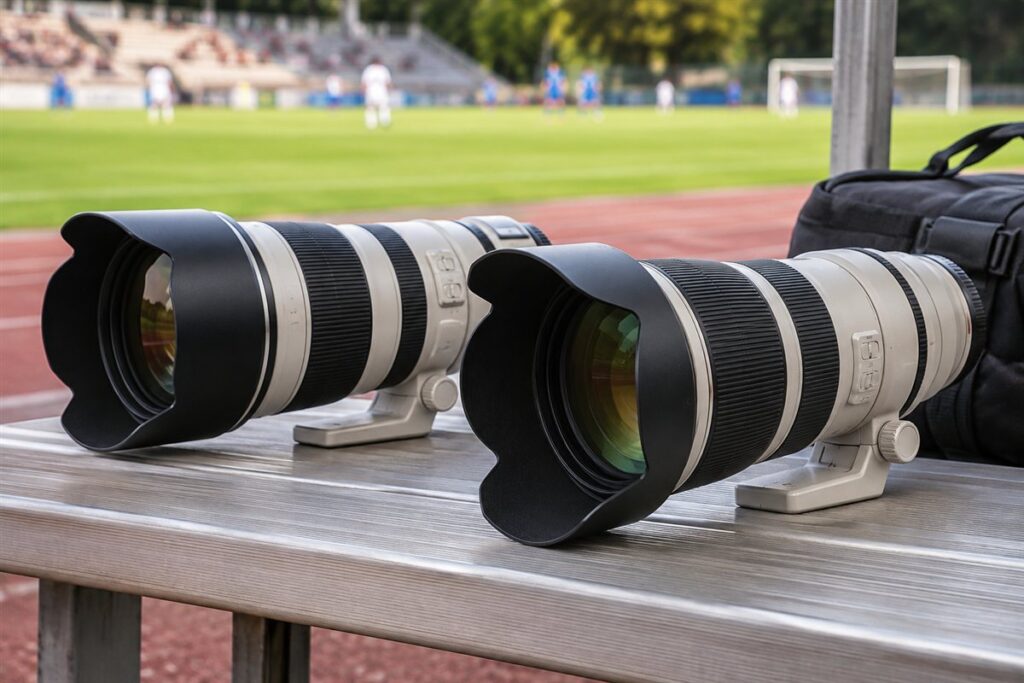
Tamron and Canon both make 70-200mm f/2.8 zooms, the classic telephoto for portraits, sport and events. The main differences are the maker, the available mounts and the specific generation of lens. Choose Canon for first-party matching on a Canon body, and Tamron if you want an alternative or if you shoot on another system.
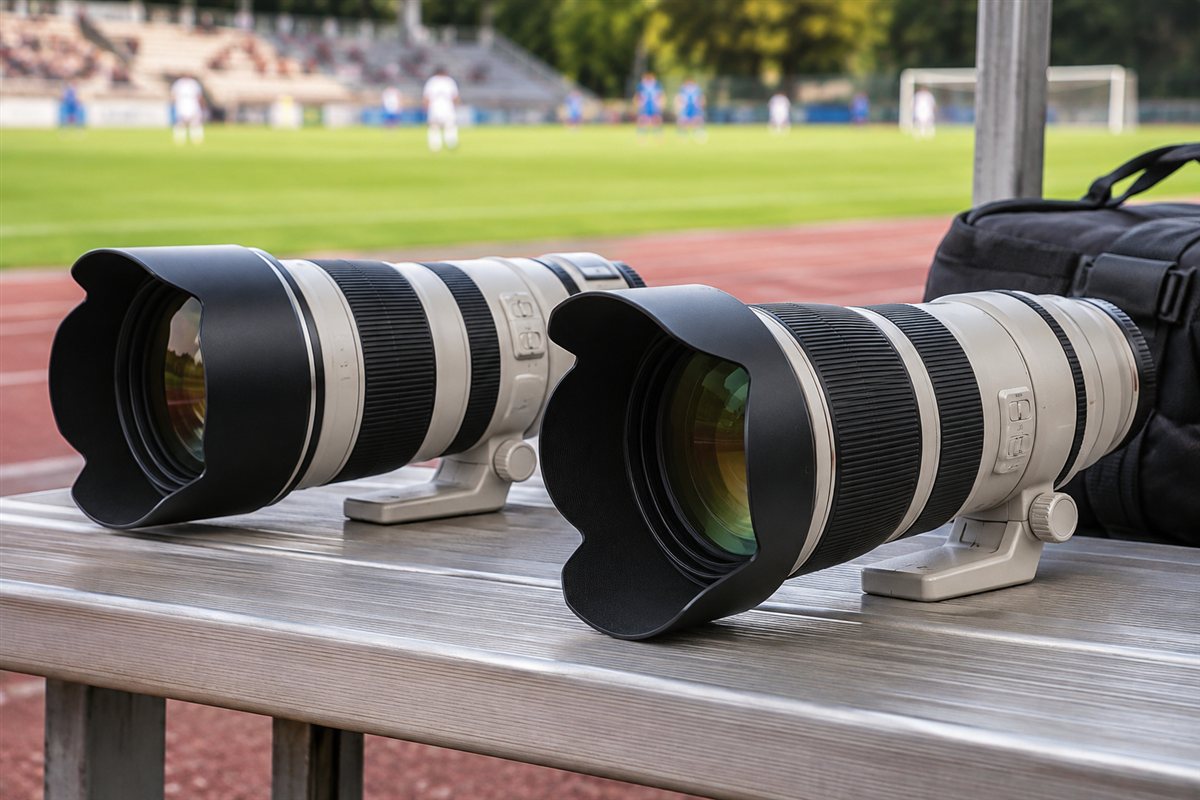
What These Lenses Are For
A 70-200mm f/2.8 combines a useful range with a bright constant aperture. It frames a head and shoulders portrait at the short end, isolates distant action at the long end, and holds exposure steady while you zoom. That is why it is a staple for wedding, sport and event photographers.
Know Which Generation You Mean
Both makers have released more than one version, so the first step is to identify the exact model.
- Canon offers EF-mount versions for DSLRs and RF-mount versions for its mirrorless bodies.
- Tamron has offered a DSLR version called SP 70-200mm f/2.8 Di VC USD, with an updated G2 model, and a mirrorless version in Di III VXD form for other mounts.
Mount availability differs, so confirm what is offered for your camera.
Key Differences
| Trait | Tamron | Canon |
|---|---|---|
| Aperture | Constant f/2.8 | Constant f/2.8 |
| Range | About 70mm to 200mm | 70mm to 200mm |
| Maker type | Third party | First party |
| Mount choice | Varies by model | EF or RF by model |
| Feel | Often noted as a capable alternative | Designed alongside Canon bodies |
Check exact specs, size and weight on each maker’s page.
How to Decide
- Match the mount to your body or adapter plan.
- Compare the generation you would buy, including used units.
- Consider how much you value first-party support, warranty and the maker’s own support channels.
- Try handling both if you can. Balance and zoom ring feel differ.
Shooting Guidance
- For portraits, try f/2.8 to f/4 and stand a few steps back so the lens compresses the face in a flattering way.
- For action, a shutter speed of roughly 1/500 and faster freezes most movement, and fast sport may call for 1/1000 or more.
- For handheld stills at 200mm, a shutter speed near 1/250 is a common reference.
Treat these as rough guides and adjust to your subject and light.
Carrying and Supporting a Heavy Telephoto Zoom
A 70-200mm f/2.8 is one of the larger and heavier lenses most photographers will own, and how you carry and support it affects both comfort and image quality. Check the weight and length on each maker’s page, then think about a typical day. At a wedding or a sports match you may hold the camera for hours, and the weight accumulates in your wrists, shoulders and neck.
A strap that attaches to the camera is fine for short sessions, but for long ones consider a harness or a strap that connects to the lens collar, if the lens has a removable or rotating one. Using the collar to carry or support the lens puts the weight where it belongs, close to the lens balance point, and reduces strain on the camera mount. A monopod is another effective way to take weight off your arms, and it also steadies the lens when you zoom and track action.
Using a tripod? Mount the lens, not the camera, by its collar so that the load stays balanced. Look at whether the collar is removable and whether it rotates smoothly between landscape and portrait orientation.
- Keep the lens hood on to protect the front element in crowds.
- Use a padded case that holds the lens with the hood reversed for storage.
- Do not leave a heavy lens hanging from the camera mount alone on a tripod.
Handheld Technique for Sharper Telephoto Shots
Long focal lengths magnify not only your subject but also any camera movement, so technique matters. Stand with your feet apart, tuck your elbows against your body, and support the lens from underneath with your left hand near the barrel. Breathe out gently and press the shutter smoothly rather than jabbing at it. Brace against a wall, a post or a seat back where possible to add stability.
If the lens or camera has stabilization, switch it on and read the manual for any special modes. Some systems include a mode designed for panning, which stabilizes only the vertical direction while you sweep horizontally with a moving subject. Do not assume stabilization will freeze a moving subject. It steadies the camera, not the person running across the field. For that, you need an adequate shutter speed.
Focus technique also counts. Back-button focus separates focusing from the shutter, allowing you to track a moving subject and release when ready. Pick a focus area mode that matches your subject, such as a single point for portraits, or a tracking mode for movement. Review early frames to make sure that your settings are producing sharp results before the key moment arrives.
- Use a faster shutter speed than your first instinct when the subject moves toward or across you.
- Take a short burst to improve your chances of a sharp frame.
- Check the corners of your images for motion blur and adjust your technique.
Checking Compatibility with Your Camera Body
Before you commit to a lens, confirm exactly how it will work with the camera you own. Mount matters first. Lenses made for one mount do not fit another without an adapter, and some features may not carry over when an adapter is used. This includes autofocus speed, tracking, stabilization coordination and customizable buttons. Read the maker’s compatibility notes for your body and, if you plan to use an adapter, read what the adapter maker says about supported lenses and features.
Check also how the lens interacts with camera features. Some cameras can combine lens stabilization with in-body stabilization, and the benefit depends on the pair. Some bodies apply in-camera corrections for vignetting and distortion if they have the lens profile, which may require a firmware update. Third-party lenses may depend on updates from the lens maker, so look at the maker’s support page for firmware options.
Consider your sensor size as well. On a smaller sensor the same lens will give a tighter field of view, which can be helpful for distant subjects but can make portraits and indoor work awkward. Think about the distances you work at.
- Verify the exact lens model name and version number against your mount.
- Check that your camera firmware is up to date before testing a new lens.
- Test autofocus on a moving subject, not only on a still object.
Inspecting a Used 70-200mm Before You Buy
Because this lens has been made in several generations, the used market has many choices. Make sure that you know which version you are buying and what changed between versions by reading the maker’s information. Ask the seller for the full model name and serial number, and check that they match the listing.
Inspect the physical condition. Look at the barrel for dents, which can suggest a past drop. Check the collar, the mount and the hood bayonet for wear or cracks. Turn the zoom ring and the focus ring through their ranges to feel for roughness, and check that the zoom does not creep when the lens points downward. Extend the zoom to see that the barrel moves without wobble.
Look through the lens for dust, haze, fungus and scratches by shining a small light through it. Some dust is normal, but haze and fungus are not. Test autofocus at near and far distances and on both a bright and a dim subject. Test the stabilization switch and the focus limiter, if the lens has one, to be sure the controls work. Take test shots and look at the edges and corners at full size.
- Ask about any repairs, and request photos of the lens mount and contacts.
- Check that the supplied hood and collar belong to this lens.
- Choose a seller with a clear return policy.
Accessories, Teleconverters and Care
A few accessories can extend what the lens does. A teleconverter multiplies the focal length at the cost of some light and, in some cases, autofocus performance. Check the maker’s compatibility list to see which converters work with your lens and body, because not all combinations are supported. Extension tubes are generally not useful for this type of lens, and close focus is limited by the lens design, so check the minimum focusing distance if you plan to shoot small subjects.
Filters should be chosen carefully. Check the filter thread size, and consider a circular polarizer for outdoor work or a neutral density filter for video. Drop-in filters are available on some telephoto designs, so check the lens specification if you want this option.
Care for the lens regularly. Keep the front and rear caps on when it is not in use, wipe the barrel after wet or dusty outings, and let it dry before packing it away. Avoid leaving it in a hot car, since heat can harm lubricants and electronics. If the lens has a focus limiter, use it to speed up autofocus by restricting the search range, and remember to reset it when your subject distance changes.
- Store the lens with the hood reversed or in a padded case.
- Use a blower before wiping dust to avoid scratching.
- Have a lens that behaves strangely checked by a qualified repair service.
Which 70-200mm f/2.8 lens should you buy?
Buy the Canon if you shoot on a Canon body and want a lens designed around that system, and look at the Tamron if you want a third-party alternative or if its mount fits the camera you own. The right answer depends more on your mount and the generation you pick than on the badge on the barrel.
Use these pairings as a starting point, then confirm details on each maker’s page.
- You own a Canon DSLR: look at the Canon EF-mount versions, or at the Tamron SP 70-200mm f/2.8 Di VC USD and its G2 update if you are open to a third-party lens.
- You own a Canon mirrorless body: the Canon RF-mount lens is the first-party route. Tamron’s Di III VXD version is aimed at mirrorless systems, but check whether your specific mount is offered.
- You want maker-backed support and a matched feel: Canon is the natural pick, since the lens and body come from the same company.
- You want to compare alternatives before spending: Tamron gives you a second option with the same constant f/2.8 aperture and the same classic range.
- You plan to buy used: either brand has older generations on the market, so compare the exact generation, not just the name.
If two lenses both fit your mount and both suit your budget, handling them decides it. A lens that balances well on your camera and has a zoom ring you like will be used more often than one that looks better on paper.
Keep in mind that the table above compares broad traits only. Neither maker’s lens is automatically better for every photographer, so match the lens to your body, your subjects and your comfort with the weight.
What should you check before buying a 70-200mm f/2.8 lens?
Check the mount, the exact lens version, what is included in the box and the seller’s return terms before you pay. Most disappointments with a 70-200mm f/2.8 come from a mismatch that could have been spotted on the listing.
- Mount: confirm the lens is made for your camera mount, such as EF or RF for Canon bodies, and read the adapter notes if you plan to adapt it.
- Version: look for the full model name, including any generation marking, and compare it with the maker’s page so you know which features you are getting.
- Included parts: check whether the hood, the tripod collar, the caps and a case are in the box. Some of these are separate on certain listings.
- Stabilization: confirm whether the version has it, and how it works with your camera’s own stabilization if the body has any.
- Weight and length: read the figures on the maker’s page and think about whether you can carry this lens for a whole event.
- Filter size: note the front thread so you can buy a polarizer or protective filter that fits.
- Warranty and returns: read the terms on the listing, including who handles repairs and whether the warranty applies in your region.
- Firmware: check whether the maker offers updates and how you apply them.
If you are buying second hand, add the inspection steps from the section above on used lenses, and ask for a clear return window so you can test the lens properly on your own camera.
Take a few minutes to write down your answers before you click through. A short checklist saves you from ordering a lens that does not fit the way you shoot.
Is a third-party 70-200mm f/2.8 as good as the first-party lens?
A third-party 70-200mm f/2.8 can be a perfectly sensible choice, but the answer depends on the exact lens and camera pairing, so do not assume either way. Tamron is widely regarded as a capable alternative, and Canon’s advantage is that the lens and body are designed by one company.
Here is how the trade-off usually looks in practice.
- Integration: a first-party lens is built to work with every feature of its own camera line. A third-party lens usually works well, but some advanced features may behave differently on some bodies.
- Updates: first-party lenses and bodies tend to receive coordinated firmware. With a third-party lens, check the maker’s support page for update options.
- Choice: a third-party maker gives you another model to compare, which can help if the first-party option does not suit your needs.
- Resale and support: consider how easy it will be to get service and to sell the lens later, and read the warranty terms.
None of this means a Tamron lens is a compromise. It means you should read the compatibility notes for your exact body before buying, particularly for autofocus tracking, stabilization and any custom buttons.
The same careful reading applies to a first-party lens bought used, because an older generation may lack features that a newer one has. In both cases, the model name and version are what tell you what you are really getting.
If your photography is demanding, such as fast sport, test autofocus on a moving subject during the return window instead of relying on general reputation.
What can you shoot with a 70-200mm f/2.8 zoom?
A 70-200mm f/2.8 zoom suits portraits, weddings, events, indoor and outdoor sport, concerts and general telephoto work where you cannot move close to the subject. It is a flexible lens, but it is not the best tool for every job.
- Portraits: the short end gives a flattering view of the face, and f/2.8 helps separate the subject from the background.
- Weddings and events: you can shoot ceremonies from a distance without disturbing the moment, and the constant aperture keeps exposure steady as you zoom.
- Sport: the reach and bright aperture help with school, club and local matches, though very distant action may need more focal length.
- Concerts and stage work: the wide aperture helps in dim venues, but check what the venue allows before bringing a large lens.
- Wildlife and birds: 200mm is short for small or shy animals, so a longer lens may suit you better. A teleconverter can help if your lens supports one.
- Landscapes and travel: it can compress distant layers nicely, but it is heavy for a day of walking.
The comparison with an f/4 version is mostly about weight, size and light. If you shoot in bright conditions and carry your kit all day, a lighter f/4 telephoto may be more comfortable. If you often work indoors, at dusk or want stronger background blur, f/2.8 earns its weight.
Think honestly about where you will use it. A lens that stays in the bag because it is too heavy does not help you take photographs.
Is it worth paying more for a 70-200mm f/2.8, and who should skip it?
It is worth paying for this lens if you regularly need f/2.8 light, constant exposure while zooming and a strong telephoto range. If you rarely use those strengths, a lighter or simpler lens may serve you better.
Be honest about the downsides before you decide.
- These lenses are large and heavy, which affects comfort on long days.
- You may need extra gear such as a monopod, a harness or a padded case.
- Newer generations may cost more than older ones, so decide whether the extra features matter to you.
- A third-party lens may need more checking for compatibility, and a first-party lens may cost more for a similar range.
You might skip this lens if you mostly shoot landscapes in daylight, if you travel light, or if you only shoot telephoto occasionally. An f/4 telephoto, or a shorter zoom, could fit better.
Signs that it is time to replace an older 70-200mm include autofocus that no longer tracks reliably, zoom creep that a repair cannot fix, haze or fungus inside the glass, or a version that lacks a feature you now need, such as better stabilization or compatibility with your new camera body.
When you are ready, compare the generations that fit your mount, check the current listing for what is included and the return terms, then choose the lens that matches how you will actually shoot.
FAQ
Is f/2.8 worth it over f/4?
If you shoot indoors, at dusk or want stronger background blur, f/2.8 helps. For daytime travel and landscapes, an f/4 lens is usually smaller and lighter.
Which is better for sport?
Both are used for it. Focus tracking depends on the specific lens and camera body, so compare the model you are considering.
Do I need a tripod collar?
If you use a tripod or monopod, the collar is the right place to mount the lens, since it supports the lens's weight. Handheld, you can leave it attached or remove it if the design allows.
What is a focus limiter?
It is a switch that restricts the distance range the lens searches during autofocus. It can speed up focusing when your subject is at a known distance, such as in sport.
Can I use a teleconverter with these lenses?
Some combinations are supported and some are not. Check the maker's compatibility notes for your lens and teleconverter, and expect some loss of light.
Will a 70-200mm work on a crop-sensor camera?
Yes, if the mount matches. The field of view is tighter, which helps with distant subjects but is less convenient indoors.
How can I check for zoom creep on a used lens?
Point the lens down with the zoom extended, and see whether the barrel slides in on its own. Also check the lock switch if one is present.
Is image stabilization necessary on a 70-200mm?
It helps in handheld shooting at slower shutter speeds. For fast action with high shutter speeds, it matters less, and for tripod use it may be turned off.
How heavy is too heavy to carry for a full day?
It depends on your strength and your support gear. Try the lens for a few hours before a long event, and use a harness or monopod if you feel strain.
Can I use an EF-mount 70-200mm f/2.8 on a Canon mirrorless camera?
Usually yes, with the maker's mount adapter, but check the compatibility notes for your body. Some features, such as autofocus tracking, can behave differently with an adapter. Read the adapter maker's list of supported lenses before you buy.
What does f/2.8 mean on a telephoto zoom?
It is the widest aperture the lens can open to, and a lower number lets in more light. On a constant f/2.8 zoom, the maximum aperture stays the same across the whole zoom range. This helps with indoor shooting and with background blur.
Is a 70-200mm f/2.8 good for portraits?
Yes, it is a popular portrait lens because the focal range gives a flattering view of the face and the wide aperture separates the subject from the background. It needs more space than a shorter lens, so it suits outdoor sessions and larger rooms best.
Should I buy a new or used 70-200mm f/2.8?
Buy new if you want a full warranty and the latest generation, and consider used if you want to spend less and can inspect the lens. For a used lens, confirm the version, test the zoom and autofocus, and make sure the seller has a clear return policy.
Do I need a lens hood on a 70-200mm?
A hood is a good idea because it reduces flare and protects the front element from knocks. Keep it on outdoors and in crowds. Many lenses come with one, but check the listing.
Is a 70-200mm f/2.8 too heavy for handheld use?
Many photographers use it handheld, but weight is a real consideration over a long day. A harness, a collar-mounted strap or a monopod can reduce strain. Try carrying the lens for a few hours before a big event.
How do I know which generation of a Tamron or Canon lens I have?
Look at the full name printed on the lens barrel and compare it with the maker's product pages. The name and mount marking identify the version. If you are buying second hand, ask the seller for a clear photo of the barrel and the serial number.
Can a 70-200mm f/2.8 shoot sports in low light?
It is a common choice for indoor and evening sport because f/2.8 lets in more light than slower lenses. Autofocus performance still depends on the lens and camera body. Check how your body tracks moving subjects with the lens you choose.
The Short Version
Canon is the natural choice for matching your camera, and Tamron is a sensible alternative where its mount fits. Identify the exact generation of each lens before comparing, and confirm the details on the makers’ pages.