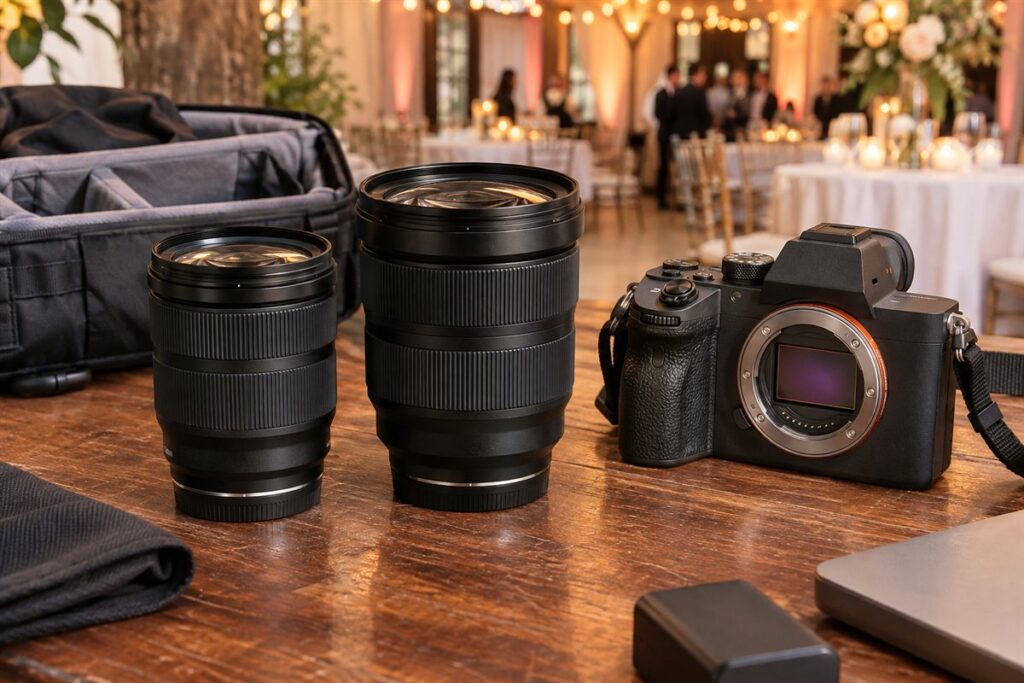
The Tamron 28-75mm f/2.8 Di III VXD G2 and the Sony FE 24-70mm f/2.8 GM II are both constant-aperture standard zooms for Sony E mount. The Tamron is a compact third-party lens, while the Sony is a premium G Master lens with a wider opening angle and top-tier features. Choose by weight, features and the wide end you need rather than range alone, and confirm specs with each maker.
What Each Lens Is
The Tamron 28-75mm f/2.8 is a second-generation standard zoom designed to be compact and versatile. It reaches 75mm, a little longer than usual, which helps with portraits.
The Sony FE 24-70mm f/2.8 GM II belongs to Sony’s G Master series, the maker’s top lens line. It goes wider at 24mm and is built to meet high expectations for focus and optical quality.
Key Differences
| Trait | Tamron 28-75mm G2 | Sony 24-70mm GM II |
|---|---|---|
| Range | 28-75mm | 24-70mm, wider at the short end |
| Aperture | Constant f/2.8 | Constant f/2.8 |
| Tier | Third-party, compact | Sony premium G Master |
| Intended users | Enthusiasts and many working shooters | Demanding professional and advanced use |
The wider 24mm end of the Sony makes a noticeable difference for interiors, groups and landscapes. The Tamron’s extra length at 75mm helps for portraits and tighter framing.
How to Choose
- Decide whether you need 24mm. If you shoot real estate, travel interiors or tight groups, it matters.
- Think about how much you shoot. Occasional shooters may not need the top-tier features of a flagship lens; frequent professionals may value them.
- Look at weight and size on your body, and handle both if you can.
- Check feature support on your camera, including autofocus modes and firmware, since first-party lenses usually have the broadest support.
- Consider how long you plan to keep the lens and whether you might upgrade your body to match.
Where Each Fits
- The Tamron suits enthusiasts, travelers and hybrid shooters who want a bright zoom without the weight of a flagship.
- The Sony suits professionals and committed enthusiasts who want the best of Sony’s lens line.
- Both handle portraits, weddings and events well when used with good technique.
It is also worth looking at the whole kit. A standard zoom sits at the center of most bags, so think about what else you carry, such as a fast prime or a telephoto zoom, and whether the weight and filter sizes of each option fit that plan. A few minutes with the makers’ spec sheets will show differences in weight, close focus distance and control rings that photos alone cannot.
The Wide End: 24mm Versus 28mm in Use
Four millimeters sounds trivial, but at the wide end it changes how you work. A 24mm view includes noticeably more of a scene than 28mm, which matters when you cannot step back. Group photos in a small room, a hotel interior, a narrow street and a landscape with a close foreground all benefit from the extra width.
At 28mm you still have a moderately wide view that suits most street, travel and environmental portrait work. Many photographers find 28mm perfectly comfortable for everyday scenes, and the slight reduction in width encourages you to move your feet and compose more deliberately.
The way to decide is to check your own library. Look through photos you have taken with a similar zoom and see how often you end up at the widest setting. If you frequently shoot at the widest end and wish for more, the 24mm lens matters. If the widest setting is used rarely, you may not miss it.
Remember that you can often stitch a few frames into a panorama if you need a wider view occasionally. That solution is not available for moving subjects, but it works for landscapes and architecture.
The Long End and Portrait Work
The Tamron stretches to 75mm and the Sony stops at 70mm. The difference is smaller than it sounds, but it does help a little with tighter portrait framing, and it can reduce the number of times you need to crop. For headshots and half-length portraits, 70mm and 75mm both give a natural perspective that flatters faces.
What shapes portraits more is how well you handle background and light. Keep the subject separated from the background by a few steps, use the widest aperture, and watch for distracting objects behind the head. Both lenses open to f/2.8, so background blur is comparable at the same focal length and distance, even if rendering of out-of-focus areas differs.
Rendering can differ in subtle ways, such as how bokeh balls look or how smoothly transitions fall. These are difficult to judge from a spec sheet, so compare real sample portraits taken at f/2.8 and similar distances. Pay attention to the edges of bright highlights and to the way the background fades.
For events, both lenses cover the typical needs, and shooters often keep a fast prime or a longer zoom as a backup for tighter shots.
Autofocus, Features and Camera Integration
A first-party lens usually receives full support for the camera’s newest features, while a third-party lens may support most of them. Check the specific features you care about: subject tracking, eye detection, high-speed burst shooting, focus breathing compensation and lens-based corrections. The maker of each lens lists supported camera models and features.
Controls matter too. Look at what physical controls each lens offers: an aperture ring, a focus hold button, a customizable switch, a zoom lock. These can be small details that become important in daily use. A focus hold button, for example, can be assigned to many functions on the camera.
Firmware plays a part. Lenses from third-party makers often can be updated through a dock or the camera, which may improve compatibility over time. Check how updates are delivered and whether you are comfortable performing them.
If you shoot video, pay attention to how the lens behaves during focus transitions and whether it shows focus breathing. A body that can correct breathing in-camera may reduce the difference, but support varies by camera and lens. Verify before buying.
Build, Weight and Weather Conditions
Physical differences affect daily comfort. The compact lens is easier to carry on a long day, balances better on smaller bodies and draws less attention. The premium lens may feel more substantial and may include additional sealing or control features, but check the weight figure and dimensions on each page.
If you shoot outdoors in rain, dust or cold, look at what each maker says about weather resistance. Descriptions vary, so read them carefully and avoid assuming that any lens is fully waterproof. Take simple precautions anyway: use a hood, wipe off moisture after use, and avoid changing lenses in wet or dusty conditions.
Think about the front element and coating. Some lenses have a coating that repels water and oil and makes it easier to clean fingerprints. Check the maker’s description of coatings for each lens, and keep a microfiber cloth handy.
Also consider the zoom mechanism. Some lenses change length as you zoom, while others keep a fixed length. A fixed-length design is often easier on gimbals and in dusty places, because the barrel does not move in and out. The product page describes the design.
Long-Term Value and Resale
A lens may stay with you longer than your camera body, so think about how long you plan to keep it. A lens that serves you well for years offers better value than a cheaper one that you replace after a short time. At the same time, a flagship lens that you use rarely is not good value either.
Resale values vary with demand, condition and the age of the model. First-party premium lenses often attract wide interest on the used market, while third-party lenses can also sell well when they are popular. Do not rely on resale to justify a purchase. Buy what you will use.
Consider what happens if you change systems. A lens in a mount you no longer use is just an item to sell. If you think a switch is likely within a few years, factor that into your decision.
Finally, ask about service. Check warranty length, what it covers, and how repairs are handled in your region. Keep your receipt and original packaging, and register the product if the maker offers registration. These steps cost little and can help later.
Matching Each Lens to Your Existing Kit
A standard zoom rarely lives alone. It sits in a bag with a body, perhaps a fast prime, a flash and a few accessories, so the best choice is the one that fills a gap in what you already own. If you carry a wide-angle zoom for landscapes, the extra width of the Sony may overlap with it, and the Tamron could be the more sensible partner. If your bag has no ultra-wide at all, the wider opening angle of the Sony may let you leave a second lens at home.
Think also about the telephoto end of your kit. Someone who already owns a long zoom will rarely miss a few millimeters at the long end of a standard zoom. Someone without one might lean on the 75mm end more often than expected. Write down the three lenses you reach for most, and see which gap each candidate fills.
Handling and Ergonomics in Daily Use
Specifications say little about how a lens feels after three hours at a wedding or a long walk through a city. Balance matters as much as weight. A compact lens on a small body can feel nimble, while a larger lens may feel better on a camera with a deep grip. Try to hold each lens on the body you actually own, because a lens that is comfortable on one camera can feel front-heavy on another.
Pay attention to the zoom ring and focus ring as well. A smooth, well-damped zoom ring helps with video and careful framing, and a lens that extends or changes length while zooming behaves differently from one that stays the same size. Check the maker’s description for details on internal zoom, switches and customizable buttons, since these small controls shape your daily experience more than a spec sheet suggests.
Video Considerations Worth Checking
Filmmakers and hybrid shooters should look closely at how a lens behaves while recording. Focus breathing, which is a change in the angle of view as focus shifts, can be distracting in video. Some lenses control it better than others, and in-camera correction may help depending on the body. Quiet, smooth autofocus is another factor, because motor noise can reach the microphone.
Consider also how well each lens supports gimbal work. A lighter lens makes balancing simpler and puts less strain on a small stabilizer, while a heavier one may require a larger rig. Look at the stated filter size too, since matching diameters across your lenses saves money on filters and makes swapping quick. For specific behavior, rely on the makers’ documentation and independent video samples.
Side-by-Side Decision Table
| Question | Leans toward the Tamron | Leans toward the Sony |
|---|---|---|
| Carrying comfort matters most | Yes, generally more compact | Less so, check weight |
| You want the widest opening view | No, begins at 28mm | Yes, begins at 24mm |
| You shoot on a tighter budget | Often the easier fit | A bigger commitment |
| You need top-tier features and control | Check the listing | Designed for this |
| You sell or upgrade often | Check used listings | Check used listings |
| You travel by plane often | Easy to pack | Pack with care |
Treat this as a thinking aid. Your own priorities decide the winner, and the details on each listing should confirm the claims above.
Common Mistakes When Choosing a Standard Zoom
The first mistake is paying for capability you will not use. A professional tool can be wonderful, yet if your work is mostly relaxed family pictures and travel, extra features may sit idle while you carry the extra weight. The reverse also happens: a person who shoots paid work every weekend may find a more modest lens limiting in demanding conditions.
A second mistake is ignoring the lens hood, caps and case, which are part of daily use. A third is skipping a check of body compatibility and firmware. Always read the maker’s compatibility notes for your camera model. Finally, many buyers compare sample photos on small screens, where almost any modern lens looks excellent. Judge differences by viewing full-size files, and remember that technique usually outweighs equipment.
How to Try Before You Commit
Renting is an inexpensive way to learn what suits you. Reserve each lens for a weekend, shoot the kind of work you actually do, and keep notes. Photograph a similar scene with both lenses, then compare framing, handling and the frames you kept at the end of the day. Pay attention to how often you wished for more width or more reach.
If renting is not possible, visit a camera shop and mount the lenses on your own body. Check how quickly the camera locks focus indoors, how the controls feel, and whether the lens fits your bag. Buy from a seller with a clear return policy so you can swap if the lens does not suit you after a week of real use.
Three Example Shooters and Their Likely Choices
Imagine a travel blogger who walks all day, photographs street scenes, food and architecture, and posts mostly to screens. This person values a light bag above everything. The Tamron fits that life comfortably, and the small loss of width at 28mm can be handled by stepping back or stitching a panorama. Money saved can go toward a flight or a spare battery.
Now take a wedding photographer who works in cramped venues, shoots dozens of frames per minute during key moments and cannot ask a bride to repeat an entrance. The wider opening view of the Sony helps in tight rooms, and its premium handling and control layout can reduce missed moments. The cost is higher, but for paid work that cannot be redone, many professionals accept it.
Lastly, consider an enthusiast who photographs family gatherings, hikes and the occasional portrait. Either lens will serve well. The deciding factors become budget, weight and whether the extra features would ever be used. For this person, the lighter and less costly option often brings more joy simply because it gets carried more often.
Thinking About Resolution and Future Bodies
Camera bodies change faster than lenses, so a standard zoom is a long-term purchase. If you expect to move to a higher resolution body in the coming years, consider how demanding that sensor will be on your glass. Higher resolution sensors reveal softness at the edges more readily, and a premium lens is usually designed with such bodies in mind. Even so, a well-made third-party lens can hold up well on many current cameras.
Look for independent test charts and sample galleries from several sources instead of relying on one opinion. Compare corners at the apertures you actually use, such as wide open and a stop or two down. Remember that real photographs rarely depend on corner sharpness alone, and that subject, light and composition will matter more to most viewers than tiny differences in resolution.
Care and Maintenance for a Working Zoom
Any zoom with moving parts benefits from simple habits. Keep the front and rear elements covered when the lens is not in use, and clean the glass with a blower and a soft cloth made for optics rather than a shirt tail. Avoid changing lenses in dusty or windy places, and point the camera downward during swaps to limit dust entering the body.
If you shoot in rain or sea spray, wipe the lens afterward and let it dry in open air before closing the bag. Weather resistance varies, so follow the maker’s guidance on what the lens can handle. Store equipment with moisture-absorbing packets in humid climates, and have the lens inspected by a qualified service center if you notice stiffness, grinding or condensation inside.
Short Glossary for Lens Shoppers
- Constant aperture: a zoom that keeps the same maximum opening across its range.
- Focus breathing: a shift in the angle of view while focusing.
- Internal zoom: a design where the lens barrel keeps a steady length as you zoom.
- Filter thread: the front threading that accepts screw-on filters.
- Parfocal: a zoom that holds focus as you change focal length.
- Lens correction: automatic adjustment for distortion and vignetting inside the camera or software.
Final Checklist Before Buying
- List the three lenses you use most and find the gap.
- Decide whether 24mm or 28mm suits your wide shots.
- Weigh the bag with each lens and consider your longest day.
- Read the maker’s notes on camera compatibility and firmware.
- Compare filter sizes with the accessories you own.
- Confirm the return window and warranty terms with the seller.
Once these points are settled, the decision is usually clear. Pick the lens that supports the way you work, and spend the time you save on actually taking pictures.
FAQ
Is the Tamron close enough to the Sony for most people?
For many uses, yes. The differences tend to show up in demanding situations, such as fast action, critical edge detail or wide interiors. Think about your own needs rather than the label.
Which one is better for video?
Both can work well. Compare focus breathing, stabilization options and weight for handheld work using the makers’ details.
Is a constant f/2.8 zoom necessary for weddings?
Many wedding photographers prefer it because it supports low light and consistent exposure. Other lens types also work, but f/2.8 gives flexibility in dim venues.
Should I buy the premium lens if I am an enthusiast?
Only if its specific features matter to you, such as the wider end or advanced controls. A compact third-party lens may meet your needs for less weight.
Do both lenses support in-camera lens corrections?
Many cameras apply corrections automatically, but support depends on the camera and lens. Check the maker's compatibility lists for your body.
Can I use these lenses on an APS-C Sony camera?
They will generally mount, and the field of view will be narrower than on full frame. Check the maker's notes for any limitations.
Does a heavier lens give better image quality?
Weight does not guarantee quality. Judge a lens by sample images and by features that matter to you.
How do I check for a good used copy?
Inspect the glass for scratches or haze, test zoom and focus across the range, and shoot sample images at several focal lengths. Ask about the lens's history and warranty status.
What filter size should I choose?
Look up the filter thread size on each product page. If you already own filters, a lens that shares the size saves money.
The Short Version
Choose the Tamron 28-75mm f/2.8 G2 for a compact, capable standard zoom with extra length. Choose the Sony FE 24-70mm f/2.8 GM II for a wider short end, premium build and the broadest first-party support. Verify details on each maker’s page.