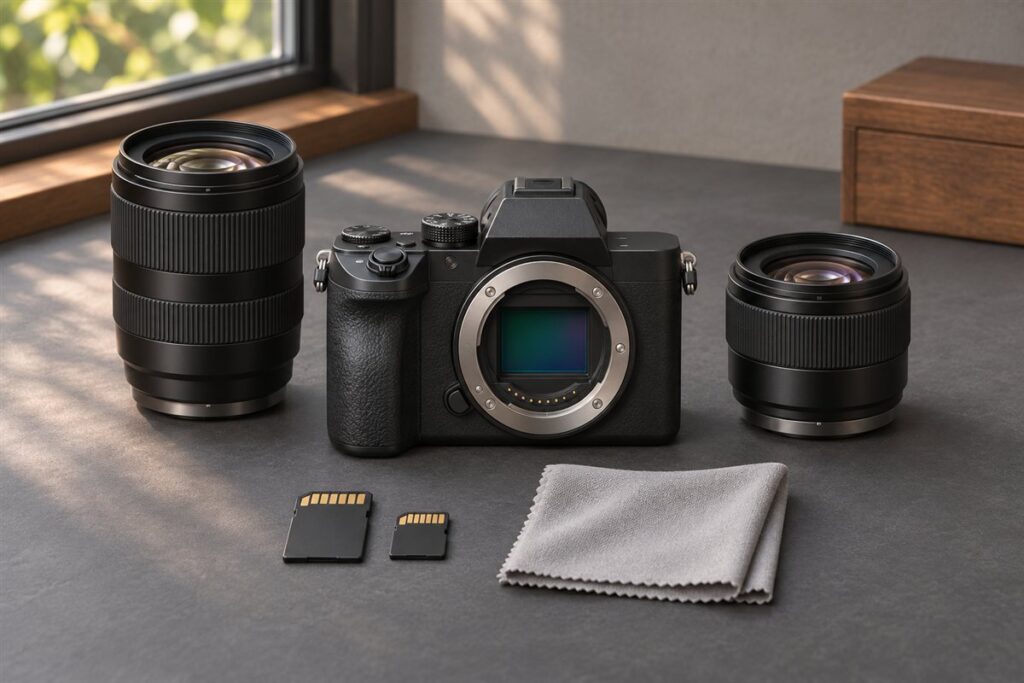
The Nikon FE and the Nikon FM are small manual focus film SLRs that share the Nikon F mount and a similar body, and the key difference is automation. The FE adds aperture priority auto exposure and needs a battery for its shutter, while the FM is mechanical and works fine without one. Choose the FE for convenience and the FM for simplicity and independence from batteries.
What each camera is for
The FE was made as a compact camera with an electronic shutter and an automatic mode. You set the aperture, and the camera chooses a shutter speed. You can also set exposure manually using the meter.
The FM is a mechanical camera. The shutter fires without power, and the battery runs only the meter. You choose both settings yourself, which makes it a simple and dependable way to learn exposure.
Key differences
| Trait | Nikon FE | Nikon FM |
|---|---|---|
| Exposure | Aperture priority and manual | Manual only |
| Shutter | Electronic | Mechanical |
| Battery need | Required to shoot | Only for the meter |
| Lens mount | Nikon F | Nikon F |
Check a trustworthy manual to confirm exact speeds and compatibility.
When each one makes sense
- Learning film: the FM makes you think about each setting, which builds skill.
- Quick walks and street shots: the FE auto mode lets you focus on framing.
- Cold weather and long trips: the FM is not at the mercy of a dead battery.
- Mixed use: some people enjoy the FE because they can switch between modes.
Buying tips
- Check that the meter needle or display responds when you press the shutter button halfway.
- Test shutter speeds by ear: slow speeds should sound distinct from fast ones.
- Look for decayed light seals and replace them if needed.
- Look through the viewfinder for haze, fungus or dust.
- Run a test roll and look for even exposure.
Handling and everyday use
The two bodies look and feel very similar, with small dimensions and a clean top plate. The practical gap shows up when light changes quickly. With the FE you can leave the camera in automatic mode and adjust aperture only, while with the FM you adjust both settings and follow the meter needle. Neither approach is better for every person, so think about whether you want to slow down or move fast.
Understanding the Meter and Batteries
The light meter is a big part of how these cameras work in practice, and it is also one of the first things to age. Both bodies rely on a battery for metering, and the FE also depends on one for its shutter. Understanding how this works helps you avoid missed shots and wasted film.
Look up the battery type in a reliable manual, because older designs often used cells that are no longer sold in their original chemistry. Many shooters use modern replacements that are designed to give a stable voltage, but check what the manual recommends and what current sellers advise. The wrong cell can give inaccurate readings even when the meter appears to move.
- Carry a spare battery, particularly with the FE, since a dead battery means the shutter will not fire normally.
- Turn the meter off or lock the camera when it is stored, if the body has a way to do so, to avoid draining the cell.
- In cold weather keep spare batteries in an inner pocket, as cold reduces output.
- Compare the meter with a phone app or a handheld meter once, to learn whether it reads consistently or leans one way.
If the meter seems unreliable, you can still shoot using the sunny sixteen rule or a handheld meter. This is one reason many people enjoy the FM, because the shutter does not care about the battery. Keep that in mind when you plan trips away from shops.
Common Wear Points and Faults to Expect
Cameras of this age will not be in factory condition, and knowing what typically wears out keeps expectations realistic. This list applies to both bodies, with a few differences in the electronics.
- Light seals and mirror foam: the foam around the back door and mirror can turn sticky or crumble. Replacements are inexpensive in principle, but the job requires care.
- Shutter speed accuracy: slow speeds may stick or run long when lubricants age. A professional service can restore them.
- Viewfinder problems: haze, dust inside the prism and weak focusing screens can reduce brightness.
- Film advance and rewind: the advance lever should be smooth, and the rewind crank should not slip.
- Electronic faults on the FE: because it is electronic, intermittent failures such as unreliable shutter timing or a stuck mirror can occur, and parts may be hard to find.
- Cosmetic wear: brassing on the edges of the body is normal and not a mechanical problem, but dents on the prism or the lens mount can matter.
Ask a seller whether the camera has been serviced and when. A cheaper camera that needs a service may end up costing more than a pricier one in working order. If you are not comfortable with repairs, choose a seller who offers a clear return period and who describes the condition in detail.
Choosing Lenses for These Bodies
The Nikon F mount offers a huge selection of lenses across decades, so lens choice can be as important as the body. Start with a simple setup and expand gradually.
A standard prime lens is a good first choice. A normal-length lens with a wide aperture is compact, works well in dim light and teaches you to move your feet instead of zooming. A moderate wide-angle suits street, travel and interiors, and a short telephoto suits portraits. Zooms from the manual focus era exist too, but they are often larger and slower, so decide whether the convenience is worth the size.
- Check that the lens has an aperture ring and works with the body’s coupling. Check the manual or a trusted compatibility chart for specifics on the FE and FM.
- Look for clean glass without fungus or haze, smooth aperture blades with no oil, and focus rings that turn evenly.
- Be careful with lenses made for other mounts or newer electronic designs without aperture rings, since they may not function correctly or may even damage the body.
- Consider lens hoods and filters that match the lens thread size.
Test a lens by shooting a roll at several apertures and comparing sharpness. A modest, well-kept lens often beats a rare one in poor condition, so judge each by its results.
Film Choices and Simple Exposure Habits
Film brings its own decisions. As a beginner, pick one or two film stocks and shoot them repeatedly so you learn how they respond. Color negative film is forgiving of exposure mistakes and works in many conditions. Black and white negative film is a good teacher of contrast and light. Slide film has less latitude, so exposure accuracy matters more. Check the box for the speed rating and set the camera to match it.
- Set the film speed dial correctly each time you load a roll, since both cameras rely on it for metering.
- Use the meter as a guide and adjust for scenes with bright backgrounds or deep shadows by opening or closing exposure.
- When in doubt on negative film, give a little more exposure, since shadows hold more detail than blown highlights.
- Keep notes on aperture and shutter speed for the first few rolls, so you can compare with the results.
- Load and unload film in shade, and check that the rewind knob turns as you advance, confirming the film is catching.
Developing and scanning services vary by region, so find a lab you trust before you start. Ask about turnaround times and the file formats they provide. Patience pays off, because the slower pace is part of why people choose these cameras in the first place.
Servicing, Storage and Long-Term Care
With sensible care, a classic film SLR can keep working for a long time. Basic habits matter more than any single repair.
Store the camera in a dry, moderate place with the lens cap and body cap on. Avoid damp basements, hot attics and sealed plastic bags that trap moisture. Remove the battery if you will not use the camera for a long period, to prevent leakage. A silica gel packet in a camera bag can help in humid climates. Fire the shutter at all speeds now and then, because moving parts benefit from regular use.
- Clean the viewfinder and mirror area with a blower only, since the mirror is delicate.
- Do not oil the camera yourself, as the wrong lubricant can spread onto the shutter blades.
- Replace light seals when you see damage, or when you notice light streaks on your film.
- Choose a technician who has experience with manual cameras and ask what the service includes and whether it carries a warranty.
It is time to look for professional help if the shutter hangs, speeds sound wrong, the film does not advance evenly or the viewfinder is dim. Comparing the service cost with the price of a better-condition body helps you decide whether to repair or replace.
FAQ
Are these cameras good for beginners?
Yes. Both are simple and compact. The FM is a good teacher, while the FE adds a helpful automatic mode.
Do they share lenses?
Both use the Nikon F mount and work with many manual focus Nikon lenses. Newer lenses without aperture rings may not work well, so check each one.
Can I use modern lenses on these cameras?
Some can be used, but lenses without an aperture ring may not work correctly on these bodies. Check the lens and camera manuals for compatibility before mounting anything, and avoid forcing a lens that does not fit properly.
What should I do if the meter stops working on the FM?
Start by replacing the battery and cleaning the contacts. If the meter still does not respond, you can keep shooting by using a handheld meter or an exposure guide, and consider a service if you want the built-in meter back.
Will the FE work without a battery?
Its shutter depends on electronic control, so you should not count on it working normally without a battery. Carry spares, and check the manual for any emergency settings the camera offers.
How often should these cameras be serviced?
There is no fixed schedule that suits everyone. Have a camera checked if you buy it without service history, and again if you notice sticky speeds, light leaks or other changes.
Is it worth replacing the light seals myself?
Many hobbyists do, using kits made for the purpose, but the work needs patience and clean removal of the old material. If you are not confident, a repair shop can do it for a modest fee.
What film speed is best to start with?
A general-purpose speed in the middle of the range is a flexible starting point, since it works outdoors and in moderate indoor light. Pick one stock and learn it before experimenting.
How do I check for a light leak?
Look for streaks or fogged edges on developed film, and inspect the back door seals by eye. A test roll shot in bright light will show problems quickly.
The Short Version
Choose the FE for aperture priority convenience, and choose the FM for a fully mechanical shutter and a simpler camera. Both are compact and good for learning.