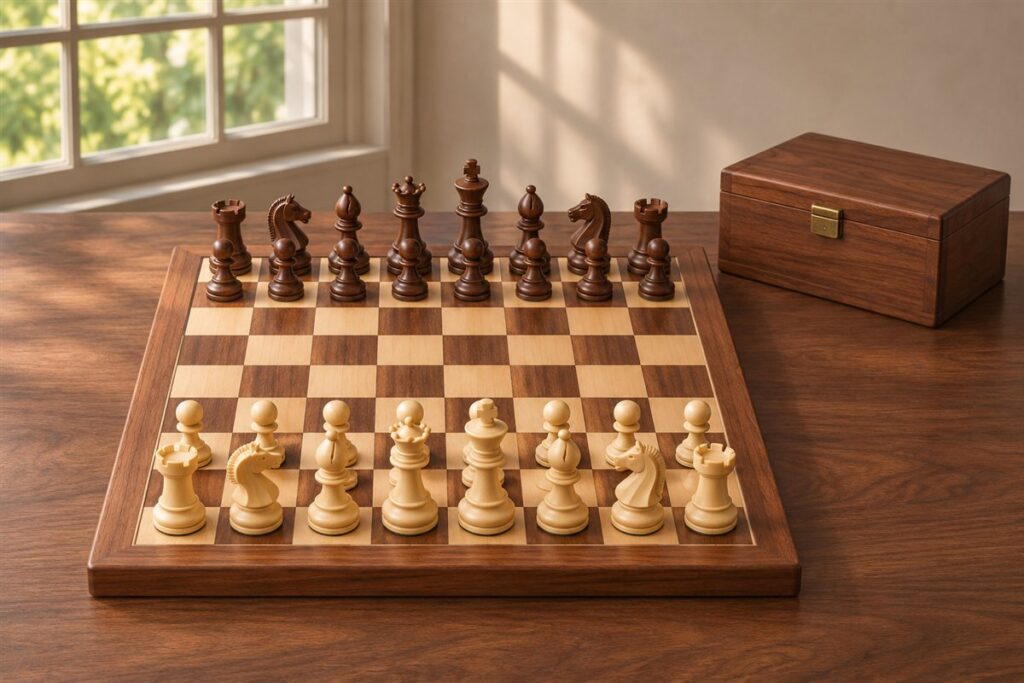
There is no single correct answer to which player was stronger, because Garry Kasparov and Magnus Carlsen reached their peaks in different eras with very different tools. Both dominated the world for years, and fair arguments exist for each. The sections below compare how they played and why the comparison is tricky.

Two Different Eras
Kasparov became world champion in the 1980s and dominated through the 1990s, retiring from professional play in the middle of the 2000s. Carlsen became champion in the next decade and held the title for around ten years. Their peaks did not overlap, and neither played the other in a title match.
The world of chess also changed between them. Kasparov built his strength in an age of books, adjourned games and early computers. Carlsen grew up with strong engines, large databases and online play, which changed how everyone prepares.
Playing Styles
- Kasparov: energetic, attacking and driven by deep opening preparation. He often chose sharp lines and used dynamic piece play to overwhelm opponents.
- Carlsen: flexible and universal. He is known for keeping positions balanced, then squeezing small edges in long endgames and outlasting opponents.
Both were strong in every phase, but Kasparov is remembered for the opening and the attack, and Carlsen for patience and technique.
How to Compare Them Fairly
| Factor | Kasparov | Carlsen |
|---|---|---|
| Era tools | Books and early computers | Strong engines and databases |
| Signature strength | Preparation and initiative | Endgame skill and flexibility |
| Opposition | Elite specialists | A deeper pool of strong players |
| Legacy | Title match dominance | Long reign across several formats |
Published number lists place both near the very top of history, but number comparisons across eras are only a rough guide, since the pool of players and the methods of play differ.
What Would Change the Answer
- If you value innovation and influence on opening theory, many fans lean toward Kasparov.
- If you value consistency across classical, rapid and blitz, many fans lean toward Carlsen.
- If you value results against the strongest field of their day, both have strong cases.
- If you imagine them in the same era with the same tools, no one can say.
Why Peak Comparisons Are Hard
Comparing champions from different generations sounds simple, but every method has a flaw. Ratings are the most common yardstick, yet a rating only measures performance against the pool of players that existed at the time. If the pool changes in size, age or training methods, the same number can mean different things in different decades. Ratings also depend on how often a player faces strong opposition and how the rating system is calibrated.
Results in title matches are another yardstick, but they tell you about one opponent on one occasion. A champion who faced a weaker challenger may look more dominant than one who faced a fierce rival, without being stronger. Tournament wins have a similar problem, because fields vary from event to event.
The fairest approach is to treat each measure as one clue rather than a verdict. Ask what the player did against the best opposition available, how long the level lasted, and how much of the advantage came from skill versus preparation. When you read any claim that settles the question with a single figure, check where the figure comes from and what it leaves out. Treat confident declarations from either camp of fans with the same caution.
The Role of Computers in Preparation
One of the biggest differences between the two eras is how players prepare. In Kasparov’s early years, opening knowledge came from books, notes, analysis with trusted helpers and long hours at the board. Home preparation could still surprise an opponent with a new idea, and a deep novelty could decide a game before the middlegame began.
In Carlsen’s era, engines and large databases are available to almost every serious player. A surprise is harder to find, and a novelty is often checked within hours. That shifts the contest toward other skills: choosing lines you understand deeply, reaching playable positions, and out-thinking an opponent in the middle and late stages when memorized theory runs out.
This matters for the comparison because each champion thrived in a setting that rewarded his strengths. Deep preparation was a decisive edge when few had access to it. Practical skill in unclear positions mattered more when everyone could prepare. It is reasonable to say that each adapted to the tools of his time, and the question of how either would fare under the other’s conditions is a thought experiment rather than something that can be measured.
Measuring Play by Accuracy and Engines
Some fans try to settle the debate by running old games through a modern engine and counting errors. This is an interesting exercise, but it has limits. Engines evaluate positions with a strength far beyond any human, so they flag mistakes that no opponent could have exploited. The number of such flagged moves also depends on game length, opening choice and how forcing the position was.
A sharp, tactical game gives more chances for flagged errors than a quiet, balanced one, even when both players are playing at the top of their ability. That means accuracy scores can reward a safe style over a bold one without telling you who was more dangerous across the table.
- Check which engine and settings were used before trusting any comparison.
- Look at whether the games compared had similar structure and length.
- Remember that human opponents respond to pressure, which engines do not model.
Used carefully, engine review is a useful teaching tool for studying either player’s games. As a way to crown one of them, it answers only a narrow part of the question.
What to Study From Each Champion
Whatever your view on who was stronger, both players offer lessons for improving club players. From Kasparov, study how he used the initiative: developing pieces with purpose, creating threats that force awkward replies, and keeping the opponent busy defending. Look at the strategic ideas behind his openings, not only the move orders.
From Carlsen, study how small advantages are converted. His games often show patient improvement of piece placement, trades that favor a better pawn structure, and a willingness to keep playing positions that look equal. Endgames are a good place to learn this, because the plans are concrete and the lessons transfer to your own games.
A practical way to learn is to pick a few annotated games by each player, play through them without an engine first, and write down what you would have played at key moments. Then compare with the annotations. Focus on the ideas rather than memorizing lines, since opening theory changes and your opponents will rarely follow the same path. Combining both styles, active when the position calls for it and patient when it does not, makes for a well-rounded player.
Common Mistakes in the Debate
Online discussions about this topic tend to repeat the same errors. Knowing them helps you read arguments more critically and form your own view.
- Treating a rating gap as a match result. A number gap between two eras does not predict how a direct match would go.
- Ignoring context. Tools, time controls and the depth of the player pool all shaped each career.
- Judging by one famous game. A single brilliant win shows creativity, not overall strength.
- Assuming style equals quality. Attacking games are more memorable, but quiet technical wins count just as much.
- Treating the question as settled. Strong players and historians disagree, and that is reasonable.
A healthier approach is to ask which qualities you value: dominance in head-to-head contests, longevity, adaptability or creative impact. Different priorities lead to different answers, and both can be defended with evidence from their careers.
Defining What “Stronger” Could Mean
Before comparing two champions, we need to agree on the question. Stronger can mean who would win a match if both were at their best on the same day with the same tools. It can mean who dominated their own era by the biggest margin. It can mean who played the most accurate chess, or who showed the most creative ideas, or who faced the toughest rivals. Each definition leads to a different conclusion, and mixing them in one argument is the main reason debates on this topic never end.
A fair discussion states its definition first. If you ask about dominance, you compare each player against the field they faced. If you ask about a hypothetical match, you must imagine them with comparable preparation resources, which immediately raises the question of computers. If you ask about creativity, you are in the territory of taste, where fans differ for good reasons. Naming the standard at the beginning makes the rest of the conversation more honest.
A Comparison Grid for Several Standards
| Standard | What to look at | Caution |
|---|---|---|
| Dominance in their era | Tournament results, match results and gaps to rivals | Fields and formats differ |
| Longevity | Years spent at or near the top | Careers have different lengths and breaks |
| Accuracy | Engine-based analysis of move quality | Engines change over time and depend on settings |
| Preparation | Opening depth and novelties | Tools available to each player differ greatly |
| Practical skill | Converting small edges and defending tough positions | Hard to measure without subjective judgement |
| Influence | Effect on how others play and prepare | Influence is not the same as strength |
Using the grid, you can see that neither player wins every row in a way that everyone accepts. Each has strong claims in several areas, and the final order depends on which rows you weigh most heavily.
The Technology Gap in Plain Terms
Perhaps the largest difficulty is that the two players lived through different stages of chess technology. Kasparov’s career spanned a period when preparation moved from books and human analysis to early computer assistance, and he took part in famous matches against chess machines. Carlsen came of age when strong engines and huge databases were already part of daily preparation for serious players. Today, a student can check an opening line against a program stronger than any human in minutes.
This matters because the same player with different tools might play very differently. A champion in an earlier time had to rely more on personal analysis and memory, while a modern champion has to filter and apply a flood of computer suggestions. Neither situation is easier. They are different challenges, and the skills rewarded by each differ. So when someone says a modern player would crush an older one simply because standards of play have risen, that argument confuses the progress of the whole field with the strength of one individual.
How to Evaluate Games Responsibly
If you want to examine their play yourself, you can follow a simple process.
- Choose several games from each player, not just famous wins, including some losses and draws.
- Study each game first without an engine and write down what you think the key decisions were.
- Only then run an engine and compare its view with yours.
- Note which kind of mistakes occurred: tactical oversights, strategic misjudgements or time-related errors.
- Repeat with a different opponent and a different time period to avoid cherry-picking.
This approach teaches you more about chess than about the debate. You will notice how often a grand strategic idea rests on concrete calculation, and how often the engine’s top line is hard for humans to find or even to justify.
Different Strengths You Can Borrow
Kasparov is often described as a dynamic, energetic attacker with deep opening knowledge and a ferocious will to win. Carlsen is often described as a flexible, patient player who excels at converting small advantages in endgames and at asking opponents difficult practical questions. These are generalisations, and both players could play almost any type of position, but the contrast offers a useful pair of study models.
Lessons From Kasparov’s Style
- Prepare openings thoroughly and understand the plans, not only the moves.
- Look for initiative and keep asking the opponent concrete problems.
- Treat energy and fighting spirit as part of the toolkit.
Lessons From Carlsen’s Style
- Value small advantages and keep playing positions that are not obviously winning.
- Strengthen endgame technique, because many games are decided there.
- Stay flexible in opening choice, steering toward positions you understand well.
Errors That Spoil the Debate
Several habits make online arguments unproductive. One is treating a single number as the whole story. Another is ignoring the context of match formats, such as classical, rapid and blitz. A third is assuming that the most recent player must be better, or that earlier players must have been better because of nostalgia. A fourth is quoting a single game or a single loss as proof. Finally, many fans forget that both players have openly praised the other’s abilities in various forms, so a fierce rivalry between fans does not reflect the attitude of the players.
A helpful rule is to ask what evidence would change your mind. If nothing could, your view is a preference, not a conclusion. Preferences are fine, as long as you label them honestly.
Using the Comparison to Improve Your Own Chess
For a club player, the practical outcome of this debate is not a ranking but a study plan. Pick one game from each champion each week. Play through it on a physical board if you can, pausing to guess the next move. Write one sentence about the plan each side was following. After a month you will have a collection of insights about initiative, structure and technique that will help your own games far more than any online argument.
You can also set practical goals: improve your opening repertoire using ideas from one champion, and your endgame accuracy using the other. Combine this with regular tactics practice and a careful look back at your own games, and you will make steady progress.
A Thought Experiment With Fair Conditions
To make the hypothetical match meaningful, imagine three conditions. In the first, both players are transported to the present and given the same modern tools, including strong engines and large databases. In the second, both players are placed in the past, with only the resources of the earlier era. In the third, both are given identical resources of a middle period. A thoughtful fan will admit that the outcome could change from one condition to the next, and that confidence in any single answer should therefore be modest.
Notice that the experiment also shows what the debate cannot settle. Even with equal tools, a player’s habits formed in a particular era shape how they use those tools. Someone raised on deep home analysis might adapt differently from someone raised on constant engine feedback. Time controls matter too. A player who excels at long games may face different problems in quicker formats. Thinking through these layers is more rewarding than defending a final ranking.
What Neutral Observers Usually Agree On
- Both players are among the greatest in the history of the game.
- Both dominated their contemporaries for long stretches.
- Each shaped how later players prepare and think about the game.
- Direct comparison across eras is inherently uncertain.
- Engines have raised the quality of play for everyone, which complicates raw accuracy comparisons.
Because the evidence cannot settle the question, the most useful stance is curiosity. Enjoy the games from each period, borrow what helps your play, and let the debate be a gateway to learning rather than a wall between fans. If you teach or coach others, present the topic as a case study in historical reasoning: how to compare things fairly when conditions change.
Teaching Students to Compare Champions
If you run a chess club, this topic works well as a discussion night. Split players into two groups, give each a handful of annotated games, and ask them to present the strongest case for their champion using at least one concrete position. Then swap sides and argue the opposite. The exercise trains respectful disagreement, careful use of evidence and the habit of checking claims against actual moves rather than slogans.
Short Glossary
- Initiative: the ability to make threats that force the opponent to respond.
- Novelty: a new move in a known opening line.
- Classical: chess played with long time controls.
- Engine: a computer program that analyses positions.
- Conversion: turning an advantage into a win.
- Repertoire: the set of openings a player knows well.
FAQ
Did they ever play each other?
They did meet at the board in informal and rapid events, mostly when Kasparov was retired and Carlsen was young. These games do not settle the question of peak strength.
Can I learn from both?
Yes. Study Kasparov for attacking ideas and opening preparation, and Carlsen for practical decisions, endgame technique and keeping pressure.
Are chess ratings from different eras directly comparable?
Not exactly. A rating measures results against the players of that time, so changes in the size and quality of the player pool affect what a number means. Use ratings as one clue alongside results and style.
Does opening preparation matter less today?
It is available to nearly everyone now, so a surprise is harder to keep. Understanding your lines and playing well afterward matters more than simply knowing a novelty.
Which player should a beginner study first?
Either can teach you a lot. Start with annotated games that match your level, and focus on the ideas such as initiative or endgame technique rather than long opening lines.
Can engine analysis prove who played better?
It can show where moves were inaccurate, but results depend on engine settings, game length and style. It is better as a learning aid than as a final ruling.
Does a longer reign make a champion stronger?
Longevity shows consistency, but it does not alone prove greater strength at the peak. Opposition, format and era all affect how long someone holds a title.
Why do fans disagree so strongly on this question?
People weigh different things, such as peak dominance, adaptability or creativity. Since there is no direct match to settle it, each view rests on interpretation.
Should I copy the playing style of a champion?
Learn from the ideas, but choose openings and plans that suit your own temperament. A style you understand and enjoy will serve you better than an imitation.
The Short Version
Kasparov and Carlsen each have strong claims, and which one you favor depends on whether you value attacking preparation or all-round flexibility. Treat the debate as a way to study two great styles, and confirm historical details on reliable sources.