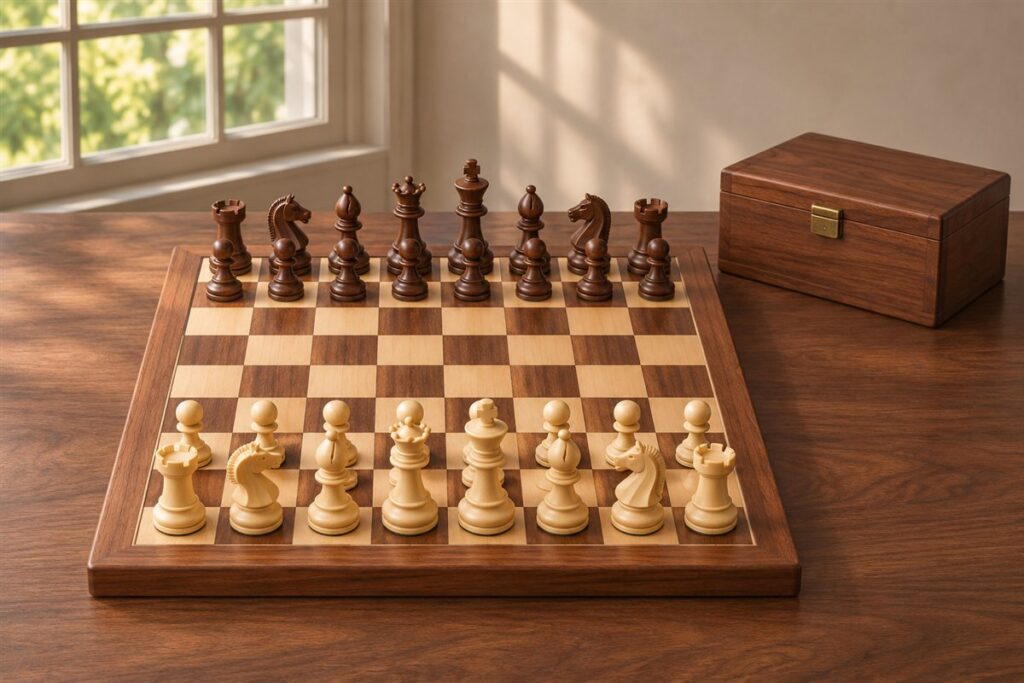
Neither piece wins more often in every position. A bishop usually does better when the board is open and pawns are on both wings, while a knight usually does better when the position is closed or when pawns sit on the same color as the bishop. The structure of the pawns decides most of the story.

Why the Bishop Often Likes Open Boards
A bishop travels long distances in one move, so it can hit targets on both wings and support a passed pawn from afar. When pawns are on both sides of the board, the bishop’s range gives it a clear edge, since the knight needs several moves to cross.
Why the Knight Likes Closed Positions
A knight jumps over pieces, so locked pawn chains do not block it. It can also rest on a strong outpost that no enemy pawn can attack. In crowded positions, it can be more useful than a bishop that is hemmed in by its own pawns.
| Factor | Favors the bishop | Favors the knight |
|---|---|---|
| Board | Open, with long diagonals | Closed, with locked pawns |
| Pawns | On both wings | All on one wing, or on the bishop’s color |
| Squares | Weak squares of its color | Strong outposts |
| King | Far from the action | Close to support the knight |
How to Play Each Side
- With the bishop, open the position, keep pawns on both wings, and create a passed pawn far from the other side.
- With the knight, keep the pawns locked, and look for an outpost the bishop cannot challenge.
- Place your pawns on the opposite color of your bishop when you can, so they do not block it.
- Bring the king into play early. In endgames, the king is an active piece.
- Look for the idea of a second weakness, on a different wing, to overload the other piece.
Common Mistakes
- Putting pawns on the same color as your own bishop and blocking it.
- Letting a knight sit on the edge of the board where it has few moves.
- Trading into an ending without comparing the minor pieces first.
- Ignoring the opponent’s king position.
Pawn Structure as the Deciding Factor
Pawns decide whether a knight or a bishop shines. A bishop moves on one color of squares, so pawns fixed on its color can block it, while pawns on the opposite color leave it free. A knight is not bound by color and can jump over obstructions, but it needs outposts and nearby targets because it moves slowly across the board.
Look at where each side’s pawns stand. If your pawns are on the same color as your bishop, the bishop is often called bad, since it bites on its own pawns. If your pawns sit on the other color, the bishop tends to be good. If the opponent’s pawns are fixed on one color, a bishop of the opposite color can attack them from behind, while a knight may have trouble reaching them without a long route.
Pawn majorities and passed pawns matter too. A passed pawn far from the king may require a piece to stop it, and a bishop can control the promotion square from a distance. A knight needs time to arrive. On the other hand, when pawns are all on one side of the board, a knight can be slow to move between wings. Before deciding which piece is better, count tempi, check pawn chains and identify weak squares. These details usually answer the question faster than general rules do.
Outposts and Weak Squares
A knight loves a protected outpost, a square deep in the opponent’s territory that cannot be attacked by enemy pawns. From there it can hit several targets at once and is difficult to dislodge. In endgames, an outpost close to the enemy king or pawns can make a knight stronger than a bishop.
A bishop likes to attack weak squares of its own color. If the opponent has pawn weaknesses on the color of your bishop, you have a natural target. A bishop also exerts long-range pressure that ties down enemy pieces, so the defender may have to place their king or pawns on awkward squares.
- Check whether an enemy pawn can chase your knight away from its outpost.
- Check whether your bishop has open diagonals to reach weak pawns.
- Look for squares your opponent cannot defend with a pawn.
- Consider whether trading pieces would help or hurt your structure.
Studying master games and endgame books can help you recognize outposts quickly. Practice by setting up positions with a knight and a bishop and seeing which squares each piece can control. Over time, you will start to see which structure favors which piece before moves are played. It also helps to remember that an outpost is only as good as the follow-up plan, so ask what the knight will attack next, not only where it can stand safely.
King Activity and Piece Coordination
In endgames, the king becomes a fighting piece. A centralized king supports pawns and attacks enemy ones. How the king works with a knight or bishop changes the evaluation. A knight and king together can form a compact, flexible unit, and the king helps cover squares the knight cannot reach quickly. A bishop and king can coordinate on both colors, with the king covering squares of the opposite color to the bishop.
The distance to the action matters. If the fight is on one side, a bishop can switch quickly across the board in a single move, while a knight needs several moves. If the fight is in a cramped area with many pawns, a knight may navigate more easily. When the king is close to the passed pawn, the knight can help escort it, but a bishop on a long diagonal may stop it from afar.
Always calculate king routes. Count the moves needed to reach key squares and compare with the opponent’s route. A single tempo can decide the result. Avoid moving the king into forks, since a knight can attack king and another piece simultaneously. When you are on the defending side, aim to bring the king toward pawns that need protection and keep it near the center until the situation clears. Piece activity and king placement together often outweigh the abstract values of pieces.
Practice Methods for Minor Piece Endgames
Understanding comes from practice. Set up simple endgames and play them against a friend or an engine, switching sides. Start with a king, a knight and a few pawns against a king, a bishop and a few pawns. Try different pawn structures and see how the evaluation changes. Note when the bishop is strong, when the knight is strong and what pawn changes shift the balance.
Study classic endgame positions. Many books and online resources present basic principles of minor piece endgames, with explanations that build your pattern recognition. Work through a few positions each week, trying to find the plan before reading the solution. Write down the key ideas in your own words.
Review your own games. When a minor piece endgame appears, stop and ask what you could have done differently. Look for missed outposts, trapped pieces and king errors. Practice calculating short variations without moving pieces, then check with an engine for mistakes. Time-controlled training can help too, because endgames often arrive when the clock is low. Keep a notebook of recurring themes. After a few months, you will likely make faster, more confident decisions when you must choose which piece to trade or keep. Reviewing your own endgames with these questions in mind, and writing down the pattern each game showed, turns every practice session into lasting knowledge you can reuse.
A Decision Checklist Before You Trade
Before trading a knight for a bishop or the reverse, pause and run through a short checklist. First, look at the pawn structure. Which side of the board is open, and which is closed? Are there fixed pawns on one color? Second, identify targets. Which of the opponent’s pawns or squares are weak, and can your piece reach them?
Third, consider the king positions. Which king is nearer to the action, and how will the trade change that? Fourth, think about the tempo. Does the trade gain time, or does it give your opponent a free move to improve their position? Fifth, check passed pawns. Will the remaining piece be able to stop or support them?
Finally, ask what endgame you want. Sometimes simplifying into a pawn endgame is the best path, and sometimes keeping pieces on the board retains winning chances. If you are ahead, trading to reduce the opponent’s counterplay is often wise. If you are behind, avoid trades that remove your last active piece. Use this checklist in your games, then look back at results to learn which factors you weigh too much or too little. Rules of thumb help, but concrete calculation is the final judge. Treat the checklist as a habit rather than a formula, and refine it with every endgame you play or study.
FAQ
Is a bishop worth more than a knight?
Common values treat them as roughly equal, and the practical difference depends on the position. Treat any fixed number as a guide.
What about a single pawn on one wing?
If all the pawns are on one wing, the knight often has a good chance of drawing or holding, since the bishop cannot use its range as well.
Is a knight or a bishop better in a pawn-heavy position?
Closed positions with many fixed pawns often favor knights, while open positions tend to favor bishops. The exact pawn structure and king positions can change this.
What is a bad bishop?
It is a bishop blocked by its own pawns on the same color of squares. It may still be useful defensively, so judge the position concretely.
Should I always keep the bishop pair?
The bishop pair is often valuable in open positions, but it is not a rule. Evaluate structure, activity and the plans available.
Can a knight stop a distant passed pawn?
It can be slow to arrive, especially on the opposite wing. A bishop can often cover the promotion square more quickly.
How can I improve my endgame skills?
Study basic endgame principles, play out simple positions, and review your own games. Short, regular practice usually works better than rare long sessions.
Do chess engines value knights and bishops equally?
Engines judge positions by concrete features rather than fixed values, so the better piece depends on the position. Use engine analysis to understand why, not just to copy moves.
The Short Version
The bishop likes open boards with play on both wings, and the knight likes closed positions with outposts. Check the pawn structure, the king, and the open lines before deciding which ending to aim for.