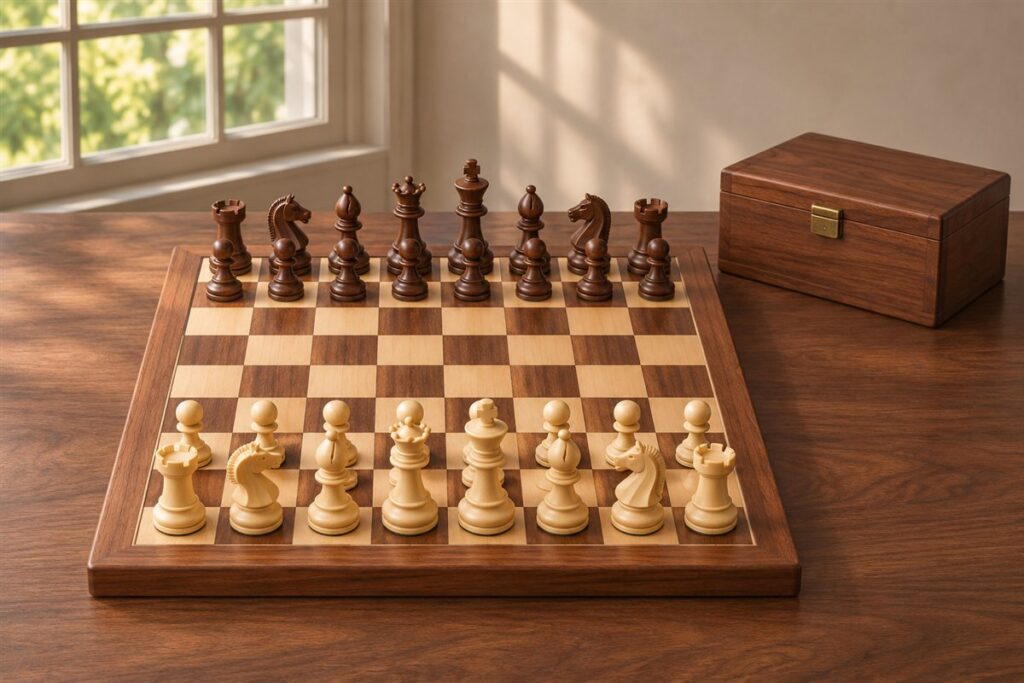
Use a chess engine after you have done your own thinking, not before. If you check it during a game or on every move of a puzzle, your calculation fades; if you form your own opinion first and then compare, the engine becomes a very patient coach.

Where Engines Go Wrong for Learners
An engine gives answers without reasons. It may say one move is slightly better than another by a small margin, and that margin often has no practical meaning for a human. Reading long lines of computer moves can feel like learning while building no real understanding.
- Checking mid-game removes the effort that builds calculation.
- Chasing the top engine line makes you memorize moves you cannot reproduce.
- Small score differences distract from the big mistakes that decide most games.
A Healthy Workflow
- Play the game and finish it. Never consult an engine during a game that counts.
- Annotate on your own. Mark the moments where you felt unsure, where the plan changed, and where you think the game turned.
- Only then run the engine. Compare its view with your notes.
- Focus on the biggest swings first. Ignore tiny differences between two good moves.
- Ask why. For each swing, find the tactic or idea you missed, and say it out loud in a sentence.
- Save the position to a collection and revisit it later without the engine on.
Settings and Habits
Most engine tools let you limit the number of lines shown and hide the evaluation until you ask. Showing one or two lines is a sensible default for study. Turn off any feature that suggests the best move automatically while you are working through a position.
| Use | Helpful or harmful |
|---|---|
| After a finished game | Helpful |
| To confirm a tactic you found | Helpful |
| During live play | Harmful, and against fair play rules |
| To replace your own calculation | Harmful |
Other Ways to Use It Well
- Test your opening ideas against it, then study where your plan stopped working.
- Play from an endgame position against it to practice technique.
- Use it to check your analysis of a puzzle once you have a final answer.
Reading Evaluations the Way a Human Needs To
Engines present their opinion as a number, often shown in pawn units, with a plus sign when White is better and a minus sign when Black is better. Learners tend to treat that figure as precise truth. It is better to treat it as a rough signal. A small advantage, such as a fraction of a pawn, often means the position is balanced for human players, since neither side has a clear way to turn it into a win. A large advantage usually indicates a real problem, such as a lost piece or a decisive attack, and that is where your attention should go.
Engines also report mate scores, which show a forced checkmate in a certain number of moves. These are valuable for learning, because they show tactics you missed, but they can be misleading for practical play if the only winning path requires a long chain of precise moves. Ask whether a human could realistically find the line over the board. If not, there may be an easier path to the same advantage, or the position may be harder to play than the number suggests.
Pay attention to how evaluations change after each move. A sudden drop is a signal that you or your opponent made a significant error. Mark these moments in your notes. Ignore small fluctuations. Also remember that evaluations depend on search depth and settings, so different engines or modes may show different numbers for the same position. Think of the figure as a guide to where the game turned, not a verdict on your ability. Always ask what the number is trying to tell you, and turn it into a sentence in your own words.
Turning Mistakes Into a Personal Training Plan
Engine analysis is most valuable when it feeds a plan. After reviewing several games, look for repeated themes in your biggest mistakes. Do you often miss opponent threats, leave pieces undefended, misjudge endgames or run into trouble in the same opening? Create a simple list of categories and tally your errors over a month. The patterns will usually be clear, and they tell you what to study.
Match your study to the category. If you miss tactics, practice puzzles without the engine. If you lose endgames, study basic positions with a book or lessons, then play them out against the engine to check your technique. If openings are the issue, learn the main ideas and typical plans, not long move sequences. If time management is the problem, practice with a clock and set limits for each move in training games.
Keep a mistake journal. For each important error, write the position or move number, what you played, what you should have considered and the lesson in a single line. Review the journal weekly. Over time, you will notice that some issues fade as you improve, while others persist, and you can adjust your focus. Add the positions to a study collection, and try to solve them again after a week without any help. If you can, you have probably learned the idea. If not, it needs more work. This approach turns engine feedback into lasting skill, rather than a pile of forgotten evaluations.
Using Engines for Opening and Endgame Work
Engines are strong tools for exploring openings and endgames, provided you stay in charge. For openings, start from a position you have reached in your games and ask what plans each side has, instead of memorizing the engine’s top choices. Look at several lines, not only the first. Try to identify the pawn structure, piece placement and typical ideas, and then check the engine’s moves against your understanding. If a line surprises you, explore why. This builds understanding instead of rote memory.
Be careful about engine-approved lines that are only good with perfect follow-up. Choose openings that suit your style and are easy to play, even if the engine shows slightly better alternatives. Practicality matters more than a tiny edge. Use game databases or opening books alongside engine analysis, to see how humans handle the positions.
For endgames, set up well-known positions and play them against the engine from both sides. Try to find the correct plan before moving. If the engine has access to tablebases, which are databases that settle certain endgames perfectly, check the maker’s documentation to see how they are used. Compare your results with the theory in a book, and repeat the positions until you can handle them reliably. Short sessions spread through the week work better than one long session. Make sure to combine engine work with your own thinking at every step, and avoid the habit of clicking the engine’s move automatically. The goal is to understand why moves work and be able to find them yourself.
Healthy Habits for Different Levels of Player
The best way to use an engine depends on your level. Beginners benefit from using it for simple checks: did I leave a piece hanging, did I miss a one-move tactic? At this level, big blunders decide most games, so spending time on subtle evaluation is not useful. A beginner should limit engine time to a few minutes after each game and spend the rest of the study time playing, doing basic puzzles and learning principles.
Intermediate players can use more detailed analysis, such as comparing candidate moves and examining the middlegame plans. They should still try to form their own opinions first and write them down. A good practice is to predict the engine’s evaluation before looking, and track how often you are right. This builds judgment and shows where your assessment is off.
Advanced players use engines for deep preparation, but they also run the risk of relying on them too much. They should treat engine output as input for discussion with a coach or study partner, check lines for human playability and make sure they understand the ideas behind them. Whatever your level, set limits. Decide how long you will spend on engine analysis, how many lines you will show, and when you will turn it off. Take breaks, since long sessions lead to passive scrolling through moves. Combine engine work with other activities such as reading, playing training games and discussing positions with others. Keep your focus on understanding, and you will keep your own thinking skills active.
Fair Play and Keeping the Game Honest
Engines have changed chess, and with that come responsibilities. In rated games, online or over the board, receiving outside help during play is prohibited under fair play rules. This includes consulting an engine on a phone, a second device or through another person. Violations can lead to account closures, bans or other penalties, and the damage to your reputation can be lasting. Read the rules of each site or event, and follow them.
The rules also affect how you analyze. Be careful with live analysis of games in progress. Even looking at a computer evaluation of a game you are playing, perhaps on a shared account or a tab you left open, can count as a violation. Close analysis tools and applications before starting a game, and make sure notifications from them are silent. If you are unsure whether a tool is allowed, ask the platform or the organizer. When in doubt, don’t use it.
There is a personal side to this too. If you want to know how strong you are, you need to play without help, and your results should reflect your own ability. Using an engine to cheat on training puzzles undermines the practice that makes you better. If you play correspondence chess, check the rules for that format, since some events allow engines and others forbid them. Be open with opponents and coaches about how you study. Teach younger players about fair play, too. Engines are best seen as a tool for learning after the fact, and a good habit is to close the engine window when the game is done and think about what you learned.
FAQ
Should beginners use an engine at all?
Yes, in small doses. A beginner can use it to spot hung pieces and simple tactics after a game. Deeper evaluation numbers matter far less at that level.
Can I use an engine while playing online?
No. Sites treat that as cheating in live games, and it also takes away the practice you are there to get. Keep engines for analysis after the game.
How long should I think before checking the engine?
Try to reach your own conclusion first, even if it takes a few minutes. The goal is to compare your thinking with the engine's, so skipping the thinking defeats the purpose.
Is it fine to use an engine for puzzles?
Use it only to check your final answer. Looking at the engine's move before solving the puzzle removes the practice of calculation.
What does a plus 0.3 evaluation mean?
It means the engine sees a slight edge for White, which is usually not significant in human play. Focus on larger swings, where a real mistake has occurred.
Should I follow the engine's top move every time?
Not necessarily. Several moves are often close in value, and a move that you understand may be better for you in practice. Look for the idea, not just the move.
Can an engine help me learn openings?
Yes, if you use it to explore ideas and test your lines, not to memorize sequences. Combine it with books or courses that explain the plans.
How often should I analyze my games?
A regular habit, such as after each important game or once a week, works for many players. Quality of review matters more than quantity.
Are there downsides to analyzing on my phone during a tournament break?
Check the tournament's rules, since some events restrict devices in the playing area. Avoid analyzing games that are still in progress, and follow all fair play guidelines.
The Short Version
Think first, check second. Limit what the engine shows, focus on large mistakes, and always put the reason into your own words. Used this way, it helps you improve instead of doing the work for you.