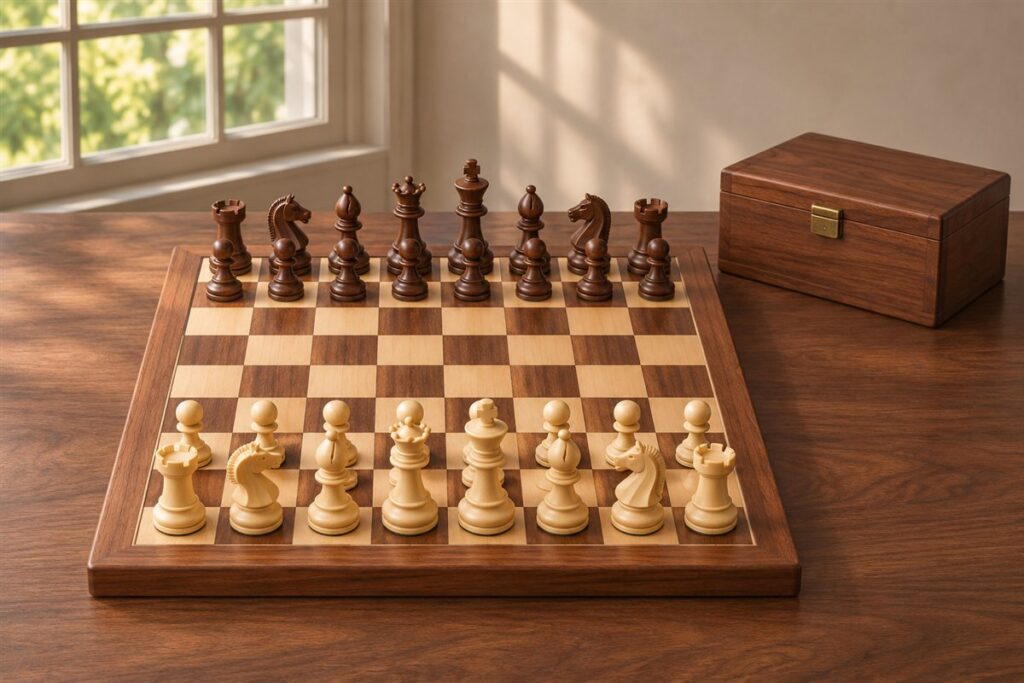
With four players, the simplest family chess tournament is a round robin, where everyone plays everyone else once, giving three rounds and six games. If you prefer a knockout feel, use a semi-final and final format with a third place game so nobody leaves after one match. Add handicaps for mixed ages and the whole event can fit into a relaxed afternoon.
Choose a Format
Two formats suit four players well.
Round Robin
Each player faces the other three. It works with two boards, so two games run at once while two players rest or watch. Points are one for a win, a half for a draw and zero for a loss.
Knockout Bracket
Two semi-finals, then a final and a third place match. Everyone gets two games, which is gentler on younger players who might otherwise go home after one defeat.
| Format | Games per player | Best for |
|---|---|---|
| Round robin | 3 | Fair results, long afternoons |
| Knockout with third place game | 2 | Drama, shorter events |
Setting It Up
- Write each name on a card and draw them out of a bowl to set the bracket or schedule.
- Decide on a time limit. Fifteen minutes per player is a common general choice, or use a quicker limit for younger children.
- Set up two boards in different spots so players have space to think.
- Print or draw the bracket on a large sheet and hang it where all can see.
- Agree on rules before round one, including touch move, draws and whether take-backs are allowed.
- Choose a small prize or a silly trophy, and decide who is in charge of the schedule.
These are suggestions. Adjust the times to your family’s pace.
Keeping It Fun for Mixed Ages
- Time odds. Give the weaker player more time on the clock than the stronger one.
- Piece odds. A stronger player begins without a rook or a knight.
- Bonus points. Award a point for a creative move or a polite handshake.
- Snack breaks. Plan short breaks between rounds to keep energy up.
Handling Disputes and Big Feelings
Pick one family member to act as the arbiter, ideally someone not playing the current game. Agree that their ruling stands. If a child gets upset after a loss, give them a break before the next round and remind them that everyone loses sometimes.
A Ready-Made Round Robin Schedule
With four players, the pairings fall into a neat pattern, and writing them out in advance saves arguments. Call the players A, B, C and D. Each round, two games run at the same time, and every player is busy in every round, so nobody sits out while others play.
- Round one: A plays B, and C plays D.
- Round two: A plays C, and B plays D.
- Round three: A plays D, and B plays C.
That gives six games and ensures everyone meets everyone once. Decide who plays White in each game by drawing lots or by following a simple rule, such as the first-named player in each pairing taking White. A fairer approach for long events is to make sure each person has White about as often as Black, and with three games each, that means two of one color and one of the other. You can rotate this so that different people get the extra White game.
Before you start, write the schedule on a large sheet with blank spaces for results, and draw a small crosstable where each player’s row shows their result against the others. Marking a win, draw or loss as soon as each game ends keeps the sheet accurate and the mood exciting. Use a pencil in case a result is entered in the wrong box. If you run the event with a break between rounds, tell everyone the plan and the approximate start time of the next round, so players can rest, eat or stretch.
If players finish at different times, let the first to finish watch the other game quietly, or start a casual game on a spare board. A little organization at this stage keeps the afternoon running smoothly and helps younger players know what to expect.
Clocks and No-Clock Options
Clocks add pressure and excitement, but they may not suit every family. Think about the ages and temperaments of your players before choosing. If you own a chess clock, agree on how to use it and spend a few minutes practicing before the first round. If you use a phone app or a kitchen timer, check that everyone understands how it works.
- No clock: the simplest option, best for beginners or for younger children. Games may last a long time, so set a rule such as a maximum of forty-five minutes, after which the position is judged by an adult or declared a draw.
- Shared time limit: each player gets the same amount of time for the whole game. Pick something that suits your group, and be ready to change it if games finish too quickly or run too long.
- Time odds: as mentioned earlier, a weaker player gets extra time. Keep the difference small enough that the stronger player does not feel the game is unfair.
- Move limit instead of a clock: for a casual event, agree that the game ends after a fixed number of moves, and the player with more material wins or the game is a draw. This is not standard chess, but it can keep things moving.
Whichever you choose, explain what happens when time runs out. In standard play, a player whose time expires loses, but a family event may include exceptions, for example allowing a child to continue if the opponent has no way to checkmate. Agree on this before the first round, not in the middle of a dispute. It is also kind to let players know that clocks are optional, so no one feels pressured.
Roles and Ceremony
A tournament feels special when it has a few simple roles and rituals. These do not need to be elaborate, and they give everyone something to look forward to, including people who are not playing.
- Arbiter: one person who explains the rules and settles disputes. If all four family members are playing, pick someone who is neutral for each game, or agree to ask a visitor or relative to help.
- Scorekeeper: a person who updates the bracket or crosstable after each game. Giving this job to a younger sibling or a relative can make them feel part of the event.
- Announcer: someone who calls out pairings, results and standings. A bit of humor goes a long way here.
- Host: the person in charge of snacks, drinks and keeping the space tidy.
Think about small ceremonial touches too. Create name cards for each board, and shake hands before and after every game. Decide on a trophy, a certificate or a silly title, such as champion of the afternoon, and prepare it in advance. If you want every player to have a memento, give them a certificate that lists a distinct achievement, such as best comeback, most creative opening or best sportsmanship. These awards recognize qualities other than winning and help players who lose all their games leave with a smile.
Take photos of the event, the bracket and the players at the boards. These images will make a nice memory and build excitement for the next time.
Variant Rounds and Team Twists
If your family enjoys variety, a tournament can include a special round or a team element. Variants can also help when players have very different skill levels, because they reduce the advantage of memorized openings. Make sure everyone knows the rules before the event begins, and test variants in a practice game.
- Randomized starting positions: some variants, such as Chess960, shuffle the back-rank pieces so that no one can rely on opening theory. Share the rules in advance, and decide how to choose the starting position fairly.
- Partner games: bughouse is played by two teams of two across two boards, with captured pieces passing to teammates. It is lively and noisy, and it can work as a final round for a group that enjoys chaos. Explain the rules carefully and keep the mood light.
- Handicap games: as discussed earlier, a stronger player can give up a piece, but you can also try playing without queens or with fewer pawns for a different feel.
- Blitz finale: a short round with a few minutes per side can be a fun closer, when players are relaxed and results are less serious.
- Team scoring: if you have more than four people, split into two teams and add up scores for a family cup.
Keep the main tournament standings separate from any special rounds unless everyone agrees to combine them. Make sure that variants are optional for those who prefer standard chess. The point is to keep everyone engaged and having fun, not to force a particular format.
Wrapping Up and Planning the Next One
How the event ends influences how everyone remembers it. When the final game finishes, gather the group, add up the results and announce the standings. If there is a tie, use the tie-break method you agreed on, and keep the mood cheerful. Present the trophy, certificates or small prizes, and thank everyone for playing.
- Congratulate every player on something specific, such as a clever tactic, a calm endgame or good manners.
- Invite players to show one favorite moment from their games on the board, and let others comment kindly.
- Save the bracket or crosstable, and write the date and winner on it. Over time, a collection of these sheets forms a family record.
- Ask for feedback while the event is fresh: what was fun, what felt too long, and what they would like to change.
- Use the answers to plan the next event, adjusting the time limits, format or handicaps.
- Pick a date for the next tournament, or a regular schedule such as once a season, so people have something to look forward to.
If anyone struggled, spend a few minutes with them later to talk about the day and offer a casual game or puzzle. Chess can bring up big feelings, and a kind word after the event matters. Tidy the boards together, pack the pieces carefully and store the equipment where it can be found easily. A well-run family tournament may become a tradition that grows as more relatives and friends join in.
FAQ
What if two players tie at the end of a round robin?
Use the head to head result between them, or play a quick short game as a tie breaker.
Can we add a fifth person?
Yes. Five players in a round robin gives five rounds, with one person resting each time, which is easy to manage.
How long does a four-player round robin take?
It depends on your time limits and the players' pace. Three rounds with breaks between them often fit into an afternoon, but allow extra time if games are untimed or if the players are beginners.
Do we need two boards?
Two boards let both games of each round run at once, which keeps the schedule short. With only one board, you can run the games one after another, but the event will take longer and players will wait more.
How do we decide who gets White?
Draw lots, flip a coin, or use a rule such as alternating colors across rounds. Aim for a fair balance, so everyone has White about as often as Black.
What if one player is much stronger than the rest?
Use handicaps such as time odds or piece odds, or give the stronger player a role such as arbiter for some games. Make sure the weaker players still feel they have a chance.
Can younger children join a tournament with adults?
Yes, with some adjustments. Use handicaps, shorter or untimed games, and extra breaks. Make sure there is a supportive atmosphere, and let a child who is tired step out.
How should we handle illegal moves or touch-move disputes?
Agree on the rules before starting, and let the arbiter decide. For a friendly event, you might allow one warning for an illegal move before applying a penalty.
What prizes work well for a family event?
Small, inexpensive items like a homemade trophy, a certificate or a choice of dinner are enough. Awards for effort and sportsmanship help everyone feel included.
The Short Version
For four players, choose a round robin for fairness or a knockout with a third place game for excitement. Use handicaps for mixed ages, set the rules ahead of time and keep snacks nearby.