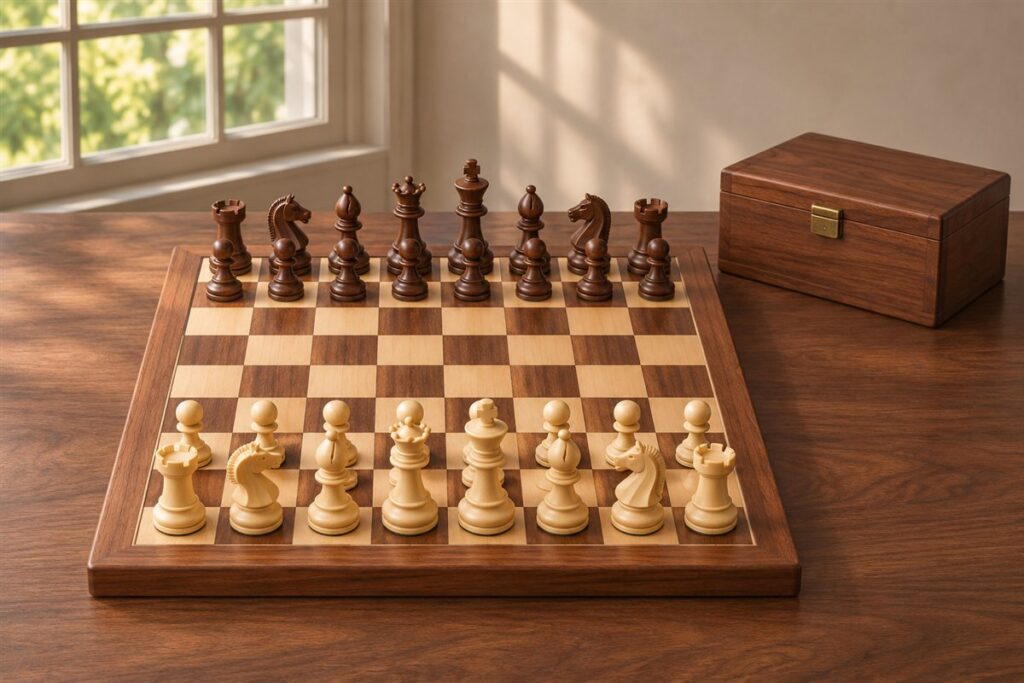
To prepare a child for a first USCF tournament, practice the touch-move rule, a clock and basic etiquette at home, pack simple supplies, and set calm expectations about results. Most first events are about learning how a tournament works, so a few weeks of gentle preparation goes a long way.

Skills to Practice Beforehand
Children do best when the event feels familiar. Play a few practice games with these rules in place:
- Touch move. If you touch a piece, you must move it. If you touch an opponent’s piece, you must capture it when legal.
- Clock use. Press the clock with the same hand that moved the piece, every time.
- Quiet play. No talking about the game while it is going on, and no looking at other boards in a distracting way.
- Calling an adult. If there is a dispute or a rule question, raise a hand and wait for the tournament director instead of arguing.
Check the event flyer for the exact time control and rules, since each organizer sets its own details.
A Four-Week Plan
- Week one: Join the membership and confirm the entry steps on the federation site. Read the event flyer together.
- Week two: Play two or three games on a real board with touch move and no take-backs.
- Week three: Add a clock. Try a time limit near the real one so the pace feels normal.
- Week four: Practice writing moves, if the section requires notation, and run a mock round where you act as the director.
Treat these as general suggestions. Younger players may need only a lighter version of the plan.
What to Pack
- A pen and a notation sheet or notebook, if needed
- Water and a small snack that is easy to eat in the hallway
- A book or quiet game for the time between rounds
- The registration confirmation and any membership details
- A board, set and clock only if the flyer asks players to bring them
Game-Day Mindset
Tell your child before the first round that most players lose some games, and that this is normal. Set small goals, such as checking for threats before each move or shaking hands politely. Avoid asking only about the result. Questions such as “what was your favorite move?” keep the focus on learning.
Between rounds, let your child relax. Heavy post-mortems with a parent can wear them out. If a loss makes them upset, give them a few quiet minutes before the next pairing.
Choosing the Right First Event and Section
Where your child starts has a large effect on how the day feels. A well-chosen event is welcoming, not too long and matched to their level, so read the details before you register.
- Look for beginner-friendly events. Scholastic tournaments and local club events often have sections for newer or younger players. Large open events with strong adult fields can feel overwhelming for a first outing.
- Check the schedule. Count the rounds and the length of each day. A one-day event with a handful of games is easier on a young player than a long weekend.
- Understand the sections. Many events group players by grade, age or rating. Unrated players are usually placed according to the organizer’s rules, so read the flyer or contact the organizer.
- Consider the location. A venue that is close to home, has a quiet playing hall and offers food nearby makes the day smoother.
- Ask about the format. Most tournaments use a pairing system that matches players with similar scores. Your child will play every round even after a loss, which is worth saying out loud in advance.
- Look at the entry details. Entry fees, registration deadlines and any membership requirements are set by the organizer, so confirm them on the event page.
If you are unsure, send the organizer a short message describing your child’s age and experience and ask which section suits them. Organizers are usually glad to help new families, and the answer can prevent a mismatch that spoils the experience.
Building Chess Skills That Matter for Tournament Play
Winning is not the point of a first event, yet some skills make the games enjoyable. A child who can handle the basics will feel more confident and spend less energy worrying about what to do.
- Checkmate patterns. Practice finishing simple endings, such as king and queen against king, and king and rook against king. Many young games hinge on whether a player can convert an advantage.
- Safety checks. Teach a habit of asking before each move: what does my opponent threaten, and is the piece I am moving protected?
- Basic opening principles. Develop pieces, control the center and castle early. These ideas are enough for a first event, and a long list of memorized lines is unnecessary.
- Special rules. Make sure they know castling, en passant, promotion, stalemate and the idea of a draw by repetition. These come up more often than parents expect.
- Time awareness. Play several games with a clock so they learn to move at a steady pace. Show them that thinking is good, but taking too long on each move can leave them short of time.
- Review mistakes. After practice games, look at one or two moments together and ask what they would do differently.
Short, regular practice usually works better than a single long session. Puzzles, online play against friendly opponents and games with family members all help. Make sure the practice remains fun, since a child who dreads it is unlikely to enjoy the tournament.
Handling the Clock and the Scoresheet
Two things confuse newcomers most: the clock and recording moves. Both are easy to learn with practice, and mastering them removes a lot of anxiety.
The clock. Show your child how to set it, how to start it and how to press it after each move. Explain that each player has a limited total time for the game, and that the clock runs while the opponent is thinking. If a time delay or increment is used, the flyer or the director will say so. Practice what to do if the clock stops, if a flag falls or if they are unsure of the time. The answer in most cases is to raise a hand and ask the director for help. Keep any questions about rules for the director rather than the opponent.
The scoresheet. Some sections require players to write down their moves, and others do not, so check the flyer. If notation is needed, practice writing the moves while playing, even if slowly. Teach the basic format: the piece letter, the destination square and symbols for capture and check. Show your child how to correct a mistake neatly. A small notebook or a printed sheet and a pen they like can make the habit more pleasant.
It is fine for a beginner to be slow at first. Many events have rules for players who cannot keep up with notation, but those rules differ, so ask the director if it arises.
Practicing these routines at home removes surprises and lets your child concentrate on the chess.
Managing Nerves, Energy and the Long Day
A tournament is a mental and physical effort, and children can tire quickly. Looking after basic needs is part of preparation, and it affects how well they play.
- Sleep. Aim for a normal bedtime the night before and a calm morning. Late-night cramming usually does more harm than good.
- Breakfast and snacks. Offer a familiar breakfast and pack snacks that are easy to eat and not too sugary. Water should be on hand throughout the day.
- Arrive with time to spare. Rushing raises stress. Allow time to check in, find the playing hall, use the restroom and settle in.
- Use the breaks. Between rounds, encourage movement, fresh air or a quiet activity. Some children want to analyze their games with friends, and others prefer to play a different game or draw.
- Name the nerves. Tell your child that butterflies before a game are normal. A few slow breaths and a reminder to look at the whole board before each move can help.
- Plan for tears. Losing a game can be upsetting. Stay calm, offer comfort and avoid criticism. Let your child decide whether to talk about the game or wait.
If your child wishes to stop or take a break, listen. A tournament is supposed to be a positive experience, and one bad day does not mean they are unsuited to chess. Sometimes withdrawing from a round and returning for the next is allowed by the organizer, but ask before deciding. The most useful message is that you are proud of their effort, whatever the score.
After the Event: Learning and Next Steps
What happens after the last round shapes whether your child wants to return. The best follow-up is calm, curious and low pressure.
- Celebrate participation. Mention specific things they did well, such as staying focused, shaking hands or finding a good move.
- Ask open questions. “Which game was the most interesting?” or “What was the hardest moment?” invites reflection better than “Why did you lose?”
- Review one game. If they want to, replay a game using the scoresheet or a written record, and look for a turning point. Choose one lesson rather than a long list.
- Look at the results together. Explain how any official rating will be calculated by the federation, using the information on its site, and that early ratings can change quickly with more games. Do not treat the first number as a verdict on their ability.
- Set a small goal. It might be to avoid one-move blunders, to try a new opening idea or to play in a club once a month.
- Find a regular outlet. A local club, a school team or a friendly online group provides practice against varied opponents.
Take notes about logistics too. What did you forget to pack? What would make the day smoother next time? These small details help you prepare for the next event. If your child wants to go again, choose the next tournament together and look at what you learned. Gradual, steady experience is the best teacher for young players.
FAQ
Does my child need to know notation?
It depends on the section and the organizer. Many scholastic sections do not require it, but learning basic notation helps later. Check the flyer.
Should I stay in the playing room?
Most tournaments keep parents out of the playing hall. Plan to wait in the designated area and confirm the rules with the director.
How do I know if my child is ready for a tournament?
If they know the rules, can finish a game in a reasonable time and want to try, they are probably ready. Choose a beginner-friendly section and keep expectations modest.
What happens if my child makes an illegal move?
The rules for this are set by the event and the director. The best step is for your child to stop the clock if needed, raise a hand and ask the director for help instead of arguing with the opponent.
Should I teach my child opening theory before the event?
Basic principles are enough for most beginners. Long memorized lines are easy to forget under pressure, and practical skills like safety checks and simple endings are usually more valuable.
Can my child draw a game by agreement?
In many events, players may offer a draw according to the rules, but details such as timing vary. Teach your child to ask the director if unsure, and not to accept or offer one without understanding the position.
How should I handle a loss that upsets my child?
Give them space, offer a drink or a snack and acknowledge their feelings. Talk about the game later when they are calm, and remind them that every player loses games.
Is it okay to coach my child during the tournament?
Most events do not allow help during a game, from parents or anyone else. Save advice for between rounds and follow the director's instructions on where spectators may stand.
How many tournaments should we play before judging progress?
Progress takes time, and results vary a lot from event to event. Look at the quality of play, enjoyment and growing confidence over several events, not a single result.
The Short Version
Practice touch move, the clock and quiet behavior at home, read the flyer closely and pack light. Keep expectations gentle so the first event is a good experience that makes your child want to return.