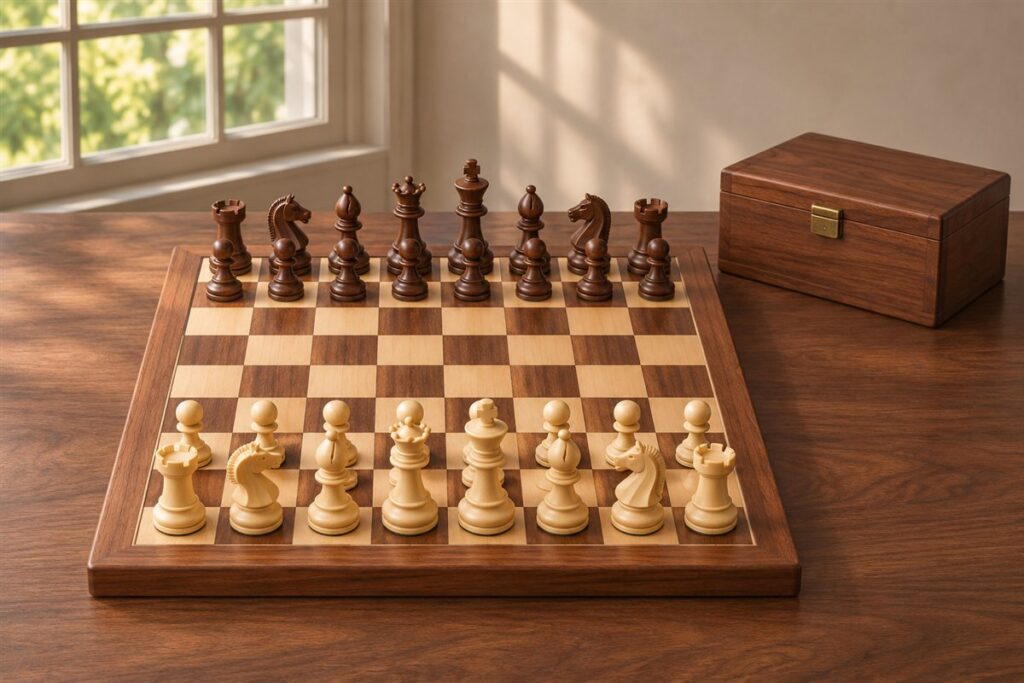
The Queen’s Gambit is mostly believable in its board play and tournament feel, while its dramatic visuals and fast career rise are closer to storytelling than daily club reality. This article compares the series with the way most players actually experience the game.
What the Series Gets Right
The drama is based on a novel by Walter Tevis, and the production reportedly worked with respected chess consultants to make the games and positions credible. Viewers who play often tend to notice details that feel familiar.
- Players record moves by hand on a score sheet during tournament games.
- Clocks, handshakes, and quiet rooms are recognizable parts of over-the-board events.
- Opening names and common ideas, such as control of the center, are used sensibly.
- The role of study, analysis, and preparation between rounds feels true.
Where Drama Takes Over
Some elements are there for the screen. They are not mistakes so much as choices that make chess watchable.
- Imagining pieces on a ceiling is a visual way to show calculation, not a method taught in clubs.
- Rapid progress from beginner to top competitor is far faster than most real careers.
- Tournament games are shown in highlights, so you rarely see the long, quiet middle stretches that fill real events.
- Rivalries and press attention are heightened for effect.
How Real Players Actually Improve
If the show inspired you to improve, the real path is less cinematic but clear. Try these steps as general guidance.
- Play regularly at a time control that lets you think.
- Solve short tactical puzzles most days.
- Learn a simple opening setup instead of memorizing long lines.
- Look over your lost games and find the single move that changed the result.
- Study basic endgames, since they appear in many games.
A Note on the Opening Itself
The Queen’s Gambit is a real, respected opening that begins with White offering a pawn on the queen’s side to gain central control. It is not a true sacrifice in most lines, because Black can accept but usually cannot hold the pawn for long. It is a sound choice for players at all levels and a classic way to learn central play. Because the name is the same as the series, many newcomers search for it first, and they find plenty of free lessons that cover the main lines.
What a Real Tournament Day Looks Like
The series gives a strong sense of atmosphere, but a real event has a rhythm that a television episode has to compress. Most tournaments are organized in rounds. You are paired against an opponent, play a game that can last for hours, and then wait for the next pairing. Between rounds there is usually a break to eat, rest and look at your position. Over a weekend event, the waiting, the walking around and the quiet conversation take up a large share of the day, and they rarely appear on screen.
Several practical rules shape the experience that a viewer may not notice. Players follow touch-move conventions, meaning a piece you deliberately touch generally has to be moved. Arbiters or directors settle disputes about the clock, illegal moves and conduct. Phones are normally switched off or kept away, and talking during a game is discouraged. Rules differ between organizers and federations, so a new player should read the event announcement before arriving.
- Arrive early enough to find your table and check the pairings.
- Bring a pen for your score sheet if the event requires notation.
- Learn how the clock works before the first game.
- Ask the arbiter if you are unsure about a rule, rather than guessing.
The result is that real chess has more routine and less spectacle than drama suggests, and for many players that calm structure is part of the appeal.
Watching the Games With a Board in Front of You
If the series made you curious about the positions themselves, one of the best ways to learn is to treat it as a study aid. Pause during a game scene, set up the position on a board or an app if you can identify the moves, and ask what each side is trying to do. Even without knowing the exact line, you can look at where the pieces are developing, which pawns are controlling the center, and whether the king has castled.
Be careful about treating screen games as an authoritative record. Scenes are edited for pacing, and some moves are shown briefly or not at all. If you want the actual game, use published sources about the book and the production, or search reputable chess sites for discussion of the featured positions. Treat any single claim as something to verify rather than assume.
A good habit is to write down one idea per scene, such as how a player trades pieces to simplify, or how an attack builds on an open file. Collect these in a notebook and try them in your own games. This turns passive viewing into active practice, and it keeps your expectations realistic: the point is to borrow concepts, not to copy a character’s results.
Mistakes New Players Make After Watching
Inspiration is useful, but a few predictable errors follow it. The first is trying to play flashy attacking chess before basic safety is in place. In real games at beginner level, most results are decided by simple oversights, such as leaving a piece undefended, so checking every move for threats is worth more than learning a clever combination.
The second mistake is memorizing a long opening line without understanding it. A single deviation by the opponent leaves you without a plan. Learn the ideas first: develop your pieces, control the center and get your king safe.
The third is judging yourself against fictional speed. The story shows a very fast climb, but real improvement is gradual and uneven, with plateaus that are normal. Measuring progress over dozens of games gives a fairer picture than a single result.
- Do not play only blitz at the start, because there is little time to learn from errors.
- Do not skip endgames, which decide many games.
- Do not assume every strong player studies alone; clubs, coaches and friends are common sources of help.
- Do not compare your first month to anyone’s career.
Finding Real Games Near You
If you want to try the over-the-board experience that the series portrays, a local club is usually the easiest door. Many clubs welcome beginners and hold casual evenings alongside rated events. Libraries, community centers, schools and cafes sometimes host chess meetups as well. Search for local organizers or your national federation’s website to see what is available, and contact them to ask about beginner nights before you turn up.
When you attend, expect a friendly mix of ages and strengths. Most players are glad to explain a rule or look at a game afterward. Bring a board and clock if you have them, but do not be put off if you do not, since many clubs provide equipment. If you prefer to start online, many platforms let you play at relaxed time controls and review your games with built-in analysis, which can build confidence before sitting across a real board.
Ask the organizer whether the club offers rated play and what the entry process involves. Ratings are a way to track progress, not a measure of worth, and many members play for the pleasure of a good game. The social side is often what keeps people playing for years.
Telling Fact From Fiction in Chess Media
Any dramatic treatment of chess blends accuracy with invention, and a few questions help you sort one from the other. First, ask whether a scene shows something that could happen at a club or event: a clock being pressed, a draw offered, a result recorded. These details tend to be grounded in real practice. Second, ask whether a claim sounds unusually effortless, such as winning a major event with no preparation or seeing dozens of moves without analysis. Those are usually dramatic shorthand.
Third, look for what the scene leaves out. Real preparation involves repetition: reviewing games, solving puzzles and revisiting mistakes. Because those activities are slow to film, they are shown briefly if at all. Remembering this can protect you from discouragement when your own study feels plain.
When you read articles or watch videos about chess in film and television, favor sources that name what they are comparing and explain their reasoning. Be cautious of precise numbers or dates that are not attributed, and check them against the original source when possible. Enjoying a story and keeping an accurate picture of the game are compatible goals.
The Look and Sound of Serious Chess on Screen
One of the series’ strongest qualities is how it presents the physical side of the game. Players hover over the board, hands pause above a piece, a hand hits a clock with a decisive slap and the room falls quiet except for the tick of the mechanism and the occasional cough. Anyone who has played in an organized event will recognize that atmosphere. The silence is real, the tension is real, and the strange intimacy of two people locked in thought across a small table is captured well.
What the screen cannot show is how slow most of that time really is. A real game can contain long stretches in which nothing visible happens, because the action is in the heads of the players. Directors compress this with quick cuts, close-ups of eyes and dramatic music. Real tournament halls are plainer, with plastic sets, pairing sheets pinned to a wall and players wandering out to stretch their legs between moves. If you go to your first event expecting cinema, you will find the reality gentler, but you may also find that the shared concentration has a beauty of its own.
Visualizing Positions in the Mind
The show makes much of its heroine imagining pieces moving across a ceiling. Visualization is a genuine skill in chess, and strong players do hold positions in their minds, calculating lines several moves deep without touching a piece. The visual effect on screen is a creative way to depict something invisible. In reality, most players do not see a glowing board on the ceiling, and the ability develops gradually through practice, not through sudden flashes of vision.
If you want to build this skill, there are simple exercises. Look at a position for thirty seconds, close your eyes and try to name every piece and square. Play short games against a friend without a board, calling out moves. Work through puzzles by thinking the full line before moving a piece. Over weeks these habits sharpen the mind’s eye in a way that feels magical but comes from routine.
Time Controls and the Clock in Real Play
Clocks are part of nearly every serious game. In the series, they appear in the background of many scenes, but their role in real play is bigger than it looks. Time management is a skill of its own: spending too long on an early decision can leave you rushing at the end of the game, when the critical choices arrive. Many beginners lose positions they had under control simply because they ran short of time.
| Format | General feel | What it rewards |
|---|---|---|
| Long classical games | Slow, deep, several hours | Preparation and careful calculation |
| Rapid games | Moderate, usually under an hour each | Balance of intuition and thought |
| Blitz games | Fast, a few minutes per side | Pattern recognition and nerve |
| Casual play without a clock | Relaxed | Learning and enjoyment |
The exact time limits differ from event to event, so check the rules of any tournament you plan to join.
Preparation, Study and the Role of Coaches
The show suggests that talent and flashes of inspiration carry much of the weight. Real improvement usually relies on regular study. Players go over openings, solve tactical puzzles, study endgames and analyze their own games, often with the help of a coach or training partner. They also learn to manage energy, travel and nerves. The best players in history all had long hours of preparation behind their achievements.
If the series inspires you to improve, set up a manageable routine. A few puzzles each day, a game or two each week and some time looking back at your mistakes will take you further than occasional bursts of study. Seek out a club, a coach or an online community for feedback, because it is hard to see your own blind spots.
Etiquette and Behavior at the Board
Real tournaments have rules of conduct that the series only touches on. Players are expected to stay quiet, avoid distracting opponents, follow touch-move rules and handle disputes through an arbiter, not through arguments. Mobile phones are normally switched off or kept away, and players do not receive outside help during a game.
- Shake hands, or greet your opponent politely, before and after the game.
- Do not discuss the position with others while games are still in progress.
- Keep your own score if the rules require it, and stay honest.
- If something seems wrong, stop the clock if allowed and call the arbiter calmly.
Mistakes New Fans Make After Watching
- Expecting rapid improvement without regular work.
- Skipping the basics, such as piece safety and simple tactics, to chase advanced openings.
- Believing that famous names in an opening mean the opening is right for them.
- Playing only very fast games, which can hide gaps in understanding.
- Comparing themselves to fictional characters instead of real peers.
Turning Inspiration Into a Habit
If the series made you want to play, take that energy and give it a shape. Get a board, find a friendly opponent, join a local club or an online group and decide on a modest weekly goal. Keep a notebook of games you enjoyed and ideas you want to explore. Be patient with yourself: chess rewards persistence, and the pleasure of a well-played game, win or lose, is the same pleasure the screen story tries to capture.
Above all, remember that fiction is allowed to simplify. The truth of real chess is quieter and more varied than a drama can show, and that is no reason to feel disappointed. Many players find that the daily texture of the game, with its puzzles, friendships and small victories, is richer than any story.
Rivalries, Friendships and the Chess Community
Drama thrives on rivalry, and the series gives its heroine a set of opponents who become allies. Real chess communities do contain strong competitors, but they are also remarkably friendly. After a hard game, it is common for both players to sit together, set the pieces back up and discuss what happened. This postmortem is one of the best learning habits in chess, since your opponent knows exactly what they were thinking and can show you ideas you never saw.
If you join a club, expect a mix of ages, backgrounds and strengths. Teenagers play against retired teachers, and a quiet newcomer may beat a veteran. Clubs often run beginner nights, casual ladders and friendly matches against neighboring clubs. These gatherings give you steady practice and company, which is far more useful than any dramatic montage.
Why Real Improvement Feels Slower Than Fiction
A television season compresses years of work into a few hours. In real life, progress arrives in small, uneven steps. You may play fifty games without any visible leap and then suddenly notice that you spot tactics more easily. Plateaus are normal, and so are setbacks after a good run. The most useful response is patience combined with curiosity: look at your losses, find the common pattern, and fix one thing at a time.
It also helps to measure progress in ways other than results. Notice whether you blunder less often, whether you plan more clearly and whether you enjoy the game more. These signs of growth show up long before a number changes.
Opening Habits the Series Leaves Out
The show touches on openings, but it cannot show the quiet work of building a repertoire. Most club players choose a small set of openings for White and a reply or two for Black, then learn the main ideas behind them instead of memorizing long lists of moves. Understanding why a pawn goes to a square matters more than remembering that it does. When your opponent leaves the book early, which happens often at club level, your grasp of principles carries you through.
A sensible beginner plan is to pick one setup you enjoy, play it for a few months and note where you struggle. Then adjust. Constantly hopping between systems leaves you with shallow knowledge of many and deep knowledge of none.
A Short Beginner Kit for Fans Who Want to Play
- Learn how every piece moves, then practise simple checkmates until they feel automatic.
- Play slow games against friends or online partners and write down what you noticed afterward.
- Solve a few tactical puzzles each day, saying the full line aloud or in your head before moving.
- Study basic endgames, because they teach how pieces work together.
- Join a club or online group and ask people to look at your games.
FAQ
Did the show help chess?
Many people reported interest in learning the game after watching, and online chess activity rose around that time. Exact figures vary by source, so check the platforms directly.
Is the opening good for beginners?
It is often recommended for its clear ideas about the center and piece development. It is not the only option, so choose what you enjoy.
Do real players really visualize the board with their eyes closed?
Some players can visualize positions well, and it is a skill that improves with practice. It is not required to play well, and it does not involve seeing a literal picture on the ceiling.
Is it realistic to enter a tournament as a beginner?
Yes, many events have sections for newer players or for those without a rating. Read the entry details and ask the organizer about the format first.
Do players really record every move?
In many formal events, notation is required, though some fast or casual events do not require it. Check the rules of the specific event.
Do I need a coach to improve?
A coach can help, but many players improve with regular play, puzzles and self-review. Choose what fits your goals and time.
How much should I study each week?
There is no single right amount. A steady routine you can keep, such as short daily puzzle sessions and a weekly game review, tends to work better than irregular long sessions.
Are online games a good substitute for club play?
They are convenient and useful for practice, but over-the-board play has its own feel, including handling pieces and the clock. Many players do both.
The Short Version
The Queen’s Gambit gets the feel of tournaments and study right and exaggerates the speed and visuals for drama. Enjoy the story, then build real improvement through regular play, puzzles, and endgames.