Disclosure: As an Amazon Associate, reviewstook.com earns from qualifying purchases. Links on this page are affiliate links; they cost you nothing extra. Prices and availability change often, so check the current Amazon listing before you buy.
The glass vs steel side panel debate looks like a beauty contest and behaves like an engineering decision. A tempered glass panel turns your build into a display piece — every cable route, every light, every carefully matched component visible from across the room. A solid steel panel hides the same build behind a quiet slab of metal, and in exchange offers durability, silence and, in the perforated designs that dominate modern airflow cases, a direct path for air to reach your graphics card. Mesh sits between the two philosophically and, in thermal testing, often beats both. This guide works through the real differences — thermals, acoustics, safety, maintenance, transport and the psychology of looking at your own computer — and reviews four verified cases that embody the positions, so the panel you choose is a decision rather than a default.
Key takeaways
- Glass is about display, not performance: a glass side panel neither helps nor meaningfully hurts cooling in a well-ventilated case, but it blocks any side intake entirely.
- Perforated steel and mesh panels can feed a graphics card fresh air directly, which matters in small cases and with hot, high-wattage GPUs.
- Solid steel is the quietest and toughest option; glass is the heaviest and the only one that can shatter — tempered glass fails dramatically but rarely, usually on hard floors during handling.
- Glass demands a tidy build and regular dusting because it displays both; steel forgives messy cables and hides dust until you choose to deal with it.
- Many cases now sell both ways or bundle swappable panels — the Fractal North reviewed below is the cleanest example — which turns the debate into a per-build choice.
- Where the PC lives should decide: a showcase desk setup argues for glass; a floor-standing, frequently moved or child-adjacent machine argues for steel.
In this guide
Glass Vs Steel Side Panel: the short answer
Choose glass if the build is a deliberate object in your room and you will keep it clean; choose perforated steel or mesh if thermals, noise or toughness lead your priorities; choose solid steel if the PC is furniture that happens to compute. The performance gap between the best and worst panel choices is real but bounded — a few degrees on the GPU in a good case, more in a compromised one — while the lifestyle gap is unbounded: one panel makes you look at your computer every day, the other makes you forget it exists. Both are legitimate relationships with a machine. Know which one you want.
| Trait | Tempered glass | Solid steel | Perforated steel / mesh |
|---|---|---|---|
| Visibility | Full display of the build | None | Partial, diffused |
| Side airflow | None | None | Direct intake or exhaust path |
| Noise | Moderate damping | Best damping, especially lined panels | Leaks the most noise |
| Durability | Can shatter on hard impact or tile floors | Dents, does not break | Dents, does not break |
| Weight | Heaviest | Light | Light |
| Maintenance | Fingerprints and visible dust | Minimal | Mesh collects dust; washable |
What each panel is actually made of
Case glass is tempered safety glass, typically four millimetres thick, heat-treated so that it resists ordinary knocks and, when it does fail, breaks into small blunt granules rather than shards. That failure mode is safer than raw glass but total: the panel is gone, the build is full of granules, and the usual trigger is not a dramatic blow but a corner or edge meeting a hard surface — ceramic tile is the notorious one — during removal or transport. Steel panels are thin sheet steel, sometimes with a bonded sound-damping layer on better cases, held by thumbscrews or tool-less latches. Perforated variants trade some of that damping for hundreds of small holes or a woven mesh section, turning the panel from a wall into a lung.
The third material in the room is acrylic, found on older and very cheap cases: lighter than glass, clearer than its reputation, and prone to scratching if you so much as dust it with enthusiasm. It survives mostly at the extreme budget end, and this guide treats it as a footnote — if a case tempts you with an acrylic window, the same money usually buys a steel case that will age far more gracefully.
The reviewed cases
Four verified cases stake out the territory: one design sold with both a glass and a mesh panel, so you can see the choice isolated from everything else, plus two airflow-first cases that show where the industry’s centre of gravity now sits.

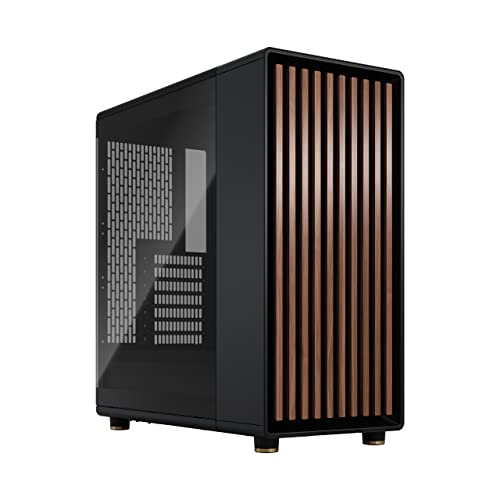
Fractal Design North, Tempered Glass — the showcase panel
Best for: builders whose PC lives visibly in a living space and who want the build itself as decor. Not suited for: anyone who opens the case weekly or moves it between rooms.
- Panel: tempered glass side, dark tint on the Charcoal version
- Front: genuine walnut slats over mesh — the case’s signature
- Cooling: two 140mm fans included; radiator support front and top
- Character: furniture-grade design that happens to be a computer case
Strengths
- The glass and walnut combination looks expensive because the design is genuinely resolved.
- Same excellent chassis as the mesh version — no thermal or layout penalty beyond the panel itself.
- The dark tint flatters tidy builds and softens LED excess.
Trade-offs
- The glass panel is the heaviest single part you will handle at every upgrade.
- Side intake is impossible; the GPU breathes through the front and bottom paths only.
- Dust inside is on display, so the cleaning schedule is set by your eyes, not the thermals.

Fractal Design North, Mesh — the breathing panel
Best for: the same room and the same taste, with thermals and discretion ranked above display. Not suited for: builders who chose their components partly to look at them.
- Panel: steel mesh side panel, fine perforation over the full face
- Front: genuine walnut slats, matching the glass version
- Cooling: two 140mm fans included; side panel adds a passive intake path
- Character: the quiet sibling — same furniture design, less theatre
Strengths
- The mesh feeds the graphics card directly, which shows up as lower GPU temperatures under sustained load.
- No shattering risk, less weight, and no fingerprint theatre.
- Internals glow through the mesh as a soft presence rather than a shop window.
Trade-offs
- More fan and coil noise escapes than through glass or solid steel.
- The mesh gathers dust on its outer face and wants a vacuum brush now and then.
- Your cable management sins are hidden but your component choices are too.
The two North variants are this article in miniature: identical case, identical price class, one panel decision. Check price on Amazon

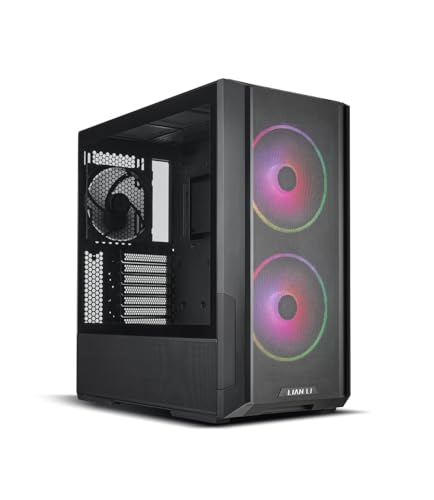
NZXT H7 Flow — glass in an airflow-first design
Best for: builders who want the display panel and refuse to compromise the front-to-back airflow path to get it. Not suited for: side-intake strategies; this design breathes through its perforated front, top and bottom instead.
- Panel: tempered glass side on a perforated steel airflow chassis
- Cooling: bottom-mounted fan positions aimed directly at the GPU
- Layout: clean cable channels that make the glass view worth having
- Character: the industry’s current compromise, executed well
Strengths
- Proves glass need not mean hot: the perforated panels elsewhere do the breathing.
- Bottom intake aimed at the graphics card is exactly where modern GPUs want air.
- The interior layout is designed to be looked at, cables included.
Trade-offs
- The glass is still glass: heavy, fragile at the edges, and fingerprint-prone.
- Bottom fans draw from under the case, so carpet is this design’s enemy.
- No side intake option exists if a future build wants one.

Corsair 4000D RS Frame — modular panels, modular answer
Best for: builders who like changing their minds — the Frame design treats panels as swappable parts. Not suited for: buyers who want the absolute quietest solid-panel build.
- Panel: tempered glass in the RS configuration, on a modular frame system
- Cooling: three RS fans included, room for multiple 360mm radiators
- Layout: InfiniRail fan mounting and reverse-connector motherboard support
- Character: the panel as a component, not a commitment
Strengths
- Modularity is the honest answer to this whole debate: change the panel, keep the case.
- Generous radiator and fan support keeps glass builds cool by brute airflow.
- Reverse-connector motherboard support makes the glass view exceptionally clean.
Trade-offs
- Swappable-panel ecosystems mean the extra panels are extra purchases.
- Three included fans is a start, not a finished cooling setup for a flagship GPU.
- The modular frame adds complexity a simple steel box never asks of you.
Thermals: what the panel really does to temperatures
Air does not care about your panel’s material; it cares about paths. A graphics card in a modern build is fed by front intake fans, by bottom intake where the case provides it, and by the card’s own fans pulling from the space beneath it. A solid side panel — glass or steel, thermally identical — seals one face of the case, which in a front-to-back airflow design is not a loss at all: the air was never meant to enter there. This is why well-designed glass cases test within a degree or two of their steel equivalents, and why the “glass ovens” of a few years ago were actually front-panel ovens: cases that sealed the front behind glass or solid plastic and starved every fan in the system, then blamed the side window.
Perforation changes the physics rather than the aesthetics. A mesh side panel lets the GPU’s fans draw cool room air across a distance of centimetres instead of air that has already travelled the case’s length and warmed over the motherboard. In small cases, where the card sits close to the panel, that direct path can be worth several degrees and a clearly quieter fan curve. In large cases with strong front intake, the same panel adds little. The honest summary: panel choice moves GPU temperatures by roughly nothing in a good big case, a few degrees in a typical one, and a lot in a small or front-starved one — and the front panel’s design usually matters more than the side’s.
Acoustics: the panel as a lid
Sound escapes a case through its openings, so the acoustic ranking is the airflow ranking reversed. A solid steel panel, especially one bonded with damping material, is the best lid; glass is a respectable second, its mass blocking midrange fan noise while passing a little more low hum; perforated panels leak the most, including the high-frequency whine of small fans and, in unlucky builds, coil whine that a solid panel would have muffled into inaudibility. Under a desk, these differences compress — distance and the desk itself do much of the work. On a desk beside your ear, they are the difference between a computer you hear and one you do not. Silence seekers should also know that the panel is rarely the loudest path: an open top vent above the CPU cooler usually leaks more than any side panel, which is why truly quiet builds choose solid tops before they argue about sides.
Safety, transport and the tile floor problem
Tempered glass fails rarely and memorably. The pattern in owner reports is consistent: the panel survives years of handling, then meets a ceramic tile floor, a stone worktop edge or a concrete step during a move, and a corner impact does what flat knocks never could. Builders who handle glass panels develop rituals — remove the panel over a bed or carpet, never set it down on hard floors, keep the case’s original box for moves — and those rituals work. Steel’s failure mode is the opposite temperament: it dents, scratches and bends at the edges, all of it cosmetic, none of it catastrophic, and a bent mounting tab can be straightened with pliers in a way a shattered panel cannot be un-shattered. If your PC travels — to LAN events, between home and university, between rooms — steel is not the boring choice; it is the engineering choice. If your PC will sit on a desk for five years, glass’s risk is a single careful afternoon at each end of its life.
Maintenance and the psychology of the visible build
Glass shows dust in weeks and fingerprints in minutes, and owners divide into those who find the cleaning ritual satisfying and those who discover, a year in, that they own a display case for dust. Steel hides everything until the day you open it, which for some owners is also the day they discover a felted radiator. Neither rhythm is healthier for the hardware if the filters are maintained, because filters — not panels — do the actual dust work in a positive-pressure build. The deeper difference is psychological: a glass build is never finished. You will notice the one cable that sags, the GPU whose lighting clashes, the fan you mounted a quarter-turn off. For builders, that restlessness is the hobby. For everyone else, it is a tax on attention that a steel panel simply declines to levy. Choose according to which person you have been with every previous hobby you own.
How to work inside each kind of case
Panel choice changes the maintenance ritual, and a few habits serve each material well. For glass: remove the panel by its frame edges, never by flexing it; lay it on a towel or bed, glass-side up; clean it with a microfibre cloth and nothing abrasive, because tempered glass still scratches; and check the mounting posts are fully seated before the final thumbscrews, since a stressed corner is a future failure. For steel: mind the sharp interior edges on budget cases, straighten rather than force any tab that resists, and if your panel carries a damping layer, keep solvents away from its adhesive. For mesh: vacuum the outside face monthly, wash removable mesh sections when they grey, and treat the mesh as a filter in your cleaning schedule, because functionally it is one. In all three cases, the ten minutes before you close the panel — cables clear of fan blades, connectors seated, nothing resting against the GPU — is the highest-value ten minutes in the build’s life.
Buying guidance
Start from the room, not the component list. A PC on a desk in a living room or studio, built with any care, earns its glass panel daily in the simple pleasure of the object — take the North in glass, or the H7 Flow, and keep a microfibre cloth in the drawer. A PC under a desk, in a workshop, in a child’s reach or in a touring life should wear steel, and the North’s mesh variant shows that steel-adjacent choices need not look like office equipment. A small case with a hot GPU should perforate something — side, front or both — before it decorates anything. And a builder who genuinely cannot decide should buy modularity, as the Corsair Frame design offers, and let the build’s first year cast the deciding vote. The broader field is in our roundup of the best PC cases, cooling specifics in the best PC case fans, and the components you might display are in the best graphics cards and GDDR6 vs GDDR6X explained. Keyboard-side desk aesthetics continue in our Glorious GMMK lineup guide.
Common mistakes
- Blaming glass for a sealed front panel. The famous “glass oven” cases starved their intakes at the front; the side window was innocent.
- Removing a glass panel over tile or stone. Nearly every shattering story in the hobby begins on exactly that floor.
- Buying glass for a build you will not cable-manage. The panel displays whatever is behind it, including the octopus.
- Ignoring the top panel. Noise and dust care about the top vent at least as much as the side.
- Choosing mesh in a dusty home without a cleaning plan. A clogged mesh panel is a solid panel with worse acoustics.
- Assuming steel means ugly. The best current steel and mesh designs are furniture-grade objects in their own right.
Final verdict
Glass vs steel side panel is not a contest with a winner; it is a question about what your computer is in your home. Glass makes it an exhibit — beautiful, demanding, occasionally fragile. Steel makes it an appliance — quiet, tough, forgettable in the honourable sense. Perforated designs split the difference and win the thermal argument outright. Decide by room, by GPU heat and by your honest cleaning temperament, and the panel will feel chosen rather than inherited. That feeling, renewed every time you sit down, is worth more than the few degrees that separate the options.
Frequently asked questions
Does a glass side panel make a PC hotter?
Not by itself. In a case with proper front, bottom or top airflow, glass and solid steel test within a degree or so of each other. Heat problems blamed on glass usually trace to sealed front panels starving the intake fans. A perforated side panel can help a GPU further, especially in small cases.
Can tempered glass panels really shatter on their own?
Spontaneous failure is extremely rare; nearly all breakages involve an edge or corner striking a hard surface, most famously ceramic tile, sometimes with the damage appearing as the panel is set down or lifted. Handle glass by its frame, over soft surfaces, and the risk becomes very small.
Which panel is quietest?
Solid steel, particularly with a bonded damping layer, followed closely by glass. Perforated and mesh panels leak the most noise. Remember the top vent and front openings often leak more than the side panel does, so panel choice is one part of a quiet build, not the whole of it.
Is mesh better than both?
Thermally, often yes — a mesh side panel gives the graphics card a direct supply of cool air. The costs are noise leakage and dust management. For a hot GPU in a compact case, mesh is usually the right answer; for a quiet living-room build, it usually is not.
Can I swap panels later?
Sometimes. Some manufacturers sell alternative panels for the same chassis — the Fractal North’s glass and mesh variants are the cleanest example — and modular designs like Corsair’s Frame treat panels as interchangeable parts. Most cases, though, are sold one way, so check before assuming a swap exists.
What about acrylic windows?
Acrylic is light and cheap but scratches easily and clouds with age and cleaning. It survives mainly on very inexpensive cases. If you want a window on a budget, tempered glass on a simpler chassis ages far better for similar money.
How the window won: a short history of case design
For its first three decades, the PC case was a beige steel box whose design goal was invisibility. The window arrived from the modding scene of the early 2000s, when enthusiasts cut holes in steel panels and riveted in acrylic to show off cold-cathode lights and water-cooling loops — the panel was literally a hole in the steel consensus. Manufacturers industrialised the idea, acrylic gave way to tempered glass around the mid-2010s as RGB lighting became standard equipment, and for several years glass was simply what a gaming case was, culminating in designs wrapped in glass on three sides that cooled like aquariums because, thermally, they were. The correction came from testing culture: as reviewers standardised thermal benchmarks, airflow cases with mesh fronts and perforated panels reclaimed the high ground, and the industry’s current settlement — glass where it decorates, perforation where it breathes, steel where it works — is exactly the compromise the four cases above embody. The debate in this article’s title is therefore not a stalemate; it is the sound of a market that has tried everything and kept the parts that worked.
Tints, mirrors and the middle styles of glass
Not all glass panels are windows. Dark tints, like the Charcoal North’s, dim the interior into a moody suggestion of components, hiding cable imperfections while keeping the sense of depth — the forgiving option within the glass family, and the one to choose if your cable management is honest rather than artistic. Clear glass is the full commitment: every sleeve, every matched fan, every millimetre of GPU sag on record. Mirrored and smoked finishes sit between, opaque at rest and translucent when the interior lights come on, which makes them the choice of builders who want the PC to disappear into a room’s decor until it is switched on. When comparing listings, confirm which finish a variant carries, because manufacturers sell the same chassis under near-identical names with different tints, and the difference between a display build and a shadow box is entirely in that line of the specification.
Small cases: where the panel choice stops being cosmetic
Everything in this guide sharpens in a small-form-factor build. In a case of fifteen litres, the graphics card sits millimetres from the side panel, and that panel is effectively part of the cooling system. A perforated panel there is not a preference but a supply line — the GPU breathes through it directly, and a solid glass panel in the same position can cost the card its boost clocks under sustained load. This is why so many small cases ship with swappable panel sets or default to mesh, and why their owners discuss panels the way full-tower owners discuss radiators. If your build is small, invert this article’s order of operations: thermals first, panel second, and treat glass as an upgrade you grant the build only after its temperatures have proven they can afford the view.
The workstation and server verdict on glass
Professional hardware voted long ago. Workstations and servers use steel — vented where airflow demands, solid where it does not — because their priorities are density, serviceability, electromagnetic shielding and surviving freight. A steel panel is also an EMI shield in a way glass is not, which matters in certification regimes that gaming rooms never meet. None of this shames a glass gaming build; it simply marks the boundary of the glass idea. Glass is for machines whose appearance is part of their job. The moment a computer’s job description is purely computational, the industry reaches for steel every time, and a builder choosing steel for a home server or a render node is in the largest and most experienced company imaginable.
Vertical GPUs, sag and what the window reveals
The glass era changed how components are mounted, not just how they are seen. Vertical GPU brackets exist because a graphics card’s fan side is its face, and glass made faces worth showing; the same window exposed GPU sag — the slow droop of a heavy card in its slot — and created the market for support brackets that are now half engineering, half jewellery. A steel-panel builder can ignore all of this, and many do, which is a freedom worth naming: behind steel, a card can sag a millimetre, a cable can cross another, an LED can be the wrong colour, and the machine is precisely as good as it was. Glass converts the interior into a second product that must also be designed. Some builders love that second product. The mistake is buying it accidentally, then resenting the upkeep of an exhibit you never meant to curate.
Dust: the panel is not the filter
A persistent misconception holds that solid panels keep a PC cleaner inside. Dust enters with intake air, and what decides the interior’s fate is filtration and pressure: filtered intakes and slightly more air entering than leaving (positive pressure) mean dust arrives at the filters and mostly stays there, whatever the side panel is made of. An unfiltered mesh side panel is the one genuine exception — it admits unfiltered air directly — which is why mesh owners should treat the panel itself as a filter in their cleaning routine. Glass owners see dust sooner because they see everything sooner; the dust load is the same. If cleanliness is a deciding factor for you, spend your attention on the case’s filter quality and your room’s floors, and let the panel decision return to its proper grounds of looks, noise and toughness.
Cost and value across the panel divide
Glass used to carry a clear premium; today the same chassis in glass and mesh variants often sits within a few pounds or dollars of each other, because the glass panel’s cost is offset by the mesh panel’s perforation work. The real cost differences are downstream. Glass can demand prettier components, sleeved cables and lighting to justify itself — a soft tax that has emptied real wallets. Steel can demand nothing at all, which is its own kind of value. Resale runs the other way: a tidy glass build photographs beautifully and sells as an object, while a steel build sells as a specification list. Neither effect should govern a first build, but both belong in an honest accounting, because the panel is the one component whose costs and returns are mostly about the owner’s behaviour rather than the hardware’s.
Room by room: placing the machine
The studio desk. Glass, lit tastefully, on the desk at eye level — the machine as a designed object among designed objects. This is the scenario the entire glass industry exists to serve, and it serves it well. The bedroom. Temper the enthusiasm: a glass build’s lighting at night is a nightlight you did not choose, and fan noise at pillow distance argues for solid panels and slow fans. Many bedroom builds end up happiest in steel with the lighting off — a combination that requires the discipline to admit the window was for an audience of none. The living room. The North’s entire design brief: furniture first. Glass or mesh both work; the deciding factor is whether the room’s other occupants experience the PC as decor or as clutter with a fan. The workshop, garage or student room. Steel, without a second thought — dust, knocks, moves and borrowed desks are its native habitat. The streaming corner. Glass, but for the camera rather than for you: a lit build in frame is set dressing that works every hour you broadcast, and streamers are the one group for whom the display logic is a business case rather than a taste.
What to check on any case listing before you buy
- Panel material and thickness for glass, and whether the listing’s photos show the variant you are actually ordering — glass, mesh and solid versions share product pages.
- Which panels are perforated, and where the intake air is honestly meant to enter; a case whose only intake is a slit behind a glass front is telling you its priorities.
- Filter provision on every intake, and whether the filters remove without tools for cleaning.
- Whether alternative panels are sold for the chassis, if you suspect your preference may change.
- Panel mounting style: captive thumbscrews and hinged designs survive years of upgrades better than loose screws and fragile clips.
- Weight with the panel fitted, if the machine will ever travel — glass cases are heavier than their dimensions suggest.
None of these checks requires expertise, and together they prevent every common regret in this category: the wrong variant, the starved intake, the panel that cannot be replaced, and the case that is beautiful exactly once — on the day it is built — and a burden every day it is opened thereafter.
The honest middle: why so many builders end up owning both
Talk to builders a decade into the hobby and a pattern emerges: the first build wears glass, because the first build is a celebration; a later build wears steel or mesh, because by then the celebration is the using rather than the looking. Neither stage is a mistake, and the sequence is not a fall from enthusiasm — it is enthusiasm maturing into priorities. Some builders reverse the order, discovering display builds after years of appliances, and enjoy them the more for knowing exactly what they are choosing. The panel market’s healthiest feature is that both doors remain open at every price tier, and cases like the North — one chassis, two panels, no wrong answer — acknowledge that the same person may want different things from different machines. Your gaming PC can glow behind glass while your home server stands in steel ten feet away, and the consistency police will not be notified.
A closing word on evidence
The thermal claims in this guide are stated as ranges because that is what the evidence supports: panel effects are real, bounded and case-dependent, and any source quoting a single universal degree figure for “glass versus steel” is selling certainty the physics does not contain. The acoustic and durability claims rest on the materials themselves and are firmer. Where a number would decide your purchase — a small case, a flagship GPU, a hot room — the only honest procedure is to check thermal testing of the specific case you are buying, in the panel configuration you are buying it in. Reviewers test exact configurations for a living; this guide’s job is to make sure you know which configuration to look for, and what you are trading when you choose it.
Replacing, repairing and living with damage
Panels get damaged, and the aftermath differs by material in ways worth knowing before you need them. A shattered glass panel is a warranty-and-support conversation: most major case makers sell or supply replacement panels for current models, and the wait is measured in weeks rather than months, but the build runs open-sided or retired in the meantime, and the granules demand a patient vacuum of every crevice and fan. A dented steel panel is an afternoon’s non-event — straighten it, touch it up, or order a replacement at a fraction of a glass panel’s cost, and many owners simply live with the dent as patina. Mesh sections tear rarely and patch invisibly from inside. The lesson is not that glass is a mistake; it is that glass ownership includes a small, real contingency that steel ownership does not, and the contingency is priced into the decision for anyone who has priced a replacement panel once.
Children, pets and other honest constraints
Buying guides prefer to discuss builders as solitary aesthetes, but cases live in households. A glass case at toddler height is a fingerprint farm and, however small the shattering risk, a worry a parent does not need; the same case on a high desk is a different object entirely. Cats, meanwhile, vote for warm, flat surfaces, and a mesh-topped or steel-topped case becomes a cat bed with opinions about your airflow — a solid top and a glass side is, accidentally, the most cat-compatible configuration in this entire guide. Dogs with tails have strong views on floor-standing glass. None of these factors appears on a specification sheet, and all of them have decided more real purchases than any thermal benchmark. The panel that suits your household’s actual population — human and otherwise — is the right panel, and any guide that tells you otherwise is optimising for a photograph.
Lighting: the commitment hiding inside the glass choice
Choosing glass quietly chooses a lighting strategy, because an unlit build behind clear glass looks like a parts warehouse while the same build behind steel looks like nothing at all. The spectrum of sensible approaches runs from a single restrained light source — a GPU logo, a strip along the case floor — through the matched-ecosystem builds where motherboard, fans, memory and card all speak one lighting protocol, to the full synchronised displays that are closer to aquariums than appliances. Each step up that ladder costs money, software patience and, occasionally, performance when lighting suites misbehave. Tinted glass forgives a minimal approach; clear glass exposes it. Steel, pointedly, asks nothing. When you price a glass build, price the lighting you will actually be satisfied with, because the difference between the panel’s cost and the exhibit’s cost is where budgets quietly double — and a half-lit build behind clear glass is the one configuration in this guide that satisfies nobody.
Second-hand cases and panel archaeology
The used market prices this debate for you. Glass cases sell quickly and dear when the panel is perfect, and stall when it is scratched or chipped, because the panel is the product. Steel cases sell on their chassis merits at any cosmetic grade, and a scuffed steel case is one of the best bargains in PC building — the structure, mounts and airflow of a premium case at a fraction of its price, with damage that is invisible in use. When buying used glass, inspect the panel’s corners and edges in person if you can; hairline damage there is the seed of the failures described earlier, and it photographs badly, which is to say it hides. When selling, photograph a glass build powered on in a dim room and a steel build with its specification list typed out; each panel has its own marketplace language, and fluency in it is worth real money on both sides of the transaction.
The decision, compressed
If your build is a piece of your room and your GPU is mid-range or your case is large, take glass and enjoy it without apology. If your GPU is a flagship, your case is small, or your room is hot, perforate — mesh side, mesh front, or both — and let the temperatures thank you. If the machine must travel, survive children, or simply never be thought about again, take steel and spend the saved attention on the components inside. And if you are building for someone else, ask them the only question that matters — do you want to look at it, or use it? — and buy the panel that matches the answer. Every case reviewed in this guide will serve any of those decisions well, because the modern market, after twenty years of argument, has learned to build all three panels properly. The debate survives because the answers are personal, not because the products are flawed.
What about the other side panel?
Every case has two sides, and the one nobody debates — the solid panel behind the motherboard tray — quietly does more daily work than the famous one. It hides the cable bulk that even tidy builders generate, it stiffens the chassis, and on better cases it carries the damping that keeps a build quiet from the desk’s other side. Glass has begun appearing there too, in dual-chamber showcase designs that put the power supply and drives on display as well, and the same logic applies doubled: twice the exhibit, twice the upkeep, twice the fragility, in exchange for a machine that is sculpture from every angle. For most builders the sensible asymmetry is the traditional one — one considered face to the room, one honest wall to the cables — and the energy saved goes into the build the window actually shows. If you find yourself pricing a dual-glass case, price the cable kit and the second lighting zone in the same breath; the manufacturers certainly did.
Panel care, season by season
A year of ownership has a rhythm. In the first month, glass owners clean fingerprints weekly and steel owners forget the panel exists; by the third month, both have settled into the truth that filters matter more than panels and that a quarterly interior dust is the real maintenance event. Summer tests the thermal choices: the mesh builds breathe easier in a hot room, the glass builds lean on their fan curves, and the difference between a well-chosen and a poorly chosen configuration is a few degrees and a little noise, exactly as the thermal section promised. Winter, with its static and its dry air, is when panels come off for upgrades — and when glass deserves its soft surface and its rituals, because more panels are lost to a December upgrade on a hard floor than to any other single cause. Plan upgrades like moves: box or bed for the panel, screws in a dish, and the machine will outlast several generations of the components behind whichever face you chose.
One last scenario: the build you give away
Many PCs end their first life as gifts — to a younger sibling, a parent, a friend’s kid starting school. The panel choice follows the machine into that second life, and it is worth a sentence of foresight. A glass build given away carries its fragility and its cleaning demands to an owner who never chose them, and the classic outcome is a beautiful machine slowly disappearing under dust behind its own window. A steel or mesh build given away asks nothing and forgives everything, which is why experienced builders who know a machine is a future gift tend to build it in steel from the start, however their own desk is dressed. It is a small, kind optimisation, and it closes this guide’s argument neatly: the right panel is the one that suits the life the machine will actually live, in the room it will actually live in, with the person who will actually live with it. Everything else — the degrees, the decibels, the photographs — is commentary on that single fit.
Reading a thermal review without being misled
Because panel effects are configuration-dependent, case reviews reward a particular reading method. First, find the test system’s GPU and its power draw; a panel comparison run with a modest card understates what a flagship card will experience in the same case. Second, note whether temperatures are reported as absolutes or as deltas over room temperature — deltas are the only figures that travel between reviews. Third, check the fan configuration: a case tested with its stock fans may gain or lose several degrees with a full complement, and the panel’s share of the result changes as the other paths open or close. Fourth, separate the GPU result from the CPU result, because side panels speak almost entirely to the GPU while top and front choices govern the CPU. A reader who checks those four things can extract an honest verdict from any competent review — including the verdict that, for their hardware, the panel in front of them makes no thermal difference worth paying for, which is a finding, not a failure of the review.
And the verdict, one final time
It is worth ending where the builders who have owned both usually end. Nobody who chose glass for a showcase desk regrets the beauty; nobody who chose steel for a working machine regrets the peace. Regret lives exclusively in the mismatches — the glass panel bought for a build that was never going to be tidied, the steel slab bought for a desk that deserved a centrepiece, the sealed case bought for a flagship GPU in a warm room. Match the panel to the room, the hardware and the human, and the glass vs steel side panel question resolves into what it always secretly was: not a specification to be won, but a small, honest act of self-knowledge at the start of a build. The cases are ready for either answer. So, now, are you.
One practical footnote for anyone still hesitating at the checkout: if the chassis you love offers both panels and the price difference is small, buy the version whose panel you want today and confirm that the other panel is sold separately. That single check converts a permanent-feeling decision into a reversible one, and reversible decisions do not deserve the anxiety this topic generates. Builders change, rooms change, graphics cards get hotter; a case that can change its face with them will outlast several rounds of this debate, whichever side of it you are on this year.
What reviewers of the future will probably say
The panel story has one more chapter visibly forming. Manufacturers are experimenting with electrochromic glass that tints at a switch’s touch, with fine-pitch mesh that reads as solid from a metre away, and with wooden and fabric faces that treat the case as furniture in earnest — the North’s walnut front is an early, successful draft of that idea. Each experiment is another attempt to dissolve the choice this article describes: a panel that displays when you want display, breathes when you want air, and disappears when you want quiet. Until one of them becomes ordinary, the three honest materials — glass, steel and mesh — remain the decision, and it is a tribute to all three that none has managed to make the others obsolete. Choose the one that fits your machine’s life, and you will have chosen as well as the state of the art allows.
And if the decision still feels larger than it should, remember its true scale: the panel is the most visible and the least consequential component in the entire build. It will not decide your frame rates, your render times or your rank in any ladder. It will decide whether you smile at the machine on an ordinary Tuesday — or never think about it at all, which for many builders is the smile. Either outcome is a success. The only failure available here is buying someone else’s answer, and you have now read enough to make the answer unmistakably your own.
Buy the panel, then, the way you would choose a picture frame or a workbench top: by the life around it. The engineering has been done for you, thoroughly, by an industry that spent twenty years arguing this exact question with prototypes. What remains is the part no reviewer can do — knowing your room, your habits and your machine. Trust that knowledge, make the call, and get on with the build, which was always the point.