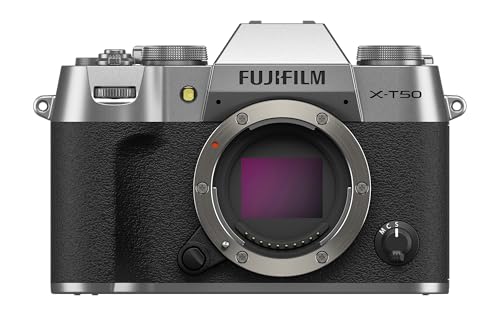
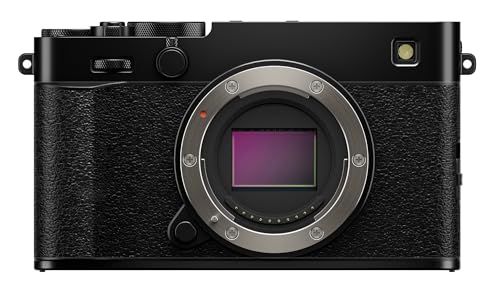
The X-E5 is a slim rangefinder-style camera with the viewfinder at the corner, while the X-T50 is a compact SLR-style camera with a central viewfinder and a dedicated film simulation dial. Both are small Fujifilm APS-C bodies, so choose on handling and design rather than on image quality alone.

Design Philosophy
The X-E5 follows the Fujifilm X-E tradition: a flat top, an offset viewfinder and a pocketable shape that suits street work and travel with a small prime lens. The X-T50 follows the X-T tradition on a smaller scale, with a viewfinder in the center, a hump on top and a dial for film simulations. Because the two cameras come from the same family, they share the familiar Fujifilm color looks.
In this guide
Comparing Them
| Area | X-E5 | X-T50 |
|---|---|---|
| Body style | Rangefinder | Compact SLR |
| Viewfinder position | Left corner | Center |
| Best with | Small prime lenses | Compact zooms and primes |
| Feel | Slim and minimal | Chunkier grip, more dials |
Details such as sensor resolution, stabilization, battery life and video features should be checked on Fujifilm’s product pages, as they are the kind of specifications that decide close comparisons.
How To Decide
- Try each camera’s grip. Slim rangefinder bodies look great but can feel small with larger lenses.
- Check how you hold the camera. Some people like the viewfinder at the corner because the left eye stays open to the scene.
- Think about lenses. Small primes make the X-E5 feel natural; heavier zooms balance better on the X-T50.
- Think about dials. If a film simulation dial helps you switch looks quickly, the X-T50 has that advantage.
- Think about eyeglasses. A central viewfinder is sometimes easier for glasses wearers, though comfort varies.
Typical Users
The X-E5 appeals to street photographers, travelers and anyone who wants a stylish camera that does not draw attention. The X-T50 appeals to hobbyists who want a flexible small camera for family events, travel and general use, with room for a zoom lens.
Lens Pairing Ideas
A small prime in the standard range suits both bodies and keeps the camera light enough to carry daily. For the X-E5, a compact wide or standard prime keeps its slim profile intact. For the X-T50, a compact standard zoom turns it into an easy walk-around kit for family days and trips. Check the sizes of the lenses you want, because a large lens can make a slim body feel unbalanced.
Shooting street and travel scenes with each body
Both cameras suit walking-around photography, but the way each is held changes how people react to you and how you work. A slim rangefinder-style body with a corner viewfinder keeps the camera from covering your face. Because you can keep your other eye on the surroundings, you can anticipate someone stepping into the frame, a cyclist approaching or a change in light. Many street photographers value that open view, and it also makes the camera feel less intrusive to the people you photograph.
A body with a central viewfinder works more like a traditional SLR. Pressing the camera to your face blocks both eyes’ view, though many people find it natural and it gives a stable three-point hold with the grip, the finder and your supporting hand. It can be better when you are using a longer lens or a zoom where stability matters.
Think about how you carry the camera. A slim body hangs close to the chest on a short strap and slips into a coat pocket with a small prime, so you can bring it everywhere. A body with a bit more depth of grip may need a small bag but is easier to hold with one hand. In busy places, a wrist strap or a short neck strap keeps the camera secure.
For travel days, plan a simple routine. Set a default exposure mode, check your batteries and cards in the morning, pick one lens, and review a few shots at lunch to catch settings errors. Use zone focusing or a small focus area for street work, and make sure your camera’s silent or electronic shutter setting is appropriate for the places you visit. Some venues and cultures welcome photography and others do not, so be respectful and ask when in doubt.
Customizing controls for fast handling
Small cameras have fewer physical controls, so the way you assign buttons and menus matters. Spend time setting up each camera so that your most common adjustments are one press or one turn away.
Start with the list of things you change often: exposure compensation, ISO, focus area, film simulation, drive mode and perhaps white balance. Check which of these have dedicated dials on each body, and which can be assigned to function buttons or a quick menu. The X-T50, as noted above, has a dial for film simulations, so switching looks is quick. Look at how the X-E5 lets you reach film simulations and whether a quick menu or custom button can match that speed. Check Fujifilm’s manual for which controls are customizable on each model.
A quick menu is a screen of shortcuts that you can personalize. Fill it with the settings you change most and remove the rest. Assign a function button to something you would otherwise dig through menus to find, such as switching the electronic shutter on or off, or changing focus mode.
Set up custom settings banks, if the camera offers them. One bank could hold a daytime street setup, another a low-light setup with higher ISO limits and a third a black-and-white look for experimentation. Practice switching between them until it is automatic. Also consider the rear screen: if it tilts or touches, decide whether to use touch focus or disable it to avoid accidental changes by your nose or thumb. A short session of setup pays back every time you pick up the camera.
Grips, straps and small accessories
Compact cameras can feel fiddly in the hand, and a few accessories can change that. Think about what would improve your grip and protection before you spend money on anything decorative.
A thumb grip or an add-on hand grip gives your fingers something to hold, which helps with heavier lenses. Check that any grip you consider is made for your exact model and does not block the battery door, memory card slot or ports. A metal base plate can add grip and allows quick battery changes on a tripod, but compare its weight and whether it leaves the connectors accessible. Check how the grip interacts with your tripod plate if you use one.
A good strap is more important than most people expect. A wrist strap keeps the camera ready and secure with a small lens, while a cross-body sling spreads weight when carrying a heavier setup. Avoid thin straps that dig into the neck. Make sure the strap attachment points are secure and check them occasionally.
Add a soft case or a small insert for your everyday bag so the camera is protected from keys and bottles. A spare battery and an extra card in a small pouch cover most problems. A lens hood protects the front of the lens and reduces flare. A small flash can be useful for events and indoor portraits, but check compatibility with the hot shoe and the camera’s flash modes. A screen protector is optional. Keep accessories minimal to maintain the main advantage of a small camera, which is that you take it with you.
Choosing lenses around a small body
Lens choice has a larger effect on the character of a small camera than the body does. Both models use the same mount, so any X-mount lens that fits is available, but not every combination makes sense.
Make a short list of the lenses you need. A common starting set is a compact standard prime with a bright aperture, a wide prime for interiors and street scenes, and a compact standard zoom for family and travel use. Compare the size and weight of each option on Fujifilm’s pages. A slim body with a large lens is front-heavy and awkward, and you may end up holding it by the lens, which reduces stability.
Consider whether you value an aperture ring. Many Fujifilm lenses have one, and it changes how quickly you can adjust. Consider also whether the lens is weather resistant, if the body is, and whether the lens has stabilization, which matters if the body does not provide it. Check the details for each body on Fujifilm’s page.
Use one lens for a few weeks before buying another. Note the focal lengths you use and where you feel limited. A lot of photographers discover that one well-chosen prime covers most of their needs. When you add a second lens, choose one that complements it, such as a wider view or a longer reach, rather than something that overlaps. Used lenses can offer good value, so check condition carefully. Keeping the kit simple helps the camera stay light, which is the reason many people choose these bodies.
Battery, cards and everyday reliability
Small bodies often use small batteries, so power planning is part of choosing one. Battery life ratings differ between models and rely on standard test conditions, so confirm on Fujifilm’s pages and plan for fewer shots in real use, particularly with the screen on, in cold weather or with heavy autofocus and video.
Carry at least one spare battery. Check whether the camera can charge over USB, which allows top-ups from a power bank during the day, and whether it can run from external power. Keep spare batteries in a pocket instead of loose in a bag with keys and coins, and use a case to avoid contact between terminals.
For cards, check the type and speed class the camera needs, particularly for video or fast bursts. Buy from reputable sources to avoid counterfeits, and format cards in the camera before use. Using two smaller cards instead of one large card can limit the loss if a card fails. Back up images soon after shooting, on two devices if possible.
Reliability also involves care. Keep the lens mount covered when changing lenses and avoid dusty or windy places for lens swaps. Clean the screen and viewfinder with a soft cloth, and avoid using liquid on the camera body. Update firmware from Fujifilm’s support page after reading the notes and with a full battery. If you notice dials loosening, buttons sticking or odd error messages, contact the maker’s service early.
A Needs Checklist Before Picking Either Body
Two cameras from the same maker can feel alike on paper and different in the hand. Before you compare details, think about how and where you shoot. The checklist below turns that into a few practical questions. Answer them with your normal habits in mind rather than the way you imagine you might shoot one day.
- Do you prefer a flat, slim body that slips into a jacket pocket, or one with a deeper grip?
- Do you like to compose through a viewfinder in the center or at the corner of the body?
- How important are physical dials to you compared with menus and a touch screen?
- Do you plan to use small prime lenses, or a larger zoom for flexibility?
- How much do you shoot video, and do you need a flip screen or particular ports?
- How many hours do you want to shoot between battery changes?
Keep your list short and honest. A camera that suits your real habits will see more use than one that merely looks impressive.
How to Read the Two Specification Pages
Go to the maker page for each body and compare the same lines side by side. Begin with the sensor, the image processor and the stabilization, since these affect image quality and handheld shooting. Next look at the viewfinder type and resolution, the rear screen and its movement, and the control layout shown in the photos. Check the battery model and the stated number of shots, and the card slot type and number.
Then compare size and weight. A difference of a few dozen grams may not matter on paper but can change how a camera feels after hours of carrying. Finally, read the list of supported file formats, video modes and film simulations, and check whether the features you care about are listed for both.
Comparing Handling by Situation
| Situation | What to look for | Questions to ask |
|---|---|---|
| Street and city walks | Compact size, quiet shutter, quick focus | Can I reach the dials without looking? |
| Travel days | Weight, battery life and weather care | Will it fit with a lens in my small bag? |
| Portraits | Eye detection and grip comfort | Can I hold it steady with a larger lens? |
| Casual video | Screen movement and recording limits | Does it handle long clips comfortably? |
Mistakes People Make With Small Bodies
A small body is not automatically easier to use. Buyers sometimes choose the smallest option and then add a large lens that unbalances the camera. Match the lens to the body, and consider an add-on grip if you find it hard to hold. Another mistake is overlooking the controls. Some people love tiny dials, while others find them fiddly with gloves or large hands, so try to handle a body before you decide.
Another mistake is ignoring battery size. Compact bodies often use smaller batteries, so carry a spare. And a third mistake is forgetting weather. Many small bodies are not sealed against rain or dust unless the maker says so, so use a cover when the weather turns.
Setting Up Custom Controls and Looks
Spend an evening with the manual and customize the camera. Assign the function buttons to the settings you change most, such as focus mode, film simulation or sensitivity. Save a few custom setting banks for typical situations, such as a street day, a low-light evening and a portrait session. Test them at home so that you know exactly how the camera behaves when the light changes.
Take time to set the shutter type and the focus area to match your style. A camera that is configured well disappears from your attention and lets you watch the scene.
When to Check the Maker Guidance
For firmware updates, accessory compatibility and weather sealing statements, rely on the maker documentation. If a button or dial seems loose, or the camera does not turn on reliably, contact the maker support rather than trying a repair yourself.
A Short Glossary of Terms You Will See
- Film simulation: a built-in color and tone look that imitates a type of film.
- In-body stabilization: a sensor that moves to cancel hand shake.
- Electronic shutter: a silent mode that reads the sensor without a mechanical blade.
- Rolling shutter: distortion on fast-moving subjects that can occur with an electronic shutter.
- Custom banks: saved sets of settings that you can recall quickly.
- Hot shoe: the mount on top of the body for a flash or other accessory.
Lens Ideas for a Small Camera
Small bodies pair well with small lenses. A compact prime in a standard or slightly wide focal length keeps the whole kit light and quick to use, while a small zoom adds flexibility for travel. Larger telephoto lenses can overwhelm a slim body, so think about how you will hold the camera when you add them.
When you choose a lens, consider how often you will carry it. A lens you leave at home does nothing for your photos. Pick one that you will happily keep on the camera, and add a second later when you know what you miss.
- One small prime for everyday carry.
- One compact zoom for travel days.
- One faster lens for evenings and indoor scenes.
Everyday Habits That Keep a Compact Camera Reliable
Carry a spare battery and a spare card, and clean the lens regularly with a soft cloth. Keep the camera in a padded pouch when it travels in a bag, so that keys and coins do not scratch it. Check the strap attachments from time to time, since small bodies carry their weight on small lugs.
Update the firmware following the instructions the maker publishes, and keep a note of your favorite settings in case you ever need to reset the camera.
Ready to Buy? Start Here
If this guide helped you decide what to look for, these products are a place to start.


As an Amazon Associate we earn from qualifying purchases. Prices and availability are shown on Amazon.
Street Photography Habits With Small Bodies
Small cameras change how a street photographer is perceived, and perception is half the craft. A compact body draws less attention, invites less performance from strangers, and lets you work closer to the ordinary flow of a place without becoming an event inside it. Both of these bodies offer that discretion, though they invite different grips on the moment: the rangefinder style encourages a calm, watchful stance with the camera often at waist or chest height until the instant arrives, while the SLR style encourages a more deliberate raise, compose, and shoot rhythm through a central viewfinder.
Whichever rhythm suits you, build the habits that make small cameras sing: zone focus when the light allows, a shutter sound setting that does not announce you across a square, and a strap arrangement that keeps the camera ready rather than buried. Practice raising and framing in one motion at home, because street moments rarely wait for a second attempt. The best street photographs from small bodies look effortless, and that effortlessness is rehearsed.
Ethics travel with the technique. Work respectfully, accept refusal gracefully, and remember that a smaller camera does not change your responsibilities toward the people in the frame. Many street photographers find that a smile, a gesture of thanks, or showing the photograph when asked turns a tense moment into a pleasant one, and keeps the streets welcoming for the next photographer who passes.
Travel Days: One Body, One Lens, No Regrets
The classic test of a compact system is the one-lens travel day. Choose the focal length that matches how you see, set the camera up the night before, and let the day unfold without gear decisions competing with the place itself. Both bodies excel here because their size removes the usual excuse for leaving the camera behind, and their film simulations reduce the evening editing session to a quick selection over dinner. The photographs from such days often have a coherence that multi-lens days lack, because a single viewpoint disciplines the whole set.
Plan the practicalities the night before: battery charged, card with space, a small cloth in the pocket, and the weather checked honestly. A compact kit fits in a jacket or a small shoulder bag, which changes where you can go: museums with bag rules, crowded markets, and long stair climbs all become easier. Security habits matter more as the kit gets smaller and more forgettable; keep the strap on your body in crowds and the bag in front of you on transport.
At the end of the day, resist chimping through everything and deleting in haste. Mark a few favorites, back up the card if the trip is long, and let the rest wait for home. Travel photographs often improve in memory’s absence; the frame that seemed ordinary beside the real scene can become the one that carries the feeling of the place once you are far from it.
Portraits and Family Life on Compact Bodies
Compact cameras are sometimes dismissed for portraits, yet their friendliness is a genuine portrait tool. Subjects relax in front of a small camera in a way they rarely do before a large professional rig, and relaxed expressions are worth more than any technical margin. Work close, use natural light from a window or open shade, and let the film simulations handle color while you handle the conversation. Keep directions simple, shoot in short bursts of a few frames during genuine moments, and review together occasionally so the sitter feels included rather than examined.
For family life, speed of readiness beats almost everything. A compact body that lives on a shelf by the door, charged and set to sensible defaults, will capture the moments that a technically superior camera in a cupboard will miss. Set up a custom mode or a saved configuration for household light so the camera is always one switch away from competence. Children and pets do not repeat their best moments for a photographer who is still in the menus.
Prints complete the family workflow. Small cameras encourage shooting, and shooting deserves an ending: a few prints on the wall or in an album each season. The photographs that get printed become the family’s memory, while the rest become an archive. Choose for feeling rather than perfection, because the slightly imperfect frame of a real laugh will outrank a flawless frame of a posed one in every future viewing.
Customization Projects for a Weekend Afternoon
Both bodies reward an afternoon of deliberate setup, and the project is best done with a notebook and a few test subjects. Start with the controls you touch constantly: exposure compensation, focus mode, and the simulation or look you favor. Assign them so your fingers find them without your eyes leaving the scene. Then set the small mercies: how long images review, how the camera behaves when it sleeps, and which warnings you actually want to see. A camera configured for its owner feels like a different, better camera than the same body on factory defaults.
Create saved setups for your recurring situations: street, family, travel, and deliberate tripod work are a common set. Each setup should differ in the few settings that genuinely change between those situations, not in everything, or you will forget which setup holds which surprise. Photograph something familiar under each setup and confirm the results match your intention before trusting them in the field.
Revisit the configuration after a month of real use. Your early guesses about which controls matter will have been corrected by experience, and a short second session aligns the camera with the photographer you actually are rather than the one you imagined. Manufacturers design for everyone; customization is how a camera becomes yours.
The Long View: Growing With a Compact System
A compact system is a fine platform for growth because its lenses and habits scale with your ambitions. Start with the standard lens your photographs ask for, add focal lengths only when a recurring frustration names them, and let projects rather than catalogs direct the spending. A year spent mastering one body and two lenses teaches more than a season of swapping equipment, and the resulting portfolio will show a coherence that reviewers and clients notice even when they cannot articulate it.
Skills compound in the same way. The photographer who learns to see in one focal length, to work a scene patiently, and to finish files with a consistent look has built the foundation every later camera will stand on. When an upgrade eventually makes sense, it will be because your work demands something specific, and you will be able to name it in a sentence. That clarity is the true product of the compact years.
Keep enjoying the smallness. The deepest advantage of these bodies is not any specification but the frequency with which they are present: at breakfast, on the walk, during the unplanned detour where the day’s best photograph was waiting. Presence is a feature no flagship can add later, and it is the reason so many experienced photographers, who could carry anything, choose to carry something like these.
Learning to See in One Focal Length
Whichever body you choose, pairing it with one prime lens for a season is the fastest education in composition available. A fixed focal length teaches you where to stand, and standing is the decision from which all others follow. Within weeks you begin to see frames before raising the camera, noticing how a step forward cleans a background or a step back restores a relationship between subject and place. Both of these bodies are at their best in exactly this discipline, because their size encourages the walking that the lesson requires.
Keep a simple record of the season: the photographs you kept, and a line about the ones that failed because the focal length was wrong. That second list is the honest guide to your next lens, if there needs to be one. Many photographers discover the failure list is shorter than expected, and that the money they planned for a second lens serves them better as travel to somewhere worth photographing.
The exercise also settles the body debate in an unexpected way. After a season of one-lens shooting, you will know whether your frustrations were about controls and handling, which a body change can fix, or about light and access, which no purchase can. Buy the next thing only for a named frustration, and your kit will stay small, loved, and used.
Weather, Seasons and the Camera That Comes Along
Compact cameras earn their keep across the calendar because they fit the margins of life: the coat pocket in winter, the small bag in summer, the quick walk between obligations. Adapt your habits to the seasons rather than expecting the camera to ignore them. In winter, keep a battery warm, beware condensation when coming indoors, and favor controls you can work with gloves or cold fingers. In summer, protect the camera from heat in parked cars and from the sand and spray that small cameras, carried everywhere, inevitably meet.
Rain deserves a calm protocol rather than avoidance. A compact body under a jacket, a cloth in the pocket, and a willingness to shoot from doorways and under awnings will produce atmospheric photographs on days when larger kits stay home. Dry the camera patiently afterward and let it rest in ventilated air. The photographs of wet streets and soft light are often the season’s best, and they belong to the photographers who simply went out.
Across all seasons, the ritual that matters most is the nightly one: battery charging, card copied, camera back in its place by the door. A compact system lives or dies by readiness, and readiness is a habit, not a feature.
Printing Small, Printing Often
Compact cameras produce an abundance of everyday photographs, and printing is how abundance becomes meaning. Print small and often rather than rarely and grandly: a handful of modest prints each month, pinned, framed cheaply, or gathered into a simple album, keeps the work alive in the household and teaches your eye what actually holds up on paper. Many photographers are surprised by which frames survive printing; the quiet, well-seen everyday image often outlasts the technically impressive one.
Let the prints feed back into the shooting. A wall of recent work shows you your habits, your repeated subjects, and your slow improvements more honestly than any screen folder. When you notice a theme emerging, a person, a place, a quality of light you keep chasing, follow it deliberately. Themes are how casual photography becomes a body of work, and compact cameras, present for ordinary life, are theme-finding machines.
Give prints away. A photograph of a friend, a neighbor, a grandparent, printed and handed over, does more for your development than a hundred likes, because it completes the act of photography in another person’s hands. Both of these little cameras exist, ultimately, to make that exchange easy and frequent.
A Note on Slowing Down in a Fast Feed World
These cameras arrive in a culture that photographs quickly and looks briefly, and part of their appeal is permission to do the opposite. A body that encourages a considered frame, a simulation chosen with intent, and a file that needs little rescue invites a slower loop: fewer photographs, looked at longer, printed more often. Photographers who adopt that loop rarely return to volume, because the satisfaction per photograph rises even as the count falls, and satisfaction is the metric that sustains a lifetime practice.
Slowness is not nostalgia; it is a working method with measurable results. The photographer who works a scene, who waits for the gesture or the light to complete the composition, brings home a higher proportion of keepers and a clearer memory of why each frame was made. Reviewing such work teaches quickly, because every photograph carries its intention visibly. Reviewing a thousand hurried frames teaches mostly that you were busy.
Let the camera’s pace set the day’s pace on personal work, even if professional work demands speed at other times. The two modes can coexist in one photographer, and the slow mode will quietly improve the fast one, because the eye trained by patience sees the decisive arrangement sooner when it has only a second to act.
Secondhand Examples and What to Check
Both of these bodies will circulate in the used market, and a careful buyer can do very well. Beyond the standard inspection, pay attention to the small-body specifics: the condition of the grip material where fingers work hardest, the action of the smaller dials, the screen mechanism if it moves, and the state of the electronic viewfinder or rear display you will live with daily. Small cameras live hard lives in pockets and bags, so cosmetic wear is common and honest, but controls must feel precise, because you will operate them thousands of times.
Test the camera with your own card and, ideally, your own lens, and make the photographs you actually make: a portrait at conversational distance, a street-style frame in mixed light, a careful still life. Review at magnification and listen to the camera work. A body that passes your real tests has told you more than any shutter statistic can.
Buy from sellers who describe flaws plainly, and keep a little of the budget for a fresh battery and a service check. A used compact that has been inspected, serviced, and given a new power cell can feel like a new camera at a fraction of the commitment, and it will ask only to be carried, which is what it was for.
The Compact as a Second Camera for System Owners
Photographers who already own a larger system often discover that a compact body changes their total output more than any lens could, because it covers the hours the big kit stays home. The second camera’s rules are different: it should be ready instantly, configured simply, and forgiven its limitations in advance, since its job is presence rather than perfection. Set it up once, resist optimizing it endlessly, and judge it by the photographs that would otherwise not exist.
The pairing works best when the two cameras have clear territories. The system body takes the planned, the paid, and the demanding; the compact takes the daily, the spontaneous, and the risky. Territories prevent the comparison shopping that poisons ownership, because each camera is judged only against its own assignment.
Many photographers find, after a year of this pairing, that the compact’s archive is the one they show friends, while the system’s archive is the one they show clients. Both are successes, and together they describe a complete photographic life.
The Two Cameras at a Family Celebration
A family celebration is a small, complete photographic assignment: mixed light, moving children, elderly relatives who tire of posing, and moments that will not repeat. Bring either of these bodies to it properly prepared and it will serve beautifully, but they serve in different styles. One invites you to circulate almost invisibly, collecting candid frames whose finished color can be shared from the camera before the guests have gone home. The other invites a slightly more deliberate stance, working through its viewfinder with the confidence of a photographer who intends to edit a considered set afterward.
Preparation decides more than the body. Arrive with the battery full, the card empty, and two configurations ready: one for the bright room and speeches, one for the dimmer corners and the evening. Know where the good light lives in the venue, near windows, away from the mixed ceiling spots, and steer the important groupings toward it with a host’s tact. A photographer who scouts light at a party is not being precious; they are being kind to everyone’s future album.
Shoot the generations deliberately. The photograph of the oldest and youngest together, made while both are fresh, is the one the family will print, and it should be attempted early rather than left to the end of a long day. Compact cameras excel at such moments because they do not intimidate either end of the age range.
Deliver quickly and generously. A small set of the best frames within a day or two, while the celebration is still warm, is worth more than a perfect set delivered in a month. Both bodies support that generosity, one through its finished files, the other through an efficient editing routine you have practiced in advance.
Keep the negatives, so to speak: the full card, backed up, with the rejects intact. Family history has a way of promoting a background face in an ordinary frame into the most precious person in the picture, years later. The archive’s mercy is a professional virtue at home.
And be in some photographs yourself. Hand the camera over, set it kindly for the volunteer, and accept the frames with gratitude. The family photographer who never appears has edited themselves out of the story, and no camera choice can fix that afterward.
FAQ
Do the two cameras make similar images?
They are from the same brand and APS-C format, so the look is similar. Differences in sensor generation or processing, if any, are listed on Fujifilm’s pages.
Which is better for video?
Check the video specifications of each model on the maker’s page. Features and limits differ between models, and these are not points to guess at.
Can I attach a flash to either camera?
Check Fujifilm's specification for the hot shoe or built-in flash on each model. Confirm that the flash you want is compatible and supports the modes you need.
Is a slim body harder to hold steady?
It can be with larger lenses. A thumb grip, a hand grip or a strap helps, and pairing it with small prime lenses keeps the balance comfortable.
Should I use the electronic shutter for street photography?
It is quiet, but it can show distortion with fast-moving subjects and banding under some lights. Test it in your conditions and check the manual for limits.
How can I switch film simulations quickly?
Check which controls are available on your model. A dedicated dial, a quick menu or a custom function button can all give fast access. Set them up before you need them.
What lens is best for a first purchase?
A compact standard prime with a bright aperture is a common first choice because it is light, versatile and good in dim rooms. A compact zoom suits those who want flexibility.
Do I need a case for a small camera?
A soft case or insert protects against scratches and knocks in a bag. It is a low-cost way to avoid damage.
How do I protect the camera from rain?
Check Fujifilm's sealing information for the body and lens. If either is not sealed, use a rain cover or keep the camera under shelter and dry it afterward.
Which body is better for learning manual exposure?
Both teach it well, but the experience differs: external dials make changes visible and tactile, which many learners find clarifying, while a more conventional layout concentrates control through the viewfinder. Try both styles if you can, because the one whose logic you remember without thinking is the better teacher for you.
Can a compact body handle a paid portrait session?
Yes, in the hands of a photographer who knows its limits. Manage light carefully, choose lenses for the look you need, and be honest with clients about the style of work the session will produce. Many clients care about the photographs and the experience far more than the size of the camera.
How do I keep a small camera steady for slower shutter speeds?
Brace your elbows against your body, control your breathing, and use walls, posts, and tables as improvised support. In-body stabilization helps, but posture and timing help more, and practicing at home with test subjects builds the skill quickly.
Is one lens really enough for travel?
For many photographers, yes, and the constraint often improves the photographs. Choose the focal length you naturally see with, frame with your feet, and let the coherence of a single viewpoint become the style of the trip’s story.
How do I decide between a prime and a zoom as my only lens?
Choose the prime if you value size, low-light ability, and the discipline of moving to compose; choose the zoom if your subjects vary quickly and you cannot move freely, such as events with children. Your last month of photographs, reviewed honestly, will usually announce the answer.
What is a good everyday camera setting routine for a compact body?
Charge and check the battery in the evening, keep a card with space in the camera, and leave the body on your most-used configuration so it is ready instantly. Readiness is the compact camera’s whole advantage, and the routine protects it.
The Short Version
Choose the X-E5 for a slim, discreet camera that pairs with small primes. Choose the X-T50 for a more traditional grip, a central viewfinder and quick access to film simulations. Confirm the details with Fujifilm before buying.
