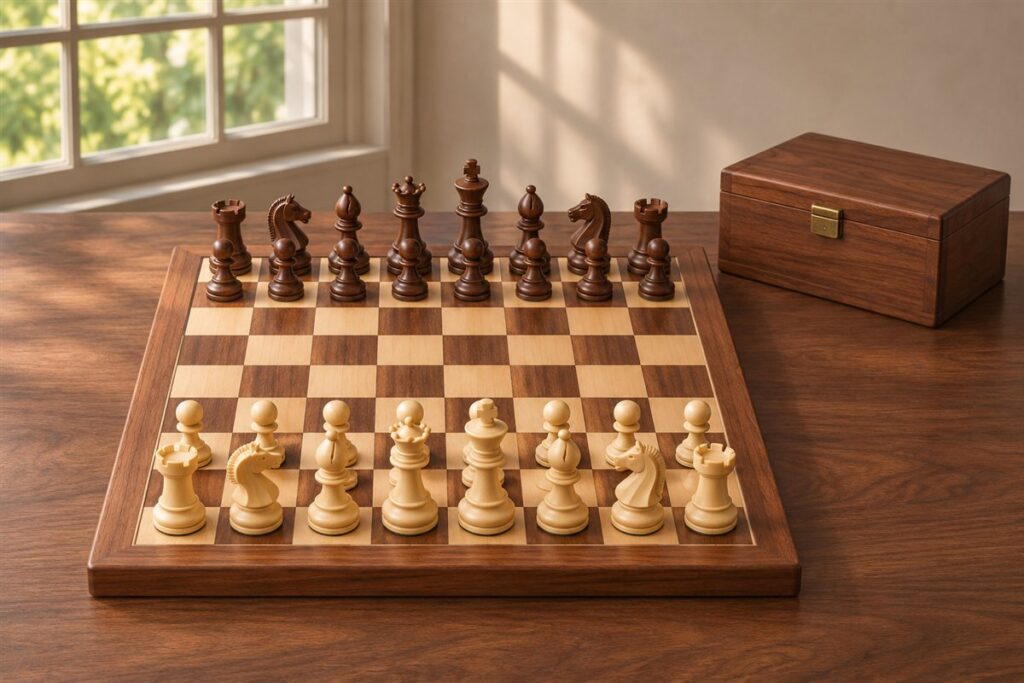
In Fog of War chess, you can see only the squares your own pieces occupy or could move to, so the rest of the board is hidden. You plan with incomplete information, much like in a strategy video game. The common aim is to capture the enemy king, since it may be impossible to know whether a king is in check.
Common Rules
Details differ by site, so read the rules of the one you use. Typical rules are:
- You see your own pieces and every square one of them could legally move to.
- Enemy pieces on visible squares show up, and the rest stay hidden.
- There is usually no check or checkmate, and the king can be captured to win.
- Moves are made as in standard chess, but you may not see why a move is illegal.
- Pieces that stand behind other pieces may stay hidden until the way is open.
How It Differs From Normal Chess
- Information: you have to guess what your opponent has done and where their pieces are.
- Surprise: a hidden piece can capture something you thought was safe.
- King safety: because there is no check warning, you must predict threats yourself.
- Scouting: moving a pawn or piece forward can reveal new squares, so even small moves have value.
Tips for Your First Games
- Develop pieces the usual way, because active pieces reveal more of the board.
- Keep track of the last squares where you saw enemy pieces, and guess where they might be now.
- Do not leave your king exposed on a file or diagonal that an unseen piece could reach.
- Use a pawn move or a knight move to scout, and watch what appears.
- Avoid trading pieces without looking, since you may lose your view of the board.
- Think about what your opponent can see of you, because the same rules apply to them.
Skills It Builds
Fog of War trains visualization and memory because you track pieces you cannot see. It also builds careful thinking about risk, since each move may reveal or hide information. These skills carry over to standard chess when you read a position and imagine what an opponent could do.
Opening Ideas in the Fog
The opening in Fog of War differs from standard chess because you cannot see what your opponent is doing. Developing quickly still matters, but the goal changes slightly. You want pieces placed so that they see a lot of squares, because each piece you move out lights up part of the board. Central pawns open lines for bishops and the queen, which in turn reveal more territory. A cramped position is dangerous here, since it leaves you blind.
At the same time, you should avoid exposing your king too early. Without check warnings in many versions, a piece that lands near your king can capture it before you notice. Castling can help by tucking the king away, if the version you play allows it. Keep pawns in front of the king, and think about which squares an unseen enemy could reach.
- Open with central pawns to create vision for your pieces.
- Bring knights out early, since they see squares around them and can scout quickly.
- Do not move too many pawns on one side, which can leave holes you cannot monitor.
- Keep track of what you last saw, and update your mental picture after each move.
Treat the first few moves as a search for information. A piece that moves forward and reveals an enemy pawn tells you something about their plan, even if no capture occurs.
Tracking Hidden Pieces Mentally
The central skill is keeping a mental map. When an enemy piece disappears from view, it has not vanished. It has moved to a square you cannot see. Ask yourself where it could have gone, given how it moves and what squares it could reach. A bishop that slid off a diagonal is probably on a nearby diagonal. A knight is probably within a knight’s jump of its last seen square.
Make a habit of listing threats. Which of your pieces are exposed to an unseen attacker along a file, rank or diagonal? Which squares are blind spots? Think about the worst case, and protect the pieces that matter most. This takes effort, but with practice it becomes a quick scan.
- Note the last square where you saw each enemy piece.
- Estimate how many moves have passed since then.
- List the squares the piece could now reach.
- Check whether any of those squares attack your king or key pieces.
- Decide whether to scout, defend or counterattack.
If your platform lets you review the move list, use it. Some versions show only visible moves, so you may need to keep notes. Writing down your estimates, even briefly, helps you avoid forgetting a piece.
Scouting and Bluffing
Because information is limited, moves that reveal squares are valuable. A pawn push or a knight jump can unveil a new area. Weigh the cost against the benefit. A move that weakens your position for a glimpse may not be worth it, but a move that develops a piece and also reveals the board is ideal. Sometimes it pays to sacrifice a pawn if it reveals the location of the enemy queen.
Bluffing also plays a part. Your opponent cannot see all your pieces either. A move that suggests an attack might make them waste time defending, while your real threat sits elsewhere. Keep strong pieces out of view when you can, because an enemy who does not know where your queen is has to guess. Retreating to hidden squares can protect pieces and create surprises.
- Use pawns and knights for scouting, as they are the cheapest pieces.
- Avoid stepping into squares where an unseen piece could capture for free.
- Consider the opponent’s view as well as your own.
- Vary your habits so an opponent cannot predict your plans.
Over time, you will learn your opponents’ tendencies. Some play aggressively and reveal their hand, while others hide and strike late.
Endgames and King Safety Without Check
Endgames change in the fog. With fewer pieces, your vision shrinks, and a lone king can see only nearby squares. You may not know where the enemy king is, and the usual checkmate patterns are not the goal if the king must be captured. Instead, you hunt the king through a mostly dark board. Pawn promotion is still strong, because a new queen expands your vision and your power.
Keep your own king active but careful. In standard chess, an active king helps in the endgame. Here it can walk into a hidden capture. Move one square at a time and consider what the move reveals. If you can keep a pawn or piece next to the king, it will light up the nearby squares and warn you of danger.
- Use remaining pieces to maintain vision around your king.
- Push passed pawns, since they threaten to promote and gain vision.
- Avoid trading your last scouting piece unless you have another source of vision.
- Watch for stalemate rules on your platform, since they may differ.
Practice small endgames against a friend or a computer to learn how the game behaves with few pieces. It teaches you how vision works and how to hunt a king in the dark.
Choosing a Platform and Learning Resources
Most people play Fog of War online, because the site hides information automatically. Before choosing, read the rules offered by the platform. Differences include how the king is captured, whether check is announced, how castling works and how en passant is handled. A rule you do not know can cost you a game, so read it first. Many sites also offer a practice mode against a computer, which is a gentle way to learn.
Look at interface features. A good interface highlights visible squares clearly and keeps track of the last seen positions if the rules allow it. Check whether it supports time controls that suit you, and whether you can review games afterward. Review is valuable, since the full board is usually revealed at the end, which shows what you missed.
- Begin with slow time controls to give yourself time to think.
- Review each loss to see which hidden threats surprised you.
- Ask friends to play, as variants are more fun with company.
- Switch back to standard chess occasionally to keep your normal skills sharp.
If you want to play over the board, use two boards and a referee who moves between them, or a single board with screens. It takes organization but can be a memorable activity at a club. Agree on the rules in advance and keep the atmosphere light.
FAQ
Can I play Fog of War over the board?
Yes, but it needs a referee or a second board, because each player must see only their own part of the position. Online play is much easier.
Is it a good variant for beginners?
It can be fun once you know how the pieces move, but it asks players to remember a lot. A beginner may prefer to learn standard chess first.
Is there still check in Fog of War?
It depends on the platform. Many versions remove check and make the goal to capture the king, but others differ. Read the rules before you play.
Can I see my opponent's last move?
Often only if it happened on a square you can see. Some platforms show more, so check the interface and rules.
How do pawns capture in the fog?
They capture as usual. You can see the squares they attack, so a pawn is a good source of vision on diagonals.
Does castling work?
In many versions it does, but rules vary. Check whether castling through attacked squares is allowed when you cannot see attackers.
Is Fog of War good training for standard chess?
It can improve visualization and awareness of unseen threats. It is a different game, so it should complement rather than replace regular practice.
How long should my first games be?
Longer time controls help you learn, because you need time to track hidden pieces. Shorten them as you gain confidence.
What is the most common beginner mistake?
Forgetting about pieces that went out of view and leaving the king open to a surprise capture. Keep a running mental list.
The Short Version
Fog of War chess hides all squares that your pieces cannot reach, so you play with partial information and aim to capture the king. Develop actively, scout carefully and guard your king against unseen threats. Check the rules on your platform before you play.