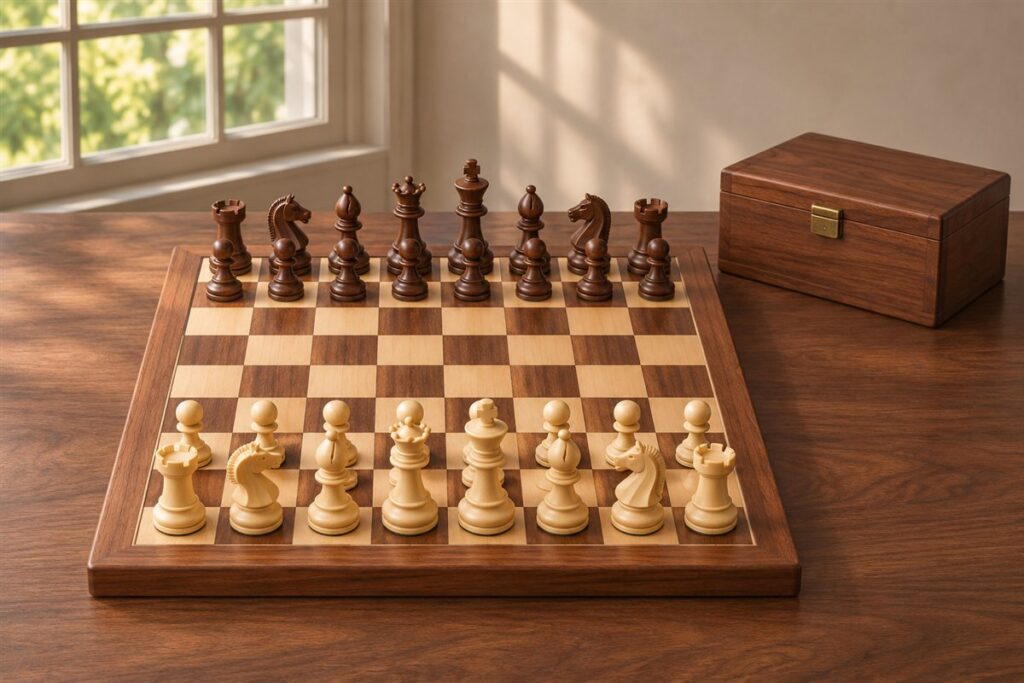
Duck Chess is a chess variant in which a neutral piece, the duck, sits on the board and must be moved after every regular move. The duck blocks squares and lines for both sides, which changes how attacks and defenses work. It became popular because it is easy to learn and creates surprising tactical moments, so it is a fun change from standard chess.
Basic Rules
Rules can differ slightly between sites, so read the version you play. The core ideas are these:
- The duck is a neutral piece that belongs to neither side.
- On each turn, you make a normal chess move and then move the duck to any empty square.
- The duck cannot be captured and cannot be moved to an occupied square.
- Pieces cannot move through the duck, so it works as a movable wall.
- There is no check in the usual sense. The goal is to capture the enemy king.
How It Changes the Game
- Defense is harder: the duck can block a defender or shield a threat, so a protected piece may suddenly be lost.
- Attacks are quicker: because the king can be captured, a line to the king matters at once.
- Tempo matters: each turn combines two decisions, so planning ahead is more complex.
- Calm positions are rare: something is usually under threat, and the duck can create new threats instantly.
Tips for Your First Games
- Before moving, ask where the duck would hurt you most and be ready to respond.
- Use the duck to block your opponent’s strongest line, not only to hide your own pieces.
- Keep your king covered so a single duck move cannot open a path.
- Look for moves that create two threats, since the duck can usually stop only one.
- Play slower time controls until the double move feels natural.
Where to Play
Duck Chess is available on some online chess sites and in community events, and players can also use a physical piece, such as a coin or a spare token, to represent the duck at home. Check each site’s variant list for the current rules and options.
Opening Ideas With a Neutral Blocker
Because the duck can be placed on any empty square, the first moves of a game look different from standard chess. The opening principles still help: develop pieces, control the center and prepare your king. The difference is that every move comes with a duck placement, and that placement can interfere with your opponent’s development or protect your own plans.
One useful habit is to use the duck to slow the opponent’s most useful piece. For example, placing it in front of a central pawn or on a key diagonal can delay an attack. Be careful about leaving it where it blocks your own pieces, since it also stops you. The duck is neutral, and your opponent can take advantage of any block you create by moving it next turn.
Think about the king as well. Since the aim is to capture the king, the usual comfort of a protected king behind pawns still matters, but there is no check to warn you. Look every move for any enemy piece that has a clear path to your king after the duck moves. Keep that path closed or defended.
Avoid copying long standard lines, because the duck changes which moves are safe. Instead, ask each turn what the opponent threatens, what the duck could do to help them, and whether you have a reply. Quiet, solid development tends to be rewarded, because it prevents quick tactics.
Tactical Patterns to Recognize
A handful of patterns come up often in Duck Chess. The first is the duck block that stops a defender. If your piece is guarded by another along a line, the duck can sit in between and make the guard useless, so the piece is loose. Check protection after considering where the duck might go.
The second is the double threat. Since the duck can usually only stop one danger, a move that creates two separate threats is hard to meet. Look for forks, discovered lines and attacks on both the king and another piece. Remember that your opponent also gets a duck move, which can block one of them, so make sure the threats use different lines.
The third is the duck as a shield. You can put it in front of your king or a valuable piece to cut off an attacker. This works until the opponent moves it elsewhere, so the shield is temporary. Count the attacks that appear when the duck leaves.
The fourth is the trap of the forced duck move. Because the duck must move each turn, it cannot stay in a perfect spot. A position where the only helpful square is the one it just left can cause problems, depending on the rules you use. Learn the exact rule for your platform. Finally, watch for pieces that are stuck behind the duck, since they can be captured while unable to move away.
Endgames and the King Hunt
With fewer pieces, the duck becomes even more powerful, because there are fewer blockers and each line matters. Endgames are often decided by who can open a path to the king first. A rook or queen with a clear line is a serious threat, and the duck can block or clear that line in a single move.
Pawn promotion remains important. A pawn near the last rank forces the opponent to respond, and the duck can be used to stop it advancing by placing it on the square in front. The defender then has to decide whether to move the duck away, which gives the pawn a path, or to use another piece to deal with it.
Because king capture ends the game, king activity is less of a priority than in standard chess, where the king helps in the endgame. Here, exposing your king can be fatal, so keep it behind your pieces for longer. At the same time, small material advantages can be decisive if they let you build a double threat.
Be careful with stalemate-like situations. Rules about what happens when a player has no legal move vary between versions, so read the rules of your platform. When ahead, the safest plan is to keep control of lines to the enemy king while keeping your own king covered, and to avoid giving the opponent a chance to use the duck to block your pieces.
Playing Over the Board With a Physical Duck
Duck Chess is easy to play at home with a few adjustments. Use any marker for the duck, such as a coin, a button, a small toy or a spare piece of a different color. It needs to be clearly distinct from the other pieces so no one confuses it with a pawn or a captured piece.
Agree on the rules before you start. Points to settle include whether the duck may be placed on any empty square, whether it must move every turn, whether it can start the game on a specific square, and how the first move works. Also decide what happens if one side forgets to move the duck, and whether a touched piece must be moved. Writing the rules on a card avoids arguments.
The turn order can get muddled, so make a habit of saying “move, then duck” aloud. A clock can be used, but ensure both of you agree on when it stops and starts, for example after the duck is placed. For beginners, play without a clock first.
Keep the board clean and the duck visible. It helps to place it with a deliberate motion so the other player sees it. For a group, you can take turns on a shared board or play a small tournament with short games. This format is friendly to children, but explain the king capture goal clearly.
Learning From Your Duck Chess Games
To get something useful out of Duck Chess, review your games the way you would review standard ones. Find the moment you lost material or the king, and ask whether it was a missed double threat, a poor duck placement or a lapse in protecting a piece. Most losses come from forgetting that the duck can change what is protected.
A short checklist helps before every move. What does my move threaten? What does my duck placement block? What can the opponent do after moving the duck? Which of my pieces are loose if a line is blocked? Using the list for a few games makes the double decision feel more natural.
Play at a pace that allows thinking. Fast games are fun and chaotic, but slower ones teach more. If you play online, check whether the platform offers analysis tools for the variant, since support varies.
Duck Chess can sharpen general tactical vision, but it is a different game, and strong results do not directly transfer to standard play. Treat it as a way to enjoy the pieces in a fresh setting, to practice spotting threats quickly, and to share an amusing game with friends. If you want to improve at standard chess, keep a separate routine of study and review.
FAQ
Is Duck Chess good practice for normal chess?
It can sharpen your attention to loose pieces and open lines, but because the rules differ, it does not replace standard practice for openings and endings.
Can the duck stay in the same place?
In common versions, the duck must move to a new empty square each turn. Confirm this in the rules of the site or group you use.
Is there a first-move advantage in Duck Chess?
We cannot point to reliable results on this, so treat it as unknown. For casual play, it matters little. If you play often, you can alternate colors.
How do I play Duck Chess without a computer?
Use any marker as the duck and agree on the rules in advance, including whether it must move every turn and where it may be placed. Write them down to avoid disputes.
Can I castle in Duck Chess?
Rules differ between versions, so check the ones used by your platform or group. Make sure both players agree before the game starts.
What happens if the duck blocks a pawn promotion?
The pawn cannot move into an occupied square, so the duck can stop it for a turn. The other side can move the duck away or deal with the pawn another way.
Do I need to learn new opening theory?
Not in detail. General principles about development and king safety carry over, but standard theory is less reliable because the duck changes what is safe.
Is Duck Chess suitable for kids?
Many children enjoy it, provided they already know how the pieces move. Explain that the king can be captured and play slowly at first.
Why do games end so suddenly?
Because the king can be captured and the duck can block defenders, a single oversight can lose the game. Checking each line before you move prevents most sudden endings.
The Short Version
Duck Chess adds a neutral blocker that you relocate after every move, turning each turn into a double decision. Expect fast, tactical games where king safety and threats matter more than quiet plans. Try it for fun, learn the exact rules of your platform and enjoy the chaos.