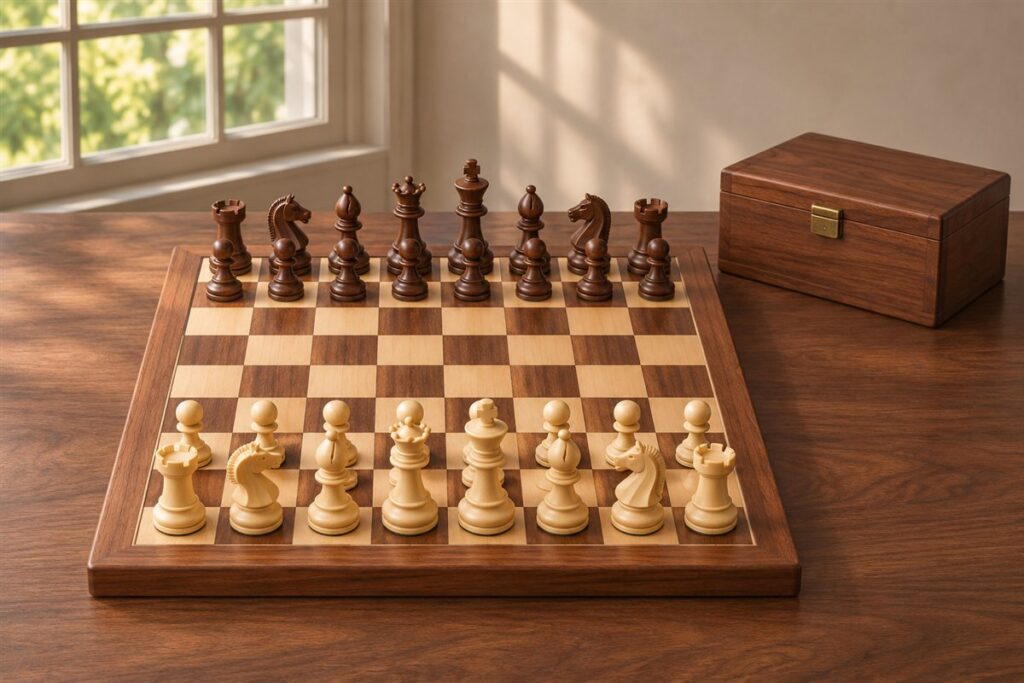
Neither format wins outright: standard chess trains opening knowledge and the structures you will meet in most games, while Chess960 trains general principles and independent thinking. The most useful plan for most players is to mix them, with standard chess as the main course.
What Is Different
In Chess960 the back-rank pieces are placed in one of 960 possible arrangements before the game, with some rules about bishops and the king. Standard chess uses the same familiar arrangement every time. That means opening theory matters little in Chess960, because the position is new each game.
| Feature | Standard chess | Chess960 |
|---|---|---|
| Opening knowledge | Very important | Much less important |
| Early thinking | Often from memory | From principles and calculation |
| Match to most games | Direct | Indirect |
| Best use | Main training format | Variety and skill building |
What Chess960 Trains
- Basic principles: develop pieces, control the centre, protect the king.
- Calculation, since you cannot rely on memory.
- Flexibility, because positions look unfamiliar.
- Enjoyment, especially for players tired of repeating theory.
What Standard Chess Trains
- Recognition of structures that recur across thousands of games.
- Opening plans and typical middlegame ideas.
- Preparation for tournaments and club matches, which use the standard setup.
A Practical Mix
- Play standard chess for your main games and training.
- Add a few Chess960 games a week as a change of pace.
- After each game, check the first ten moves for principle mistakes.
- Study standard openings in short bursts, and keep your repertoire simple.
Whether Chess960 makes you stronger overall depends on the player. Strong players use it for variety, but the evidence for a major boost in playing strength is not something we can point to. Treat it as a useful supplement.
Who Gains Most From Each
Players who feel stuck in memorised lines often find Chess960 refreshing, because every game forces them to think from the first move. Players who are preparing for a specific event gain more from standard chess, since the opening knowledge carries over directly.
- Beginners: standard chess first, so the usual setup becomes second nature.
- Club players: mostly standard, with Chess960 as a weekly change.
- Coaches and parents: Chess960 is a handy way to keep sessions fresh without opening theory.
Whichever you choose, look back over your games afterward and look for the same few mistakes. Improvement comes from understanding why a move failed, not from the format itself.
How the Chess960 Setup Is Built
Understanding the starting position rules removes much of the mystery. In Chess960 the pawns start where they always do, and only the pieces on the back rank are shuffled. The two sides mirror each other, so White and Black begin with matching arrangements. The shuffle follows a few constraints: the two bishops must start on squares of opposite colors, and the king must start somewhere between the two rooks. Those limits are what produce the 960 distinct starting positions, and the standard setup is one of them.
The king-between-rooks rule matters because it keeps castling possible on both sides. Castling is adapted so the king and rook finish on the same squares they would in a standard game, whichever squares they started on. The move can look odd the first time, since the king may travel a long way or hardly at all, and some positions require squares between the pieces to be empty. Read a clear explanation on a trusted site and practice castling in a few casual games before a serious one.
Most online platforms and apps generate the starting position for you, so you rarely need to build one by hand. If you play over the board, you can use a numbered chart or a random generator to pick a position, then set the pieces before the game. Agree on the position with your opponent first, so nobody feels surprised, and use the same position for a rematch with colors reversed if you want a fair comparison.
Finding First Moves When Theory Is Missing
The biggest practical question in Chess960 is what to do in the opening when you have no memorized lines. A useful approach is to answer a short list of questions before moving. Where are my bishops aimed, and which pawn moves open them? Which central pawn can I advance safely? Is my king safe where it stands, and where would it like to castle? Which piece is stuck behind a pawn, and how can I free it?
Early priorities are the same as in standard chess. Control or contest the center, bring out the minor pieces, and avoid wasting time moving the same piece twice. The difference is that a piece may not have an obvious best square. A bishop sitting in a corner next to a rook can be strong after one pawn move, while a knight in the same spot may take longer to reach play.
Watch for early tactics. Because the pieces start on unusual squares, a loose pawn or an undefended piece may be easier to attack than you expect. Before each move, check what your opponent can capture or fork. Many first Chess960 games are decided by an early blunder that would be rare in familiar positions, so slow down for the first ten moves and use that time to build a safe structure.
- Check which pieces are undefended after your move.
- Prefer moves that open lines for your bishops and rooks.
- Delay committing your king until you know where it is safest.
How to Review Your Games for Improvement
Playing more games does not help much without review, and the review method differs a little between the two formats. After a standard game, compare your first moves with the opening ideas you studied and note where you left them. After a Chess960 game, there is no book to check against, so focus on principles. Did you develop quickly? Did you leave a piece undefended? Did your king stay safe, or did you castle into trouble?
For both formats, find the moment the evaluation changed. That is usually one move where you missed a threat, allowed a fork or gave up a piece for nothing. Write one sentence about what you overlooked. After a few weeks, patterns appear: perhaps you often forget to check checks and captures, or you rush when ahead. Those patterns are the actual training targets.
A chess engine can help you find the turning point, but try to find it yourself first, since the effort builds your own pattern recognition. Keep a short list of recurring mistakes and read it before your next session. If you play Chess960, keep a separate note for positions where the starting arrangement made a difference, such as a hard-to-develop corner, so that you learn from those cases too.
Common Mistakes When Switching Between Formats
Players who move between the two formats often make predictable errors. In Chess960, the most common is playing standard-chess moves out of habit, such as pushing the same central pawns or developing the same way, even though the pieces are on different squares. Another is neglecting the king, because the familiar castled structure is not available straight away.
In standard chess, the mistake is the opposite: assuming that because Chess960 is about principles, you can ignore opening knowledge. The standard setup is where you will play club games and events, and a few solid ideas for both colors save time and risk. Memorizing long lines is not necessary, but knowing why common moves work is.
A subtler mistake is judging progress by results in only one format. Chess960 results can swing because the starting position can favor one side slightly, and both players have the same uncertainty. Standard rating changes are more stable measures of your growth. Do not be discouraged by a run of losses in either format.
Finally, avoid using Chess960 only to escape studying. If your standard results are held back by weak endgames or missed tactics, those need direct work. A format change can refresh your interest, but it will not fix gaps by itself.
Building a Weekly Routine
A simple routine keeps the formats working together. Spend most of your sessions on standard chess: play a few longer games, review them, and solve a small set of tactics puzzles. Add one or two Chess960 sessions as a change, played at a time control long enough to think, since quick play tends to hide the benefits of working out unfamiliar positions.
Include some study of endgames, because endgames look the same in both formats once pieces are traded. Basic king and pawn endings, simple rook endings and the idea of activating the king carry over directly, so this time is useful whichever format you prefer.
Track your habits instead of promises. For example, note how many games you reviewed and which mistake appeared most. If you find that Chess960 games bring out more careless blunders, play them slower. If standard games feel stale, swap one session for Chess960 to renew interest. The aim is steady practice you will actually keep up.
If you coach or play with a child, a short Chess960 game at the end of a lesson can be a reward that also teaches principles. Keep the setup simple, check the position together before starting, and talk about what each piece wants to do.
FAQ
Should beginners play Chess960?
Beginners can, but it is often easier to learn standard chess first so the pieces and basic setups become familiar.
Does castling work the same way?
The rules for castling are adapted so the king and rook end on the usual squares. Read the rules on a trusted site before your first game.
How many starting positions are there in Chess960?
There are 960, which gives the format its name. The standard starting position is one of them. The positions follow rules about bishop placement and the king standing between the rooks.
Does Chess960 change how the pieces move?
No. Pieces move as usual, and only the starting arrangement of the back-rank pieces and the castling procedure are adapted. Read the castling rules before your first game.
Where can I play Chess960?
Many online chess platforms and apps offer it and generate the position for you. You can also play at home with a random position chart. Check the variant list on your preferred site.
Is Chess960 good for opening preparation?
Not directly, because positions rarely repeat. It does help you practice thinking through unfamiliar positions, which is a different skill from memorizing lines.
Can I use an engine to review Chess960 games?
Many engines and platforms support it, but check that the analysis tool you use is set to the correct variant. Try to find your own mistakes first before looking at the engine's suggestions.
Which time control is best for learning from Chess960?
Slower time controls generally work better, since you need time to think through the unfamiliar setup. Faster games are fine for fun once you are comfortable.
Will Chess960 hurt my standard chess?
There is no sign that it needs to, as long as you keep playing and reviewing standard games. Treat it as a supplement and keep your main practice in the format you compete in.
The Short Version
Use standard chess to learn structures and openings, and use Chess960 to sharpen principles and calculation. A blend of both is a good choice for steady improvement.