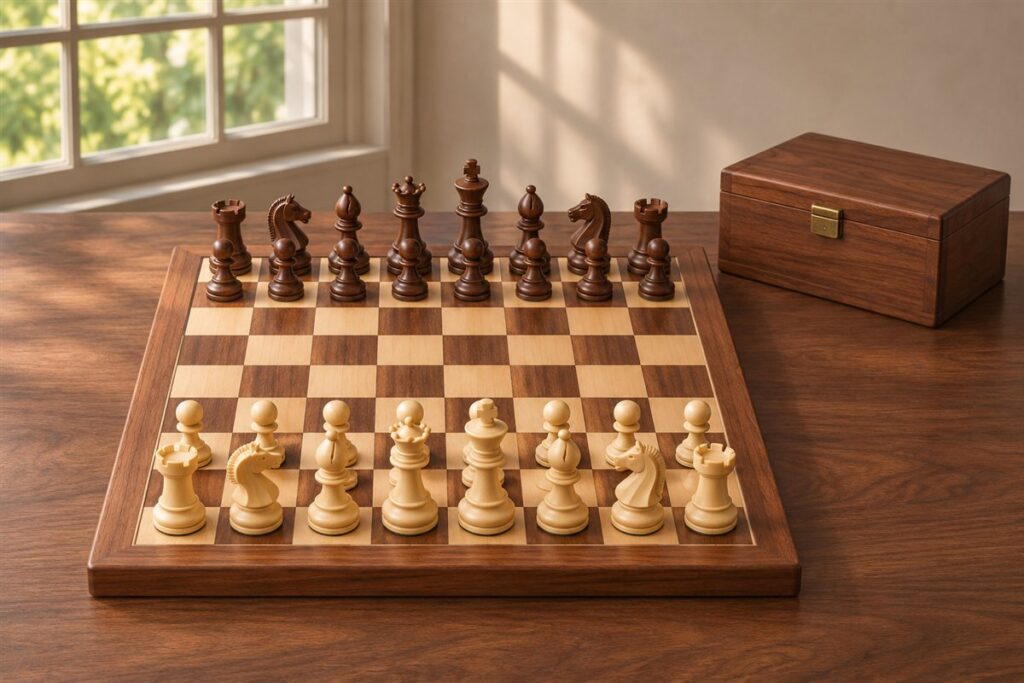
Chess appears in hip-hop because it works as a metaphor: strategy, sacrifice, reading an opponent and thinking several moves ahead are all themes that artists use to describe life and the music business. This article looks at the common ideas, without relying on any single claim about who played what.

The Metaphors Artists Reach For
Lyrics that mention chess tend to lean on the same handful of images. Knowing them helps you spot the references when you listen.
- The king and the pawn: power and being overlooked.
- Checkmate: a final, decisive win.
- Sacrifice: giving something up now for a bigger gain later.
- Moves ahead: planning a career or a business a few steps in advance.
- The board: a world with rules that an artist sees clearly.
Why the Match Feels Natural
Hip-hop values skill, wit and competition, and chess rewards the same traits. A battle rap and a chess game both involve answering an opponent’s last move with something sharper. Chess also needs no expensive equipment, a point that links neatly to the culture’s roots of making something from limited means. Street boards and park tables in big cities have long drawn players of all kinds.
How to Explore the Link Yourself
- Make a list of songs you know that mention chess and note the exact lines.
- Ask which piece or move the artist is using, and what it says about the speaker.
- Look up interviews where artists talk about the game in their own words.
- Try a game while listening, and notice how pace and rhythm shape your thinking.
Be careful with secondhand stories about which famous artist plays or how well. Check any claim against the artist’s own statements before repeating it.
Bringing Chess to Hip-Hop Fans
If you teach or run a club, hip-hop can be a way in. Music, art and fashion tie-ins make the game feel current for teenagers who think it is old-fashioned. Pair a playlist with a casual tournament, and let players decorate boards with their own artwork. Keep the focus on play, not on reputation.
Listening With a Chess Ear
Once you know the common images, you begin to notice how the metaphors differ. A line about a pawn usually speaks of humble beginnings, while a line about the queen often points to the most powerful person in a story. Artists also borrow chess words for confidence, such as saying they are several moves ahead. Try writing down what each reference tells you about the speaker, then compare notes with a friend. It makes a good opener for conversation at a club night or a classroom session.
Wordplay and Chess Vocabulary in Rhymes
Chess gives writers a compact vocabulary that fits easily into verses. Many of its terms are short, punchy and already carry emotional meaning, which makes them useful for rhythm and punchlines. Words such as check, mate, castle, gambit, fork, pin and tempo can be bent in several directions, and a single line may work on both a literal chess level and a personal or street level.
Look at how the terms behave. Check works as a warning or a challenge. A gambit suggests taking a calculated risk, often by giving something up to gain position. A fork suggests being attacked from two sides at once. A pin suggests being unable to move because something more valuable is behind you. Zugzwang, the idea that every available move makes things worse, is a vivid image for a person stuck in a bad situation, though it is harder to fit in a line.
Wordplay is also about sound. Rhymes and internal rhythms with words like knight and night, rook and book, or pawn and dawn appear naturally in verse. Writers who know these opportunities can build lines that sound smooth.
- Listen for double meanings, where the chess term and the everyday meaning both fit.
- Notice when a term is used correctly and when it is used loosely; both can be effective.
- Write your own line using one chess term and see how many meanings you can fit in.
This kind of close listening makes the music more enjoyable and also teaches you a little chess vocabulary along the way. If you teach, ask students to pick a term and write a short verse with it.
Strategy Versus Improvisation
Hip-hop values both preparation and improvisation, and chess does too. A player studies openings and patterns, then must adapt in real time to an opponent who does something unexpected. A freestyle rapper does something similar: they draw on a store of rhymes, styles and ideas, and then react to the moment.
That link helps explain why the comparison feels natural to many people. Preparation is not the opposite of creativity. A strong player knows the ideas well enough to leave them behind at the right time. A strong writer knows structure and flow well enough to break the rules on purpose.
It is also true that both activities involve reading the other person. In chess you look at what the opponent wants to do and respond. In a verbal contest, you listen to what has been said and answer it. The skills of listening, anticipating and replying overlap, even though the surface forms are different.
- Preparation: learn patterns and keep a stock of ideas.
- Reading the opponent: watch what they repeat and what they avoid.
- Tempo: knowing when to speed up or slow down.
- Surprise: breaking from the expected path when it counts.
When you next play a game, try noticing the moment where preparation ends and improvisation begins. That is where most real chess happens, and it is the part many fans of the music find most interesting.
Visual Style: Chess in Art and Fashion
The board is a strong visual symbol. Black and white squares, clear patterns and recognisable pieces appear in cover art, music videos, clothing graphics and stage design. The checkered pattern is bold and works at any scale, which makes it popular for backdrops and prints.
Pieces carry symbolism that designers can use quickly. A king suggests authority, a queen suggests power and influence, a knight suggests an unusual route, and a pawn suggests someone who is overlooked but may rise. Placing a piece in a photograph or a graphic lets a viewer understand a message without words.
If you are a designer or a fan creating your own material, think about what you want the image to say. A lone pawn facing a row of pieces says something different from a king surrounded by pawns. Be thoughtful too about legal and ethical matters: use your own artwork and avoid copying other people’s designs or logos.
- Study how existing visuals use the board, but create your own versions.
- Match the piece to the message; do not choose it only because it looks good.
- Consider how the design reads at small sizes, such as on a phone screen.
For club organisers, a themed poster or a set of printed boards with local artwork can draw in people who might not otherwise try the game. Offer a chance for participants to design their own set and keep a gallery of the results.
Running a Music-Themed Chess Night
A themed event is a friendly way to introduce chess to people who enjoy music. Keep the format simple, so the focus stays on play and conversation.
- Choose a space with enough tables, good light and a sound level that still allows players to think. Quiet background music at low volume is better than a loud mix.
- Prepare a playlist of songs with chess references or a general mix, and check any content for suitability for the age group present.
- Set a time control that suits beginners, such as a relaxed rapid format, and have spare boards and clocks ready.
- Offer short lessons for newcomers, covering piece movement and the basic aim of the game.
- Add a casual quiz or a lyric-spotting game between rounds.
Make the evening welcoming. Pair beginners with friendly, patient partners, and avoid pressure or ranking at the start. Let players choose whether to play for fun or in a simple tournament.
Check venue rules, permissions and any licence requirements for playing recorded music in a public space, since these differ by location. If you are unsure, ask the venue or your local organisation. Finally, ask for feedback so that the next event is better.
Checking Claims and Sources
Stories about artists and chess spread quickly, and not all of them are accurate. A claim that a famous performer is a master or took a certain lesson may be repeated across many sites with no source. Before sharing, it is worth checking.
The best evidence is the artist’s own words, such as an interview, a post on their official account or a statement in a documentary. Next best is a respected publication that cites its sources. Be wary of unsigned posts, quotes without context, and lists that repeat the same unsupported claims.
When you read lyrics, quote them accurately and consider the context. A line about chess does not prove that the artist plays, and a metaphor does not show how skilled they are. Treat the lyric as an image, not as a biography.
- Look for the original source of a claim, not only a repost.
- Note the date and context of an interview, as views change over time.
- Use careful wording such as “has said” or “has referred to” where appropriate.
If you write about the subject, acknowledge uncertainty openly. Readers value honesty more than a confident but unverified statement. This habit also improves your own research skills for any topic.
How does chess connect to hip-hop for a new listener?
The simplest link is that both are contests of skill where the person who prepares, adapts and keeps a cool head tends to come out ahead. Chess in hip-hop works as shorthand, letting an artist describe a whole attitude with one piece or one move.
For a new listener, the easiest way in is to treat each reference as a small character sketch. When a rapper says they are playing chess while others play checkers, the line is about perceived depth of thinking. When a verse mentions a pawn, it often points to someone starting at the bottom. When a verse mentions the king, it is usually about status, or the pressure of being the one everyone targets.
You do not need chess knowledge to follow this, but a few basics help.
- The pieces have different value: a pawn moves slowly and is easy to trade, while the queen is the most mobile piece. Artists lean on that contrast.
- The king cannot be captured: the game ends by checkmate, which is why that word signals a final win.
- Sacrifices are deliberate: players give up material on purpose to gain position, which is a ready image for risk-taking.
- Every move answers the last one: the back-and-forth mirrors a verbal exchange.
Start with songs you already like, find the chess line, and ask what the speaker wants you to think about them. That one question turns passive listening into close reading and gives you a way to compare artists without needing any claims about their personal lives.
What do chess references in rap lyrics not prove?
A chess line in a song proves that the writer is using chess as imagery. It does not prove that the writer plays well, plays often or plays at all. Keeping that distinction clear makes you a better listener and a more trustworthy writer.
Lyrics are crafted language. A writer may pick a chess image because it rhymes, because it sounds smart or because it fits a theme on the record. The same is true of references to boxing, cooking or space travel. Reading a metaphor as a biography is a common mistake.
Here are some habits that keep you accurate.
- Separate the lyric from the person. Say “the song uses a chess image” instead of “the artist is a chess master.”
- Look for the artist’s own statements before writing that they play, and note the date and setting of any interview.
- Avoid ranking artists by supposed chess skill. Without verified games, that is guesswork.
- Watch for exaggerated claims in list posts, which often copy each other without a source.
Honest wording does not make the topic less interesting. It tells readers what is known and what is only suggested. If you share your findings with a class or a club, invite people to argue about what a line means, because several readings can be valid at once.
What should you check before buying chess gear for a themed event?
Before buying gear for a music-themed chess night, check that the boards are a usable size, the pieces are easy to tell apart and the clocks suit beginners. Simple, durable equipment matters more than style, because players will handle it all evening.
- Board size and square size: pieces should fit squares comfortably, with room to move them without knocking neighbors. Check the listing for dimensions and the stated piece height.
- Piece design: a standard, easily recognizable design helps newcomers. Decorative sets can look great but may confuse a beginner if the knight or bishop is hard to read.
- Board surface: a flexible roll-up board is cheap to store and carry, while a hard board feels more stable on shaky tables. Pick based on your space.
- Clocks: simple analog or digital clocks are enough for a casual event. Check how the clock is set and whether the instructions are clear.
- Storage and transport: bags, boxes and counts of pieces matter. Make sure a full set is included and check what the listing says about spare pieces.
- Returns and warranty: confirm the terms on the listing in case something arrives damaged or incomplete.
- Quantity: plan one set per pair of players, plus a spare or two.
If you want a hip-hop look without overspending, use plain, durable sets and add the theme through posters, playlists and player-made artwork. That keeps the focus on play and makes it easy to replace a lost piece.
Is a hip-hop chess theme right for every club or class?
A hip-hop chess theme works best with groups who already like the music and want a fresh way into the game, and it works less well when the music is a distraction. Be honest about your audience before building an event around it.
The theme is a good fit in these cases.
- Teen and young adult groups: a recognizable cultural link can lower the barrier to trying a game that feels old-fashioned.
- Classrooms: lyrics offer material for discussing metaphor, planning and decision-making alongside the game.
- Community centers and libraries: a casual, social format brings in people who would not join a formal club.
It may not suit these situations.
- Serious tournaments: competitive players need quiet and standard equipment, and themed distractions can annoy them.
- Mixed-age audiences: some lyrics contain explicit language, so check every song before playing it publicly.
- Groups that dislike the genre: forcing a theme can backfire. Offer it as an option, not a requirement.
The trade-off is simple. A theme can bring more people through the door, but it also adds planning, content checks and possible licensing questions. If you do not have time for those, keep the evening plain and add one small touch, such as a short lyric quiz between rounds.
What are the best next steps to explore chess in hip-hop?
The best next step is to pick three songs, read the chess lines carefully and write one sentence on what each reference says about the speaker. Then play a few games and see how the vocabulary feels once you have used it yourself.
- Listen first: choose songs you know well so you can focus on the wording instead of the beat.
- Learn the basics: a short tutorial covering how each piece moves and how a game ends is enough to follow nearly every reference.
- Play a few casual games: notice when you feel like you are preparing and when you are improvising.
- Share and compare: discuss readings with friends, since different people hear different meanings in the same line.
- Write your own: try a short verse that uses one chess term in two ways. It shows how much work a single word can do.
If you are planning an event, start small. Invite a handful of people, bring a few simple sets and a short playlist, and ask what they enjoyed. Build on what works.
Next step: choose your three songs, check the lyrics and sources carefully, set up a simple board, and give the idea a try this week before you plan anything bigger.
As a final tip, keep a notebook of the lines you find. Over time you will see patterns in how different writers use the same piece, and that comparison is where the topic becomes most rewarding.
FAQ
Is there a famous hip-hop group tied to chess?
Chess shows up in names, lyrics and album themes across the genre, but confirm the details of any specific group from reliable sources before you cite them.
Do I need to play to enjoy the references?
No. Knowing how the pieces move is enough to follow most of the imagery.
Which chess terms show up most in lyrics?
Common ones include checkmate, king, queen, pawn, move and sacrifice. They are short and carry clear meanings that suit verses and hooks.
Do I need to be a good chess player to write chess-themed lyrics?
No. Knowing the basic pieces and a few terms is enough to write a convincing line, though a little more knowledge helps avoid mistakes.
How can teachers use this connection in class?
Ask students to find a lyric with a chess reference, explain the metaphor and write their own verse. It links the game with language skills in a way many students enjoy.
Is chess a good way to start a conversation about strategy?
Yes. Because the game is familiar as a symbol, people readily discuss planning, risk and trade-offs using chess examples.
Where can beginners learn the basics quickly?
Free tutorials and practice modes on chess websites and apps cover piece movement and simple tactics. A local club can also help.
Can I use chess imagery in my own designs?
Yes, if the artwork is your own or properly licensed. Avoid copying logos or protected designs from others.
Why do games and music events work well together?
Both bring people together in a shared space with a relaxed mood. Low-volume music helps conversation without disturbing play, and a theme gives newcomers a reason to join.
Why do rappers compare themselves to chess players?
Chess stands for planning, patience and outthinking an opponent, which are qualities many artists want to claim. The comparison is quick to understand and flatters the speaker. It is a metaphor, not proof of skill at the board.
What does checkmate mean in a rap lyric?
It usually means a final, decisive win where the opponent has no answer left. In chess, checkmate ends the game because the king is under attack with no escape. Artists use it for victories in battles, business or rivalries.
What does a pawn represent in hip-hop lyrics?
A pawn commonly stands for someone with humble beginnings or someone who is overlooked or used by others. Because pawns can be promoted when they reach the far side of the board, the image can also suggest a rise. The reading depends on the line.
Is chess popular in hip-hop communities?
Chess is played in many communities, including parks and community centers, and it appears often in music and culture. Specific claims about how popular it is should come from reliable sources. Treat sweeping statements with caution.
How can I use rap lyrics to teach chess?
Pick a clean lyric with a chess image and ask students to explain the meaning, then match it to a real move or piece. Follow with a short game. Always check the content is suitable for the age group first.
What is the difference between a gambit and a sacrifice?
A sacrifice is giving up material for some advantage. A gambit is a sacrifice made early, usually in the opening, to gain speed or position. Writers use both for taking a calculated risk.
Do I need a chess clock for a casual music night?
Not for a relaxed event, since many players enjoy untimed games. A clock helps keep rounds moving if you run a small tournament. Keep the time generous for beginners.
The Short Version
Chess and hip-hop share ideas about strategy, competition and creativity under limits. Learn the main metaphors, listen closely, and check facts before repeating them.