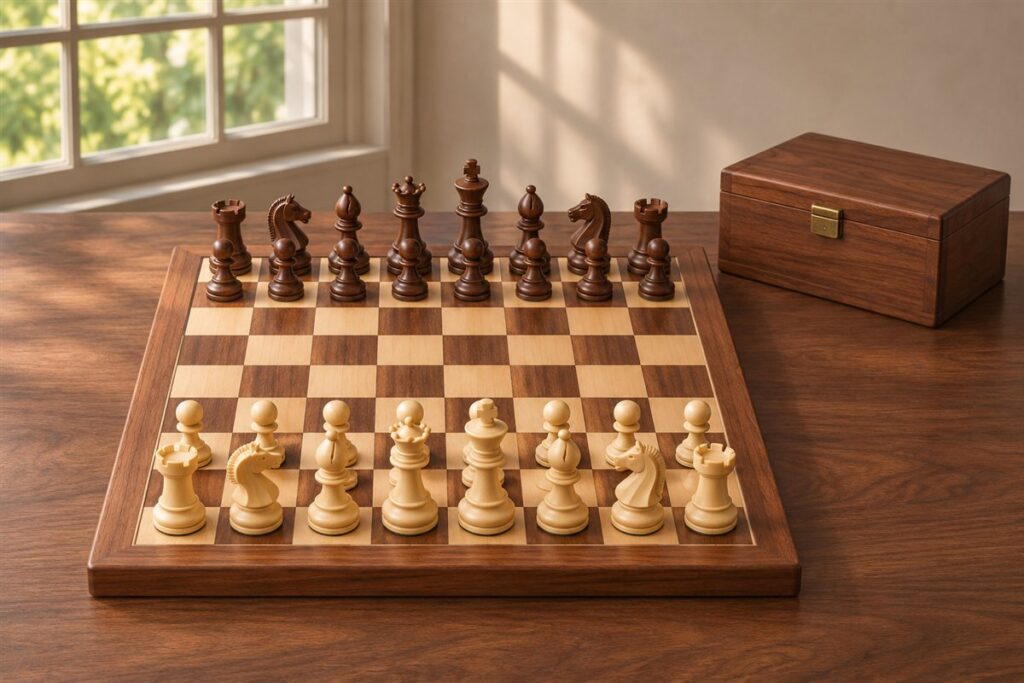
If you play 1.d4, the Queen’s Gambit gives you a classical fight for the centre with well-known plans, while the Catalan gives you a long-term pressure game with a fianchettoed bishop. Neither is simply better; the choice depends on whether you like open central play or slow, positional squeezing.

What Each Setup Looks Like
In the Queen’s Gambit White plays c4 early and offers a pawn to pull Black’s d-pawn away from the centre. Many lines lead to isolated pawns, hanging pawns or minority attacks. In the Catalan White also plays c4 but develops the king’s bishop to g2, aiming it down the long diagonal toward Black’s queenside.
| Feature | Queen’s Gambit | Catalan |
|---|---|---|
| Key piece | Pawns and central tension | Bishop on g2 |
| Style | Classical, direct | Positional, pressure based |
| Theory load | Large, many branches | Moderate, but needs care |
| Move order | Flexible and well known | Often needs a precise order |
Strengths of the Queen’s Gambit
- Plenty of model games and books at every level.
- Clear plans: pressure on the centre, a minority attack, or an attack on an isolated pawn.
- Works well against many Black setups.
Strengths of the Catalan
- Pressure on Black’s queenside that can last deep into the endgame.
- Lower risk of being caught in a sharp opening trap.
- A natural fit for players who enjoy quiet, strategic positions.
How to Choose
- List the positions you enjoyed most in past games: open centres or slow squeezes.
- Try each opening in ten practice games with a longer time control.
- Check how Black replied. If you kept facing the same few setups, study those first.
- Choose the opening whose recurring structures you could describe to a friend.
Give each opening a fair trial. A few games are not enough to judge a structure, because early results often depend on one tactical slip rather than on the opening. Keep short notes after every game: which plan you followed, which move surprised you, and which position felt uncomfortable. After ten games you will have a clear picture of which setup suits you.
It also helps to look at how strong players handle the middlegame in each structure. Watching how a Catalan player uses the long diagonal, or how a Queen’s Gambit player handles an isolated pawn, shows you the plans that raw move lists do not.
Be aware that Black can often steer a Catalan back into Queen’s Gambit style positions, and the reverse is also possible. Learning both families of structures helps in either case.
Typical Pawn Structures in Both Systems
Understanding the pawn structures will tell you more about each opening than a list of moves. In the Queen’s Gambit, the structure depends on how Black replies. If Black accepts the gambit or exchanges, White may get a strong centre or a free pawn majority. If Black holds with …e6, the centre stays tense, and exchanges on d5 can lead to the Carlsbad structure, where White often plays a minority attack on the queenside with pawns on b4 and b5. In other lines, an isolated queen’s pawn appears, with active pieces as compensation, and hanging pawns on c5 and d5 offer both sides dynamic chances.
In the Catalan, White often keeps the pawn on d4 supported by the fianchettoed bishop and does not rush the centre. A common theme is that White offers the c4 pawn, and the bishop on g2 gets it back with pressure along the long diagonal. The structure is flexible, and the game often turns on piece play rather than pawn breaks.
- Carlsbad structure: learn the minority attack and how Black reacts.
- Isolated pawn: learn when to attack it and when to push it.
- Hanging pawns: learn both the strengths and the weaknesses.
- Catalan long diagonal: learn how the bishop on g2 puts pressure on b7 and the queenside.
Choose the structures you can explain in a few sentences. If you can describe the plan for both sides, you are ready to play it. If a structure seems confusing, look at model games before adding it to your repertoire.
Move Orders and Transpositions
Move order matters more than people expect. White can reach a Catalan by several routes, and Black may choose a setup that avoids it or steers toward lines White does not know. A repertoire built on one move order can be ruined by an unexpected reply on move two or three.
Think about the first few moves from both sides. If you start with 1.d4 and 2.c4, what are the main replies? If Black plays …e6 and …Nf6, are you happy to enter the Catalan by playing g3, or would you prefer to keep Nc3 flexible? If Black plays a different setup such as the Slav or a Queen’s Indian, do you have a plan?
The advantage of the Catalan move order is that it can limit options for Black. The cost is that you must be prepared for specific lines where Black takes the pawn or plays an early …c5, which require careful study.
- Write out the main first six moves of your chosen setup for both sides.
- Mark the points where Black can deviate.
- Decide on one answer to each deviation.
- Check a current source for the lines where the evaluation may have changed.
Transpositions can help or hurt. Keep a list of the common ones, such as how the Catalan can turn into a Queen’s Gambit structure, and know which you want. Preparing for these routes reduces the number of surprises and lets you save study time for the positions you will actually play.
Building a Compact Repertoire Around 1.d4
A repertoire is a plan for the most likely positions, not a catalogue of every line. Start by deciding what you want after 1.d4. Do you want solid positions with clear plans, or sharper play with more theory? Then build around that.
A practical approach is to choose a main setup against the most common Black replies, and then add one answer for each sideline. For a Queen’s Gambit repertoire, that may mean one setup against the Queen’s Gambit Declined, one against the Slav family and one against Indian defenses. For a Catalan repertoire, it may mean one reply against the closed lines, one against the open lines, and a plan against early …c5 or …dxc4.
Do not try to cover everything at once. Start with the lines you actually face in your games, and expand from there. Review your game history to find the three or four replies you meet most often.
- Choose reliable lines that match your style, and keep notes.
- Add depth gradually, spending more time on the positions that occur most.
- Replace lines that give you repeated trouble or that you find boring.
Consider using a spaced review: look at your notes after a day, a week and a month. This keeps the lines fresh without constant study.
If you are short of time, a smaller repertoire that you know well beats a large one you half remember.
Common Mistakes for White in These Openings
Several mistakes appear repeatedly at club level. The first is playing for the opening alone. Many players memorise ten moves and then do not know what to do. After the opening, you need a plan, such as pressing on the queenside, creating a passed pawn or targeting a weakness.
The second is misplacing the bishop. In the Catalan, the bishop on g2 is a key piece, so trading it too early or blocking it with your own pawns removes the opening’s main idea. In the Queen’s Gambit, the light-squared bishop needs a good square, and the dark-squared bishop should be considered before exchanges.
The third is ignoring king safety and development. Castling late, or grabbing a pawn with the queen, can allow Black to take over the initiative.
The fourth is playing too slowly in the Catalan. The opening is positional, but that does not mean passive. If Black plays …c5 or …b5 to challenge the structure, respond actively.
- Know the plan after the opening, not just the moves.
- Keep your best-placed piece on its best square.
- Do not overextend pawns without piece support.
- Check tactical traps, especially when you win a pawn.
Review lost games to find which of these mistakes you make most often. Fixing the biggest one gives more benefit than adding new theory.
Study Materials and a Practice Routine
Choose study materials that match your level and goals. For the Queen’s Gambit, there is a large literature, so you can pick between a theory-heavy book and one that focuses on plans. For the Catalan, fewer resources exist, so check the publisher’s description to see which lines are covered and how recent the book is.
Video courses can be useful for seeing plans in action, and annotated model games help show how strong players handle the middlegame. A database lets you see how often each line appears and how it scores in practice, though results vary with the players involved.
Build a routine. Spend a short session on opening study, then play a game with the opening, then review. Switch between theory and practice instead of doing only one.
- Study one line for twenty minutes.
- Play two or three games with that line.
- Review each game and note where you left the plan.
- Return to the book or database to fix the problem areas.
Include some time for endgames, since both openings often lead to positions where structure decides. Over time you will notice patterns repeating, and your decisions will speed up.
Keep your expectations realistic: opening knowledge helps, but game results depend on tactics, time management and endgames as well.
FAQ
Can I combine the two?
Yes. Many 1.d4 players use the Queen’s Gambit move order and switch to the Catalan setup when Black allows it. Treat that as an upgrade once the first one feels comfortable.
Which needs more memorisation?
The Queen’s Gambit has more branches overall, but its plans are easy to grasp. The Catalan has fewer main lines, though accurate move orders matter. Confirm current theory in a recent book or database.
Is the Catalan harder to learn than the Queen's Gambit?
Not necessarily. It has fewer main lines but requires accurate move orders and an understanding of long-diagonal play. Many players find it easy to grasp the ideas and hard to refine the details.
What should I do if Black takes the pawn on c4?
Learn a main plan for regaining it or for using the lead in development. The details vary by line, so check a current source and practise the resulting positions.
Which opening is better for rapid and blitz?
Both can work. The Queen's Gambit offers familiar plans and a lot of experience, while the Catalan gives solid positions that are less trap-prone. Choose the one you can play quickly and confidently.
How many games should I play before deciding?
Aim for at least ten serious games with each, and keep notes on how you felt in the typical positions. A few results are not enough to judge.
Do I need to learn the Black side as well?
It helps. Playing a few games as Black in the same structures shows you what your opponent wants and where the pressure points are.
Should I use an engine for opening preparation?
Yes, as a check for tactical errors and sharper lines. Do your own analysis first so that you understand the ideas behind the moves.
What if my opponent avoids the main lines?
Prepare a simple, sound reply for common sidelines, and rely on general principles. Most deviations are manageable if you know the pawn structures.
The Short Version
Choose the Queen’s Gambit for classical central play and abundant learning material. Choose the Catalan for slow pressure and a strong bishop on the long diagonal. Test both in practice games before you commit.