Disclosure: As an Amazon Associate, reviewstook.com earns from qualifying purchases. Links to Amazon on this page are affiliate links; they cost you nothing extra.
A Bluetooth speaker should fit where you use it most.
Last updated: November 1, 2026.
Size and sound
Bigger speakers go louder. See Bluetooth speakers and party speakers.
In this guide
Waterproofing
See waterproof speakers and shower speakers.
Budget
See cheap speakers.
Battery Life and Charging
Battery life depends heavily on volume, and the playtime in a listing usually reflects moderate listening. Treat the figure as an upper guide rather than a promise. If you plan to use the speaker for long parties or camping trips, favor a larger battery and check whether it can charge other devices.
- Look at the charging port type, and make sure you already own a compatible cable.
- Check whether the speaker can play while charging, which is handy for long events.
- Note how long a full charge takes, if the listing says.
- Consider whether the battery is replaceable, since batteries wear with time.
Bright lights, bass-heavy playback and loud volumes can all draw more power. For daily home use, a smaller battery is often enough, while travel and outdoor use benefit from extra capacity.
Bluetooth Version, Pairing and Range
Most speakers pair with a phone in a few steps, but the details vary. A newer Bluetooth version generally offers better range and stability, though the real range depends on walls, interference and your device. The listing often states a range under ideal conditions, so expect less indoors.
Some speakers can connect to more than one device, which helps if you share the speaker with family. Others can link with a second speaker for wider sound or stereo. Check whether such pairing needs the same model, since speakers from different makers rarely link. If you want to connect a television or computer, look for a wired input or support for audio codecs your device uses. Wired inputs also help if you want to avoid latency when watching video.
Sound Features Worth Understanding
Spec sheets can be confusing, so focus on what affects listening. Drivers produce the sound, and larger drivers can generally move more air for bass. Passive radiators or ports help with low frequencies in a compact body. Stereo speakers separate left and right channels, though a small single speaker cannot create a wide stereo image.
Peak power numbers are often marketing figures and say little about real-world loudness or quality. Listen to reviews that describe how the speaker sounds at high volume, or try it if you can. Look for an equalizer in the companion app if you like to adjust bass and treble. Be careful of apps that require an account or permissions you are not comfortable with, and check the privacy settings before installing.
Durability, Carry Features and Outdoor Use
If you take your speaker outdoors, look past the waterproof rating to the build. Check for rubberized corners, a sturdy grille, protected ports and a secure cover over the charging socket. A strap, carabiner loop or handle makes it easier to carry or hang. Floating designs exist, but only if the listing says so.
Think about heat and sand as well. Direct sun can heat a speaker and shorten battery life, and fine sand can get into buttons and seams. Rinse a speaker after exposure to salt water or chemicals only as the maker’s manual permits, and dry it before charging. Make sure the port cover is closed whenever the speaker is near water.
Common Buying Mistakes to Avoid
Some mistakes are easy to avoid with a little checking.
- Choosing by size or looks alone, without considering where the speaker will be used.
- Assuming that a high power number means better sound.
- Ignoring the charging port, then finding that you need another cable.
- Expecting a small speaker to fill a large room or give deep bass.
- Skipping the return policy, which matters if the sound is not to your taste.
Decide your main use first: a desk speaker, a shower or pool companion, a party speaker or a travel speaker. Then compare the features that matter for that use, and use the budget tiers to narrow the field. Lower tiers cover basic listening, while higher tiers often add stronger build, better sound tuning and more features.
Placement and Room Tips for Better Sound
Where you put a speaker changes how it sounds. Placing it against a wall or in a corner boosts bass, sometimes too much, while moving it away can give cleaner sound. Setting it on a shelf at ear height helps the sound reach you directly.
- Avoid placing it on a surface that rattles, which adds buzzing.
- Keep it away from large metal objects and thick walls that block the Bluetooth signal.
- Try placing it on a stand or foam pad to reduce vibration.
- In a large room, move it closer to where people sit.
Outdoors, sound spreads out and bass fades, so a speaker may seem quieter than it does indoors. Try different positions and listen. Keep your phone near the speaker to avoid dropouts. If you use the speaker for calls or video, check how it handles voices as well as music, since tuning can differ.
Matching a Speaker to Your Routine
The same speaker rarely suits every situation, so start by naming the place you will use it most. A desk or bedside speaker can be small, because you sit close and do not need much volume. A kitchen or living room speaker benefits from a larger body and a steadier power source, since it may play for hours. A backyard or party speaker needs more output, a sturdier build and a battery that can last through an afternoon.
Travel changes the priorities again. Weight, a compact shape and a secure carry strap matter more than sheer loudness, and a speaker that fits in a bag side pocket is easier to bring along than one you must carry by hand. Pool, beach and shower use put the emphasis on water protection, closed ports and a body that is easy to rinse and dry.
- Desk or bedside: small size, clear voices, quiet background noise.
- Home rooms: fuller sound, a wired input, the option to play while plugged in.
- Outdoors and parties: larger drivers, tough casing, long playtime.
- Travel: light weight, a strap or loop, and a common charging port.
If you expect to use one speaker in several places, choose for the hardest setting. A rugged mid-size speaker can still work well on a desk, while a tiny desk speaker will struggle at a gathering.
Audio Codecs and Video Delay
A codec is the method your phone and speaker use to compress and send audio over Bluetooth. Both devices must support the same codec to use it, and if they do not match, they fall back to a basic one that every device supports. That is why a listing that names a fancy codec does not guarantee better sound with your particular phone. Check what your phone supports in its specifications or settings before paying extra for the feature.
Delay is the other point to understand. Bluetooth audio adds a small lag between the picture and the sound. For music, you will never notice it. For video, games or calls, the lag can make speech look slightly out of step with the speaker’s lips. Many phones and apps compensate by delaying the video to match, but this is not universal.
If you plan to watch films or play games through the speaker, look for a listing that mentions low-latency support, or choose a model with a wired input so that the sound arrives with no delay. Test with a short video soon after unboxing, and use the return window if the lag bothers you.
Also remember that sound quality depends on the source file. A low-quality stream will sound thin on any speaker, so check your streaming app’s quality setting.
Stereo Pairs and Party Linking
Linking speakers can solve two different problems. A stereo pair uses two identical speakers, with one playing the left channel and the other the right. This gives a wider and more natural image than a single small unit can produce, and it suits a desk, a shelf or a small room. Place the pair apart and angled slightly toward the listening spot.
Party linking plays the same sound on several speakers at once, which is useful for spreading music across a yard or a large room. Some systems support both modes, while others offer only one. The listing or manual should state which mode a model supports and how many speakers can join.
Before you buy a second speaker, check the following:
- Whether the feature needs two of the same model or just the same brand.
- Whether the pairing works through a button, an app or both.
- Whether battery life differs between the main speaker and the linked one.
- Whether you can still use microphones or wired inputs while linked.
Buying two smaller speakers is not always better than buying one larger one. A single large speaker gives deeper bass and is simpler to operate, while two small ones can cover more space. Think about whether you value coverage or simplicity.
Looking After a Speaker Over Time
A little routine care extends the life of a portable speaker. Wipe the body with a slightly damp soft cloth and let it dry fully. Avoid pushing sharp objects into the grille, because the driver cone and mesh are delicate. If the speaker has a fabric cover, follow the manual’s advice on cleaning, since some fabrics should not be soaked.
Battery habits matter too. Lithium batteries age faster when they are kept very hot or left empty for months. If you will not use the speaker for a while, store it with a partial charge in a cool, dry place, and top it up occasionally. Do not leave it in a parked car or in direct sun for long periods.
- Close the port cover firmly each time, and check that the seal is clean.
- Dry the speaker before plugging in a cable.
- Use a charger and cable that match the listing’s recommendation.
- Check the manufacturer’s site for firmware updates if the speaker supports them.
Water ratings can weaken as seals age or after a drop, so do not assume a speaker is as protected as when new. If the case is cracked or the cover no longer closes properly, treat it as splash-unsafe until you have checked the manual or contacted the seller.
Questions to Ask Before You Order
A short checklist can save you from a return. Ask yourself where the speaker will sit, how loud it needs to be and how long it should play on one charge. Then read the listing with those answers in mind rather than being drawn in by the longest feature list.
- Is the water rating stated as a formal IP code, or only described with vague words?
- Does the listing give a playtime, and under what volume conditions?
- Is there a wired input, a microphone or a way to link a second speaker if I need one?
- Which charging port does it use, and do I own the cable?
- What are the warranty terms and the return window?
Pay attention to reviews that describe real situations similar to yours, such as small apartments, outdoor use or long trips. A review that praises bass may not tell you about voice clarity, and the reverse is also true. Read a mix of comments, and be cautious about any claim that you cannot check against the listing.
Finally, think about the budget tier qualitatively. Entry tiers cover simple listening with modest bass and basic build. Middle tiers tend to add better tuning, stronger casings and longer playtime. Upper tiers often add larger drivers, more inputs and extra features. Spend where it solves your actual problem.
Signs It Is Time for a New Speaker
Speakers do not last forever, and a few signs show that replacement is more sensible than another repair attempt. A battery that drains much faster than before is the most common one, especially if the speaker shuts down at moderate volume. If the maker offers a battery service, ask what it involves before deciding.
Other warning signs include crackling or buzzing at normal volume, a driver that rattles when bass plays, and a case that has split or swelled. A swollen case can indicate a battery problem, so stop charging it and handle it carefully. Do not try to pry it open.
- Connection that drops even when the phone is close and nothing has changed.
- Buttons that stick or give no response.
- Water getting inside a model that was supposed to resist it.
- Charging that only works at an odd angle, suggesting a worn port.
When you replace the speaker, use what you learned from the old one. If it was too quiet, move up in size. If it was too heavy to carry, go smaller. If the battery was the problem, pay closer attention to the listing’s playtime details and charging features.
An old speaker can still be useful in a low-demand role, such as a plugged-in bedroom unit, once the battery no longer matters.
What to check before you buy a Bluetooth speaker, and who should skip it
Before you buy a Bluetooth speaker, check the water rating, the charging port, the playtime conditions and the return window on the listing. These four details cause most unhappy purchases.
- Size and weight: make sure the speaker fits the place you will use it and the bag you will carry it in.
- IP code: look for a formal code, not just words like “splashproof”. Remember a rating covers dust and water, not drops.
- Charging port and cable: confirm whether a cable is included and whether it matches what you already own.
- Inputs and linking: if you want a TV connection or a second speaker, confirm that the model supports it.
- Warranty and returns: read who handles claims and how long you have to send it back if the sound is not to your taste.
Be honest about the trade-offs. A small speaker will not give deep bass or fill a big room, and a large one is heavier and harder to bring along. Paying more usually buys stronger build, better tuning and longer playtime, but it does not guarantee the sound will suit you.
Who should skip a portable Bluetooth speaker: anyone who mainly watches films and cares about lip-sync, since a wired speaker or soundbar avoids delay, and anyone who wants stereo imaging from a single tiny unit. A speaker with a wired input is a safer choice if you are unsure.
Which Bluetooth speaker should you buy?
The right Bluetooth speaker is the one built for the place you use it most, so match the type to your routine instead of chasing the biggest feature list.
- For a desk or bedside: choose a small speaker with clear voices and a quiet background. See the Bluetooth speakers list linked in the size section above.
- For the shower, pool or beach: choose a speaker with a stated IP code, closed ports and an easy-to-rinse body. The waterproof and shower speaker lists above cover these.
- For parties and the yard: choose a larger speaker with long playtime and a tough casing. The party speakers list above is the place to start.
- For a tight budget: choose a basic model and spend your attention on the return policy. The cheap speakers list above helps you compare.
- For a TV or computer: choose a speaker with a wired input so the sound stays in step with the picture.
- For wider sound: consider two matching speakers as a stereo pair, if the listing says the model supports it.
If you will use one speaker in several places, buy for the hardest setting, because a rugged mid-size speaker works on a desk but a tiny one struggles outdoors. Compare the lists above, check the current listing for the rating, battery and what is included, then choose the speaker that fits where you will actually use it.
Ready to Buy? Start Here
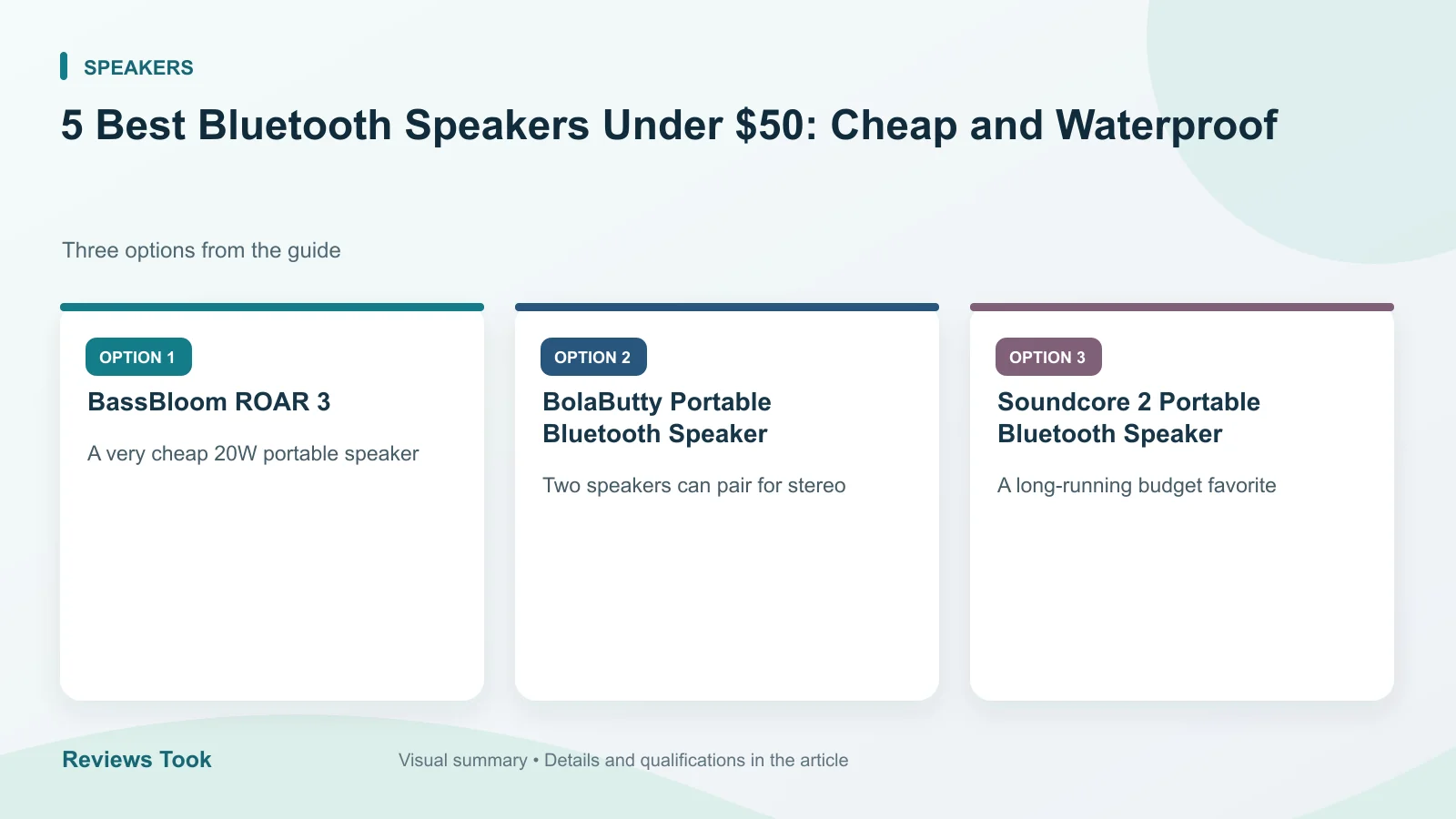
If this guide helped you decide what to look for, these products are a place to start.
As an Amazon Associate we earn from qualifying purchases. Prices and availability are shown on Amazon.
Putting the Guide Into Practice: Three Buying Walks
Advice about size, waterproofing and battery only becomes useful when it is applied to a real routine, so it helps to walk through the purchases people most often describe. Consider first the kitchen-and-garden listener: music and podcasts at moderate volume, hands often wet or floury, the speaker moved between a counter, a patio table and a shed bench. For that life, the priorities from this guide reorder themselves. Water resistance and a protected charging port come first, because the speaker will be splashed. A shape that wipes clean and stands stably on a worktop comes second. Battery claims come third, because the speaker is rarely far from a socket, and outright loudness comes last, because a kitchen does not need party volume. A buyer who ranks those in the order a listing page presents them, loudest first, will very likely buy the wrong speaker for a routine that is actually about resilience and convenience.
Now consider the traveller and camper, whose speaker lives in bags, tents and car boots. Here durability, weight and honest battery life at real listening volumes lead, followed by a charging connection that matches the cables already carried for a phone, because one shared cable is worth more on a trip than a small difference in sound. Water resistance still matters, but as weather insurance rather than as a pool feature. Finally consider the small-room listener buying mainly for films, podcasts and background music at home. That buyer should weight clarity at low volume, a wired input or low-delay connection for video, and controls that are easy to use without an app, because the speaker will be touched daily and rarely moved. Same guide, three different correct answers, which is exactly why the sections above are organised by decision rather than by product.
Testing a Speaker Sensibly in the First Week
The first week with a new speaker teaches you almost everything, if you test the things your routine will actually demand. Start at low volume with speech: a podcast or a news programme reveals whether voices are clear without turning the speaker up, which is the test most home listening has to pass and the one showroom demonstrations never apply. Then test at the loudest volume you will genuinely use, in the place you will use it, and listen for strain on familiar music rather than for impressive bass on a demonstration track. Check pairing from the rooms and distances your home imposes, including the wall or floor that will usually sit between phone and speaker, because a connection that only works in the same room will irritate you for years.
Test the unglamorous features too. Charge the speaker from empty once, noting whether it plays while charging if your routine needs that, and confirm the cable you already own fits and charges it, rather than discovering a mismatch on the first trip. If the speaker has an app, decide during the return window whether you actually value it, because an app you resent granting permissions to will not become more welcome with time. Try the physical buttons with wet or cold hands if outdoor use is planned. These small checks take an hour across a week and settle questions that specifications leave open. A speaker that passes your own routine tests can then simply be enjoyed, and one that fails can be returned while returning is still easy.
Pairing, Placement and Getting the Best From What You Bought
Most disappointment with a speaker that is fundamentally suitable comes from placement, and placement costs nothing to fix. A speaker pushed into a corner or onto a crowded shelf will sound boomy and muffled compared with the same speaker given a little space on a firm surface, because nearby surfaces reinforce some frequencies and swallow clarity. Indoors, try the speaker at roughly ear height when seated, a short distance from walls, and notice how speech clarity changes as you move it. Outdoors the problem reverses: with no walls to help, a small speaker sounds thinner and quieter, so placing it on a table or against a fence, and sitting closer rather than turning it up to distortion, gives a better result than maximum volume across a garden.
Pairing habits matter just as much over time. Keep the speaker connected to the device you use most, and learn how it behaves when a second household phone has also paired with it, because speakers that happily reconnect to the last device can appear stubborn when two phones compete. If connection problems appear, removing the speaker from a phone list and pairing afresh solves more cases than any other single step. For linked or stereo setups, test the arrangement in the room where it will live before committing to it for an event, and keep linked speakers reasonably close to each other and to the source. None of this is technical expertise. It is the small, repeatable care that separates a speaker that delights its owner for years from an identical speaker that is always somehow faintly disappointing.
Ownership Over Years: Batteries, Wear and Replacement Timing
A Bluetooth speaker usually leaves service for one of three reasons: its battery no longer holds a useful charge, its controls or port cover wear out, or its owner needs change. You can delay the first two with simple habits. Avoid leaving the speaker fully discharged for long periods, avoid storing it in hot cars or cold outbuildings, and charge it with the port cover properly refitted afterwards so the seal that protects it stays effective. Wipe grilles and seams free of sand, salt and kitchen grease before they harden into the finish, and let a wet speaker dry fully before charging, every time, without exception. These habits are boring, which is precisely why they work: battery and seal failures are usually the accumulation of small neglects rather than a single accident.
When performance does fade, judge replacement by your routine rather than by age. A speaker that still serves a kitchen perfectly at moderate volume does not need replacing because its maximum party endurance has shortened. Conversely, a travel speaker whose battery now fails mid-trip has stopped doing its job even if it sounds fine at home, and replacing it is sensible rather than indulgent. If you do replace, carry the lessons of the old speaker into this guide: the size you actually carried, the water exposure you actually met and the volume you actually used are better guides than any specification. Owners buying their second speaker almost always choose better than owners buying their first, because they are finally shopping for their real life instead of an imagined one.
Choosing for Children, Guests and Shared Households
Many speakers are bought by one person and used by a whole household, and that changes what good looks like. For a family kitchen or a shared living space, the best speaker is the one guests and children can operate without instruction: obvious buttons, a pairing process that forgives fumbling, a volume control that cannot be misunderstood and a build that survives being knocked, carried by one corner and wiped down after sticky encounters. A speaker with exquisite sound that only its owner can connect to will spend its life being bypassed in favour of a phone speaker, which is the worst outcome in this entire category. If the speaker will be shared, test it during the first week by handing it to the least technical person in the house and watching, silently, whether they can play something. That experiment is worth more than any feature list.
For childrens use specifically, add three household checks to the guide criteria. Prefer a speaker that can be volume-limited through its app or the source device if late-night enthusiasm is a concern. Prefer a design without small detachable parts and with a charging arrangement an adult can supervise easily. And place the speaker where its cable, if it charges in place, does not cross a walkway or invite pulling. None of this appears in specification tables, yet it decides whether a shared speaker becomes a beloved household object or a source of low-level conflict. The same logic applies to a speaker bought for an older relative: large, legible controls, a simple charging routine and a sound that favours clear voices at modest volume will be thanked for daily, while party loudness will be used perhaps twice. Buy for the household you have, in the rooms you have, and let the specification serve that life rather than replace it.
A Final Household Test Before the Return Window Closes
Use the return window as part of the purchase rather than as an admission of failure. In the first week, deliberately stage the moments the speaker was bought for: a podcast while cooking with wet hands and a running tap, music in the garden at the distance you actually sit, a film scene with quiet dialogue in the evening, and a morning of background listening at low volume while the house wakes up. Note which of those moments, if any, produced a complaint, and whether the complaint was about sound, connection, controls or placement, because each has a different remedy and only some of them mean the speaker itself is wrong. Move the speaker before you blame it, reconnect it cleanly before you condemn its wireless behaviour, and charge it fully before you judge its endurance. A speaker that survives that honest week of staging has earned its place. One that fails the same moment repeatedly has told you, cheaply and in time, that a different size or style from this guide will suit your life better.
Closing Perspective
One final thought belongs in every speaker purchase, whatever the size or setting. Sound is social in a way most technology is not: a speaker is usually bought to be heard by other people, in kitchens, gardens, living rooms and campsites where its success is measured by whether the moment around it got better. That is why the untechnical tests in this guide matter so much, the wet hands, the handed-over controls, the quiet dialogue late at night. A speaker that passes them becomes part of how a household relaxes, celebrates and spends ordinary evenings together, and it will be forgiven almost any specification shortfall in exchange. A speaker that fails them will be technically impressive in a cupboard. Choose, test and keep yours by the standard of the moments it will actually accompany, and the decision will still look right years from now, long after the listing details that once seemed decisive have been completely forgotten by everyone who enjoys it.
Frequently Asked Questions
What matters most?
Where you use it.
What does IP rating mean?
Dust and water protection.
Peak watts?
A maker figure.
How far can a Bluetooth speaker be from my phone?
The listing may state a range, but walls and interference reduce it. Keeping the phone in the same room gives the most reliable connection.
Can I use a Bluetooth speaker with a TV?
Some TVs support Bluetooth audio, while others need an adapter or a wired connection. Check your TV's settings and the speaker's inputs.
Why does my speaker sound distorted at high volume?
Small speakers can distort when pushed to their limit. Lower the volume, check the source's volume level and adjust any bass boost.
Can I connect two speakers together?
Many brands offer pairing features, but they usually work only within the same maker's lineup. Check the listing for pairing instructions.
How long do the batteries last over time?
Rechargeable batteries wear down with use, so playtime gradually drops. Avoid extreme heat and deep discharges to help preserve them.
Do I need a speaker with a microphone?
Only if you want hands-free calls. Built-in microphones are convenient but vary in quality.
Is a bigger speaker always better?
Bigger speakers can produce fuller sound, but they are heavier and less portable. Match the size to where you will use it.
Should I choose a speaker with a wired input?
A wired input is useful if you want to connect a TV, a laptop or an older music player without Bluetooth. It also avoids the small delay that wireless audio adds. Check the listing for the type of connector so you can bring the right cable.
Can I use a Bluetooth speaker while it charges?
Many can, but not every model. The listing or manual should say whether playback during charging is supported. Charging while playing at high volume may generate more heat, so keep the speaker in a ventilated spot.
Does a higher Bluetooth version always sound better?
Not by itself. A newer version can help with connection stability and range, but sound quality depends on the drivers, the tuning and the codec both devices share. Treat the version number as one factor among several.
Is it safe to leave a speaker plugged in all the time?
Many people do this with desk speakers, but heat is the main concern. Keep it ventilated and away from direct sun, and follow the maker's guidance. If the case becomes noticeably hot, unplug it.
How do I fix a speaker that will not pair?
Switch Bluetooth off and on, forget the speaker in your phone's list and put the speaker back in pairing mode as the manual describes. Keep the devices close together during the process. If it still fails, try another device to see whether the speaker or the phone is at fault.
What should I do if my speaker gets wet and stops working?
Turn it off, disconnect any cable and let it dry fully in open air before trying to charge it. Do not use heat sources to speed this up. If it still does not work, check the warranty terms and the manual.
Is it worth buying a speaker with a companion app?
It can be, if you want an equalizer, firmware updates or easier pairing. Many speakers work fine without any app, so decide whether you will actually use the features. Review the app's permissions before installing.
What size Bluetooth speaker should I buy for a small room?
A compact or mid-size speaker is usually enough for a small room, because you sit close and do not need much volume. A larger speaker adds bass but takes more space. Choose by how loud you listen, not by the biggest number on the box.
Is IPX7 or IP67 better for a Bluetooth speaker?
They protect against different things. The first digit covers dust and the second covers water, so a code with both numbers tells you more than one with a letter in place of the dust digit. Pick the code that matches whether you face sand, splashes or full submersion.
Can a Bluetooth speaker stay connected to two phones?
Some models can, while many connect to only one device at a time. The listing or manual should say whether multi-device connection is supported. If you share the speaker with family, confirm this before you buy.
Why does my Bluetooth speaker cut out?
Distance, walls and other wireless devices are the usual causes. Move the phone closer, remove obstacles and restart the Bluetooth connection on both devices. If it keeps dropping, test with another phone to find the weak link.
Do Bluetooth speakers lose battery when not in use?
Most lose a small amount of charge slowly even when switched off, and more if they stay in standby. Store the speaker with a partial charge and top it up now and then if you will not use it for weeks.
Is a Bluetooth speaker better than a smart speaker?
It depends on the job. A Bluetooth speaker is portable and works with any paired device, while a smart speaker usually stays plugged in and adds voice features. Choose the Bluetooth type if you move around or want a simple setup.
Bottom Line
Match size and rating to your use, then check battery.
More Speakers Guides
- Best Bluetooth Speakers
- Best Waterproof Bluetooth Speakers
- Best Party Speakers
- Best Cheap Bluetooth Speakers
- Best Shower Speakers
- Best Powered Bookshelf Speakers
- Best Computer Speakers
- All Speakers guides