Disclosure: As an Amazon Associate, reviewstook.com earns from qualifying purchases. Links to Amazon on this page are affiliate links; they cost you nothing extra.
Not every camera supports WiFi adapters.
This guide is built from Amazon product listings and maker specs, not our own testing, so confirm compatibility, speed ratings and current price on each product page.
Check the current price on Amazon before buying.
Last updated: November 1, 2026.
In this guide
Quick Picks
| Product | Type | Best for |
|---|---|---|
| TF to SD Card WiFi Adapter | WiFi SD adapter | wireless transfer |
| ASHATA TF to SD WiFi Memory Card Adapter | WiFi SD adapter | wireless transfer |
| Fdit WiFi SD Card Adapter | WiFi SD adapter | wireless transfer |
Our Picks

Top pickBest for wireless transfer
1. TF to SD Card WiFi Adapter
A TF to SD Card WiFi Adapter (wifi sd adapter), per the listing. Check price on Amazon.
Good for: wireless transfer. Watch out: Check camera compatibility.


Best for wireless transfer
2. ASHATA TF to SD WiFi Memory Card Adapter
An ASHATA TF to SD WiFi Memory Card Adapter (wifi sd adapter), per the listing. Check price on Amazon.
Good for: wireless transfer. Watch out: Check camera compatibility.


Best for wireless transfer
3. Fdit WiFi SD Card Adapter
A Fdit WiFi SD Card Adapter (wifi sd adapter), per the listing. Check price on Amazon.
Good for: wireless transfer. Watch out: Check camera compatibility.

How to Choose
Capacity
128GB to 256GB covers most uses. Check the maximum your device supports.
Speed rating
U3, V30 and A2 describe sustained video and app performance. Match them to your device.
Seller and fakes
Buy from a reputable seller to avoid counterfeit cards.
How a Wireless Card Adapter Works
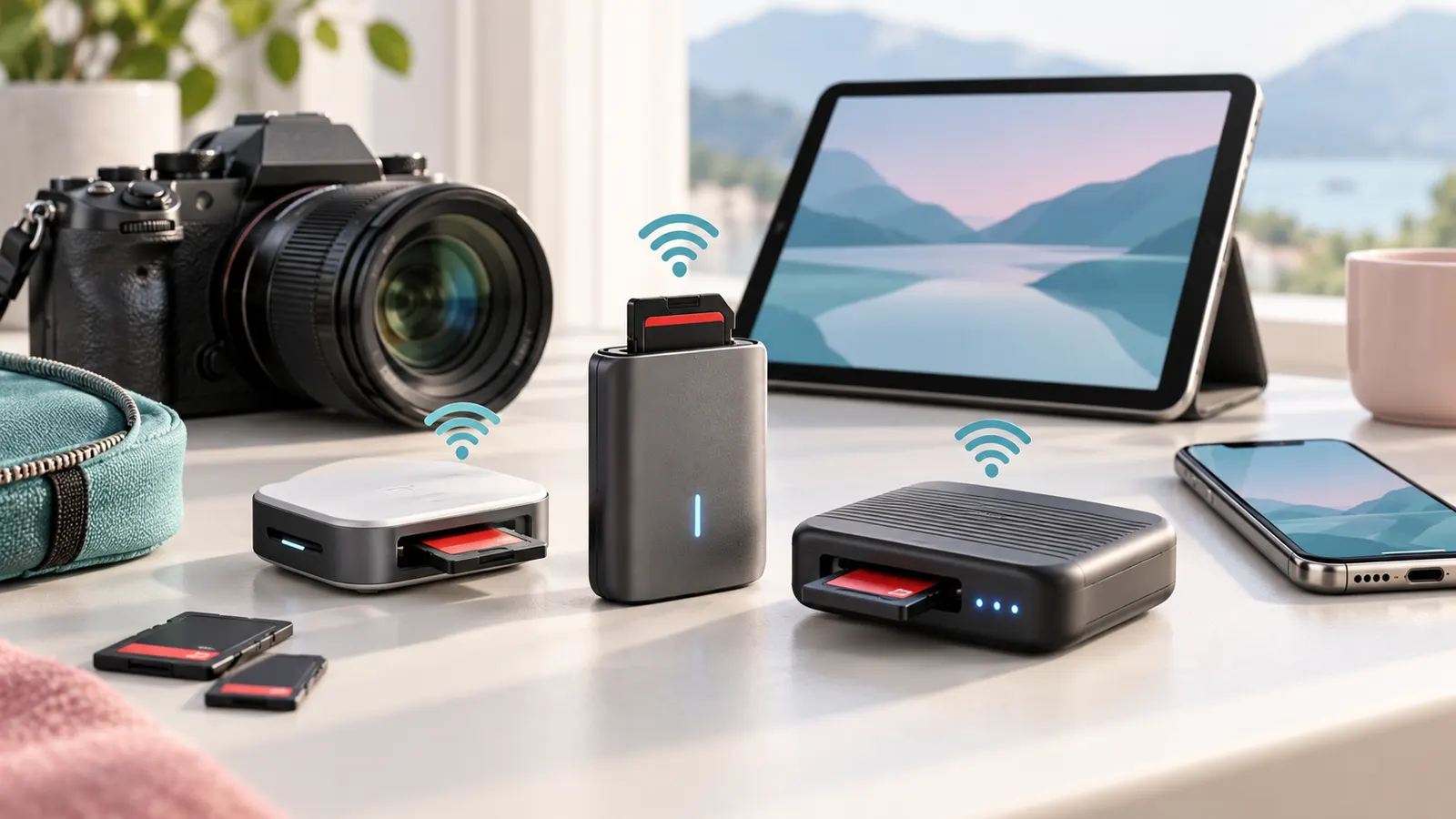
A wireless SD adapter looks like an ordinary full-size SD card, but it contains a small radio and a slot for a microSD (often called TF) card. When you place a memory card in it and slip it into the camera, the camera saves pictures to the card as normal. The adapter’s radio then lets a phone, tablet or computer connect to it and see the stored files.
Most adapters of this type create their own wireless network and rely on a companion app or a web page. Your phone connects to the adapter, browses the thumbnails and copies the files you choose. This differs from a camera that has built-in wireless features, where the camera itself handles the connection. The adapter turns an older camera into one that can share files, with some limits.
Because the adapter is a separate device, the camera has no idea the radio exists. It does not trigger transfers on its own, and it cannot manage the connection. You should expect a process that is slower and less polished than built-in features. Read the product listing to see what the adapter claims it can do, and read the camera manual for any warning about third-party cards.
Camera and Card Format Limits
The most common problem with these adapters is compatibility. A camera needs to accept a full-size SD slot, read the card format and supply enough power for the radio. Older cameras that only support smaller capacities may not recognize a large card inside the adapter. Others may refuse the adapter because of how it presents itself to the camera.
Two of the picks in this post are named as TF to SD adapters, which means a microSD card goes inside; check the third listing for its card type. Check the card capacity the listing says is supported, and the card format, because cameras may expect a specific file system for certain sizes. The note at the top of this post, that not every camera supports wireless adapters, is a warning to verify first, not after unboxing.
If a camera has a write-protect behavior, shoots in a mode that locks the card or uses dual card slots with special rules, it can affect results. Look for owner reports for your exact camera model in the listing questions, and keep the receipt in case you need to return. Test the adapter with a small number of pictures before relying on it for an important shoot.
Transfer Speed and File Size Expectations
Wireless transfer through a tiny adapter is slower than a cable or card reader. The rate depends on the radio inside, the signal quality, interference and the size of the files. A small JPEG may move in a moment, while a large raw file or a video clip can take a long time and may fail halfway.
The listing may not give a transfer figure, and if it does, treat it as a best case. Consider what you actually need. If you are sending a handful of pictures to a phone for social media, a modest speed is enough. If you want to move hundreds of raw files after a day of shooting, a card reader remains the more practical choice.
Some apps let you transfer reduced-size versions, which can save time. Others only copy the originals. Batch selection helps, as does keeping the phone close to the camera. Remember that the camera must stay powered on during the transfer, and a long session can drain the camera battery, so start with a full charge. Try transferring at a spot with minimal interference, away from microwave ovens and crowded wireless networks, and keep the phone and camera close and steady until the progress indicator confirms each file has arrived.
Connecting Securely and Managing the Network
Because many adapters broadcast their own network, your phone may leave your home network and lose its normal internet connection while connected. Some apps allow both connections, while others do not. Read the setup instructions and see how to switch back easily. If your phone automatically reconnects to the adapter at inconvenient times, there may be a setting to disable that.
Security deserves attention. Change the default network name and password if the app allows it, and avoid leaving the adapter on a network with no password. Turn the camera off or remove the adapter when you are not transferring, both to save battery and to prevent unwanted access. Be careful with sensitive pictures.
Keep the adapter’s firmware and app up to date when the maker provides updates, and use only the app or page the manufacturer recommends. If the listing does not clearly describe its app, platform support and update process, take that as a caution. Check that the app works with the version of the operating system on your device before ordering. For public events, consider turning the adapter’s network off entirely until you are ready to copy files, which limits who can see the adapter and keeps the camera battery in better shape.
Troubleshooting and Getting Reliable Results
If the camera cannot read the card, remove the adapter, check that the microSD card is seated fully and try again. Format the memory card in the camera, which creates the structure it expects. Remember that formatting erases the card, so copy anything important first. Try a different card if problems persist, because some cards behave differently inside adapters.
If the phone cannot find the adapter, check that the camera is on and not in sleep mode, since many cameras cut power to the slot after a period of inactivity. Make sure the radio is enabled and the battery is charged. Move closer to reduce interference, and disconnect from other networks that might compete for the connection.
Keep a backup habit even with wireless transfer. Do not erase the original card until you have confirmed the files on your device. Handle the adapter gently, since the thin shell and exposed contacts can wear, and avoid heat and moisture. Replace it when it stops being recognized, the shell cracks or the connection becomes unreliable, and consider a regular card reader if the wireless features cause more trouble than they save. If you still see odd behavior, search for the exact model name together with your camera model, since other owners often share working settings and notes that the manual leaves out.
Choosing the microSD Card That Goes Inside
Because the adapters in this guide act as a carrier for a smaller card, the card you slide into them decides a good share of your results. The adapter’s radio only exposes what the card holds, so a slow, worn or poorly matched card shows up as slow browsing, missed files or a camera that refuses to write. Spend a little time on the card before you blame the adapter.
Start with capacity limits. Many older cameras were built for cards up to a certain size, and a larger card can behave oddly even when it physically fits. The adapter listing and the camera manual should both name a ceiling. If they disagree, trust the lower number. A moderate capacity is also easier to manage wirelessly, since a card with thousands of images takes longer to index and scroll through on a phone screen.
Next, think about speed class. A camera that records burst sequences or video needs a card that can keep writing without stalling, and the wireless layer adds its own overhead on top. Choose a card with a speed rating at least as high as your camera asks for, and buy from a reputable source, because counterfeit cards often advertise sizes and speeds they cannot sustain. A quick way to catch a fake is to fill the card with test files and then verify that every file reads back correctly.
- Pick a brand-name card rather than an unbranded bargain, since the adapter cannot fix a failing card.
- Format the card in the camera, not on a computer, so the file structure matches what the camera expects.
- Keep the card and adapter together as a pair, and label them so a spare does not get swapped in unnoticed.
- Replace a card that has begun producing read errors rather than hoping the radio will cope.
Wireless Adapter Versus Other Ways to Move Photos
It helps to compare this approach with the alternatives before you commit. A wireless SD adapter is one of several routes from camera to phone, and each has a different mix of convenience, speed and cost.
Card reader and cable
A small USB card reader, or a phone adapter that accepts a card, is usually the fastest and most dependable method. There is no radio to configure, no network to join and no battery draw from the camera. The cost is a manual step: you remove the card, plug in the reader and copy files. For large raw files, this is still the sensible default.
Built-in camera wireless
Newer cameras often include their own wireless features, with a maker app that can trigger transfers, tag files and sometimes control the shutter. If your camera already offers this, an add-on adapter adds little. The adapter’s value lies with older cameras that have no radio at all.
Add-on adapter
The adapter sits between the two: no reader to carry and no replacement camera to buy, in exchange for slower transfers and more setup. It makes the most sense when you want to share a few good pictures quickly, such as sending a photo from a trip or an event while you are still there.
Be honest about your volume. If you shoot a few dozen frames a session and share a handful, the adapter’s convenience is real. If you shoot hundreds and edit everything, a reader will save you time.
Workflow Habits That Make Wireless Transfer Practical
The adapter works best when you build a few routines around its limits. None of these are complicated, but together they separate a useful tool from a frustrating one.
Shoot first and transfer later. Trying to move files while you are still composing shots wastes camera battery and splits your attention. Take your pictures, then pause, power up the connection and pick only the ones worth sharing. Mark keepers in the camera if it allows, so you can recognize them in the phone’s thumbnail view.
Use smaller file settings when sharing is the goal. If you know the shots are headed to a social feed or a message thread, a lower-resolution setting produces files that move faster and take up less room on the phone. If you also want full-quality originals, record at the higher setting and use the card reader later at home.
Keep a simple backup rule. Because the adapter copies files rather than moving them, the originals stay on the card. Do not delete them from the card until they are safely stored somewhere else, and do not treat a successful phone transfer as a backup, since the phone copy may be a reduced version.
- Charge the camera battery before an outing where you plan to transfer.
- Join the adapter’s network only when you need it, then switch your phone back to its usual connection.
- Transfer in small batches and confirm each batch opens correctly.
- Carry a card reader as a fallback for the day the wireless link will not cooperate.
Heat, Power Draw and Long-Term Reliability
An adapter with a radio inside draws power from the camera’s card slot, and that power becomes a little heat. Over a short session this is rarely noticeable, but a long transfer on a warm day can leave the adapter warm to the touch. Heat is a reason to avoid leaving the radio active in a closed camera bag, and to turn it off when you are not sending files.
Power draw also explains why some adapters behave differently in different cameras. A camera that supplies steady power to its slot treats the adapter well, while another may struggle with the extra load and drop the connection. If you see random disconnects, try a fully charged battery first, then test a different camera if you have one, to see whether the pattern follows the camera or the adapter.
For longevity, treat the adapter like any memory card. Keep it dry and clean, avoid bending it, and store it in a case rather than loose in a pocket. Check the maker’s support page now and then for firmware updates, which sometimes address compatibility with specific cameras. If a unit starts to show errors in several cameras and with several cards, it has probably reached the end of its life, and a replacement is cheaper than lost pictures.
A Closer Look: Getting More From This Choice
A wireless SD adapter is a workaround that became a workflow: it gives cameras without built-in wireless a way to hand photos to a phone or tablet in the field, at the cost of speed, battery and a little patience. Judging one fairly means judging the whole chain it creates, the microSD card inside it, the camera’s playback behaviour, the app, and the network the adapter creates around itself. The sections below go through that chain link by link, compare the adapter route honestly with cables, readers and built-in camera wireless, and set out the habits that make wireless transfer a dependable tool rather than a novelty that disappoints on its second outing.
The three adapters here, the TF to SD Card WiFi Adapter, the ASHATA TF to SD WiFi Memory Card Adapter and the Fdit WiFi SD Card Adapter, all follow the same architecture: a full-size SD shell holding a microSD card, with a small wireless radio that serves the card’s contents to an app. Because the architecture is shared, the differences that matter are practical rather than conceptual: app quality and updates, how reliably the adapter wakes and connects, and how honestly each listing describes compatibility. Whichever you choose, budget equal attention for the microSD card that goes inside it, since that card sets the real capacity and much of the real transfer behaviour, and test the pairing in your own camera before relying on it away from home.
Troubleshooting Card Problems in the Order That Finds Faults Fastest
When a camera reports a card error, resist the urge to format. Formatting destroys the evidence and often the files. Work through the simple causes first: power the camera off, remove and reseat the card, check the contacts for dust or fingerprints and clean them gently with a dry cloth, and try the card in a second device or reader. A card that reads perfectly in a reader but not in the camera points at the camera slot or a formatting mismatch; a card that fails everywhere points at the card itself. That one comparison splits the problem in half.
If files appear corrupted, stop writing to the card immediately. Continued use overwrites the very data recovery tools would look for. Set the card aside, work from a spare, and attempt recovery later from a computer using the card in a reader, copying recovered files to a drive rather than back onto the same card. Many apparent corruptions turn out to be a single damaged file among hundreds of healthy ones, and calm handling recovers nearly everything. Panic actions, repeated formatting, shooting over the card, checking it in device after device, do more damage than the original fault usually did.
Recurring errors with several different cards in one camera suggest the camera, not the cards: a worn slot, a bent contact or ageing firmware can all produce card complaints. Recurring errors with one card in several cameras confirm the card, and the answer is retirement, not another format. Keeping a short note of which card was in which camera when a problem occurred turns a confusing pattern into an obvious one within two or three incidents. Memory is unreliable for this; a dated note in your bag or phone is not.
A card that has been dropped in water or mud should be dried fully before it is powered, rinsed first with clean water if the contamination was salty or gritty, and then copied at the first opportunity and retired from critical work even if it seems fine. Corrosion can develop slowly on contacts after the card appears recovered. Treat any card that has survived an accident as a temporary rescue device: get the files off, thank it, and replace it. The cost of a replacement card is trivial compared with the shoot you would lose by trusting a compromised one once too often.
Choosing and Using a Card Reader That Does Not Bottleneck You
A reader should match the fastest card you own, not the slowest. If any card in your kit uses the UHS-II interface, the reader needs the second row of contacts to use it; otherwise that card transfers at UHS-I pace no matter what its label promises. The same logic applies at the computer end, where the port and cable decide what the reader can deliver. Buying a reader is therefore a small systems decision: list your fastest card, your computer’s best port, and choose the reader that connects those two without a weak link in between.
Multi-slot readers that can copy two cards at once change evening workflow on big shoots, because the second card copies while you sort the first. Even a single-slot reader benefits from a routine: start the copy the moment you sit down, before editing, email or anything else, so the transfer overlaps with tasks that need you rather than competing with them. Shooters who complain that offloading takes too long usually mean it takes too long at the end of the process, when it has become the only thing left to wait for. Moving it to the front costs nothing.
Carry the reader with the same seriousness as a spare card. A reader left at home turns a laptop into a paperweight on a trip, and camera USB cables are a slow substitute that also tie up the camera. A small reader in the camera bag, another at the desk, and cables you have actually tested remove the whole category of problem. Test a new reader the day it arrives by copying a full card and spot-checking files at the start, middle and end of the copy, because a faulty reader discovered on a deadline is a crisis and the same reader discovered on a quiet afternoon is a return label.
Formatting Discipline: Small Habits That Prevent Big Losses
Format cards in the camera that will use them, every time, after the files are safely copied. Formatting in the camera lets the camera build the exact folder structure and file system it expects, which removes a whole category of compatibility surprises. Formatting on a computer is not dangerous in itself, but it introduces variables, a different file system choice here, a quick-format default there, that occasionally collide with a particular camera’s expectations. The in-camera habit costs nothing and keeps one more thing standard across all your cards and bodies.
Never delete images one by one in the camera to make room mid-shoot. Deleting scattered files fragments the card’s free space, and the camera then has to work harder to write new files into the gaps, which can slow writing and, in the worst cases on older gear, contribute to file errors. The safer pattern is simple: carry enough capacity that you never need to delete in the field, swap to a fresh card when one fills, and do all culling later at the computer where you can see the images properly and where a mistaken deletion is easier to catch and reverse.
Give each card a recovery window. After a shoot, the card should stay untouched until its contents exist in two places and you have opened a sample of the files to confirm they are readable. Only then does it return to the active rotation. Shooters who format the card the moment it enters the reader are one failed copy away from losing the day. A small labelled case with two sides, shot cards on one side and cleared cards on the other, makes the state of every card visible at a glance and removes the guesswork entirely.
Verifying a New Card Before It Earns Your Trust
Counterfeit cards rarely fail on day one. They usually report a large capacity they do not have, accept files happily until the real storage fills, and then begin overwriting or corrupting what came before. That is why a new card should be tested before it carries anything that matters. A full write-and-verify test, filling the card completely and reading everything back, exposes false capacity in one pass. Free utilities exist for every major operating system that do exactly this, and the test needs no skill beyond patience. Run it once, on the day the card arrives, while returning it is still easy.
Buy from the marketplace seller, not just on the marketplace. The same listing page can be fulfilled by different sellers with very different sourcing, and counterfeit risk follows the seller rather than the brand name on the card. Prefer listings sold and dispatched by the platform itself or by the card maker’s authorised store, keep the order confirmation, and be suspicious of a premium card offered far below its usual level by an unfamiliar seller. A genuine card bought once is cheaper than a fake bought twice, and the savings on a suspicious listing are small next to the value of a single important shoot.
Inspect the physical card and packaging when it arrives. Blurry printing, misspelled words, a capacity or class marking that does not match the listing, and packaging that differs from the maker’s current design are all reasons to test rigorously or return immediately. Then register the purchase details somewhere simple, even a note with the date, seller and order number, because warranty help later depends on proof of purchase. None of this takes long, and together these habits reduce the counterfeit problem from a gamble to a routine check you perform on every new card.
A Complete Shoot-Day Card Workflow, Start to Finish
Start the day with every card formatted in the camera it will serve, empty, verified and stored cleared-side-up in the case. Batteries and cards get checked together, because a shoot rarely fails for one exotic reason; it fails for a flat battery or a full card that a ten-second check would have caught. Decide the slot strategy if your camera has two slots, confirm the setting rather than assuming it survived from last time, and note your starting card numbers if you are running a numbered rotation. The goal is that no decision about cards remains to be made once the shooting starts.
During the shoot, swap on your schedule, not the card’s. Changing cards at natural breaks, before the ceremony, before the second half, before the light changes, keeps each card’s contents aligned with a chapter of the day and means a card is never quite full when a decisive moment arrives. Put exposed cards back in the case on the shot side, in order, without exception. If a card must be reused the same day, it is only reused after its contents are copied and verified, and it goes to the back of the rotation so every other card is used first.
After the shoot, the order is copy, copy again, verify, then rest. The first copy goes to your working drive, the second to your backup, and verification means opening files, not just watching a progress bar finish. Cards stay on the shot side of the case until both copies exist and have been spot-checked; only then are they formatted and moved to the cleared side, ready for the next job. This rhythm feels ceremonial for the first few shoots and automatic after that, and it is the single biggest difference between photographers who have lost work and photographers who have not.
Storage, Handling and Care That Extend a Card’s Working Life
Memory cards are tougher than their size suggests, but their contacts and casing have real weaknesses. Store cards in individual cases rather than loose in a bag pocket, where grit scratches contacts and coins or keys can crack a casing edge. Keep the case in a consistent place so a missing card is noticed immediately. Heat is the slow enemy: a card left on a dashboard or in a car boot through a hot afternoon ages faster than one kept indoors, and repeated heat cycles are harder on the casing and contacts than steady room temperature ever is.
Handle cards by their edges and avoid touching the contact area. Skin oils attract dust and, over time, contribute to the intermittent contact problems that masquerade as card failure. If contacts do need cleaning, a dry, soft cloth and a gentle wipe along the contacts is enough; solvents and abrasives cause more harm than the dirt did. Insert and remove cards with the camera powered off unless the maker says otherwise, and never force a card that resists, because resistance usually means wrong orientation or debris, both of which get worse with pressure.
Retirement should be planned rather than discovered. Cards that have served through years of heavy use, that have survived drops or water, or that have produced even one unexplained error belong in light duty: casual snapshots, a spare in the glovebox, jobs you could reshoot without pain. Mark retired-from-critical-work cards clearly so they are not grabbed in a hurry for the one shoot that matters. A card’s price is small; its cargo is not. Rotating fresh cards into critical work on a schedule, rather than waiting for failures, is one of the cheapest reliability upgrades in all of photography.
Costly Card Mistakes That Have Nothing to Do With Speed
The most expensive card mistake is buying on capacity alone from an unknown seller at a suspicious price, then discovering during a once-only event that the card’s real capacity is a fraction of its label. The second most expensive is the single-card strategy: one huge card holding an entire trip, formatted by accident or lost with the bag, taking everything with it. Both mistakes are buying and planning errors, not technology failures, and both are completely avoidable with the verification and rotation habits described in this guide. Speed, the thing most buyers obsess over, causes remarkably few losses by comparison.
Frequently Asked Questions
Does a faster card help?
Only if your device can use the speed.
What is A2?
An app-performance rating useful for apps and games.
How do I spot fakes?
Buy from the official store or a trusted seller and test capacity.
Will a wireless SD adapter work with any camera?
No. Compatibility depends on the camera's slot, supported card sizes and power supply. Check the camera manual and the adapter listing before buying.
Does it drain the camera battery?
The radio draws power from the camera, so battery life can shorten, especially during long transfers. Start with a full battery and turn the camera off when not transferring.
Can I transfer raw files or video?
Often possible, but slow because of the file size. Test with a few files first, and consider a card reader for large batches.
Do I still need an app?
Many adapters rely on a companion app or a browser page. Check the listing for the app and the supported device systems before buying.
Is it safe to leave the adapter in the camera all the time?
It generally works as a normal card, but the radio may use power and expose files over wireless. Set a password and turn the camera off when it is not in use.
Why does my phone lose internet when connected to the adapter?
Many adapters create their own network, so the phone connects to that instead of your usual one. Check the app instructions for a way to keep both.
Can I use it as my regular memory card?
Typically yes, since it stores pictures like a normal card with a microSD inside. Check supported capacity and format, and avoid relying on a single card for important work.
Can I edit photos on my phone straight from a wireless SD adapter?
Usually you first copy the pictures from the adapter into your phone’s gallery or the maker’s app, then edit them with any editor. Editing files while they still sit on the adapter is rarely possible. Copy the keepers, confirm they open, and edit the phone copy so the originals on the card stay untouched.
Should I format a card in the camera or on a computer before using it in an adapter?
Format it in the camera whenever you can. The camera writes the folder structure and file system it expects, which reduces the chance of read errors. Formatting erases everything, so copy off any pictures you want first. Check the adapter instructions too, since some makers give their own formatting advice.
What happens if a wireless transfer is interrupted halfway?
The original file stays on the memory card, so nothing is lost, but the copy on your phone may be incomplete or corrupt. Delete the partial file, move closer to the camera, make sure the camera is still powered on, and send that file again. Transferring in small batches makes interruptions easier to spot.
Can I use a wireless SD adapter in a dash cam or video camera?
It depends on the device. Constant video recording asks a lot of a card and a radio, and some devices simply do not accept adapters or may overheat them. Check the adapter listing and the device manual for compatibility, and test with non-critical footage before trusting it for anything important.
Questions to Ask Before You Buy
- Which device will receive the files: a phone, tablet or laptop, and which system version does it run?
- Does your camera accept this kind of adapter, and does the camera maker mention any limits?
- Do you need to transfer whole folders, or just glance at a few shots on a small screen?
- Does the companion app work with the version of the software on your device?
- How long can the adapter run on battery power inside your camera before it drains it?
- What does the maker’s listing say about the supported memory card size?
Compatibility Checks
These adapters sit between your memory card and the camera slot, so physical fit comes first. Check the slot type, the card format and whether the camera expects a particular file system. Some older cameras only recognize smaller capacities, and some will not power the wireless radio at all. The manual for your camera is the best place to confirm this.
Next, think about the wireless side. Many adapters create their own network, which means your phone may drop its normal internet connection while you transfer files. Read the maker’s instructions to see how that works and whether you can switch back easily.
Matching It to Your Use
Someone sharing snapshots on a trip has different needs from a photographer who shoots in large raw files and wants a backup on a laptop. Transfer time grows quickly with file size, so consider how much you will move at once. If you often work in places with no network coverage, an adapter that makes its own connection may be handy.
Who Should Skip It
If your camera already has built-in wireless features, an adapter adds little. If you prefer a simple cable or a card reader and are happy with that workflow, you can skip it, particularly when you handle sensitive files and want to limit wireless exposure.
Why does my adapter connect at home but fail on location?
Location failures are usually power or interference rather than distance. A tired camera battery sags under the adapter’s extra draw, crowded wireless environments compete for the same airspace, and some cameras cut power to the slot sooner than the adapter expects. Test with a fresh battery, stand close to the camera for the first connection, and change one variable at a time; the cause is normally found within a few patient minutes.
Should I transfer every photo or only the keepers?
Only the keepers. Wireless transfer is the slow leg of the workflow, so mark or protect your best frames in the camera, transfer those, and leave the full card for a proper reader session later. This selective habit is what makes an adapter feel quick in practice: it was never meant to empty a card, it was meant to get the right handful of images onto your phone while the moment is still shareable.
Can the adapter stay in the camera as its everyday card?
It can, but judge it as a card first and a radio second. The camera writes to the microSD inside the adapter, so your everyday reliability is that microSD card’s reliability plus one extra layer of contacts. Many owners use the adapter for trips and events where sharing matters, and a plain card for everyday shooting. Either pattern works; drifting into it untested is what causes trouble.
What happens to files if the wireless connection drops mid-transfer?
The originals on the card are untouched, because the adapter is reading, not moving. The receiving app may hold a partial file or none, and the remedy is simply to reconnect and transfer again, then compare the received images with the card’s contents before formatting anything. Treat every wireless session as a copy to be verified, exactly as you would a cable copy, and interruptions become an annoyance instead of a risk.
How do I keep the adapter’s network secure in public places?
Change the default network name and password before your first outing, since defaults for popular gadgets are widely known. Connect only your own devices, and switch the adapter off, or remove it, when you are not transferring. The exposure window of a camera accessory is small, but the photos it serves are yours, and a minute of setup at home closes the question for the life of the product.
Bottom Line
Check camera compatibility before buying.
More Storage Guides
- Best Pro SD Cards
- SD Card Speed Ratings Explained for Beginners
- microSD vs SD Card
- Best MicroSD Cards for Phones, Handhelds and Cameras
- Best MicroSD Cards for Android Phones and Tablets
- Best Steam Deck microSD Cards
- Best Action Camera microSD Cards for 4K Video
- Best High-Endurance microSD Cards for Dash Cams


