Tower speakers are tall floor-standing loudspeakers with several drivers in one cabinet, built to fill a room with fuller bass and wider sound than most compact designs. We have not used these products ourselves, so this guide relies on general knowledge and the maker’s own descriptions rather than personal experience. It helps you compare drivers, cabinets and requirements before you choose.
The room matters as much as the speaker. Size, furniture, wall surfaces and where you sit all change how a pair sounds, and large towers can overwhelm a small space. Also check what drives them, because towers need a suitable amplifier or receiver, and a mismatch in power or impedance can limit how well the system works.
As an Amazon Associate we earn from qualifying purchases. Links on this site are affiliate links, and they do not change the information we give.
In this guide
Quick Picks
| Pick | Product | Best For |
|---|---|---|
| Best for Home Theater | Klipsch Reference Premiere RP-8000F II (Ebony, Each) | Big dynamics and easy volume in larger rooms |
| Best All-Rounder | Polk Signature Elite ES60 (Walnut, Each) | A balanced flagship for music and movies |
| Best Value for Stereo | ELAC Debut 2.0 F6.2 (Black, Each) | Three-way sound on a sensible budget |
| Best for Bass and Movies | SVS Prime Tower (Black Ash, Each) | Deep, controlled low end from a 3.5-way design |
| Best Budget Pick | Polk Monitor XT60 (Midnight Black, Each) | Hi-Res certified towers at an entry price |
Our Picks

1. Klipsch Reference Premiere RP-8000F II (Ebony, Each) — Best for Home Theater
Klipsch’s RP-8000F II is the flagship of the Reference Premiere II line, built around a 1-inch titanium LTS tweeter loaded into a larger 90° x 90° Hybrid Tractrix horn and two 8-inch Cerametallic woofers. The headline figure is sensitivity: at 98 dB, this speaker plays loud with modest amplifier power, which is exactly what the guide above says to check when matching towers to a receiver. Klipsch rates power handling at 150 W continuous into a nominal 8 ohms, and the rear-firing Tractrix port helps the dual woofers breathe, though you should still give the cabinet some distance from the back wall. Dual binding posts allow bi-wiring or bi-amping, and the Ebony finish cabinet stands about 43 inches tall. This listing is for a single speaker, so order two for a stereo pair. If your room is large, your amplifier is mid-powered and your listening leans toward films and live recordings, the RP-8000F II’s easy dynamics are hard to match at this tier.

2. Polk Signature Elite ES60 (Walnut, Each) — Best All-Rounder
The ES60 is the largest model in Polk’s Signature Elite range and the one to shortlist if one pair of towers has to handle music, films and games equally well. It combines a 1-inch Terylene dome tweeter, certified for Hi-Res Audio, with three 6.5-inch Dynamic Balance polypropylene woofers in a tall cabinet with Polk’s Power Port venting, which is designed to smooth airflow and reduce port noise while deepening bass. Polk quotes a frequency response of 36 Hz to 40 kHz and a sensitivity of 90 dB, and states the speaker works happily with amplifiers rated for 4 or 8 ohm loads, so most receivers are a safe match. The cabinet stands about 44.5 inches tall, and this Contemporary Walnut listing is for a single speaker. There is no powered section or wireless input; it is a straightforward passive tower that expects a proper amplifier. For a mixed-use living room where tonal balance matters more than sheer output, the ES60 is the most even-handed pick here.
View Polk Signature Elite ES60 on Amazon

3. ELAC Debut 2.0 F6.2 (Black, Each) — Best Value for Stereo
Designed by Andrew Jones, the ELAC Debut 2.0 F6.2 is a three-way floorstander at a price where many rivals are still two-way designs. A 1-inch cloth dome tweeter sits in a wide-dispersion waveguide, a dedicated 6.5-inch aramid fiber midrange handles vocals, and two further 6.5-inch aramid woofers take care of the bass in a braced MDF cabinet with three rear ports. ELAC quotes a frequency response of 39 Hz to 35 kHz, a sensitivity of 87 dB and a nominal impedance of 6 ohms, with a maximum power input of 140 W, so it pairs best with an amplifier that is comfortable driving a slightly heavier load. The cabinet is about 43 inches tall and finished in black ash vinyl, and this listing is priced per single speaker. Because the ports fire backward, follow the guide’s advice and keep some space behind it. For a music-first stereo system built step by step, the F6.2’s driver layout and cabinet work are unusually thorough for the money.

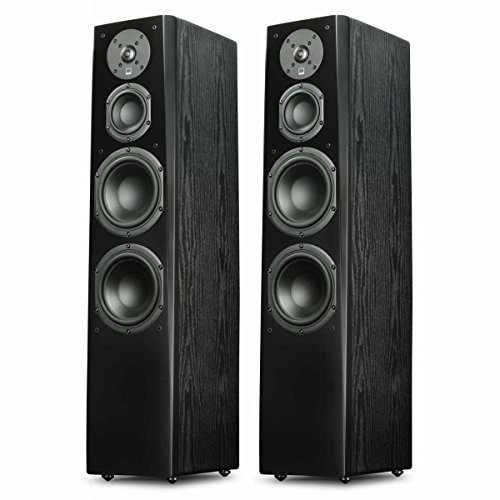
4. SVS Prime Tower (Black Ash, Each) — Best for Bass and Movies
The SVS Prime Tower uses a 3.5-way SoundMatch crossover, an arrangement more common in pricier speakers: a 1-inch aluminum dome tweeter, a dedicated 4.5-inch polypropylene midrange in its own sealed compartment, and two 6.5-inch woofers, each in a separate chamber with its own rear-firing port. That layout is why SVS can quote a frequency response down to 30 Hz, deep enough that many movie watchers can delay buying a subwoofer, as the guide’s FAQ discusses. Sensitivity is 87 dB into 8 ohms, and SVS recommends between 20 and 250 W of amplification, so a capable AV receiver or stereo amp is a good match. Build touches include chamfered driver surrounds, an FEA-optimized tweeter diffuser and a choice of finishes; this listing is the Premium Black Ash version, sold per speaker. At roughly 40 inches tall it is also a little easier to fit than the biggest towers here. If low-end weight and clear dialogue are your priorities, this is the pick.

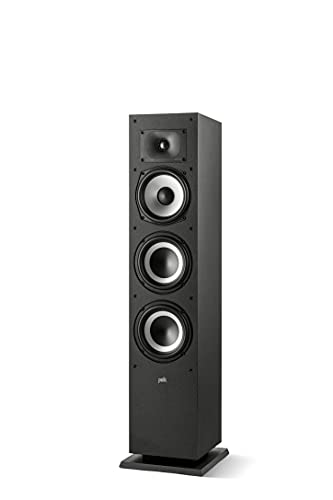
5. Polk Monitor XT60 (Midnight Black, Each) — Best Budget Pick
The Monitor XT60 is Polk’s most affordable tower and a sensible first floorstander. It pairs a 1-inch Terylene dome tweeter, Hi-Res Audio certified with response quoted to 40 kHz, with a 6.5-inch Dynamically Balanced woofer and two 6.5-inch passive radiators, which add low-end output without a port that needs wall clearance behind it. Polk quotes overall response from 38 Hz, a sensitivity of 86 dB and power handling up to 200 W, and describes the XT60 as compatible with 4 and 8 ohm amplifiers, so a typical entry-level receiver will drive it without drama. The cabinet stands about 36.4 inches tall, noticeably shorter than the other picks here, which helps in the smaller rooms the guide warns about, and it can accept Polk’s optional XT90 height module on top if you later build toward an Atmos setup. It is sold as a single speaker in Midnight Black. For a first home theater or a modest stereo corner, it covers the basics with the least strain on the budget.
What to Look For
| Factor | Why it matters | What to check |
|---|---|---|
| Driver layout | Woofers, mid-range and tweeters share the sound range. | Number of drivers, sizes and materials, as stated |
| Sensitivity | It shows how easily a speaker plays loud from an amplifier. | Maker’s sensitivity figure and recommended power |
| Impedance | It must suit what your amplifier can drive. | Nominal impedance and amplifier guidance |
| Cabinet build | A rigid cabinet reduces unwanted vibration. | Panel thickness, bracing and finish |
| Ports and placement | Port position affects how close to a wall you can place them. | Front or rear port and recommended distance |
| Connections | Terminals decide which speaker cables you can use. | Binding posts, bi-wire support and spikes or feet |
| Size and look | Tall cabinets need floor space and visual fit. | Height, width, depth and grille design |
Setup and Care Tips
- Place the towers an equal distance from the side walls and from you.
- Angle the speakers slightly inward toward your listening seat.
- Use spikes or feet according to the floor type and the maker’s guidance.
- Match the cable thickness to the run length and connect polarity correctly.
- Dust the cabinets with a soft cloth and keep drinks away from the drivers.
Mistakes to Avoid
- Pushing the towers against the back wall and creating boomy bass.
- Pairing them with an amplifier that does not suit their impedance.
- Ignoring the size of the room when choosing a large pair.
- Mixing up the positive and negative connections.
- Pressing on the driver cones while cleaning.
Which tower speakers should you buy?
The right tower speakers depend on your room size, your amplifier and whether you listen mostly to music or movies. Here is how the five named picks line up with common buyer types, based on the descriptions in this guide.
- Large room, home theater, mid-powered receiver: go for the Klipsch Reference Premiere RP-8000F II. Its high sensitivity means it plays loud without demanding much from the amplifier.
- One pair for music, movies and games: choose the Polk Signature Elite ES60. It is the balanced, even-handed option for a mixed-use living room.
- Music-first stereo on a sensible budget: the ELAC Debut 2.0 F6.2 is a three-way design that suits listeners building a system step by step.
- Bass and dialogue clarity for films: pick the SVS Prime Tower, which is the choice for low-end weight and may let you delay a subwoofer.
- First floorstanders or a smaller room: the Polk Monitor XT60 is the shorter, lower-cost route and its passive radiators do not need a rear port cleared of the wall.
Notice that every listing here is for a single speaker. Order two for a stereo pair, and make sure both are the same finish. If you plan to add a center channel and rear speakers later, staying within one maker’s range usually makes the sound blend more naturally. Compare the buttons above, check the listing for what is included, then choose the pair that fits your room and receiver.
How do you choose tower speakers for your room?
Choose tower speakers by starting with the room, not the spec sheet: a large room can use big cabinets with several woofers, while a small room is easily overwhelmed by too much bass. Room size, ceiling height, flooring and furniture all shape the final sound.
Hard floors, bare walls and large windows reflect sound and can make a pair sound bright. Rugs, curtains, bookshelves and upholstered furniture absorb some of that energy and calm the room. If your space is very reflective, a warmer-sounding tower or a few soft furnishings can help.
Think about the shape of the room as well. A long, narrow room can leave you sitting close to a back wall, which strengthens bass and may make it boomy. An open-plan space lets sound escape and may need more output to feel full.
- Small room: favor a shorter cabinet with ports that do not fire toward a nearby wall.
- Medium room: most three-way towers fit well and have room to breathe.
- Large or open room: look for higher sensitivity so the speakers fill the space without strain.
The seating position counts too. If you sit very close to the pair, you hear the individual drivers more clearly, and if you sit far away, room reflections become more important. Try to leave space behind and beside each cabinet so the bass stays controlled and the sound image forms between the pair.
Tower speakers vs bookshelf speakers with a subwoofer
Tower speakers give you full-range sound from one cabinet, while bookshelf speakers with a subwoofer split the job into small speakers and a separate bass unit. Neither is better in every home, so the choice comes down to space, budget and how much control you want over bass.
Towers are simpler to set up, because there is one pair of cabinets and no extra crossover to configure. They also tend to blend bass and midrange smoothly, since the same cabinet handles both. The drawbacks are floor space and the fact that placement of the pair affects bass and stereo imaging at the same time.
Bookshelf speakers and a subwoofer let you place each part where it works best. You can position the speakers for imaging and move the subwoofer to where the bass is smoothest. This gives flexibility, but it adds a cable run, a crossover setting and one more box to fit in the room.
- Choose towers if you have the space, want a simple system and prefer a single cabinet to handle music.
- Choose bookshelf plus subwoofer if you need a small footprint, want to tune bass separately or plan to use stands.
- Combine both if you want towers for stereo and an added subwoofer for movies later.
Whichever route you take, plan the amplifier and cables at the same time. A good pair matched to a poor amplifier will not sound its best.
What to check before you buy tower speakers
Before you buy tower speakers, confirm the amplifier match, the size, the connections and what comes in the box. Most returns and disappointments come from a mismatch that was visible on the listing.
- Amplifier match: compare the maker’s stated impedance and recommended power range with your receiver or amp manual.
- Single or pair: several listings in this guide are for one speaker, so confirm the quantity before checkout.
- Height, width and depth: measure your space and allow room behind the cabinet for ports.
- Finish: check the color name on the listing, because the finish choices differ between models.
- Binding posts: make sure your cable terminations fit, and check whether bi-wiring is supported if you want it.
- Feet or spikes: see what comes with the cabinet and whether it suits your floor.
- Grilles: check whether they attach magnetically or with pins, and whether the cabinet looks tidy with the grille off.
- Warranty and returns: read the seller’s terms on the listing, and keep the packaging until you are happy.
Heavy cabinets should be unpacked carefully. Ask someone to help lift them, and place them on a protected surface. Do not rely on a customer average alone; read how people describe the sound, the build and the packaging in general terms, and check how many people have rated the model.
Are more expensive tower speakers worth it?
More expensive tower speakers are worth it when you will hear the improvement in your room, such as better driver materials, tighter cabinet bracing and smoother tone. They are not worth it if the room, amplifier or sources hold the sound back.
Here is a fair comparison across the tiers in this guide.
- Entry level such as the Polk Monitor XT60 covers the basics, fits smaller rooms and leaves budget for a receiver and cables. It is a sensible first pair.
- Mid tier such as the ELAC Debut 2.0 F6.2 and the Polk Signature Elite ES60 add more refined drivers and larger cabinets, which suit people who listen to music often.
- Higher tier such as the Klipsch RP-8000F II and the SVS Prime Tower offer more output, deeper bass or more elaborate designs, which matter most in larger rooms.
The downsides are honest ones. Larger towers cost more to feed, take more floor space and can sound too heavy in a small room. A mid-sized room with a modest receiver may get more out of a well-matched pair than a bigger, harder-to-drive model.
Who should skip them? People who listen quietly at a desk or live in a small flat may be happier with compact speakers. If towers fit your space and your goals, compare the picks above, check the current listing for the finish and quantity, then choose the one that suits how you will use it.
Room, Placement and the Physics Behind Tower Speaker Specs
A tower speaker’s specifications describe what it does in a measurement chamber, but your room decides what reaches your chair. Bass builds up near walls and corners, so the same speaker can sound lean in the middle of a room and boomy pushed into a corner, and the distance from the rear wall is the first tuning tool you own. As a starting point, give towers breathing room behind and to the sides, sit at roughly the same distance from each speaker as the speakers are from each other, and angle them toward your listening position in small steps, listening after each change.
Sensitivity and impedance decide how hard your amplifier works. A more sensitive tower plays louder with less power, which matters for modest receivers and for large rooms, while a speaker that dips to low impedance asks more current from the amplifier at exactly the frequencies where music is busiest. You do not need to become an engineer, but you should confirm that your receiver or amplifier is comfortable with the impedance of the towers you choose, especially if you play loudly or plan to run a full surround system from one unit.
Driver arrangement shapes the sound between the speakers. Towers with the tweeter between or above midrange drivers, carefully designed crossovers, and cabinets that resist vibration aim to keep voices clear and centred. Floorstanding cabinets also give designers room for larger or multiple bass drivers, which is why towers usually extend deeper than bookshelf models; but depth is not the same as control, and a well-behaved moderate tower in a small room will sound better than a bass-heavy one exciting every resonance the room owns.
- Ported versus sealed: most towers are ported for deeper bass from a given cabinet; ports near a wall can over-emphasise bass, so placement flexibility is worth checking if your room forces speakers close to boundaries.
- Bi-wire and bi-amp terminals: present on many towers; they offer options for enthusiasts but are not a reason to choose one speaker over another for most listeners.
- Spikes and outriggers: stabilise tall cabinets on carpet and couple them firmly; on hard floors, use the supplied pads to protect the surface and prevent rocking.
- Centre-channel matching: if home theatre is in your future, choose towers from a range with a matching centre speaker, because dialogue consistency across the front stage matters more than any single specification.
Choosing Between the Picks in This Guide
The Klipsch Reference Premiere RP-8000F II and the SVS Prime Tower both chase impact, by different routes. The Klipsch uses horn-loaded high frequencies for an efficient, lively presentation that fills large rooms and home theatres with ease, and it asks little of amplifiers. The SVS pursues deep, controlled bass and a more neutral balance, suiting listeners who want movies and music served by the same pair and who may add a subwoofer later rather than immediately. If your room is big and your receiver modest, the Klipsch’s efficiency is a genuine advantage; if your taste runs to measured, even sound, the SVS argues its case.
The Polk Signature Elite ES60 is the all-rounder between them, voiced to flatter a wide range of music and film without demanding particular electronics, and its finish options acknowledge that towers are furniture as much as equipment. The ELAC Debut 2.0 F6.2 is the value engineer’s pick, designed to deliver the essentials of tower sound, clarity, reasonable depth, honest imaging, at a level that leaves budget for the amplifier and sources that complete a system. The Polk Monitor XT60 undercuts even that, and its role is the first step into real stereo or the foundation of a growing surround system.
All five are sold individually, so remember to budget and plan for a pair, and to think in systems: the best tower for you is the one that leaves your whole chain, amplification, placement, and room, in balance, not the one with the most impressive single number.
Setting Up Towers Step by Step
- Start with the speakers roughly where they will live, an equal distance from your main seat, and play familiar music with a centred vocal to establish a baseline before moving anything.
- Adjust the distance from the rear wall in small steps; moving towers out usually tightens bass and deepens the soundstage, while moving them back adds weight at the cost of clarity.
- Set toe-in gradually, from pointing straight ahead to aimed at your shoulders, and stop where voices focus into a stable centre without the sound narrowing.
- Level and stabilise each cabinet, fit spikes or pads for your floor type, and confirm a tall tower cannot rock, especially in homes with children or large pets.
- Run your receiver’s room correction if you use one, then listen again with it on and off; correction is a tool, not a verdict, and your ears arbitrate.
- Revisit after a week of normal listening, because your ears adapt and the placement that impressed in a test often wants one final, smaller adjustment.
Cable runs deserve the same calm attention. Keep left and right cables to similar lengths, route them where they will not be tripped over or pinched by the cabinets themselves, and make connections with the system off. Banana plugs or well-prepared bare wire both work; what matters is a firm, clean contact that will not loosen as cabinets are nudged during cleaning.
Tower Speakers in Four Real Situations
A dedicated home theatre room
Efficiency, dynamic headroom, and a matching centre channel lead the decision. Towers will carry the front stage’s music and effects, a subwoofer should still handle the deepest film bass, and placement should favour the main seats rather than the whole room. Dark finishes disappear under projection light, which is a practical virtue, not an aesthetic footnote.
A living room that is mostly for music
Choose voicing and looks together, because you will live with both daily. Placement will be a negotiation with furniture and traffic, so towers that behave well at moderate distances from walls are worth more than theoretical performance that needs a metre of clearance your room cannot give. A pair that images well at low evening volumes serves this room better than one that only wakes up when played loudly.
A growing system on a budget
Start with the value picks as a stereo pair, enjoy them fully, and add a matching centre, then surrounds, then a subwoofer as funds allow. Buying into a range with stable matching models matters more than squeezing one tier higher on the towers alone, because the system’s coherence over years is the real return on the first purchase.
A large, open-plan space
Open plans eat bass and demand output. Sensitive towers with real bass capability, placed with care around the listening zone rather than the whole space, are the answer, and expectations should be set honestly: you are building a listening area within the space, not pressurising all of it. A subwoofer placed near the listening position often contributes more here than a larger tower placed far away.
Testing and Living With Tower Speakers
Audition with your own recordings, including one you know is imperfect. Great speakers reveal good recordings beautifully and bad ones honestly, and a speaker that flatters everything in a short demo may tire you over months. Listen for whether voices stay intelligible at low volume, whether bass notes have pitch rather than thud, and whether you can listen for an hour without fatigue; that last test predicts ownership satisfaction better than any single impressive moment.
Ownership is mostly placement patience and dust. Keep cabinets out of direct sunlight, which fades finishes and ages surrounds, vacuum grilles gently, and re-check spike and pad stability after the speakers are moved for decorating or cleaning. If the sound changes one day for no obvious reason, check the simple things first: a loosened cable, a moved speaker, a setting changed by another household member. Towers are among the longest-lived products in home entertainment, and pairs chosen for your room rather than for a showroom routinely serve through several generations of the electronics feeding them.
Tower Speaker Terms, Explained Plainly
- Sensitivity: how loud a speaker plays with a given amount of power; higher sensitivity suits smaller amplifiers and larger rooms.
- Impedance: the electrical load the speaker presents to the amplifier; lower and more variable loads demand more capable amplification.
- Crossover: the circuit dividing frequencies between drivers, so each handles the range it reproduces best.
- Soundstage and imaging: the perceived width, depth, and placement of sounds between and beyond the speakers when setup is right.
- Toe-in: angling the speakers toward the listener, used to tune focus and high-frequency balance at the seat.
A Final Tower Speaker Decision Walkthrough
Measure your room and your amplifier before you fall for a cabinet. A modest receiver in a large room points to the efficient picks; a capable amplifier in a small room points to control and voicing over raw output. A music-first listener should weight the all-rounder and value picks by an hour of relaxed listening, while a theatre-first buyer should weight dynamics and the availability of a matching centre. Decide, finally, as a pair and as a system, because that is how the speakers will actually live in your home.
Amplifiers, Receivers and Powering Towers Honestly
The most common tower speaker disappointment is not the speaker; it is an underpowered or misconfigured receiver asked to drive demanding towers loudly in a big room. Read power specifications sceptically: figures quoted with one channel driven at high distortion flatter weak amplifiers, while honest ratings with all channels driven tell you what a film soundtrack will actually get. You do not need the largest amplifier, but you do need one whose maker publishes sober numbers and which is rated comfortably for your speakers’ impedance.
If you listen mostly in stereo, a good integrated amplifier will usually outperform a feature-stuffed receiver at the same money, because its budget went into power and preamp quality rather than licences and channels you never use. If film is central, a receiver with competent room correction and a proper subwoofer output serves you better, and the towers become part of a managed system where the deepest bass is handed to a subwoofer, letting the towers and the amplifier both work in the range where they are strongest.
Set speaker sizes and crossover points deliberately rather than accepting defaults. Towers set to large with no subwoofer is right for pure stereo; towers crossed over to a subwoofer in a theatre system often sound cleaner and play louder, because the amplifier and the tower woofers are relieved of the deepest frequencies. Change one setting at a time and live with it through a film and an album before judging, because system tuning by five-minute impressions produces systems tuned for demos rather than for ownership.
Room Correction and Simple Acoustic Fixes
Before spending on treatment panels, use what the room already owns. A rug between the speakers and your seat tames the floor reflection that hardens voices, curtains soften the wall behind the listening position, and a bookcase on a side wall breaks up reflections better than a bare surface. Moving your seat even a short distance out from the rear wall often improves bass evenness more than any electronic correction, because seats against walls sit exactly where bass pressure piles up.
Automatic room correction in modern receivers measures these problems and compensates, mainly in the bass, where the room dominates. Use it, but verify: keep the microphone at ear height at your real seat, measure the positions the system asks for, and afterwards listen for whether correction has thinned the sound by over-correcting higher frequencies. Many experienced users limit correction to the lower frequencies and leave the speaker’s natural character above them alone, which is an option worth exploring in your receiver’s settings.
Treat one problem at a time and keep notes. Rooms are systems, and changing the rug, the speaker position, and the correction settings in one afternoon leaves you with a different sound and no idea which change earned it. The patient method, placement first, furnishings second, electronics last, produces rooms that stay satisfying because every improvement was understood when it was made.
More Questions Worth Asking About Tower Speakers
Can tower speakers work in a small room?
Yes, with the right expectations and the right towers. Choose models with moderate bass output and well-controlled low frequencies, place them carefully, and sit far enough away for the drivers’ outputs to blend, which is the real small-room limit rather than the cabinet’s height. A tower that overwhelms a small room with bass will do so at any price, while a modest tower, properly placed, gives small rooms a scale and ease that small speakers strain to match.
Should I buy the subwoofer or the better towers first?
For film, a subwoofer transforms what towers of any tier can do, because the deepest effects are simply outside their design brief; for music, many listeners find good towers sufficient and prefer to invest in the pair they hear on every track. The practical order for a mixed system is towers you love in stereo first, since they carry almost everything you hear, then a subwoofer when film nights expose the missing foundation.
How long do tower speakers last, and what wears out?
Cabinets and drivers are long-lived; a well-kept pair commonly serves for decades. The ageing items are foam driver surrounds on some older designs, which can perish and are repairable, and the capacitors in crossovers over very long periods. Modern towers with rubber surrounds ask for little beyond dusting, stable placement, and protection from direct sun and curious toddlers’ fingers on exposed domes. Buy the pair that suits your room and you are likely choosing for a very long time, which argues for patience at the buying stage.
Buying Tower Speakers Second-Hand or on Sale: What to Check
Towers are among the safest hi-fi purchases second-hand, because they have no software to abandon and few moving parts to wear, but inspect the drivers before anything else. Look for pushed-in dust caps or domes, which often still play but signal careless handling, for surrounds that are cracked or sticky on older models, and for cabinets with corner damage that suggests a fall. Play a quiet, familiar track and listen for buzzes or rattles at moderate volume, which reveal loose panels, tired surrounds, or something resting inside a port.
Confirm both speakers of the pair are present, genuinely a pair from the same range and finish, and that grilles, spikes, and port plugs are included where the model uses them, because replacements for small fittings are disproportionately annoying to source. Ask why the seller is parting with them; upgrades and house moves fill the used market with honest pairs, and a seller who can describe the system they ran them in is usually a seller who looked after them.
On sale pricing, speaker ranges are replaced on multi-year cycles, and the outgoing range is routinely discounted hard while remaining identical in performance to the day it launched. If the picks in this guide have successors by the time you buy, the previous generation of the same model is often the smartest money in the category, provided the matching centre and surrounds for a future theatre system are still findable, which is the one forward-looking check worth making before you commit.
A Tower Speaker Listening Session, Run Properly
Whether you audition in a shop or in your own room during a returns window, structure the listening or it will structure you. Take the same short list of recordings every time: a voice you know intimately, a recording with genuine bass that has pitch and texture rather than mere thump, a busy piece that separates systems that stay composed from those that blur, and one quiet, simple recording that exposes noise, rattles, and imbalance mercilessly. Listen at the volume you actually live at, and then briefly at the volume your biggest film night demands, because speakers have two characters and you are buying both.
Change one thing at a time and write down what you hear in plain words before touching anything else: placement first, then toe-in, then any electronic settings. The notes matter because ears adapt within minutes and memory rewrites itself by evening; the listener who wrote three honest sentences at noon can still trust them at midnight. End the session by listening to a whole album or film scene without analysing anything, because the final question is not whether the speakers passed your tests but whether you forgot them while the music played, and that forgetting is the product you are actually buying.
FAQ
Do tower speakers need a subwoofer?
Not always, since towers often reach low frequencies themselves. Some listeners still add a subwoofer for extra low-end control, depending on the room and the music.
Are towers better than bookshelf speakers?
Towers usually give fuller bass and more output, while bookshelf models save space. The right choice depends on your room and how loud you listen.
How far should tower speakers be from the wall?
There is no single distance, because it depends on whether the ports fire to the rear and on the room. Many owners start with some space behind each cabinet and move them gradually until the bass sounds tight. Check the manual for the maker's guidance.
Do tower speakers need a special amplifier?
They need an amplifier or receiver that suits their stated impedance and power range, but not a special type. Check the manual of both the speakers and the amplifier. Towers are passive, so they cannot play without an external amplifier.
Should I buy one tower speaker or a pair?
Buy a pair for stereo sound. Several listings in this guide are for a single speaker, so you need to order two for left and right channels. Match the finish on both.
Can I use tower speakers for a home theater?
Yes, towers are a common choice for the front left and right channels in a home theater. You can add a center and surround speakers later, ideally from the same range so the tone blends.
Do I need to angle tower speakers toward the listener?
Angling them slightly inward often sharpens the stereo image, but it depends on the room and the speaker. Try both straight and angled placement and keep whichever sounds more focused from your seat.
What cable should I use for tower speakers?
Use proper speaker cable of a thickness suited to the length of the run, and connect positive and negative terminals consistently. Longer runs generally call for thicker cable. Check the amplifier manual for guidance.
Can I put tower speakers on carpet?
Yes, many towers include spikes or feet designed for different floors, including carpet. Follow the maker's guidance, and use protective discs on hard floors so the spikes do not scratch the surface.
How do I know if my receiver is powerful enough?
Compare the receiver's rated output into the speaker's impedance with the speaker's recommended power range. Higher sensitivity makes a pair easier to drive. If the numbers fall within the maker's guidance, the match is usually fine.
Questions to Ask Before You Buy
- How large is the room, and how far from the back wall can each cabinet sit?
- Does my receiver or amplifier match the impedance and power range listed for the speaker?
- Will the floor carry the weight, and do the cabinets come with spikes or feet that suit my flooring?
- Do I plan to add a center channel and rear speakers later, and would the tonal character blend?
- Are the binding posts friendly to the cable type I already own?
- Can I live with the cabinet height and depth next to my shelving and screen?
Writing answers down before browsing keeps the search honest. A tall cabinet looks impressive in a photo, but a narrow apartment living room may suit a slimmer design far better.
Matching Towers to Your Use
Music-first listeners often care about how a pair images across the room, so they tend to sit slightly off the wall and angle the cabinets inward. Movie fans usually care about dialogue clarity and how the towers pair with other channels. Mixed-use rooms call for a balanced voicing that does not tire the ear during long sessions.
| Use | What to Weigh | Typical Layout |
|---|---|---|
| Stereo music | Imaging, driver quality, cabinet bracing | Pair with room to breathe |
| Home theater | Matching across channels, sensitivity | Pair plus center and surrounds |
| Mixed living room | Footprint, finish, easy grille removal | Pair along a side wall |
Who Should Skip Towers
If your listening space is a small bedroom or a desk, a pair of compact stand-mounted models will usually fit the room better. Renters who move often may also find heavy cabinets a hassle. Towers reward space, so if you lack it, a smaller design is a perfectly sensible choice rather than a compromise.
Take a tape measure to the room, mark the footprint on the floor with tape, and live with that outline for a day. It is a simple way to learn whether the cabinets will crowd your walkways, block a window, or sit awkwardly beside a doorway. Also check how the grilles attach, since some owners prefer them off for critical listening and want a design that looks tidy either way.
Listening Position
Sit roughly as far from the pair as they are apart from each other, and try small adjustments of a few centimeters before settling.
The Short Version
Good tower speakers suit your room, your amplifier and the kind of music you enjoy. Measure the space, check the impedance and sensitivity, and compare the specs. Before buying, think about where you will sit and how far from the walls the cabinets can stand, because placement shapes the sound as much as the speakers do. Also plan the extras that complete the system, such as speaker cable, an amplifier or receiver, and a stable place for each cabinet, since these small additions shape the sound as much as the speakers do.
Related Guides
- How to Choose the Best Car Speakers: Buyer's Guide (2026)
- How to Choose the Best DJ Speakers: Buyer's Guide (2026)
- How to Choose the Best Outdoor Patio Speakers: A Buyer's Guide
- How to Choose the Best Wifi Speakers: Buyer's Guide (2026)
- 7 Best Full Tower PC Cases: Large E-ATX Builds (2026)