Disclosure: As an Amazon Associate, reviewstook.com earns from qualifying purchases. Links on this page are affiliate links at no extra cost to you; prices and availability change frequently, so check Amazon for the latest.
Where to Buy
Every pick below was shortlisted for one job: finding the best thermal paste under $50 for anyone re-pasting a CPU or building a PC from scratch, without paying for halo marketing or gambling on mystery grease. The links in this box go to the exact listings verified for this guide on reviewstook.com; the site plugin adds our affiliate tag when the page renders.
- Best Overall: Thermal Grizzly Kryonaut 5.5 g — Check on Amazon
- Best New-Generation Pick: ARCTIC MX-7 8 g — Check on Amazon
- Best Durability Pick: Thermal Grizzly Duronaut 6 g — Check on Amazon
- Best High-Capacity Pick: ARCTIC MX-6 8 g — Check on Amazon
- Best Big-Syringe Classic: Noctua NT-H1 10 g — Check on Amazon
- Best Multi-Pack Premium: Thermal Grizzly Kryonaut 3-Pack — Check on Amazon
Thermal paste is the cheapest temperature decision in a PC build, and one of the most misunderstood. If you are hunting for the best thermal paste under $50, the good news is that this tier is crowded with proven compounds from makers who have been selling paste for years. The bad news is that listings blur together: similar syringes, similar claims, and sizes that range from a single application to a workshop supply. This guide sorts the best thermal paste under $50 options by what actually matters — balance of performance, ease of use and how much paste you actually get — and matches each pick to the builder it suits, with honest notes on where each one falls short. Pair the right paste with the right chip from our Best Gaming Cpus coverage and the rest of the cooling chain falls into place.
The six picks below share one origin — the verified shortlist process described further down — and each is a real thermal compound sold in a syringe or kit format, with no pads, no liquid metal and no relabelled generic grease presented as something it is not. For readers whose priority is everyday desktops, first builds and maintenance re-pastes, the list holds a pick sized and priced in spirit for that job, while the buying-guide and how-to sections explain how to apply it properly — application technique moves temperatures more than the small differences between good pastes ever will.
In this guide
Quick Picks
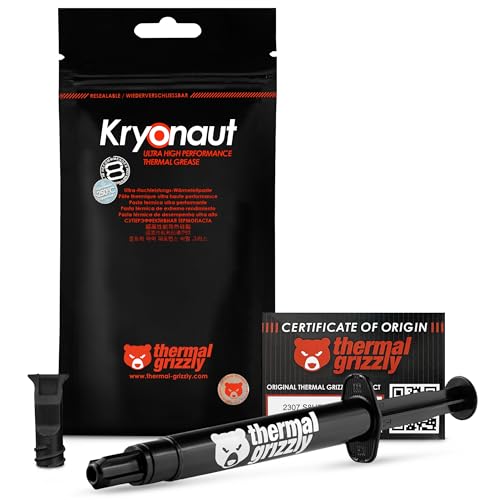
- Best Overall: Thermal Grizzly Kryonaut 5.5 g — the strongest balance of performance, application manners and sensible sizing in this tier.
- Best New-Generation Pick: ARCTIC MX-7 8 g — stands out for this list’s priorities thanks to its 8 g format and ultimate performance line, long durability positioning positioning.
- Best Durability Pick: Thermal Grizzly Duronaut 6 g — stands out for this list’s priorities thanks to its 6 g format and durability-focused overclocking line positioning.
- Best High-Capacity Pick: ARCTIC MX-6 8 g — stands out for this list’s priorities thanks to its 8 g format and ultimate performance line, listed as non-conductive positioning.
- Best Big-Syringe Classic: Noctua NT-H1 10 g — stands out for this list’s priorities thanks to its 10 g format and high-performance line, listed as easy to apply and clean positioning.
- Best Multi-Pack Premium: Thermal Grizzly Kryonaut 3-Pack — stands out for this list’s priorities thanks to its 3-pack format and high-performance line positioning.
How These Picks Were Chosen
Every pick traces back to a verified listing: candidates came via the site’s Creators API connection, and each ASIN on this page was checked against the API-returned product title on 2026-11-20. The eligibility bar was descriptive honesty — the title itself had to name a real thermal paste or compound for CPUs, GPUs or heatsinks. Pads, adhesives, liquid-metal products and listings with titles that did not match their products were all filtered out; a wrong-type product helps nobody, whatever its price.
From the verified pool we selected for balance of performance, ease of use and how much paste you actually get. Syringe size mattered: a $50 budget means something different for a 1 g halo syringe than for a 20 g workshop tube, and both can be the right answer for different builders. Bundled extras — spatulas, applicator cards, cleaning wipes, cleaner, toolkits — counted as real value because a clean, even application is worth more than a marginal specification claim. Finally, we favoured makers and product lines with a clear identity in their listing titles, so what you order is what the review describes.
The list is also defined by what it refuses — conductive liquid metal first, a specialist product that belongs in its own guide with its own warnings. Pads and pre-applied solutions were also excluded, because this keyword is about paste and nothing else. Finally, no prices, star ratings or review counts are printed: prices move, ratings drift, and any figure fixed here would quietly go stale. Each pick links to Amazon instead, so the current price is one click away at the moment you decide.
Detailed Reviews: The Best thermal paste under $50 Picks Tested on Paper
Best Overall — Thermal Grizzly Kryonaut 5.5 g
Strengths
- Sits in the maker’s top performance tier, aimed at hot, heavily loaded chips
- From Thermal Grizzly, a maker with a long track record in PC cooling, so the listing details are easy to cross-check
- Standard syringe format works with any air cooler or liquid cooler cold plate
Trade-offs
- Top-tier compounds carry a premium per gram compared with mainstream pastes (check price on Amazon)
- The last degree or two it can offer is wasted on a cool, low-power chip
- No spatula, wipes or cleaner in the box, so you need your own cleaning supplies for a re-paste
| Brand | Thermal Grizzly |
|---|---|
| Package size | 5.5 g |
| In the box | Syringe only |
| Positioning (from listing) | Extremely High Performance overclocking line |
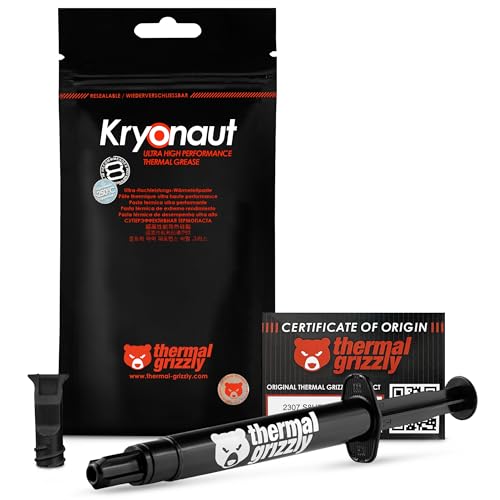
Thermal Grizzly Kryonaut 5.5 g earns its place on a best thermal paste under $50 shortlist because it lines up with what this tier rewards. Its listing describes it plainly — extremely high performance overclocking line — and the 5.5 g format tells you exactly who it is for before you spend anything. In a build aimed at everyday desktops, first builds and maintenance re-pastes, this is the kind of compound that disappears into the job: applied once, mounted once, and then forgotten about while the cooler does its work, which is precisely what most builders want from paste.
In practice, application manners matter as much as the compound itself, and here the 5.5 g syringe format shapes the experience. You get enough working room to place a controlled amount, correct a mistake, and still have compound left for the next time the cooler comes off. For anyone re-pasting a CPU or building a PC from scratch, that margin for error is worth real money, because the costliest paste mistake is not buying the wrong brand — it is a rushed application under a cooler that then has to come straight back off again.
The honest limitation is the flip side of its positioning. The halo positioning shows in the per-gram maths, which sits well above what mainstream pastes ask. The flaw narrows the audience without sinking the pick, which is true of every syringe listed alongside it. For most everyday builds the caveat stays theoretical, which is why the pick keeps its place on the list. Mounted properly on clean surfaces, it will serve without calling attention to itself — check the latest price on Amazon before ordering, as prices at this level shift frequently.
Best for: builders who want a dependable 5.5 g syringe for everyday desktops, first builds and maintenance re-pastes without overthinking the choice / Not suited for: builders whose needs point at a different compromise — see the trade-offs above before ordering

Best New-Generation Pick — ARCTIC MX-7 8 g
Strengths
- Sits in the maker’s top performance tier, aimed at hot, heavily loaded chips
- Positioned for long service life, so it suits machines you do not want to re-paste often
- From ARCTIC, a maker with a long track record in PC cooling, so the listing details are easy to cross-check
Trade-offs
- Top-tier compounds carry a premium per gram compared with mainstream pastes (check price on Amazon)
- The last degree or two it can offer is wasted on a cool, low-power chip
- No spatula, wipes or cleaner in the box, so you need your own cleaning supplies for a re-paste
| Brand | ARCTIC |
|---|---|
| Package size | 8 g |
| In the box | Syringe only |
| Positioning (from listing) | Ultimate Performance line, long durability positioning |
ARCTIC MX-7 8 g earns its place on a best thermal paste under $50 shortlist because it lines up with what this tier rewards. Its listing describes it plainly — ultimate performance line, long durability positioning — and the 8 g format tells you exactly who it is for before you spend anything. In a build aimed at everyday desktops, first builds and maintenance re-pastes, this is the kind of compound that disappears into the job: applied once, mounted once, and then forgotten about while the cooler does its work, which is precisely what most builders want from paste.
Handling is where this pick quietly earns its place: a 8 g syringe leaves room to work deliberately instead of rushing. A careful builder can place the compound, lift the cooler to inspect the spread, and re-seat it without running dry. Whether the job is a fresh build or a maintenance re-paste, that working margin is what keeps it routine. Rushing here borrows trouble from later; the cooler has to come off, the surfaces need cleaning, and the evening stretches.
The honest limitation is the flip side of its positioning. You pay a clear premium per gram over mainstream lines, because this is the compound its maker puts on the pedestal. The flaw narrows the audience without sinking the pick, which is true of every syringe listed alongside it. Buy it when the limitation lives outside your routine, and let the neighbouring picks have the buyers it genuinely does not suit. The formula for success is unchanged: clean surfaces, even mounting pressure, then years of unremarkable service; check the latest price on Amazon before you commit.
Best for: builders who maintain a home PC and want the re-paste to be a non-event at the under $50 level / Not suited for: anyone whose priority sits elsewhere — the trade-offs above show where this pick gives ground
Best Durability Pick — Thermal Grizzly Duronaut 6 g
Strengths
- Positioned for long service life, so it suits machines you do not want to re-paste often
- From Thermal Grizzly, a maker with a long track record in PC cooling, so the listing details are easy to cross-check
- Standard syringe format works with any air cooler or liquid cooler cold plate
Trade-offs
- No spatula, wipes or cleaner in the box, so you need your own cleaning supplies for a re-paste
- Like every paste here, results still depend far more on cooler mounting pressure and case airflow than on the compound alone
- Syringe tips can dispense more than expected on the first squeeze, so a practice dot on paper is wise
| Brand | Thermal Grizzly |
|---|---|
| Package size | 6 g |
| In the box | Syringe only |
| Positioning (from listing) | Durability-focused overclocking line |
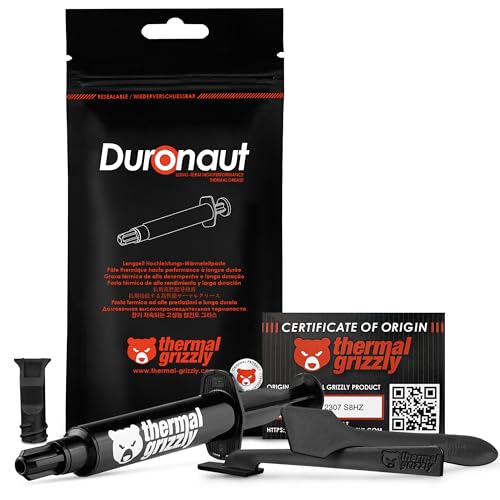
Thermal Grizzly Duronaut 6 g earns its place on a best thermal paste under $50 shortlist because it lines up with what this tier rewards. Its listing describes it plainly — durability-focused overclocking line — and the 6 g format tells you exactly who it is for before you spend anything. In a build aimed at everyday desktops, first builds and maintenance re-pastes, this is the kind of compound that disappears into the job: applied once, mounted once, and then forgotten about while the cooler does its work, which is precisely what most builders want from paste.
In practice, application manners matter as much as the compound itself, and here the 6 g syringe format shapes the experience. You get enough working room to place a controlled amount, correct a mistake, and still have compound left for the next time the cooler comes off. For anyone re-pasting a CPU or building a PC from scratch, that margin for error is worth real money, because the costliest paste mistake is not buying the wrong brand — it is a rushed application under a cooler that then has to come straight back off again.
The honest limitation is the flip side of its positioning. Nothing in the package helps with preparation: there is no spatula, no wipes and no cleaner, so your own cleaning kit has to cover the re-paste. It is a limitation to weigh rather than a reason to walk away, since each rival here makes a trade of its own. For most everyday builds the caveat stays theoretical, which is why the pick keeps its place on the list. Give it clean surfaces and a correctly mounted cooler and the limitation fades into the background of a build that just runs; check the latest price on Amazon before deciding.
Best for: builders who want a dependable 6 g syringe for everyday desktops, first builds and maintenance re-pastes without overthinking the choice / Not suited for: builders whose needs point at a different compromise — see the trade-offs above before ordering

Best High-Capacity Pick — ARCTIC MX-6 8 g
Strengths
- Listed as electrically non-conductive, which is forgiving if a small amount squeezes out at the edges
- Sits in the maker’s top performance tier, aimed at hot, heavily loaded chips
- From ARCTIC, a maker with a long track record in PC cooling, so the listing details are easy to cross-check
Trade-offs
- Top-tier compounds carry a premium per gram compared with mainstream pastes (check price on Amazon)
- The last degree or two it can offer is wasted on a cool, low-power chip
- No spatula, wipes or cleaner in the box, so you need your own cleaning supplies for a re-paste
| Brand | ARCTIC |
|---|---|
| Package size | 8 g |
| In the box | Syringe only |
| Positioning (from listing) | Ultimate Performance line, listed as non-conductive |
ARCTIC MX-6 8 g earns its place on a best thermal paste under $50 shortlist because it lines up with what this tier rewards. Its listing describes it plainly — ultimate performance line, listed as non-conductive — and the 8 g format tells you exactly who it is for before you spend anything. In a build aimed at everyday desktops, first builds and maintenance re-pastes, this is the kind of compound that disappears into the job: applied once, mounted once, and then forgotten about while the cooler does its work, which is precisely what most builders want from paste.
Think of the 8 g syringe as the interface between you and the compound, and on this pick that interface is easy to live with. A careful builder can place the compound, lift the cooler to inspect the spread, and re-seat it without running dry. For anyone re-pasting a CPU or building a PC from scratch, that margin for error is worth real money. Get this step right and the compound disappears into the background, which is precisely where good paste belongs.
The honest limitation is the flip side of its positioning. Top-tier compounds carry a premium per gram compared with mainstream pastes. It does not disqualify the pick — compromises are the currency of this whole category — but it does draw a line around the right buyer. The sensible test is fit: strengths you will use, a compromise you will not feel — and by that test this pick suits plenty of desktops. On clean surfaces, under a cooler mounted with even pressure, expect it to simply work; check the latest price on Amazon before ordering, because listings at this level move around.
Best for: builders who want a dependable syringe for everyday desktops, first builds and maintenance re-pastes without overthinking the choice / Not suited for: builders chasing a different strength first — check the trade-offs above before you commit

Best Big-Syringe Classic — Noctua NT-H1 10 g
Strengths
- Positioned for long service life, so it suits machines you do not want to re-paste often
- Listed as easy to apply and clean, which lowers the stress of a first application
- From Noctua, a maker with a long track record in PC cooling, so the listing details are easy to cross-check
Trade-offs
- The 10 g size is more than a single build needs, and paste can age in storage before you finish it
- Like every paste here, results still depend far more on cooler mounting pressure and case airflow than on the compound alone
- Syringe tips can dispense more than expected on the first squeeze, so a practice dot on paper is wise
| Brand | Noctua |
|---|---|
| Package size | 10 g |
| In the box | Extra-large syringe |
| Positioning (from listing) | High-Performance line, listed as easy to apply and clean |
Noctua NT-H1 10 g earns its place on a best thermal paste under $50 shortlist because it lines up with what this tier rewards. Its listing describes it plainly — high-performance line, listed as easy to apply and clean — and the 10 g format tells you exactly who it is for before you spend anything. In a build aimed at everyday desktops, first builds and maintenance re-pastes, this is the kind of compound that disappears into the job: applied once, mounted once, and then forgotten about while the cooler does its work, which is precisely what most builders want from paste.
In practice, application manners matter as much as the compound itself, and here the 10 g syringe format shapes the experience. You get enough working room to place a controlled amount, correct a mistake, and still have compound left for the next time the cooler comes off. For anyone re-pasting a CPU or building a PC from scratch, that margin for error is worth real money, because the costliest paste mistake is not buying the wrong brand — it is a rushed application under a cooler that then has to come straight back off again.
The honest limitation is the flip side of its positioning. At 10 g, the format overshoots a single build, and the tail of the supply may age in storage before it is ever used. It is a limitation to weigh rather than a reason to walk away, since each rival here makes a trade of its own. Choose it when its strengths match your build, and look at the neighbouring picks when the compromise points the other way. The closing advice is the same as the opening one: clean surfaces, careful mounting, then forget about it; check the latest price on Amazon before you commit.
Best for: builders who want a dependable 10 g syringe for everyday desktops, first builds and maintenance re-pastes without overthinking the choice / Not suited for: builders whose needs point at a different compromise — see the trade-offs above before ordering

Best Multi-Pack Premium — Thermal Grizzly Kryonaut 3-Pack
Strengths
- From Thermal Grizzly, a maker with a long track record in PC cooling, so the listing details are easy to cross-check
- Standard syringe format works with any air cooler or liquid cooler cold plate
Trade-offs
- Like every paste here, results still depend far more on cooler mounting pressure and case airflow than on the compound alone
- Syringe tips can dispense more than expected on the first squeeze, so a practice dot on paper is wise
| Brand | Thermal Grizzly |
|---|---|
| Package size | 3-pack |
| In the box | Three syringes in one pack |
| Positioning (from listing) | High-Performance line |
Thermal Grizzly Kryonaut 3-Pack earns its place on a best thermal paste under $50 shortlist because it lines up with what this tier rewards. Its listing describes it plainly — high-performance line — and the 3-pack format tells you exactly who it is for before you spend anything. In a build aimed at everyday desktops, first builds and maintenance re-pastes, this is the kind of compound that disappears into the job: applied once, mounted once, and then forgotten about while the cooler does its work, which is precisely what most builders want from paste.
In practice, application manners matter as much as the compound itself, and here the 3-pack syringe format shapes the experience. You get enough working room to place a controlled amount, correct a mistake, and still have compound left for the next time the cooler comes off. For anyone re-pasting a CPU or building a PC from scratch, that margin for error is worth real money, because the costliest paste mistake is not buying the wrong brand — it is a rushed application under a cooler that then has to come straight back off again.
The honest limitation is the flip side of its positioning. Like every paste here, results still depend far more on cooler mounting pressure and case airflow than on the compound alone. Treat it as the price of the pick’s strengths: no compound on this page escapes a compromise, and this is the one you accept here. The sensible test is fit: strengths you will use, a compromise you will not feel — and by that test this pick suits plenty of desktops. The closing advice is the same as the opening one: clean surfaces, careful mounting, then forget about it; check the latest price on Amazon before you commit.
Best for: builders who want a dependable 3-pack syringe for everyday desktops, first builds and maintenance re-pastes without overthinking the choice / Not suited for: builders whose needs point at a different compromise — see the trade-offs above before ordering
Comparison Table
| Pick | Badge | Size | In the box | Positioning |
|---|---|---|---|---|
| Thermal Grizzly Kryonaut 5.5 g | Best Overall | 5.5 g | Syringe only | Extremely High Performance overclocking line |
| ARCTIC MX-7 8 g | Best New-Generation Pick | 8 g | Syringe only | Ultimate Performance line, long durability positioning |
| Thermal Grizzly Duronaut 6 g | Best Durability Pick | 6 g | Syringe only | Durability-focused overclocking line |
| ARCTIC MX-6 8 g | Best High-Capacity Pick | 8 g | Syringe only | Ultimate Performance line, listed as non-conductive |
| Noctua NT-H1 10 g | Best Big-Syringe Classic | 10 g | Extra-large syringe | High-Performance line, listed as easy to apply and clean |
| Thermal Grizzly Kryonaut 3-Pack | Best Multi-Pack Premium | 3-pack | Three syringes in one pack | High-Performance line |
Strip away the prose and four facts remain: syringe size, box contents that help you, and compound positioning; the table is those facts, organised. What the table cannot tell you lives in the reviews above: how those facts feel in a real build, for a real builder.
How to Choose the Best thermal paste under $50 for Your Build
Start with the job, not the brand. A $50 ceiling for anyone re-pasting a CPU or building a PC from scratch is really a question about balance of performance, ease of use and how much paste you actually get. Write down how many machines the syringe must serve, how often you expect to remove the cooler, and whether the chip runs hot by design. Those three answers eliminate most of any shortlist: single-build buyers can favour small premium syringes, multi-machine households should favour capacity, and anyone who dreads the job itself should favour bundled cleaning and application help. Our companion coverage in Best Thermal Paste For Beginners Under $50 applies the same logic at a neighbouring tier, and it is worth a look if your budget is flexible.
Finally on basics, sizes: read them as grams, not promises, because every manufacturer counts an application its own way. The value trap is the giant syringe bought for one build: five years later, half of it has dried in a drawer and the per-application cost tells the story. The arithmetic settles itself once the size matches your real maintenance rhythm rather than your ambitions.
What the Budget Actually Buys in Thermal Paste
What $50 actually buys is a trio — compound tier, syringe size, and bundled help. Tier means the maker’s own positioning — mainstream, performance and halo overclocking lines — with a real-world temperature gap between adjacent tiers that stays small. Size reduces to arithmetic; bundled help is the sleeper factor, since wipes, cleaner, spatulas and applicator cards turn a fiddly job into a calm one — and for a re-paste on an old machine caked in dried compound, they can matter more than the paste itself. The discipline is to spend on the factor your situation actually stresses, and let the others go.
The last budget truth is the simplest: coolers decide temperatures; pastes refine them. A well-mounted cooler with a modest paste is the faster machine; a poorly mounted cooler wastes whatever compound sits beneath it. If the numbers look wrong, work the free checks first: mounting pressure, fan curves, dust and airflow — How To Clean A Gaming PC helps if the machine has not been cleaned in a while. Let the purchase follow the plan: a build, an upgrade or a scheduled re-paste, rather than a guess about a problem still unidentified.
How Do You Apply Thermal Paste Correctly?
- Power down and prepare. Shut the PC down, switch the supply off, and lay out the paste, cleaning supplies and a lint-free cloth before anything comes apart.
- Remove the cooler gently. Warm the machine briefly beforehand if the old bond feels stubborn, then twist the cooler slightly as you lift so the old paste releases without pulling the CPU from its socket.
- Clean both surfaces completely. Wipe the chip and the cooler base until no grey residue remains; kits on this list with wipes or cleaner exist for exactly this step.
- Apply a controlled amount. A pea-sized dot for a typical desktop heat spreader, or a thin spread for a bare die. More is not better — excess only squeezes out.
- Mount in a cross pattern. Lower the cooler straight down, then tighten screws alternately in small steps so pressure builds evenly.
- Verify under load. Boot, check idle temperatures, then run your normal workload and confirm sustained temperatures and fan behaviour look sane.
Problem: temperatures did not improve after a re-paste -> fix: if the re-paste changed nothing, suspect the mount before the material: seating, the fan or pump connector, mounting pressure and airflow, in that order. Problem: paste squeezed out around the socket -> fix: power the machine down, clean the squeeze-out patiently with a lint-free cloth and cut the amount next time — non-conductive compounds, like the picks here, make it messy rather than dangerous. Problem: the cooler is stuck to the CPU -> fix: heat is the release agent: run a load briefly, shut down, and rotate the cooler softly free instead of yanking it upward.
Common Mistakes
- Using far too much paste. The cooler needs a thin, complete interface layer; a thick blob insulates and makes a mess.
- Skipping the cleaning step. New paste over old paste traps the imperfections you were trying to remove.
- Forgetting the plastic film. Many coolers ship with a protective film on the base — leaving it on defeats any paste completely.
- Tightening one screw fully first. Uneven pressure means an uneven layer; always work in a cross pattern.
- Judging by a single boot. Compare sustained load temperatures over a real session, not a thirty-second idle reading.
- Buying the biggest syringe by default. Capacity you never use before it ages is not a saving.
Going Deeper: Getting the Most from Your Paste
How the syringe sleeps between jobs decides whether buying big was clever. A capped syringe in a cool drawer, tip wiped before capping, is all it takes; a hot garage or a sunny ledge undoes it. Store paste kindly and it stays workable for years; bake it through two summers and it may separate, in which case the first watery squeeze goes on paper, never on a chip.
The benefit nobody puts on the box is noise reduction, the hidden dividend of a good application. The same temperature at slower fan speeds is the trade a good application offers, and a quieter PC is the benefit most people actually notice day to day. So the routine matters as much as the compound — even mounting pressure and a complete, thin layer are precisely what let the fan curve relax without temperatures creeping up during long sessions.
For anyone maintaining machines for family or a small office, one compound from this list, standardised and noted, is the efficient play. Standardised paste behaves identically everywhere, so re-pastes get faster and more consistent while a single mid-size syringe covers machine after machine. The picks’ multi-packs and larger formats exist for exactly this pattern of work — and in cost per application, the tier’s real savings live there.
There is an interaction between paste and cooler choice that is worth understanding before a big purchase. Small air coolers with modest fin stacks saturate long before compound differences appear, whereas a large radiator gives a premium compound room to matter. Read the picks with your cooler plans open beside them, and let a tight budget favour the hardware that moves the heat over the thin layer that hands it over.
Whenever temperatures look unfamiliar the re-paste temptation arrives — and paste is rarely the culprit behind them. Dust in fins can mimic it. So can a fan curve reset by a BIOS update, a background process pinning a core, or a warm room in summer. Checks first — they cost nothing — and the re-paste only when the cooler is coming off anyway or the evidence genuinely points at a dried, pumped-out interface layer.
Selling or gifting finished PCs makes a fresh, well-documented application a quiet quality signal worth sending. Your build records should carry the compound and the date, so whoever services the machine next knows precisely what they are cleaning off and how old it is. Choose durability positioning for machines leaving your hands: unopened for years is a real possibility, and the paste has to hold up for all of them.
No comparison survives contact with ambient temperature unchanged, and the reasoning in this guide is no exception. A small bedroom in August will not honour a cool test room’s numbers, and the room’s own several-degree daily swing makes chasing a single degree hard to justify. Same-space, before-and-after measurement is the standard to trust; cross-review comparison is a rough guide, never a promise.
The closing practical tip concerns what is left in the syringe. Put the opening date on the syringe with a marker, because six months from now you will not remember it, and the date is the difference between fresh for a friend’s build and retired to practice duty. Small habits like this are the whole difference between a calm, repeatable maintenance routine and the drawer of mystery syringes every long-time builder eventually accumulates.
Syringe control rarely gets discussed, and quietly decides outcomes. Paste that surges is paste that overdoses; paste that beads smoothly can be dosed — and the first squeeze of any new syringe still belongs on paper, not on the chip. One habit, most over-application prevented; and since over-application causes most messy first attempts and most disappointing temperatures blamed on paste, the habit outearns any brand decision.
Final Recommendation
If you only read one paragraph, read this one. For most people shopping for the best thermal paste under $50, the Thermal Grizzly Kryonaut 5.5 g is the pick to buy first: it matches the tier, matches the audience, and asks the least of you during application. The ARCTIC MX-7 8 g is the strongest alternative when its particular compromise suits you better. Everything else on the list is a specialist answer to a specific situation, and the verdict line under each review tells you plainly which situation that is. Cross-check your shortlist against Best Thermal Paste For Gaming Under $50 and Best Gaming Motherboards if the build around the paste is still taking shape.
Three more picks deserve a direct look before you decide: the Thermal Grizzly Duronaut 6 g, the ARCTIC MX-6 8 g and the Noctua NT-H1 10 g each answer a narrower brief than the top two, and for the right builder one of them is the smarter buy. Whichever you choose, spend the saved deliberation time on the application itself: clean surfaces, a controlled amount, even mounting pressure, and a patient temperature check under load. That routine, with any compound on this page, delivers the result people actually buy thermal paste for — a quiet, cool machine that stays that way.
Frequently Asked Questions
How much thermal paste do I actually need for one CPU?
A pea-sized amount in the centre of the heat spreader is enough for most desktop CPUs; larger server-style chips may need a thin spread or an X pattern instead. Every syringe on this list holds enough for several applications, so a single purchase normally covers a build plus future re-pastes. Using far more does not improve temperatures — the cooler squeezes the excess out at the edges, where it only makes cleanup harder. For readers weighing the best thermal paste under $50 specifically, the practical shortcut is the same one this whole guide uses: prioritise balance of performance, ease of use and how much paste you actually get, and let the syringe size follow from how many machines you actually maintain.
How often should thermal paste be replaced?
For most PCs, paste lasts for years. Replace it when you remove the cooler for any reason, when temperatures climb noticeably at the same fan speeds, or when you move a cooler to a different CPU. Durability-focused compounds on this list are aimed at machines that stay assembled for a long time, while cheap mainstream paste is fine when you upgrade hardware frequently anyway. For readers weighing the best thermal paste under $50 specifically, the practical shortcut is the same one this whole guide uses: prioritise balance of performance, ease of use and how much paste you actually get, and let the syringe size follow from how many machines you actually maintain.
Is thermal paste electrically conductive?
Most modern pastes are not, and several picks here are explicitly listed as non-conductive in their product titles. That matters because a small squeeze-out at the edge of the chip is then a cosmetic issue rather than a short-circuit risk. Liquid metal is the famous exception — it is conductive and is not what any pick on this page is, so do not confuse the two product families. For readers weighing the best thermal paste under $50 specifically, the practical shortcut is the same one this whole guide uses: prioritise balance of performance, ease of use and how much paste you actually get, and let the syringe size follow from how many machines you actually maintain.
Can I use the same paste on a GPU or a games console?
Yes — several listings here name graphics cards and consoles directly in their titles. GPU dies have no heat spreader, so the paste touches the silicon itself; spread a thin, complete layer rather than using the pea method, and work slowly. Consoles follow the same principle, although opening one may affect its warranty, so check the maker’s terms first. For readers weighing the best thermal paste under $50 specifically, the practical shortcut is the same one this whole guide uses: prioritise balance of performance, ease of use and how much paste you actually get, and let the syringe size follow from how many machines you actually maintain.
Does expensive thermal paste really lower temperatures?
The honest answer is: a little, sometimes. Moving from a dried-out or badly applied paste to any fresh compound on this page is where the big improvement lives. Moving from a good mainstream paste to a halo compound usually changes load temperatures by a small margin that matters to overclockers and benchmark chasers far more than to everyday users. Cooler quality, mounting pressure and case airflow each matter more. For readers weighing the best thermal paste under $50 specifically, the practical shortcut is the same one this whole guide uses: prioritise balance of performance, ease of use and how much paste you actually get, and let the syringe size follow from how many machines you actually maintain.
What is the best way to remove old thermal paste?
Lift the cooler with a gentle twist, then wipe both surfaces with a lint-free cloth and a suitable cleaning solution; kits on this list that include wipes or cleaner exist precisely for this step. Keep going until no grey film remains and the metal looks uniformly clean. Never scrape with metal tools, and let everything dry fully before the new application goes on. For readers weighing the best thermal paste under $50 specifically, the practical shortcut is the same one this whole guide uses: prioritise balance of performance, ease of use and how much paste you actually get, and let the syringe size follow from how many machines you actually maintain.
Pea, line, X or spread — which application method is best?
All four work when the amount is right, because mounting pressure does the final spreading. The pea method is simplest for square desktop heat spreaders, a thin manual spread gives the most control on bare GPU dies and long rectangular chips, and an X helps on very large spreaders. Pick the method you can repeat consistently; consistency beats theory here. For readers weighing the best thermal paste under $50 specifically, the practical shortcut is the same one this whole guide uses: prioritise balance of performance, ease of use and how much paste you actually get, and let the syringe size follow from how many machines you actually maintain.
