Targus has spent decades doing one thing — carrying other people’s laptops safely — and that specialisation is why a single-brand guide to its backpacks makes sense. Where a generalist luggage brand treats the laptop pocket as one compartment among many, Targus treats it as the engineering problem at the centre of the bag: shock-absorbing materials borrowed from protective gear, suspension systems that hold the machine off the base of the pack, checkpoint designs patented for airport security lanes. As an Amazon Associate, this site may earn an affiliate commission from qualifying purchases made through links on this page, at no extra cost to you, and that support is what keeps these in-depth buying guides free to read.
This guide covers five current Targus laptop backpacks, every one of them with a dedicated laptop compartment sized for 15 to 16 inch machines according to the manufacturer’s own specification. They are separated by the axis that actually matters in this catalogue: how the laptop is protected. At the top sit two distinct protection technologies — D3O impact material in one model, a suspended SafePort sling in another — and below them a ladder of modular organisation, commuter security and travel design. Four of the five belong to the EcoSmart line, and each of those carries a manufacturer-stated recycled content figure, counted in reclaimed plastic bottles, which the reviews quote model by model because the numbers differ more than the shared branding suggests.
One warning before the picks, because this brand demands it: Targus sells generations side by side. The flagship Cypress Hero exists in an older version with ordinary padding and a newer one built around D3O, and the difference is a model code, not a product name. Colour variants change codes too. Every review below names the exact code for the specification it describes, and the notes on variants are not fine print — they are the difference between buying the bag described and buying its predecessor. Match the code at checkout with the same care you would match a laptop’s own model number.
Context helps explain the catalogue’s depth. Targus built its name supplying the bags that corporations issued with their laptop fleets, and the range still carries that fleet DNA: durability and protection are engineered first, fashion is applied afterwards, and model lines persist for years because business buyers reorder what already works. That is why this guide can contain a design as long-serving as the Drifter II alongside a 2025 modular experiment like the Work+ without either looking out of place — the brand serves the replacement cycle of working equipment, not the season cycle of accessories. For a buyer, the practical consequence is pleasant: specifications are published in unusual detail, model codes are stable, and a bag bought this year can usually be reordered, repaired or replaced with its twin years later.
The boundary of the guide is simple. These are work bags for laptops: no camera backpacks, no gaming luggage, no other brands, however strong their rival models. The site’s general guide to laptop backpacks covers the cross-brand field for readers still choosing a maker; here the question is the narrower one Targus owners actually face — which of the company’s own designs fits the way you move through a working week, and what exactly the protection claims on each one mean.
In this guide
Quick picks: best targus laptop backpacks
| # | Product | Where to buy |
|---|---|---|
| 1 | Targus Cypress Hero EcoSmart Backpack | Check on Amazon |
| 2 | Targus HeritageLuxe Backpack | Check on Amazon |
| 3 | Targus Work+ EcoSmart Backpack | Check on Amazon |
| 4 | Targus Terra EcoSmart Backpack | Check on Amazon |
| 5 | Targus Drifter II | Check on Amazon |
What to Look for in a Targus Laptop Backpack
Inside one brand, the differences that matter are protection technology, organisation and security, in that order. The factors below translate Targus’s own vocabulary into buying decisions.
Laptop Protection: D3O, SafePort Sling and Padding
Three levels of protection divide this range, and they are genuinely different mechanisms rather than marketing tiers. D3O is a specialist impact material — soft and flexible in ordinary handling, stiffening on sudden impact — and Targus lines the laptop compartment of the current Cypress Hero with its D3O Zero formulation, so the machine’s corners and faces sit against a material engineered for knocks rather than mere foam. The SafePort SafeSling in the HeritageLuxe takes the opposite approach: the laptop is suspended in a sling inside the compartment, held away from the base and walls of the bag, so the most common accident — a backpack set down hard or dropped on its base — spends its force on the bag’s structure instead of the computer’s corner. Below those two, the rest of the range uses conventional padded compartments, which protect against scratches, jostling and casual bumps perfectly well. Decide by your accident history: daily train commuters whose bags get dropped and kicked should buy a mechanism; careful car commuters are paying for insurance they may never claim.
Sizing: 15.6 Inches, 16 Inches and the Thick-Laptop Problem
Screen-size badges are a shorthand, and like all shorthands they hide the cases that matter. Four of these five bags are specified for laptops up to 16 inches, and the Drifter II for machines up to 15.6 inches, but the figure describes the class of machine the compartment was designed around, not a guarantee for every chassis sold under that screen size. A slim ultrabook slides into any compartment here with room to spare; a thick gaming or workstation laptop with protruding rear vents can be a tighter proposition in the same nominal class, and its owner should compare the machine’s actual dimensions against the compartment’s before ordering. Sleeves and cases carried inside the bag consume room too. The safe habit is to measure the laptop you own — width and depth, not the diagonal on its box — and treat the badge as the beginning of the check rather than the end of it.
Capacity and Organisation
Capacity in this range runs from the low twenties in litres, and the litres behave differently from model to model. The Work+ reorganises the whole idea: its laptop and tablet live in a detachable tech organizer that clips out by magnetic fasteners, so the bag converts between full pack and light carry without repacking. The Drifter II is the largest here at 32 litres, shaped for travellers who pack the bag itself as their luggage. Count what you actually carry — laptop, charger, headphones, water bottle, a layer — and buy the smallest bag that swallows it without force, because an oversized backpack spends its life half-empty and unbalanced, and its owner spends the day carrying air.
Organisation Styles: How the Interior Thinks
Two organisational philosophies run through this range, and choosing between them is choosing how you pack. The conventional philosophy — Cypress Hero, Terra, Drifter II — gives the bag fixed compartments: a laptop section, a main hold, a workstation front panel for pens, cables and small items, and pockets whose purposes are obvious at a glance. It suits people whose load is stable and who want to find things by memory in the dark. The modular philosophy of the Work+ treats the interior as removable furniture, suiting people whose load changes shape daily. Neither is more advanced; they are answers to different diaries. The failure mode to avoid is buying the modular bag for a fixed routine, where its flexibility becomes fiddliness, or the fixed bag for a shape-shifting week, where its order becomes a straitjacket. Pack a mental week before you pack the bag.
Security: RFID Pockets, Lockable Zips and Hidden Storage
Security features cluster in the commuter end of this range and they address different threats. RFID-blocking pockets — fitted to the HeritageLuxe — shield contactless cards and passports from skimming readers in crowded places. Lockable zips on the Work+ deter the opportunist in a café or carriage rather than the determined thief, which is the honest level of most bag security. The Terra adds anti-theft locking hardware on its main pockets, and the Drifter II hides a valuables pocket inside its thickly padded back panel, against the wearer’s body, where it is effectively unreachable in a crowd. None of this makes a bag a safe; all of it changes the odds in the specific minutes — queues, platforms, security lanes — when laptops and wallets actually go missing.
Travel Design: Checkpoint Layouts and Trolley Straps
Frequent flyers should read for the trolley strap, a sleeve or strap arrangement that slides the backpack over a rolling suitcase handle; the Work+ builds this into its Multi-Flex strap system, which also converts to a sternum strap on the move and a security tether at rest. The Drifter II, with its 32 litres and weather-resistant base, is the bag that swallows a two-day trip without a second piece of luggage. A bag that rides the suitcase through the terminal and then carries the whole trip is solving the most annoying minutes of business travel, and for road warriors those minutes are the product.
Judge these features by frequency rather than by novelty. A trolley strap used twice a year is a nice panel of fabric; used twice a week, it is the difference between a bag that fights its owner through every terminal and one that disappears onto the suitcase and is forgotten until the gate. The same arithmetic applies across this guide — rain covers and detachable organizers all repay their cost in proportion to how often the owner’s life actually presents the problem they solve, which is why the reviews below keep returning to the shape of the reader’s week rather than to the length of any feature list.
EcoSmart and Recycled Content
EcoSmart is Targus’s sustainability programme, and in this range it is usefully specific: the manufacturer states, for each model, how many plastic bottles its recycled materials represent and, in the flagship’s case, the recycled share of the whole bag. The current Cypress Hero is made from 30 bottles with 60 percent recycled content; the HeritageLuxe’s lining accounts for 21 bottles, the Terra from 8 bottles of GRS-certified material, and the Work+ lining from 7. The spread matters because it corrects a lazy assumption — the EcoSmart badge alone does not rank these bags, the figures do. A buyer for whom recycled content is a real criterion can choose the Cypress Hero on the numbers; a buyer for whom it is a tiebreaker can let protection and organisation lead, knowing every EcoSmart pick here carries some verified recycled content rather than a vague green claim.
Warranty and Long-Term Ownership
A work backpack is one of the few tech accessories expected to serve for five or ten years, so the ownership terms belong in the buying decision. Targus backs its backpacks with a limited lifetime warranty in its home market, covering defects in materials and workmanship — the failure modes that actually end a bag’s life are usually zips, stitching and strap anchors, and a manufacturer willing to stand behind them changes the arithmetic of paying for the better model. The brand’s long model runs help in a second way: a bag that stays in the catalogue can be matched, replaced or supplemented years later, which matters to anyone equipping a small team or replacing a lost favourite. None of this appears on a spec sheet’s front page, and all of it is part of what the premium picks in this guide are charging for.
Carry Comfort and Weather Readiness
The last factor is the one felt at the end of the longest day. Padded back panels and contoured straps are standard across this range, but the details diverge: the Drifter II’s thickly padded back panel hides a valuables pocket and doubles as lumbar support, the Terra is built to stay outdoors with a weather-resistant approach crowned by an included rain cover and straps that secure a cycling helmet to the outside of the bag, and the Drifter II’s water-resistant nylon base shrugs off wet platforms and luggage belts. Match the bag to your weather and your commute’s length; a twenty-minute drive forgives almost any strap design, while a forty-minute walk in November rain grades every seam honestly.
The Picks: Five Targus Backpacks for Five Kinds of Working Week
The five are ordered along the protection axis first — the two engineered protection systems, then modularity, then the outdoor hybrid, then the rugged all-rounder. Every capacity, bottle count and feature quoted belongs to the exact model code in the heading.
Top pick
1. Targus Cypress Hero EcoSmart Backpack 15–16 inch
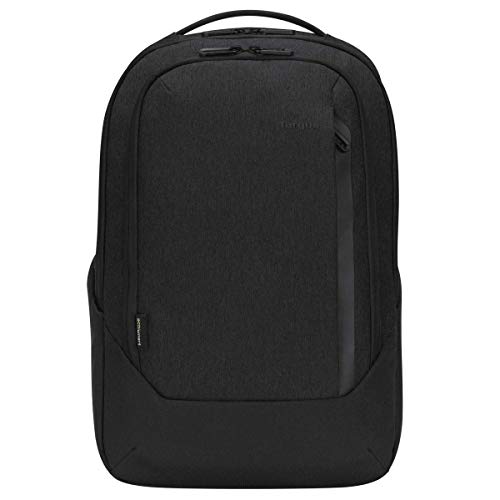
The Cypress Hero EcoSmart, model code TBB96402GL, is the protection flagship of the current range. Its laptop compartment is lined with D3O Zero, the impact material that stays flexible until a sudden knock makes it stiffen, giving the machine inside a crumple zone rather than a padded sleeve. The bag is built from the equivalent of 30 reclaimed plastic bottles, with recycled content reaching 60 percent of the whole product — the strongest sustainability figures Targus publishes for a backpack — and its 22-litre main compartment is organised for a full working day. A dedicated pocket for a tracking device is built in, so the bag can be located with the rest of your tracked gear if it ever goes astray.
The generation discipline from the brief is at its most important here, so it bears repeating in the review itself: this pick is the current TBB96402GL with D3O and 30 bottles. An earlier Cypress Hero, code TBB58602GL, is still widely listed and looks near-identical, but it carries ordinary padding and a 26-bottle construction. A buyer who orders the name without checking the code can receive the lesser bag at a similar price and never know the protection they paid for is absent. With the correct code, what arrives is the most complete commuter specification in the guide: engineered impact protection, the highest recycled content, sensible capacity and tracker provision in one understated design that raises no eyebrows in a boardroom.
Day to day, the Cypress Hero’s virtue is that its technology stays invisible. The D3O lining adds no bulk or stiffness in normal handling — the bag loads, zips and carries like any well-made commuter pack — and the organisation is conventional in the best way, with the laptop, documents and daily clutter each having an obvious home. It is not the largest bag here, nor the most feature-decorated; it is the one whose spec sheet is strongest exactly where a laptop bag’s spec sheet matters, at the moment the bag hits the floor.
The material at the centre of this bag has a pedigree worth understanding. D3O formulations protect motorcycle riders, industrial workers and athletes — applications where impact absorption is measured rather than marketed — and its behaviour is the opposite of foam’s: where foam is always as stiff as it will ever be, the D3O Zero lining stays supple while you load the bag and only firms at the instant of a knock or a drop. For a laptop, whose enemies are corner impacts and point loads rather than steady pressure, that behaviour is well matched to the threat. It is also invisible in the shop and on the shoulder, which is precisely the point: the Cypress Hero asks its owner to believe in engineering they will only ever notice on the one day it saves the machine.
It also behaves well in the unglamorous middle of the day. The silhouette is slim enough for a crowded carriage and the profile stays tidy whether the bag is full or nearly empty, which cannot be said of every 22-litre design. The tracker pocket is placed for the owner’s convenience rather than the thief’s, and the recycled shell fabrics shrug off platform scuffs and office-floor dust without showing their age early — a quiet virtue in a bag bought to be kept. Owners upgrading from the older Cypress Hero generation will find the organisation familiar and the protection transformed, which is exactly the upgrade path the model code was changed to describe.
Strengths: The best laptop protection Targus sells, via a genuine impact material rather than thicker foam, combined with the range’s highest recycled content — 30 bottles, 60 percent of the bag — and a built-in tracker pocket. The 22-litre organisation is boardroom-appropriate and fuss-free.
Trade-offs: The older non-D3O generation stalks every listing, so the purchase demands code-checking care. Capacity is mid-range — overnight packers should look at the Drifter II — and it carries neither the Work+’s lockable-zip security set nor the Terra’s outdoor hardware.
Who it suits: Commuters whose bags live a hard life on trains, platforms and office floors, and buyers who want the strongest protection and the strongest recycled-content figures in a single, sober design. If one bag in this guide is the default recommendation for a working laptop, it is this one — check price on Amazon.
Check price on Amazon: Targus Cypress Hero EcoSmart Backpack

2. Targus HeritageLuxe Backpack 15–16 inch
The HeritageLuxe, model code TBB656GL, is the premium business traveller of the range, and its centrepiece is a different answer to the protection question: the SafePort SafeSling, a patent-pending suspension system that cradles the laptop inside the compartment, held off the bag’s base and walls so drops spend their energy on the structure around the machine. Around that engineering, Targus wraps its most finished exterior — genuine leather detailing, a 23-litre capacity, an RFID-protected pocket, and a lining made from 21 recycled bottles. This is the bag aimed at the executive corridor rather than the cycle lane.
Its second headline feature needs the plainest statement in this guide. The HeritageLuxe carries a patented, retractable USB-C connector that routes charging through the bag — and it is a connector, not a battery. No power bank is included and none is built in; you supply your own portable battery inside the bag, and the retractable lead brings its power to a tidy external point for topping up a phone or the laptop on the move. Described honestly, it is a genuinely convenient piece of cable management that keeps a power bank useful without a nest of loose leads. Described carelessly, it could mislead a buyer into expecting stored power that is not there, so the distinction is made here in full.
In use, the HeritageLuxe plays the role of the boardroom bag completely. The sling suspension gives it drop behaviour a padded compartment cannot match, the leather detailing and restrained styling sit naturally beside a suit, and the organisation — laptop in its sling, documents, the RFID pocket for passport and cards — matches the rhythm of airport, taxi, meeting, airport. It is the most expensive-feeling object in the guide, and its specification, read correctly, justifies the positioning for the traveller whose bag is part of their professional presentation.
Consider how the HeritageLuxe’s features compose across a single travel day, because that is how its owner will judge it. Morning: the laptop rides suspended in its sling through the drop-prone business of taxis and security trays. The flight: passport and cards sit in the RFID pocket, the phone tops up through the retractable connector from the power bank inside, and the bag’s leather-trimmed silhouette draws no second look in the lounge or the cabin. Arrival: the same bag walks into the client meeting as part of the presenter’s outfit rather than as luggage apologising for itself. Plenty of bags protect, plenty look the part, and a few organise a day this completely; the HeritageLuxe’s claim is that it refuses to make its owner choose between those virtues.
Strengths: Suspension-based laptop protection that addresses the commonest drop — straight onto the base — plus genuine leather detailing, an RFID pocket and the retractable USB-C charging route for your own power bank. The most polished business presentation in the range.
Trade-offs: The charging feature includes no battery, and buyers must budget their own power bank to use it. Leather detailing asks for more care than the EcoSmart synthetics elsewhere, and the price position is the premium end of the range.
Who it suits: Executives and consultants who fly and present for a living, and anyone whose backpack must look at home in a boardroom while still protecting the laptop like equipment rather than luggage. If your bag is part of the suit you wear to the meeting, this is the one cut for you — check price on Amazon.
Check price on Amazon: Targus HeritageLuxe Backpack

3. Targus Work+ EcoSmart Backpack 15–16 inch
The Work+ EcoSmart, model code TBB657GL, launched in 2025, is the modular thinker of the range. Its core idea is a tech organizer that carries the 15 to 16 inch laptop and a 13 inch tablet together and detaches from the backpack on magnetic fasteners: arrive at your desk or meeting, lift out the organizer with both screens inside, and leave the rest of the bag behind. The full pack offers 23 litres, its lining is made from 7 recycled bottles, and its Multi-Flex strap system converts between a sternum strap for carrying, a trolley strap for rolling luggage, and a security configuration that tethers the bag at rest.
Modularity is easy to announce and hard to execute, and the Work+ earns its place by making the detachable unit genuinely useful rather than a gimmick. The organizer is a complete mini-bag for the two devices most people actually move between rooms, so the daily pattern of desk, meeting room, café and home stops involving the repeated unpacking and repacking of chargers and machines. The Multi-Flex strap is the same philosophy applied to transit: one strap system that adapts to the three ways the bag is carried or parked across a working trip. Buyers should note the naming discipline in the brief — the Work+ Play Flex and Trio lines are sports designs sharing part of the name, and they are not this bag.
The honest compromises follow from the concept. A detachable organizer is a seam in the system: the laptop’s protection inside the main bag is conventional padding rather than the D3O or sling engineering of the first two picks, and the total organisation rewards travellers who pack in layers and modules rather than those who want one cavernous compartment. The recycled figure, 7 bottles in the lining, is the most modest in the EcoSmart picks here. What the Work+ offers instead is adaptability — the only bag in the guide that changes its shape to match the hour of the day.
Picture the hot-desking week the Work+ was drawn for. Monday’s office has no assigned desks, so the whole working kit travels daily; the organizer lifts out at whichever desk is free and the empty shell hangs on the chair. Tuesday is a client site, where only the organizer — laptop, tablet, nothing else — goes through their security and into their meeting room, while the bag waits in the car. Wednesday’s conference wants the full pack again, trolley strap over the suitcase through the station, sternum strap across the concourse. Each of those transitions is a small tax that ordinary backpacks collect in unpacking and repacking; the Work+ exists to stop collecting it. Buyers whose weeks hold still will find the modularity unnecessary, and the design is honest enough not to pretend otherwise.
Strengths: A detachable, magnetically fastened tech organizer for laptop and tablet that genuinely changes how the bag is used between desk and meeting, plus the convertible Multi-Flex strap covering sternum, trolley and security duties. The most flexible design in the range.
Trade-offs: Laptop protection is conventional padding, a clear step below the Cypress Hero’s D3O and the HeritageLuxe’s sling. The modular layout suits organised packers and frustrates single-compartment ones, and its recycled-content figure is the smallest here.
Who it suits: Hybrid workers and consultants whose day is a chain of desks, meeting rooms and trains, and anyone who has ever wished the laptop half of their bag could simply lift out and come with them. If your working day has modules, this is the bag built in your image — check price on Amazon.
Check price on Amazon: Targus Work+ EcoSmart Backpack

5. Targus Terra EcoSmart Backpack 15–16 inch
The Terra EcoSmart, model code TBB649GL in black, is the range’s outdoor hybrid: a 23-litre work backpack that expects to be rained on and ridden with. It ships with a rain cover for the bag itself — not a promise of water resistance, an actual cover in the box — carries a strap system that secures a cycling helmet to the outside of the pack, and fits anti-theft locking hardware to its main pockets. Its construction uses 8 bottles of GRS-certified recycled material. The grey version is a separate code, TBB64904GL, and the two should not be confused at checkout.
The Terra’s logic is the mixed commute. A growing share of laptop carriers split their week between train, bicycle and foot, and their bag has to survive all three without looking like expedition equipment in the office. The helmet straps answer the cyclist’s daily puzzle of where the helmet goes indoors; the rain cover answers the climate honestly, because no seam-sealed claim survives a November downpour like a physical cover does; and the anti-theft hardware acknowledges that a bag carried through stations and locked to café furniture faces the crowd risks the Commuter also addresses. Underneath the outdoor hardware sits a conventional, competent work bag with a padded 15 to 16 inch laptop compartment.
The trade-offs are those of any hybrid. The Terra’s laptop protection is padding rather than the engineered systems at the top of this guide, its recycled figure of 8 bottles is modest next to the Cypress Hero’s 30, and its feature set — helmet straps, rain cover — is dead weight for a driver. But for the rider and the walker, it is the only pick here that treats weather and the bicycle as first-class design inputs rather than as abuse the bag must merely endure.
The rain cover deserves its own paragraph because it is so often misunderstood as a gimmick. A backpack’s water resistance lives in its fabric; its vulnerability lives in its zips and seams, which is why a soaked conventional bag admits water at the closures long before the shell fails. A fitted cover closes exactly those paths, and it doubles as a sacrificial layer against road spray and platform grime on the days when the weather is merely filthy rather than wet. The helmet straps show the same practical streak: a helmet carried on the bag is a helmet not dangling from a wrist, not balanced on the laptop inside, and not left behind in the office. These are the choices of designers who ride, and the Terra is full of them.
Strengths: An included rain cover, helmet retention straps and anti-theft pocket hardware on a full-size 23-litre work bag — the only pick designed for cycling and all-weather commuting, with GRS-certified recycled construction.
Trade-offs: Conventional padded laptop protection, a mid-pack recycled-content figure, and outdoor hardware that car commuters will never use. The black and grey versions carry different codes that listings do not always make obvious.
Who it suits: Cycling commuters, walkers and mixed-mode travellers whose backpack faces real weather, and anyone tired of choosing between a work bag and an outdoor bag. If your laptop commutes the way you do — outside, in the rain, on two wheels — the Terra is the honest answer — check price on Amazon.
Check price on Amazon: Targus Terra EcoSmart Backpack

6. Targus Drifter II Laptop Backpack 15.6 inch
The Drifter II, model code TSB238, closes the guide with the rugged all-rounder: a 32-litre backpack built for business travel and the daily commute alike, with a padded compartment for laptops up to 15.6 inches, a water-resistant nylon base, and the thickest back padding in this guide. It is the largest pack here at 32 litres, and its longevity in the catalogue is itself evidence of a solved problem — Targus has sold this design for years because business travellers keep reordering it.
The carrying comfort is the whole argument, and it deserves precise framing. The shoulder straps are heavily padded, the back panel is a thick air-mesh pad with lumbar support, and a large hidden zippered compartment sits inside that padding, against the wearer’s body, where valuables are effectively unreachable in a crowd. Two exterior mesh pockets take water bottles, a scratch-resistant pocket on top takes glasses and other fragile items, and a removable phone pocket rides on the shoulder strap with an elastic loop for sunglasses. The main compartment’s divider and mesh accessory pocket keep files and cables in order.
Two cautions complete the picture. First, the code discipline: TSB238 is this 15.6-inch Drifter II, and the TSB239 is the larger 17-inch version — similar names, different laptop fit. Second, the design’s age shows in what it lacks: no EcoSmart recycled construction, no detachable organizer, and laptop protection of the conventional padded kind rather than an engineered system. A buyer whose priority is drop survival should step up to the Cypress Hero; a buyer who wants the biggest, toughest everyday pack will not hesitate.
As the largest bag here, the Drifter II rewards a packing strategy of its own. At 32 litres it swallows a two-day business kit — laptop in its padded compartment, clothes in the main hold, wash bag in the base’s weather-resistant zone — and still presents as a backpack rather than a suitcase when the meeting starts. The top pocket quietly becomes the journey’s small-things vault: sunglasses on the way out, earbuds and cables on the way back, everything fragile in one scratch-resistant place instead of migrating through the bag. Travellers who already pack this way will recognise the design as one of their own; travellers who do not may find the bag teaches the habit.
Strengths: The largest capacity here at 32 litres, the thickest back padding with lumbar support and a hidden valuables pocket, a water-resistant base, and a pocket for everything — including two exterior bottle pockets — in a design refined over years in the catalogue.
Trade-offs: No recycled-content construction, conventional laptop padding, and a weight and bulk that suit a traveller better than a minimalist. The similarly named 17-inch TSB239 is a different fit and a real ordering trap.
Who it suits: Business travellers and heavy daily carriers who want the biggest Targus pack and the most comfortable straps, and buyers who pack a two-day kit into one bag. If your week is measured in miles and meetings, this is the Targus built for the long haul — check price on Amazon.
Check price on Amazon: Targus Drifter II
How the Five Compare
The table below lines the five up on the qualities that separate them — protection mechanism, capacity, signature feature and the caution that belongs with each.
| Model | Laptop protection | Capacity | Signature feature | Recycled content | Watch for |
|---|---|---|---|---|---|
| Cypress Hero EcoSmart TBB96402GL | D3O Zero impact lining | 22 litres | Tracker pocket | 30 bottles, 60 percent | Older TBB58602GL has no D3O |
| HeritageLuxe TBB656GL | SafePort SafeSling suspension | 23 litres | Retractable USB-C charging connector | 21 bottles in lining | No power bank included |
| Work+ EcoSmart TBB657GL | Padded compartment | 23 litres | Detachable magnetic tech organizer | 7 bottles in lining | Not the Work+ Play sports line |
| Terra EcoSmart TBB649GL | Padded compartment | 23 litres | Rain cover and helmet straps included | 8 bottles, GRS-certified | Grey version is code TBB64904GL |
| Drifter II TSB238 | Padded compartment | 32 litres | Hidden back-panel pocket, lumbar support | None stated | TSB239 is the 17-inch version |
The recycled-content column tells its own story about the brand’s priorities. The flagship protection model is also the sustainability flagship, the mid-range commuter and outdoor bags carry respectable figures, and the oldest design in the table carries none at all — a fair snapshot of a catalogue modernised from the top down over several years. A buyer equipping themselves for the long term can read the table as a map of where Targus’s engineering attention currently lives, and it lives, reassuringly, in the bags at the top of this guide.
Read down the protection column and the range’s honesty shows: two engineered systems at the top, then four variations of good padding, each compensated by a different specialism — modularity, security, weather, or the airport. There is no filler row in the table, which is more than most single-brand ranges can claim.
Frequently Asked Questions About Targus Laptop Backpacks
Do all five backpacks fit a 16-inch laptop?
Four of the five are specified by Targus for 15 to 16 inch laptops: the Cypress Hero, HeritageLuxe, Work+ and Terra. The Drifter II is specified to 15.6 inches, so owners of larger 16-inch machines should choose from the other four. In every case the compartment size is the manufacturer’s figure for the machine’s screen class; an unusually thick gaming laptop deserves a dimension check against the compartment before ordering, whatever the badge says. The same caution applies in reverse to very slim machines in the suspended and lined compartments: a thin ultrabook in the HeritageLuxe’s sling or the Cypress Hero’s compartment is held as designed, but a loose sleeve added around it can change the fit, so try the combination you actually intend to carry.
Does the HeritageLuxe backpack charge my devices by itself?
No — and this is the most important clarification in the guide. The HeritageLuxe provides a patented, retractable USB-C connector that routes power from a power bank you place inside the bag to a convenient charging point. No battery is built in and none is included in the box. Supply your own power bank and the system is genuinely convenient; expect the bag itself to store power and you will be disappointed at the first airport.
What does EcoSmart mean on these Targus backpacks?
EcoSmart is Targus’s programme for building products from recycled materials, principally plastic bottles diverted from landfill and waterways. The useful detail is that the manufacturer quantifies it per model: the Cypress Hero is made from 30 bottles with 60 percent recycled content overall, while the linings and shells of the other EcoSmart picks here account for between 7 and 21 bottles, the Terra’s material being GRS-certified. Treat the badge as an invitation to read the figure, not as the figure itself. Recycled shells of this kind wear indistinguishably from virgin equivalents in daily use, so the choice costs the owner nothing in durability — which is rather the point of publishing the numbers.
Does any of these backpacks have a checkpoint-friendly design?
No — none of the five picks in this guide carries Targus’s patented lay-flat checkpoint compartment. The CitySmart EVA Pro that had it did not appear in the live listings checked for this guide, so a buyer who flies weekly and wants that design should check Targus’s current checkpoint-friendly range separately. The Drifter II is the travel pick here instead: its 32 litres and weather-resistant base suit a two-day trip, but the laptop comes out at security like any ordinary bag.
Which of these Targus backpacks suits a cycling commute?
The Terra EcoSmart, and it is not close. It is the only pick with a rain cover included for the bag, straps that secure a helmet to the outside of the pack, and anti-theft hardware for the minutes the bag is locked up or left in a rack room. Its 23 litres swallow a workday plus a change of clothes, and its padded compartment handles the 15 to 16 inch machine. The Drifter II is the runner-up for riders who value its 32 litres and water-resistant base more than a rain cover.
How to Choose: Match the Bag to the Week
Begin with the accident and the itinerary, in that order. If your laptop’s greatest risk is being dropped — platforms, office floors, the boot of a car — buy a protection mechanism: the Cypress Hero’s D3O lining for impact, or the HeritageLuxe’s suspended sling if the bag must also pass in a boardroom. If the risks are human — crowds, cafés, unattended minutes — the Work+’s lockable zips and the Drifter II’s hidden back-panel pocket answer them. If the risk is the sky, the Terra’s rain cover and helmet straps are the only honest reply in the range.
There is a final, unfashionable test worth applying before the codes are checked: load the bag in your mind with your actual day. Laptop, charger, the bottle, the book, the layer you carry in winter, the lunch that leaks if it tips. Walk that load through each design above and notice which one keeps asking you to compromise — the organizer you would never detach, the checkpoint design on a bag that never flies, the rain cover on a car commute. The right Targus is the one that never asks. Every pick in this guide is well made; only one of them is well made for your week, and the difference between a bag that serves for a decade and one that is replaced by spring is almost always that fit, not the specification.
A word, too, for the buyer equipping more than themselves. Small teams and families benefit from this brand’s stability more than most: identical bags can be reordered across years, the fleet-issue heritage means the designs tolerate institutional use, and the spread of specialisms lets one purchasing decision cover the executive, the field engineer and the cycling junior without leaving the catalogue. The five designs above read, from that angle, less like a product line and more like a kit list for the ways people actually get to work.
Then let the calendar arbitrate the rest. A week of meetings in different rooms belongs to the Work+ and its lift-out organizer; a week measured in flights belongs to the Drifter II and its 32 litres of two-day capacity. The EcoSmart figures can break a tie with a clear conscience — the Cypress Hero’s 30 bottles and 60 percent recycled content are the strongest numbers here — but they should not overturn a protection or travel decision, because the bag you carry is equipment first and a statement second. Whatever you choose, spend the thirty seconds at checkout matching the model code in the listing to the code in these headings; with this brand, that half-minute is where the right bag is actually bought.
A laptop backpack is the one piece of work equipment you touch every single day of your working life, and the right Targus is the one whose protection, pockets and straps disappear completely into the routine — until the one bad moment when they quietly save the machine inside.


