A pedalboard holds your effects in one place, keeps the cables tidy and lets you set up in minutes. Some are plain frames that rely on hook-and-loop tape, while others add a raised second tier or a power supply hidden underneath.
The six boards below run from a 16 inch aluminum frame and an expandable single row to powered boards and a plastic two-tier model. Sizes, materials and power details come from each listing page. We have not used these boards ourselves, and strength claims are the makers’ own.
As an Amazon Associate we earn from qualifying purchases. Links below are affiliate links, and they do not change the product information we give.
What to Look For
| Feature | Why it matters |
|---|---|
| Board size | Count your pedals and leave space for cables and a power supply |
| Material | Aluminum, steel alloy and ABS plastic differ in weight and stiffness |
| Built-in power | A powered board saves buying and mounting a separate supply |
| Tiers and slope | A raised row keeps back pedals within reach |
| Carry bag | A soft case or gig bag helps when you travel |
Specs at a Glance
| Board | Size | Material | Notes |
|---|---|---|---|
| Pedaltrain Metro 16 | 16 x 8 in | Aluminum alloy | Three-rail frame; soft case; hook-and-loop tape and zip ties |
| D’Addario XPND Core | About 16.15 x 5.25 in listed | Aluminum | Expandable; cable management; pre-applied loop Velcro |
| Vangoa VPPD-S | About 15.9 x 6.5 in | Aluminum alloy | Built-in isolated supply with 8 outputs; foldable legs; 4.29 lb |
| ALLSET AP-100 | 24 x 12.6 in | Metal alloy | Built-in isolated supply with 10 outputs; 13.47 lb |
| AKLOT Dual Tier | 26 x 11 in plus a 15.75 x 5.5 in upper deck | Aluminum | Removable upper platform; carry bag; cables included |
| Rockhouse 2-Tier | About 20 x 10 in | ABS plastic | Power room and 10 cable holes; gig bag; 2.42 lb empty |
The 6 Best Pedalboards
Top pickBest for a small, simple frame
1. Pedaltrain Metro 16
A 16 x 8 inch aluminum-alloy pedalboard with a three-rail frame design. It ships with a soft case, hook-and-loop tape and zip ties. The item dimensions field shows 19.45 x 11 x 5.1 inches, which looks like the packed size, and the maker lists a one year limited warranty.
Suits: a small, simple frame. Strengths: a soft case and fasteners included. Weaknesses: no power supply. Skip it if you want power built in.

View Pedaltrain Metro 16 16-inch x 8-inch Pedalboard with Soft Case on Amazon
Best for a board you can extend later
2. D’Addario XPND Core
A compact single-row aluminum board that the maker says can grow into a longer board with an expansion kit. It lists a cable management system, pre-applied loop Velcro and tools for assembly in about 15 minutes. The listing weight is 500 grams and the size field reads 16.15 x 5.25 x 4.7 inches.
Suits: a board you can extend later. Strengths: built-in cable routing. Weaknesses: the expansion kit is sold separately. Skip it if you need two rows today.

View D’Addario XPND Core Pedalboard, Small Single Row on Amazon
Best for a short chain with power hidden inside
3. Vangoa VPPD-S
A small aluminum-alloy board of about 15.9 x 6.5 inches with a built-in isolated power supply. The maker lists 8 outputs, foldable legs for a 20-degree angle, a one-piece bent design and room for 4 to 6 pedals. The listing weight is 4.29 pounds.
Suits: a short chain with power hidden inside. Strengths: power and a tilt in one unit. Weaknesses: limited room. Skip it if you run more than six pedals.

View Vangoa VPPD-S Guitar Pedal Board with Built-in Isolated Power Supply on Amazon
Best for a larger powered setup
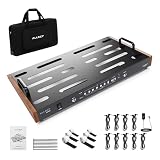
4. ALLSET AP-100
A 24 inch powered pedalboard with a built-in isolated supply and 10 outputs. The maker describes a rigid steel-alloy unibody chassis, hook-and-loop tape, cable channels and a tilted playing surface. The material field says metal alloy and the listing weight is 13.47 pounds.
Suits: a larger powered setup. Strengths: 10 outputs and a stiff body. Weaknesses: heavy at 13.47 pounds. Skip it if you carry your board far.
Best for a large rig with a raised row
5. AKLOT Dual Tier
A 26 x 11 inch aluminum board with a removable raised platform of 15.75 x 5.51 inches for second-row pedals. The listing includes a thickened carry bag, cables and hook-and-loop fasteners. The bullets give about 6 pounds, while the weight field shows 12.92 pounds, which appears to be the package.
Suits: a large rig with a raised row. Strengths: a removable upper deck and a bag. Weaknesses: no power supply is listed. Skip it if you want a compact frame.
View AKLOT Dual Tier Guitar Pedalboard on Amazon
Best for a light two-row layout
6. Rockhouse 2-Tier ABS
A 20 x 10 inch two-tier board made of ABS plastic with a slope that separates two rows. It has a built-in power room, 10 cable holes and comes with a gig bag. The maker lists 2.42 pounds empty and warns that the power room does not fit a Voodoo Lab supply.
Suits: a light two-row layout. Strengths: a hidden power compartment and low weight. Weaknesses: plastic instead of metal. Skip it if you own a Voodoo Lab supply.
View Rockhouse 2-Tier ABS 20 x 10 Guitar Pedal Board with Gig Carry Bag on Amazon
Setup Tips
- Lay the pedals out on the board before sticking any tape down.
- Put the pedals you step on most in the front row.
- Route power and signal cables apart where the board allows.
- Check the power supply size against any compartment before buying.
Mistakes to Avoid
- Choosing a board that is exactly as wide as your pedals.
- Reading the packed size as the board size.
- Forgetting the weight of a powered board in a bag.
- Assuming a power room fits every supply.
Measuring for Your Pedal Collection and Planning Growth
The most common pedalboard error is buying by the number of pedals rather than by footprint. Measure each pedal’s width and depth, including the jacks on the sides and the knobs on top, because cables need room. Lay your pedals on the floor in the arrangement you want, add a gap of an inch or two between them for plugs and fingers, and measure the total width and depth. That is the minimum board size, and you should add some extra margin for a power supply, a tuner, a volume pedal or anything you might add later.
Pedal sizes vary. Compact pedals are narrow, while full-sized ones, multi-effects and expression pedals can take up much more space. A board that holds six small pedals might hold only four large ones. Check the usable surface of the board, not just its outside dimensions, since rails, bars and frame sections reduce the area available for mounting.
Plan for growth. Many players add pedals over time, and a board that is full on day one means a second purchase. If you cannot afford a larger board, an expandable design or one with a spare section is a sensible compromise. However, a board that is too large for your needs adds weight, bulk and cost for no benefit.
Consider the case you will carry it in. A board that fits your gig bag, car trunk or flight case is more useful than a bigger one that does not. Measure the interior of the bag, not just the exterior.
Frame, Surface and Material Trade-Offs
Pedalboards come in several construction styles. Rail or frame boards use bars with gaps that let you route cables beneath and mount a power supply underneath. They are light and well ventilated, but pedals attach to the rails via hook-and-loop tape, and cables underneath can be harder to reach. Solid-surface boards, often made of a flat plate with a raised edge, give a larger mounting area and a cleaner look, though they may be heavier and offer less airflow.
Material affects weight and durability. Aluminum is light and resists corrosion. Steel alloy is stiffer and heavier. Plastic such as ABS is light and cheap but may flex under heavy loads. Wood boards are rare and handmade options exist, but check the listing for weight capacity. Heavier materials add stability when stepping on pedals, while lighter ones are easier to carry.
The mounting surface matters. Most use hook-and-loop fasteners, and the quality of the adhesive determines how well pedals stay attached. Pedals with large rubber feet or non-flat bases may need a plate or a different fastening system. Check whether the board comes with fasteners and whether it has holes or rails for zip ties.
Slope can improve ergonomics. A tilted surface brings back-row pedals into reach and places controls at a comfortable angle, which is useful if you play standing up. A flat board is simpler and often lower in profile, which suits seated players. Choose based on how you stand and play.
Signal Chain Order and Layout Logic
How you arrange pedals affects both sound and usability. A common starting order runs from the guitar through a tuner, then dynamics such as compressors, then gain pedals like overdrive and distortion, then modulation like chorus and phaser, then time-based effects like delay and reverb. This is a guideline, not a rule, and many players experiment. The order changes how effects interact, so move pedals around until you like the result.
Think about physical placement too. Put pedals you switch often at the front where your foot reaches them easily, and place set-and-forget pedals toward the back. A tuner is often at the left or at the edge for quick access. Expression and volume pedals need room for movement, so give them space and an edge position.
Keep cable runs short and tidy. Long cables add capacitance and can dull high frequencies, particularly in chains with many pedals. Right-angle plugs make tight layouts possible. Route power cables away from audio cables where possible, and cross them at right angles to limit interference.
A buffer pedal or a loop switcher can help with long chains or complex setups. Think about whether you want a single-switch system for turning multiple pedals on at once, as this changes the board’s design and size.
Finally, lay everything out before you attach it. Take a photo of the layout, note the cable routes, and test the full chain before fixing anything down.
Power Planning for the Board
Power affects layout, so decide on a plan before buying. If you choose a board with a built-in supply, check the number of outputs, the voltages offered and the current per output against your pedals. A built-in supply simplifies cabling, but it ties the board to a specific set of outputs and may be difficult to replace if it fails. A separate supply mounted underneath offers flexibility and can be upgraded.
If you add your own, measure the space under the board. Some frames leave very little room beneath, and a supply may not fit. Check dimensions and bracket options in advance. A board with a power compartment is only helpful if your chosen supply fits inside it, and some listings warn that specific supplies do not.
Think about the power cord. A board needs one cable to the wall, ideally routed to the edge where you can plug in easily. A board with an integrated power input, or a place to anchor the cord, reduces strain on the connector.
Always match each pedal’s voltage and polarity to its output. Mixing voltages is a common cause of damaged pedals. Label outputs if needed, and keep a list of what each pedal requires.
Finally, weigh the total board weight. Powered boards with metal chassis can be heavy, and a full board with a supply and a case can be a burden on stairs or public transport. Consider a bag with good straps or a wheeled case if you move often.
Cases, Transport and Stage Use
A board is only as useful as its ability to travel intact. Soft cases and gig bags are light and convenient, but they offer limited protection against impacts, so cables and knobs can be damaged if the bag is crushed. Hard cases protect better and are the safer choice for flights, but they add weight and bulk. Check the dimensions inside the case, including the height, since pedals and cables sit above the board surface.
Secure everything. Use zip ties or cable clips for cable runs, and consider locking plugs that stay put when the board is moved. Wrap spare cables and keep a small kit of tools, tape and fuses or spare adapters in the bag. Mark input and output ends so setup at a dark venue is quick.
On stage, stability matters. A board should not slide on the floor, so a non-slip base or a small mat helps. Make sure the surface is flat, and avoid placing a board on an uneven stage. If the board has legs that fold, check that they lock firmly in place.
Think about how quickly you can set up. A board with a single input and output, labeled cables and a single power cord can be ready in a minute, while a sprawling system takes longer. That time matters at a gig with a short changeover.
Inspect regularly. Check hook-and-loop strips for wear, tighten loose screws, and replace damaged cables. A bit of maintenance prevents a failure at the wrong time.
Pedalboards FAQ
Which boards have power built in?
The Vangoa VPPD-S and ALLSET AP-100 list built-in isolated supplies. The Rockhouse has a power room for a supply you add.
Which board can be expanded?
The D’Addario XPND Core is described by the maker as expandable with a separate kit.
How big should my first pedalboard be?
Measure the pedals you own, add space for cables and a power supply, and leave a little room to grow. A board slightly larger than your current needs is usually better than one that is already full.
Is a powered pedalboard better than adding my own supply?
A built-in supply is convenient and tidy, but it is harder to swap or upgrade. A separate supply gives flexibility and can be moved to a new board later.
What is the benefit of a tilted pedalboard?
It brings back-row pedals within reach and presents controls at a comfortable angle. It is helpful when standing, while seated players may prefer a flat board.
How do I attach pedals to the board?
Most players use hook-and-loop tape, which is easy to adjust. Zip ties and cable clips handle cables, and some pedals need a plate or special fastening.
Does cable length affect tone?
Very long runs can dull high frequencies, particularly with many pedals. Use short, good-quality patch cables and consider a buffer if your chain is long.
What order should my pedals go in?
A common starting point is tuner, dynamics, gain, modulation, then delay and reverb. Experiment, since the best order depends on your sound.
Do I need a hard case?
A soft bag is fine for local gigs, but a hard case protects better for flying or heavy travel. Choose by how roughly the board will be handled.
The Short Version
For a simple frame with a case, the Pedaltrain Metro 16. For an expandable row, the D’Addario XPND Core. For a small powered board, the Vangoa VPPD-S. For a large powered board, the ALLSET AP-100. For a raised second row, the AKLOT Dual Tier. For a light plastic two-tier, the Rockhouse.