A guitar setup means checking neck relief, string height, nut slots and pickup height, and each of those jobs wants a gauge or a small tool. Kits bundle them so you are not hunting for separate pieces, and the contents differ a lot from one kit to the next.
The six kits below run from a small set of stainless gauges to a large tech kit with wrenches and screwdrivers and a work mat. Contents come from each listing page. We have not used these kits ourselves, and the quality claims are the makers’ own.
As an Amazon Associate we earn from qualifying purchases. Links below are affiliate links, and they do not change the product information we give.

What to Look For
| Feature | Why it matters |
|---|---|
| Gauges | Relief, action, radius and nut height gauges do the measuring |
| Wrenches and drivers | Hex keys and screwdrivers fit truss rods, saddles and covers |
| Instructions | A booklet helps when you are new to setup work |
| Units | Inch gauges, metric gauges and both are all listed |
Specs at a Glance
| Kit | Main contents | Extras | Notes |
|---|---|---|---|
| MusicNomad MN604 | Truss rod, action, radius and nut height gauges | Pick capo, 24 page booklet, case | Stainless steel; 7.2 oz |
| MusicNomad MN609 KISS | The MN604 gauges plus a 26 pc screwdriver and wrench set and an 11 pc truss rod wrench set | Booklet, case | 2-year warranty listed; 839 g |
| StewMac Basic Setup Kit | String action gauge, 18 inch straightedge, 9 understring radius gauges | Instructions | Inch markings; 3 pieces |
| POGOLAB 31 pc | 3 files, 3 hex wrenches, rulers, winder, screwdriver | Bridge pins, picks, strap locks, bag | 7.9 x 3.9 x 2.0 in bag; 11.3 oz |
| TIMDAM 28 pc | Hex wrenches, files, steel ruler, action ruler, winder and cutter | Crowning file, fret rocker, radius gauges, carry bag | 1.03 lb; 7.8 x 3.9 x 1.9 in |
| MusicNomad MN290 | 26 pc screwdriver and wrench set, string winder, cutter and puller | 36 x 17 in work mat with gel neck cradle, cleaning products | Work station format |
The 6 Best Guitar Setup Kits
Top pickBest for measuring only
1. MusicNomad Precision 6 pc. Setup Gauge Set
Six stainless steel gauges with etched numbers: a truss rod gauge with .006, .008 and .010 inch relief steps, a string action gauge in inches, metric and 64ths, radius gauges from 7.25 to 20 inches, and a nut height gauge, plus a pick capo, a 24 page booklet and a case.
Suits: measuring only. Strengths: instructions printed on each gauge. Weaknesses: no wrenches or screwdrivers. Skip it if you need tools to turn screws.
View MusicNomad Precision 6 pc. Guitar Setup Gauge Tool Set (MN604) on Amazon
Best for doing the whole setup with one kit
2. MusicNomad KISS 43 pc. Tech Kit
The six gauges from the MN604 combined with a 26 piece screwdriver and wrench set (12 Allen key sizes, three Phillips, three flat blades, seven hex wrench sizes and a spanner) and an 11 piece truss rod wrench set, with a booklet and case. A 2-year warranty is listed.
Suits: doing the whole setup with one kit. Strengths: gauges and wrenches together. Weaknesses: more pieces than a casual owner needs. Skip it if you only need to measure relief.

View MusicNomad 43 pc. KEEP IT SIMPLE, SETUP (KISS) Guitar Tech Tool Kit (MN609) on Amazon
Best for a small, precise measuring set
3. StewMac Basic Guitar Setup Kit
A three piece set: an imperial string action gauge for strings, nuts, saddles and pickups, an 18 inch precision straightedge for checking neck relief, and nine laser-cut steel understring radius gauges. Instructions from a StewMac tech are included.
Suits: a small, precise measuring set. Strengths: a long straightedge. Weaknesses: inch markings only per the listing. Skip it if you want wrenches in the box.

View StewMac Basic Guitar Setup Kit, Inches, 3-Piece Luthier Tools on Amazon
Best for general upkeep
4. POGOLAB 31 pc. Guitar Tool Kit
A small zippered bag kit with a string clipper, three files, three hex wrenches (4, 5 and 6 mm), a steel string ruler, a string action ruler, six bridge pins, ten picks, a peg winder, a screwdriver and two strap locks. The listing says it fits acoustic, electric, bass, mandolin, banjo and ukulele.
Suits: general upkeep. Strengths: compact bag and wide instrument range. Weaknesses: no radius or relief gauges listed. Skip it if you want etched steel gauges.

View POGOLAB 31Pcs Guitar Tool Kit, Guitar Repair Kit, Luthier Tools on Amazon
Best for a wide mix in a small bag
5. TIMDAM 28 pc. Guitar Tool Kit
A carry-bag kit listing hex wrenches, files, a screwdriver, a steel ruler, a string action ruler, a winder and cutter with pin puller, nut and saddle sanding files, fingerboard guards, a fret crowning file, a fret rocker, understring radius gauges and a fretboard sticker. The page gives no sizes for the individual tools.
Suits: a wide mix in a small bag. Strengths: fret tools included. Weaknesses: individual tool sizes are not listed. Skip it if you want documented gauge ranges.
View TIMDAM 28Pcs Guitar Tool Kit, Guitar Maintenance Kit with Carry Bag on Amazon
Best for a bench-style home setup
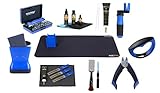
6. MusicNomad Ultimate At Home Work Station
A work station package built around a 36 x 17 inch mat with a soft gel cradle cube for neck support, with products to clean, polish and condition the body, fretboard, hardware and strings, a 26 piece screwdriver and wrench set, and a string winder, cutter and puller plus Tune It lubricant. The weight field on the page is clearly a typo, so check the box contents.
Suits: a bench-style home setup. Strengths: a neck cradle on a mat. Weaknesses: no listed gauges. Skip it if you need relief and radius gauges.
View MusicNomad Ultimate At Home Guitar and Bass Work Station (MN290) on Amazon
Setup Basics
- Check relief and action before touching a truss rod.
- Use the correct wrench size for your truss rod nut.
- Work on a padded surface so the finish stays clean.
- Write down measurements before you change anything.
Mistakes to Avoid
- Buying a gauge-only kit when you also need wrenches.
- Ignoring whether the markings are inch or metric.
- Forcing a truss rod nut that will not turn.
- Assuming a large piece count means more useful tools.
What a Guitar Setup Actually Involves
A setup is a series of small adjustments that make a guitar play comfortably and in tune. The usual order starts with the neck. The truss rod, a metal rod inside the neck, controls the curve of the neck, which is called relief. Too much relief and the strings sit high in the middle of the neck, while too little can cause buzzing. Once relief is set, you adjust string height at the bridge or saddle, called action, and then check the nut slots, which affect how the strings feel and sound in the first position. Pickup height, intonation and string choice come after.
Each step needs a tool or a gauge. A feeler gauge or a straightedge checks relief, a ruler or action gauge measures string height, radius gauges check the shape of the saddle or fingerboard, and screwdrivers and wrenches turn the parts that move. A kit is useful because it groups these tools, but it cannot replace understanding what the adjustments do.
It helps to start with the symptom. Buzzing near the first frets points to different causes than buzzing near the twelfth. A guitar that is hard to press down in the middle of the neck may have too much relief or a high action. Learn the order of operations and change one thing at a time, so you can see what each change does.
- Neck relief first, then action, then the nut, then pickup height.
- Re-tune and re-check after each change.
- Make small adjustments, such as a quarter turn of a truss rod.
Matching the Kit to Your Guitar Type
Not every guitar needs the same tools. Electric guitars with bolt-on necks often have an adjustable bridge with saddle screws and a truss rod accessed at the headstock or heel. Acoustic guitars may have a truss rod that opens inside the soundhole or at the headstock, and bridge saddles that are changed rather than adjusted. Guitars with floating tremolo bridges need extra care and sometimes different tools. Basses and other instruments have their own wrench sizes and string spacing.
Truss rod nuts come in several sizes and shapes, including hex, socket and spoke types. If your wrench does not fit, do not force it. Check the guitar’s manual or the maker’s website to see what the guitar uses. Metric and inch sizes both exist, so confirm what your instrument needs before choosing a kit. Gauges are marked in inches, metric units or both, so choose one you can read confidently.
If you own several guitars, a broad kit with multiple wrenches and gauges is practical. If you own one, a smaller kit that covers your instrument may be enough.
- Check the truss rod type and size on your guitar.
- Look at the saddle and bridge screws, since they need correct drivers.
- Confirm whether your guitar uses inch or metric hardware.
- Consider whether you need tools for tremolo, locking nuts or other special parts.
Gauges Versus Tool Bundles: What Each Type of Kit Is For
The kits in this guide fall into two broad groups, and knowing the difference prevents disappointment. Gauge-focused kits are about measuring. They include things such as relief gauges, action rulers, radius gauges and nut height gauges, and they help you know what is happening before you change anything. Tool bundles are about doing. They include screwdrivers, hex keys, string cutters, winders and sometimes files, and they let you carry out adjustments and string changes.
Some kits combine both, and some work stations add a mat and neck support so you can work comfortably. A gauge-only set is incomplete if you do not already own the right wrenches, while a bundle without measuring tools leaves you guessing. Many beginners benefit from starting with a combined kit, while players with a decent tool collection may only need gauges.
Be careful with piece counts. A large kit may include many small items you rarely use, and the quality of individual pieces varies. Check what each piece is and whether the sizes match your instrument. Files, fret tools and sanding items are for more advanced work such as nut slotting and fret leveling. These are skills that take practice, and mistakes can be costly. Leave them to a professional unless you have been taught.
- Beginner: a combined kit with an instruction booklet.
- Owner of tools: a gauge set.
- Home workshop: a kit with a mat and tools together.
Safe Adjustment Habits and Limits of a DIY Setup
Most setup work is reversible if you go slowly, but a few steps can cause real damage. The truss rod is the most important. Turn it in small increments, around a quarter turn at a time, then let the neck settle before checking again. Never force a rod that will not move. A stuck or stripped rod, or a rod that has reached the end of its travel, is a job for a technician. Loosen the strings slightly before large adjustments if the guitar’s manual suggests it.
Work on a padded surface or a mat so the finish does not get scratched. Hold the guitar securely, and be careful with sharp tools near the body. Remove a cover or plate with the correct screwdriver, and keep the screws in a tray so they do not roll away. Take notes or photos of the original settings, such as saddle heights and truss rod position, so you can return if needed.
Know your limits. Nut slotting, fret work and electronics repair need specialized tools and experience. If your guitar has a persistent problem after basic adjustments, such as uneven frets, a warped neck or a cracked joint, take it to a qualified repairer.
Re-tune frequently when making changes, because new string height and neck relief affect tuning. Allow time for the guitar to adjust to the new settings, particularly after truss rod changes.
Storing Tools, Upkeep and When to Upgrade Your Kit
Good tools last for years if they are kept clean and dry. Wipe gauges and wrenches after use, especially if you work around cleaning products or sweaty hands. Keep metal tools away from moisture and store them in the case or bag they came in, so small pieces do not get lost. Check feeler gauges for bends or kinks, since a bent gauge gives false readings. Store straightedges flat or hang them so they do not warp.
Protect your instrument too. Use soft cloths and mats, and avoid tools with sharp or burred edges that could scratch the finish. Replace worn screwdrivers or hex keys that round off, because they can strip screws. If a wrench starts to slip on a truss rod nut, stop and replace it.
Think about when to upgrade. If you find yourself borrowing a tool again and again, or you find that a gauge does not offer the range you need, it may be time to add a specialist tool. If you begin working on several instruments, a more complete kit makes sense. Keep your first kit anyway, as it may remain useful for quick checks.
Finally, keep records of your setups. Note the string gauge, tuning, action and relief for each guitar, so you can repeat results after string changes or seasonal climate shifts. This turns a kit into a practical routine and helps you notice changes over time.
Guitar Setup Kits FAQ
Which kits include truss rod wrenches?
The MusicNomad MN609 lists an 11 piece truss rod wrench set. The POGOLAB and TIMDAM list hex wrenches or Allen keys.
Which kit is only for measuring?
The MusicNomad MN604 and the StewMac Basic kit are gauge-based sets without wrenches.
Can I do my own guitar setup as a beginner?
Many players handle simple tasks such as string changes and small action tweaks. Start slowly, learn the order of adjustments and take a professional's advice for anything you are unsure about, particularly truss rod problems.
How often should I set up my guitar?
There is no fixed rule. Seasonal humidity and temperature changes can shift the neck, and strings wear out. Many players check their guitar when it starts to feel different or buzz, and at least when they change strings.
What is neck relief?
It is the slight forward curve of the neck. A small amount lets strings vibrate without buzzing. The right amount depends on the guitar and the player, so follow the maker's guidance.
Do I need different tools for acoustic and electric guitars?
Often the basic tools overlap, but truss rod access and bridge hardware differ. Check your guitar's design and the tools listed in the kit.
Are metric or inch tools better?
It depends on your guitar. Some are built with inch hardware and some with metric. Check which fits, and use the right size to avoid damaging screws.
What should I do if a truss rod will not turn?
Stop. Do not force it. Loosen the strings slightly if the manual advises, and take the guitar to a qualified repairer.
Is a work mat necessary?
It is not essential, but it protects the finish and holds the neck steady. A towel and a pillow can work for occasional use.
Can a kit replace a visit to a technician?
It can handle routine adjustments, but some jobs need a technician's skills and tools. A kit helps you maintain the guitar and understand what a repairer does.
The Short Version
For gauges, the MusicNomad MN604. For a full tech kit, the MN609. For a straightedge trio, the StewMac Basic kit. For a small bag of tools, the POGOLAB. For fret tools in the bag, the TIMDAM. For a mat and cradle, the MN290.