A keyboard pedal unit brings soft, sostenuto and sustain pedals together in one housing, in the layout of an acoustic piano. Most are made for one family of digital pianos, so the model name matters more than the shape. A few are universal and plug into a standard 1/4 inch jack.
The six units below include model-specific boards from Roland, Casio and Yamaha, a Studiologic triple pedal and a universal board. Fit, layout and weight come from each listing page. We have not used these units ourselves, and feel claims are the makers’ own.
As an Amazon Associate we earn from qualifying purchases. Links below are affiliate links, and they do not change the product information we give.

What to Look For
| Feature | Why it matters |
|---|---|
| Piano fit | Model-specific units list the digital pianos they match |
| Layout | Soft, sostenuto and sustain, or three sustain pedals |
| Polarity | Universal units add a switch to match the keyboard |
| Stand needs | Some units bolt onto a matching furniture stand |
Specs at a Glance
| Unit | Made for | Weight | Notes |
|---|---|---|---|
| Roland RPU-3 | FP-90, FP-60, RD-2000 | Not stated | Separate 1/4 inch output per pedal; 9.5 x 12.38 x 3.38 in |
| Casio SP-34 | PX-S and CDP-S series | 2.2 lb | Portable; 12.2 x 6.06 x 2.72 in |
| Yamaha LP1B | P225, P125, P121, P525, P515 | 7.13 lb | Half-damper; needs a matching stand |
| Roland KPD-70 | FP-30 | 16 oz listed | Black or white finish |
| Studiologic VFP-3-10 | Keyboards and MIDI controllers | 2.4 lb | Open polarity; rubberized levers; mono and stereo plugs |
| Universal P3-S1 | Digital pianos and MIDI keyboards | 4.15 lb | Polarity switch; all three pedals act as sustain |
The 6 Best Keyboard Pedal Units
Top pickBest for roland stage pianos
1. Roland RPU-3
A three-pedal unit with a separate 1/4 inch output for each pedal. The bullets list the Roland FP-90, FP-60 and RD-2000 as compatible and say the pedals can control functions such as registrations or vocal effects. The listed size is 9.5 x 12.38 x 3.38 inches.
Suits: Roland stage pianos. Strengths: three separate outputs. Weaknesses: no weight listed. Skip it if you play another brand.
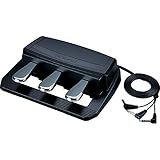
View Roland RPU-3 Electronic Keyboard Pedal or Footswitch 3 Pedal on Amazon
Best for slim Casio pianos
2. Casio SP-34
A portable three-pedal unit for the Casio PX-S1000 series and PX-S3000, also named for CDP-S and Privia PX-S pianos. The listing size is 12.2 x 6.06 x 2.72 inches and the weight is 2.2 pounds.
Suits: slim Casio pianos. Strengths: light and portable. Weaknesses: limited to Casio models. Skip it if you want a stand-mounted unit.
View Casio SP-34 Portable 3-Pedal Unit for CDP-S and Privia PX-S Digital Pianos on Amazon
Best for yamaha P-series pianos on a matching stand
3. Yamaha LP1B
A black three-pedal unit for the Yamaha P225, P125, P121, P525, P515, PS500 and DGX670. The bullets describe a traditional soft, sostenuto and sustain layout with half-damper function, and say a Yamaha L125, L121 or L515 stand is required. The listing weight is 7.13 pounds.
Suits: Yamaha P-series pianos on a matching stand. Strengths: half-damper function. Weaknesses: needs a specific stand. Skip it if you use a plain X-stand.

View Yamaha LP1B 3-Pedal Unit for P225 P125 P121 P525 P515 PS500 and DGX670 Black on Amazon
Best for fP-30 owners
4. Roland KPD-70
A custom pedal unit for the Roland FP-30, sold in black or white finish. The size field reads 53 x 9 x 6 inches with a 16 ounce weight, which looks like the packed stand set, so check the pedal dimensions before buying.
Suits: FP-30 owners. Strengths: a finish choice. Weaknesses: unclear size fields. Skip it if you have a different Roland model.

View Roland KPD-70 Electronic Keyboard Pedal Unit for FP-30 Digital Piano Black on Amazon
Best for stage keyboards and controllers
5. Studiologic VFP-3-10
A piano-style triple sustain pedal for keyboards and MIDI controllers with open polarity at rest, a solid body, rubberized levers and a 6.56 foot cable with mono and stereo connectors. The listing weight is 2.4 pounds.
Suits: stage keyboards and controllers. Strengths: brand-neutral design. Weaknesses: sustain function only. Skip it if you need half-damper support.

Best for mixed keyboard brands
6. Universal P3-S1 Triple Sustain Unit
A universal unit with a 1/4 inch plug and a side polarity switch. Unlike traditional boards, all three pedals work as sustain pedals, giving a wide striking area. The bullets mention a wooden-style shell and an anti-slip base, and the listing weight is 4.15 pounds.
Suits: mixed keyboard brands. Strengths: polarity switch and wide pedal area. Weaknesses: no soft or sostenuto function. Skip it if you want true piano pedal roles.
Care and Setup
- Check the piano model against the compatibility list before ordering.
- Plug in before powering on so polarity is read correctly.
- Place the unit on a flat, non-slip surface.
- Keep the cable clear of the bench legs.
Mistakes to Avoid
- Buying a model-specific unit for another brand.
- Forgetting that some units need a matching stand.
- Ignoring the polarity switch on universal units.
- Trusting a size field without checking the pedal footprint.
Questions to Ask Before You Buy
- Does your instrument have a jack for this kind of foot control, and what size is it?
- Do you want one control only, or a unit with more than one?
- Will it sit on a rug or hard flooring, and does it need to stay put?
- Do you play at home, on stage, or both?
- Does the maker’s listing say it works with your instrument model?
- Do you want a feel close to an acoustic instrument, or is a lighter touch fine?
Matching It to Your Use
A player at home who practices quietly has different needs from someone who loads gear into a car every weekend. Weight, base grip, and cable length all matter more when you travel. For a fixed setup, a heavier unit that stays where you leave it can be a relief.
Think about the way you use your foot. Some players press fully and often; others need subtle control. Try to match the unit’s style to your playing habits, then read the maker’s instructions to see how any polarity setting works with your instrument.
Who Should Skip One
If your instrument already includes a suitable control in the box, you may not need another. Players who use only short pieces and light pieces may be content with the included one. And if your instrument lacks a matching jack, check the manual before buying anything.
Quick Note
Always confirm warranty terms and compatibility on the maker’s listing, and follow the maker’s instructions when you plug in or unplug the cable. Switching the instrument off before connecting is a common habit worth keeping.
What Each of the Three Pedals Actually Does
On an acoustic piano the three pedals have distinct jobs, and a pedal unit copies that layout. The right pedal is the sustain (damper) pedal. It lifts the dampers so notes keep ringing after you release the keys, and it is by far the most used of the three. Pianists press it on and off many times in a single piece, so this is the pedal that wears first and the one whose feel matters most.
The left pedal is the soft pedal. On an upright piano it moves the hammers closer to the strings, and on a digital piano it usually lowers the volume and softens the tone. How much it changes the sound depends on the instrument’s own settings, not on the pedal board.
The middle pedal is the sostenuto pedal. It holds only the notes that are already down at the moment you press it, while later notes play normally. Many digital pianos let you reassign this pedal to another function, such as page turning in a notation app or a different effect. Check the keyboard manual to see what each jack or pedal input can do.
This is why a board where all three pedals act as sustain, like the universal unit in this guide, is a different tool. It suits players who only want a wide sustain surface. Players working from classical repertoire that calls for the soft or sostenuto pedal should look for a unit that keeps the three roles separate.
Continuous Sustain Versus On/Off Switching
Not every sustain pedal reports the same kind of signal. A simple switch-type pedal is either on or off. A continuous pedal, often described as having half-damper function, reports how far the pedal is pressed, so the instrument can respond to partial presses the way an acoustic piano does. The Yamaha LP1B in this guide is listed with half-damper function; for any other unit, read the listing for that wording rather than assuming it.
A continuous pedal only helps if the keyboard supports it. If your piano’s sustain input accepts only a switch signal, a half-damper pedal will still work, but it will behave like an ordinary on/off pedal. The manual for your piano will say whether the pedal input or the dedicated pedal connector reads partial presses.
When does this matter? Intermediate and advanced players who shape long pedal changes, release the pedal slowly to let a chord fade, or use light touches for blurred harmonies will notice the difference. Beginners learning basic pedal timing are well served by a simple on/off response, and it is not a flaw. A switch-type board such as the Studiologic unit here lists sustain function only, which is fine if that is all your music asks of it.
Connectors and Polarity Explained
Pedal units reach the piano in two main ways. Model-specific boards usually connect through a dedicated cable and connector made for that family of pianos, and they cannot be swapped between brands. Universal boards use a standard 1/4 inch plug that fits a footswitch jack, and they depend on the keyboard reading the signal correctly.
Polarity is the part that trips people up. A sustain pedal is a switch that is either normally open or normally closed at rest. If the keyboard expects one and receives the other, sustain acts backward: notes hold when the pedal is up and cut off when it is pressed. Some keyboards detect polarity at power-on, which is why the guide above suggests plugging in before switching the instrument on. Others need the pedal to be set with a switch on the pedal itself, or a menu setting on the keyboard.
If you see backward sustain, do not assume the pedal is broken. Switch the instrument off, check the polarity switch if the unit has one, reconnect with your foot off the pedals, and power on again. Then consult the manual for any polarity or pedal-type setting in the keyboard menu.
Build, Feel and Stability on the Floor
Because you press a pedal unit with your whole foot, the physical build counts as much as the features. Weight is a rough guide. A very light unit is easy to carry but can creep across a smooth floor, particularly with a firm press. A heavy unit stays where you leave it and tends to feel more like a piano. The listings above give weights, but check how each one grips the floor, since a non-slip base matters more than a few ounces.
Look at the pedal surfaces too. Wide, flat levers are easier to find by feel than narrow ones, and a textured or rubberized surface helps if you play in socks or thin shoes. Notice whether the levers return smoothly and quietly. A pedal that clicks or thumps will be audible in a quiet room, and recordings can pick it up.
Spring tension varies between designs. A stiff spring gives resistance for controlled playing but can tire a beginner’s foot, while a very light spring may feel vague. Maker descriptions rarely quantify this, so lean on written reviews that mention pedal feel, and keep the return policy in mind.
Model-specific boards that bolt to a matching stand add rigidity, since the pedal housing becomes part of the furniture. That is a real advantage for home setups, but it also commits you to the matching stand.
Troubleshooting and When to Replace
Most pedal problems come from the connection rather than the pedals themselves. If a pedal stops responding, power the keyboard off, unplug the cable, inspect the plug for bent pins or dirt, reseat it firmly and power on again. Make sure the cable is not pinched under a bench leg or stand foot, and avoid yanking it sideways, because the strain tends to loosen the connector over time.
Sustain that never releases, or releases late, can come from a worn spring or a sticky lever. Look for debris or liquid residue around the hinge area and check that nothing blocks travel under the pedal. Do not open the housing unless the maker’s instructions say so, since that may affect any warranty.
Signs that it is time to replace the unit include intermittent sustain that persists after reseating the cable, a lever that no longer returns on its own, a cracked housing, or a connector that wobbles in the socket. If the unit is under warranty, contact the seller first.
When you do replace one, check whether the original model is still sold for your piano, since a like-for-like board saves you from re-checking compatibility. If you are moving to a different keyboard, match the new instrument’s pedal input and polarity behavior before ordering.
Keyboard Pedal Units FAQ
Which units work across brands?
The Studiologic VFP-3-10 and the universal P3-S1 list general keyboard use. The P3-S1 adds a polarity switch.
Which one needs a furniture stand?
The Yamaha LP1B bullets say an L125, L121 or L515 stand is required.
Do I need a three-pedal unit if my piano only has a single sustain pedal in the box?
Not necessarily. Many players use only sustain for years. A three-pedal unit makes sense if your music uses the soft or sostenuto pedal, or if you want a layout that feels like an acoustic piano. Confirm that your piano has a pedal input that supports a three-pedal board.
What does half-damper mean?
It means the pedal reports partial presses so the instrument can respond with partial sustain, the way an acoustic piano does. The keyboard must support it too. Otherwise the pedal behaves like a simple on/off switch.
Why does my sustain work backward?
This is usually a polarity mismatch. Switch the instrument off, set the polarity switch if the unit has one, plug in with your foot off the pedal, and power on again. Your manual may also list a pedal-type setting.
Can I use a pedal unit from another brand on my digital piano?
Model-specific boards generally cannot be swapped between brands because the connector and signals differ. Universal units with a standard 1/4 inch plug may work, but check your piano's manual first.
Will a lighter pedal unit slide on the floor?
It can, especially on smooth flooring. Look for a non-slip base, place the unit on a rug or mat if needed, and keep the cable clear so it does not drag the board out of place.
How long should a pedal unit last?
The listings give no lifespan, and use varies a lot. Pedals that are pressed daily wear sooner than those used occasionally. Replace the unit when the sustain becomes unreliable, the levers stick or the connector loosens.
Can the middle pedal be used for something other than sostenuto?
On some digital pianos it can be reassigned to other functions. Check your keyboard manual to see which functions are available and how to change them.
The Short Version
For Roland stage pianos, the RPU-3. For slim Casio pianos, the SP-34. For Yamaha P-series, the LP1B. For the FP-30, the KPD-70. For a brand-neutral board, the Studiologic VFP-3-10. For a universal polarity switch, the P3-S1.
Related Guides
- 6 Best Pedal Power Supplies: Isolated Outputs Compared (2026)
- 6 Best Guitar Pedal Cables: Solderless Kits Compared (2026)
- 6 Best Phantom Power Supplies: Battery and AC Units (2026)
- 6 Best Wine Cellar Cooling Units: Through-Wall and Ducted (2026)
- 6 Best Pedalboards: Frames, Tiers and Powered Boards (2026)