An octagonal softbox, often called an octabox, spreads light from a round-looking front panel, which gives round catchlights in the eyes and a wraparound look on a face. Size, mount type and the included diffusers decide how it fits a light.
The six modifiers below run from a 23.6 inch Bowens-mount box to a 59 inch Godox and a simple umbrella-style octa. Sizes, materials and contents come from each listing page. We have not used these softboxes ourselves, and light-quality claims are the makers’ own.
As an Amazon Associate we earn from qualifying purchases. Links below are affiliate links, and they do not change the product information we give.

What to Look For
| Feature | Why it matters |
|---|---|
| Size | A larger face gives softer light but needs more room and a sturdier stand |
| Mount | Bowens mount fits many strobes and LED lights; umbrella models fit speedlites |
| Diffusers and grid | Inner and outer diffusers soften light; a honeycomb grid narrows it |
| Weight and folding | Quick-fold ribs and a carry bag help on location |
In this guide
Specs at a Glance
| Softbox | Size | Mount | Notes |
|---|---|---|---|
| Godox Octa-90 | 35.4 in (90 cm) | Bowens | About 2.4 lb; two diffusers, grid, deflector disk, carry bag |
| Godox Octa-150 | 59 in (150 cm) | Bowens | About 3.85 lb; two diffusers, grid, deflector disk, carry bag |
| NEEWER BASICS NS34P | 35 in (90 cm) | Bowens | 2.5 lb; 8 ribs; two diffusers and a grid; carry bag |
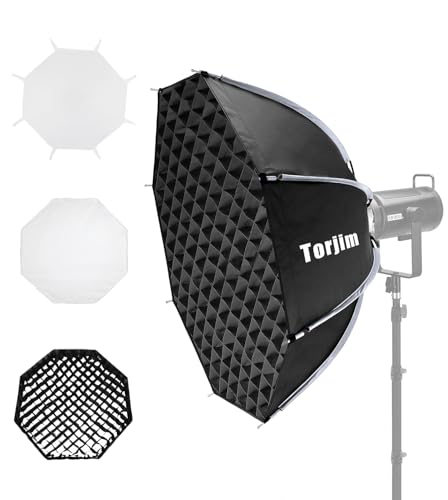
| Torjim T13 | 35.4 in (90 cm) | Bowens, quick release | Removable diffusers and grid; carry bag |
| K and F CONCEPT | 23.6 in (60 cm) | Bowens, quick release | 743 g; grid with pouch; carry bag |
| Godox umbrella octa | 31.5 in (80 cm) | Umbrella holes | Nylon; front cloth; storage bag |
The 6 Best Octagonal Softboxes

Top pickBest for a portable all-round octa
1. Godox Octa-90
A 35 inch foldable octagonal softbox with an umbrella-style fold and a side zipper, a silver interior coating on nylon cloth and a Bowens mount. The listing includes an inner diffuser, an outer diffuser, a honeycomb grid and a deflector disk, and gives a weight of 2.4 pounds with a carry bag.
Suits: a portable all-round octa. Strengths: four accessories and low weight. Weaknesses: the CRI of 85 is the lowest figure listed here. Skip it if you need a larger face.

View Godox Octa-90 35 inch Octagonal Softbox with Bowens Mount on Amazon

Best for full-length portraits and large subjects
2. Godox Octa-150
The large version of the same design: a 59 inch octagonal softbox with a Bowens mount, an umbrella-style fold that collapses without removing the diffuser, inner and outer diffusers, a grid and a deflector disk. The listing gives 21.65 inches of depth and 3.85 pounds with a carry bag.
Suits: full-length portraits and large subjects. Strengths: a very large face for its weight. Weaknesses: it needs space and a solid stand. Skip it if your room is small.

View Godox Octa-150 59 inch Octagonal Softbox with Bowens Mount on Amazon
Best for nEEWER light owners
3. NEEWER BASICS NS34P
A 35 inch octagonal kit in oxford cloth with a nylon alloy chuck, eight ribs, a silver interior, two diffusers, a honeycomb grid and a carry bag. It uses a Bowens mount, lists a CRI of 90, weighs 2.5 pounds and names many NEEWER, SmallRig, Aputure and Godox lights as compatible.
Suits: NEEWER light owners. Strengths: a long compatibility list and a CRI of 90. Weaknesses: the line is described as plain by its own maker. Skip it if you want extra deflector parts.
View NEEWER BASICS Octagonal Softbox Kit NS34P on Amazon
Best for a standard 90 cm octa
4. Torjim 35.4 Inch
A 35.4 inch collapsible octagonal softbox with a quick-release Bowens mount, removable diffusers and a grid. The listing describes a dual-layer build, a carry bag and use with LED, tungsten and flash lights. The Built-In Media field says DVD and no weight is shown, so confirm the contents on the page.
Suits: a standard 90 cm octa. Strengths: a quick-release system. Weaknesses: sparse spec detail. Skip it if you want a stated weight.
View Torjim 35.4 inch Octagonal Softbox with Quick Release Bowens Mount on Amazon
Best for solo shooters on location
5. K and F CONCEPT 23.6 Inch
A 60 cm octagonal softbox that the maker says folds or opens in five seconds. It weighs 743 grams, folds to 5 cm thick and 58 cm long, and has a grid tethered to the body that is stored in a pouch. The listing names ABS, metal, stainless steel and TPU as materials.
Suits: solo shooters on location. Strengths: the lightest and smallest here. Weaknesses: a smaller face means harder light. Skip it if you shoot groups.
View K and F CONCEPT Octagonal Softbox 23.6 inch Grid Pouch Quick Release on Amazon
Best for speedlite users
6. Godox 31.5 Inch Octagon Umbrella Softbox
An octagon umbrella made of high-density nylon with a front soft cloth so it works as a softbox. It opens like an umbrella, attaches to a stand through umbrella holes, comes with a storage bag, and the listing names speedlites as a fit. It has no Bowens mount.
Suits: speedlite users. Strengths: very quick setup. Weaknesses: no mount for studio strobes. Skip it if you use a Bowens light.
View Godox 31.5 inch 80cm Octagon Umbrella Softbox with Carrying Bag on Amazon
Setup Notes
- Match the mount first: Bowens boxes do not fit umbrella holes.
- Use a sturdy stand and a sandbag with the 59 inch box.
- Fold the ribs gently and keep the cloth dry before packing.
- Add the grid when you want less light spill.
Mistakes to Avoid
- Choosing a size without checking room and stand capacity.
- Assuming every softbox includes a grid and two diffusers.
- Ignoring the mount type listed on the page.
- Skipping the compatibility list for your light.
Why the Octagon Shape Suits Portraits
An octagonal softbox produces a nearly round light source, and that shape shows up in two places. First, it creates round catchlights in the eyes, which many photographers prefer to the rectangular reflections left by a square softbox. Second, it spreads light evenly across the face and shoulders, giving a smooth gradient from highlight to shadow. Because the front panel is roughly circular, the light wraps around the subject instead of striking from one flat plane.
That does not make it the right modifier for every job. A strip or rectangular box gives more directional control for full-length shots and product lines, and a small box makes a harder light that suits dramatic portraits. An octa is a general-purpose tool: it works for headshots, half-length portraits, fashion, small groups and video. It is also forgiving when subjects move because the light is broad.
The diffusion layers shape the result. An inner baffle spreads the light from the bulb or LED before it reaches the outer face, which removes hot spots. The outer diffuser then softens edges further. Removing the outer layer gives a slightly punchier light, and adding a grid narrows the spread and keeps spill off backgrounds. Read the listing to see which layers are included, rather than assuming.
When comparing models, consider where you shoot most. In a small room, a smaller octa placed close can give soft light without needing space, while a large one is best when you have room to back away.
Size, Distance and the Softness of Light
Softness depends on the relative size of the light compared to the subject, and on how close the light is. A large softbox placed near the subject produces gentle shadows with slow transitions. The same box moved farther away behaves like a smaller source, and shadows sharpen. This is why close placement is one of the most useful habits with an octa.
Choose a size for your typical subject. A box in the range of about two feet suits close headshots, products and tight video framings, and it travels easily. A box around three feet is a common middle choice for portraits and half-length work. A very large box, around five feet, suits full-length figures, groups and fashion, but it needs more space, a stronger stand and more power.
Power is another point. A large softbox spreads light over a bigger area, so less of it reaches the subject. The light source inside must be strong enough, and with low-power LEDs a very large box can look dim. Check whether your light is suitable, using the maker’s guidance on recommended wattage or modifiers.
- Small room, solo shoots: a smaller box close to the subject.
- General portraits: a mid-sized box on a boom or stand.
- Full-length and groups: a large box with a sturdy stand and ballast.
Test with a short session. Move the light nearer and farther and watch the shadow edges on a nose or chin, as this builds an intuition faster than any chart.
Mount Types and Adapters Explained
The mount is the most important compatibility detail. Many studio strobes and LED lights use a Bowens-style mount, and a softbox with that mount attaches directly. Others use proprietary mounts, and these need an adapter ring or a different softbox. Speedlites and small flashes do not use any of these mounts, and they usually pair with umbrella-style boxes or special brackets.
Before ordering, identify your light’s mount. Check the manual or the front of the light. Then compare it to the softbox listing. Do not assume that a listing that mentions “universal” fits yours. Look for the mount type by name, and if your light needs an adapter, check that the adapter exists and what its dimensions and weight are.
Quick-release features make setup easier. They let you attach the ring to the light first and then insert the folded box, which is helpful for solo work or on a ladder. Umbrella-style folding boxes open like an umbrella and typically set up faster than rib-and-ring designs. The compromise is that a quick fold may sacrifice some rigidity or require more careful handling.
Heat is relevant with continuous lights. Some LED lights run warm, and a softbox needs adequate ventilation or a heat-resistant design. Check the maker’s guidance on maximum wattage for the softbox and never use a light beyond that rating. If you use tungsten or other hot lights, choose a box rated for them.
Finally, remember weight at the end of a boom. A heavy light plus a large box shifts the balance, so use a counterweight and a stand rated for the load.
Grids, Diffusers and Positioning Techniques
A honeycomb grid fits across the front and narrows the beam, reducing light spill on walls and keeping contrast higher. It is useful in small rooms, where spill from a broad softbox bounces around and fills shadows, and for dramatic looks with darker backgrounds. The trade-off is a loss of light and a more directional quality, so use it when you want control.
Starting positions are simple. For a classic portrait, place the octa slightly above eye level and about forty-five degrees to one side, angled down at the face. This gives modeling shadows that define cheekbones. Add a reflector or white board on the opposite side to open shadows. For flat, flattering light, position the box directly in front of and above the subject, sometimes called a beauty setup, and add a reflector below for fill.
For video, an octa behind the camera and slightly above gives even light. Keep it close to reduce shadows on the wall. Be careful with glasses, where a large round source can reflect; move the light up or sideways to avoid it.
Watch the background distance. The farther the subject is from the wall, the darker the wall appears because light spreads less. Use that to your advantage for separation.
Finally, practice moving the light in small steps. A few inches of change in height or angle can alter the look more than switching modifiers.
Care, Storage and Long-Term Use
Folding softboxes are made from fabric stretched over ribs, and handling affects their lifespan. Open and close the box slowly, guiding the ribs rather than forcing them. Avoid pinching the fabric in the joints and keep the inner reflective surface from being creased. A crease or scratch in the reflective lining can show up as uneven light.
Keep the box dry. After use in damp conditions, let the fabric air out before packing, as moisture can cause odors and mold. Use the carry bag to protect against dust and abrasion, and do not leave the box in a hot vehicle where the adhesive and fabric may deteriorate. Wipe diffusers with a soft, slightly damp cloth if needed and let them dry flat.
Check the speed ring and rod connections for wear. A bent rib or a loose connector can cause the box to sag, which tilts the light. Replace damaged parts, or the box, if they cannot be fixed. Check that the ring locks securely to the light before lifting a box overhead.
Stand safety matters more than the box itself. Use sandbags on stand legs, especially outdoors or with larger boxes, because a softbox acts like a sail in wind. Keep cables out of walkways and tape them down.
Finally, consider replacement when the diffuser yellows or tears, the lining flakes, or the structure no longer holds shape. A worn box affects color and consistency, and consistency is the point of using a modifier.
Choosing a Softbox Size for Your Subject and Space
The larger a light source is compared with the subject, the softer the shadows tend to look. That one principle explains most softbox buying decisions. Use the guide below, then confirm all details against each product listing.
- Headshots and small products: a smaller octagonal box is easier to place close to the subject and gives gentle falloff.
- Half and full-length portraits: a larger octagon, often over a meter wide, wraps light more evenly across the body.
- Video calls and desktop streaming: a compact box fits a desk, but check stand height and boom reach.
- Small studios: big softboxes need space. Measure the room, ceiling height and the distance between you and the subject first.
Octagonal shapes produce round catchlights in the eyes, which many portrait shooters find natural. The grid, a fabric honeycomb that attaches to the front, narrows the spill of light, so it helps when you want less on the background. Packages that include one are convenient, but look at how it attaches.
Mount Compatibility and Assembly Checklist
A softbox is only useful if it fits your lights. Mount type is the detail most often overlooked, so check it before you buy.
Match the speed ring or mount
Softboxes attach to the light through a speed ring or mount adapter. Different light brands use different mounts, and some listings include several adapters. Confirm that your light’s mount is on the supported list, or pick a box that lets you change adapters.
Heat and continuous lights
If you use continuous LED or bulb lights, read the maker’s wattage limits for the softbox fabric. Never exceed the stated limit. Strobes and flash heads have their own guidance, so follow the instruction sheet.
Rods and fabric
Most octagonal boxes use flexible rods that slot into a ring, like an umbrella frame. Take your time on the first assembly, and keep the original bag so the frame folds back neatly.
Stand and counterweight
Larger boxes are top heavy. Use a sturdy stand with a sandbag or counterweight on the legs, and avoid outdoor use in gusts. A boom arm can help for overhead lighting, but it needs a counterbalance too.
Diffusion layers
Many boxes have an inner baffle plus an outer diffusion panel. Using both gives smoother light, while removing the baffle may give more punch. Try each setup and note the difference in your own shots.
Storage and Transport
Fold the frame along the maker’s pattern, tuck the fabric neatly and keep the carry bag with the ring. Large octagons can bend if forced into the wrong shape. Store the box dry and away from direct sun, and wipe marks from the fabric with a soft damp cloth. If you shoot on location, pack spare clips or ties for windy days and ask the maker which accessories fit your size.
A Second Look at the Six Picks, Matched to Real Sessions
Reading the six picks as a set is easier once you sort them by the job rather than by the listing order. The K and F CONCEPT 23.6 Inch sits at the small end and suits tight rooms, tabletop work and single headshots where a large modifier would crowd the stand. In the middle, the Torjim 35.4 Inch and the Godox Octa-90 cover the classic one-person portrait range, giving a broad source without demanding much ceiling height. The Godox 31.5 Inch Octagon Umbrella Softbox trades some build ceremony for speed, opening like an umbrella when setup time matters more than maximum control. At the top end, the Godox Octa-150 is a group and full-length tool: it wraps light around several people at once, but it also asks for a sturdy stand, real counterweighting and enough distance from the background to stay useful.
When the light from an octabox looks wrong
Most disappointing first results trace back to distance, not to the box itself. A large octa placed too far away behaves like a small source, so move it closer before you blame the modifier, and watch the catchlights grow as you do. A bright center with dim edges usually means the inner diffuser is missing, folded or fitted unevenly, while one dark side often means the box is angled so part of the panel faces away from the subject. If portraits look flat, the box is probably square-on and too high; lowering it and feathering the edge across the face restores shape without adding a second light. Glasses reflections respond to small moves: raise the box slightly, tilt it down, and let the subject turn a few degrees rather than rebuilding the whole setup.
Grids change the comparison between picks, too. A mid-size box with a grid can feel more controlled than a larger box used bare, because the grid stops spill from lifting the background. That is why two photographers can own different sizes from this list and both be right: one controls light by closeness, the other by direction.
Keeping an octabox ready for the next session
Octaboxes age at their joints and seams rather than in the middle of the panel. Check rods for bends after location work, because one tired rod makes the front panel sit unevenly and quietly changes the light. Shake loose dust off diffusers outdoors, store the fabric dry and uncreased where you can, and keep the speed ring with the box it belongs to so the next setup starts with matching parts. If a panel picks up a mark, note which light and mount it was used with before cleaning anything; some marks are scorch from a hot continuous light mounted too close, and that pairing should not be repeated. Treated this way, the differences between these six picks stay what they should be: size, mount and working style, not surprises.
Octagonal Softboxes FAQ
Which ones include a honeycomb grid?
The two Godox Octa models, the NEEWER NS34P, the Torjim and the K and F list a grid. The Godox umbrella octa does not.
Which is the lightest?
The K and F CONCEPT lists 743 grams, lighter than the 2.4 pound Godox Octa-90.
Can I use an octagonal softbox with an LED panel?
Only if the panel has a compatible mount or you have a suitable adapter. Check the manufacturer's guidance for approved modifiers and heat limits, as some panels are not designed for enclosed softboxes.
Do I need the outer diffuser?
It softens the light further. Removing it gives slightly more contrast and a little more output, so you can choose based on the look you want.
What size octa is best for headshots?
A mid-sized box used close to the subject is a common starting point. Smaller boxes work in tight spaces, while larger ones give broader light when you have room.
Why does my light look uneven?
Common causes include a creased inner lining, a poorly seated diffuser, or a light head that is not centered. Reassemble the box carefully and check each layer.
Is a grid worth buying?
If you shoot in small rooms or want a darker background, yes. A grid reduces spill and increases contrast, at the cost of some brightness.
Can I use an octabox outdoors?
Yes, with a sturdy stand and sandbags, since wind can easily catch a large box. Keep the fabric dry and watch for gusts.
How do I stop reflections in glasses?
Raise the light, move it farther to the side, or angle the subject slightly. A flag or a small adjustment of chin angle can also help.
Positioning an Octagonal Softbox Like a Portrait Photographer
Owning a good softbox and placing it well are different skills, and the second matters more. The classic starting position for a portrait is the softbox up and to one side of the camera, angled down toward the subject at roughly the height of their forehead or a little above, close enough that its edge is just outside the frame. Close placement is the part beginners resist and the part that matters most: a softbox’s softness comes from its apparent size as seen from the subject, and moving it nearer makes it effectively larger, softening shadows and wrapping light around the face, while moving it away hardens the light no matter how big the box is.
From that starting position, small movements create distinct looks. Raising the box and angling it down more steeply shortens the shadow under the chin and gives a more dramatic, fashion-leaning result. Dropping it toward eye level flattens the modeling and flatters subjects who prefer gentler treatment. Swinging it further around to the side splits the face into light and shadow for a moodier portrait, while bringing it toward the camera axis fills shadows and brightens the whole face. None of these requires new equipment; the same box, moved a foot at a time, is a small lighting studio in itself, which is why photographers are urged to exhaust placement before shopping.
Feathering: the technique that separates good from great
Feathering means aiming the softbox slightly past the subject, so they are lit by the edge of its output rather than its center. The edge of a softbox’s light falls off gradually, and that gradient produces a particularly smooth transition between light and shadow, along with more control over how much light reaches the background behind the subject. It feels counterintuitive to aim a light away from the person being lit, but one session of test frames, centered aim versus feathered, teaches the difference permanently. Feathering also reduces hotspots on skin and clothing, because the brightest part of the beam lands beyond the subject rather than on them.
Working with one light and a reflector
A single octagonal softbox plus a simple reflector is a complete portrait kit. The box provides the main light; the reflector, placed opposite and below, returns a portion of it into the shadow side at an intensity set by its distance and surface. This arrangement teaches light control faster than multi-light setups do, because every change has one clear cause. Photographers building a first studio could do far worse than to spend months with one box and one reflector, learning placement, feathering, and distance until the results are predictable, before adding a second light for backgrounds or hair.
Octagonal Softboxes for Different Subjects
Portraits are the octagon’s home ground, but the shape serves other subjects well. For beauty and headshot work, the near-round catchlights an octagonal box produces in the eyes look natural and lively, and a large box placed close gives the soft, shadowless wrap that style demands. For full-length fashion, a single box is often supplemented or replaced by a taller modifier, but an octagon still works as the key light for the face and upper body while other lights handle the rest, and its catchlights remain the ones viewers notice.
Product photographers use octagonal boxes differently: as bright, even sources whose reflections appear in glossy objects. The shape of a modifier is literally drawn in the reflections on glass, metal, and packaging, and the octagon’s soft-edged, near-round reflection reads as elegant on bottles, watches, and cosmetics. Still-life and food photographers value the box for controlled gradients across a scene, feathering its edge across a table to let light fall off naturally. Even video creators benefit, since a large octagonal source close to a presenter produces flattering, stable light that tolerates the subject moving slightly without dramatic changes in exposure.
Group portraits and the limits of one box
Groups stretch a single softbox hard. Even coverage across several faces asks for a large source placed further back, and further placement hardens the light and reduces the wrap that made the box attractive for individuals. The honest options are a bigger box, a second light to share the work, or accepting a different look: slightly harder, more directional light that suits an environmental group portrait perfectly well. Knowing where a tool’s comfortable range ends is part of using it professionally, and the octagon’s range, while wide, does end at the large group.
Assembly, Speed, and Working on Location
How a softbox goes together decides how often it gets used. Traditional rod-and-speedring designs are sturdy and pack small, but they take minutes and some hand strength to assemble, which is a real cost when a shoot involves several setups or a tight schedule. Quick-release and umbrella-style designs open in seconds, and for location photographers that difference can decide whether the box comes along at all. Whichever style you choose, practice the assembly at home until it is fluent; fumbling with rods under a client’s gaze is an experience worth having exactly once, in private.
On location, wind becomes the softbox’s enemy: a large box is a sail, and a light stand carrying one needs weight, a wide footprint, and respect for gusts, especially outdoors. Sandbags on the stand are standard practice, and an assistant holding the stand is better still. Indoors, watch ceiling height, since a large octagon on a stand angled down needs vertical room, and plan the power or battery arrangement for the light inside the box with the same care as its position, so cables cross the floor where nobody walks, or do not cross it at all.
Packing and transporting softboxes
Softboxes travel best in their own cases, with diffusion panels kept flat or gently rolled rather than creased, since deep creases in diffusion fabric can show in the light. Keep the grid, if you own one, stored flat as well, and check hook-and-loop edges for lint before a shoot, because a grid that will not stay attached chooses its moment to fall. A small repair kit, tape, spare clips, and a cloth for the diffusion panels, rounds out the location bag and turns most field problems into brief pauses.
Light Quality Checks You Can Do at Home
A softbox’s condition shows in its light, and a few simple checks keep yours honest. Photograph a plain wall with the box at a fixed distance and look for unevenness: dark patches or streaks can reveal a torn inner baffle, a diffusion panel that has yellowed unevenly, or a grid seated crookedly. Compare the catchlight shape in a portrait against what you expect; a distorted shape points to a panel or rod problem. These checks take minutes and belong in the same routine as cleaning your lenses, done a few times a year or whenever results look subtly wrong.
Diffusion panels age. Heat and time yellow them, and a yellowed panel warms every photograph taken through it, which can masquerade as a white-balance problem. Holding a panel against a sheet of white paper in daylight shows its true color honestly. Replacement panels, where the maker offers them, restore a box for a fraction of its replacement cost, and keeping the panels clean, handling them by their edges and storing them away from smoke and kitchen grease, stretches the interval between replacements considerably.
When a softbox should be retired
Retire or repair a box when its structure no longer holds shape, when rods bend or a mount cracks, or when panels are torn or stained beyond cleaning. A softbox that sags changes its own light in ways that vary from setup to setup, and unpredictability is the one thing a lighting tool must never offer. The fabric shell of a quality box lasts for years of careful use; most early retirements trace back to transport damage, which returns the discussion, as so often, to cases and careful packing.
Questions That Come Up About Octagonal Softboxes
Is bigger always softer?
Bigger is softer at the same distance, because softness follows the source’s apparent size from the subject’s position. A large box across the room can produce harder light than a smaller box placed close. Choose size for your subject and space, then use placement to fine-tune the softness, which is the order experienced photographers work in.
Do I need a grid for portraits?
A grid narrows the spread of light, keeping it off the background and deepening the portrait’s mood, but it is a refinement rather than a requirement. Learn placement and feathering first; both control spill substantially. Add a grid when you repeatedly want a darker background without moving the subject further from it, which is the specific problem a grid solves elegantly.
Can one softbox serve for both photo and video?
Yes, provided the light inside it suits both duties. Continuous lights serve video directly and stills adequately for many subjects, while flash serves stills with more power for freezing motion. The box itself is neutral; it shapes whatever light it is given. Photographers who do both often keep the same boxes and swap the light units inside them.
Why do my portraits look flat with a big softbox?
Flatness usually means the box is too close to the camera axis and too frontal, filling its own shadows. Move the box further to the side and slightly higher, let one side of the face fall into gentle shadow, and consider feathering. Modeling comes from the direction of light as much as its softness, and an octagon rewards being placed with intent.
The Modifier That Teaches Lighting
There is a reason the octagonal softbox appears in so many first studios and stays in so many experienced ones. It is forgiving enough for a beginner’s first portraits to succeed, and responsive enough that years later its placement is still teaching its owner about direction, distance, and falloff. Bought in the right size for your subjects and space, mounted on a light you already understand, and used close with intent, it is less an accessory than a long-term tutor that happens to be made of fabric and rods.
Two-Light Setups Built Around an Octagonal Key
When a second light joins the kit, the octagonal box usually keeps the starring role as the key light, and the second light takes a supporting part. As a fill, it sits near the camera axis at lower intensity, lifting shadows to a level the photographer chooses rather than eliminating them. As a background light, it creates separation and can turn a plain wall into a gradient that frames the subject. As a rim or hair light, placed behind and above, it draws the outline that lifts a subject off a dark background. In each case the octagon’s soft, directional key remains the foundation, and the discipline is to add the second light at the lowest level that does its job, then adjust, because setups built by piling on light become difficult to diagnose.
Balance between the two is judged on the subject, not on the lights’ settings. Photograph the key alone first and confirm it satisfies on its own; then add the second light and watch only what it changes. This one-at-a-time method, slow as it sounds, is how experienced photographers build complex setups quickly, because every light’s contribution is known. It also means that when a frame disappoints, the responsible light can be identified and adjusted rather than the whole arrangement being dismantled in frustration.
Matching color between lights
Two lights of different kinds rarely match in color exactly, and the mismatch shows most in skin tones and white clothing. Where both lights offer color adjustment, set them to a common target and confirm with a test frame that includes something white and something skin-toned. Where they cannot be adjusted, gels are the traditional equalizer. A softbox cannot fix a color disagreement between the lights inside and outside it, so the check belongs in setup, before the subject settles in.
Small Spaces, Low Ceilings, and Other Real Rooms
Most portraits are not made in studios, and the octagonal softbox adapts to real rooms with a few adjustments. In a small room, a smaller box placed close beats a large box that cannot be positioned properly, and walls themselves become reflectors that fill shadows whether invited or not; darkening a too-helpful wall with distance or a dark panel restores control. Low ceilings limit how high a box can rise, which flattens the downward angle of light; compensating by moving the box more to the side restores modeling that height would have provided.
Reflective rooms also bounce the box’s light back as ambient fill, which can be a gift for gentle corporate portraits and a problem for dramatic ones. The photographer’s tools are the same in both cases: distance, angle, feathering, and the grid, which earns special value in small bright rooms by keeping the box’s output aimed at the subject instead of at every wall. A home studio with one octagonal box, thoughtfully placed, produces work indistinguishable from larger facilities for the great majority of portrait assignments, which is a genuinely encouraging fact for photographers building their practice in spare rooms.
Noise, heat, and session comfort
Continuous lights in softboxes warm a small room over a long session, and subjects feel it before photographers do. Ventilation, breaks, and choosing efficient light sources keep a session pleasant, and a comfortable subject photographs better than a warm one. Flash-based setups sidestep heat almost entirely. Comfort sounds like a soft consideration next to modifiers and mounts, but portraiture is a people business conducted at close range, and the softbox is part of the environment the subject experiences.
A Practice Routine for Learning Your Softbox
Photographers who want predictable results from a new softbox can compress months of casual learning into a few structured sessions. Set the box in its classic starting position and photograph a willing subject, or a mannequin head or even a ball and a block if no sitter is available, then change exactly one variable at a time: distance first, in steps, watching the shadows soften and the background darken as the box comes closer; then height; then angle around the subject; then feathering. Review the series side by side and the box’s behavior stops being theory and becomes a map you own.
Repeat the exercise with the grid fitted and note how the background and spill change at each position. Repeat it once in the smallest room you shoot in and once outdoors or in your largest space, since the room itself is part of the lighting. Keep the test frames; they are a personal reference worth more than generic diagrams, because they show your box, your light, and your camera rendering together. Photographers who do this once rarely feel uncertain with the modifier again, and their client sessions gain the calm that comes from knowing what a foot of movement will do before moving.
Notes worth keeping
Professionals often tape small marks on the floor for their standard setups and note distances and heights in a phone note per studio or location. This is not rigidity; it is a starting point that can be recreated in minutes and then adjusted for the subject in front of the lens. A softbox whose behavior is documented is a softbox that can be shared with an assistant, rebuilt after a move, and trusted under time pressure, and all three of those are worth the few minutes the notes take.
Buying Second-Hand and Borrowing Before You Buy
Softboxes are durable, simple, and frequently sold second-hand as photographers change systems, which makes the used market a rational place to look. Inspect a used box as you would check its light: assemble it fully, look for bent rods, cracked mounts, torn seams, and panels that have yellowed or stained, and confirm that every part, inner baffle, both diffusion panels, grid if included, and the case, is present, since missing panels can cost more to replace than the saving justified. A box that assembles true and diffuses evenly is a bargain; one with a distorted shape will distort its light for as long as you own it.
Borrowing or renting first is equally sound when you are deciding between sizes. A weekend with each candidate size, spent on the structured practice described earlier, answers the size question with evidence from your own subjects and rooms rather than with other photographers’ preferences. Studios differ, subjects differ, and the right octagon is the one whose size and mount fit your work, a conclusion that an afternoon of testing reaches more reliably than any amount of reading, this guide included.
Keep one last proportion in mind: the softbox is a shaper of light, not a source of it, and its results will never exceed the care put into the light inside it and the subject in front of it. Photographers sometimes chase a better modifier when the honest gap is in placement practice or in the light’s own quality. Work the box you have through the practice routine first. If, after that, a different size or a grid still answers a problem you can name, the purchase will be a precise one, and precise purchases are the kind that stay in a kit for years.
And when the session ends, pack the box away clean and complete, panels flat, rods straight, grid stored with it, so the next session starts from readiness rather than repair. Lighting rewards that kind of housekeeping disproportionately, because a modifier that is always ready is a modifier that gets used, and a modifier that gets used, close to the subject and placed with intent, is most of what portrait light ever needed to be.
The Short Version
For a portable 35 inch box, the Godox Octa-90. For a large face, the Godox Octa-150. For NEEWER lights, the NS34P. For a 90 cm quick release, the Torjim. For travel, the K and F CONCEPT. For speedlites, the Godox umbrella octa.