Your RV battery bank is the quiet backbone of every night you spend off-grid: it runs the lights, the water pump, the furnace fan and the fridge controls long after the campground hookup is gone. Pick the wrong chemistry or the wrong capacity and you learn about it at two in the morning, in the dark, with a furnace that will not start. As an Amazon Associate, we may earn an affiliate commission from qualifying purchases made through links on this page.
Quick comparison: the six picks at a glance
| Pick | Chemistry | Usable energy | Best for |
|---|---|---|---|
| Renogy 12V 100Ah LiFePO4 | Lithium iron phosphate | High | Compact lithium for tight battery compartments |
| Renogy 12V 200Ah LiFePO4 | Lithium iron phosphate | Very high | Big banks and solar-heavy rigs |
| Redodo 12V 100Ah LiFePO4 | Lithium iron phosphate | High | Budget-friendly first step into lithium |
| VMAXTANKS 12V 125Ah AGM | AGM sealed lead-acid | Moderate | Drop-in replacement without system changes |
| ExpertPower 12V 100Ah AGM | AGM sealed lead-acid | Moderate | Occasional campers on a tight budget |
| Trojan T-105 (pair, 6V) | Flooded lead-acid | Moderate | Owners who maintain their bank themselves |
In this guide
What to look for in a deep cycle battery for an RV
Chemistry decides almost everything else
Three chemistries dominate RV house batteries, and the choice between them shapes every other decision you will make. Lithium iron phosphate, usually written LiFePO4, delivers nearly all of its rated capacity as usable energy, holds its voltage steady until it is almost empty, charges quickly, and weighs roughly half as much as a lead-acid battery of the same capacity. It costs more up front, and its built-in battery management system refuses to accept a charge when the cells are below freezing, which matters more than most first-time buyers expect. AGM, or absorbed glass mat, is a sealed lead-acid battery: maintenance-free, spill-proof, tolerant of vibration, and a direct drop-in for almost any existing RV electrical system. Its weakness is depth of discharge; regularly draining an AGM below half its capacity shortens its life sharply, so a battery rated at one hundred amp-hours realistically gives you about fifty usable amp-hours. Flooded lead-acid is the oldest and cheapest technology, with the longest track record and the most forgiving charging profile, but it needs water top-ups, vents hydrogen while charging, and must be mounted upright in a ventilated compartment. None of these is objectively best. The right one is the one whose compromises fit your camping style, your budget, and your willingness to change the rest of your electrical system.
Usable amp-hours, not rated amp-hours
Manufacturers advertise rated capacity, but what runs your RV is usable capacity, and the gap between the two is where most buying mistakes happen. A lithium battery can safely be discharged to nearly empty night after night, so a hundred amp-hours on the label is close to a hundred amp-hours in your rig. An AGM or flooded battery should be kept above roughly fifty percent charge for decent service life, which means a hundred amp-hour AGM gives you about fifty usable amp-hours in practice, and a two hundred amp-hour lead-acid bank behaves like a hundred amp-hour lithium bank. This single fact explains why so many RVers who switch to lithium report that a smaller lithium bank outperforms the bigger lead-acid bank it replaced. When you size a bank, work backwards from your nightly consumption: add up the amp-hours your lights, fan, pump, fridge controls and devices will draw between sunset and sunrise, add a margin for a cloudy day or a late arrival, then divide by the usable fraction of your chosen chemistry. Buy once, with honest numbers, and you avoid the most common upgrade in RV life: buying a second bank six months after the first.
Cycle life and the real cost per night
A battery is not a one-time purchase; it is a consumable you pay for over every night it serves. Lithium cells are typically rated for several thousand deep cycles, which can mean a decade or more of regular use, while AGM batteries commonly deliver several hundred cycles at fifty percent depth of discharge and flooded batteries sit somewhere in between depending on how carefully they are maintained. The sticker price of lithium looks painful until you divide it by the number of nights it will serve: a lithium battery that costs three times as much and lasts five times as long is the cheaper battery. That said, cycle life is a laboratory number, and real life adds vibration, heat, partial charging and long storage. The owners who get the advertised life from any chemistry are the ones who charge fully, avoid leaving batteries flat for weeks, and keep terminals clean. If you camp a few weekends a year, a cheaper AGM bank may never wear out before the rig is sold. If you live in your RV, cycle life is the number that matters most.
Cold weather behaviour
Cold is where chemistry differences turn from theory into a cold shower and a dead furnace. Lithium batteries can be discharged in cold weather but cannot be charged below freezing without damaging the cells, so a good lithium battery carries a battery management system that blocks charging when it is too cold, and some models add self-heating pads that warm the cells before accepting a charge. That protection is essential, but it also means a lithium bank in a freezing compartment can refuse a morning charge from your solar panels until the sun warms the bay. AGM and flooded batteries keep accepting a charge in the cold, though their capacity drops as the temperature falls, and a flooded battery left discharged in a hard freeze can crack its case. If you camp in shoulder season or winter, think about where the batteries live: an insulated, heated compartment changes the equation for lithium, while an unheated exterior bay argues for lead-acid or for a heated lithium model. Never charge a frozen lead-acid battery, and never bypass a lithium battery management system to force a cold charge.
Weight, size and the compartment you actually have
RV battery compartments are small, awkward and often placed where weight matters most, and the physical realities of the box you own will veto some choices before the spec sheet does. A hundred amp-hour lithium battery weighs roughly a third of its lead-acid equivalent, which matters on a trailer with a tight tongue weight budget and on a motorhome where every kilogram of house battery competes with water and cargo. Two six-volt flooded batteries wired in series deliver twelve volts with a footprint that fits many standard trays, but they need headroom for watering and a vent path. Measure your compartment before you buy anything: length, width, height, terminal clearance, and the size of the access hatch you must carry the battery through. A battery that cannot be installed without removing a step or a panel is a battery you will resent every time it needs service. Check group size too; a Group 27 battery will not fit a Group 24 tray, and an adapter plate is a poor answer to a wrong size.
LiFePO4 vs AGM vs flooded: the honest trade
The debate between lithium and lead-acid in RV circles has the heat of a religious argument, but the facts are calmer than the forums suggest. Lithium wins on usable capacity per kilogram, on charging speed, on voltage stability under load, and on cycle life. It loses on purchase price, on cold-charging limits, and on the fact that some older RV converters and alternator charging setups do not speak its language without an upgrade. AGM wins on simplicity: it drops into the system you already have, needs no new charger profile, tolerates being mounted in odd orientations, and asks nothing of you between trips. It loses on usable capacity and on the cost of replacing it sooner. Flooded wins on purchase price and on a century of known behaviour; it loses on maintenance and on the slow, silent damage of a battery left discharged. The honest way to choose is to count your nights. A weekend camper who plugs in at campgrounds most nights will never recover the premium of lithium and will be perfectly happy with AGM. A boondocker who runs a furnace all night, works from the rig, and recharges from solar every day will save money and weight with lithium within a few seasons. Between those poles sits the biggest group of all: campers who want AGM today and lithium later, and for them the smartest move is to buy a battery that fits the tray and the budget now, and to leave the charging system ready for the upgrade when it comes.
Sizing: how many amp-hours you actually need
Sizing a battery bank is arithmetic, not guesswork, and a short audit before you buy will save you from the two classic errors: a bank so small you live in fear of the low-voltage alarm, and a bank so large you paid for capacity you never use. Start with a single overnight stay. The furnace fan is usually the biggest draw on a cold night, followed by the fridge control board, the water pump in short bursts, LED lights, and device charging. A typical two-person rig on a cool night draws somewhere in the region of fifty to eighty amp-hours overnight, and a rig with a residential fridge, a CPAP machine or a big inverter load can double that. Multiply your nightly draw by the number of nights you want to run without recharging, then divide by the usable fraction of your chemistry: close to one for lithium, about half for AGM and flooded. Then look at your charging. A bank that is too large for your solar array or converter will spend its life partially charged, and lead-acid batteries punish partial charging with sulphation while lithium simply takes longer to fill. A hundred amp-hours of lithium and a modest solar array will serve a weekend camper better than three hundred amp-hours of lead-acid and no way to recharge them. Size the bank to the charging you have, not to the charging you imagine.
The best deep cycle batteries for RV, reviewed
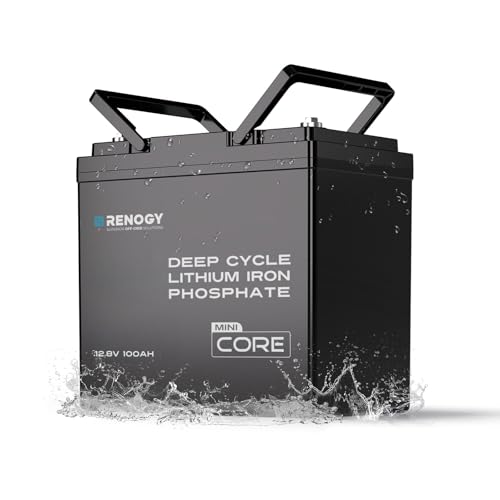
Renogy 12V 100Ah LiFePO4: the compact lithium all-rounder
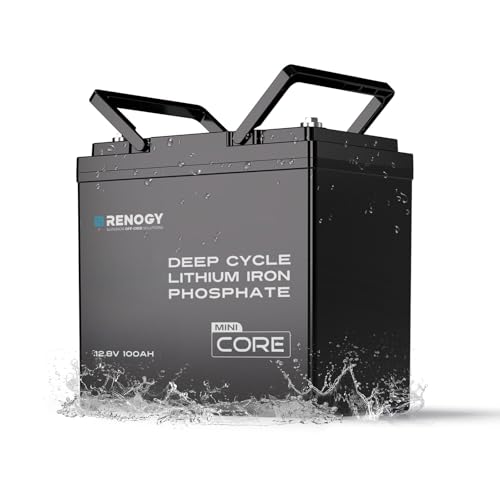
Renogy’s hundred amp-hour lithium battery is the natural starting point for owners switching a single-battery rig to lithium, and this version shrinks the formula: a mini-size case, noticeably smaller than the Group 31 footprint most hundred amp-hour batteries use, that fits compartments and trays where a standard case will not go. Inside is the package Renogy has refined across its whole off-grid catalogue: lithium iron phosphate cells, a hundred-amp battery management system guarding against overcharge, over-discharge, short circuits and temperature extremes, and an IP65-rated waterproof case that shrugs off the damp of a hard-working battery bay. In a rig, it behaves the way lithium is supposed to behave: voltage stays high and steady until the battery is nearly empty, so lights do not dim and inverters do not complain as the night goes on, and it accepts a charge at a rate that makes a short generator run or a few hours of sun genuinely useful. It can be wired in parallel or series for larger banks, so a single battery bought today can become half of a two-battery bank next season without drama, which is the quiet feature that lets owners stop worrying about the battery and start worrying about the view.
Strengths: Exceptional cycle life for a house battery, with thousands of deep cycles behind the design, so regular campers can expect years of nightly service. The mini-size case fits tight compartments that reject Group 31 batteries, which opens lithium to smaller trailers and campervans. Voltage stays flat under load, which keeps inverters, fans and pumps running at full performance until the battery is nearly empty. The battery management system is genuinely protective rather than decorative, cutting off charge and discharge outside safe limits, and the IP65 waterproofing suits exposed mounting. It charges quickly from solar, converter or alternator, so a short drive or a sunny morning refills a meaningful amount of energy. It integrates cleanly with Renogy’s charge controllers and solar gear, which many owners already run.
Trade-offs: It will not accept a charge below freezing, so owners who camp in winter need a heated compartment, and the protection cutoff can surprise owners the first time a cold morning blocks solar charging. The hundred-amp discharge ceiling is enough for most house loads but not for the largest inverters, which need a bigger bank or the two hundred amp-hour model below. It weighs far less than lead-acid, which is a benefit in most rigs but can change tongue weight on a trailer in ways worth checking. Older RV converters with fixed lead-acid charging profiles will not charge it to full; a lithium-capable converter or a programmable charger is part of the real cost. The purchase price sits above the budget lithium tier, in exchange for the brand’s support network and ecosystem.
Who it suits: Owners making the move to lithium in a small or mid-size rig, especially where the battery compartment is tight and a standard case will not fit. It suits weekend and seasonal campers who cycle the bank regularly, and system builders who already run Renogy solar and charging equipment. If your RV spends most nights on hookups and the battery is a weekend accessory, the AGM picks below are simpler; if the battery is your power grid and space is at a premium, this is the lithium to start with. For current availability in the configuration you want, check price on Amazon.

Renogy 12V 200Ah LiFePO4: the big-bank builder
Renogy’s two hundred amp-hour lithium battery is built for owners who think in systems rather than single batteries: one unit holds roughly the usable energy of four hundred amp-hours of lead-acid, which means a two-battery bank of these covers a large motorhome or a solar-heavy trailer with room to spare. It comes from a company whose catalogue covers the whole off-grid chain, so the battery is designed to sit alongside Renogy solar panels, charge controllers and inverters without compatibility guesswork. The battery management system handles overcharge, over-discharge, short circuits and temperature protection, and the unit supports parallel and series wiring for banks that grow with the rig. In use, its most noticeable quality is the absence of drama: the voltage holds, the capacity is what the label promises, and a big solar array can push serious current into it on a clear day. For owners building a serious off-grid system, the appeal is fewer connections, fewer points of failure, and a battery bay that holds twice the energy in the same number of boxes.
Strengths: Double the capacity of a standard hundred amp-hour unit in a single case, which simplifies wiring and frees space in the battery bay. Usable energy is close to the full rated capacity, so the effective bank is much larger than the same weight of lead-acid. The battery management system is well proven across Renogy’s range and integrates cleanly with the company’s charge controllers and inverters. It charges quickly, which matters when the sun is only up for a few hours in winter or when the generator runs on a schedule. The case is built for RV and marine vibration, and the terminal layout suits standard cable lugs. For large rigs, buying one two hundred amp-hour battery can cost less per usable amp-hour than buying two hundred amp-hour units.
Trade-offs: A single two hundred amp-hour battery is heavy for one person to lift into a high or awkward compartment, and its size may not fit trays designed for Group 27 or Group 31 batteries. Like all lithium, it will not charge below freezing without heating, so a cold-weather rig needs a heated bay. The upfront cost is substantial, and a fault in a single large battery takes the whole bank down, where two smaller batteries would leave half the bank running. Some older converters and alternator charging systems need upgrading before they can charge lithium properly, and the cost of that upgrade should be counted in the decision. The battery’s high charge acceptance can also overwhelm an undersized alternator if the charging path is not protected with a DC-to-DC charger.
Who it suits: Owners of large motorhomes, fifth wheels and solar-equipped trailers who want a big bank with minimal wiring. It suits system builders who already run Renogy solar and charging equipment, and full-timers who run a residential fridge, an inverter and a full work setup from the bank. If your rig is small or your trips are short, a single hundred amp-hour battery is a better fit; if you are building the electrical system of your dreams, this is the unit to build it around. To see how the two hundred amp-hour model compares with the smaller picks, check price on Amazon.

Redodo 12V 100Ah LiFePO4: the affordable way into lithium
Redodo has become a default recommendation for RVers who want lithium performance without the premium price, and the reason is simple arithmetic: it delivers the core benefits of lithium chemistry, nearly full usable capacity, fast charging and a long cycle life, at a price that undercuts the established premium brands by a wide margin. The battery carries a built-in hundred-amp management system that protects against overcharge, over-discharge, short circuits and temperature extremes, and it is rated for more than four thousand deep cycles, which is the number that makes the value case work over time. In a rig it behaves like lithium should: steady voltage, quick charging from solar or a converter, and a weight that makes installation a one-person job. It is a Group 31 size, so it drops into many existing trays, its case is IP65 waterproof, and it supports banks of up to four in parallel and four in series for owners who start small and grow. Owners who have made the switch commonly report the same surprise: the bank they thought was too small outperforms the lead-acid bank it replaced, because every amp-hour on the label is actually available.
Strengths: The strongest value proposition in the lithium category, with a price that makes the switch realistic for owners who could never justify a premium brand. Nearly the full rated capacity is usable, so a hundred amp-hour Redodo behaves like a much larger lead-acid bank. It charges quickly and holds voltage under load, which keeps inverters and appliances running properly until the battery is nearly empty. The built-in battery management system covers the essential protections, and the rated cycle life of more than four thousand deep cycles makes the total cost per night very competitive. The Group 31 case and IP65 waterproofing make it a straightforward fit for standard trays and exposed compartments. At roughly a third of the weight of a comparable lead-acid battery, it is easy to install and frees up payload for everything else.
Trade-offs: The management system is simpler than those on premium batteries, and the battery lacks some of the refinements of the top tier, such as low-temperature charging protection with self-heating or Bluetooth monitoring, so owners in cold climates need to manage charging temperatures themselves. The warranty and support network are thinner than the premium brands, which matters if something goes wrong far from home. It will not accept a charge below freezing, and without a heated model the owner must keep the battery bay warm or wait for the temperature to rise. Some older RV converters need a lithium charging profile to fill it fully, and the cost of that upgrade belongs in the budget. The brand’s rapid growth means quality control has been good so far, but the long-term track record is shorter than the established names.
Who it suits: Owners making their first move into lithium who want the performance without the premium price, especially weekend and seasonal campers who cycle the bank regularly but do not live in the rig full-time. It suits budget-conscious builders of solar systems and owners of smaller trailers where weight savings matter. If you camp in deep winter or need the longest warranty and the most hand-holding support, a premium brand may be worth the extra cost; if you want the best lithium value on the market today, this is the pick to start with. For the latest listing and full specifications, check price on Amazon.
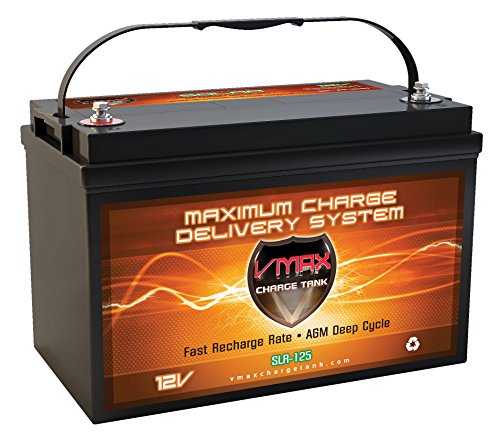
VMAXTANKS 12V 125Ah AGM: the drop-in workhorse
VMAXTANKS has built its name on heavy-duty AGM batteries for marine and RV use, and the twelve-volt, hundred-and-twenty-five amp-hour model is the company’s sweet spot for house banks: a sealed, maintenance-free battery that drops into an existing system with no charger changes, no new wiring and no learning curve. AGM chemistry stores its electrolyte in glass mats rather than liquid, so the battery cannot spill, can be mounted in positions a flooded battery cannot tolerate, and shrugs off the vibration of rough roads. The hundred-and-twenty-five amp-hour rating gives it a useful edge over the common hundred amp-hour AGM, and with a sensible fifty percent depth of discharge it delivers a solid night of power for a typical two-person rig. It is a heavy battery, as all lead-acid batteries are, but its Group 31 form factor fits the trays most RVs already have, and its terminals accept the cables that are already there. For owners who want a better battery without rebuilding their electrical system, this is the most straightforward upgrade available.
Strengths: A true drop-in replacement: no charger profile change, no converter upgrade, no rewiring, just swap and go. The sealed AGM design is maintenance-free and spill-proof, so it can live in compartments where a flooded battery cannot. It tolerates vibration and rough roads well, which is exactly what an RV battery faces. The hundred-and-twenty-five amp-hour capacity gives a useful margin over standard hundred amp-hour AGMs, and the battery recovers well from the moderate discharges of normal camping. It charges on any standard RV converter or solar controller set to an AGM profile, and it accepts a charge in cold weather where lithium refuses. The build quality and the heavy plates inside give it a reputation for surviving seasons of hard use.
Trade-offs: Only about half the rated capacity is usable if you want the battery to last, so a hundred-and-twenty-five amp-hour AGM behaves like a roughly sixty amp-hour lithium battery in practice. It is heavy, and a bank of two or four of these adds serious weight to the rig. Cycle life is measured in hundreds of deep cycles rather than thousands, so full-timers who cycle daily will replace it far sooner than a lithium bank. Charging is slower than lithium, especially in the final absorption phase, which means a short generator run or a brief sunny spell refills less energy. Leaving it discharged for weeks damages it permanently, and a deeply discharged AGM that has been left flat may never fully recover. The purchase price is lower than lithium, but the cost per usable amp-hour over its life is higher.
Who it suits: Owners who want a better house battery without touching the rest of their electrical system, and campers who use hookups most nights and only need the bank for overnight stops. It suits trailers and motorhomes with standard Group 31 trays and standard converters, and owners who value simplicity over maximum performance. If you boondock for weeks at a time and cycle the bank daily, lithium will serve you better and cheaper over time; if you want a reliable, maintenance-free battery that just works, this is the workhorse to buy. To confirm current stock and configuration options, check price on Amazon.

ExpertPower 12V 100Ah AGM: the honest budget pick
ExpertPower’s hundred amp-hour AGM is the battery for owners who need a reliable house battery on a tight budget and are honest with themselves about how often they actually camp off-grid. It is a sealed, maintenance-free AGM in the standard Group 31 size, which means it fits the tray, connects to the cables you already have, and charges happily on the converter your RV left the factory with. Its performance is exactly what the spec sheet promises: about fifty usable amp-hours per night if you treat it well, a solid charge acceptance rate for a lead-acid battery, and a build that handles the vibration of highway travel. It will not win any specification contest, and it is not trying to. What it does is deliver dependable power for weekend trips, overnight stops and the occasional boondock, at a price that leaves money in the budget for the rest of the rig. For many owners, that is precisely the right trade.
Strengths: The lowest sensible price in the category for a battery from a known brand, which makes it realistic to buy a pair for a larger bank without a painful bill. The sealed AGM design needs no watering, no venting and no special mounting, so installation is a simple swap. It fits standard Group 31 trays and accepts standard cable lugs, so there are no adapter plates or surprises. It charges on any existing RV converter or solar controller set to AGM, and it keeps accepting a charge in cold weather. For occasional use, its cycle life is more than enough: a battery cycled a few dozen times a year can last many seasons. The brand has a long record in the RV and solar markets, and the battery is widely available.
Trade-offs: Usable capacity is about half the rated figure, so a hundred amp-hour label means roughly fifty amp-hours of real power per night. Cycle life is the shortest in this roundup at deep discharge, so owners who cycle it hard every day will wear it out quickly. It is heavy for the energy it delivers, and a two-battery bank adds a lot of weight to a small trailer. Charging slows markedly in the absorption phase, so a short generator run refills less than the same run would put into a lithium battery. It must not be left discharged for long periods, and a battery that sits flat through the winter may not come back in the spring. The warranty is shorter than premium brands, reflecting the price.
Who it suits: Weekend campers and occasional boondockers who mostly use hookups and need the battery for overnight stops, and owners replacing a dead house battery on a tight budget. It suits first-time RV owners who want a simple, proven battery while they learn how much power they actually use, and it makes a sensible spare or second battery in a mixed bank. If you live in your rig or boondock for weeks at a time, invest in lithium or a larger AGM bank; if you camp a few weekends a year and want dependable power for the money, this is the honest budget pick. For today’s availability on this budget model, check price on Amazon.

Trojan T-105 (pair, 6V): the maintain-it-yourself classic
The Trojan T-105 is the battery that built the modern RV house bank, and it remains in this roundup because no other battery rewards involved, do-it-yourself ownership quite like it. Sold as a six-volt unit, it is used in pairs wired in series to make twelve volts, and the pair delivers a deep, honest two hundred and twenty-five amp-hours of rated capacity with plates built thick for repeated deep cycling. This is a flooded lead-acid battery, which means it needs watering, ventilation and a level of attention the sealed batteries in this list do not ask for, but in return it offers a service life that careful owners measure in years, a charging profile that any RV converter understands, and a price per amp-hour that still embarrasses the sealed alternatives. Golf cart fleets, solar installations and RVs have relied on the T-105 for decades, and the reason is not nostalgia. It is a battery that, treated properly, keeps delivering night after night long after cheaper batteries have faded.
Strengths: Genuinely deep cycle design, with thick plates built for repeated discharges to fifty percent and below, giving it a service life that careful owners measure in many seasons. The flooded design can be maintained: water levels can be topped up, specific gravity can be checked with a hydrometer, and a battery that is weakening can often be diagnosed and equalised rather than simply discarded. The cost per rated amp-hour is the lowest in this roundup, and a pair delivers more rated capacity than any single twelve-volt battery here. It charges on any standard converter or solar controller, and it accepts a charge in cold weather. The track record is unmatched: decades of use in golf carts, RVs and off-grid solar, with parts, knowledge and support everywhere.
Trade-offs: Maintenance is real and non-negotiable: water levels must be checked and topped up, terminals cleaned, and the battery kept charged, or its life shortens dramatically. It vents hydrogen while charging, so it must live in a ventilated compartment and cannot be mounted inside the living space or on its side. Only about half the rated capacity is usable for a long life, so the pair’s headline figure translates to roughly a hundred usable amp-hours. A pair of six-volt batteries is heavy and awkward to install, and the series wiring adds a connection that must be kept clean and tight. It is the slowest to charge in this roundup, and it suffers most from being left partially charged. Spilled acid is a real hazard, so handling requires care and the right safety gear.
Who it suits: Owners who enjoy maintaining their rig themselves and are willing to check water levels and clean terminals in exchange for the lowest cost per amp-hour and the longest proven track record. It suits full-timers with a ventilated battery compartment and a solar setup that keeps the bank charged, and owners of larger trailers who have room for a pair. If you want a battery you can install and forget, choose a sealed AGM or lithium instead; if you want a battery you can maintain for years and understand completely, the T-105 pair is the classic for a reason. To compare the pair configuration with the single-battery picks, check price on Amazon.
How these six made the cut
Every battery in this roundup earned its place on the same grounds: a proven design with a real track record in RV service, a capacity and chemistry that fits a recognisable camping style, and availability through the channels RV owners actually buy from. We weighted usable capacity over rated capacity, because a battery’s label is a promise and its usable energy is the delivery. We weighted cycle life heavily for the lithium picks and maintenance simplicity for the lead-acid picks, because the two technologies fail in different ways and should be judged on their own terms. We also considered the hidden costs: a lithium battery that needs a new converter, a flooded battery that needs a ventilated compartment, and an AGM bank that needs replacing twice as often all carry costs beyond the sticker. What we did not do is chase the cheapest battery in each category or the highest number on any single specification. A battery bank is a system, and the right battery is the one that fits your rig, your charging, your climate and your patience for maintenance. The six picks here cover that range, from the maintain-it-yourself classic to the premium lithium benchmark, so that whichever point on the spectrum you occupy, there is a battery here built for it.
Charging your bank properly: converter, solar and alternator
A battery is only as good as its charging, and the most expensive battery in this roundup will disappoint if the system feeding it is wrong. Most RVs leave the factory with a converter-charger tuned for flooded or AGM lead-acid, with a three-stage profile of bulk, absorption and float. That profile works well for the AGM and flooded picks here, but it will not fill a lithium battery completely, because lithium wants a higher absorption voltage and no float stage. Owners switching to lithium should budget for a lithium-capable converter or a programmable charger, or accept a battery that never quite reaches full charge. Solar charging needs the same attention: a charge controller set to the wrong chemistry will either undercharge a lithium bank or overcharge a lead-acid one, and the fix is a controller with a lithium profile and a temperature sensor. Alternator charging is the third path, and it is the one most likely to cause expensive damage: a lithium bank can draw far more current than an alternator is rated for, overheating it, so a DC-to-DC charger that limits current and provides the right profile is not optional for lithium owners who charge while driving. Whatever chemistry you choose, the rule is the same: the charger must match the battery, the wiring must be sized for the current, and the system should be checked with a meter after installation rather than trusted to the factory settings.
Mistakes RV owners make with house batteries
The most expensive mistake is the simplest: buying capacity before measuring consumption. Owners guess at their nightly draw, buy a bank that is far too small, and spend the first season living in fear of the low-voltage alarm, or they buy far too large and pay for capacity their charging system can never refill. The second mistake is mixing old and new batteries in one bank, where the weakest battery drags the whole bank down and the new batteries age at the rate of the old one. The third is leaving batteries discharged: a lead-acid battery left flat for weeks sulphates and may never recover, and even lithium prefers not to sit at zero charge. The fourth is ignoring the converter: a lithium bank on a lead-acid charging profile, or an AGM bank on a flooded profile, will underperform for its whole life and the owner will blame the battery. The fifth is forgetting temperature: charging a lithium battery below freezing, or leaving a flooded battery discharged in a hard freeze, can destroy a battery in a single night. And the sixth is the most human of all: never checking the terminals. A loose or corroded connection can mimic a dead battery perfectly, and many batteries have been replaced that only needed a wrench and a wire brush. Avoid these six mistakes and any battery in this roundup will serve you far better than its specification promises.
Comparison table: the six picks side by side
| Pick | Chemistry | Usable capacity | Weight | Maintenance | Cold charging |
|---|---|---|---|---|---|
| Renogy 100Ah | LiFePO4 | High | Light | None | Blocked below freezing |
| Renogy 200Ah | LiFePO4 | Very high | Moderate | None | Blocked below freezing |
| Redodo 100Ah | LiFePO4 | High | Light | None | Blocked below freezing |
| VMAXTANKS 125Ah | AGM | Moderate | Heavy | None | Yes, reduced capacity |
| ExpertPower 100Ah | AGM | Moderate | Heavy | None | Yes, reduced capacity |
| Trojan T-105 pair | Flooded | Moderate | Very heavy | Watering required | Yes, never charge frozen |
The table makes the trade visible at a glance. Lithium wins on usable capacity and weight and loses on cold charging and price. AGM wins on simplicity and loses on usable capacity. Flooded wins on cost per amp-hour and loses on maintenance and weight. There is no row where one chemistry wins everything, which is why the choice is a matter of fit rather than of ranking.
When to replace your house battery
A house battery rarely fails all at once; it fades, and the fade is easy to miss until a cold night exposes it. The signs are consistent across chemistries: the bank reaches full charge faster than it used to, yet runs flat sooner; the voltage sags under a load it once handled easily; the furnace fan stutters when the battery is below half charge. For lead-acid batteries, a hydrometer reading that will not rise after a full charge, or a battery that needs water far more often than it did, tells the same story. For lithium, a battery that trips its management system at loads it once carried, or that holds noticeably less energy than its rating, is telling you its cells are tired. The right moment to replace is before the failure, not after it: a battery that dies on a trip costs more in ruined plans than a new battery costs in the driveway. Test your bank at the start of each season with a full charge and a measured discharge, and replace a battery that has lost a fifth or more of its usable capacity rather than nursing it through another year.
Battery monitors: knowing your state of charge
Voltage alone is a poor guide to how much energy remains in a house battery, and this is doubly true for lithium, whose voltage barely moves until the battery is almost empty. A shunt-based battery monitor, wired between the battery bank and the rest of the rig, counts the amp-hours going in and out and turns that count into a percentage you can actually trust. It answers the question that matters at midnight, which is not what voltage the battery shows, but how many amp-hours you have left before the furnace stops. For lead-acid batteries, a monitor also reveals the slow truth about charging: the absorption phase takes far longer than owners expect, and a battery that looks full at midday may still be an hour from a genuine full charge. A monitor pays for itself the first time it stops you from running a battery flat, and it is the single most useful addition to any RV electrical system, whatever chemistry you choose. The display can be as simple as a small panel by the door or as complete as a phone app with graphs and history, but the principle is the same: measure the energy, not the voltage, and make decisions from the measurement. If you buy one accessory with your new battery, make it a shunt monitor.
Winter storage and off-season care
How you store a battery between seasons determines how it performs when the season returns, and the rules differ by chemistry in ways worth knowing before the first frost. A lithium battery should be stored at a partial charge, roughly half full, in a place that stays above freezing, and it should be disconnected from parasitic loads like smoke detectors and control boards that will drain it silently over months. A lead-acid battery, by contrast, should be stored fully charged, and checked and recharged through the winter, because a discharged lead-acid battery sulphates and can freeze and crack in a hard cold snap. Flooded batteries need their water levels checked before storage and topped up with distilled water, and the terminals should be cleaned and protected against corrosion. Whatever the chemistry, the storage location matters: a battery left in an unheated compartment through a northern winter is a battery at risk, while one brought indoors or kept on a maintenance charger will wake up in spring ready to work. The habit that saves the most batteries is the simplest: charge before storage, disconnect the loads, and check the voltage once a month. A battery that survives storage is a battery you do not have to buy again.
Frequently asked questions
Can I replace a lead-acid RV battery with lithium without changing anything else?
In many cases the battery will physically fit and the rig will work, but it will not work well. A converter set for lead-acid will not charge lithium to full, a solar controller on the wrong profile will do the same, and alternator charging without a DC-to-DC charger can overheat the alternator. The battery swap is the easy part; the charging profile is the part that determines whether the investment pays off. Budget for a lithium-capable converter or a programmable charger, check the solar controller settings, and add a DC-to-DC charger if you charge from the alternator. With those pieces in place, the swap is straightforward and the improvement is immediate.
How long will a deep cycle RV battery actually last?
It depends on chemistry and on how you treat it. A lithium battery cycled daily can last a decade or more, with thousands of cycles behind its design. An AGM battery used on weekends and kept above half charge can last several seasons, while the same battery cycled deeply every day may last a couple of years. A flooded battery like the Trojan T-105, maintained with regular watering and kept charged, can last many years. The numbers that matter most are depth of discharge and time spent discharged: shallow cycles and prompt recharging extend the life of every chemistry, while deep discharges and long periods flat shorten it. Buy for your real usage pattern, not for the best-case number on the box.
Is it safe to mount a lithium battery inside the RV?
Lithium iron phosphate is the safest lithium chemistry for RV use, and it is commonly installed inside living spaces because it does not vent gas during normal operation. That said, the battery should be mounted securely, protected from physical damage, wired with proper fusing, and kept within its temperature limits. The built-in battery management system protects against overcharge, over-discharge and short circuits, but it is not a substitute for correct installation. Follow the manufacturer’s mounting instructions, use the recommended cable size and fuse, and keep the battery away from heat sources. If in doubt, have the installation checked by an RV electrician.
Can I mix lithium and lead-acid batteries in the same bank?
No, not in the same bank. The two chemistries have different charging voltages, different discharge curves and different internal resistances, so a mixed bank will charge unevenly, discharge unevenly, and age the weaker batteries quickly. The lithium batteries will do most of the work while the lead-acid batteries lag, and the charging system cannot satisfy both profiles at once. If you are switching to lithium, switch the whole bank at once. The old lead-acid batteries can serve as a separate, independent bank for a different circuit, but they should never be wired in parallel or series with lithium cells.
Do I need a special charger for AGM batteries?
Most modern RV converters and solar controllers have an AGM setting, and that is all you need. AGM batteries want a slightly different absorption voltage from flooded batteries, and a charger set to the flooded profile will overcharge them over time, while a charger set to lithium will undercharge them. Check that your converter or charge controller has an AGM mode and that it is selected. If your converter is very old and has only a single fixed profile, it will still charge an AGM battery, but a modern three-stage charger with an AGM setting will give you a longer service life. The adjustment is a switch or a menu setting, not a new appliance.
best solar panels for security cameras
best rv backup camera systems
The battery you choose will shape every night you spend away from hookups, so choose it the way you would choose any piece of equipment your comfort depends on: measure first, buy the chemistry that fits your camping, and spend the money on the bank you will actually use rather than the one with the biggest number on the label.