Cinema lenses are built differently from photo lenses, with geared rings, long focus rotation and consistent barrels that matter once a camera is rigged for a real shoot. We have not used these products ourselves, so this guide does not rank or promise anything. It shows how to choose, which details deserve attention and which claims to read with care.
Use the guide below to compare options for filmmaking. Read each maker’s specification sheet, think about how you will really use the product, and treat the table as a checklist you can carry from one listing to the next.
As an Amazon Associate we earn from qualifying purchases. Links on this site are affiliate links, and they do not change the information we give.

In this guide
Quick Picks
| Pick | Product | Best For |
|---|---|---|
| Best pro wide-angle | Rokinon Xeen 24mm T1.5 Cine Lens for Canon EF (XN24-C) | Professional sets needing a true wide prime |
| Best value standard-wide | Rokinon 35mm T1.5 Cine DS Lens for Sony E (DS35M-NEX) | Building a matched Cine DS set on a budget |
| Best value standard prime | Rokinon 50mm T1.5 Cine DS Lens for Sony E (DS50M-NEX) | The everyday focal length in the Cine DS line |
| Best portrait prime | Rokinon 85mm T1.5 Cine DS Lens for Sony E (DS85M-NEX) | Close-ups and interviews in the Cine DS line |
| Best pro standard prime | Rokinon Xeen 50mm T1.5 Cine Lens for Canon EF (XN50-C) | Professional sets needing a true standard prime |
Our Picks

1. Rokinon Xeen 24mm T1.5 Cine Lens for Canon EF (XN24-C) — Best pro wide-angle
The Xeen line is Rokinon’s purpose-built cinema range, and the 24mm is its wide anchor. It projects an image circle that covers full-frame sensors, opens to T1.5 for low-light and depth-of-field control, and uses internal focusing so the barrel does not change length or rotate the front while you pull focus. What separates a Xeen from a rehoused stills lens is the mechanics the guide above calls for: 0.8 MOD focus and iris gears at unified positions shared across the set, a long 200-degree focus throw for precise marks, dual-sided scales, and Rokinon’s X-Coating, which the maker tunes so lenses bought years apart still color-match. The mount is interchangeable between EF, PL, Sony E, Nikon F and Micro Four Thirds versions. It is the most production-ready wide prime in this price class.


2. Rokinon 35mm T1.5 Cine DS Lens for Sony E (DS35M-NEX) — Best value standard-wide
The Cine DS series exists to solve a specific problem: building a matched set of cine primes without rental-house money. Every DS lens shares the same focus and iris gear positions, so swapping focal lengths does not mean repositioning your follow focus, and the range is color-matched so cuts between lenses do not jump in tone. The 35mm covers full frame, opens to T1.5 with a de-clicked iris ring, focuses as close as 1 foot, and takes 77mm front filters. On a Sony E-mount camera it is the natural everyday lens — wide enough for interiors and establishing shots, tight enough for two-shots and dialogue. It lacks the Xeen’s heavyweight housing and interchangeable mount, but as the core of a DS set bought one lens at a time, it is where most shooters should start.


3. Rokinon 50mm T1.5 Cine DS Lens for Sony E (DS50M-NEX) — Best value standard prime
If you only add one Cine DS lens first, the 50mm is the usual answer: the standard focal length handles interviews, product work and general narrative coverage without the perspective stretch of a wide or the compression of a telephoto. It shares everything that defines the DS system — full-frame coverage, a fast T1.5 maximum with a de-clicked aperture ring, geared focus and iris placed at the same positions as the 35mm and 85mm in this list so lens changes stay fast, and color rendition matched across the set. Minimum focus is 1.5 feet, and the front takes 77mm filters, the same thread as its DS siblings, which keeps your ND set simple. Mounted on a Sony E body it is a natural first cine prime; add the 35mm and 85mm later and the three behave like one designed set, because they are.

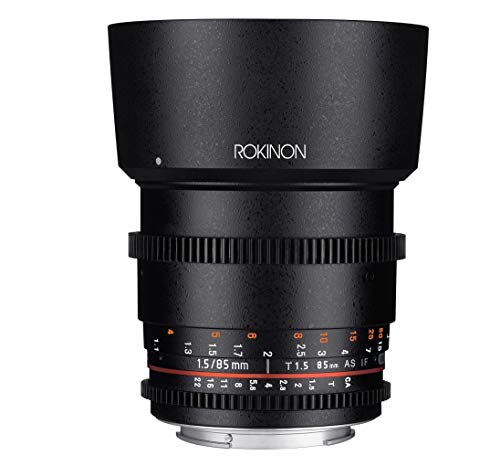
4. Rokinon 85mm T1.5 Cine DS Lens for Sony E (DS85M-NEX) — Best portrait prime
The 85mm completes the classic three-lens Cine DS kit. Its longer focal length flattens features and separates subjects from backgrounds, which is why it is the default portrait and close-up lens on narrative sets, and the T1.5 maximum keeps that look available in low light or when you want a genuinely shallow plane of focus. Like its DS siblings it covers full frame, carries unified gear positions for fast swaps with a follow focus, and is color-matched to the rest of the series so intercutting with the 35mm and 50mm stays invisible. Minimum focus is about 3.6 feet, typical for the class, and the build is the same compact metal housing as the rest of the line. For Sony E shooters assembling a matched set in stages, this is the third lens to buy — and the one that makes dialogue coverage feel cinematic.

5. Rokinon Xeen 50mm T1.5 Cine Lens for Canon EF (XN50-C) — Best pro standard prime
The Xeen 50mm is the professional counterpart to the Cine DS standard prime: same focal length and full-frame image circle, but in the heavier-duty Xeen housing built for daily production use. You get the full Xeen mechanical package — 0.8 MOD gears at positions unified across the Xeen set, a 200-degree focus throw for repeatable marks, an 11-blade iris, X-Coating for cross-set color consistency, and an interchangeable mount system, so the lens can move between EF, PL, Sony E, Nikon F and Micro Four Thirds cameras as your camera package changes. Internal focusing keeps matte box and follow focus geometry constant during a pull. Choose it over the DS 50mm when the lens will live on crewed sets, take rental-style wear, or needs to match other Xeen glass; choose the DS when budget and weight matter more.

What to Look For
| Factor | Why it matters | What to check |
|---|---|---|
| Image circle coverage | The lens must cover your sensor without dark corners. | Match the stated coverage to your camera’s sensor format. |
| Aperture type | T-stops measure real light transmission, helpful for consistent exposure. | Check whether the lens uses T-stop or f-stop markings. |
| Focus throw | Longer rotation gives finer control for focus pullers. | Look for the degrees of rotation listed by the maker. |
| Gear rings | Standard gear positions let you use follow focus and matte box gear. | Check ring pitch and whether gears sit in the same place across the set. |
| Mount | The mount sets compatibility and adapter options. | Confirm the mount and ask whether it can be swapped. |
| Matching across a set | Similar color, size and front diameter speed up lens changes. | Compare front diameters and the maker’s note on color consistency. |
| Weight and size | Heavy glass affects balance on gimbals and handheld rigs. | Check the weight and length against your support gear. |
Setup and Care Tips
- Mount lenses with care and keep the rear cap on whenever the lens is off the camera.
- Use a lens support when a heavy lens hangs from a light body, so the mount is not stressed.
- Clean the front element with a blower and a soft cloth made for optics.
- Mark focus and iris positions with removable tape on a rehearsal day.
- Keep lenses in padded cases with desiccant packs away from heat.
Mistakes to Avoid
- Ignoring image circle coverage and finding vignetting on the first shot.
- Mixing lenses with very different gear positions, which forces constant rig changes.
- Buying a full set at once when two or three focal lengths would cover your needs.
- Forgetting to check the maker’s notes on breathing and focus behavior.
- Treating still photography glass as identical to cinema glass in handling.
Which cinema lens should you buy?
The right cinema lens depends on your camera mount, your budget and how hard the lens will be used. Match those three things to the picks above and the choice gets much simpler.
Here is a plain way to map your needs to the lenses already named in this guide:
- If you shoot on a Sony E-mount body and want to build a matched set slowly, start with the Rokinon 50mm T1.5 Cine DS Lens for Sony E (DS50M-NEX), then add the 35mm and 85mm later.
- If your work is mostly interiors, establishing shots and dialogue, the Rokinon 35mm T1.5 Cine DS Lens for Sony E (DS35M-NEX) is the natural everyday lens in the line.
- If you shoot interviews or close-ups and want separation from the background, choose the Rokinon 85mm T1.5 Cine DS Lens for Sony E (DS85M-NEX).
- If the lens will live on crewed sets, take regular wear and may change cameras, look at the Rokinon Xeen 50mm T1.5 Cine Lens for Canon EF (XN50-C), because the post describes its mount as interchangeable.
- If you need a true wide prime for a professional package, go for the Rokinon Xeen 24mm T1.5 Cine Lens for Canon EF (XN24-C).
When two options both fit, weigh weight and budget against durability. The Xeen housing is described as heavier duty, while the Cine DS range is the lighter and more affordable route into matched cine glass. Neither choice is wrong; they simply suit different working conditions.
Budget tiers are easy to read in this guide. The Cine DS lenses sit at the more affordable end for matched cine glass, while the Xeen lenses are the professional step up. Decide how many focal lengths you truly need before you compare costs.
If you are still unsure, rent one lens for a weekend first. Seeing how a geared, long-throw lens feels on your own rig tells you more than any description can.
What to check before you buy cinema lenses
Before you buy a cinema lens, confirm the mount, the sensor coverage and what actually ships in the box. A short checklist now prevents returns later.
- Mount: the listing names the mount for each version. Make sure it matches your camera, or that the lens offers a mount you can swap.
- Sensor coverage: check the maker’s stated image circle against your sensor format so corners stay clean.
- Front filter size: a shared thread across a set keeps your neutral density filters and matte box simple.
- Gear rings: confirm they sit where your follow focus expects them, and that positions match across the lenses you own.
- Support gear: check weight against your gimbal, cage or rods before you commit.
- Minimum focus distance: make sure it works for your closest framing, especially with longer lenses.
- What is included: look for caps, case and any paperwork listed on the page.
- Warranty and returns: read the terms on the listing, and keep the original packaging until you have tested the lens on your camera.
Test a new lens soon after it arrives. Check focus at several distances, turn the iris through its range and look for vignetting at wide apertures. If something feels wrong, you want to find out inside the return window.
Care also counts. Keep rear caps on, clean with a blower first, and store the lens in a padded case away from heat.
Cine DS or Xeen: which cinema lens line fits?
The Cine DS line fits budget-conscious Sony E shooters building a set, while the Xeen line fits crews who need rugged housing and a swappable mount. Both come from the same maker and both aim at consistent handling.
From the descriptions above, the two lines share several traits: a fast maximum aperture, full-frame coverage, geared focus and iris rings, and color matching across each family. The differences are about build and flexibility.
- Housing: Xeen is described as heavier duty and built for daily production use. The DS housing is compact metal.
- Mount flexibility: the Xeen lenses are described as available in several mount versions and swappable. The DS lenses in this guide are listed for Sony E.
- Focus throw: the Xeen picks mention a long rotation for repeatable marks, which helps focus pullers.
- Weight and cost: the DS range is the lighter and more budget-friendly path, which suits solo shooters and small crews.
Avoid mixing the two lines casually. Gear positions are unified within each family, so a mixed kit may force you to reposition your follow focus between lenses. If you already own one family, buying the next lens from it keeps the rig predictable.
Always confirm exact specifications on the current listing or the maker’s sheet, since versions and mounts can vary.
How to build a cinema lens kit in stages
You can build a cinema lens kit one prime at a time, starting with the focal length you use most. Buying a full set at once is rarely necessary.
A sensible order looks like this:
- First lens: pick the focal length that covers most of your shots. For many shooters that is a standard prime.
- Second lens: add a wider option for interiors and establishing shots, ideally from the same family so gears and color match.
- Third lens: add a longer portrait lens for close-ups and interviews.
- Accessories: add a matte box, filters and a follow focus once you know your workflow.
Staging the purchase spreads the cost and lets your real projects show you which focal length is missing. It also means you learn how geared rings feel before you invest in a whole set.
Keep notes as you go. Write down which focal lengths you reached for, which shots felt cramped and which lenses stayed in the bag. Those notes are a better guide than any generic kit list.
If you rent crew, ask what they prefer. A focus puller who knows the gearing will work faster, and their input can steer which lens to buy next.
Is a cinema lens worth it? Honest trade-offs
A cinema lens is worth it if you will use manual focus, a follow focus and a matched set on real shoots. If you mostly shoot stills or quick handheld video, it may be more than you need.
Here are the downsides worth weighing:
- No autofocus: pulling focus by hand takes practice and patience.
- Size and weight: cinema barrels are larger and can unbalance small gimbals and light bodies.
- Extra gear: to get full value you may need a follow focus, rods and a matte box.
- Cost of a set: even the more affordable range adds up if you buy every focal length.
Is it worth paying more for the Xeen line? It makes sense when durability, a swappable mount and crew-friendly handling matter to your work. If you shoot alone and value lighter weight and a lower spend, the Cine DS range may serve you better.
Who should skip it? Photographers who want autofocus, casual video shooters and anyone with a very small gimbal should think twice, because the handling advantages mostly appear on rigged shoots.
Compare the picks above, check the current listing for the mount and what is included, then choose the lens that fits how you will shoot.
Judging a Cinema Lens by the Working Day It Creates
A cinema lens is a working tool before it is an optical instrument. Its job is to let a focus puller hit a mark without looking, let an operator change aperture without a visible jump in exposure, and let a crew swap lenses without the image changing size, colour or character. That is why cinema lenses are built the way they are: geared rings that turn the same way on every lens in a set, long focus throws, markings you can read from the side, and housings that keep accessories in the same place from lens to lens. The five picks in this guide all follow that philosophy at an accessible level, and judging them well means judging the working day they create, not just the images they make.
Optics still matter, of course, but in a different order than in stills photography. For cinema, consistency across a set often outranks the absolute performance of any single lens, because a scene is cut together from several focal lengths and the audience should never feel the joins. Character matters too: how a lens renders out-of-focus areas, how it flares when a light enters the frame, how contrast holds at the widest aperture. The Rokinon families in this guide are known for offering a consistent, usable character at prices that let a small production own a set rather than rent one, which is precisely their argument.
Weight and size deserve respect on small productions. A lens that needs heavy support slows every setup; a matched set of modest size lets a small crew move fast and lets a gimbal or handheld rig stay balanced across lens changes. When you compare picks, imagine the tenth setup of the day, not the first: the lens you want is the one whose handling has not become a negotiation by then.
Matching the Picks to Real Camera Work
Establishing shots and interiors
The Rokinon Xeen 24mm is the wide voice of this guide, picked as the pro wide-angle. On its intended formats, a lens of this length establishes spaces, follows movement through interiors, and gives gimbal and Steadicam work the stability that wider views forgive. Wide cinema lenses demand care with placement: a few inches of camera movement changes the frame dramatically, and faces near the edges distort, so block scenes with the lens’s geometry in mind. In return, it makes small rooms filmable and gives movement a sense of speed that longer lenses flatten away.
The standard views most scenes are built from
The 35mm and 50mm picks are the storytellers. A 35mm is the classic working length for scenes: two people talking, a subject in their environment, movement that stays natural. The Rokinon 35mm Cine DS pick offers that view in the value line, while the two 50mm picks — the Cine DS for Sony E and the Xeen for Canon EF — offer the tighter, more intimate standard view that dialogue and close work default to. If a production could own only one focal length from this guide, it would be one of these, because more professional footage is shot at standard lengths than at all others combined.
Portraits, details and compression
The Rokinon 85mm pick is the portrait prime of the set: the length that flatters faces, separates a subject from a background, and compresses space for a more deliberate, composed feel. It is the lens for interviews shot tight, for inserts and details, and for the moment a scene slows down and looks at someone. Its narrower view makes handheld work less forgiving and demands more distance from the subject, which small rooms may not allow; that is not a flaw but a planning note. Every set benefits from one lens that sees this way, because it gives the edit a different emotional register to cut to.
Choosing a line: Cine DS or Xeen
The deeper decision in this guide is between Rokinon’s two families. The Cine DS lenses are the value route to a matched set: consistent colour and gear positions across the range, compact housings, and prices that let an owner build a three-lens set for the cost of one prestige lens. The Xeen line is the professional step: larger, more robust housings, and the build expected on crewed productions where lenses are handled by a camera department all day. Owner-operators who are their own crew usually find the DS line’s size and cost persuasive. Productions with assistants, rental potential or heavy schedules justify the Xeen build. Both lines make real cinema images; they differ in the working life they are built for.
Head-to-Head: Where the Five Picks Actually Differ
The two 50mm picks are the same idea at two levels. The Cine DS 50mm gives the standard view with the set’s shared gear positions and colour, in a housing a solo operator can handle all day. The Xeen 50mm gives the same view with a housing built for a department: more metal, more presence, more confidence under daily professional handling. Image character is closer than the price gap suggests, which is exactly why the decision should be made on workflow. If the lens will live on your own camera and travel in your own bag, the DS logic is strong. If it will be pulled by an assistant, mounted on rented bodies and expected to earn fees, the Xeen logic takes over.
The 35mm versus the 50mm is a framing decision that shapes a whole production’s look. The 35mm keeps environment in the story; the 50mm removes it. Directors choose between them by how much context a scene needs, and a set containing both lets that choice happen per scene rather than per production. If budget forces a sequence, most filmmakers buy the 50mm class first for faces and dialogue, then add the wider view, then the 85mm for reach and compression — the order in which scenes typically demand them.
The 24mm Xeen versus the 35mm DS is a comparison across both focal length and family, and it shows why sets are bought as sets. Mixing families is possible — mounts and image circles permitting — but you lose the matched colour and handling that make lens changes invisible. If the wide lens matters to your work, decide early whether you are building a Xeen set or a DS set, and let that decision organise the purchases. A deliberate two-lens start in one family beats a scattered collection across both.
Working Habits That Make Cinema Lenses Shine
Learn the focus throw. Cinema lenses turn a long way between near and far, which is what makes precise pulls possible, and it changes how you rehearse. Mark your positions for rehearsed moves, use the witness marks rather than the monitor when a pull must be exact, and give a focus puller — even if that is you, an hour later — a follow focus in good condition with no play in the gear mesh. Small backlash in the gear train is the enemy of repeatable focus, so check the fit between lens gear and follow focus whenever you rig.
Respect the T-stop workflow. Cinema lenses are marked in T-stops, which measure actual transmitted light, so an exposure set on one lens in a matched set holds when you swap to another at the same T value. That consistency is a working gift: light once, swap freely. It also means aperture changes are smooth and stepless, so exposure can be ridden gently during a shot when a cloud crosses the sun — a move impossible with the clicked rings of stills lenses. Build your lighting and exposure habits around that consistency and the set earns its keep daily.
Support the lens, not just the camera. Heavier cinema glass on a small body can stress a mount over time, especially on a rig that moves. Use lens support where the system offers it, keep matte box weight off the front of lenses not built for it, and never carry a rig by the lens. When you change lenses on location, cap immediately, rear cap first in dusty places, and keep the set in a case with the order you work in, so changes are quick and unhurried at the same time.
Troubleshooting Common Cinema Lens Frustrations
Focus marks do not match the image
If measured focus and the image disagree, suspect the camera’s flange distance or an adapter before suspecting the lens, especially when adapted mounts are involved. A lens that focuses past infinity noticeably, or cannot reach it, is telling you the adapter’s thickness is off. Test with a chart or a taped measure and a cooperative subject, at a wide aperture where errors are visible. Professional bodies and adapters offer adjustment; inexpensive adapters vary. Solve it at the mount, because no pulling technique compensates for a scale that lies.
The image shifts when changing lenses mid-scene
Within a matched set this should be minimal, so visible shifts point to mixed families, different filtration between lenses, or a support change that altered camera height — the classic cause, since a slightly different lens diameter on the same support raises or lowers the optical centre. Keep filtration consistent across a scene, note your support settings per lens if you mix families, and shoot a few frames of a chart at the start of a production day if the edit will intercut heavily. Prevention is a two-minute habit; repair in post is a compromise.
Gears feel rough or the follow focus slips
Check the obvious first: the follow focus gear’s mesh and tightness, and whether the lens gear ring is clean. Dust and grit in gear teeth make motion notchy and can wear both parts. Clean with a soft brush, never with solvents near optics. If slip happens at one part of the throw, inspect that section of the ring for damage. A lens that has taken a knock may have a subtly bent ring; that is a service job, and catching it early keeps a small repair from becoming a ruined shoot day.
More Questions, Answered
Can I build a set one lens at a time?
Yes, and most owners do. Buy within one family and mount so the set stays matched as it grows, and start with the focal length your scenes use most — usually a standard. Rent the specialist lengths until their rental cost approaches ownership, or until a production’s schedule makes owning them clearly worthwhile. A growing set bought deliberately stays coherent; a set bought opportunistically often contains three versions of the same view and no wide option.
Do cinema lenses hold their usefulness as cameras change?
Better than almost anything else in the kit. Lenses are mechanical and optical, mounts adapt, and a good cinema lens can serve several generations of camera bodies. That longevity is a core argument for owning quality glass in this category. Protect it by choosing mounts with healthy adapter ecosystems and by keeping the lenses serviced and dry, and a set bought today can plausibly work for a decade of productions.
What should I check when buying a used cinema lens?
Optics first: shine a light through the lens and look for fungus, haze or cleaning marks, and check the aperture blades move smoothly across the whole de-clicked range. Mechanics second: the focus and aperture rings should turn evenly with no gritty patches or looseness, and the mount should show no excessive wear. Finally, mount it and shoot a focus test at several distances to confirm the scale is honest. A lens that passes those checks is a sound buy; one that fails the optics check rarely becomes a bargain at any price.
Filters and matte boxes: the front of the lens
Cinema lenses are designed to work with matte boxes and filtration, and a small set of neutral density filters is the working companion to a fast lens set, because it lets you keep the aperture where the scene wants it when light is abundant. Keep filtration consistent within a scene and note what was used, since mixing filter types between shots can shift colour in ways the edit will notice. Whatever system you choose, make sure it mounts without stressing the lens front, and that filters are cleaned with the same care as the lens itself — a smeared filter softens every lens behind it equally.
Renting to complete a set for one production
Owning the core lengths and renting the extremes is a rational pattern for small productions. The wider and longer ends of a set often work fewer days than the standard lengths, so renting them per production can beat owning them — until the rental bills say otherwise. When you rent, rent within your set’s family where possible so colour and handling match, and test the rented lens on your body before the shoot day. Keep a simple record of what you rented and how often; that record is the most honest buying guide you will ever read.
Storing and transporting a lens set
A lens set travels as a set: a case with fitted spaces, caps on both ends, and desiccant if your climate is humid. At home, store lenses upright in a dry cabinet rather than in a bag that lives in a damp room, because fungus is the one enemy that attacks quietly over months. When a production wraps, clean and inspect each lens before it goes back in the case, not before the next job; problems found at wrap are problems with time to solve them. Treat the case as part of the equipment, and your set will arrive at every location in the condition it left the last one.
How mount choice shapes a set’s future
The picks in this guide span mounts — Canon EF and Sony E among them — and that is not a detail. A set bought in a widely adapted mount keeps its options open across camera bodies and brands, because EF glass in particular has been adapted to almost everything. A set bought in a native mount fits its intended bodies perfectly with no adapter variables. Neither is wrong, but the decision compounds: every later lens inherits it. Think about which bodies you will plausibly own in five years, and let the mount of your first cinema lens lean in that direction.
What a focus puller wishes directors knew
Focus pulling is a performance, and it improves with rehearsal, marks and honest communication about where actors will actually be when the line lands. Give the puller a rehearsal at full speed, not a walk-through, because timing is the skill. Keep marks discreet but real, and light the scene so the lens can work at an aperture that gives the puller a fair chance — asking for razor-thin focus in a moving scene is asking for retakes. The lenses in this guide have the throws and markings for professional pulling; the production’s habits decide whether that potential is used.
De-clicked apertures and exposure riding
Still photographers meeting cinema lenses often ask why the aperture ring turns smoothly with no clicks. The answer is the shot where the light changes mid-take — an actor crossing from shade to sun, a door opening — and the operator rides the aperture gently so exposure breathes with the scene instead of jumping. It is a small feature that changes what a single take can contain. It also means aperture is set by eye and meter rather than by counting clicks, a habit that becomes natural within a day of working this way.
When one lens must do everything
Some productions — travel documentaries, tiny crews, one-bag shoots — ask a single lens to cover the day. In this guide that lens is a standard: the 50mm class for interviews and detail with environmental context sacrificed, or the 35mm for context with intimacy sacrificed. Choose by what your film cannot lose. A documentary about people in places usually keeps the 35mm; a film built on faces and testimony usually keeps the 50mm. Either way, a single fast prime plus discipline about moving the camera is a proven way to work, and many admired films were made under exactly that constraint.
Cleaning cinema lenses without anxiety
Cinema lenses are cleaned like any fine optics, only more often, because they live on sets. Air first: a blower removes grit that a cloth would drag across the coating. Cloth second, with a proper lens tissue or microfibre kept clean and dedicated to the task, working gently from the centre outward. Keep cleaning fluid for the stubborn marks and use it sparingly. The rear element matters as much as the front and is easier to forget, so include it in the routine. A lens cleaned calmly and correctly after each day rarely needs professional attention; a lens cleaned rarely and roughly eventually does.
Understanding image circle and sensor coverage
Every lens projects a circle of image, and the sensor must fit inside it. A lens designed for a smaller format may mount on a larger-sensor body yet darken at the corners or fail to cover at some apertures and focus distances. When you build a set, confirm each lens covers the largest sensor you realistically plan to use, because coverage is the one specification that cannot be adapted around later. This is another argument for buying within a coherent family: the coverage question is answered once, consistently, instead of rediscovered with every purchase.
FAQ
Are cinema lenses worth it over photo lenses?
They bring geared rings, long focus throw and consistent sizing, which help on set. If you shoot alone and mostly handheld, photo lenses may suit you better.
Do I need a full matched set?
Not at first. Many filmmakers begin with a few focal lengths that cover their typical shots and add more later, ideally from the same family.
What does T1.5 mean on a cinema lens?
T1.5 is a T-stop, which measures how much light actually passes through the lens rather than the geometric aperture alone. It helps keep exposure consistent across lenses in a set. Lower numbers mean a wider opening and more light.
Can you use a cinema lens for photography?
Yes, you can, but the handling is built for video. Focus is manual and the barrels are larger, so many photographers find a regular photo lens easier. Check the mount and sensor coverage first.
Do cinema lenses have autofocus?
Cinema lenses are generally manual focus designs. Geared rings and long focus throw are meant for precise manual pulls. If you need autofocus, a photo lens is usually the better match.
What is the difference between a cine lens and a photo lens?
A cine lens is built for smooth, repeatable manual control, with geared rings, a long focus rotation and a consistent barrel. A photo lens focuses on autofocus speed and compact size. Optical looks can overlap, but the handling differs.
Do I need a follow focus with cinema lenses?
You do not strictly need one, but the geared rings are designed to work with it. A follow focus makes precise pulls easier and helps repeat marks. Many solo shooters start by turning the ring by hand.
Why does matching lenses in a set matter?
Matched lenses share similar color, contrast and gear positions, so you can swap them without re-rigging or fixing color in grading. This saves time on set. Check the maker's notes on matching for each family.
Should I rent a cinema lens before buying?
Renting is a practical way to test the workflow. A weekend with one lens shows you how manual focus and extra support feel on your own projects. It can prevent an expensive mismatch.
How do I clean a cinema lens safely?
Use a blower first to remove dust, then a soft cloth made for optics on the front element. Avoid pressing hard or using household cleaners. Keep caps on when the lens is not mounted.
Questions to Ask Before You Buy
- Which mount does your camera use, and can it be swapped or adapted?
- Does the lens cover the full sensor area you plan to record with?
- Do you need geared focus and iris rings for a follow focus unit?
- Is the front diameter consistent, so a matte box can stay in place between changes?
- How much does each lens weigh, and can your support handle it?
- Do you prefer clean, neutral rendering or a more characterful look?
Matching It to Your Use
Narrative Filmmaking
Matching color and contrast between focal lengths saves time in grading. Many crews build a kit around a few primes, then add specialty glass for particular scenes.
Documentary and Interviews
A versatile zoom can reduce lens changes when events move quickly. Weigh the convenience against size, since cinema zooms can be large and need solid support.
Commercial and Music Video Work
Distinctive flare, softness, or bokeh can help define a visual identity. Try lenses side by side on a test chart or a short scene before you decide, since sample footage can look very different on your own camera.
Feature Trade-offs
| Choice | Advantage | Cost to Consider |
|---|---|---|
| Prime lenses | Wide apertures and compact design | More changes during a shoot |
| Zoom lenses | Flexible framing | Heavier and often slower |
| Large image circle | Works across sensor sizes | Bigger and heavier barrel |
| Vintage style | Distinct character | Less consistency between copies |
Who Should Skip It
If you shoot mostly stills or casual video, a cinema lens can be needless complexity. Manual rings, large barrels, and the need for extra support are real commitments, and photo lenses with autofocus may serve you better.
They can also be an awkward match for small gimbals and lightweight bodies. Weight and balance change quickly, and you may find yourself buying more rigging than you expected.
Renting before committing is a practical option. A weekend with a set of lenses will show you whether the workflow suits your projects.
Also consider the people around you. Focus pullers and camera assistants often have strong preferences about gearing, ring direction, and barrel markings. If you hire crew, ask what they are comfortable with, since familiar equipment keeps a set moving smoothly.
The Short Version
Pick cinema lenses by coverage, mount, focus feel and how well they match each other. Begin with the focal lengths you use most, confirm compatibility with your camera and support gear, and rely on the maker’s specification sheets rather than assumptions.