A 35mm lens has long been a favorite for photographers who want a view close to how people naturally see a scene, with a touch more width. It suits street photography, documentary work, family events, travel and casual video, and many people use it as their single everyday lens. On cameras with smaller sensors the effective view is tighter, which is worth remembering when you compare listings.
This guide helps you weigh the main choices: speed, size, focus performance and mount. We have not used these products ourselves; the comparisons rely on listing information and general knowledge, so verify details on each listing before you order.
As an Amazon Associate we earn from qualifying purchases. Links on this site are affiliate links, and they do not change the information we give.

In this guide
Quick Picks
| Pick | Product | Best For |
|---|---|---|
| 1 | Canon RF 35mm f/1.8 Macro IS STM | Best for Canon EOS R owners |
| 2 | Sony FE 35mm f/1.8 (SEL35F18F) | Best for Sony E-mount |
| 3 | Sigma 35mm f/1.4 DG HSM Art for Canon EF | Best for low light |
| 4 | Fujifilm Fujinon XF 35mm f/2 R WR | Best compact weather-sealed |
| 5 | Nikon AF-S DX NIKKOR 35mm f/1.8G | Best budget for Nikon DSLRs |
Our Picks
1. Canon RF 35mm f/1.8 Macro IS STM — Best for Canon EOS R Owners
Canon’s own 35mm for the RF mount pairs a bright f/1.8 aperture with optical image stabilization rated at up to five stops, which makes it an easy single-lens answer for EOS R shooters. The close-focusing design reaches 0.5x magnification at a minimum focus distance of about 17 cm, so it handles food, product details and small subjects that most 35mm primes cannot approach. The STM stepping motor focuses quietly and smoothly, suiting the hybrid stills-and-video use the guide above points to, and the customizable control ring adds a direct way to adjust settings. At roughly 305 g it stays light enough for all-day carry, and the 52mm filter thread is a common, inexpensive size. There is no weather sealing, so treat it gently in rain, but for a native full-frame everyday lens it covers the most ground.
View Canon RF 35mm f/1.8 Macro IS STM on Amazon
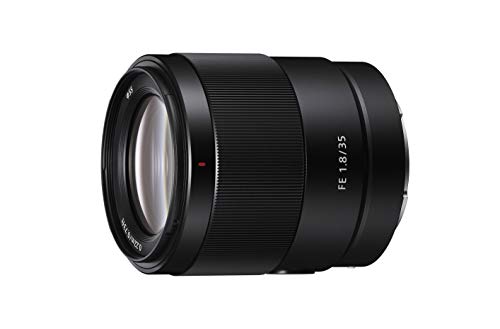
2. Sony FE 35mm f/1.8 (SEL35F18F) — Best for Sony E-Mount
Sony’s FE 35mm f/1.8 is the native pick for Alpha full-frame bodies, and it is also a sensible tighter option on APS-C E-mount cameras. A linear-motor drive gives fast, precise and quiet autofocus that works well for both stills and video, and a focus hold button on the barrel can be customized through the camera menu. The optical design uses an aspherical element to keep resolution high across the frame, and the nine-blade circular aperture softens backgrounds at f/1.8. Minimum focus is 0.22 m with 0.24x magnification, closer than many rivals, and the lens weighs only about 280 g, so it balances nicely on smaller bodies. Sony describes the build as dust and moisture resistant, which helps for daily carry in changeable weather, though it is not a guarantee against heavy rain.
3. Sigma 35mm f/1.4 DG HSM Art for Canon EF — Best for Low Light
If the widest aperture matters most, Sigma’s 35mm f/1.4 Art remains the benchmark fast prime for Canon EF DSLRs, and it adapts readily to mirrorless bodies. The f/1.4 opening gathers a full stop more light than f/1.8 rivals, helping in dim interiors and giving the strongest background separation a 35mm view can offer. Inside, FLD and SLD glass elements and a floating inner focus system are designed to keep sharpness high even at close range, with a minimum focus distance of 30 cm. The Hyper Sonic Motor drives autofocus quickly and quietly, and the lens is compatible with Sigma’s USB dock for focus fine-tuning and firmware updates. The trade-off is size: at about 665 g with a 67mm filter thread, it is noticeably heavier than the other picks here, so choose it when image quality and speed outrank portability.
View Sigma 35mm f/1.4 DG HSM Art on Amazon
4. Fujifilm Fujinon XF 35mm f/2 R WR — Best Compact Weather-Sealed
Fujifilm’s XF 35mm f/2 R WR is built for X-mount cameras, where it gives a roughly 53mm equivalent view, the classic standard-lens framing. Its headline feature is the WR weather-resistant construction, with seals intended to keep out dust and moisture so you can keep shooting in light rain and cold conditions where unsealed lenses stay in the bag. A physical aperture ring gives the tactile control the checklist above asks about, and the inner-focus system with a stepping motor is designed for fast, quiet autofocus. At about 170 g it is the lightest pick here, with a small 43mm filter thread, so it suits the compact street and travel role the guide describes. Minimum focus is 35 cm, which is ordinary rather than close-up territory, and f/2 gathers slightly less light than the f/1.8 options, but the size and sealing make it the one most likely to be with you.
View Fujifilm Fujinon XF 35mm f/2 R WR on Amazon
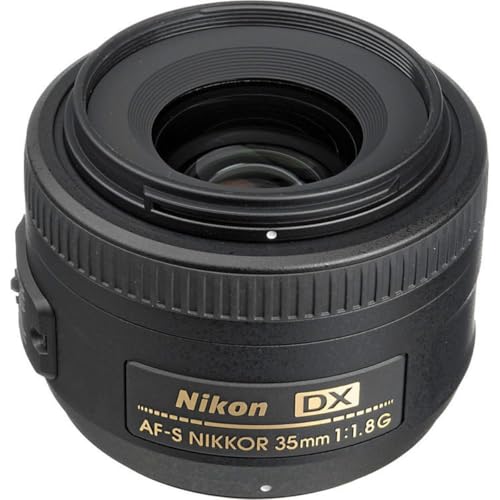
5. Nikon AF-S DX NIKKOR 35mm f/1.8G — Best Budget for Nikon DSLRs
Nikon’s DX 35mm f/1.8G is the low-cost way for owners of Nikon APS-C DSLRs such as the D3000 and D5000 series to get the classic everyday view, equivalent to about 52.5mm on those bodies. It is worth stating plainly that this is a crop-sensor lens, exactly the coverage check the guide above warns about, so it is not the pick for full-frame F-mount bodies. Within its intended system it does a lot right: a Silent Wave Motor for quiet autofocus, an aspherical element to control aberrations, a minimum focus distance of 0.30 m, and a light 200 g build with a 52mm filter thread. The f/1.8 aperture still gives a clear step up in low light and background blur over a kit zoom. For Nikon DSLR owners watching the budget, it remains the straightforward value choice.
What to Look For
| Factor | Why it matters | What to check |
|---|---|---|
| Mount and sensor coverage | The lens must match your camera body to work properly. | Confirm the mount and whether the lens covers your sensor size. |
| Maximum aperture | A wide opening helps in low light and gives soft backgrounds. | Compare the widest setting against size and weight. |
| Autofocus system | Quiet, accurate focus matters for people and video. | Look for motor type and any notes on focus noise. |
| Sharpness and rendering | Some lenses look crisp, others look softer and more classic. | Check sample images at the apertures you plan to use. |
| Size and weight | A compact lens is more likely to be with you. | Check length, weight and filter thread. |
| Minimum focus distance | Closer focus allows detail shots and small subjects. | Read the stated minimum focus distance. |
| Build and sealing | Daily carry means bumps, dust and weather. | Check the mount material and any maker claims about sealing. |
Setup and Care Tips
- Keep a clear filter or a hood on the lens to guard the front glass.
- Clean dust with a blower first, then use a lens cloth for fingerprints.
- Check the focus switch position before shooting to avoid confusion.
- Store the lens upright or in a padded pouch with both caps on.
- Update the camera firmware when the maker offers it, since lens behavior can improve.
Mistakes to Avoid
- Choosing the widest aperture when a lighter lens would suit your use better.
- Buying a lens built for another mount and relying on an adapter without checking compatibility.
- Judging a lens from a single sample photo.
- Expecting heavy background blur from a wide-angle view.
- Leaving the lens loose in a bag where the front element can get scratched.
Which 35mm lens should you buy?
The best 35mm lens is the one that fits your camera mount first and your shooting style second. Because every pick in this guide targets a different system, the decision is usually shorter than it looks.
Use these matches as a starting point, then confirm details on the listing:
- If you shoot Canon EOS R mirrorless: go for the Canon RF 35mm f/1.8 Macro IS STM. It is the native choice, and the close focusing and stabilization make it a flexible single lens.
- If you use Sony E-mount: choose the Sony FE 35mm f/1.8 (SEL35F18F). It is light, quiet to focus and made for the system.
- If dim rooms and background separation matter most: choose the Sigma 35mm f/1.4 DG HSM Art for Canon EF, and accept the extra size and weight.
- If you want a small, weather-sealed street lens on Fujifilm X: pick the Fujifilm Fujinon XF 35mm f/2 R WR.
- If you own a Nikon APS-C DSLR and want a low-cost upgrade over a kit zoom: the Nikon AF-S DX NIKKOR 35mm f/1.8G is the straightforward fit.
Notice that most of these choices are decided by the mount, not by a spec sheet contest. A lens that does not fit your body, or covers only a smaller sensor, cannot be the right answer however good it looks on paper.
If two options both fit your camera, ask what you will carry most days. A lens you leave at home takes no pictures, so weight and size should break most ties.
What to check before you buy a 35mm lens
Before you order any 35mm lens, confirm that the mount, sensor coverage and included accessories match what you expect. A few minutes with the listing prevents most returns.
Work through this checklist:
- Mount and sensor size: confirm the exact mount name and whether the lens is built for full-frame or a smaller sensor. Some lenses cover only the smaller format.
- Adapter plans: if you intend to use a lens made for another system through an adapter, check that autofocus and stabilization are supported on your body.
- What is in the box: look for caps, a hood and a pouch. Some listings leave items out, so read the contents line.
- Filter thread: compare it with filters you already own so you do not buy duplicates.
- Weather resistance: if the maker mentions sealing, read the manual wording for limits, because it rarely means fully waterproof.
- Return and warranty terms: confirm the return window and the warranty on the listing, and note whether the seller is the maker or a third party.
- Firmware: check whether your camera body needs an update to work well with the lens.
- Care needs: a blower, a soft cloth and a front filter or hood cost little compared with a scratched element.
Also check how many people have rated the item and what the written feedback mentions most often, such as focus noise, softness at wide apertures or build issues. Read that feedback in general terms and weigh it against your own needs rather than chasing a single score.
Is f/1.8 enough, or do you need f/1.4?
For most people, f/1.8 is enough, and the extra stop of f/1.4 is worth paying for only if you often shoot in dim places or want the strongest background blur. The difference is real but smaller than many buyers expect.
A wider aperture lets in more light, which allows faster shutter speeds or lower ISO indoors. It also thins the zone of sharp focus, which helps separate a subject from the background. At 35mm, though, the view is wide, so background blur is gentler than on a longer lens whatever the aperture.
The costs of a wider aperture are practical:
- Weight and size: the Sigma 35mm f/1.4 DG HSM Art is noticeably heavier than the f/1.8 and f/2 options in this guide.
- Focus precision: with a very thin zone of focus, small focus errors show up more, so your technique and camera autofocus matter.
- Handling: a larger lens can feel less discreet on the street.
A smaller aperture is not a weakness for daily use. The Fujifilm Fujinon XF 35mm f/2 R WR trades a little light for compact size and sealing, which many street shooters find a fair deal. Stabilization, as on the Canon RF 35mm f/1.8 Macro IS STM, also helps in low light for still subjects, though it does not freeze a moving subject the way a faster shutter speed does.
Think about your usual scenes. If you shoot mostly in daylight, outdoors or with flash, the wider opening adds little. If you photograph evening events, choose the faster lens.
How do you choose a 35mm lens for video and hybrid shooting?
For video, choose a 35mm lens with quiet, smooth autofocus and stable framing when focus changes. Stills photographers can forgive a little motor noise, but a microphone will pick it up.
Look for the following traits on the listing and in the manual:
- Motor type: stepping and linear motors are generally associated with quiet, smooth focus, which suits video. The Canon RF 35mm f/1.8 Macro IS STM and the Sony FE 35mm f/1.8 (SEL35F18F) both describe motors designed for that use.
- Focus breathing: some lenses change the framing slightly as focus shifts. Check sample clips if this matters to your work.
- Stabilization: in-lens stabilization can steady handheld walking shots, while some camera bodies offer their own system. Check how the two work together in your manual.
- Control ring or aperture ring: a smooth, tactile control helps when you adjust settings while recording.
A 35mm view is a comfortable choice for vlogs, interviews in small rooms and walk-and-talk shots, because it includes the person and some surroundings without the stretched look of an ultra-wide lens. Older DSLR lenses, such as those designed for still photography, can work but may focus loudly or hunt in video modes, so check feedback about video use before you commit.
Is a 35mm lens worth it, and who should skip it?
A 35mm lens is worth it if you like to move closer and compose carefully, and if you want one light lens for daily use. It is a poor fit if your subjects are far away or you need to change framing without moving.
Here are the honest trade-offs:
- Fixed view: you cannot zoom. If you often need both wide and tight shots from one spot, a zoom may serve you better.
- Cost versus a kit zoom: a prime usually costs more than the basic zoom that came with your camera, and you may gain mostly in light gathering and rendering rather than in versatility.
- Weight: the faster options are heavier, which matters on long days.
- Learning curve: framing with your feet takes practice, and your first results may feel less flexible.
Should you pay more for a faster or sealed lens? Only if you will use that feature. Pay for the Sigma 35mm f/1.4 DG HSM Art if you shoot dim scenes often, and for the Fujifilm Fujinon XF 35mm f/2 R WR if you really go out in changeable weather. Otherwise, a lighter and simpler lens in your own mount may serve you better.
Compare the picks above, check the current listing for mount, size and what is included, then choose the lens that fits your camera and how you will carry it.
Field Testing a 35mm Lens in the First Week
A 35mm lens is bought for everyday shooting, so test it on everyday subjects rather than test charts alone. Begin with a flat, detailed target shot square-on at the widest aperture and at a couple of stops down, and compare centre and corner sharpness at full magnification. Mild corner softness wide open is typical; uneven softness, where one side is clearly worse, suggests a decentered copy worth exchanging early. Then photograph a person at a conversational distance, the classic 35mm task, and check how the lens renders the transition from sharp eyes to softer background.
Next, test the lens in the light you actually shoot in. Dim interiors reveal how the autofocus behaves when contrast drops: does it hunt, does it lock onto background edges, and how often does it confirm focus on the wrong plane? Shoot a short video clip while walking slowly and listen for motor noise on the recording, then review how smoothly focus moves between near and far subjects. Finally, carry the lens for a full day without the rest of your kit. A 35mm earns its place by being the lens you forget you are carrying, and weight or an awkward focus ring only becomes obvious after hours, not minutes.
Close focusing deserves its own check if the lens offers it. Photograph a small subject at the minimum distance and confirm the magnification the listing promises, and note how the corners behave at that distance, since many lenses are optimised for distant subjects and soften at close range. Knowing these traits in the first week shapes how you use the lens for years.
How the Five Picks in This Guide Differ in Practice
The Canon RF 35mm f/1.8 Macro IS STM is the most versatile single-lens answer for EOS R owners: stabilisation in the lens, half life-size close focusing and a quiet motor cover stills, video and detail work in one light package. Its compromise is the absence of weather sealing, so it asks for care in rain. The Sony FE 35mm f/1.8 plays a similar everyday role for Alpha bodies, with a linear motor, a customisable focus hold button and dust and moisture resistance; it lacks stabilisation of its own, leaning on the body instead.
The Sigma 35mm f/1.4 DG HSM Art is the outlier on aperture and size. That extra stop of light and the strongest background separation in this group make it the low-light and look-first choice for Canon EF bodies and adapted mirrorless setups, and its compatibility with Sigma’s dock allows focus fine-tuning. You pay for it in weight: it is more than double the lightest picks here, which changes how an all-day kit feels. The Fujifilm Fujinon XF 35mm f/2 R WR goes the other way, prioritising compactness and weather resistance for X-series bodies, with a narrower equivalent view than full-frame users may expect from the number on the barrel. The Nikon AF-S DX NIKKOR 35mm f/1.8G is the budget DSLR option, a long-proven design for DX bodies that keeps cost and size down while giving beginners a genuine fast prime.
Read the group this way: native mirrorless picks optimise for quiet focus and low weight, the Sigma optimises for light and rendering, and the older DSLR design optimises for value. Your mount decides the shortlist first; after that, the honest question is whether your shooting is limited by light, by weight or by weather.
Working Distance and Storytelling at 35mm
Thirty-five millimetres is often called a storytelling focal length because it forces a particular working distance. To fill the frame with a person you stand close enough to talk to them, and that closeness shows in the pictures: the viewer feels present in the scene rather than observing from across the room. Photographers who come from longer lenses often find their first 35mm images too loose, with the subject small and the edges full of clutter. The fix is physical, not technical: step closer, and keep stepping until the frame edges contain only what supports the subject.
Edges are where 35mm images succeed or fail. Before pressing the shutter, scan the corners for distractions: bright signs, half a stranger, a bin, a lamp growing out of a head. Because the lens sees a wide slice of the environment, background management matters more than background blur. Moving one step sideways often cleans an edge more effectively than opening the aperture. At gatherings, work in layers: a near subject, a middle action and a background that gives context. That layered depth is what the focal length does better than any other.
For family and documentary work, the focal length also keeps you honest about participation. You are close enough to be part of the event rather than a distant observer with a telephoto, and subjects relax because the lens is small and unintimidating. Many photographers leave the camera at a moderate aperture, prefocus at a typical distance and shoot moments as they unfold instead of directing them, which suits the candid style this lens is known for.
Zone Focusing and Low-Light Habits for Street Work
Zone focusing is the classic 35mm street technique, and the depth of field at this focal length makes it practical. Stop down to a mid aperture, set focus at a distance that matches the width of a pavement or market stall, and everything from noticeably closer to much farther stays acceptably sharp. On lenses with a distance scale you can set this precisely; on focus-by-wire mirrorless lenses, use the camera’s distance readout or focus once on a target at the right distance and switch to manual focus to hold it.
The technique trades critical sharpness for speed and discretion. Nothing in the zone is as sharp as a perfectly focused shot at a wide aperture, but nothing is badly out of focus either, and you can shoot the instant a moment aligns without waiting for autofocus. It works best in decent light, where mid apertures still allow a fast shutter speed, and it pairs naturally with the storytelling distance described above.
In low light the habits change. Autofocus slows and hunts more readily, so give the system a contrasty edge to work with: a collar line, a window frame, the boundary between a lit sign and a dark wall. Where the lens offers a wider aperture, opening up buys shutter speed and focus accuracy at once, at the cost of a thinner plane of focus. Raise ISO sooner than you would with a stabilised lens if your pick lacks stabilisation, because a sharp, slightly grainy frame beats a blurred clean one for moving subjects.
Troubleshooting: Fringing, Soft Frames and Adapter Quirks
Purple and green fringing along high-contrast edges, such as branches against a bright sky, is the most common optical complaint with fast 35mm lenses. It is strongest at wide apertures and usually fades a stop or two down. In-camera correction and raw software profiles remove most of it automatically; if fringing survives correction, check that the profile for your exact lens is enabled, since similar model names can load the wrong one.
Soft frames at f/1.8 or f/1.4 are more often a depth-of-field problem than a lens problem. At close distances the sharp zone is only centimetres deep, so a subject who leans, or a photographer who sways after focusing, moves the eyes out of it. Use continuous autofocus for people who are moving, place the focus point on the nearer eye, and take several frames. If sharpness is consistently off in one direction on a DSLR, a focus fine-tune adjustment or, for the Sigma in this guide, the maker’s dock calibration addresses it.
Adapted lenses add their own quirks. An adapter that is slightly out of tolerance can tilt the lens and soften one side of the frame; test an adapted lens on a flat subject before an important shoot. Autofocus speed and eye-detection behaviour may also differ from native glass, and firmware updates for both adapter and lens sometimes improve matters. None of this makes adapting a poor choice, but it rewards testing in the first week rather than discovering quirks at an event.
35mm for Family Documentary: A Weekend Workflow
The 35mm lens suits family life because it photographs from inside the event. A practical weekend workflow starts with the camera kept in the room where life happens, lens fitted, battery charged, and settings left in a ready state: a mode that handles changing light, continuous autofocus with face or eye detection, and a card with space on it. Photographs of ordinary moments are lost to cameras packed in bags far more often than to any technical failing.
Work in sequences rather than single frames. A child building something, a meal being prepared, a grandparent telling a story: each unfolds in stages, and the 35mm view lets you include the room, the other people and the reactions that give the moment meaning. Move around the scene quietly, shoot from adult height and from the child’s height, and let some frames include hands, tools and half-finished work in the foreground. Those context frames are the ones that age best, because they record how life looked, not only how faces looked.
At the end of the day, copy the files, back them up, and pick a small number of keepers while the memories are fresh enough to caption. A modest, captioned set survives and gets revisited; an unedited thousand-frame dump does not. The lens’s contribution to all of this is that it never made you step back out of the moment to fit it in.
35mm on Video: Framing, Focus and Sound Habits
As a video lens, 35mm is the natural talking-and-doing focal length: wide enough to show a person and their workspace, narrow enough to keep proportions honest. Frame a seated subject with headroom and a little of the environment, and the shot reads as intentional rather than as a webcam accident. On a crop-sensor body the view tightens further, which suits single-person pieces to camera from a desk or kitchen counter.
Focus behaviour decides whether the footage is usable. Continuous autofocus with face tracking handles a presenter who leans and gestures, but test how your lens and body combination behaves when the subject looks down or turns away, since hunting during those moments is the common failure. A manual focus pull between two marked positions is the deliberate alternative for controlled pieces, and lenses with smooth, linear focus response make it repeatable. Focus breathing, the slight zoom effect as focus changes, shows most on static product shots; if your body offers compensation for supported lenses, enable it and confirm your lens is on the list.
Sound is the third leg. Quiet focusing motors, a genuine advantage of the native mirrorless picks in this guide, let you record usable audio near the camera, but room echo and appliance noise still dominate most home footage. A small external microphone placed near the speaker improves dialogue more than any lens upgrade, and recording a few seconds of test audio before the real take is a habit worth building.
Carrying Less: What a One-Lens 35mm Kit Teaches
Shooting with only a 35mm for an extended period is the fastest known cure for indecision in front of a scene. With framing fixed, attention moves to light, timing and position, which are the variables that actually separate strong photographs from weak ones. Photographers who try the exercise often discover their real preferences: some find the view feels like home within a week, others learn they naturally see tighter or wider, and both discoveries are worth more than another lens bought on speculation.
The exercise also exposes honest weaknesses in technique. Without a zoom to rescue composition from a fixed spot, you learn to notice backgrounds before raising the camera, to anticipate where a moment will happen, and to accept that some frames belong to a different focal length and should be let go. Street and documentary photographers built entire careers inside those constraints.
Practically, the one-lens kit is also the travel kit that never gets left at the hotel. A small body and a fast 35mm cover dawn streets, museum interiors, dinners and portraits of travelling companions, and the whole kit fits the bag you were already carrying. If the picks in this guide have a shared virtue, it is that most of them preserve that lightness; the one deliberate exception trades it for low-light power, which is its own legitimate travel strategy for photographers who shoot mostly after dark.
When 35mm Is the Wrong Tool
A 35mm lens fails politely but clearly in a few situations. Formal headshots ask for distance and compression it cannot give without cropping away much of the frame. Wildlife, sports from the stands and stage performances from the back of a hall all need reach it does not have. Very tight interiors can defeat it too: in a small bathroom or a car cabin, its view may still be too narrow to show the space, which is wide-angle territory.
It is also the wrong tool when you cannot move. Fixed seating, barriers and assigned positions punish any prime, but a mid-wide prime suffers most because its whole method is choosing distance. Photographers covering events from a press pen or a ceremony from a single permitted spot will serve their subjects better with a zoom.
Recognising these limits clarifies what the lens is for. The picks above excel when you are free to stand where the story is, close enough to participate and far enough to include context. If your photography mostly happens at a distance you do not control, spend on reach first and let a 35mm join later as the lens for everything else.
Composition Habits That Make 35mm Images Hold Together
Strong 35mm photographs are usually built from three habits. The first is the deliberate foreground: something near the camera, a table edge, a shoulder, a market stall, that establishes where the viewer stands and gives the eye a way into the frame. A 35mm lens includes enough environment that a frame without a foreground often feels like it starts nowhere; with one, the same scene gains depth that no aperture setting can manufacture.
The second habit is layering with intent. Because the lens sees widely, unrelated elements drift into the edges, so compose by arranging near, middle and far elements that comment on each other: a craftsman in front, his tools mid-frame, the street he serves behind. When the layers connect, the photograph tells a small story; when they merely coexist, the frame feels like a snapshot of a place rather than a picture of something. Checking the four corners before exposure, a two-second ritual, removes most accidental layers, the stranger’s elbow, the bright bin, the sign that will shout over your subject.
The third habit is timing over technique. At this focal length you are close enough that expressions and gestures are the content, and the decisive fraction of a second matters more than another increment of sharpness. Keep the camera ready at settings that suit the light, previsualise where the moment will happen, and let it arrive. Many of the photographers this focal length is associated with worked exactly this way, and their contact sheets show the method: patience, position and then a short burst of frames as the scene aligned. Your lens choice supports that method by being small, fast and forgettable, which is the deepest reason the category endures.
FAQ
Is 35mm or 50mm better for everyday use?
It depends on your space and taste. 35mm shows more of the scene and works well in tight places, while 50mm feels tighter and more focused on the subject.
Can I use a 35mm lens for video?
Yes. Many creators like the view for walking shots and interviews. Look for smooth, quiet focus and a design that does not shift the frame while focusing.
What is a 35mm lens best used for?
A 35mm lens is best for street, travel, documentary and everyday photography where you want a natural view with a little extra width. It also works well for casual video and environmental portraits. Its limit is distant subjects, which look small at this focal length.
Is a 35mm prime lens good for beginners?
Yes, a 35mm prime is a good beginner lens because it is simple, light and teaches you to compose by moving. The wide aperture also helps in low light compared with many kit zooms. The trade-off is that you cannot zoom, so some framing needs a few steps forward or back.
Do I need image stabilization in a 35mm lens?
Not always, because the wide view is forgiving of small hand movement and many camera bodies offer their own stabilization. Lens stabilization helps most for handheld video and slow shutter speeds with still subjects. Check your camera manual to see how body and lens stabilization work together.
What does crop factor mean for a 35mm lens?
Crop factor describes how a smaller sensor makes the view look tighter than the number on the lens suggests. A 35mm lens on a smaller sensor frames more like a standard lens than a wide one. Look up the factor for your camera body before you compare listings.
Can I use a 35mm lens for portraits?
Yes, for environmental portraits that show the person and their surroundings. Avoid placing faces near the edges of the frame, where a wide view can stretch features slightly. For tighter headshots, many photographers prefer a longer lens.
Is a weather-sealed 35mm lens worth it?
It is worth it if you often shoot outdoors in dust, drizzle or cold. Sealing is not a promise of waterproofing, so read the maker manual for limits. If you mostly shoot indoors or in fair weather, you can put the money toward other features.
How do I clean a 35mm lens safely?
Start with a blower to remove loose dust, then use a clean lens cloth for fingerprints. Avoid rubbing grit across the glass. Follow the maker instructions for any cleaning fluid, and keep caps on when the lens is stored.
Should I buy a lens made for another mount and use an adapter?
Only if you have confirmed that the adapter supports autofocus and any stabilization on your body. Adapters can add bulk and may limit features. A native lens is usually the simpler and more reliable choice.
Questions to Ask Before You Buy
- Is the lens built for your camera mount and sensor size?
- Do you want a wide aperture for soft backgrounds and low light?
- Is autofocus quiet enough for your video work?
- How close can it focus when photographing small objects?
- Does the barrel have an aperture ring or only camera-body control?
- Will the filter size match any filters you already own?
On a smaller sensor, the field of view will look tighter than the number suggests. Look up the crop factor for your body.
Matching It to Your Use
Street and documentary
A compact, lightweight lens keeps you unobtrusive. Many shooters like zone focusing, so a clear distance scale is a plus.
Environmental portraits
The view includes the person and some surroundings. Watch for edge stretching if you place faces near the corners.
Travel and interiors
A moderate wide view handles tight rooms and landmarks without the extreme look of an ultra-wide lens.
Feature Trade-offs
| Feature | Benefit | Consideration |
|---|---|---|
| Very wide aperture | Shallow depth, dim light | Heavier and larger |
| Compact design | Easy to carry | Narrower aperture |
| Manual focus ring | Tactile control | Slower for moving subjects |
| Weather sealing | Handles drizzle and dust better | Check the manual for limits |
Compatibility Checks
Lens names can hide differences in how they fit and work. Check these items on the maker listing before ordering.
- Mount type: native fit, or a mount that needs an adapter.
- Sensor coverage: some lenses are made only for smaller sensors.
- Firmware: some lenses need a body update to work properly.
- Hood and filter: look at included accessories and thread size.
Who Should Skip It
If you prefer tight, distant framing for sports or wildlife, this focal length will feel too wide. Buyers who already own a zoom covering the same range may gain little beyond a wider aperture. A single focal length rewards people who like moving closer and composing carefully, so think about whether that style fits you.
Storage Notes
Keep both caps on, store the lens in a padded pouch or case, and avoid damp closets. Use a blower before a soft cloth on the glass, and follow the maker manual and instructions for cleaning. Leave the focus ring at a middle position if it is stored for a long time.
Is 35mm too wide for headshots?
For tight headshots, usually yes. Filling the frame with a face at 35mm means standing very close, and that proximity exaggerates the nose and forehead relative to the ears. Step back and crop, or use the lens for half-body and environmental portraits where its view is an advantage, and keep a longer lens for formal headshots.
Can I use a 35mm lens for landscapes?
Yes. It captures a natural slice of a scene without the stretching of a wide-angle lens, and it suits layered compositions with a foreground subject. Stop down for corner sharpness, watch the edges for distractions, and stitch a panorama on the occasions when the view is simply too wide for one frame.
Should a beginner choose a 35mm prime or keep the kit zoom?
Both routes work, but they teach different lessons. A prime teaches you to move to change the framing and gives you low-light ability a kit zoom cannot match. A zoom is more forgiving while you learn what you like to shoot. Many beginners keep the zoom for outings and use the prime at home and in the evening, where its aperture matters most.
Does a 35mm lens distort faces?
The lens itself introduces little geometric distortion in most modern designs; the unflattering effect people notice is perspective, caused by standing close. Distance is the control: the same lens produces natural proportions from a few steps back. Keep faces away from the frame edges, where stretching is strongest, and the rendering looks natural.
How should I carry a camera with a 35mm lens for street photography?
Keep it ready rather than packed: a wrist strap or a cross-body strap, lens cap off when you are actively shooting, and settings preset for the light so you can raise and shoot in one motion. The small size of most 35mm lenses is part of the technique, since a discreet camera changes how strangers react to being photographed.
The Short Version
A 35mm lens is a flexible daily companion. Match the mount, decide how much speed you really need, and favor a size you will happily carry every day.
Related Guides
- Tamron vs Sigma 35mm Lenses: Which Brand Fits Your Style
- How to Choose the Best 24mm Lenses: Buyer's Guide (2026)
- How to Choose the Best 85mm Lenses: Buyer's Guide (2026)
- How to Choose the Best Canon Lenses: Buyer's Guide (2026)
- How to Choose the Best Fisheye Lenses: Buyer's Guide (2026)