reviewstook.com is reader-supported. When you buy through links on our site, we may earn an affiliate commission.
Where to buy
Night on the ground is a negotiation with whatever light a city feels like offering. A sodium lamp over a wet crosswalk, the spill from a late shopfront, a bus shelter glowing against a dark arterial road — none of it was arranged for a camera, and all of it arrives mixed in colour, patchy in coverage and far dimmer than a sensor would prefer. Choosing the best canon cameras for night shots means choosing for that reality: streets after closing time, handheld frames at the edge of what a shutter speed can freeze, and files that must survive being lifted in the edit without dissolving into mush.
- Canon EOS R6 Mark II: check price on Amazon
- Canon EOS R6 Mark III: check price on Amazon
- Canon EOS R5: available through Canon dealers and major camera retailers
- Canon EOS R8: available through Canon dealers and major camera retailers
- Canon EOS R3: available through Canon dealers and professional retailers
- Canon EOS 6D Mark II: mostly found on the used market through reputable dealers
Ground-level night work differs from pointing a camera at the sky, and this guide stays firmly on the pavement. A companion roundup in this series covers the best canon cameras for shooting night sky, where tripods, trackers and ten-minute exposures rule; here the problems are human ones. People move. Traffic moves. A photographer standing on a kerb at midnight cannot ask a scene to hold still, so shutter speed becomes a creative floor rather than a suggestion, and the sensitivity needed to hold that floor is what separates the bodies below.
Glass matters as much as the body, arguably more after dark. A fast prime that opens wide gathers several times the light of a slow kit zoom at the same scene, and that difference converts directly into lower sensitivity, cleaner files and shutter speeds that freeze a walking stranger instead of smearing him across the frame. Every judgement in this guide assumes the reader will pair a body with at least one fast lens; a superb sensor behind slow glass is a sports car on bicycle tyres, and the night exposes the mismatch within one outing.
Stabilisation quietly rewrites the night photographer’s arithmetic for everything that does not move. A cathedral wall, a parked motorcycle, rain standing on a café table — subjects like these can be photographed at remarkably slow shutter speeds when in-body stabilisation steadies the frame, which keeps sensitivity low and files clean. Anything alive breaks the bargain. Cats, drunks, cyclists and the photographer’s own shivering hands all set their own limits, and the reviews below keep returning to that dividing line because it decides real purchases.
Key Takeaways
- Canon’s R6 Mark II pairs a moderate-resolution full-frame sensor with confident high-sensitivity files, the sweet spot for handheld street work after dark.
- The newer R6 Mark III suits night photographers who split their evenings between stills and serious video.
- Canon’s R5 earns its place when night images must be printed large or cropped hard, accepting bigger files as the toll.
- The R8 carries full-frame night ability in the lightest body here, for long walks through a city.
- Canon’s R3 serves night events and sport, where focus speed in near-darkness outranks everything else.
- A used 6D Mark II remains the cheapest honest doorway into full-frame night photography with Canon glass.
In this guide
Quick Picks
| Camera | Badge | Why it is here |
|---|---|---|
| Canon EOS R6 Mark II | Best all-round night street camera | Clean high-sensitivity files, strong stabilisation and focus that keeps working as light collapses. |
| Canon EOS R6 Mark III | Best night hybrid | The R6 formula refreshed for photographers who also shoot demanding video on the same night walk. |
| Canon EOS R5 | Best for huge night prints | High resolution that holds detail in shadowed architecture and allows aggressive cropping of night frames. |
| Canon EOS R8 | Best light full-frame night walker | Full-frame gathering power without the weight penalty on a three-hour evening wander. |
| Canon EOS R3 | Best for night events | Professional focus and speed for concerts, night sport and movement under floodlights or streetlight. |
| Canon EOS 6D Mark II | Best used entry point | A full-frame DSLR whose used price leaves budget for the fast prime that matters more. |
How did we choose the best canon cameras for night shots?
High-sensitivity behaviour came first, judged the way night photographers actually judge it: not by the maximum number on a dial, but by how a file looks at the sensitivities a street demands. Chroma noise that speckles a coat with false colour ruins a frame faster than fine luminance grain, which many photographers happily keep as texture. Bodies whose files stay colour-honest deep into the evening earned the top places; bodies that merely post big numbers did not.
Autofocus after dark was the second filter. Contrast dies at night, edges soften, and a focus system that hunts through a dim scene costs the exact moment the photographer stepped out to find. Subject detection that recognises a person under a streetlamp, and lenses driven decisively at low light levels, separate working tools from specification sheets. Several otherwise fine Canon bodies were left off this list because their focus confidence fades precisely when this guide’s readers need it.
Handling in the cold and the dark completed the shortlist. Buttons findable by glove and memory, a rear screen that dims low enough to preserve night vision and a photographer’s cover, weather resistance against the drizzle that makes streets photogenic — these unglamorous traits decide whether a camera gets carried on the marginal evenings when the best frames happen. Weight mattered too, honestly weighed: a body left at home gathers no light at all.

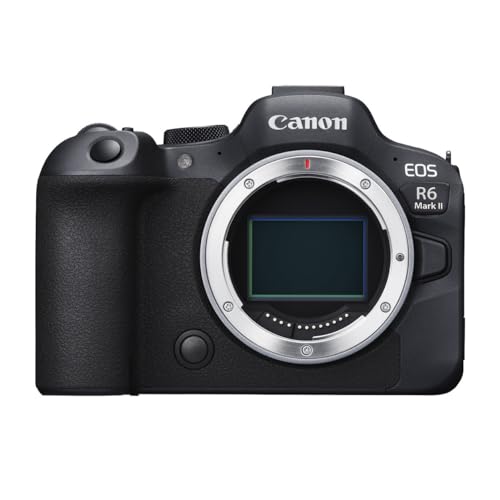
Canon EOS R6 Mark II — Best all-round night street camera
Walk a wet shopping street at eleven at night with the R6 Mark II and a fast prime, and the camera’s character declares itself within a dozen frames. Sensitivity climbs to wherever the scene demands and the files refuse to panic: coats stay the colour they were, faces under mixed lamp light keep their modelling, and the grain that does arrive has the fine, even texture photographers describe as filmic rather than broken. Moderate resolution is the quiet reason. Larger photosites gather light generously, and the processing behind them has been tuned by a maker who understands that night shooters live at the top of the dial, not the bottom.
Focus behaviour after dark seals its position at the head of this list. Eye detection finds a companion across a dim café table and holds on through the micro-movements of conversation; on the street it settles on a passer-by under a lamp with a decisiveness that older mirrorless bodies, and most DSLRs, simply do not manage in gloom. Low-contrast scenes — a dark coat against a dark doorway — still slow it, honestly noted, yet the recovery is quick and the hunting rare enough that a night’s shoot yields keepers rather than apologies.
Stabilisation extends the body’s reach into the static city. Handheld exposures of lit architecture, shop windows and rain-slick still lifes stay sharp at shutter speeds that would embarrass an unstabilised camera, letting sensitivity fall and files clean up accordingly. Paired with a stabilised lens the effect compounds. Moving subjects ignore the favour entirely, as physics insists, but a night photographer’s evening is mostly stillness punctuated by people, and this body serves the stillness superbly while its shutter speeds handle the people.
Consider the evening as a working photographer actually lives it, because that is where this camera pulls away. Rain begins; the sealing shrugs. A glove goes on; the controls remain findable. The rear screen tilts for the low angle across a flooded pavement reflection, then folds away when the camera hangs at the hip between frames. Battery endurance covers a long winter evening without the pocket-check anxiety that smaller bodies induce. None of these virtues photographs well in a brochure, and all of them decide whether the camera is in your hand at the moment the street performs.
Video after dark is a genuine second talent rather than a brochure line. The body records high-quality 4K footage from its full sensor width, and night street videographers use it for the atmospheric cutaways — steam, signage, traffic trails rendered as motion — that stills-led evenings increasingly include. Rolling shutter and heat on the longest takes deserve the usual respect, yet for the hybrid shooter this guide addresses later in greater depth, the stills case alone justifies the ranking here.
Paired glass decides how much of this promise a given owner actually collects. A fast 35mm or 50mm prime turns the R6 Mark II into the definitive Canon night walkabout; a 24-105mm zoom of modest aperture spends the sensor’s sensitivity advantage on the lens’s darkness and returns ordinary results. Budget conversations for this body should therefore always be body-plus-prime conversations, a theme the buying sections below develop at length.
- Type: full-frame mirrorless, 24.2 megapixel sensor
- Stabilisation: in-body, coordinated with stabilised RF lenses
- Focus: subject and eye detection rated for very low light
- Video: 4K recording up to 60p from full sensor width
Strengths
- Colour-honest files deep into high sensitivities
- Focus that keeps deciding after streetlights take over
- Stabilisation unlocks slow, clean shots of the static city
Trade-offs
- Resolution limits heroic cropping of distant night subjects
- Fast glass is effectively a compulsory second purchase
- Longest video takes need heat awareness on warm nights
Best for: street photographers working handheld under city light all evening. Not suited for: shooters whose night work is mostly distant wildlife needing heavy crops.

Canon EOS R6 Mark III — Best night hybrid
Canon’s third-generation R6 arrives in this guide with a specific reader in mind: the night photographer whose evenings have quietly become half video. Perhaps the street work now feeds a channel; perhaps clients began asking for motion alongside the stills; either way the brief changed under the camera bag. The Mark III answers as the line’s refreshed hybrid flagship-in-all-but-name, a full-frame body that treats demanding video as a first-class citizen while keeping the stills character that made its predecessor the default recommendation for low light.
Judged purely as a stills camera for the dark, it builds on the Mark II’s formula rather than reinventing it. The full-frame sensor gathers light with the generosity night work requires, the stabilisation system steadies the static city for slow handheld frames, and the focus system carries Canon’s latest subject-recognition refinements into the gloom. Photographers upgrading from the Mark II for stills alone should expect evolution; photographers arriving from older bodies, or from crop sensors, will experience the same revelation the Mark II delivered — files that stay composed and colourful at sensitivities they previously feared.
Where the newer body separates itself is the moving image after dark. Its video specification reaches well beyond the Mark II’s, aimed at creators recording serious footage in the same unlit streets: higher-end recording options, the processing headroom to sustain them, and the focus behaviour to keep a walking subject honest under lamplight. A night market filmed on this body, cut against stills from the same evening, holds together as one visual world rather than two qualities of souvenir.
Ergonomics follow the R6 family’s mature pattern, which matters more at night than in any studio. Controls sit where a Mark II owner’s hands already know them; the menus reward the photographer who configures custom modes before leaving home — one for walking stills, one for video, one for the tripod — and then never opens a menu in the dark at all. That configurability, unglamorous as it sounds, is a genuine night feature: every second spent reading a bright screen is a second of night vision spent and a moment on the street missed.
Honesty requires a note on value. The Mark III commands the newer body’s premium, and a stills-only night photographer counting frames per coin will find the Mark II above it in this list the shrewder purchase while both remain on sale. The premium buys the hybrid ceiling — the video depth, the latest processing, the longer relevance — and buyers should name which of those they actually need before paying for all of them. Guides that pretend a flagship refresh is compulsory do their readers a disservice this one declines to copy.
Lens advice mirrors its predecessor’s with one addition. Fast primes remain the night photographer’s true instrument, and the RF system’s wide-aperture standard primes suit this body beautifully. Hybrid shooters should add a consideration stills-only buyers skip: focus breathing and motor noise matter when the same lens records a quiet night scene, so the video-led reader should audition glass for its manners as well as its aperture before committing a bag to it.
- Type: full-frame mirrorless, latest-generation R6 line
- Stabilisation: in-body system for handheld night stills
- Focus: current Canon subject recognition for people and animals
- Video: high-end recording options beyond the Mark II’s scope
Strengths
- Deepest video ability of any body in this roundup
- Refined focus and processing for mixed night media
- Mature R6 handling that gloves and memory can operate
Trade-offs
- Premium pricing over the still-excellent Mark II
- Stills-only buyers may never touch its extra ceiling
- Hybrid glass choices add cost beyond the body
Best for: night creators shooting stills and serious video on the same outing. Not suited for: stills-only photographers watching value closely while the Mark II remains available.
Canon EOS R5 — Best for huge night prints
Some night photographs are destined for a phone screen; others are commissioned for a hotel lobby wall. The R5 exists for the second destiny. Its high-resolution full-frame sensor records night scenes with a density of detail that survives enormous printing and ruthless cropping — the neon district shot wide and then mined for three separate compositions, the cathedral façade whose stonework stays crisp at arm’s length on paper. Photographers whose night work ends large should read no further down this list for their primary body, though they should read the caveats with equal care.
Resolution taxes low light in ways marketing prefers to mumble. Smaller photosites gather less light each, so at identical sensitivities an R5 file shows its noise sooner than an R6 file when both are viewed at full magnification. Print both at the same size, however, and the difference shrinks dramatically, because the R5’s noise is finer and its detail advantage real. The honest summary: pixel-peepers will call the R6 cleaner; printers will call the R5 better. Both are describing the same physics from different ends of the workflow.
Around the sensor sits a professional instrument in every other respect night shooters care about. Stabilisation matches the R6 family’s generosity, focus detection works confidently in gloom, the viewfinder is a pleasure in the dark, and the sealing tolerates the weather that makes city nights worth photographing. Video capability runs deep as well, including high-resolution recording that landscape-at-night filmmakers prize for dawn timelapses begun in full darkness, with the thermal management on long takes that such modes have always demanded of this line.
Street photographers should weigh the file sizes as a lifestyle choice. An evening’s shooting on the R5 fills cards and backup drives at a rate that changes habits: culling grows stricter, storage budgets grow larger, and the laptop that edited R6 files happily may audibly object. None of this is a flaw; it is the standing price of resolution, charged nightly. Buyers who print small and post online are paying that price for a benefit they will never collect, which is why this superb camera sits third rather than first.
There is also a psychological effect worth naming. Carrying the high-resolution body tempts a photographer toward the grand, tripod-minded vista and away from the quick, close, human frame the street offers at sensitivity’s edge. The R5 can shoot those frames — its focus and handling allow it — but its soul leans architectural. Night photographers who know their work is buildings, skylines and considered compositions will feel that lean as alignment; roamers after fleeting faces should heed the R6’s pull instead.
Used examples have begun appearing as upgraders chase newer bodies, softening the entry cost for print-led buyers with patience. Check shutter counts and sensor condition with the diligence any professional tool deserves, and prefer sellers who can show the camera working in the low light it will actually face.
- Type: full-frame mirrorless, high-resolution 45 megapixel class sensor
- Stabilisation: in-body, coordinated with stabilised RF lenses
- Focus: subject and eye detection for people, animals and vehicles
- Video: high-resolution recording including 8K on this line
Strengths
- Night detail that survives very large printing
- Cropping freedom for mined compositions
- Professional build, finder and weather sealing
Trade-offs
- Noise shows sooner at full magnification
- File sizes tax cards, drives and editing machines
- Overkill for screen-only night photography
Best for: night landscape and architecture photographers who print large. Not suited for: high-volume street shooters posting mainly to phones.
Canon EOS R8 — Best light full-frame night walker
Every night photographer knows the arithmetic of the last hour. The light has peaked, the crowds have thinned to the interesting, and the camera that felt featherweight at dusk now hangs like a brick — so it goes back in the bag, and the best frames of the evening walk past unphotographed. The R8 attacks that arithmetic directly. It carries a full-frame sensor with the same light-gathering character as its R6 relatives into the lightest, simplest body Canon sells with that sensor, trading professional armour for the radical advantage of still being on your shoulder at midnight.
Image quality after dark is where sceptics should recalibrate. Sharing the sensor family of the R6 Mark II, the R8 produces night files of essentially that character: colour-honest at high sensitivities, grain fine enough to keep, shadows liftable in the edit without collapsing into bands. Blind tests between the two bodies’ night output embarrass photographers who assumed the price gap lived in the files. It lives instead in the stabilisation — the R8 has none in-body, leaning on stabilised lenses — and in the battery, the single card slot and the simplified controls, all weighed honestly below.
That missing in-body stabilisation defines the R8’s night technique. Static subjects at slow shutter speeds lean on the lens’s own stabilisation, which in Canon’s RF zooms and several primes is genuinely good, though a step behind the coordinated systems of its siblings. The walking photographer’s answer is technique: elbows in, breath out, lean on the lamppost the city thoughtfully provides. Generations photographed the night with no stabilisation at all; the R8 merely asks for a little of their discipline while giving them a sensor those generations would have wept over.
Focus and video both punch above the body’s humble station. Subject detection mirrors the smarter bodies’ behaviour in most real scenes, finding eyes under streetlight with confidence that makes the camera feel anything but entry-level. Video recording reaches the 4K quality hybrid shooters need for night b-roll, and the compact body rides a small gimbal more happily than any sibling here — a pairing worth considering for creators whose night work moves.
Compromises gather where professionals would predict. One card slot means a night’s work lives on a single piece of media until backup; the smaller battery asks for a spare in the pocket on long evenings; the viewfinder and weather sealing step down a class. For the walker, the student and the traveller, these are fair trades announced in advance. For the working event photographer, they are the reasons the R6 bodies sit above it, and this guide will not blur that line.
As a second body the R8 deserves a paragraph of its own. Professionals who shoot the R5 or R3 by day keep asking for a night-walk camera that shares their lenses and batteries of chargers yet disappears into a coat — and this is that camera, priced so the asking stays casual. Paired with one fast prime it forms the definitive grab-and-go night kit in the Canon system at any budget.
- Type: full-frame mirrorless, 24.2 megapixel sensor
- Stabilisation: lens-based only, no in-body system
- Focus: subject and eye detection in low light
- Video: 4K recording suitable for hybrid night work
Strengths
- Full-frame night files in the lightest body here
- Sensor character matching far pricier siblings
- Small enough to ride compact gimbals for video
Trade-offs
- No in-body stabilisation for static night scenes
- Single card slot and smaller battery
- Sealing and finder a class below the R6 line
Best for: long night walks, travel and second-body duty. Not suited for: paid night events demanding dual slots and maximum endurance.
Canon EOS R3 — Best for night events
Floodlit sport at night, a headline set in a dark arena, a winter wedding’s candlelit first dance — a family of assignments shares one demand: focus and frame rate in light so poor that ordinary cameras begin to guess. The R3 is Canon’s answer built without compromise for exactly that family. Its stacked sensor reads out at speeds that tame rolling shutter, its focus system was designed to track athletes under stadium light, and its body is a one-piece professional tool with a built-in grip that balances the long fast glass night events require.
Eye-controlled focus remains the party trick that turns out to be a profession. The photographer looks at a player, a singer, a dancer — and the focus point follows the gaze. Under arena light, where a dozen subjects cross the frame and the decisive one changes by the second, that interface collapses the distance between seeing and shooting. It takes an evening to trust and a season to master, and event photographers who have mastered it describe returning to conventional point selection as typing with mittens.
Sensitivity behaviour suits the assignment rather than the laboratory. The R3’s moderate-resolution sensor keeps files clean at the sensitivities floodlit work demands, and its processing handles the mixed colour of arena lighting — LED boards, tungsten house light, television spill — with a composure that saves hours in the edit. Burst depth matters here too: night action is shot in volleys, and a body that buffers generously lets the photographer shoot the play rather than the buffer.
Build and endurance complete the professional picture. The integrated grip houses a large battery that treats a double-header as a warm-up; sealing shrugs at the rain delay; dual slots protect the client’s evening. All of it arrives in a body whose size announces itself — this is not a camera for inconspicuous street wandering, and at a wedding it reads as crew rather than guest, which for working professionals is precisely the correct reading.
Cost places the R3 beyond hobbyist logic, and this guide places it fifth without apology: for its intended reader the price is a business expense recovered across a season of night assignments. For everyone else it is a magnificent over-answer, and the honest advice is to rent it for the one arena weekend of the year — a strategy the rental guide elsewhere in this batch explores in depth — rather than own a tool that spends eleven months supervising a shelf.
One further constituency should note it: night motorsport and wildlife photographers working from hides near floodlit waterholes or feeding stations. The stacked sensor’s silent, distortion-free electronic shutter photographs behaviour that a mechanical clatter would end, and the focus tracking holds animals moving through uneven light. It is a narrow door, but for those who walk through it, no other Canon body in this list opens it.
- Type: full-frame mirrorless, stacked sensor, integrated grip
- Stabilisation: in-body system for handheld work
- Focus: eye-controlled point selection plus deep subject tracking
- Video: high-frame-rate and 4K recording for event coverage
Strengths
- Focus tracking under floodlights without rival here
- Silent stacked-sensor shutter for skittish subjects
- Battery and build sized for double assignments
Trade-offs
- Professional price far beyond hobbyist need
- Size and presence unsuited to discreet street work
- Capability most owners would use a dozen nights a year
Best for: working photographers covering night sport, concerts and events. Not suited for: hobbyists whose nights are walks rather than assignments.
Canon EOS 6D Mark II — Best used entry point
Before mirrorless rewrote the night, the original 6D taught a generation that full-frame darkness was affordable, and its Mark II successor now occupies the used market at prices that make it the thinking beginner’s doorway. The proposition is arithmetic: a used 6D Mark II plus a fast 50mm prime costs less than most new crop-sensor kits, yet gathers light like the full-frame instrument it is, with a centre focus point famously sensitive in gloom that once made it the budget astrophotographer’s darling — a talent its ground-level work inherits.
Expectations must be set in the DSLR era’s terms. The optical finder shows the night as the eye sees it, which romantics love and pragmatists tolerate while chimping exposures on the rear screen. Live view focusing is slower and less certain than any mirrorless body in this list; video is a generation behind; there is no in-body stabilisation, so the static city asks for walls, posts and beanbags. Dynamic range at base sensitivity trails modern sensors, though at the high sensitivities night shooters actually use, the gap narrows to near-irrelevance.
What the older body returns for those concessions is a shooting experience many photographers still prefer. The shutter’s mechanical voice, the grip shaped by decades of DSLR refinement, battery endurance measured in days of evenings rather than hours, and an EF lens ecosystem whose used prices have fallen to gift levels — fast primes and even professional zooms now circulate at sums that let a beginner build a real night kit around this body for the price of one new RF lens.
Reliability on the used market is the genuine risk, and it is manageable. Buy from dealers who grade honestly and warranty briefly; check shutter count against the body’s rated life; examine the sensor with a bright frame for the scratches and stubborn marks that night editing would magnify. A clean example has years of evenings left. A neglected one is a lesson in why the discount existed, and the difference is visible to anyone who performs the checks this paragraph lists.
Position in a photographer’s life deserves a final honest framing. The 6D Mark II is a beginning, not a destination: a year or two of night walks on it teaches exposure, composition and discipline at full-frame quality, after which its owner upgrades to the R6 line knowing exactly which features their own shooting demands. Few purchases in photography educate as cheaply. That is a different kind of best, and for the reader counting coins at the start of the road, it may be the truest one in this guide.
- Type: full-frame DSLR, 26.2 megapixel sensor
- Stabilisation: none in-body; lens stabilisation on EF IS glass
- Focus: 45-point system with a highly sensitive centre point
- Video: Full HD recording of its generation
Strengths
- Used prices that leave real money for fast glass
- Battery endurance across several evenings
- Vast, cheap used EF lens ecosystem
Trade-offs
- No in-body stabilisation and dated live view
- Video and dynamic range a generation behind
- Used purchase demands careful inspection
Best for: beginners building a full-frame night kit on a strict budget. Not suited for: shooters needing modern video or mirrorless focus confidence.
One further filter deserves naming because readers ask about it constantly: video was weighed, but as a supporting quality rather than the headline. Ground-level night photography remains a stills discipline for most of the people searching this guide, so bodies were ranked by the frames they make standing on a kerb at midnight. Readers whose nights are primarily filmed should cross straight to the hybrid discussion in the Mark III’s review and to the dedicated video roundup linked at the end, where the ranking logic inverts and motion leads.
Which Canon lens actually makes the night?
Photographers new to darkness shop for bodies and inherit whatever lens the kit included, then wonder why their night files look like soup while a friend’s older camera produces silk. The answer is hanging on the friend’s camera. Aperture is exposure’s front door: a prime opening to f/1.8 admits roughly four times the light of a zoom at f/3.5, and that light converts directly into shutter speed or sensitivity headroom. One fast prime — 35mm for environmental street work, 50mm for tighter frames, 85mm for faces across a café — transforms any body in this list more completely than an upgrade to the next body would.
Stabilised zooms earn their place on the other side of the subject divide. For architecture, interiors and cityscapes that hold still, a stabilised standard zoom at modest apertures, steadied by lens and technique, produces clean slow frames all evening. The moment people enter the picture the prime resumes its throne. Wise night kits therefore grow in a deliberate order: body, one fast prime, then the zoom for the still world, then a second prime at a different focal length before any thought of a second body.
Adapted EF glass deserves its paragraph for Canon shooters specifically. The RF mount accepts EF lenses through Canon’s adapters with full electronic cooperation, and the used market’s fast EF primes — built for the DSLR decades — now sell for fractions of their RF successors. Night performance depends on aperture and coatings more than on mount vintage, so a budget night kit built on adapted glass loses remarkably little. Focus speed drops a notch on the oldest designs; at night, photographing people at conversational distances, almost nobody notices.
How do the six compare after midnight?
| Camera | Night role | Signature strength | Watch out for |
|---|---|---|---|
| Canon EOS R6 Mark II | Handheld street all-rounder | Clean files and focus in gloom | Cropping distant subjects |
| Canon EOS R6 Mark III | Stills-and-video hybrid | Video depth on the same walk | Premium over its predecessor |
| Canon EOS R5 | Large-print night work | Resolution for prints and crops | File sizes and pixel-level noise |
| Canon EOS R8 | Lightweight night walker | Full-frame files, minimal weight | No in-body stabilisation |
| Canon EOS R3 | Night events professional | Tracking and eye-control focus | Price and conspicuous size |
| Canon EOS 6D Mark II | Used entry to full frame | Price leaves budget for glass | Dated video and live view |
What settings carry a handheld night walk?
Start from the subject’s motion, not from a forum recipe. A walking stranger needs a shutter speed in the region of 1/250th to stay crisp, a standing conversationalist forgives 1/100th, and the static city, stabilised, can be courted far slower. Set the floor for the fastest thing you refuse to blur, open the lens to the aperture the depth of field honestly needs — often wide open for single subjects, a stop or two down for groups — and let sensitivity climb to whatever closes the exposure. Modern Canon files forgive sensitivity; nothing forgives motion blur dressed as atmosphere.
Exposure compensation becomes a night photographer’s constant companion because meters believe the world is mid-grey and the night disagrees. Scenes dominated by darkness fool the meter into overexposing, turning midnight into a washed noon; dialling compensation down restores the mood and protects the lamp highlights that give night frames their sparkle. Shoot raw as a matter of religion after dark: mixed lighting guarantees white balance will need steering in the edit, and raw files hold the shadow detail that lifting a dark corner of the frame demands.
Focus settings reward one deliberate choice. Continuous subject tracking serves moving people in open spaces; single-point or a small zone, placed by the photographer, serves the layered street scene where the camera cannot know that the subject is the woman at the third table rather than the waiter crossing in front. Learn to swap between those modes without opening a menu — custom buttons exist for this — and the night’s keeper rate climbs in a way no sensor upgrade matches.
Why does mixed light turn faces orange and green?
Because the modern street is lit by a committee that never met. Tungsten shopfronts burn orange, LED signage leans cyan or magenta, sodium lamps pour amber over everything, and a single face can collect three of those opinions at once. Cameras averaging the scene choose one white balance and betray the other two sources; photographers who shoot raw postpone the argument to the edit, where local adjustments can cool a forehead and warm a background independently. Chasing perfect neutrality in camera at night is a beginner’s tax — mood lives in the mixture, and the skill is steering it rather than sterilising it.
Practical defences exist at the moment of capture. Standing a subject nearer one dominant source simplifies their light to a single opinion the edit can honour. Watching for the green spike of cheap fluorescents in food stalls and underpasses saves the worst corrections. And embracing monochrome remains the night photographer’s oldest joker: a frame whose colour argues with itself often becomes timeless in black and white, where only the light’s shape remains.
What goes wrong on most first night walks?
Trusting the meter’s cheerful lies leads the catalogue: midnight rendered as midday, highlights in every lamp blown to chalk. Second comes the slow-shutter smear, discovered at home on a big screen after an evening of confident chimping on a small one. Third is focusing on the brightest object rather than the intended subject, because contrast detection loves a lamp more than a face. Fourth, and most quietly expensive, is leaving the fast prime at home because the zoom was already mounted — a decision the files prosecute all evening.
How should a beginner build night skill deliberately?
Give the first month a single street, a single lens and a single hour. Repetition strips away novelty until the photographer starts seeing the light itself: which corner flatters a face, where the wet pavement doubles a sign, how the last train rearranges the crowd. Keep the rejects and study them at full size; night photography’s lessons live in failed frames, each one naming a shutter speed, a focus choice or a sensitivity the next outing can correct. Progress at night is unusually measurable — keeper counts climb in plain sight — and few disciplines in photography reward a winter of evenings as visibly as this one.
How does rain change the night photographer’s plan?
Rain is the night street photographer’s unfair advantage, because it manufactures light. Dry pavement swallows illumination; wet pavement returns it, doubling every sign and streetlamp in reflection and laying a lit stage under every subject. Photographers who watch forecasts the way sailors do learn to be standing on a familiar corner twenty minutes after a shower passes, when the ground still mirrors the city and the crowds have not yet returned to spoil the reflections. Every body in this guide is sealed well enough for drizzle duty except the used DSLR, whose owner should add a rain cover to the bag and think no less of the camera for needing one.
Technique shifts with the weather. Reflections reward low angles — the camera near the pavement, stabilisation earning its keep at slow speeds — and reward patience at crossings, where a single figure with an umbrella crossing a doubled neon sign composes the kind of frame photographers print. Exposure wants guarding: bright reflections seduce the meter exactly as snow does, and a touch of negative compensation keeps the scene nocturnal. Lenses fog when a cold camera meets warm café air during a drying-off break, so the experienced night walker lets the body acclimatise in the bag before ordering, and carries the cloth mentioned in the questions below as a matter of routine.
Safety and courtesy deserve their sentences even in a camera guide. Wet pavements, dark clothing and a photographer stepping backward into a cycle lane compose a risk no frame justifies; reflective details on a camera bag are unfashionable and wise. Subjects, too, read differently in the rain — hurried, hooded, less inclined to welcome a lens — and the street photographer’s consent instincts should sharpen with the weather. The rain gives generously to those who plan for it and takes its fee from those who merely endure it.
When should a night photographer choose monochrome?
Black and white is not a filter applied in regret; at night it is often the scene’s truest rendering. Sodium light paints an entire district one shade of amber, cheap LEDs scatter colours no edit reconciles, and mixed sources can make an honest colour file look mistaken even when the exposure is perfect. Stripping colour away leaves the elements night photography is actually about — the shape of light, the geometry of shadow, faces modelled by a single source — and many of the strongest images in any street photographer’s archive began as colour frames the lighting committee had sabotaged.
Shooting with monochrome in mind changes decisions at the moment of capture. Contrast becomes the subject: a silhouette against a lit window, a face half in lamplight, steam crossing a headlight beam. Photographers who set a monochrome picture profile for the preview, while recording raw files that keep every colour option open, compose for tone in the field and keep the final decision for the desk. Canon’s bodies all support that workflow, and the R6 family’s viewfinders make the tonal preview genuinely pleasurable to work through on a dark street.
Restraint is the closing note. A photographer who converts every difficult frame to black and white stops learning colour, and the night city in honest colour — neon on wet stone, the blue hour behind amber windows — holds images monochrome cannot touch. Treat conversion as a second language, fluent when the scene speaks it, rather than a refuge when colour gets hard. The bodies in this guide serve both languages equally; the photographer’s judgement, as ever after dark, is the limiting instrument.
What should a night kit bag contain besides the camera?
Remarkably little, and every item earns its place by solving a problem the dark actually presents. Two batteries, because cold evenings shorten every battery’s shift and a dead camera at the best corner in the city is a special kind of sorrow. A fast prime mounted and one small second lens at most — night walking rewards commitment to a focal length and punishes the ditherer changing glass in the drizzle. A headtorch with a red mode preserves night vision while rummaging, and marks the photographer as a person rather than a looming shape on a towpath. Beyond that: the microfibre cloth already praised, a rain cover sized to the body, and a notebook or phone note for the locations that promise more than one evening gave. Photographers who audit their bags after a month of nights find the same truth every time — the gear carried daily shrinks to what the light demanded, and the rest was insurance against a fear the street never realised.
Final Recommendation
Match the body to the night you actually photograph. Handheld street work under city light belongs to the R6 Mark II, whose balance of clean files, focus confidence and stabilisation no sibling quite reproduces at its price. Hybrid creators should step to the Mark III and pay for the video ceiling knowingly. Print-led landscape and architecture shooters belong on the R5; long-distance walkers and second-body hunters, on the R8; paid night events, on the R3; and the budget beginner, on a carefully bought used 6D Mark II with a fast prime in front of it. Whichever body wins, reserve real money for glass — after dark, the lens is the camera.
Related guides
- Best Crop Sensor Cameras for Low Light: Fast Glass, Honest Limits and One True APS-C Pick
- Best CCTV Cameras for Wildlife: Trail Cameras for Long Watches, Fast Triggers and Night Work
Frequently Asked Questions
Do I really need full frame for night street photography?
Need is too strong a word — skilled photographers make fine night images on smaller sensors with fast lenses. Full frame buys forgiveness: cleaner high-sensitivity files, shallower depth of field when you want it, and headroom in the edit. Since this guide compares Canon bodies for readers already leaning that way, every pick gathers light at full-frame scale, but technique and glass outrank sensor size in the field.
Which sensitivity is too high on these bodies?
The honest ceiling is set by your output, not a number. Files destined for phone screens tolerate sensitivities that a gallery print would expose. As working guidance, the R6 family stays comfortable deep into five figures for web use, while print-led shooters pull their personal ceiling lower and lean on stabilisation and fast glass to stay beneath it. Test your own body at a range of settings on one evening and print the results; your ceiling will announce itself.
Is a tripod worth carrying for ground-level night shots?
For the static city, yes — long exposures turn traffic into light trails and water into glass in ways no handheld trick reproduces. For street life, a tripod mostly anchors the photographer to one corner and one kind of picture. Many night walkers compromise on a monopod or simply master the lamppost lean. Choose per assignment rather than by ideology.
Why do my night photos look sharp on the camera screen but soft at home?
Small screens flatter everything. Slow shutter speeds that seemed adequate reveal their smear at full size, and high-sensitivity noise hides until magnification exposes it. Review at full magnification in the field for the first frames of each new lighting situation, adjust, and only then trust the evening to the settings you verified.
Can these Canon bodies film video at night as well?
Yes, with the R6 Mark III and R5 offering the deepest video specifications and the R6 Mark II close behind for most creators. Night video obeys the same physics as night stills — fast glass and honest sensitivity ceilings — with the addition of shutter-speed conventions for natural motion. The dedicated video guide in this series treats the subject at full length.
What single accessory improves night shots most cheaply?
A fast prime lens, if it counts as an accessory; beyond that, a simple wrist strap that lets the camera hang ready without occupying a hand, and a microfibre cloth — breath fog and drizzle undo more night frames than any electronic failing, and the cure costs almost nothing.
Related Guides
When the pavement gives way to open country, the companion roundup of the best canon cameras for shooting night sky takes over with tripods, long exposures and the Milky Way. Readers weighing a shorter commitment can explore the best canon cameras for photography for rent guide, where several bodies from this list reappear as hire-fleet favourites. And for evenings that turn into filming, the best canon cameras for videos roundup develops the hybrid argument in full.


