reviewstook.com is reader-supported. When you buy through links on our site, we may earn an affiliate commission.
Where to buy
First, a word about the search that brought you here, because honesty about keywords is a habit of this site. You typed something like “best cameras for undera” — a word cut off in the middle, almost certainly on its way to becoming “underwater”. We are interpreting it that way, openly and in the first paragraph, because every other reading dissolves on inspection and because the underwater interpretation produces a guide genuinely worth writing: our verified pool happens to be unusually rich in cameras that swim, from a dedicated rugged compact built for the reef to a fleet of waterproof action cameras at every level of ambition.
If “undera” meant something else to you — a place, a brand fragment, a different hobby entirely — this guide will not serve it, and we would rather say so now than dress a snorkel camera as something it is not. But if the water is where your photography is going — the reef, the pool, the river, the kayak, the child’s first snorkel and the diver’s hundredth — then the six cameras below are the strongest underwater tools our pool can offer, judged on the criteria the underwater world actually imposes.
- OM SYSTEM Olympus Tough TG-7: check price on Amazon
- GoPro HERO13 Black: check price on Amazon
- DJI Osmo Action 5 Pro: check price on Amazon
- Insta360 Ace Pro 2: check price on Amazon
- AKASO Brave 7 LE: check price on Amazon
- AKASO EK7000: check price on Amazon
Underwater photography punishes pretension faster than any other branch of the craft. Light dies by metres, colour dies by wavelengths, particles hang in every frame, and the photographer is a guest in a medium that is actively trying to fog, flood and float their equipment. The picks below were chosen for how they meet those facts: sealing that can be trusted at the depths holidays actually reach, controls that work through gloves and water, close-focus talents for the reef’s small citizens, and video that stays steady while its operator is anything but.
Key Takeaways
- “Undera” is read here as “underwater” — stated openly, because the pool’s waterproof cameras make that reading a genuinely strong guide.
- The OM SYSTEM Tough TG-7 is the underwater stills specialist: waterproof, freeze-proof and macro-gifted for reef life.
- Serious underwater video belongs to the GoPro HERO13 Black, with lens options and stabilisation for divers who publish.
- DJI’s Osmo Action 5 Pro brings the best low-light and colour-depth manners to dusk dives and caves’ edges.
- The Insta360 Ace Pro 2 adds low-light polish and a flip screen for snorkellers who present to camera.
- AKASO’s Brave 7 LE and EK7000 put honest underwater recording within beginner and spare-camera budgets.
In this guide
Quick Picks
| Camera | Badge | Why it is here |
|---|---|---|
| OM SYSTEM Olympus Tough TG-7 | Best underwater camera for stills and macro | A rugged compact that focuses almost at its lens and shrugs off water, cold and drops. |
| GoPro HERO13 Black | Best for serious underwater video | Flagship stabilisation, 5.3K video and interchangeable lens options for divers who publish. |
| DJI Osmo Action 5 Pro | Best for low light below the surface | A larger sensor and colour-depth recording for deeper, darker and dusk water. |
| Insta360 Ace Pro 2 | Best for snorkelling storytellers | Low-light strength and a flip screen for pieces to camera at the surface. |
| AKASO Brave 7 LE | Best value for new underwater shooters | Touchscreen, stabilisation and a waterproof case in a beginner-priced package. |
| AKASO EK7000 | Best spare and starter underwater camera | A simple, inexpensive 4K action camera with a waterproof housing for first swims. |
How did we choose the best cameras for underwater work?
Depth honesty came first. Every pick’s waterproofing was read as a working limit rather than a headline: the depths a snorkeller, a swimmer and a recreational diver actually visit, the difference between a camera sealed in its own body and one sealed inside a housing, and the discipline each design demands — rinsing, seal inspection, housing checks — before it can be trusted again tomorrow. A camera whose waterproofing depends on a ritual scored well only if the ritual is simple enough to survive a beach holiday’s fifth day.
Optics for the medium came second. Water eats distance, so underwater photography is close photography: the winning cameras focus near, frame wide and keep their colour manners as the reds drain away with depth. Macro ability — the reef’s shrimps, nudibranchs and coral polyps are the size of thumbnails — counted heavily, as did video stabilisation, because a diver is a moving platform in three dimensions and unwatchable footage is the default the equipment must defeat.
Finally we weighed forgiveness. Salt water finds every weakness, batteries die colder and faster, and a flooded camera ends a trip’s photography entirely. Simple sealing, affordable replacement and bodies that tolerate drops, frost and sand all scored — because the best underwater camera is the one still working on the holiday’s last dive, not the one with the finest first dive.
What happens to light and colour underwater — and why does it choose your camera for you?
Water filters sunlight by wavelength, red first, so that even a few metres down the world runs blue-green and unlit subjects lose their warmth. Cameras answer in three ways: white balance that can be set or corrected for the depth, sensors and processing that keep the remaining colour honest, and — for the serious — lights and filters that put the red back. Every pick below handles the first two respectably; the guide’s advice sections explain where the third becomes worth its bulk.
Water also shortens sight. Suspended particles — backscatter when a flash or light catches them, murk when it does not — mean the underwater photographer works close or not at all, and wide lenses stop being a style and become the physics of the medium. This is why the list is built from wide action cameras and a macro-gifted compact rather than telephoto anything: underwater, the zoom is your fins, and the cameras that thrive are the ones designed to be taken within arm’s reach of their subjects.
Buoyancy writes the last rule. Cameras float, sink or hang by their housings and trays, and a rig’s behaviour in the hand decides how steady its footage is and how likely it is to be dropped into the blue. The handling notes in each pick — grips, cases, wrist straps that actually secure — are not accessories talk; underwater, they are image-quality talk.

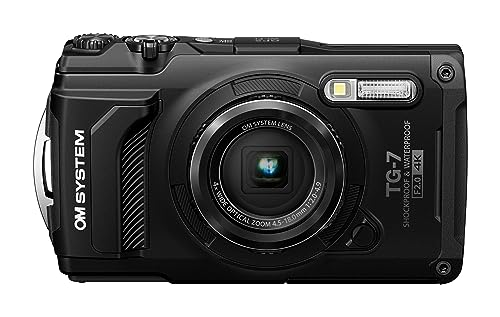
OM SYSTEM Olympus Tough TG-7 — Best underwater camera for stills and macro
If this guide has a native — a camera born for the water rather than adapted to it — it is the Tough TG-7. OM SYSTEM’s rugged compact is waterproof in its own body to depths recreational divers actually reach, freeze-proof for the cold-water and winter end of the hobby, crush- and drop-tolerant for boat decks and rocky entries, and built around a bright lens whose party trick has made the Tough line beloved: microscope-class macro focusing almost at the front element, in a camera that needs no housing to go and look at a nudibranch.
That macro talent reorganises an underwater photographer’s whole day. The reef’s charismatic megafauna — turtles, rays, sharks — are luck; its small citizens are a certainty on every dive, and they are where the TG-7 feasts. Cleaner shrimps in their anemones, crabs in their crevices, coral polyps at night-feed extension: subjects measured in millimetres, photographed at distances where other cameras cannot focus at all. Divers who learn the small reef with this camera stop depending on luck for their albums.
Through this article’s underwater lens, its stills-first design is the distinction. The action cameras below are video instruments that photograph; the TG-7 is a photographic instrument that also films, with RAW capture for the diver who edits, a proper flash system for its ecosystem’s underwater strobes, and field-sensor logging that marries depth and position to the day’s images. For the photographer whose deliverable is the printed reef portrait rather than the dive film, it stands alone in this pool.
Its toughness extends the parish beyond the dive. The same body kayaks, snorkels, fishes, freezes on the ski tour and survives the beach bag’s sand — the adventure compact in the fullest sense, which is why so many divers own it as their surface camera too. One body from the airport to the reef and back simplifies a trip’s packing in a way the housed action cameras, for all their virtues, do not attempt.
Underwater handling respects the medium: controls that can be worked deliberately, a grip that survives gloves, and modes — including its underwater settings — that acknowledge the colour physics this guide described rather than pretending the reef is a landscape. Its video is entirely respectable, a supporting act to the stills rather than a rival to the flagships below.
Limits are a compact’s limits: a small sensor beside the full-frame world, a zoom range chosen for closeness rather than reach, and a price that buys serious action cameras outright. None of them is an underwater argument. In the water, for photographs, this is the pool’s specialist, and specialists are what this guide exists to identify.
Night shore work shows another facet of its character. Torch-lit rockpools, bioluminescent shallows, the turtle-nesting beach photographed under the warden’s red light — the Tough’s close focus and flash manners operate in a world the action cameras visit only as tourists. The photographer whose water is as much coastline as reef will find this body becoming their default camera far beyond the dive boat.
Its logging deserves a final mention for the methodical. Depth, temperature and position married to each frame turn a holiday’s diving into a record a marine-biology friend can actually use, and citizen-science reef programmes run on exactly such cameras. A holiday tool that can also contribute data is a rare thing, and the TG-7 wears the double role lightly.
There is a final, unfashionable reason divers keep this line of cameras for decades: it photographs well out of the water at the moments diving trips are actually made of — the dawn harbour, the boat’s wake, the market dinner after the last dive. A specialist that is also a companion is the one that gets packed, and packing, as this guide has argued in other waters, is destiny.
- Format: rugged compact, waterproof in its own body
- Macro: microscope-class close focus for reef small life
- Build: freeze-proof, drop- and crush-tolerant
- Stills: RAW capture with underwater modes and logging
Strengths
- Photographs the reef’s small citizens like nothing else here
- No housing ritual between the boat and the water
- Toughness covers the whole adventure trip, not just dives
Trade-offs
- Video is a supporting act beside the action flagships
- Small-sensor ceiling in the darkest water
- Zoom is chosen for closeness, not distant subjects
Best for: underwater stills, macro divers, snorkellers and cold-water adventurers. Not suited for: video-first divers or anyone needing interchangeable lenses.

GoPro HERO13 Black — Best for serious underwater video
Serious underwater videographers in this pool reach first for the HERO13 Black, and its qualifications are cumulative. Waterproof in its own body for the snorkel and shallow-dive world, with housings extending its range for deeper work; stabilisation that turns a finning diver’s surge into watchable glide; 5.3K video that crops and reframes in the edit without apology; and an interchangeable lens ecosystem that lets one body shoot the wide reef scene and the more natural perspective for a buddy portrait. Underwater video is a chain of small problems, and this camera has an answer filed for most of them.
Colour handling below the surface is where its generation earns its keep. Underwater modes and modern processing hold skin, sand and coral in a believable register as the reds fall away, and the footage grades kindly for divers who correct depth colour in the edit — the normal professional workflow, since no camera’s automatic answer survives every depth and every water. The HERO13 gives that workflow the most information to work with of any action camera here.
On a dive boat, meanwhile, it becomes something larger than a camera: the trip’s system. Mounts put it on a tray with lights, on a mask strap for the diver’s own view, on a pole for the shy octopus’s den; batteries and cards rotate through the boat day in a rhythm the whole liveaboard understands, because half the boat is running the same system and its spares, cables and folklore. Underwater, where a missing adapter cannot be improvised, that shared ecosystem is a genuine safety margin for the photography.
Its stills, pulled as frames or shot as photographs, serve the dive log and the social post handsomely, though the TG-7 remains the stills specialist of this guide. The GoPro’s parish is motion: the turtle’s pass, the shark’s patrol, the wreck’s swim-through, the buddy’s descent down the line into blue — subjects whose meaning is movement, filmed by a camera that treats movement as its home medium.
Handling in the water is glove- and surge-friendly: big record control, voice and screen options at the surface, and a body whose buoyancy behaviour with its usual mounts is a known quantity divers can trim. A camera whose habits are known is a camera whose owner can think about the reef instead, which is the whole point of experience-rated equipment.
Buy it as the underwater film camera of the set and it will not be outgrown quickly; its ceiling is set by housings, lights and the diver’s own craft, in that order. Paired with the TG-7 for stills, it completes the most capable underwater partnership our pool can field.
Slow motion is its underwater party piece. Surge, bubbles, a ray’s wingbeat and a freediver’s turn all repay high-frame-rate filming, and the HERO13’s slow-motion footage of the water’s ordinary moments is consistently what dive-trip audiences ask to see again. The medium is movement slowed by water already; a camera that slows it further, cleanly, is speaking the reef’s own language.
Its photo modes, finally, should not be undersold to the hybrid shooter. Timed captures on a mini-tripod at a cleaning station, frame grabs from 5.3K footage sharp enough for the album’s full pages — the diver who films everything and photographs opportunistically will find the stills ceiling higher than the action-camera stereotype suggests.
Liveaboard life suits its logistics precisely. Charging rotations, card swaps and nightly reviews are the rhythm of a week at sea, and the GoPro’s ecosystem — every cable, mount and spare already aboard in someone’s kit — means a failure is a borrow rather than a bereavement. Equipment that a whole boat can keep alive is equipment a solo traveller can trust at the far end of the world.
- Type: flagship action camera with 5.3K video
- Sealing: waterproof body, housings for deeper diving
- Lenses: interchangeable options for reef-wide or natural views
- Stabilisation: flagship-class for surge and finning
Strengths
- Underwater footage with genuine editorial headroom
- Ecosystem of trays, lights and mounts is unmatched
- Colour workflow rewards the diver who grades
Trade-offs
- Stills play second to the TG-7’s specialism
- Serious depths require the housing ritual
- Flagship cost before lights and tray are added
Best for: divers filming seriously — wrecks, big animals, published footage. Not suited for: macro stills specialists or casual pool use on a budget.

DJI Osmo Action 5 Pro — Best for low light below the surface
Descend, and the light goes with a swiftness that surprises every new underwater photographer — the bright social world of the surface becomes, within a dive’s first minutes, a blue dusk where cameras earn or lose their reputations. The Osmo Action 5 Pro earns its: a larger sensor than its action-camera peers, colour-depth recording that gives the edit more to rescue, and low-light processing that keeps the deeper reef, the wreck’s shadow side and the dusk dive legible rather than impressionistic. In this pool, it is the camera for the water’s darker half.
Its colour science deserves the underwater-specific praise. DJI’s colour-depth options record more of the gradation that depth correction needs — the difference between a turtle that grades back to olive-and-amber and one that stays a blue cut-out — and its automatic answers at snorkel depth are among the most believable here for divers who do not grade at all. Both audiences, the editor and the holidaymaker, are served by the same sensor generosity.
Night and dawn, the reef’s two shift changes, are where it specialises. Night dives — the reef’s shift change, when the day fish sleep and the hunters and feeders emerge — are many divers’ favourite hour and every camera’s examination. The Action 5 Pro, paired with a decent video light, keeps that hour’s footage clean at working distances, and its battery endurance covers the full evening programme of dusk dive, surface interval chat to camera on its front screen, and night dive, without a swap in the dark on a moving boat.
Surface manners complete the profile: waterproof in its own body for snorkelling and shallow work, housings available for the deeper programme, quick mounting shared with the action-camera world, and stabilisation that handles surge and finning with the family’s usual calm. It is, in short, the thinking diver’s alternative flagship — chosen on light and colour rather than on ecosystem breadth.
Its stills are honest documentary frames, its lens fixed in the wide underwater register the physics of the medium demands. Divers who want the reef’s small life in stills should pair it with the TG-7’s macro rather than ask it to impersonate a compact, a division of labour this guide recommends in several of its pages.
Choose it when your diving leans deep, dark or nocturnal — or when your editing leans serious about colour — and it will bring back footage from water the other action cameras here describe less faithfully.
Wreck exteriors are its examination hall. The shadowed hull, the dark swim-through’s entrance, the reef wall dropping into blue — scenes where the exposure must hold the lit coral and the unlit structure in one frame — play directly to its sensor’s dynamic generosity. Divers whose water is architecture as much as biology will find its footage the most truthful record of what the wreck actually looked like.
There is a temperament point, too: its menus and modes are the calmest of the flagships to operate with cold hands on a night boat, and underwater equipment is used disproportionately in exactly those conditions. Design that respects the operator’s state is safety equipment in disguise, and this DJI respects it.
Snorkellers should not overlook it for its depth reputation, either. At the surface its colour and calm stabilisation produce the most effortless bright-water footage of the action flagships, and the same body then descends with the divers in the afternoon. A camera equally at home in both halves of a reef day simplifies a mixed party’s packing to a single decision.
- Format: action camera with larger sensor
- Colour: colour-depth recording for depth correction
- Endurance: long dives and double-dive evenings
- Sealing: waterproof body, housings for depth
Strengths
- Deeper, darker water stays legible and gradeable
- Night-dive footage with a light is its showcase
- Believable colour even for divers who never edit
Trade-offs
- Ecosystem narrower than the GoPro’s
- Stills are documentation, not macro art
- Fixed wide lens, like all its action peers
Best for: deeper divers, night dives, dusk water and colour-serious editors. Not suited for: macro stills or the very tightest budgets.

Insta360 Ace Pro 2 — Best for snorkelling storytellers
The Ace Pro 2’s underwater case rests on a pairing nobody else in this pool offers: genuinely strong low-light imaging — a large sensor for its class with dual-chip processing and Leica-tuned colour — behind a flip touchscreen that makes the snorkeller or freediver its own presenter. Surface intervals become pieces to camera; the descent can be narrated at the buoy; the day’s story assembles itself with its storyteller inside it, which is precisely the shape modern dive and snorkel content takes.
Below the surface, that low-light strength earns its keep in the water’s commonest conditions: the overcast reef, the green coastal water of home shores, the kelp forest’s cathedral gloom, the cenote’s halved light. Holiday underwater footage fails most often not at depth but in ordinary dimness, and the Ace Pro 2’s sensor was plainly specified by people who knew it. Its colour, tuned with a photographer’s hand, flatters skin and reef in the same frame — the buddy portrait problem, solved more gracefully than most.
Judge it as the freediver’s and snorkeller’s camera rather than the scuba flagship’s rival, and its design snaps into focus. Its parish is the top ten metres, where the light is alive, the sessions are long and breath-held, and a camera’s manners — quick wake, certain record, flip-screen review on the float — decide how much of the session becomes footage. In that parish its combination of polish and presentation is unmatched in this pool.
Waterproofing in its own body covers that parish, with housings extending it for divers who want its colour deeper. Mounting follows the action standards, stabilisation keeps the duck-dive and the surge composed, and its stills are a cut above the action-camera norm for the day’s album.
Battery manners are respectable rather than endless, so the snorkel guide’s routine — charge at lunch, swap on the long afternoon — applies. And the fixed wide view is the medium’s own choice, as this guide has explained: underwater, you zoom with your fins, and the Ace Pro 2 expects to be taken close, where its sensor does its best work anyway.
Choose it for bright-water storytelling with a presenter in it — the snorkel vlog, the freedive diary, the family reef film narrated by its own swimmers — and it brings a polish to the surface world that the pure divers’ cameras do not attempt.
Its stills of the surface world deserve their sentence. The boat ride out, the island lunch, the sunset swim — the Ace Pro 2’s colour and lens produce the day’s above-water album at a level that lets it serve as the trip’s only camera for travellers whose diving is snorkelling. One camera for the whole water’s-edge day is a packing philosophy, and this is its strongest candidate.
Freedivers should note its session rhythm: quick surface reviews on the flip screen between dives, footage checked while the breath recovers, settings adjusted on the float rather than ashore. A camera that fits the breath cycle instead of interrupting it gets used for the whole session, and the session is where freediving footage lives.
Its audio at the surface, so often an action camera’s afterthought, records the snorkel guide’s briefing, the boat’s laughter and the presenter’s narration with a clarity that lets the day’s film be assembled without a separate recorder. Underwater storytelling is half told above the water, and this camera hears that half properly.
- Format: flagship action camera, flip touchscreen
- Sensor: large for class, dual-chip low-light processing
- Colour: Leica-tuned, kind to skin and reef together
- Sealing: waterproof body for the bright top metres
Strengths
- Ordinary dim water — cloud, kelp, coast — stays handsome
- Flip screen puts the storyteller inside the story
- Stills a cut above the action-camera norm
Trade-offs
- Deep programme needs its housing
- Battery is respectable, not exceptional
- Macro stills belong to the TG-7’s parish
Best for: snorkellers, freedivers and presenters filming in bright-to-dim water. Not suited for: deep technical diving or macro stills work.

AKASO Brave 7 LE — Best value for new underwater shooters
The Brave 7 LE is where underwater photography’s door opens widest in this pool. AKASO’s formula — 4K video, electronic stabilisation, a touchscreen, dual displays’ convenience in its class, and a waterproof case in the box’s ecosystem — at a price that treats a first flooded camera as a lesson rather than a catastrophe. For the beginner snorkeller, the kayaker, the pool-and-reef holidaymaker, that pricing is not a compromise; it is the feature that makes experimentation psychologically possible.
Its underwater manners are honestly matched to its parish. In its case it visits the recreational depths; on its own it shrugs off the surface world of rain, spray and beach. Stabilisation keeps the snorkel session’s bobbing watchable, the touchscreen — usable at the surface and through the case’s controls in the water’s own way — keeps the interface learnable, and the footage that comes home from a first reef is, to the only audience that matters, miraculous: their reef, their turtle, their film.
There is a tuition argument for it, too: this is the camera to learn the underwater workflow on. Seal checks, rinsing, anti-fog discipline, buoyancy with a float grip, the white-balance habits of depth — every ritual the expensive cameras demand is demanded here too, at tuition prices. Divers who serve this apprenticeship arrive at a flagship later with their mistakes already made and paid for at AKASO rates, which is the cheapest education the hobby offers.
It doubles, usefully, as the trip’s second angle: mounted on the boat, lent to the teenager, fixed to the kayak’s bow while the flagship rides the diver. Underwater trips generate more simultaneous moments than one camera can attend, and a capable, affordable second body is how ordinary travellers cover them.
Limits are the value tier’s own: low-light polish trails the DJI and Insta360 flagships, ultimate detail trails the GoPro, and the ecosystem is narrower than the giants’. In bright tropical water — the beginner’s natural habitat — those gaps narrow to near-invisibility, which is exactly where this camera is meant to live.
Buy it to start, to lend, or to multiply angles, and it will be remembered as the camera that made the underwater world feel affordable to enter — because it is.
Pool and training work is an underrated parish it serves well. Swim squads, synchronised teams, sailing schools and lifeguard courses all film in controlled water where its case, screen and stabilisation produce coaching footage at a price a club can justify — and lose to a lane rope without tears. The democratisation of underwater filming runs through cameras at exactly this tier.
Its dual-screen convenience, at the surface, makes it the family’s reef camera in practice: the parent films, the child reviews on the boat, the footage is shared before the towels are dry. Underwater photography’s future is being recruited in those boat reviews, and the Brave 7 LE is an effective recruiter.
For the travelling family it solves the multiplication problem: one Brave 7 LE per swimmer is a fleet a flagship budget cannot field, and a reef filmed from three heights and two generations is a richer record than any single perfect angle. Underwater memories are ensemble pieces, and this is the ensemble’s instrument.
- Format: value action camera, 4K video with stabilisation
- Sealing: waterproof case for recreational depths
- Interface: touchscreen, beginner-legible
- Role: first underwater camera or second angle
Strengths
- Underwater entry at a price that forgives learning
- Case included in its ecosystem for real depths
- Teaches the full seal-and-rinse workflow cheaply
Trade-offs
- Low light trails the flagship picks
- Detail and colour depth are a tier below
- Accessory world narrower than GoPro’s or DJI’s
Best for: first underwater cameras, snorkel holidays, kayaks and second angles. Not suited for: night dives or publication-grade footage.

AKASO EK7000 — Best spare and starter underwater camera
The EK7000 is the elder statesman of budget underwater cameras — a simple 4K action camera with electronic stabilisation, a remote control in its ecosystem and a waterproof housing rated for the recreational depths — and its longevity in the market is itself the review. It has been the first underwater camera of a generation of snorkellers, and it remains in this guide for the roles that longevity suits: the starter, the spare, the lendable, the camera sent where a flagship’s loss would end the trip’s photography and its owner’s temper.
Its underwater proposition is unpretentious and complete for the bright shallows. In its housing it films the reef tour, the pool training, the river float and the waterfall swim in 4K that the family archive accepts happily; its wide view is the medium’s own; and its simplicity — a record button, a remote for the mounted shots, an app for the transfers — means the learning curve is measured in minutes, leaving the holiday’s attention for the water.
Think of it, finally, as insurance that happens to have a lens. Trips carry spare masks and spare fins; a spare camera at EK7000 prices is the same logic, and it pays out in the scenarios every diver recognises: the flagship’s battery dead at the second dive, the housing mishap, the companion who wants to film their own swim. A trip whose photography survives its worst equipment day is a trip whose album survives, too.
It is also the camera to give a child properly. A young snorkeller with their own EK7000 — their own seal checks to learn, their own footage to review at dinner — is receiving the hobby itself as a gift, at a price where a parent’s supervision can be about the water rather than about the equipment’s value. Several underwater photographers of our acquaintance began exactly here, and speak of the model with a warmth its specifications cannot explain.
Age shows in the expected places: stabilisation and low-light work a generation behind the flagships, detail and colour a tier below the Brave 7 LE’s, and an interface from an earlier, simpler school. In bright water, on a first trip, in a spare’s role, those are footnotes.
Buy it as the household’s underwater utility — starter, spare, lender, child’s first — and it will quietly be the most-used camera of the set, because it is the one nobody is afraid to take swimming.
River and waterfall work rounds out its parish. Fresh water is kinder than salt but harder on equipment in every other way — knocks, grit, current — and a housed EK7000 on a grip films the gorge swim and the plunge pool with a cheerfulness that a flagship’s owner, watching their tray go over the same rocks, will envy. Cheap cameras go further because they are allowed to.
Its remote control, a small thing, solves the mounted selfie and the group swim photograph — the whole party in the lagoon, nobody stranded behind the camera. Family water days are this camera’s natural habitat, and it has served more of them than every other pick in this guide combined.
And if it is finally lost — to a current, a depth, a moment’s inattention — the loss is a story rather than a disaster, which is precisely the emotional economics a spare camera is bought for. The flagship stays tethered and cherished; the EK7000 goes adventuring, and brings back the footage of everywhere the cherished one was not risked.
- Format: budget action camera, 4K with stabilisation
- Sealing: waterproof housing for recreational depths
- Extras: remote control in its ecosystem
- Role: starter, spare and lendable underwater camera
Strengths
- The cheapest honest ticket into underwater filming
- Simple enough for a child’s first snorkel camera
- Spares the flagship on risky and casual swims
Trade-offs
- A generation behind on stabilisation and low light
- Detail trails its AKASO sibling and the flagships
- Interface is basic by modern standards
Best for: starters, spares, children and casual bright-water filming. Not suited for: serious divers or publication footage.
How do you get good underwater pictures on your very first trip?
Get close, then get closer, and let that single discipline carry the whole trip. Water eats clarity by the metre, so the beginner’s best reef photograph is taken from half a metre, the second-best from one metre, and the one from four metres is a blue rumour. Every camera in this guide is wide for exactly this reason: move until the subject fills the frame, shoot, and let the wide lens forgive the geometry. Add a slow approach — reef citizens forgive a patient photographer and flee a hurried one — and a first trip’s album will embarrass many experienced ones.
Mind the light’s direction and the particles it betrays. Shoot with the sun behind you where you can, angle any light away from the lens’s immediate foreground to keep backscatter down, and prefer the day’s bright middle hours for a first trip’s serious attempts. Review each evening with a diver’s honesty: the frames that worked were close, lit and patient, and tomorrow’s dive should be planned around making more of exactly those.
And drill the unglamorous liturgy until it is reflex: seals inspected and cleaned before every closure, housing latched and checked at the surface, camera rinsed in fresh water after every salt session, batteries and cards on the same nightly rotation as the rest of the kit. Underwater careers end by flooded housings far more often than by bad photographs, and the ritual is the price of the medium’s admission.
Which of the best cameras for undera suits which kind of water?
Bright tropical shallows — the snorkel holiday, the house reef, the lagoon — are the AKASO pair’s home water and the Ace Pro 2’s showcase, where light is generous and value tells. The working reef at scuba depths, with stills ambitions, belongs to the TG-7; the same depths on film belong to the HERO13, and their darker, deeper or nocturnal extensions belong to the Action 5 Pro. Cold and rough water — the northern shore, the winter lake, the white-water river — returns the verdict to the TG-7’s freeze-proof toughness and the housed action cameras’ indifference.
Match by the trip’s centre of gravity rather than its single deepest moment. A camera bought for one wreck dive and carried through a fortnight of snorkelling is a camera mis-bought, however fine the wreck footage; the set above is arranged so that the holiday’s ordinary water chooses first, and its exceptional hour chooses second.
How should you care for a camera that swims?
Rinse it like you mean it: a soak or a gentle shower in fresh water after every salt session, worked around the seals and controls, before the salt dries into the abrasive, corrosive film that eats housings and bodies alike. Dry it in shade, store it unlatched where its design prefers, and keep seals clean, inspected and — where the maker advises — lightly maintained on schedule. Ten unhurried minutes at the basin is the entire secret of underwater cameras that last a decade.
Desiccant and discipline guard the inside. A small silica sachet in the housing fights the fog that warm hands and cold water conspire to create, and a camera closed in dry shade rather than humid sun starts every dive clearer. None of this is glamorous, and all of it is the difference between the photographer whose gear is a standing joke about floods and the one whose decade-old camera still seals like a promise.
What about lights, filters and trays — when does an underwater camera need help?
Later than the shops suggest, and in a strict order. First comes proximity, which costs nothing and fixes most colour and clarity by itself. Second comes a colour-correction filter for the ambient-light depths, a small and inexpensive mercy for the snorkeller and shallow diver filming without lights. Third, and only when your subjects and depths have proven the need, comes light: a video light for filming, a strobe for stills, mounted on a tray that steadies the whole rig and gives both hands a home. Each step should be bought because last trip’s footage asked for it by name.
The tray deserves its sentence because beginners dismiss it as furniture. Underwater, a two-handled tray is a stabiliser, a light mount and a drop-prevention system in one, and it transforms every camera in this guide from a held object into a rig. When the footage stops improving with practice, the tray — not the next camera — is usually the correct purchase, a truth the dive shops will confirm if asked at the right moment in the conversation.
Comparison Table
| Camera | Badge | Sealing style | Underwater talent |
|---|---|---|---|
| OM SYSTEM Olympus Tough TG-7 | Best underwater camera for stills and macro | Waterproof body | Macro stills and reef detail |
| GoPro HERO13 Black | Best for serious underwater video | Waterproof body, housings deeper | Flagship dive filming |
| DJI Osmo Action 5 Pro | Best for low light below the surface | Waterproof body, housings deeper | Deep, dusk and night water |
| Insta360 Ace Pro 2 | Best for snorkelling storytellers | Waterproof body, housings deeper | Presented snorkel and freedive films |
| AKASO Brave 7 LE | Best value for new underwater shooters | Waterproof case | Learning the craft affordably |
| AKASO EK7000 | Best spare and starter underwater camera | Waterproof housing | Starters, spares and children |
The sealing column deserves a second look before purchase: a waterproof body is a convenience every day, while a housing is a commitment every dive — and the right choice is the one whose ritual you will still be performing cheerfully on the trip’s fifth day.
What mistakes do new underwater photographers make?
The flood is the famous one, and it is almost never the camera’s fault: a hair across a seal, a latch half-closed in a hurry, a housing opened with wet hands over a sandy towel. The liturgy in this guide’s how-to section exists because the mistake is so preventable and so final. Slow down at the boat’s edge; the reef has been there for millennia and will wait the extra ninety seconds.
Distance is the second: the blue, empty, far-away reef photograph, taken from where the photographer floated rather than where the subject was. Underwater photography is a contact sport played gently — proximity is quality, and the discipline of approaching slowly, low and down-current is worth more than any camera upgrade in this list.
Third is chasing the famous fauna past the certain one. The dive spent hunting the turtle that never came is a dive not spent with the anemone city that was there all along; the TG-7’s macro parish exists as this guide’s standing corrective. Albums built from what the reef offered, rather than what the brochure promised, are the ones that get rewatched.
Last is neglecting the surface half of the discipline: unrinsed gear corroding quietly, cards un-backed-up with the whole trip aboard, batteries uncharged for the morning boat. The underwater day is won at the evening’s wash basin and charging strip as surely as at the reef, and the photographers who last in this medium are, without exception, the ones who learned to enjoy the liturgy.
Final Recommendation
Choose by the water you will actually swim in. For underwater photographs — above all the reef’s small life — the OM SYSTEM Tough TG-7 is this pool’s specialist and this guide’s first recommendation. For underwater film at a serious level take the GoPro HERO13 Black, or the DJI Osmo Action 5 Pro where your water runs deep, dark or nocturnal; for the bright shallows with a storyteller in them, the Insta360 Ace Pro 2. Begin the hobby, multiply the angles or equip a child with the AKASO Brave 7 LE and EK7000, whose honesty at their prices is its own kind of excellence. And whatever “undera” meant in your search history, if it led you to the water, it led you well: pick the camera your water chooses, learn its liturgy, get close — and come back with the reef.
One last encouragement for the beginner reading all of this with a housing in their future: every underwater photographer alive flooded, fogged or fumbled something in their first season, and the reef forgave them by simply being there again tomorrow. Start shallow, start close, and start with whichever of these six cameras your water has already chosen for you.
Related guides
- Best Disposable Underwater Cameras for Snorkeling: Film Picks for Bright Shallow Reefs
- Best Cameras Under 5p Bucks, Read as $500: Complete Cameras at a Real Budget
Frequently Asked Questions
What did this guide take “undera” to mean?
Underwater. The keyword arrives truncated, and rather than pretend otherwise, this guide states its interpretation in the first paragraph and builds honestly on it — our pool’s waterproof cameras make the reading a strong one. If your search meant something else entirely, the disclosure at the top was written for you, and no camera here has been disguised as anything it is not.
Do I need a housing, or is a waterproof camera enough?
It depends on depth and design. The TG-7 and the action cameras’ bodies are waterproof for snorkelling and shallow recreational depths as specified by their makers; deeper diving calls for the rated housing, fitted and checked with the liturgy this guide describes. Read your chosen camera’s own depth rating as a working limit, and never treat any rating as a challenge.
Why do my underwater photos look blue, and which camera fixes it?
Water absorbs red light first, so unlit subjects lose warmth with depth. Cameras help with underwater white-balance modes and honest colour processing — all six picks offer respectable versions — and editing can restore much of the rest. Beyond that, the real answers are proximity, light and filters, in that order; no camera repeals the physics, and the best ones, like the DJI’s colour-depth recording, give your correction the most to work with.
Which camera is best for a child’s first snorkelling trip?
The AKASO EK7000: inexpensive enough to be truly theirs, simple enough to master in minutes, housed for real snorkelling depths, and good enough that their first reef film will be a family treasure. The Brave 7 LE is the step up when the child’s interest proves serious and their seal-check liturgy is reliable.
Can these cameras dive as deep as I can?
Recreational limits and camera limits are different numbers, and the camera’s own rating — body or housing, as fitted — is the one that governs. Technical diving beyond recreational depths is specialist territory with specialist housings, and this guide’s pool does not pretend to equip it. Within recreational water, the TG-7, the housed flagships and the cased AKASOs cover the programme comfortably.
What is the first accessory an underwater beginner should buy?
A float grip or a secure wrist tether, before lights, filters or trays. A camera that stays in the hand and at the surface when released survives to take the second photograph; buoyancy discipline is the cheapest image quality in the medium. Lights come second, when your depth and your subjects have taught you which darkness you actually need to argue with.
Related Guides
Keep exploring with our companion guides: best action cameras for underwater, best cameras for marine wildlife and best cameras for a cruise.


