A camera strap decides how a camera hangs on you: around the neck, across the body or around the wrist. The padding, the hardware that clips to the camera and the way the length adjusts matter more than the logo on the webbing.
The six straps below cover a padded neoprene neck strap, a metal-plate strap, a magnetic quick-release strap, a neoprene strap with a pocket, a cross-body sling and a wrist strap. Details come from each listing page, and load figures are the makers’ own. We have not used these straps ourselves.
As an Amazon Associate we earn from qualifying purchases. Links below are affiliate links, and they do not change the product information we give.

What to Look For
| Feature | Why it matters |
|---|---|
| Carry style | Neck, sling and wrist straps sit and move differently |
| Padding | Neoprene or foam spreads the weight of a heavier body |
| Attachment | Quick-release plates, magnetic beads and rings change how fast you detach |
| Extras | Pockets, tethers and spare parts add use or cost you extra |
In this guide
Specs at a Glance
| Strap | Style | Material | Notes |
|---|---|---|---|
| USA Gear TrueSHOT | Neck | Stretch neoprene | Quick-release buckles; card pockets; 100 g |
| Altura Photo | Neck or cross-body | Padded webbing | All-metal plate; tether backup; 1/4 inch screw |
| TARION Magislide | Neck | Nylon seatbelt-style webbing | Magnetic beads; 32.5 to 55.5 in; Dyneema anchors |
| K and F CONCEPT | Neck | Neoprene | Removable zipper pocket; braided rope; 0.11 kg |
| BLACKRAPID | Cross-body sling | Nylon, polyester, spandex | Cam-locks; carabiner; shoulder pad; mesh bag |
| PGYTECH wrist | Wrist | UHMWPE with microfiber | Aluminum adjuster; 34 g; quick connector |
The 6 Best Camera Straps
Top pickBest for a padded everyday neck strap
1. USA Gear TrueSHOT
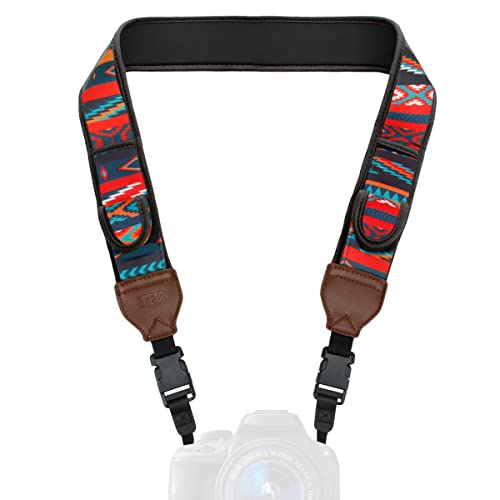
A stretch neoprene neck strap with a non-slip surface, dual quick-release buckles on 3/8 inch reinforced loop straps, and side pouches and memory card pockets. The listing says it fits Canon, Nikon, Sony and other DSLR and mirrorless cameras, weighs 100 grams and carries a three-year manufacturer warranty.
Suits: a padded everyday neck strap. Strengths: card pockets and a light body. Weaknesses: neoprene can feel warm. Skip it if you want a sling.

Best for moving between handheld and tripod
2. Altura Photo Quick Release
A strap built around an all-metal quick-release plate with a rubber base, which the maker says stays on the camera so you can go from strap to tripod without removing it. It adds a tether as a backup connection, uses a standard 1/4 inch tripod screw and can be worn as a neck, shoulder or cross-body strap. The maker quotes a 40 pound capacity.
Suits: moving between handheld and tripod. Strengths: a metal plate and a tether. Weaknesses: the plate adds a part to the camera base. Skip it if you want a plain strap.

Best for fast on-off between camera and tripod
3. TARION Magislide Magnetic
A magnetic quick-connection strap: the anchors click on without looking, use Dyneema fiber the maker says carries 110 pounds, and include a three-layer wear indicator. The length adjusts one-handed from 32.5 to 55.5 inches, the webbing is seatbelt-style nylon, and the ladder-lock buckle doubles as a bottle opener. The kit lists four orange magnetic beads for switching between two devices.
Suits: fast on-off between camera and tripod. Strengths: one-handed length changes. Weaknesses: more hardware than a basic strap. Skip it if you prefer simple rings.

View TARION Quick Release Magnetic Camera Neck Strap Magislide on Amazon

Best for carrying small items on the strap
4. K and F CONCEPT Neck Strap
A neoprene neck strap with an anti-slip body side, a removable zipper pocket for small items such as batteries and cards, and a UTX buckle. A braided three-layer rope has a wear warning, and the kit includes anti-scratch leather stickers and extra hardware rings for more cameras. The listed weight is 0.11 kg.
Suits: carrying small items on the strap. Strengths: a zipper pocket and spare rings. Weaknesses: pocket space is small. Skip it if you want a magnetic release.

Best for hip carry with quick access
5. BLACKRAPID Cross-Body Sling
A sling strap worn on the left shoulder with the camera at the right hip, built for one or two cameras. It has front and rear spring-loaded cam-locks, a removable underarm stabilizer, a shoulder pad and a hardware kit with a swivel locking carabiner, LockStar II, FastenR FR-5 II and a camera tether, packed in a zippered mesh bag. The listing describes it for right-handed photographers.
Suits: hip carry with quick access. Strengths: a full hardware kit. Weaknesses: described for right-handed use. Skip it if you want a neck strap.
View BLACKRAPID Camera Strap for 1 or 2 DSLR, SLR and Mirrorless Cameras on Amazon

Best for a light camera carried in hand
6. PGYTECH Wrist Strap
A wrist strap with a quick connector the maker says locks at any angle, UHMWPE fiber with a stated capacity of 55 kg, a three-layer wear warning, microfiber on both sides and an anodized aluminum adjuster for one-handed changes. The listing weight is 34 grams and it names DSLR, SLR, mirrorless and GoPro cameras.
Suits: a light camera carried in hand. Strengths: very low weight. Weaknesses: not made for heavy bodies hanging at the neck. Skip it if you want a neck or sling strap.

View PGYTECH Camera Wrist Strap for DSLR SLR Mirrorless Quick Release, Dark Grey on Amazon
Care and Setup
- Attach the strap to the camera and give each connection a gentle pull before you lift it.
- Hand wash nylon and neoprene straps as the listing directs.
- Replace any strap whose wear layer starts to show.
- Check that the strap hardware matches your camera’s lugs or tripod socket.
Mistakes to Avoid
- Choosing a wrist strap for a heavy body and long lens.
- Assuming every quick-release plate fits every tripod head.
- Ignoring the maker’s stated capacity for your camera and lens.
- Forgetting that a sling is set up for a specific shoulder.
Choosing a Carry Style for How You Shoot
The three styles in this guide solve different problems, and the right one depends on how long you carry the camera and how often you raise it. A neck strap is the familiar default: the camera hangs at chest height, the weight sits on your neck and shoulders, and your hands stay free. It is simple and secure, but a heavy body with a long lens can become tiring over a full day, and the camera tends to swing when you bend over.
A cross-body sling moves the load to one shoulder and lets the camera rest at your hip. It suits walking, travel and event work where you raise and lower the camera constantly. The trade-off is a slightly more involved setup and a strap that is made for one side or the other. A wrist strap is the lightest and least intrusive option. It works well for compact cameras and smaller mirrorless bodies that you hold most of the time, but it puts all the weight on your hand and wrist, so it is a poor match for a heavy body.
- Short walks and casual use: a padded neck strap is usually enough.
- All-day travel with a heavier body: consider a sling or a wide, padded strap.
- Street shooting with a small camera: a wrist strap keeps the camera ready and unobtrusive.
- Two cameras at once: look for hardware designed to carry a pair, and check the maker’s limits.
Padding, Materials and All-Day Comfort
Comfort comes from how a strap distributes weight, not only from how thick it looks. Neoprene and foam padding spread pressure across a wider area and add some cushioning, which is helpful for heavier cameras. Neoprene can feel warm against the skin in hot weather, and some people find it holds sweat. Woven nylon or seatbelt-style webbing is thinner, dries quickly and tends to slide more easily over clothing, though it can dig in under a heavy load if the webbing is narrow.
Width matters. A wider strap lowers the pressure per square inch on your neck, while a very narrow one concentrates it. Look at the texture of the underside too: a grippy surface keeps the strap from sliding off a shoulder, but may snag on delicate fabrics. A smooth surface glides easily but can slip more.
Think about the climate and clothing you shoot in. In cold weather you may wear a thick coat, so you need enough length to go over it. In summer, a breathable strap against bare skin is more comfortable than a thick foam one. If you wear glasses or a hat, check that the strap does not catch on them when you lift the camera to your eye. Fit the strap, wear it for a while, and adjust the length before you rely on it for a full session.
Attachment Hardware and Camera Security
The strap is only as safe as its connection to the camera. Most cameras have lugs, small metal loops on each side of the body, and traditional straps thread through them. Others use a tripod socket on the base, which lets a plate or a screw-in connector hold the strap. Check which your camera has before you buy, and whether the strap’s hardware is made for that style of attachment.
Quick-release systems add speed. Buckles, plates and magnetic or clip-style anchors let you detach the camera for tripod work or when you want to travel light. They also add parts that can loosen, so build a habit: pull gently on each connection after attaching it and before you lift the camera. If a system uses a base plate, make sure it does not block the battery door or the tripod head you already own.
Backup connections are worth considering when you carry expensive gear. A tether or secondary loop gives you a second link if the main connection fails. Ignore decorative hardware that looks strong but is not rated for a load: look for a maker’s stated capacity, and compare it with the combined weight of your camera, lens and any accessories. If the listing does not give a figure, treat that as a reason to ask before buying.
Fit, Length and Adjustment
A strap that is too long lets the camera swing and bang against your body or the edge of a table. One that is too short makes it hard to lift the camera to your eye. A good starting point for a neck strap is one that rests the camera around the chest or just below it. For a sling, set the length so the camera sits near your hip, with enough slack to slide it up comfortably when you shoot.
Adjusters vary. Simple friction buckles hold their position but can slip with a heavy load or repeated movement. Ladder locks and cam-style adjusters hold more firmly. Quick adjusters that you can operate with one hand are useful when you move between standing and kneeling, or switch between a tripod and handheld work.
- Try adjusting the length while wearing a jacket and again without one.
- Check the range in the listing, and measure your torso if you are tall or small.
- For a wrist strap, make sure the loop closes snugly without cutting off circulation.
- Trim or tuck loose ends so they do not catch on gear.
If a strap is shared between people of different sizes, a wide adjustment range matters more than almost any other feature.
Maintenance and Signs a Strap Should Be Replaced
Straps do hard, repetitive work and wear out slowly, so inspections are cheap insurance. Every few weeks, and always before a trip, look at the stitching, the webbing edges and the hardware. Fraying edges, loosening threads, cracks in plastic buckles, and bent or corroded metal rings are all reasons to take the strap out of service. Some straps include a wear indicator, a colored layer that appears as the outer layer wears. If you see it, replace the strap or that part.
Cleaning is simple. Follow the maker’s care guidance in the listing or on the packaging. Many nylon and neoprene straps can be hand washed with mild soap and air dried, but harsh heat or strong detergents may damage them. Let a strap dry fully before storing it to avoid odors and mildew. Wipe metal hardware with a dry cloth, and rinse it after exposure to salt water or sand.
Replace a strap if the camera has taken a hard fall while attached, even if nothing looks wrong, because hidden damage can weaken the connection. Also reconsider your strap if you change cameras. A new body with a longer lens may exceed what the old strap was designed to carry, and the hardware may not suit different lugs. Keeping a spare, simple strap in your bag is a practical backup.
Neck, Sling and Wrist Straps Matched to How You Shoot
The right strap depends less on the camera and more on your day. Walking all afternoon with a heavy body asks for something different than grabbing a quick portrait during a family dinner.
| Style | Strengths | Watch out for |
|---|---|---|
| Neck strap | Simple, quick to use and familiar | Can strain the neck with a heavy lens |
| Sling strap | Spreads weight across the shoulder and body | Needs adjusting when you change position |
| Wrist strap | Light and good for small bodies | Offers little support for big lenses |
| Hand strap | Locks your grip for steady carrying | Not ideal for long hanging periods |
If you carry two bodies, consider how the straps will behave together. Two neck straps can tangle, while a sling on one and a wrist strap on the other keeps things tidy.
Checking the Attachment Points Before You Trust a Strap
A strap is only as reliable as the way it connects to the camera. Spend a minute on this each time you switch to a new one, because a loose connection puts your gear at risk.
- Look at the lugs on your camera and note whether they take a loop, a ring or a quick-release plate.
- Inspect the stitching where the webbing folds over; frayed thread is an early warning sign.
- Tug firmly on the connector before lifting the camera by it.
- Make sure any locking or safety latch is fully closed.
- Remove the manufacturer strap only if the new system fits the same lugs securely.
Read the listing for the stated weight capacity, and compare it to your camera body with its heaviest lens attached. If a listing gives no figure, consider that a prompt to ask the seller or look for a model with clearer information.
Comfort deserves a trial too. Pad width, strap material and how the surface feels against bare skin all change how the strap behaves after a few hours. Wear it around the house for an evening before a trip so adjustments happen at home, not on a trail.
Looking After Your Strap Over Time
Straps wear quietly and fail suddenly, so a seasonal inspection is wise. Wash fabric webbing gently according to the maker’s notes, let it air dry and check hardware for rust or loose threads.
- Replace any strap showing cuts or stretched stitching.
- Wipe leather with a suitable conditioner and keep it away from soaking rain.
- Store spare straps flat so they hold their shape.
A strap that looks tired is an easy thing to swap, compared with a dropped lens.
If you carry the camera on long trips, keep a spare strap in the bag so a worn one never ends your day early. Check the quick-release hardware before each outing as well.
Camera Straps FAQ
Which ones have a pocket?
The USA Gear lists memory card pockets and the K and F CONCEPT lists a removable zipper pocket.
Which one is a sling?
The BLACKRAPID is the cross-body sling in this group.
Is a neck strap or a sling better for a heavy camera?
Many photographers find a sling more comfortable for a heavy body and long lens because it moves the load to one shoulder and the hip. A wide, padded neck strap can also work for shorter sessions. Try both if you can, and check each maker's stated load.
Will a quick-release strap fit my tripod?
Not always. Plates and anchors use different mounting styles, and tripod heads accept particular plate shapes. Check the listing for the tripod screw size and plate compatibility, and test the combination before you rely on it outdoors.
Can I use a strap that came with my camera?
Yes, and many are fine for light use. They are often narrow and thinly padded, so you may want to upgrade if you carry a heavier camera for long periods. Check the strap for wear first.
How tight should the strap connections be?
They should be fully seated, locked or threaded as the instructions say, and they should not slip when you pull gently. If a connection feels loose or you cannot tell whether it is locked, remove and reattach it.
Are wrist straps safe for expensive cameras?
They suit light cameras you hold in your hand, and they keep the camera from falling if you let go. Because they offer no weight distribution, they are not ideal for a heavy body. Always keep a firm grip and check the connection.
How do I stop a strap from twisting?
Check that the strap is not threaded with a twist when you attach it. Flat, wider straps twist less than narrow cords. Some people also use a strap with a grippy underside to keep it in place.
Can I wash a neoprene strap in a machine?
Follow the listing or packaging, since methods differ. Hand washing with mild soap and air drying is the cautious choice for neoprene and nylon. Avoid heat and harsh chemicals unless the maker says they are fine.
The Short Version
For padding and card pockets, the USA Gear. For a metal plate and tether, the Altura. For magnetic release, the TARION. For a zipper pocket, the K and F CONCEPT. For a sling, the BLACKRAPID. For a light wrist loop, the PGYTECH.
How to Choose Between the Picks in This Guide
The six straps in this guide cover three different ways of carrying a camera, and the carry style should be decided before the material or the hardware. A neck strap keeps the camera centred on your chest, ready in both hands, and suits shorter sessions, events where you raise the camera constantly, and lighter mirrorless bodies. The padded neoprene options here, the USA Gear TrueSHOT and the K and F CONCEPT strap, both follow that pattern, with the difference in the details: the USA Gear adds memory card pockets and quick-release buckles, while the K and F CONCEPT adds a removable zipper pocket for small items and spare hardware rings for a second camera.
A cross-body sling, represented here by the BLACKRAPID, rests the camera at your hip and spreads the load across one shoulder and your back. Photographers who walk for hours, shoot weddings, travel days or street sessions usually prefer a sling because the neck never takes the full weight. The camera slides up the strap to the eye, which is fast once practised, and spring-loaded stops keep it from sliding too far. The trade-off is that a sling is handed: the model in this guide is described for right-handed use on the left shoulder, so check the orientation before buying any sling.
The remaining two straps are about speed of connection rather than carry position. The Altura Photo strap is built around a metal quick-release plate that stays on the camera, so moving between handheld shooting and a tripod does not mean removing the strap, and it includes a safety tether as a second connection. The TARION Magislide uses magnetic anchors that click together without looking, with one-handed length adjustment, which suits photographers who swap the strap between two bodies or detach it often. The PGYTECH wrist strap is the outlier: it is not for hanging a camera at all, but for securing a light camera you hold in your hand, where the strap is a safety line rather than a carrying system.
A simple decision rule follows from this. If the camera hangs on you for hours, choose by carry style first, sling for distance and neck strap for constant readiness. If you move between tripod and hand all day, choose by the connection system. If the camera lives in your hand and only needs insurance against a drop, a wrist strap is enough, provided the body and lens are light.
Padding, Weight Distribution and All-Day Comfort
Comfort is mostly physics. A camera and lens hang from a small area of your neck or shoulder, and the pressure depends on the total weight and the width and softness of the surface spreading it. Neoprene works well because it stretches slightly and cushions the load, which is why two of the neck straps in this guide use it. The same stretch can make a heavy camera bounce as you walk, so very heavy combinations sometimes feel better on a firmer padded webbing that does not spring. Neither is universally better; match the padding to the weight and to how much you move.
Heat is the hidden comfort factor. A wide, padded strap against the neck on a summer day can feel warm, and neoprene in particular holds heat, as the guide notes for the USA Gear strap. In hot climates or during summer events, a narrower strap, a sling that moves the load to the shoulder, or simply alternating shoulders during breaks can matter more than an extra few millimetres of padding. Photographers who shoot long ceremonies often carry a small cloth to wipe the strap and neck, which sounds trivial until the third hour.
Fit the length properly. A neck strap should hold the camera around the lower chest or upper stomach, high enough that it does not swing into tables and door frames, low enough that raising it to your eye does not fight the strap. A sling should rest the camera at the hip with the grip facing backwards for a natural grab, and the underarm stabiliser, where fitted, keeps the strap from rotating as you move. Spend ten minutes adjusting at home rather than on the first job, and re-check the adjustment when you change between a light prime lens and a heavy zoom, because the balance point moves.
Attachment Hardware: Plates, Anchors, Rings and Tethers
The strap itself rarely fails. Connections do. Every system in this guide attaches differently, and understanding the differences helps you inspect and trust your own setup. Split rings through the camera’s lugs are the traditional method: simple, cheap and slow to remove. Quick-release buckles on short loop straps, like those on the USA Gear strap, leave a small tail on the camera and let the main strap come away in seconds, which is handy when the strap would dangle in front of a tripod-mounted camera.
Plate systems screw into the tripod socket. Their great advantage is that the plate can stay on the camera and work with a tripod, so the strap and the tripod share one fitting. Their risk is that everything depends on one screw, which is why the Altura Photo design adds a tether as a backup connection between camera and strap. A backup is a genuinely good idea with any single-point attachment: if the main connection ever lets go, the tether gives you a second chance instead of a fall.
Magnetic anchor systems, like the TARION design in this guide, use small connectors that stay on the camera and click into the strap. They are the fastest to use and encourage you to actually detach the strap when it is in the way, rather than working around it. Their anchors are consumable parts: the makers build in wear indicators, layers of coloured material that show as the outer layer wears, and the honest rule is to replace an anchor when the warning layer appears, not when it fails. The same applies to the braided rope with a wear warning on the K and F CONCEPT strap and the layered construction of the PGYTECH wrist strap. Wear indicators only help if you look at them, so build a glance at the anchors into your packing routine.
Whatever system you choose, do the pull test described in the care notes of this guide every time you attach the strap, and repeat it after any swap of plates, rings or anchors. Pull firmly in the direction of a fall, twist slightly, and listen for clicks or creaks that were not there before. Ten seconds of testing is the cheapest insurance in photography.
Carrying One Camera, Two Cameras and Extra Gear
Many photographers outgrow a single strap. Event and wedding photographers often carry two bodies, one with a wide lens and one with a telephoto, to avoid lens changes during moments that do not repeat. A sling designed for one or two cameras, like the BLACKRAPID in this guide, keeps both at the hips, and the skill is in setting the stops so the two cameras do not knock against each other as you walk. Separate the resting heights slightly, and practise raising each one until the movement is automatic.
Single-strap users can still organise extra gear on the strap itself. The pockets on the USA Gear strap hold memory cards, which are small, flat and exactly the thing you need quickly when a card fills mid-event. The zipper pocket on the K and F CONCEPT strap suits a spare battery, a lens cloth or cards. Keep pockets honest: they are for small, light items. A pocket stuffed with heavy objects pulls the strap out of shape and puts the weight back on your neck, defeating the padding.
Think about what happens to the strap when the camera is not in your hands. On a tripod, a dangling strap catches wind and can transmit vibration during long exposures, and it snags on tripod legs in the dark. Quick-release systems earn their keep here. In a bag, a detached strap packs flatter and does not tangle with other gear. If your strap does not detach, loop it neatly rather than stuffing it, because webbing that lives in a knot develops permanent twists.
Strap Safety, Inspection and When to Replace
A camera strap is a safety device, and it should be inspected like one. Once a month, or before any important shoot, run the whole system through your hands. Look for fraying on webbing edges, cuts where the strap passes through buckles, stitching that has opened at load-bearing points, and cracks or bending in metal hardware. Squeeze quick-release buckles and confirm they still snap positively. Check that screws on plates are tight, since vibration slowly loosens them, and confirm that rubber pads on plates have not hardened or peeled, because the pad is what stops the plate rotating.
Load figures quoted by makers are useful for comparison but should be treated with respect rather than as invitations. A stated capacity assumes new hardware, correct fitting and a static load. Real life adds swinging, snagging and the shock load of a camera slipping from a hand and being caught by the strap, which multiplies the force briefly. Keep a sensible margin between your heaviest camera and lens combination and the maker’s figure, and never use a wrist strap to hang a heavy body, as this guide warns for the PGYTECH design.
Replace a strap when the wear indicator shows, when stitching opens, when a buckle no longer locks crisply, or when webbing has been cut, melted by heat or soaked in chemicals such as insect repellent or sunscreen, which can weaken some fibres over time. Replacement is cheap compared with the camera it protects. Keep the old strap as a utility strap for a light, secondary camera only if the damage is cosmetic; if the damage is structural, cut it up so nobody else trusts it by mistake.
Using Straps in Different Shooting Situations
For travel, the priorities are security and discretion. A cross-body sling keeps the camera against your body in crowds, where a neck strap leaves it swinging in front. Keep the camera under a jacket or at your back in dense crowds, and be aware that any strap can be cut or unclipped by a thief, so in high-risk places the camera belongs in a bag between stops. A plain, unbranded strap draws less attention than one covered in camera logos.
For weddings and events, the priorities are speed and silence. Practise the slide from hip to eye until it is silent and one-handed, check that buckles and carabiners do not clink during quiet moments such as ceremonies, and tape or cover any metal part that knocks against the camera body. Dark, unobtrusive straps suit formal settings. Carry spare anchors or a backup strap in your bag, because a failure mid-event leaves no time to improvise safely.
For landscape and tripod work, the strap is mostly an inconvenience, and the best system is the one that removes fastest. Detach it before long exposures, or if it stays attached, keep it still and out of the wind. For studio work, many photographers remove straps entirely and rely on tethers only when the camera is handheld over a set. For everyday family photography, comfort and simplicity win: a padded neck strap you can grab and go with will be used more than a clever system that takes a minute to fit, and a camera that gets carried is the one that takes the photos.
More Camera Strap Questions
Should a beginner choose a neck strap or a sling?
Start with the neck strap that suits your camera’s weight, because it is simple, centred and easy to understand, and many cameras include a basic one. Move to a sling when you notice neck ache after long sessions or when you walk a lot while shooting. The ache is the signal that the carry style, not the padding, is the problem.
Can I use the same strap on two cameras?
Yes, if the connection system allows it. Anchor and quick-release systems are designed for this: fit connectors to both bodies and move the strap between them in seconds. The TARION kit in this guide includes extra magnetic beads for a second device, and the K and F CONCEPT strap includes spare rings. With plain ring attachments, swapping is slow enough that most people buy a second strap instead.
How do I stop my camera swinging when I walk?
Shorten the strap slightly, keep a hand resting lightly on the camera as you walk, and if you use a sling, fit the underarm stabiliser and set the stops so the camera rests against your hip rather than hanging freely. A camera that swings eventually hits a door frame, a table edge or another person, so taming the swing protects the lens as much as your comfort.
Is a wrist strap safe for a mirrorless camera?
For a light mirrorless body with a small lens, yes, provided the strap’s stated capacity comfortably exceeds the combination and you actually keep it on your wrist. The risk is human: people loop a wrist strap loosely or carry the camera by its grip with the strap dangling, which removes the protection entirely. If the camera spends time hanging rather than being held, use a neck strap or sling instead.
How should I clean a camera strap?
Follow the maker’s directions, which for most nylon and neoprene straps means gentle hand washing in lukewarm water with mild soap, rinsing well and drying away from direct heat. Remove metal hardware first if it detaches, and let the strap dry fully before reattaching it, since a damp strap against a camera body invites musty smells and corrosion on fittings. Never tumble dry webbing, and keep solvents away from printed logos and rubber pads.
What is a safety tether and do I need one?
A tether is a short secondary connection between the camera and the strap, separate from the main attachment. If the main plate, buckle or anchor ever releases unexpectedly, the tether catches the camera. It adds a few seconds to setup and a small amount of hardware, and in return it removes the single point of failure that plate and anchor systems otherwise have. For expensive bodies or work over hard floors, water or heights, it is a sensible habit.
Materials Compared: Neoprene, Webbing, Rope and Leather-Style Finishes
Strap materials behave differently over a long day and a long ownership. Neoprene, used by the USA Gear and K and F CONCEPT straps in this guide, is soft, slightly elastic and kind to a bare neck. It is the comfort choice for moderate weights, and it washes easily. Its weaknesses are heat and bounce: it holds warmth against the skin and lets a heavy camera spring as you walk, which some photographers find tiring in itself.
Woven webbing, including the seatbelt-style nylon on the TARION strap, is firm, smooth and slides easily, which is exactly what a sling or an adjustable strap needs. Seatbelt webbing is designed to run through adjusters without fraying, so length changes stay smooth after years of use. Firm webbing spreads weight less kindly than neoprene, so webbing straps rely on width and on separate shoulder pads for comfort. The BLACKRAPID sling follows that pattern, pairing nylon webbing with a dedicated shoulder pad.
Braided rope sections and fibre anchors are about strength in a small package. Modern fibres such as Dyneema and UHMWPE, named in the listings for the TARION anchors and the PGYTECH wrist strap, offer very high strength for their weight, which is why they appear in tiny connectors that would be bulky in steel. Their enemy is abrasion rather than load: a fibre anchor rubbing against a sharp camera lug wears gradually, which is precisely why layered wear indicators exist. Route fibre anchors so they sit smoothly, and check that no sharp edge on the lug is cutting into them.
Whatever the material, edges and stitching decide longevity. Run a fingertip along the webbing edges; a well-finished strap feels smooth, while a cheap one has a sharp, melted edge that saws at skin and clothing. Stitching at the points where the strap meets its hardware should be dense and even. These are thirty-second checks in a shop or on delivery, and they predict years of service better than any logo.
How tight should a wrist strap be?
Snug enough that it cannot slip over your hand when your grip relaxes, loose enough that it does not mark the skin or restrict movement. Use the adjuster to set that fit once, then check it with the heaviest lens you own fitted, because that is the combination the strap must catch. If you share the strap between hands or wear gloves in winter, re-check the fit for those conditions too, since a strap set for a bare hand can be dangerously loose over a smooth glove or too tight to slip on quickly.
Can a strap damage my camera?
Indirectly, yes. Metal hardware that swings against the body can mark the finish, which is why some kits include anti-scratch stickers for the contact points, as the K and F CONCEPT listing describes. A plate that is under-tightened can rotate and work its screw loose. And a strap that is too long lets the camera swing into furniture, which damages lenses far more often than finishes. Correct length, tight fittings and protective stickers where metal meets body remove nearly all of these risks.
Should I keep the strap that came with my camera?
The strap in the box is a reasonable starting point, and for a light camera used occasionally it may be all you ever need. Photographers usually upgrade for one of three reasons: comfort on long days, a faster connection system for tripod work, or a carry style that suits how they actually shoot. If none of those problems sounds familiar, keep the included strap and spend your attention on taking pictures. If one of them does, the sections above will tell you which of the six designs in this guide addresses it, and a strap chosen for a specific problem tends to stay satisfying far longer than one bought on impulse.
A Short Fitting Session Worth Doing at Home
Before the first real outing, give any new strap a proper fitting session. Attach it to the camera with the heaviest lens you own, since that is the worst case for comfort and balance. Wear it the way you plan to shoot, walk around the house, climb stairs, raise the camera to your eye twenty times, and set it down and pick it up from a table repeatedly. This sounds excessive, but it reveals in fifteen minutes the problems that would otherwise appear one by one over a month: the buckle that digs in, the length that is almost right, the anchor that twists, the pocket that sits exactly where your hand wants to grip.
Adjust one thing at a time and repeat the movement that exposed the problem. When the strap finally disappears from your attention, note the settings: count the webbing holes or mark the adjustment point with a small stitch or a dot of fabric marker, so you can restore the fit after washing or after lending the strap. If the fitting session leaves you still noticing the strap after every adjustment, that is useful information too. It usually means the carry style is wrong for your body or your camera weight, and exchanging a strap early is far better than enduring it for a season.