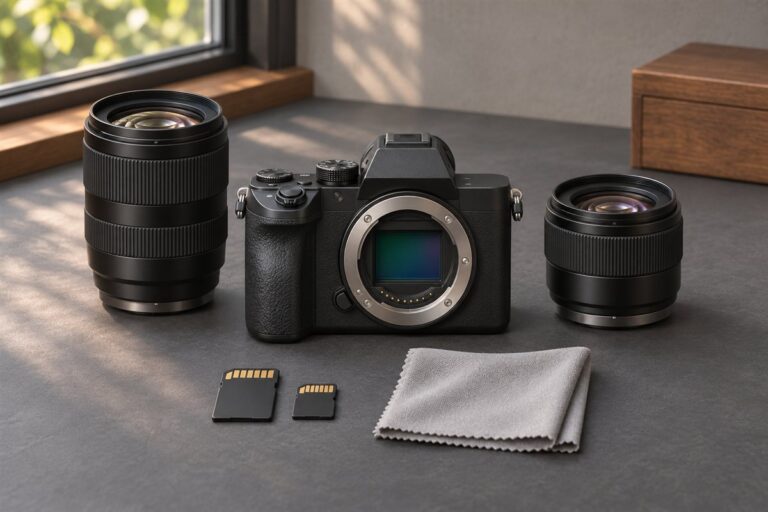
A camera holster keeps your camera at hip or chest height so it is ready without hanging from your neck. We have not used these products ourselves, so what follows draws on general knowledge and the maker’s own descriptions, not personal experience. The goal is to help you understand which holster style suits your camera and your way of working.
Think about how long you carry the camera and what else you wear: a backpack, a jacket, a belt. A holster that fits well in a studio can clash with a pack strap on a hike. The table below lists the main factors, and the specs table that follows is where you can line up candidates against your camera and lens combination. Be honest about your routine: a holster suits walking events, street outings and travel days, while a bag may remain better for studio work. Many people use both, with the holster for the active part of the day and a bag for the rest of the kit.
As an Amazon Associate we earn from qualifying purchases. Links on this site are affiliate links, and they do not change the information we give.

In this guide
Quick Picks
| Pick | Product | Best For |
|---|---|---|
| Best overall | Peak Design Capture Camera Clip V3, Black (CP-BK-3) | Fastest access from a belt or backpack strap |
| Best for all-day comfort | Cotton Carrier CCS G3 Harness for 1 Camera, Grey | Heavy camera and lens combos carried for hours |
| Best for two bodies | Cotton Carrier CCS G3 Harness for 2 Cameras, Grey | Event and wedding shooters running two cameras |
| Best weather protection | Lowepro Photo Active TLZ 45 AW (LP37345-PWW) | Top-load coverage with a built-in rain cover |
| Best for hiking and wildlife | Cotton Carrier Skout G2 Sling Harness, Realtree Xtra Camo | Hands-free carry on the trail |
Our Picks

1. Peak Design Capture Camera Clip V3, Black (CP-BK-3) — Best overall
The Capture V3 is not a bag-style holster but a rigid clip that bolts your camera to any belt or backpack strap up to 2.5 inches wide, and for pure speed of access it beats every pouch on this list. The all-metal clip is rated to hold 200 lb, locks the camera in any of four directions, and releases with a button that has a twist safety lock so it cannot pop open by accident in a crowd. The included plate is Arca-Swiss compatible, so the camera moves from clip to tripod without swapping hardware. There is no padding or weather cover, which is exactly the trade-off to weigh against the guide’s advice above: pair it with a rain shell if you shoot in bad weather. For street, travel and event shooters who keep one body ready all day, it is the reference design.


2. Cotton Carrier CCS G3 Harness for 1 Camera, Grey — Best for all-day comfort
Where a belt holster hangs all the weight on your hips, the CCS G3 is a padded vest harness that spreads the load across your shoulders and back, which is what makes it the pick for long days with a heavy body and telephoto lens. The camera rides at your side on Cotton Carrier’s patented Twist & Lock mount: drop the camera hub in, twist to lock, and it stays put until you twist and lift to draw it. A safety tether adds a second line of security. The kit includes a rain cover for the mounted camera and a hand strap, and the vest adjusts to fit over anything from a t-shirt to a winter jacket. It is bulkier than a clip, so it suits deliberate work — wildlife, weddings, sports — rather than minimal street kits.

3. Cotton Carrier CCS G3 Harness for 2 Cameras, Grey — Best for two bodies
Shooting two bodies — typically a wide zoom on one and a telephoto on the other — is where single holsters force constant bag trips. The two-camera G3 harness carries both on the same vest, one at the chest and one at the hip, each locked into its own Twist & Lock mount so you can swap between them in seconds without anything dangling from a neck strap. Both mounts use the same hub system as the single-camera version, the load stays balanced across the torso, and rain covers for both cameras are included. Wedding and event photographers are the obvious audience, but it also suits sports and wildlife shooters who alternate focal lengths. The trade-off is size: with two bodies mounted you are wearing a rig, not a strap, so try the fit with your actual lenses before a paid shoot.
View Cotton Carrier CCS G3 Harness for 2 Cameras on Amazon

4. Lowepro Photo Active TLZ 45 AW (LP37345-PWW) — Best weather protection
The TLZ 45 AW is the traditional take on a holster: a padded top-loading case that fully encloses the camera instead of leaving it exposed on a mount. It is sized for a mirrorless or DSLR body with a standard zoom attached, so the camera draws straight from the top without removing the lens. The defining feature is Lowepro’s All Weather AW Cover, a built-in rain shell that pulls over the case when the weather turns — the strongest weather answer among these picks, matching the protection criteria in the guide above. You can carry it on the included shoulder strap, thread it onto your own belt, or attach it to a larger pack, and a front pocket takes small accessories like a lens cloth and spare card. Choose it when coverage matters more than the split-second draw of an open clip.


5. Cotton Carrier Skout G2 Sling Harness, Realtree Xtra Camo — Best for hiking and wildlife
The Skout G2 is Cotton Carrier’s sling-style harness: a single camera rides at your hip on the same Twist & Lock mount as the G3 vests, but the sling form factor is lighter, cooler and easier to wear under a backpack — the combination most hikers and wildlife shooters actually need. This version wears a Realtree Xtra camo finish that blends into brush and woodland, which matters when your subjects have better eyesight than you do. The mount keeps the camera from swinging against your stride, a safety tether guards against drops, and drawing the camera is a twist and lift, quiet enough not to announce yourself. It carries one body only and leaves it exposed to the elements, so pair it with a pack cover in rain. For birders and hunters with a camera, it is the most purpose-matched pick here.

What to Look For
| Factor | Why it matters | What to check |
|---|---|---|
| Camera fit | A holster that is too loose lets the camera shift; too tight slows the draw. | Body plus lens length and any grip attached |
| Mounting method | Belt loops, clips and harness straps behave differently when you walk. | Belt width accepted, strap adjustability |
| Release system | You want a quick draw and a firm hold when moving. | Latch type, one-handed operation, lock options |
| Comfort | Edges and weight sit against the body for hours. | Padding, back panel material, weight carried |
| Lens space | Longer lenses need depth and a stable support point. | Maker’s lens length range, adjustable depth |
| Extras | Pockets for cards and batteries keep the kit together. | Pocket size, closures, loop positions |
| Pairing | Holsters often share space with bags and straps. | Compatibility with pack straps and sling styles |
Setup and Care Tips
- Fit the holster with your usual lens attached, not a smaller one.
- Practice the draw and return at home before heading out.
- Place the holster where your arm swings freely while walking.
- Keep the lens cap or hood decision consistent, since it changes fit.
- Inspect latches and stitching regularly for loosening.
Mistakes to Avoid
- Choosing by camera body alone and forgetting lens length.
- Wearing the holster high enough to hit pack straps.
- Assuming one size suits every lens you own.
- Skipping a practice session before relying on it at an event.
- Overloading side pockets until the holster tilts.
Understanding the Types of Camera Holsters
The word holster covers several quite different carry systems, and the differences matter more than brand names. Sorting the options by how they attach to your body makes the shortlist much easier to build.
Top-loading cases
A top-loading case is a padded, zippered box that hangs from a belt or strap and swallows the whole camera. The camera drops in from above, and a lid closes over it. The big advantage is protection: the body and lens are enclosed, shielded from rain, dust and knocks against doorframes. The trade-off is speed. You open a zipper or flap, lift the camera out and, when you are done, lower it back in. For a photographer who shoots in bursts and then walks for twenty minutes, that is a fair exchange. For someone who needs the camera at eye level every few seconds, it can feel slow.
Clip and plate systems
These use a small plate on the camera base and a clip on a belt or pack strap. There is no pouch at all, so the camera hangs exposed, but the draw is quick and the system packs down to almost nothing when the camera is in a bag. Because the camera is exposed, you are trusting the lock mechanism and the strap or belt it grips. Check the stated strap width range, and think about whether your usual pack strap or belt falls inside it.
Chest and hip harnesses
A harness is a vest or set of straps that carries the camera on a plate at the chest or hip. Weight spreads across both shoulders and the back instead of pulling on one hip. People who carry a heavy body with a long lens for hours tend to look at this category first, because a belt-only system concentrates all that weight in one spot. Harnesses are warmer than a clip, take longer to put on, and can conflict with a backpack chest strap, so they reward some planning.
Sling-style carriers
A sling is a single diagonal strap with a mount, so the camera rides at the hip and swings forward when needed. It is lighter and cooler than a full vest and easier to wear under or alongside a pack. It also offers less load distribution than a padded harness, so it suits moderate weights better than the heaviest telephoto setups.
Dual-camera arrangements
Some harnesses carry two bodies at once, one on each side or one high and one low. This removes lens swapping from your workflow, which is the reason event shooters use them. It also doubles the weight and the number of things that can swing into a doorway, so it is worth considering only if you actually switch between two focal lengths all day.
Matching a Holster to How You Shoot
The best choice depends on the situation more than the camera. These scenarios cover the common cases.
- Weddings and events: You change focal lengths constantly and move through crowds. Two bodies on a harness, or a clip on a belt with a second camera on a strap, keeps both ready. Choose smooth, snag-free edges, since you will be squeezing past guests in formal clothes.
- Hiking and wildlife: You walk long distances, then need a fast shot when something appears. Comfort over many hours and compatibility with a backpack hip belt come first. A sling or low-profile harness usually coexists with a pack better than a bulky pouch.
- Street and travel photography: You want the camera accessible but not conspicuous. A closed pouch or a clip worn under a jacket draws less attention than a large exposed rig, which also matters for theft in busy places.
- Weather-heavy work: Coastal, mountain and shoulder-season shooting involves rain and spray. An enclosed case, ideally with a rain cover, protects the camera between shots in a way an open mount cannot.
- Video and hybrid shooting: If you add a microphone, cage or monitor, the camera becomes bulky and may not fit a standard pouch. Measure the rigged camera, not the bare body.
- Casual days out: One small mirrorless body with a compact lens rarely needs more than a simple clip or a small pouch. Heavy gear is unnecessary here.
Weight, Balance and Comfort Over a Full Day
A camera and lens combination can weigh anywhere from a few hundred grams to several kilograms, and where that weight sits changes how tiring it is. A load hanging low on a belt tugs the waistband down and tilts the hip. A load on the chest sits close to your center of mass and can feel lighter, though it swings forward when you bend over. A load on a padded harness spreads across a broad area, which reduces pressure points.
A few practical details matter more than they look. Check whether the camera can be locked against your body to stop it swinging while you walk or climb. Look for adjustable length so the camera sits where your arm naturally reaches. If you wear glasses or a hat, test whether the camera clears your face as you lift it. If you wear a backpack, check how the straps interact, since a hip belt can push a hip-mounted camera forward and out of position.
Clothing also plays a role. A thick winter coat changes the fit of a harness, and a thin summer shirt makes pressure points more obvious. If you shoot across seasons, adjustability range is a real feature, not a footnote.
Protection, Security and Weather
A holster is also a risk decision. A camera that hangs exposed is the most accessible, and also the one exposed to rain, a bump against a rock, or a quick grab. A closed case is slower to use but safer. Neither is correct for everyone; the point is to be deliberate about the trade.
- Lock mechanisms: Quick-release plates usually include a lock that prevents accidental release. Learn how it works and use it every time, especially in crowds or on uneven ground.
- Backup attachment: A short safety tether between camera and body gives a second layer if a clip fails. Some photographers keep a conventional strap on the camera for this reason, even when using a holster.
- Rain and dust: A built-in rain cover or a separate rain sleeve is worth having if you shoot outdoors. Mounts that leave the lens exposed need a plan for wet conditions.
- Theft awareness: A camera on a clip is easy to remove in a crowded space if the lock is not engaged. In busy tourist areas, keep the camera in front of your body where you can see it.
- Hardware strength: Metal plates and bolts generally outlast plastic ones, but the stated load rating matters more than the material. Always compare the rating against your heaviest camera and lens, not the lightest.
Questions to Ask Before You Order
Before buying, run through this short list. If the product page does not answer a question, check the maker’s manual or ask the seller.
- What is the heaviest camera and lens combination I will carry, and does the stated load rating cover it with room to spare?
- What is the longest lens I use, and what lens length does the maker say fits?
- Do I wear a backpack, and will its straps or hip belt collide with the holster?
- Do I need the camera hidden from view, or is visible gear fine where I shoot?
- Can I draw and return the camera with one hand, including while wearing gloves?
- Does the product work for both my main camera and any second body I may buy later?
- What is the return policy if the fit is wrong?
The last question is not trivial. Fit depends on your build, your clothing and your habits, and it is hard to judge from a product page. A return window gives you the room to wear it around the house with your real lens attached, bend over, climb stairs and simulate a day of use before committing.
Budget vs Premium: Where the Money Goes
Price differences in holsters usually reflect materials, mechanisms and ecosystem rather than anything you would notice on a short walk. At the low end you tend to find basic pouches, simpler stitching and plastic hardware. They can be perfectly fine for a light mirrorless camera and occasional use. As prices rise, the extras become more specific: metal mounting plates, tougher fabrics, padded back panels, weather covers, and compatibility with other accessories from the same maker.
The ecosystem point deserves attention. Many holster systems use a proprietary plate or mount, and if you later add a harness, a strap or a second body, you may want parts that fit together. Buying into one system can make later upgrades cheaper and simpler. Mixing systems is possible but less tidy.
A sensible rule is to spend more where failure is costly. The part that holds a heavy camera over rocks or a crowd is not the place to economize, while the pouch for batteries and cards is. If your camera and lens together cost far more than the carry system, a sturdier mount is cheap insurance.
It also helps to think about how often you will use it. A holster used weekly for years justifies better construction than one that comes out for an annual trip. If you are unsure, begin with a simpler option and note what bothers you. Those complaints tell you exactly what to pay for in the next one.
Going Deeper: Carrying a Camera on Your Body, All Day
A camera holster or harness is judged in the fourth hour, not the first four minutes. The Peak Design Capture Camera Clip V3 in this guide represents the plate-and-clip philosophy: the camera locks to a belt or strap, rides tight against the body, and releases with a deliberate press when the moment arrives. The Cotton Carrier CCS G3 harness systems take the opposite approach, spreading the camera’s weight across the torso through a vest-style harness, in one-camera and two-camera versions for working photographers. The Lowepro Photo Active TLZ 45 AW is the classic top-loading holster case, protective and weather-aware, carried on a belt or shoulder strap. The Cotton Carrier Skout G2 sling harness, in its outdoor finish, splits the difference for hikers and wildlife photographers. Choosing between them is choosing how your body will carry weight, how fast the camera must come to hand, and what kind of day — wedding, trail, street, event — the system must survive.
Weight distribution is the science underneath all of it. A camera hanging from a neck strap concentrates its load on the cervical spine and swings as you walk; a camera on a hip belt transfers the load to the pelvis, where the body is built to carry it; a harness spreads it across the shoulders and back and holds the camera against the chest, still and instantly reachable. Photographers who work weddings, events and trails all day feel these differences in their bodies by evening, and the honest test of any system is a full working day, not a shop demonstration. Load the system with your real camera and your longest lens, walk, bend, climb stairs and sit down, and notice where the pressure lives. The right system disappears; the wrong one becomes the day’s main event.
Security: The Camera Must Stay Put Until You Decide Otherwise
Every carry system in this guide is also a security system, and its locking behaviour deserves deliberate testing. A clip or holster must hold the camera through the day’s accidents — the brushed doorway, the bent-over lens change, the jog to catch a moment — and release only on a deliberate action that you can perform without looking. Practise the release until it is muscle memory, and practise it with gloves if your photography happens in winter. Equally, practise the failure: know what the system feels like when the camera is not fully seated, because the half-latched camera is the one that falls. Photographers who build these checks into their first week with a new system keep their cameras for decades; the systems themselves, from all the makers here, are engineered to reward exactly that care.
Two-camera carrying, the Cotton Carrier G3 two-body harness’s whole purpose, is a working professional’s discipline of its own. Weddings and events reward the photographer who carries a wide body and a telephoto body simultaneously, because lens changes during a ceremony are missed moments wearing a disguise. The discipline is choreography: which body is drawn first, how the second rides without swinging into pews and doorframes, and how both are secured when you kneel, climb or hug a bride’s grandmother. Rehearse the choreography at home before the first paid day, because a harness full of cameras is a system, and systems are learned in private so they can be trusted in public.
Choosing Between the Picks in This Guide
The Peak Design Capture Clip is the minimalist’s answer and the guide’s best overall for a reason: it adds almost nothing to your outfit, works with the belt or bag strap you already wear, and suits the photographer whose carrying problem is a single camera that must vanish until needed. Choose it for travel, street and everyday carrying where a harness would be theatre. The Cotton Carrier G3 one-camera harness is the comfort choice for long days with heavier bodies — weddings, wildlife walks, events — where the torso carry repays its presence every hour. The two-camera G3 is the professional event photographer’s rig, worth its complexity exactly when a second body earns money rather than merely adding weight.
The Lowepro Photo Active TLZ 45 AW is the protective holster for the photographer who wants the camera enclosed — weather kept out, knocks absorbed, the camera carried on belt or shoulder with a case’s reassurance — and who accepts a slightly slower draw as the price of that shelter. The Cotton Carrier Skout G2 serves the hiker and wildlife photographer who moves over distance and ground: a sling harness that keeps the camera stable against the body while walking and ready when the animal appears. Five systems, five honest answers to the questions of weight, speed, protection and company. Your working day picks the winner.
Weather, Movement and the Small Disciplines
Carry systems meet weather differently. An exposed camera on a clip or harness is ready instantly and rained on equally instantly, so the outdoor photographer’s kit includes a simple rain cover for the camera and a plan for shelter that can be executed one-handed. The enclosed holster trades a little speed for built-in shelter, which is why the Lowepro’s all-weather design keeps its following among photographers whose days are spent outdoors regardless of forecast. Movement matters as much: a camera that swings will eventually strike something, so adjust whatever system you choose until the camera rides still at a jog, and re-check the adjustment when you change coats, because winter layers change every measurement your summer setup relied on.
Finally, build the small disciplines that keep carried cameras safe: a wrist or safety tether as a second line of defence during lens changes over hard ground or water, a lens cap habit that survives excitement, and a nightly wipe-down of the camera that rode against your body through dust, sweat and weather. Carry systems are simple equipment, and their failures are almost always failures of habit rather than engineering — which is good news, because habits are free to fix.
More Questions Carry-System Buyers Ask
Will a clip or harness work with my existing belts and bag straps?
Clip systems are designed to clamp to belts and straps within a stated thickness range, so check your most-used belt and your camera bag’s straps against that range before buying. Harness systems are self-contained and work over whatever you wear, though very bulky winter clothing changes the fit and should be part of your test at home.
Is a harness comfortable in hot weather?
It is warmer than a bare strap, because it covers more of the torso, and photographers in hot climates weigh that honestly against its weight distribution. Breathable designs and lighter clothing underneath help, and many event photographers accept the warmth as the price of an unaching back at midnight. Your climate and your working hours decide whether that trade favours you.
Can I carry a camera with a long lens on these systems?
Within each system’s stated capacity, yes, but long lenses change the physics: the load sits further from the body, swings more, and demands the harness-style carry or a supporting hand while walking. Test with your longest lens fitted, at a walk and on stairs, and let that honest trial — not the specification — decide.
How do I keep the camera from swinging when I bend down?
Fit first: a correctly adjusted harness or a well-placed clip holds the camera close enough that bending is uneventful. Add the photographer’s reflex of a steadying hand when you bend over anything precious or hard, and consider where the camera rides — chest-centred systems behave better in this respect than hip-mounted ones for frequent bending work.
What is the best system for a wedding photographer?
The one that matches the day’s body count. A single-body shooter is served beautifully by the Capture Clip or the one-camera harness; the two-body professional’s answer in this guide is the two-camera G3, rehearsed until the choreography is invisible. Either way, comfort across a twelve-hour day outranks every other feature, because tired photographers make tired pictures.
Trail, Street and Ceremony: Three Carrying Days Compared
It clarifies everything to walk these systems through three real days. On the trail, the day is distance: hours of walking where the camera must ride still, survive weather, and arrive at the viewpoint with its owner unfatigued. The Skout G2’s sling harness and the enclosed protection of the Lowepro holster speak directly to that day, one through stability in motion, the other through shelter. On the street, the day is invisibility and speed: the camera should read as part of your clothing, come to hand in a breath, and disappear again before the scene notices it. The Capture Clip owns that day, because it adds no visible apparatus at all. At the ceremony, the day is endurance and choreography: two bodies, formal clothes, twelve hours, no second chances. The G3 harnesses own that day, because they were designed backwards from it. Most photographers’ lives contain all three days in some proportion, which is why the honest purchase is the system that serves your most frequent day superbly and your rare days adequately — not the reverse.
There is also the matter of what these systems do to your photography itself, beyond comfort. A camera that is always on your body, instantly available, changes what you photograph: the unplanned moment on the walk between locations, the candid at the edge of the event, the wildlife that appears for four seconds on a bend in the trail. Photographers consistently report that moving from a bag to a body-carry system increases the number of photographs they take that they actually love, because the camera stopped being luggage and became clothing. That effect is the deepest argument in this entire category, and it applies to every system here — clip, holster and harness alike — provided the system is comfortable enough to be worn without negotiation. Comfort, once again, is not a luxury feature. It is the mechanism by which the photographs happen.
Fitting and Adjusting: The Half Hour That Decides Everything
Whatever system you choose, invest its first half hour in fitting rather than photographing. Adjust straps in the order the maker intends, with your real camera fitted and your real clothing on, and then run the day’s movements in miniature: walk briskly, climb stairs, bend, kneel, sit, reach overhead. Note every place the system pulls, swings or digs, and adjust once, deliberately, rather than tolerating and re-tolerating. Photograph the final strap positions with your phone so the fit can be rebuilt after the system is washed, lent or adjusted for winter layers. That half hour, spent once, is the difference between a carry system that is praised for years and one that is sold within the season — and it costs nothing but the decision to take fitting seriously as part of the purchase.
Care and Inspection: Five Minutes a Month
Carry systems fail rarely and announce their intentions early to owners who look. Once a month, inspect the load-bearing points with the seriousness they deserve: stitching where straps meet hardware, the clip’s locking surfaces for grit and wear, harness buckles for cracks, holster zips for smooth travel. Clean grit out of any locking mechanism with a soft brush, because the same dust your camera shrugs off can compromise a latch. Check that screws and mounting plates remain tight — vibration loosens them across a season of walking — and replace any strap that shows fraying at a load point rather than admiring its service record. This is five minutes of attention in exchange for the certainty that the system holding your camera over concrete, water and stairwells is in the condition its maker intended. Photographers insure their cameras and maintain their lenses; the thing that physically holds both deserves its line in the same routine.
Hold the whole category against that standard of care and the choice simplifies into a single question: which of these systems will you still be wearing, gladly and without thought, at hour ten of your longest real day? The Capture Clip answers for the minimalist, the G3 harnesses for the professional whose day is measured in ceremonies, the Lowepro holster for the photographer who wants shelter with the carry, and the Skout for the walker whose studio is a trail. Fit yours properly, inspect it monthly, rehearse its release until your hands know it in the dark, and it will do the one job that justifies every strap and buckle — it will make the camera feel like part of you, present for every moment the day offers.
Part of you is not a metaphor in this category; it is the literal design goal, and the photographers who achieve it stop thinking about carrying altogether. Their attention goes where it belongs — to light, to people, to the trail ahead — while the camera rides, silent and certain, exactly where their hands expect it to be. That is the state every product in this guide is engineered to produce, each by its own route, and it is worth choosing carefully, fitting patiently and maintaining faithfully, because once you have photographed a full day in that state, no lesser way of carrying a camera ever feels acceptable again.
So choose the system that fits your longest day, not your shortest errand, and give it the fitting half hour and the monthly five minutes it asks for. In exchange it will give you back your neck, your shoulders and your attention — and, across a season of weddings, trails and street days, a quiet pile of photographs that exist only because the camera was there, on your body, ready in the second the moment asked for it.
Those photographs are the final argument, and they are unanswerable. Every carry system ever sold is ultimately judged in an album, not in a shop — in the frames that exist because carrying stopped being a problem. Work backwards from the album you want, choose the system that serves it, and the straps and clips in this guide will disappear into what they were always meant to be: the invisible infrastructure of a photographer’s day.
Invisible infrastructure, faithfully worn, is a fine ambition for any piece of equipment — and an achievable one, starting with the fitting session you schedule the day your chosen system arrives.
Schedule it, run it honestly, and then go and make the photographs the system was bought to enable.
Starting with the very next day you carry a camera anywhere at all.
Which is probably tomorrow.
Be ready for it.
Camera in hand.
Always.
Truly.
Yes.
Go.
FAQ
Is a holster better than a neck strap?
They serve different needs. A holster takes weight off the neck and shoulders while you walk, and a strap is simpler for casual shooting. Many photographers combine the two, using a strap as a backup while the camera rests in the holster during longer walks.
Can a holster carry a camera with a large lens?
Some are made for it, but fit varies. Check the maker’s stated lens length range and consider a chest style for heavier combinations.
Where should a camera holster sit on your body?
It depends on the style. Hip placement keeps the camera out of the way while walking, and chest placement keeps it steadier and easier to reach with both hands. Pick the spot where your arm reaches the camera without lifting it past your pack straps, and check that it clears your belt buckle and backpack hip belt.
Will a camera holster work with a backpack?
Often yes, but not always. A pack hip belt or chest strap can push a hip-mounted camera out of position or block the draw. Sling and clip styles generally pair better with packs than bulky pouches. Try the combination with your loaded pack before relying on it, ideally while the return window is still open.
Are camera clips safe for expensive cameras?
They can be, provided you use the lock every time and stay within the stated load rating. The risks are an unlocked release, a strap or belt that is too wide or thin for the clip, and a bump against a hard surface. Many photographers add a backup strap or tether for extra security.
Can I carry a camera with a battery grip in a holster?
Only if the holster is sized for it. A grip adds height and width, which can make a snug pouch unusable and shift the balance on a mount. Check the maker’s stated body dimensions, then measure your camera with the grip and the lens you normally use attached.
How do I stop a camera from swinging while I walk?
Use a lock or strap that anchors it to your body, and place it where your arm does not hit it. Chest-mounted and harness styles usually move less than a hip clip. Tightening the adjustable straps and avoiding overloaded side pockets also helps keep the camera stable on uneven ground.
The Short Version
A good camera holster fits your body and lens combination, releases quickly and stays stable as you move. Check dimensions against your own kit and practice the draw before trusting it in the field. Comfort over a full day matters as much as the draw, so look closely at back panel padding and belt or strap adjustment.
Related Guides
- 6 Best Belt Clips and Holsters For Cell Phones (October 2026)
- How to Choose the Best Camera Bags: Buyer's Guide (2026)
- How to Choose the Best Camera Pouches: Buyer's Guide (2026)
- How to Choose the Best Camera Speedlights: Buyer's Guide (2026)
- How to Choose the Best Camera Stabilizers: Buyer's Guide (2026)