The best 1080 TV antennas are indoor and outdoor antennas rated to receive local broadcast channels in 1080p full HD, with no monthly bill and no streaming subscription. A 1080 TV antenna picks up the free over-the-air signals broadcast by local stations, and a television with a digital tuner turns those signals into the same local news, sport and network shows that cable carries, in the 1080p resolution the stations transmit. The six antennas in this guide all state 1080p support in their listing titles, and every one of them is a genuine listing from the product search, with the brand and the model stated.
The six antennas in this guide are the GE 33681, a flat panel indoor antenna with extendable rabbit ears and a 5ft coax cable; the GE 33675, a modern loop rabbit ears tabletop antenna with 15 inch extendable dipoles and a 4ft coaxial cable; the GE 29884, an outdoor antenna with a J mount for attic or outdoor fitting that is weather resistant; the GE 37075, a Hover amplified antenna that mounts on top of the television with a built-in signal booster and a 5ft coax cable; the Philips SDV7219N/27, a Hover amplified antenna with a signal booster, coax cable and AC adapter; and the GE 48862, an ultra-thin amplified antenna with an LTE filter and a reversible black and white finish.
An antenna suits a household that wants local channels without paying for them every month. A second television in a bedroom, a kitchen television, a television in a holiday home, or a main television in a household that has dropped cable all benefit from an antenna, because the local channels are free once the antenna is bought. The antenna does not replace a streaming service for films and series, but it covers the live local channels that streaming services often charge extra for, and it keeps working during an internet outage.
The choice that matters most is where the antenna will live. An indoor antenna suits a household close to the transmitters, where a flat panel or a rabbit ears antenna on top of or beside the television is enough. An outdoor antenna suits a household further from the transmitters, where height and a clear view matter more than convenience, and the GE 29884 in this guide is the outdoor pick. An amplified antenna suits a household on the edge of reception, where a booster lifts a weak signal into something the television can lock onto.
This guide treats the 1080p rating as the starting point, not the whole story. The picks are described with the facts stated in their listing titles, the buying guide explains how to place an antenna and how to scan for channels, and the mistakes section covers the errors that leave buyers with a blank screen, including buying an antenna for the wrong band, placing it behind the television, and forgetting to rescan after moving it.
In this guide
Quick picks: best 1080 tv antennas
| # | Product | Where to buy |
|---|---|---|
| 1 | GE 33681 | Check on Amazon |
| 2 | GE 33675 | Check on Amazon |
| 3 | GE 29884 | Check on Amazon |
| 4 | GE 37075 | Check on Amazon |
| 5 | Philips SDV7219N/27 | Check on Amazon |
| 6 | GE 48862 | Check on Amazon |
How the picks were chosen for the best 1080 TV antennas
The picks were chosen from the product listings returned by the site product search, and only antennas that state 1080p support in their titles made the list. Every listing title was checked for the resolution, and antennas that stated no resolution were excluded even when they appeared in the same search results, because the article is about 1080 TV antennas, and a buyer searching for this kind needs an antenna rated for the 1080p signals local stations transmit. Listings for antenna accessories, such as amplifiers sold on their own, were also excluded, because the article is about antennas, not parts.
The second filter was the brand and the model. Every pick is a new listing from a named brand, with the model stated in the title: GE 33681, GE 33675, GE 29884, GE 37075, Philips SDV7219N/27 and GE 48862. Listings with no brand in the title were excluded, and listings whose titles named a different model were excluded too. An antenna was only linked when its brand and its model both matched the listing, and a listing that stated a different model in its title was not used as a substitute.
The third filter was variety. The guide covers indoor antennas and one outdoor antenna, flat panel and rabbit ears designs, amplified and unamplified models, and tabletop and mount-on-top designs, so a buyer can compare them side by side. It covers two brands, GE and Philips, and it covers the antenna that suits a flat near the transmitters as well as the antenna that suits a house further out. An antenna that appeared twice under two listings was counted once, because the article is about six different antennas, not six listings of the same antenna.
What makes a 1080 TV antenna good
The first quality that matters is the band the antenna receives. Local broadcast channels transmit on VHF and UHF, and an antenna that covers both bands picks up the whole local lineup, while an antenna that covers only one band misses the channels on the other. Every pick in this guide states VHF UHF in its title, which is why they are here: the GE 33681, the GE 33675, the GE 29884, the GE 37075, the Philips SDV7219N/27 and the GE 48862 all cover both bands, so a buyer does not need to know which band a favourite channel uses before buying.
The second quality is the design, because it decides where the antenna can go. A flat panel antenna sits against a wall or a window and suits a household that wants the antenna out of sight, while a rabbit ears antenna with extendable dipoles suits a household that wants to adjust the elements by hand until the picture is clear. A Hover antenna mounts on top of the television and suits a household that wants the antenna and the television in one place, and an outdoor antenna with a J mount suits a household that needs height, because height is the single biggest factor in reception once the antenna itself is good.
The third quality is amplification, and it is a double-edged one. An amplified antenna carries a signal booster that lifts a weak signal, which helps a household on the edge of reception, and three of the picks in this guide are amplified: the GE 37075, the Philips SDV7219N/27 and the GE 48862. Amplification does not create a signal where there is none, and it can overload a strong signal close to the transmitters, so a buyer near the transmitters should choose an unamplified antenna, while a buyer further out should choose an amplified one.
Indoor, outdoor and amplified antennas, and how to choose
Indoor antennas are the simple kind: the GE 33681, the GE 33675, the GE 37075, the Philips SDV7219N/27 and the GE 48862 all sit inside the home, beside or on top of the television. Their advantage is that they are fitted in minutes with no tools and no climbing, and they can be moved around the room until the picture is clear. Their trade-off is range, because walls and roofs weaken the signal, and a household far from the transmitters may find an indoor antenna is not enough, however good it is.
Outdoor antennas are the long-range kind: the GE 29884 in this guide is the only outdoor pick, and it comes with a J mount for attic or outdoor fitting and is weather resistant. Its advantage is height and a clear view, which matter more than any other factor once the signal is weak, and an outdoor antenna will often pick up channels that no indoor antenna in the same house can find. Its trade-off is the fitting, because it needs a mount, a cable run, and a safe place to put it, and it is the wrong choice for a rented flat where drilling is not allowed.
Amplified antennas are the edge-of-reception kind: the GE 37075, the Philips SDV7219N/27 and the GE 48862 all carry a signal booster. Their advantage is that they lift a weak signal into something the television can use, and the GE 48862 adds an LTE filter, which blocks interference from nearby mobile signals. Their trade-off is that amplification can make a strong signal worse, so a buyer who lives close to the transmitters should start with an unamplified antenna and only add amplification if the picture breaks up.
Quick picks at a glance
| Antenna | Design | 1080p / Bands | Best for |
|---|---|---|---|
| GE 33681 | Flat panel indoor | 1080p, VHF UHF | A neat indoor antenna |
| GE 33675 | Loop rabbit ears, tabletop | 1080p, VHF UHF | A classic tabletop antenna |
| GE 29884 | Outdoor, J mount | 1080p, VHF UHF | Long-range outdoor reception |
| GE 37075 | Hover, mounts on TV | 1080p, VHF UHF | An amplified antenna on the TV |
| Philips SDV7219N/27 | Hover, mounts on TV | 1080p, VHF UHF | A Philips amplified antenna |
| GE 48862 | Ultra-thin indoor | 1080p, UHF VHF | A discreet amplified antenna |
The best 1080 TV antennas
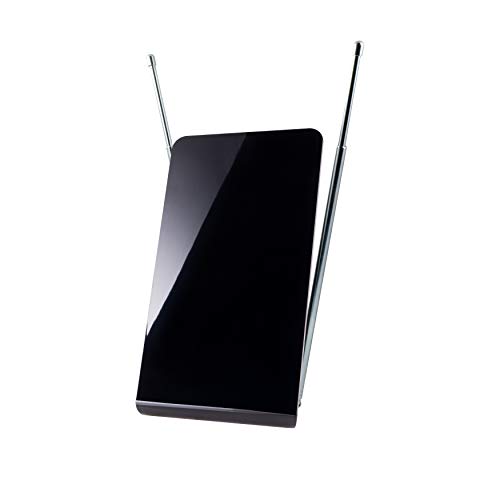
GE Flat Panel Indoor HD Digital TV Antenna 33681
The GE 33681 is the flat panel pick in this guide. The listing title states the brand GE, a flat panel indoor HD digital TV antenna, long range reception, support for 4K 1080P HD smart TV signals on VHF UHF, extendable dipole rabbit ears, an adjustable stand, and a 5ft coax HDTV cable, with the model 33681. It is the pick for a buyer who wants an indoor antenna that sits neatly beside the television and can be adjusted by hand.
A flat panel design suits a household that wants the antenna out of the way. It stands on its adjustable stand beside the television or on a shelf, and the extendable dipole rabbit ears give the buyer something to adjust when a channel breaks up, which a fixed panel cannot offer. The 5ft coax cable is long enough to reach the television from a shelf or a window sill, and the long range claim in the title means it is built to pull in signals from further out than a basic indoor antenna.
Key specs:
- Brand and model: GE 33681
- Design: flat panel indoor, adjustable stand
- Resolution: supports 4K 1080P HD
- Bands: VHF UHF
- Cable: 5ft coax HDTV cable
- Elements: extendable dipole rabbit ears
Strengths:
- Flat panel design sits neatly beside a television
- Extendable rabbit ears allow fine adjustment by hand
- 5ft coax cable gives flexible placement
Trade-offs:
- Indoor design has less range than an outdoor antenna
- Title states no amplifier, so weak signals may break up
- Flat panel needs a clear spot near the television
The GE 33681 fits the buyer who wants a neat indoor antenna with adjustable rabbit ears, or the buyer fitting a second television in a bedroom. It is the pick for a flat or a house close to the transmitters where an indoor antenna is enough.
Best for: a neat indoor antenna with rabbit ears to adjust by hand. Not suited for: a house far from the transmitters that needs an outdoor antenna.
Check price on Amazon: GE 33681
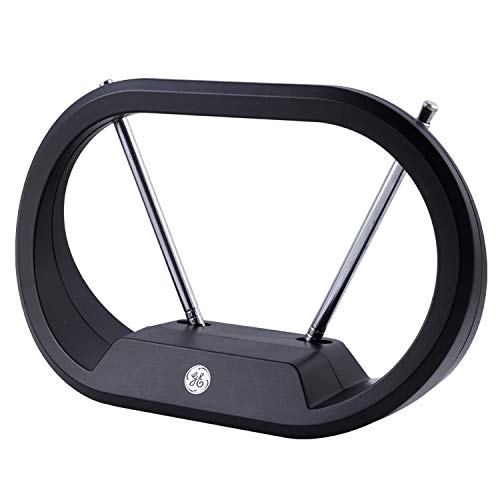
GE Modern Loop Rabbit Ears Indoor TV Antenna 33675
The GE 33675 is the classic tabletop pick in this guide. The listing title states the brand GE, a modern loop rabbit ears indoor TV antenna, 15 inch extendable dipoles, support for 4K 1080P VHF UHF, a tabletop design, digital HDTV reception, smart TV compatibility, and a 4ft coaxial cable, with the model 33675, in black. It is the pick for a buyer who wants the familiar rabbit ears design in a modern form.
A loop and dipole design suits a household that likes to tune by hand. The 15 inch extendable dipoles can be lengthened or shortened and angled until the picture clears, and the loop handles the UHF channels while the dipoles handle VHF, so the two elements together cover the whole local lineup. The tabletop design means it sits on the television stand with no fitting at all, and the 4ft coaxial cable reaches the television from the same stand.
Key specs:
- Brand and model: GE 33675
- Design: modern loop rabbit ears, tabletop
- Dipoles: 15 inch extendable
- Resolution: supports 4K 1080P
- Bands: VHF UHF
- Cable: 4ft coaxial cable
- Colour: black
Strengths:
- Loop plus dipoles cover both VHF and UHF
- 15 inch extendable dipoles allow fine tuning
- Tabletop design needs no fitting at all
Trade-offs:
- Indoor design has less range than an outdoor antenna
- Title states no amplifier, so weak signals may break up
- 4ft cable is shorter than the 5ft cables of other picks
The GE 33675 fits the buyer who wants a classic rabbit ears antenna for a tabletop, or the buyer who likes to tune the elements by hand. It is the pick for a television stand in a home close to the transmitters.
Best for: a classic tabletop rabbit ears antenna that tunes by hand. Not suited for: a house far from the transmitters that needs height or amplification.
Check price on Amazon: GE 33675

GE Outdoor HD Digital TV Antenna 29884
The GE 29884 is the outdoor pick in this guide, and the only outdoor antenna of the six. The listing title states the brand GE, an outdoor HD digital TV antenna, long range reception, support for 4K 1080P HD smart TV signals on VHF UHF, a J mount included for attic or outdoor fitting, and a weather resistant build, with the model 29884. It is the pick for a buyer who needs height and a clear view to pull in distant channels.
An outdoor antenna suits a household that an indoor antenna cannot serve. Mounted on a J mount outside the house or in the attic, it sits above the roofline or at least above the walls that weaken the signal indoors, and the weather resistant build means it can stay outside in rain and wind. The attic option matters for households that cannot mount outside, because an attic is higher than any room and still under the roof, which is often enough to turn a broken picture into a clear one.
Key specs:
- Brand and model: GE 29884
- Design: outdoor, J mount included
- Fitting: attic or outdoor
- Resolution: supports 4K 1080P HD
- Bands: VHF UHF
- Build: weather resistant
Strengths:
- Outdoor mounting gives the longest range in the guide
- J mount included for attic or outdoor fitting
- Weather resistant build stays outside in all seasons
Trade-offs:
- Needs a mount and a cable run, unlike an indoor antenna
- Fitting takes longer and may need a ladder
- Wrong choice for a rented flat where drilling is not allowed
The GE 29884 fits the buyer whose indoor antenna cannot find the channels, or the buyer in a house far from the transmitters. It is the pick for a permanent fitting on a house that needs the longest range.
Best for: a house far from the transmitters that needs an outdoor antenna. Not suited for: a rented flat or a bedroom television that needs a simple indoor antenna.
Check price on Amazon: GE 29884

GE Hover Amplified HD Digital TV Antenna 37075
The GE 37075 is the amplified Hover pick in this guide. The listing title states the brand GE, a Hover amplified HD digital TV antenna, an easy mount on top design, long range reception, support for 4K 1080P HDTV signals on VHF UHF, an indoor amplified signal booster, and a 5ft coax cable, with the model 37075. It is the pick for a buyer on the edge of reception who wants the antenna and the television in one place.
A Hover design suits a household that wants the antenna out of the way without losing it. It mounts on top of the television, so it sits high in the room and close to the set, and the amplified signal booster lifts a weak signal into something the tuner can lock onto. The 5ft coax cable gives enough length to reach the television input from the top of the set, and the mount-on-top design means there is no stand to find room for on a crowded television stand.
Key specs:
- Brand and model: GE 37075
- Design: Hover, easy mount on top of TV
- Amplifier: indoor amplified signal booster
- Resolution: supports 4K 1080P HDTV
- Bands: VHF UHF
- Cable: 5ft coax cable
Strengths:
- Amplified booster helps on the edge of reception
- Mounts on top of the television, saving stand space
- 5ft coax cable gives flexible placement
Trade-offs:
- Amplification can overload a strong signal close to the transmitters
- Needs power for the booster, unlike an unamplified antenna
- Mount-on-top design suits flat televisions best
The GE 37075 fits the buyer on the edge of reception who wants an amplified antenna on top of the television. It is the pick for a living room television where the signal is weak but not absent.
Best for: an amplified antenna that mounts on top of the television. Not suited for: a household close to the transmitters with a strong signal.
Check price on Amazon: GE 37075

Philips Hover Amplified HD TV Antenna SDV7219N/27
The Philips SDV7219N/27 is the Philips pick in this guide, and the second Hover antenna of the six. The listing title states the brand Philips, a Hover amplified HD TV antenna, an easy mount on top of TV design, long range reception, support for 4K 1080P HD signals on VHF UHF, a signal booster, and a coax HDTV cable with an AC adapter, with the model SDV7219N/27. It is the pick for a buyer who wants a Philips amplified antenna with everything in the box.
A Hover design from Philips suits a household that wants the same mount-on-top convenience as the GE 37075 with a different brand behind it. It mounts on top of the television, it carries a signal booster for weak reception, and it comes with a coax cable and an AC adapter, so the booster has its power supply included and there is nothing extra to buy. The long range claim in the title means it is built for households further from the transmitters than a basic indoor antenna can serve.
Key specs:
- Brand and model: Philips SDV7219N/27
- Design: Hover, easy mount on top of TV
- Amplifier: signal booster
- Resolution: supports 4K 1080P HD
- Bands: VHF UHF
- Included: coax HDTV cable, AC adapter
Strengths:
- Signal booster included for weak reception
- AC adapter included, so nothing extra to buy
- Mounts on top of the television, saving stand space
Trade-offs:
- Amplification can overload a strong signal close to the transmitters
- Needs power for the booster, unlike an unamplified antenna
- Hover design suits flat televisions best
The Philips SDV7219N/27 fits the buyer who wants a Philips amplified antenna that mounts on top of the television, or the buyer who wants the booster power supply in the box. It is the pick for a living room television on the edge of reception.
Best for: a Philips amplified antenna with the power supply included. Not suited for: a household close to the transmitters with a strong signal.
Check price on Amazon: Philips SDV7219N/27

GE Ultra-Thin Amplified TV Antenna 48862
The GE 48862 is the ultra-thin pick in this guide. The listing title states the brand GE, an ultra-thin amplified TV antenna, 4K Ready 1080P digital HDTV reception on UHF VHF, long range indoor reception, an amplifier with an LTE filter, and a reversible black and white finish, with the model 48862. It is the pick for a buyer who wants an amplified antenna that disappears against a wall.
An ultra-thin design suits a household that wants the antenna out of sight. It sticks to a wall or a window, and the reversible black and white finish means it can face out in white against a light wall or in black against a dark one, so it blends in rather than standing out. The amplifier with an LTE filter is the feature that sets it apart: the filter blocks interference from nearby mobile signals, which can break up a television picture in homes close to a mobile mast, and that makes it the pick for a household where the picture breaks up for no clear reason.
Key specs:
- Brand and model: GE 48862
- Design: ultra-thin indoor
- Amplifier: amplifier with LTE filter
- Resolution: 4K Ready 1080P
- Bands: UHF VHF
- Finish: reversible black and white
Strengths:
- Ultra-thin design disappears against a wall or window
- LTE filter blocks interference from mobile signals
- Reversible black and white finish suits any room
Trade-offs:
- Amplification can overload a strong signal close to the transmitters
- Needs power for the amplifier, unlike an unamplified antenna
- Thin design gives nothing to adjust by hand
The GE 48862 fits the buyer who wants a discreet amplified antenna on a wall, or the buyer whose picture breaks up near a mobile mast. It is the pick for a modern living room where the antenna should not be seen.
Best for: a discreet amplified antenna with an LTE filter. Not suited for: a household close to the transmitters with a strong signal.
Check price on Amazon: GE 48862
How to buy a 1080 TV antenna
Check what is broadcast where you live
Before buying, a buyer should find out which channels are broadcast from the nearest transmitters and how far away they are. A household close to the transmitters can use any indoor antenna in this guide, while a household far away needs an outdoor antenna or an amplified one, and a household with transmitters in different directions needs a multi-directional antenna rather than one that must be aimed. The VHF UHF coverage of every pick in this guide means the band is covered either way, but the distance decides the design.
A buyer should also check whether the television has a digital tuner, because an antenna is useless without one. Most flat televisions sold in the last decade have a tuner built in, but a monitor used as a television, or a very old set, may not, and then the buyer needs a tuner box between the antenna and the screen. The antenna connects to the tuner with a coax cable, and every pick in this guide either includes a coax cable or states one in its title, except the GE 29884 outdoor antenna, which needs a cable run of its own.
Place the antenna high and rescan
An antenna works best high up and near a window, because walls and roofs weaken the signal and a window lets it through. An indoor antenna should go on a high shelf or a window sill rather than behind the television, where the set itself blocks the signal, and a flat panel antenna should face the transmitters rather than the wall. After placing it, the buyer must run a channel scan on the television, because the set only finds channels when it is told to look, and it will not find new ones on its own.
If the scan finds few channels, the buyer should move the antenna and scan again. A move of a metre can make the difference between a clear picture and a broken one, because signals bounce off walls and cancel each other out in some spots. An amplified antenna should only be tried after an unamplified one fails, because amplification can overload a strong signal, and the GE 48862 with its LTE filter is the pick to try when the picture breaks up near a mobile mast.
Indoor or outdoor, amplified or not
The choice comes down to three questions: how far are the transmitters, is there a clear view, and can anything be mounted outside. A household close to the transmitters should choose an indoor unamplified antenna such as the GE 33681 or the GE 33675. A household on the edge of reception should choose an amplified indoor antenna such as the GE 37075, the Philips SDV7219N/27 or the GE 48862. A household far from the transmitters should choose the outdoor GE 29884, because no indoor antenna can beat height and a clear view.
A buyer who rents should choose an indoor antenna, because an outdoor antenna needs a mount and a cable run that a landlord may not allow. A buyer who owns the house and wants the most channels should choose the outdoor antenna, because it is the only pick that can be mounted above the roofline, and the difference in reception is often dramatic.
Using and caring for a TV antenna
Keep the antenna still once it works
Once an antenna finds the channels, it should be left alone. A nudge to dust the shelf can move it just enough to lose a channel, and the buyer will only notice when a favourite show breaks up. If the antenna must be moved, the television should be rescanned afterwards, because the set remembers the channels it found in the old position, not the ones available in the new one.
An outdoor antenna should be checked once a year, after winter, to make sure the mount is tight and the cable is not damaged. The GE 29884 is weather resistant, but no antenna is proof against a storm, and a loose mount will slowly turn in the wind until the channels fade. A cable that has cracked in the sun should be replaced, because water in a coax cable ruins reception long before the antenna itself fails.
Rescan after changes
A buyer should rescan for channels whenever something changes: after moving the antenna, after a new transmitter opens, or after a storm. Local stations sometimes move channels, and a television that has not been rescanned will keep showing the old channel list, which slowly goes out of date. A rescan takes a few minutes and costs nothing, and it is the first thing to try when a channel disappears.
Common mistakes with 1080 TV antennas
Buying an antenna for the wrong band
The most common mistake is buying an antenna that covers only one band, then wondering why half the channels are missing. Every pick in this guide covers VHF and UHF, which is why they are here, but a buyer who shops elsewhere should check the bands before buying, because a UHF-only antenna will miss the VHF channels and a VHF-only antenna will miss the UHF ones.
Placing the antenna behind the television
The second mistake is placing the antenna behind the television, where the set blocks the signal and the metal in the set reflects it. An antenna belongs high and near a window, not hidden behind the screen, and a buyer who hides it for the sake of tidiness will pay for it with a broken picture. The GE 48862 is the pick for a buyer who wants discretion, because it sticks to a wall and blends in, rather than hiding behind the set.
Forgetting to rescan
The third mistake is forgetting to rescan after fitting or moving the antenna. A television does not find channels on its own, and an antenna fitted without a scan will show nothing at all, which looks like a broken antenna but is only an unscanned television. Every fitting and every move should end with a channel scan.
Our recommendation for the best 1080 TV antennas
For most households, the GE 33681 is the recommendation: a flat panel indoor antenna with extendable rabbit ears, 1080p support on VHF UHF, and a 5ft coax cable, which covers the common case of a home close to the transmitters with no fitting needed. It is the simplest pick in the guide, and the simplest pick is the right one when the signal is strong.
For a household on the edge of reception, the GE 48862 is the recommendation: an ultra-thin amplified antenna with an LTE filter and a reversible black and white finish, which lifts a weak signal and blocks mobile interference while disappearing against a wall. For a household far from the transmitters, the GE 29884 is the recommendation, because only an outdoor antenna with a J mount can beat height and a clear view.
Related reading on Reviewstook: see our guides to TV antennas rated by Consumer Reports, TV antenna guide, indoor TV antennas for more on this topic.
Frequently asked questions about 1080 TV antennas
Do I need a 1080p antenna to watch 1080p channels?
A television channel is broadcast in the resolution the station transmits, and an antenna rated for 1080p reception is built to carry that signal cleanly to the tuner. The antennas in this guide all state 1080p support in their titles, which means they are rated for the full HD signals local stations transmit, and a television with a digital tuner will show those channels in 1080p where the station broadcasts them that way.
Will an indoor antenna work in my house?
An indoor antenna works well in a house close to the transmitters, and the five indoor picks in this guide cover that case. A house far from the transmitters, or a house with thick walls and a metal roof, may need the outdoor GE 29884 instead, because height and a clear view matter more than any indoor design once the signal is weak.
Do I need an amplified antenna?
An amplified antenna helps on the edge of reception, where a booster lifts a weak signal into something the tuner can use, and the GE 37075, the Philips SDV7219N/27 and the GE 48862 in this guide are amplified. A household close to the transmitters should start with an unamplified antenna, because amplification can overload a strong signal and make the picture worse.
What is the LTE filter on the GE 48862 for?
The LTE filter on the GE 48862 blocks interference from nearby mobile signals, which can break up a television picture in homes close to a mobile mast. If the picture breaks up for no clear reason and the antenna is placed well, mobile interference is a likely cause, and an antenna with an LTE filter is the fix.
How do I find channels after fitting an antenna?
Connect the antenna to the television with a coax cable, then run a channel scan from the television menu, which searches the airwaves and stores every channel it finds. If the scan finds few channels, move the antenna to a higher spot near a window and scan again, because a move of a metre can make the difference between a clear picture and a broken one.


