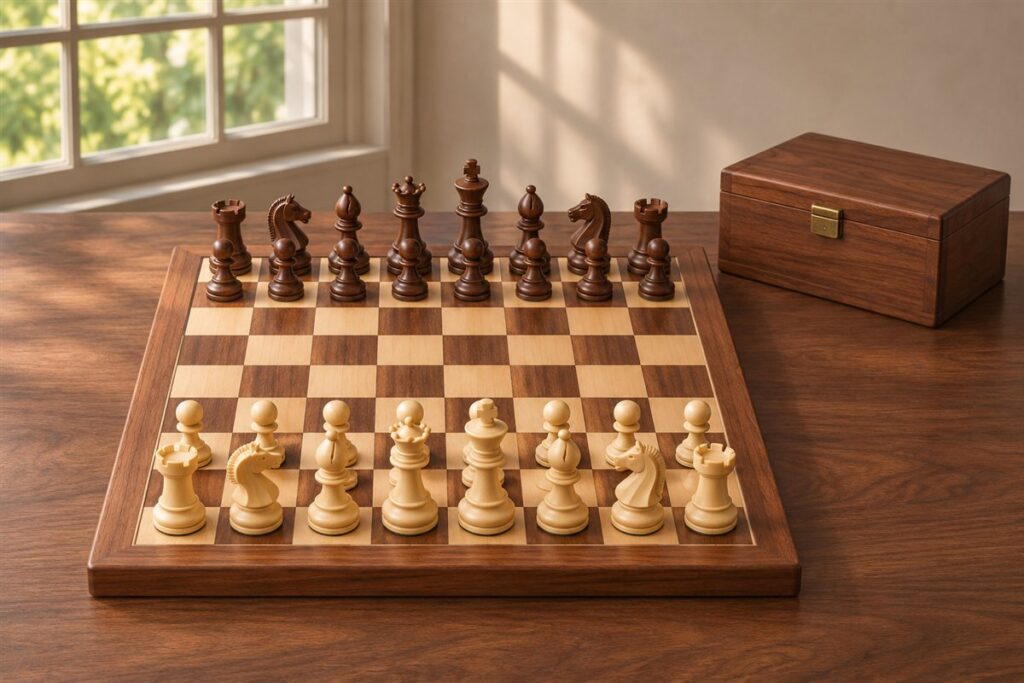
Antichess is a chess variant where you win by losing all your pieces, or in many rule sets by having no legal move. Captures are compulsory, which means your opponent can force you to take their pieces, and that is what makes the game harder than it sounds. Confirm the exact rules on the site or board you use.

The Usual Rules
- Pieces move as in standard chess, including castling in some rule sets and not in others.
- If a capture is available, you must make one. If several are available, you choose among them.
- The king has no special status. It can be captured, and there is no check or checkmate.
- Pawns can promote to a king as well as to the usual pieces.
- You win by having no pieces left. Many online rule sets also count a stalemate as a win for the stalemated side.
Because variants differ on castling and stalemate, read the rules before playing.
Why It Is Harder Than It Looks
It seems easy to just throw pieces away, but the opponent is also trying to lose. That means each side tries to offer pieces in a way that forces the other to capture, not the reverse.
Compulsory capture creates chain reactions. A single offered pawn can drag a rook across the board, open lines and set up a second forced capture. Players who plan these forcing sequences often win material, in the sense of getting rid of it, much faster.
Core Ideas
- Count forced captures. Before every move, look at which captures your opponent will be obliged to make after it.
- Keep your pieces mobile. Pieces stuck behind pawns may be forced to remain on the board when you want them gone.
- Use sacrifices to open lines for your own pieces to be captured.
- Be careful with the last few pieces. A single remaining piece that your opponent cannot attack can stay alive for a long time.
- Watch for stalemate wins if your rule set allows them. Blocking your own pieces completely can be a goal.
How It Compares With Standard Chess
| Topic | Standard chess | Antichess |
|---|---|---|
| Goal | Checkmate the king | Lose all pieces or get stalemated |
| Captures | Optional | Compulsory |
| King | Must be protected | Ordinary piece |
| Theory | Very large | Smaller, but sharp |
Opening Ideas for Antichess
Because standard opening theory misleads you here, it helps to start with a few simple principles. The first moves in antichess are about creating the first forced capture on terms that suit you. Whoever gets to make the first capture usually decides which of the two sides will be giving up material fastest, and the other side is obliged to respond. That means a quiet developing move can be far more committal than it looks.
Many players like to open pawn moves on the flanks, since those pawns can offer themselves to the opponent’s pieces without opening your king’s neighborhood, which no longer needs protection. Central pawn pushes tend to start captures immediately, so choose them on purpose.
- Ask what your opponent’s best forced capture will be after each candidate move.
- Avoid early moves that give the opponent a choice of captures, since choice is power in this game.
- Prefer offers that leave the capturing piece in a bad spot, such as deep in your territory where it can be offered up again.
- Keep track of which of your pieces are still blocked behind your own pawns.
Remember that opening books for antichess exist online, but the lines are sharper than they appear. Use them as examples of forcing play, not as scripts to memorize.
Middlegame Tempo and Forced Sequences
In the middlegame, the key skill is reading chains of obligatory moves. When captures are compulsory, the position often reduces to a small tree of options. If your opponent has only one legal capture, you can predict the next position exactly, and you can plan two or three moves in advance with confidence. If they have several, you need to consider each.
Look for moves that leave your opponent with exactly one capture, because that capture can then be steered toward a square that sets up your next offer. This is often called a forced sequence, and the best players build them like puzzles. Tempo matters as well: when no captures exist, each side makes a quiet move, and a spare quiet move can decide who has to capture next.
- List every capture available to each side in the current position.
- For each capture, picture the resulting position and list captures again.
- Stop when you find a line that removes your pieces faster than your opponent’s.
- Keep a spare waiting move in mind, such as an unobstructed pawn step, in case you need to pass the obligation.
This habit of checking the tree is more useful than any memorized idea, and it carries over to other forcing variants.
Piece Values Turned Upside Down
Standard piece values do not apply, and the reasons are worth understanding. In normal chess, a queen is strong because it controls many squares and delivers threats. In antichess, those same qualities can be a burden, because a mobile piece is harder to get rid of when you want it gone, and easy to offer when you want to open lines. What matters is how easily a piece can be forced to capture or be captured.
- Long-range pieces can be offered across the board and drag enemy pieces with them, but they can also be captured only if an enemy piece is able to reach them.
- Knights are awkward to attack and awkward to trap, so they can be difficult to lose and difficult for the opponent to lose.
- Kings are ordinary pieces here and can capture, which means a king stepping forward can start or end sequences.
- Pawns are the main tool for early offers, and their promotion options change late-game plans.
Use this as a mindset rather than a table of numbers. Ask each time: will this piece be easy for my opponent to capture when I need it to be, and will it be hard for them to avoid? If the answer is no, consider freeing it or placing it where a capture is forced.
Endgames and the Last Piece Problem
Endgames in antichess can be surprisingly tricky because the side with fewer pieces is usually the one close to winning, and that side must still find a way to lose the last ones. A single piece that cannot be attacked can survive indefinitely, particularly when the opponent has plenty of material to move around and no obligation to approach.
Several recurring ideas show up. A bishop that stays on one color can only be captured by a piece that reaches that color, so a color mismatch can make a bishop impossible to lose. A lone knight can run in circles while enemy pieces chase it. Pieces blocked in a corner by your own pawns can be stalemated, which helps only if the rule set counts stalemate as a win for the stalemated side.
- Before simplifying into an endgame, check which colored squares and which piece types your opponent will still have.
- Keep one pawn or piece that can move in reserve so you can offer the final capture.
- Count whether your opponent can run out of safe moves, since a forced offer often ends the game.
Practice small positions with one piece each side and work out by hand who wins. Those exercises build the intuition you need.
Practice and Rule Set Checks
The fastest way to improve is to play many short games and review them, since the variant punishes missed obligations. Online sites usually offer antichess as a game mode, often with a clear rules page, and you can start with a slower time control so you have time to count captures. Playing a bot or an engine, where available, lets you see how strong lines look without the pressure of a human opponent.
Always read the rules of the platform before you begin. Details such as castling, the ability to promote to a king, and how stalemate is scored differ between sites, and a rule you assumed can turn a won game into a loss. If you play over the board with friends, write the agreed rules down before the first move and agree what happens when a player cannot move.
- Play a few games at a slow pace and write down every moment you were surprised by a forced capture.
- Review each game and find the move where the obligation first turned against you.
- Replay critical positions from the end of the game backward to see how the sequence began.
- Keep a list of rule differences between the sites you use.
FAQ
Do chess skills help in antichess?
Calculation and pattern vision help, but opening habits and endgame knowledge from standard chess often mislead you. Treat it as a new game.
Is antichess the same as giveaway chess?
The names are used for closely related games, and small rule differences exist. Check the rules page rather than assuming.
Can I play antichess on a normal chess set?
Yes. You use the standard pieces and board, and you simply agree on the rules before starting. You may want to keep spare pieces nearby for promotions, since pawns can become kings in many rule sets.
Is white or black better in antichess?
Opening play is sharp and depends on the exact rule set, so it is hard to give a general answer. Check the opening resources for the version you play rather than assuming.
Why do strong chess players sometimes lose quickly at antichess?
Their habits of protecting pieces and developing safely work against them. The game rewards counting forced captures, which is a different skill from normal evaluation.
Do engines play antichess well?
Dedicated engines exist for the variant and handle forcing play very accurately. Treat them as a training partner, and use game review to understand why a move works.
What happens if I have no legal move?
It depends on the rule set. In many online versions, a player with no legal move wins, but some versions treat it differently, so read the rules page first.
Is antichess good for children?
It can be a fun way to practice noticing captures and threats, since the rule that captures are compulsory is easy to understand. Start with a slow game and explain the stalemate rule.
How is antichess different from losers chess?
Names overlap across sites, and the differences usually concern whether the king can be captured and whether check matters. Look at the definition on the platform you use.
The Short Version
Antichess reverses the goal of chess, but compulsory captures make the game tactical and surprising. Count forced captures on every move, keep your pieces free, and verify the stalemate and castling rules of the version you are playing.