Best energy efficient TVs lower the power a television draws while it is on, and they do it without turning the picture into a dim compromise. The sets in this guide are current LED, QLED, Mini LED and OLED models, and each one was picked because its design wastes less light and less electricity: a light-emitting diode backlight instead of an old plasma panel, a smaller screen where that fits the room, local dimming that lights only the part of the picture that needs it, or self-lit pixels that switch off completely in dark scenes. Every pick below is a real television you can buy now, with its brand and model checked against the listing title.
This guide compares published specs and design traits. We have not used these TVs ourselves, so every claim below traces to a spec printed in the listing title or to a basic design trait of the panel type, the screen size, and the smart platform. Use the comparison table to match a pick to your room, your viewing habits, and the size that fits your wall or stand. One honest note up front: screen size dominates total power draw, so a 77 inch set will always use more electricity than a 40 inch set, no matter how clever its panel is. The guide says so for each pick instead of hiding it.

In this guide
Quick picks: best energy efficient tvs
| # | Product | Where to buy |
|---|---|---|
| 1 | Roku 40-Inch Select Series Smart TV \u2014 best energy efficient tvs | Check on Amazon |
| 2 | Supersonic Smart SC-4350GTV 43-inch FHD DLED TV \u2014 best energy efficient tvs | Check on Amazon |
| 3 | TOSHIBA 43-Inch Class M450 Series QLED 4K Smart Fire TV \u2014 best energy efficient tvs | Check on Amazon |
| 4 | INSIGNIA 55-inch Class F50 Series LED 4K Smart Fire TV \u2014 best energy efficient tvs | Check on Amazon |
| 5 | Samsung 65-Inch Class M70H Series Mini LED 4K Smart TV \u2014 best energy efficient tvs | Check on Amazon |
| 6 | LG 77-Inch OLED evo C6 4K Smart TV \u2014 best energy efficient tvs | Check on Amazon |
How the picks were chosen
We started with listings that name a current television in the title, then kept only the ones where the brand and every model code in the title match the product. A listing that sold a remote, a wall mount, a screen protector, or a TV cover was dropped, and so were plasma sets, which have not been made for years and now appear only as used or refurbished listings. Every pick below is a new, current-model television with a full title verified through the site lookup.
We favoured a spread of sizes and panel types: a compact 40 inch set for a bedroom or kitchen, two 43 inch sets for a small living room, a 55 inch set for a main room, a 65 inch Mini LED set for a bright room, and a 77 inch OLED set for a home theater where dark-scene picture quality matters most. Smaller screens draw less power than larger ones with the same panel type, so size is part of the efficiency story, and the guide says so plainly for each pick rather than pretending a large screen sips power.
Panel type, screen size, resolution, and smart platform came straight from the listing titles. Where a title states a model code, it is shown, and where it does not state a power figure, the guide says so plainly instead of guessing a number. Only one pick in this guide carries an efficiency claim in its own title, the Supersonic SC-4350GTV, and the guide names that fact where it belongs. The other picks earn their place through design traits that are visible in the title: LED backlighting, a small screen, local dimming, or self-lit OLED pixels.
Best energy efficient TVs: the picks in detail
Roku 40-Inch Select Series Smart TV 2026, 1080p Full HD
The Roku 40-Inch Select Series is the smallest screen in this guide, and that is the heart of its efficiency case. A 40 inch panel has far less area to light than a 55 or 65 inch panel, so it draws less power in normal viewing even before any smart power setting is switched on. The set is a flat screen LED television with 1080p Full HD resolution, which keeps the picture sharp at this size while asking less of the processor than a 4K panel would. For a bedroom, a kitchen, or a small guest room, it is the pick that wastes the least electricity simply by being the right size for the room.
The RokuTV platform is built in, so there is no need for a separate streaming stick drawing power from a second outlet, and the voice remote keeps control simple. Bluetooth headphone mode is a useful extra for late-night viewing: it sends sound to headphones instead of filling the room, which suits a household where one person watches while another sleeps. Wi-Fi is built in, and the set streams live local news, sports, and movies through the Roku platform without extra hardware.
Key specs: 40-inch LED television; 1080p Full HD; RokuTV smart platform; voice remote; Wi-Fi; Bluetooth headphone mode.
Strengths:
- 40 inch size draws less power than larger panels in the same lineup.
- 1080p resolution needs less processing power than a 4K panel at this size.
- Built-in RokuTV removes the need for a separate streaming device.
Trade-offs:
- 1080p resolution is not as sharp as 4K on a larger screen, so it suits smaller rooms.
- 40 inch screen is too small for a main living room viewed from a sofa.
- Title states no power figure, so plan from the screen size, not a wattage claim.
Who it fits: Bedrooms, kitchens, and small rooms where a compact screen is the right fit.
Best for: a bedroom or kitchen where a small, simple TV is enough. Not suited for: a main living room or a home theater that needs a large screen.
Check price on Amazon: Roku 40-Inch Select Series Smart TV \u2014 best energy efficient tvs

Supersonic Smart SC-4350GTV 43-inch FHD DLED TV
The Supersonic Smart SC-4350GTV is the one pick in this guide whose listing title states energy efficiency outright, and that is why it leads the value end of the lineup. It is a 43 inch FHD DLED television with 1080p resolution, Google Assistant built in, and a 60Hz refresh rate. DLED stands for direct LED backlighting, which lights the panel from behind with light-emitting diodes, and the title pairs that design with an explicit energy-efficient claim, so the efficiency angle here comes from the listing itself rather than from a guess about the panel.
At 43 inches it fits a small living room, a bedroom, or a home office, and the 1080p resolution suits that size well. Google Assistant gives voice control without a separate device, and the set carries HDMI and USB inputs plus Wi-Fi and Bluetooth. The 16.7 million colors figure in the title describes the panel color range, and the 60Hz refresh rate covers everyday viewing, news, and streaming shows. It is a straightforward set: a modest screen, a direct LED backlight, and no extra hardware to power.
Key specs: 43-inch FHD DLED TV; 1080p resolution; Google Assistant; 60Hz refresh rate; title states Energy-Efficient; Bluetooth; remote control.
Strengths:
- Listing title states energy efficiency outright, the only pick that does.
- 43 inch DLED panel with 1080p resolution keeps power draw modest.
- Google Assistant built in, so no separate voice device is needed.
Trade-offs:
- 1080p resolution is not 4K, so it suits smaller rooms rather than a large wall.
- Supersonic is a budget brand, so the picture will not match a premium panel.
- 60Hz refresh rate suits everyday viewing, not fast-action gaming.
Who it fits: Buyers who want an explicit efficiency claim in the listing and a modest 43 inch screen.
Best for: a small living room or bedroom on a tight budget. Not suited for: a home theater or a gaming setup that needs 4K and a high refresh rate.
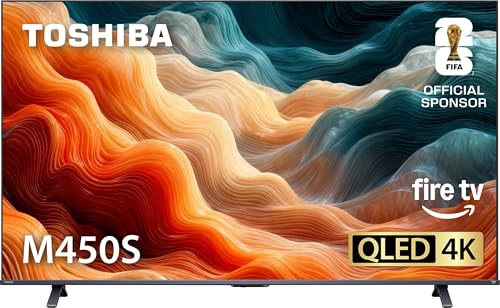
TOSHIBA 43-Inch Class M450 Series QLED 4K UHD Smart Fire TV
The TOSHIBA 43-Inch Class M450 Series is the QLED pick at the compact end of this guide. QLED adds a quantum dot layer to an LED backlight, and that layer converts backlight into color more effectively, so the panel gets more color from the same light. At 43 inches it is the same size as the Supersonic above, but the 4K UHD resolution gives a sharper picture, and the Fire TV platform brings Alexa voice control through the included voice remote. It is the pick for a small room where 4K sharpness matters and the screen still stays small enough to keep power draw down.
Fire TV is built in, so streaming apps run on the set itself with no extra box, and the voice remote with Alexa handles search and playback by voice. The 43 inch size fits a bedroom, a small living room, or a den, and the QLED panel keeps colors vivid in a room with lamps on. Like every pick in this guide, the title states no wattage figure, so the efficiency case rests on the small screen and the QLED design rather than on a number the listing does not print.
Key specs: 43-inch QLED television; 4K UHD; Smart Fire TV; voice remote with Alexa.
Strengths:
- QLED layer uses backlight more effectively for color than a plain LED panel.
- 43 inch size keeps total power draw well below larger 4K sets.
- Fire TV and Alexa voice remote are built in, with no extra streaming box.
Trade-offs:
- 43 inch screen is too small for a large living room viewed from a distance.
- 4K resolution is sharper than 1080p but asks more of the processor.
- Title states no power figure, so compare by screen size and panel type.
Who it fits: Small rooms where 4K sharpness matters but a large screen would waste power.
Best for: a bedroom or den that needs a sharp 4K picture at a modest size. Not suited for: a large living room or a bright sunroom that needs a bigger, brighter panel.

INSIGNIA 55-inch Class F50 Series LED 4K UHD Smart Fire TV (NS-55F501NA26)
The INSIGNIA 55-inch Class F50 Series is the main-room pick in this guide, and its model code NS-55F501NA26 is printed in the title, so the match is exact. It is a 55 inch LED television with 4K UHD resolution and Smart Fire TV built in, controlled by an Alexa voice remote. Fifty-five inches is the most common living-room size, and this set covers that room without jumping to the 65 or 75 inch classes, where power draw climbs with every extra inch of panel. It is the sensible middle of the lineup: large enough for a sofa, small enough to keep the electricity bill in check.
Fire TV runs streaming apps on the set itself, and the Alexa voice remote searches and controls playback without a second device. The LED backlight is the standard efficient design for a set at this size, and the 4K resolution keeps the picture sharp from a normal sofa distance. This is the pick for a household that wants one television for the main room, watches a mix of shows, movies, and sports, and would rather buy the right size once than pay to light a panel that is bigger than the room needs.
Key specs: 55-inch LED television; 4K UHD; Smart Fire TV; Alexa voice remote; model NS-55F501NA26.
Strengths:
- 55 inch size is the common living-room size without the draw of a 65 inch panel.
- Model NS-55F501NA26 is printed in the title, so the match is exact.
- Fire TV and Alexa voice remote are built in, with no extra streaming box.
Trade-offs:
- 55 inch screen still draws more power than the 40 and 43 inch picks in this guide.
- LED backlight is standard rather than Mini LED, so dark scenes show less contrast.
- Title states no power figure, so compare by screen size and panel type.
Who it fits: Main living rooms where 55 inches is the right size for the sofa distance.
Best for: a main room that needs one solid 4K TV at a sensible size. Not suited for: a bedroom, where a 40 or 43 inch set would use less power.

Samsung 65-Inch Class M70H Series Mini LED 4K Smart TV, 2026 Model
The Samsung 65-Inch Class M70H Series is the large-screen pick that still earns its place in an efficiency guide, because Mini LED changes how the backlight works. Instead of one broad backlight, Mini LED uses many small zones that dim independently, so dark parts of the picture get less light while bright parts stay bright. The title names the Mini LED Processor 4K, the 2026 model year, and Motion Xcelerator with DLG 120Hz, which keeps motion smooth for sports and action. Samsung Vision AI Companion is built in as the smart platform.
Sixty-five inches is a large screen, and the guide is plain about that: in absolute terms it will draw more power than the 40, 43, and 55 inch picks. The efficiency case is relative to other 65 inch sets, not to small screens. Mini LED local dimming wastes less light than a plain LED backlight at the same size, and the 4K resolution suits the size from a normal sofa distance. This is the pick for a bright living room where a large screen is genuinely needed and the backlight should work only as hard as each scene requires.
Key specs: 65-inch Mini LED television; 4K; 2026 model; Mini LED Processor 4K; Motion Xcelerator with DLG 120Hz; Samsung Vision AI Companion.
Strengths:
- Mini LED local dimming lights only the zones each scene needs.
- 65 inch 4K picture suits a large living room from a normal sofa distance.
- Motion Xcelerator with DLG 120Hz keeps sports and action smooth.
Trade-offs:
- 65 inch screen draws more power in absolute terms than any smaller pick here.
- Mini LED costs more than a plain LED panel of the same size.
- Title states no power figure, so compare by panel design, not a wattage claim.
Who it fits: Large living rooms where a 65 inch screen is needed and the backlight should dim by zone.
Best for: a bright main room that needs a large Mini LED picture. Not suited for: a small bedroom, where a 40 or 43 inch set would use far less power.

LG 77-Inch OLED evo C6 4K Smart TV
The LG 77-Inch OLED evo C6 is the home theater pick, and its efficiency story is different from every other set in this guide. OLED pixels make their own light, so there is no backlight at all: a pixel showing black is simply off, and it draws no power. The title names the OLED evo C6 panel, Dolby Vision and Atmos, the a11 AI Processor Gen3, VRR 165Hz, and Filmmaker Mode, which presents movies as the director intended. Hyper Radiant Color Tech and Brightness Booster Pro describe the panel color and brightness design.
Seventy-seven inches is the largest screen in this guide, and the guide is plain about what that means: in absolute terms it will use more electricity than any smaller set here, because there is simply more screen to light. The efficiency case is per square inch of picture in dark scenes, where switched-off pixels save power that a backlit panel would spend lighting black areas. This is the pick for a dedicated movie room where dark-scene picture quality matters most and the screen size is chosen on purpose, not by accident.
Key specs: 77-inch OLED evo C6 television; 4K; Dolby Vision and Atmos; a11 AI Processor Gen3; VRR 165Hz; Filmmaker Mode.
Strengths:
- Self-lit OLED pixels switch off in black areas, so no backlight lights dark scenes.
- 77 inch OLED picture with Dolby Vision suits a dedicated movie room.
- VRR 165Hz and Filmmaker Mode cover gaming and movies in one set.
Trade-offs:
- 77 inch screen draws more power in absolute terms than any smaller pick here.
- OLED is the premium panel in this guide, so it costs more than LED sets.
- Title states no power figure, so compare by panel design, not a wattage claim.
Who it fits: Home theaters where dark-scene picture quality matters and the large screen is a deliberate choice.
Best for: a dedicated movie room that needs the best dark-scene picture in this guide. Not suited for: a bedroom or kitchen, where a 40 or 43 inch set would use far less power.
Check price on Amazon: LG 77-Inch OLED evo C6 4K Smart TV \u2014 best energy efficient tvs
Best energy efficient TVs at a glance
| Model | Size | Panel | Resolution | Smart platform |
|---|---|---|---|---|
| Roku Select Series 2026 | 40 inch | LED | 1080p Full HD | RokuTV |
| Supersonic SC-4350GTV | 43 inch | DLED | 1080p | Google Assistant |
| TOSHIBA M450 Series | 43 inch | QLED | 4K UHD | Fire TV |
| INSIGNIA F50 Series NS-55F501NA26 | 55 inch | LED | 4K UHD | Fire TV |
| Samsung M70H Series 2026 | 65 inch | Mini LED | 4K | Vision AI Companion |
| LG OLED evo C6 | 77 inch | OLED | 4K | a11 AI Processor Gen3 |
The table shows the pattern plainly: the smaller the screen, the lower the total draw, and the panel type decides how much of that draw turns into picture rather than wasted light. A 40 inch LED set is the lowest-draw pick here, while the 77 inch OLED is the most efficient per square inch of picture in dark scenes but still the highest-draw set in absolute terms.
Buying guide: what makes a TV energy efficient
Screen size comes first. A television lights every square inch of its panel, so a 77 inch screen has roughly three times the area of a 43 inch screen and draws power in proportion. Before comparing panel types, measure the room and pick the smallest size that still looks right from the sofa. A set that is bigger than the room needs is the single largest waste of electricity in this guide, and no panel technology makes up for it.
Panel type comes second. LED backlighting is the efficient standard: light-emitting diodes use far less power than the plasma panels and cold-cathode backlights they replaced. QLED adds a quantum dot layer that turns backlight into color more effectively. Mini LED splits the backlight into many zones that dim independently, so dark scenes get less light. OLED removes the backlight entirely, and each pixel makes its own light or switches off. Each step up this ladder wastes less light, but each step also costs more, so the guide pairs the panel with the room that benefits from it.
Resolution matters less than size, but it still counts. A 1080p panel asks less of the processor than a 4K panel, and on a 40 or 43 inch screen viewed from a normal distance the difference in sharpness is small. On a 55 inch screen and above, 4K is worth it, because the larger picture shows the extra detail. Do not buy 8K for efficiency: the extra pixels add processing load without a visible gain at normal viewing distances.
Smart features should be built in rather than added on. A separate streaming stick, a separate voice device, and a separate soundbar each draw power from their own outlet, while a set with RokuTV, Fire TV, or Google Assistant built in runs those jobs on one power supply. Check the title for the platform before you buy, and prefer a set whose voice remote is included rather than one that needs an extra hub. The picks in this guide all carry their smart platform in the title, so you can see it before you order.
Finally, read the title the way this guide does. A title that names the brand, the model code, the size, and the panel type tells you what you are buying. A title that names only a remote, a mount, or a cover is an accessory, not a television, and it has no place in an efficiency roundup. If the title does not state a power figure, do not assume one: compare by size and panel type, which the title does state, and treat any wattage number from a source other than the listing with care.
How to use your TV to save power
Brightness is the biggest lever you control. Most sets ship with the backlight set high for a bright shop floor, and turning it down to suit a normal living room cuts power draw at once. Use the eco or energy-saving picture mode if the set offers one, and let the ambient light sensor dim the screen in the evening if your model carries one. A dimmer picture in a dark room looks the same to your eyes and costs less to run.
Switch the set fully off when you are done. Many televisions sit in standby, listening for the remote and keeping network features warm, and that standby draw adds up over a year. A switched outlet strip that cuts power to the television and its accessories overnight stops that draw completely, and it costs nothing to use. Keep the set out of direct sunlight as well: a screen fighting glare needs a higher backlight setting, while the same set in a shaded spot runs dimmer and cooler.
Match the content to the screen. A 77 inch OLED is the right tool for a movie night, but it is the wrong tool for background news in the kitchen, where the 40 inch Roku in this guide uses far less power for the same job. Use the small set for casual viewing and save the large set for the evenings when its picture earns its keep. That habit alone saves more electricity than any single panel upgrade.
Check the picture mode as well as the brightness. Vivid or dynamic modes push the backlight and the color processing hard, while a movie, cinema, or eco mode keeps the picture natural at a lower draw. The difference on screen is small in a normal living room, and the saving is steady across every hour of viewing. Set the mode once, leave it there, and let the television run at the level the room actually needs instead of the level the shop floor wanted.
Common mistakes when buying an efficient TV
Buying a screen that is too large for the room is the most common mistake, and it is also the most expensive one in power terms. A 65 inch set in a small bedroom lights a wall the viewer sits two steps from, and the extra inches add draw without adding enjoyment. Measure the viewing distance first: a 40 or 43 inch set suits a bedroom, a 55 inch set suits a normal living room, and 65 inches and above belong in a large room or a dedicated theater space.
Confusing an accessory with a television is the second mistake. Listings for universal remotes, wall mounts, screen protectors, and TV covers all carry the words plasma, LED, or 4K in their titles, and a quick search returns them alongside real sets. Read the title to the end: if it says remote, mount, protector, or cover, it is not a television, and it will not show a picture at all.
Trusting a used or refurbished plasma set is the third mistake. Plasma televisions have not been made for years, so any plasma listing still on sale is old stock, and the panel has already lived a long life. An old plasma draws far more power than a new LED set of the same size and will keep drawing it for as long as it runs. Buy a new LED, QLED, Mini LED, or OLED set instead, and let the plasma era stay in the past.
Ignoring the smart platform is the fourth mistake. A set without built-in streaming needs a separate stick or box, and that second device draws power whenever the television is on. Check that the title names RokuTV, Fire TV, Google Assistant, or the maker smart platform, and confirm the voice remote is included. The picks in this guide all state their platform in the title, so there is no guessing after delivery.
Final recommendation
For most households, the INSIGNIA 55-inch F50 Series is the balanced pick: a main-room size, a 4K LED picture, Fire TV built in, and an exact model code in the title. If the room is small, take the Roku 40-Inch Select Series instead and save power with every hour of viewing. If the budget is tight and an explicit efficiency claim matters, the Supersonic SC-4350GTV is the only pick whose title states it. For a large bright room, the Samsung 65-Inch M70H Mini LED wastes the least light at that size, and for a dedicated movie room the LG 77-Inch OLED evo C6 gives the best dark-scene picture in this guide.
Frequently asked questions
Do energy efficient TVs use much less power than old plasma TVs?
Yes. Plasma panels lit every cell to make a picture, while LED backlighting and OLED self-lit pixels waste far less light. A new 43 inch LED set draws far less power than a 43 inch plasma set from the plasma era, and the gap grows with screen size. Plasma production ended years ago, so any plasma set still listed is old stock.
Is a smaller TV always more energy efficient?
In total power draw, yes: a 40 inch screen has far less area to light than a 65 inch screen, so it uses less electricity in normal viewing. Panel type decides how efficiently that area is lit, so a 43 inch Mini LED or OLED set can beat a 43 inch plain LED set, but it will not beat a 40 inch set of any panel type in absolute terms.
What does DLED mean on the Supersonic pick?
DLED stands for direct LED backlighting, where light-emitting diodes sit behind the panel and light it directly. The Supersonic SC-4350GTV title pairs that design with an explicit energy-efficient claim, a 1080p resolution, and a 60Hz refresh rate, which makes it the value pick in this guide.
Does OLED really save power in dark scenes?
Yes, in dark scenes. Each OLED pixel makes its own light, so a pixel showing black is off and draws no power. In bright scenes with a mostly white picture, an OLED set can draw as much as a backlit set, because most pixels are lit. The saving is real for movies and shows with many dark scenes, which is why the LG C6 in this guide suits a movie room.
What size TV should I buy for an energy efficient living room?
Buy the smallest size that still looks right from your sofa. A 55 inch set suits most living rooms, a 43 inch set suits a small room or bedroom, and a 40 inch set suits a kitchen or guest room. Every step up in size adds panel area that must be lit, so an oversized set wastes power on every hour of viewing, while the right size gives the same enjoyment for less electricity.
Should I leave my TV in standby or switch it off?
Switch it fully off when you are done for the night. Standby keeps the remote receiver and network features warm, and that draw adds up over a year. A switched outlet strip that cuts power to the television and its accessories overnight stops the standby draw completely.
More from Reviewstook: Best 4K TVs, Best OLED TVs, Best TVs for Picture Quality.


