The best antennas around hills are the ones that can reach over a ridge, down into a valley, and through the trees that grow on a slope. Hills break up television signals in a way flat ground never does: a ridge between the house and the tower blocks the direct path, and the signal that arrives is a weaker reflection, or nothing at all. An antenna for hilly terrain needs to gather that weak, bounced signal, hold it steady, and lift it enough for the tuner to lock onto it.
The six antennas in this roundup were chosen for hilly terrain first. Every one of them is an outdoor antenna built to gather a distant or obstructed signal, and every one was verified against its full listing title before it earned a place here. Four of the six are Yagi-style directional antennas, because a Yagi focuses its reception in one direction and gathers more signal from a distant tower than any other shape. The GE pick and the McDuory pick are Yagi designs for attic or roof mounting. The Winegard HD7698A is a heavy-duty Yagi built for rural areas. The Five Star pick is an upgraded Yagi rated at 200 miles. The two Mornixol picks cover the other approaches: a 70-mile outdoor antenna for a home on a moderate slope, and a 150-mile motorized antenna for a home that needs to search for the best direction.
Hills change what matters in an antenna. Range figures are the first thing buyers look at, but the honest range of an antenna in hilly terrain depends on the height of the mount relative to the ridge, the direction of the tower, and the quality of the reception pattern. A directional Yagi pointed at the tower through a gap in the ridge gathers far more signal than an omnidirectional antenna that listens in every direction at once. Height is the other half of the answer: an antenna that clears the ridge sees a stronger signal than one that sits below it. The buying guide below explains how to read the terrain, where to mount the antenna, and how to aim it.
Every antenna below states its design plainly in its listing. The Yagi picks state their Yagi design and their range, and the entries below quote those details exactly as listed. There are no indoor antennas in this roundup: hilly terrain needs an outdoor or attic mount, and every pick here is built for that. The recommendation at the end names a pick for each kind of hilly home, from a house on a gentle slope to a property deep in a valley.

In this guide
Quick picks: best antennas around hills
| # | Product | Where to buy |
|---|---|---|
| 1 | GE Outdoor HD Digital TV Antenna | Check on Amazon |
| 2 | McDuory TV Outdoor Yagi Antenna | Check on Amazon |
| 3 | Winegard HD7698A Heavy-Duty Outdoor Yagi TV Antenna | Check on Amazon |
| 4 | Five Star Outdoor TV Antenna 200 Miles Long Range Upgraded Yagi | Check on Amazon |
| 5 | Mornixol Outdoor TV Antenna | Check on Amazon |
| 6 | Mornixol 360-Degree Motorized Outdoor TV Antenna | Check on Amazon |
How the best antennas around hills were chosen
The picks were chosen for three things: a genuine outdoor listing, a directional design or long range that suits obstructed signals, and a build that survives a hilltop or valley installation. A genuine outdoor listing means the antenna is built for roof, attic, or pole mounting, stated in the full listing title. Every antenna below was verified against its full title, so the brand, the model, and the design in each entry match the listing exactly. Antennas whose only listings were indoor-only, or accessories such as mounts and amplifiers, were left out.
The roundup covers the real range of hilly reception. The Mornixol 70-mile pick suits a home on a moderate slope within about forty miles of a tower. The GE Yagi and the McDuory Yagi suit homes farther out, where a directional design matters more than a mile figure. The Winegard HD7698A is rated at 65 miles and built for rural areas, with a heavy-duty design that survives wind on an exposed hilltop. The Five Star Yagi is rated at 200 miles, for the longest reach in this roundup. The Mornixol motorized pick is rated at 150 miles, with a remote-controlled rotation that searches for the best direction when the tower sits behind a ridge.
The selection also covers the practical differences between these antennas. The Yagi picks are fixed and directional, so they need aiming once and then stay put. The Mornixol motorized pick rotates 360 degrees by remote control, so it can be re-aimed from indoors when the signal changes with the seasons. The Mornixol 70-mile pick installs without tools, which suits a home where the mount is easy to reach. The entries below state the exact figures for each antenna, so the choice can be made on the numbers rather than on the name.
What makes an antenna right for hilly terrain
A hill blocks a television signal the way a wall blocks light: the direct path is gone, and only a weaker reflected signal, or a signal that bends over the ridge, reaches the house. A directional antenna answers that problem by focusing its reception in one direction, which gathers more of the weak signal than an antenna that listens everywhere at once. The Yagi design does this with a row of elements along a boom: the longer the boom and the more elements, the tighter the focus and the stronger the gathered signal. The Yagi picks in this roundup use that design, and the entries state their ranges exactly as listed.
Height is the other half of the answer, and in hilly terrain it matters more than anywhere else. A signal that clears the ridge by a few feet can be dramatically stronger than one that has to pass through the hill itself. An antenna on a tall mast, or on the highest point of the roof, sees over obstacles that block a lower mount. Every antenna in this roundup is built for a roof, attic, or pole mount, and the entries note the mounting hardware each one includes. The Five Star pick includes a mounting pole, and the Mornixol motorized pick includes a J-pole. Raising the antenna is worth more than buying a bigger one.
The reception pattern decides whether the antenna hears the tower at all. A Yagi pointed at the tower through a gap in the ridge gathers the signal from that direction and ignores the rest, which also ignores the reflections that confuse a tuner. An omnidirectional antenna gathers the reflections too, and the tuner can struggle to choose between them. That is why four of the six picks here are directional Yagi designs, and why the motorized pick rotates: when the best direction is not obvious, the antenna can search for it.
The amplifier, where one is present, deserves attention, because a bad amplifier can make a weak hilly signal worse. A good amplifier has a low noise figure, which means it adds little of its own noise to the signal, and enough gain to overcome cable loss without overloading the tuner. The Mornixol motorized pick in this roundup includes an amplifier signal booster with a remote control, which lifts the signal for the cable run indoors. The Yagi picks here are non-amplified or amplifier-free designs, which suit homes where the signal is weak but clean, and where an amplifier would add noise rather than help.
What to look for in an antenna for hilly terrain
Start with the direction of the tower, not the distance. A home in a valley may sit 30 miles from a tower and receive nothing, while a home on a ridge 60 miles away receives a clear picture. Find the tower locations from the home address, and note which ridge stands between the house and each tower. A directional Yagi, like the GE, McDuory, Winegard, or Five Star picks here, should be aimed through the lowest gap in the ridge, not simply at the tower. The Mornixol motorized pick can search for that gap by remote control.
Then look at the range figure, but read it as a ceiling. A 200-mile rating describes the best case: flat ground, a clear line of sight, and a tall mount. In a valley or behind a hill, the same antenna may reach half that distance. Compare the ratings in this roundup against the distance to the nearest towers, and choose an antenna rated for more than that distance. The Mornixol 70-mile pick suits homes within about forty miles of a tower. The 150-mile and 200-mile picks suit homes farther out or deeper in a valley.
Check the mount and the height it allows next. A Yagi on a short mount below the roofline sees a weaker signal than the same Yagi on a tall mast above it. The Five Star pick includes a mounting pole, and the Mornixol motorized pick includes a J-pole. If the house sits in a valley, a taller mast is worth more than a larger antenna, and a chimney mount or a pole on the highest point of the property may be needed. Check local rules before raising a mast above the roofline.
Finally, check whether the antenna needs an amplifier. A directional Yagi in hilly terrain often receives a weak but clean signal, and an amplifier with a high noise figure can make it worse. The Yagi picks in this roundup are non-amplified designs, which suit that case. The Mornixol motorized pick includes an amplifier signal booster, which suits a home with a long cable run or a weak signal that needs lifting. If the picture is weak but clean, try the antenna without an amplifier first, and add one only if the cable run demands it.
Quick picks at a glance
| Antenna | Range | Design | Best for |
|---|---|---|---|
| GE Outdoor HD Digital TV Antenna | Long-range | Yagi style, J mount included | A Yagi for attic or roof mounting |
| McDuory TV Outdoor Yagi Antenna | Long-range | Yagi, attic or roof mount | A Yagi for attic or roof mounting |
| Winegard HD7698A Heavy-Duty Outdoor Yagi TV Antenna | 65 miles | Heavy-duty Yagi, non-amplified | A rugged Yagi for rural hills |
| Five Star Outdoor TV Antenna 200 Miles Long Range Upgraded Yagi | 200 miles | Upgraded Yagi, ATSC 3.0 | The longest reach in this roundup |
| Mornixol Outdoor TV Antenna | 70 miles | Outdoor, no-tools install | A simple 70-mile antenna for a moderate slope |
| Mornixol 360-Degree Motorized Outdoor TV Antenna | 150 miles | Motorized 360-degree, amplifier booster | Searching for the best direction behind a ridge |
The best antennas around hills
GE Outdoor HD Digital TV Antenna
The GE Outdoor HD Digital TV Antenna is the Yagi pick for a home that wants a proven directional design for attic or roof mounting. Its listing states a long-range outdoor HD digital TV antenna in a Yagi style, supporting 4K and 1080p high-definition smart TV with VHF and UHF reception, with a J mount included for attic or outdoor use, weather resistant, model 33685. The Yagi design focuses reception in one direction, which gathers more signal from a distant tower through a gap in the ridge.
The Yagi shape is the reason to choose it. A hill blocks the direct signal, and the antenna that hears best is the one that listens hardest in the direction of the tower. The GE pick does that with a Yagi element layout, and the J mount puts it on the roof or in the attic with the hardware in the box. The 4K and 1080p support means it will not need replacing when the television is upgraded, and the weather-resistant build survives an exposed hilltop. For a home that needs a directional antenna at a fair cost, it is the straightforward pick.
Key specs:
- GE Outdoor HD Digital TV Antenna, Yagi style design
- Long range OTA HDTV antenna
- Supports 4K 1080P HD smart TV, VHF UHF
- J mount included, attic or outdoor
- Weather resistant, model 33685
Strengths:
- Yagi design focuses reception on the tower direction
- J mount included for attic or outdoor use
- Weather-resistant build for an exposed mount
Trade-offs:
- A Yagi needs aiming at the tower through the best gap
- No mile range figure is stated in the listing
- A directional antenna gathers less from other directions
This antenna fits a home on a slope with towers in one direction. It is the pick for a proven Yagi at a fair cost.
Best for: a home on a slope with towers in one direction. Not suited for: a home with towers in several directions, or one that needs a stated mile range.
Check price on Amazon: GE Outdoor HD Digital TV Antenna
McDuory TV Outdoor Yagi Antenna
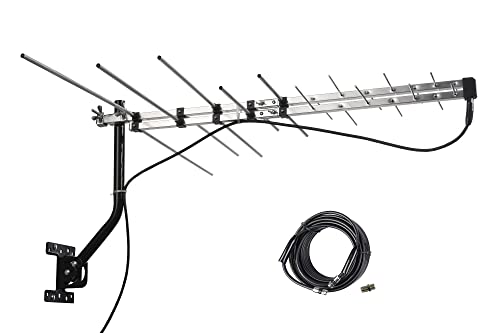
The McDuory TV Outdoor Yagi Antenna is the second Yagi pick in this roundup, and it is the antenna for a home that wants a long-range Yagi for attic or roof mounting. Its listing states a TV outdoor Yagi antenna with long-range reception capacity, a digital TV antenna available for attic or roof mounting, with long-range digital over-the-air reception for clear reception in 4K, 1080p, and HD. The Yagi design focuses on the tower direction, and the attic or roof options cover the two most common rural mounts.
The attic option matters in hilly terrain, because a high attic can clear the ridge almost as well as a roof mount, and it protects the antenna from wind and weather. A Yagi in a high attic often outperforms a lesser antenna on a low roof, because the height matters more than the exposure. The McDuory pick is built for both, so the installer can try the attic first and move to the roof only if the signal demands it. For a home that wants a Yagi with a choice of mounts, it is the flexible pick.
Key specs:
- McDuory TV Outdoor Yagi Antenna
- Long range reception capacity
- Digital TV antenna, attic or roof mount
- Long range digital OTA antenna
- Clear reception, 4K/1080P/HD
Strengths:
- Yagi design focuses reception on the tower
- Attic or roof mounting to suit the house
- Long-range digital reception in 4K and 1080p
Trade-offs:
- A Yagi needs aiming at the tower
- No mile range figure is stated in the listing
- An attic mount loses some signal compared with a roof mount
This antenna fits a home that wants a Yagi with a choice of mounts. It is the pick for attic or roof mounting in hilly terrain.
Best for: a home that wants a Yagi for attic or roof mounting. Not suited for: a home that needs a stated mile range, or towers in several directions.
Check price on Amazon: McDuory TV Outdoor Yagi Antenna

Winegard HD7698A Heavy-Duty Outdoor Yagi TV Antenna
The Winegard HD7698A Heavy-Duty Outdoor Yagi TV Antenna is the rugged pick in this roundup, and it is the antenna for a home on an exposed hilltop where wind and weather punish a light antenna. Its listing states a heavy-duty outdoor Yagi TV antenna with a 65-mile range, directional, non-amplified, durable and weather and rust resistant, for rural areas, in 4K Ultra-HD and NextGen TV. The heavy-duty build survives the wind that funnels over a ridge, and the directional Yagi design gathers the signal from the tower direction.
The 65-mile range suits homes within about forty miles of a tower with room to spare, and the non-amplified design means there is no amplifier noise added to a weak but clean signal. The heavy-duty construction is the practical difference: a light antenna on an exposed hilltop bends and breaks, and a bent Yagi loses its focus. The HD7698A is built to hold its shape, and its weather and rust resistance mean it survives years on a hilltop without attention. For a home where the wind is as much a problem as the hill, it is the durable pick.
Key specs:
- Winegard HD7698A Heavy-Duty Outdoor Yagi TV Antenna
- 65 mile range, directional, non-amplified
- Durable, weather and rust resistant
- Rural areas, 4K Ultra-HD, NextGen TV
Strengths:
- Heavy-duty build survives wind on an exposed hilltop
- Directional Yagi gathers signal from the tower direction
- Non-amplified design adds no amplifier noise
Trade-offs:
- 65-mile range is less than the 150-mile and 200-mile picks here
- A directional Yagi needs aiming at the tower
- Heavy-duty construction costs more than a light antenna
This antenna fits a home on an exposed hilltop in a rural area. It is the pick for durability and a clean, weak signal.
Best for: a home on a windy hilltop in a rural area. Not suited for: a home more than 65 miles from its towers, or one sheltered in a deep valley.
Check price on Amazon: Winegard HD7698A Heavy-Duty Outdoor Yagi TV Antenna

Five Star Outdoor TV Antenna 200 Miles Long Range Upgraded Yagi
The Five Star Outdoor TV Antenna 200 Miles Long Range Upgraded Yagi is the long-range pick in this roundup, and it is the antenna for a home deep in a valley or far from its towers. Its listing states an outdoor TV antenna with a 200-mile long range, an upgraded Yagi HD design in VHF and UHF, and support for ATSC 3.0 and 4K broadcast. The upgraded Yagi gathers more signal from the tower direction than a standard Yagi, and the 200-mile rating is the longest in this roundup.
The 200-mile rating is the headline, and it suits homes at the far edge of a broadcast market or deep behind a ridge. The upgraded Yagi design means more elements and a tighter focus, which is exactly what a weak, obstructed signal needs. The ATSC 3.0 support means the antenna is ready for the newer broadcast standard as stations adopt it, and the 4K broadcast support means it will not need replacing when the television is upgraded. For a home where the signal is faint and the hill is high, it is the strongest reach in this roundup.
Key specs:
- Five Star Outdoor TV Antenna, 200 miles long range
- Upgraded Yagi HD VHF UHF
- Support ATSC 3.0 and 4K broadcast
Strengths:
- 200-mile range, the longest in this roundup
- Upgraded Yagi design with a tighter focus
- ATSC 3.0 and 4K broadcast support
Trade-offs:
- A 200-mile rating is a best-case figure, not a guarantee
- A Yagi with a tight focus needs careful aiming
- A long Yagi is larger and more visible on the roof
This antenna fits a home deep in a valley or far from its towers. It is the pick for the longest reach in hilly terrain.
Best for: a home deep in a valley or far from its towers. Not suited for: a home close to its towers, or one that needs an omnidirectional antenna.
Check price on Amazon: Five Star Outdoor TV Antenna 200 Miles Long Range Upgraded Yagi

Mornixol Outdoor TV Antenna
The Mornixol Outdoor TV Antenna is the simple pick in this roundup, and it is the antenna for a home on a moderate slope that needs a 70-mile reach without a complicated install. Its listing states an outdoor TV antenna with a 70-mile range, a digital TV antenna with easy no-tools installation, weather resistance, and a mountable design for 4K, 1080p, and HD local channels, supporting smart TVs. It mounts outdoors with no tools, and the weather-resistant build survives the rain and wind on a slope.
The 70-mile range suits homes within about forty miles of a tower with room to spare, and the no-tools installation means the antenna goes up with no special equipment. The mountable design fits a wall, a pole, or a roof edge, which matters on a hillside house where the best mount is not always the roof. The 4K and 1080p support covers high-definition local channels, and the weather resistance keeps it working through the seasons. For a home on a gentle slope that needs a straightforward outdoor antenna, it is the simple pick.
Key specs:
- Mornixol Outdoor TV Antenna, 70-mile range
- Digital TV antenna, easy no-tools installation
- Weather-resistant, mountable antenna
- 4K, 1080P, HD local channels
- Supports smart TVs
Strengths:
- 70-mile range with easy no-tools installation
- Weather-resistant and mountable on a wall, pole, or roof edge
- 4K and 1080p support for high-definition local channels
Trade-offs:
- 70 miles is less than the 150-mile and 200-mile picks here
- A simple design gathers less signal than a Yagi from one direction
- No amplifier is stated for the longest cable runs
This antenna fits a home on a moderate slope within about forty miles of its towers. It is the pick for a simple outdoor antenna.
Best for: a home on a gentle slope close to its towers. Not suited for: a home deep in a valley, or one that needs a Yagi or a rotating antenna.
Check price on Amazon: Mornixol Outdoor TV Antenna
Mornixol 360-Degree Motorized Outdoor TV Antenna
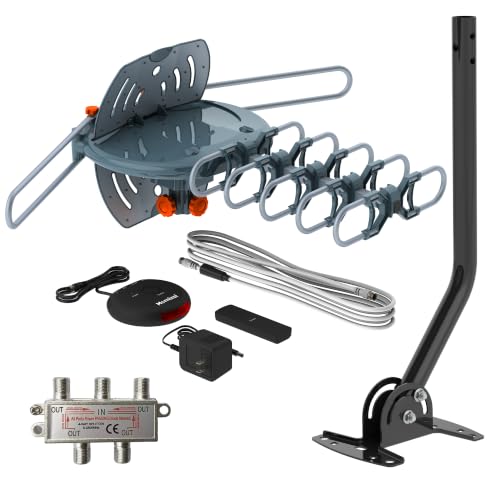
The Mornixol 360-Degree Motorized Outdoor TV Antenna is the searching pick in this roundup, and it is the antenna for a home behind a ridge where the best direction is not obvious. Its listing states a 360-degree motorized outdoor antenna with a J-pole, a 150-mile long-range reception, an antenna with an amplifier signal booster and a remote control, for 4K and 1080p televisions, with easy setup. The motor turns the antenna through a full circle by remote control, so the installer can search for the strongest direction from inside the house.
The motorized search is the reason to choose it. In hilly terrain, the strongest signal may come from a reflection off a neighboring slope, not from the direct line to the tower, and the best direction can only be found by trying. The Mornixol pick turns through 360 degrees while the viewer watches the picture, which finds the best angle without a roof climb. The 150-mile range covers most hilly distances, the amplifier signal booster lifts the signal for the cable run, and the J-pole puts the antenna above the roofline. For a home where the tower hides behind a ridge, it is the antenna that finds the signal.
Key specs:
- Mornixol TV Antenna Outdoor, 360-degree motorized
- J-pole included, 150 miles long range reception
- Amplifier signal booster and remote control
- For 4K 1080p HDTVs, easy setup
Strengths:
- Motorized 360-degree rotation searches for the best direction
- 150-mile range with an amplifier signal booster
- J-pole and remote control included
Trade-offs:
- A motorized antenna has moving parts that need care
- A 150-mile rating is a best-case figure
- Rotation adds setup time compared with a fixed Yagi
This antenna fits a home behind a ridge where the best direction is unknown. It is the pick for searching for the strongest signal.
Best for: a home behind a ridge where the best direction is not obvious. Not suited for: a home with towers in one known direction, or one that wants a fixed Yagi.
Check price on Amazon: Mornixol 360-Degree Motorized Outdoor TV Antenna
Buying guide: choosing an antenna for hilly terrain
Read the terrain before buying the antenna
Before buying any antenna, find the towers from the home address and note the ridges between the house and each tower. A home in a valley may sit 30 miles from a tower and receive nothing, while a home on a ridge 60 miles away receives a clear picture. Free online tools show tower locations and the terrain between them and an address. The result decides whether the home needs a directional Yagi, a motorized antenna that can search, or simply a taller mast. The picks in this roundup cover all three cases.
Mount high, above the ridge if possible
Height is the cheapest gain in hilly terrain. An antenna that clears the ridge sees a stronger signal than one that sits below it, because the signal has fewer obstacles to pass through. Use the tallest mast the house and the local rules allow, and put the antenna on the highest point of the roof. The Five Star pick includes a mounting pole, and the Mornixol motorized pick includes a J-pole. A few feet of height can matter more than a bigger antenna, and it costs far less.
Aim through the gap, not at the tower
A directional Yagi should be aimed through the lowest gap in the ridge, not simply at the tower, because the signal bends and reflects around the hill. The best aim is found by trying: turn the antenna slowly while watching the picture, and stop where the signal is strongest. The Mornixol motorized pick does this by remote control from indoors. The Yagi picks need a roof visit, but the aim only needs setting once. A signal meter, built into some antennas or available as a separate tool, makes the search faster.
Expect the signal to change with the seasons
Trees grow leaves in spring and lose them in autumn, and a signal that passes through trees changes with them. A picture that is clear in winter can break up in summer when the leaves return. An antenna mounted above the treeline avoids the problem, and a motorized antenna can be re-aimed when the seasons change. Rescan the channels each spring and autumn, because stations sometimes change power and the tuner only finds channels during a scan.
Installing and caring for an antenna in hilly terrain
Ground the antenna and the mast
An outdoor antenna on a hilltop is the tallest metal object for some distance, so grounding matters. Connect the mast to a ground rod, and run the coaxial cable through a grounding block before it enters the house. A grounded antenna is safer in a storm, and grounding also reduces static and interference. The work takes an hour and a few dollars of hardware, and it protects the television as well as the antenna.
Brace the mast against hilltop wind
Wind funnels over a ridge and hits a hilltop antenna harder than one on flat ground. A tall mast needs guy wires or a sturdy bracket, and the antenna needs its bolts checked each spring. The Winegard pick in this roundup is built heavy-duty for exactly this reason, but any antenna on an exposed hilltop needs a solid mount. A mast that sways in the wind moves the antenna, and a moving antenna loses the signal.
Weatherproof every connection
Water in a coaxial connection corrodes the copper and weakens the signal over months. Wrap every outdoor connection with weatherproof tape or a silicone boot, and point the connector ends downward so water runs off instead of pooling. Check the connections each spring, and replace any tape that has cracked or peeled. The antennas in this roundup are outdoor rated, but the connections are the weak point, and a little tape keeps them dry.
Rescan channels after moving the antenna
Television tuners remember the channels they found during the last scan, so a moved antenna needs a fresh scan. Run a channel scan on the television after installing or re-aiming the antenna, and run it again after a storm or a season change, because stations sometimes move or change power. A rescan takes a few minutes and often finds channels that were missing after the last one.
Common mistakes with antennas around hills
Buying an omnidirectional antenna for a valley
An omnidirectional antenna listens in every direction, which sounds useful in a valley, but it gathers the reflections as well as the signal, and the tuner can struggle to choose between them. A directional Yagi, like the GE, McDuory, Winegard, or Five Star picks here, focuses on the tower direction and ignores the rest. In a valley, focus beats coverage, and a Yagi is the right tool.
Mounting the antenna too low
An antenna below the roofline sees a weaker signal than one above it, because the hill and the trees block the path to the tower. If the picture is weak, raising the antenna by a few feet often helps more than buying a bigger one. Use the tallest mount the house allows, and keep the antenna clear of the roofline and any metal chimney.
Aiming at the tower instead of through the gap
The direct line to a tower may pass through the thickest part of a ridge, while a gap a few degrees to the side offers a clear path. A Yagi aimed at the tower can receive less than one aimed through the gap. Turn the antenna slowly while watching the picture, and stop where the signal is strongest, even if that direction is not exactly at the tower. The Mornixol motorized pick makes this search a living-room job.
Forgetting that trees change the signal
A signal that passes through trees weakens when the leaves return in spring, and a picture that was clear in winter can break up in summer. An antenna mounted above the treeline avoids the problem, and a rescan each spring finds channels the tuner lost. If the picture worsens every spring, the trees are the cause, and height is the fix.
Our recommendation
For most hilly homes, the Winegard HD7698A Heavy-Duty Outdoor Yagi TV Antenna is the best antenna around hills. Its heavy-duty Yagi design gathers the signal from the tower direction, its 65-mile range covers most hilly distances, and its rugged build survives the wind on an exposed hilltop. Homes deep in a valley or far from their towers should take the Five Star 200-mile upgraded Yagi instead, for the longest reach in this roundup. Homes where the best direction is unknown should take the Mornixol 150-mile motorized pick, which searches for the strongest signal by remote control. Homes on a gentle slope should take the Mornixol 70-mile pick for a simple install, and homes that want a Yagi with a choice of mounts should take the GE or McDuory pick.
Whichever pick fits, mount it high, aim it through the gap in the ridge, and rescan the channels after installation. Hilly terrain rewards a good installation as much as a good antenna, and these six picks give every hilly home a way to watch free local television without a monthly bill.
Related reading on Reviewstook: see our guides to long range TV antennas, digital antennas for rural areas, TV antenna guide for more on this topic.
Frequently asked questions about antennas around hills
Why does a hill block TV reception?
A hill blocks the direct path between the broadcast tower and the house, so only a weaker reflected signal, or a signal that bends over the ridge, reaches the antenna. A directional antenna gathers that weak signal better than an omnidirectional one, and a taller mount sees over more of the hill.
Is a Yagi antenna better for hilly terrain?
Usually, yes. A Yagi focuses its reception in one direction, which gathers more signal from a distant tower than an antenna that listens everywhere at once. The GE, McDuory, Winegard, and Five Star picks in this roundup are Yagi designs, and they suit homes with towers in one direction.
How high should I mount an antenna in hilly terrain?
As high as the house and the local rules allow. An antenna that clears the ridge sees a stronger signal than one that sits below it. A tall mast, a chimney mount, or a pole on the highest point of the property all help. A few feet of height can matter more than a bigger antenna.
Should I buy a motorized antenna for a valley home?
It helps when the best direction is unknown. The Mornixol motorized pick in this roundup rotates 360 degrees by remote control, so it can search for the strongest signal, including reflections off a neighboring slope, without a roof climb. If the tower direction is known, a fixed Yagi is simpler.
Do trees affect TV reception in hilly areas?
Yes. A signal that passes through trees weakens when the leaves return in spring, and a picture that was clear in winter can break up in summer. Mounting the antenna above the treeline avoids the problem, and rescanning the channels each spring finds channels the tuner lost.
How often should I rescan for channels?
Rescan after installing or moving the antenna, after a storm, and when a station is missing. Stations sometimes change power or frequency, and a tuner only finds channels during a scan. A rescan takes a few minutes and often recovers channels the tuner had lost.


