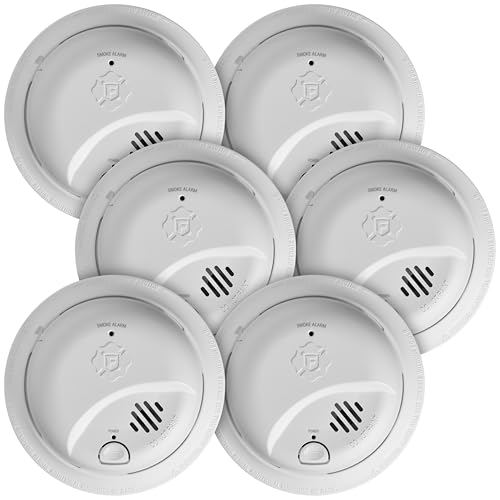
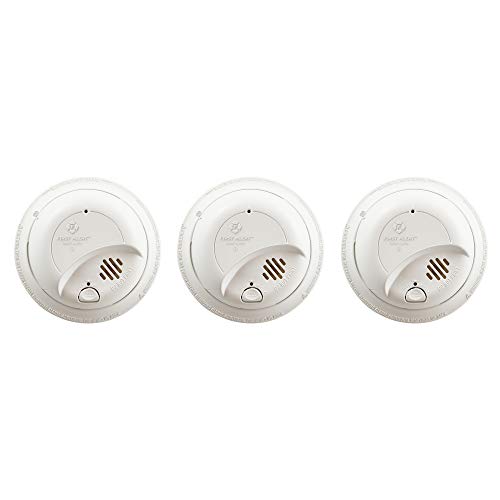
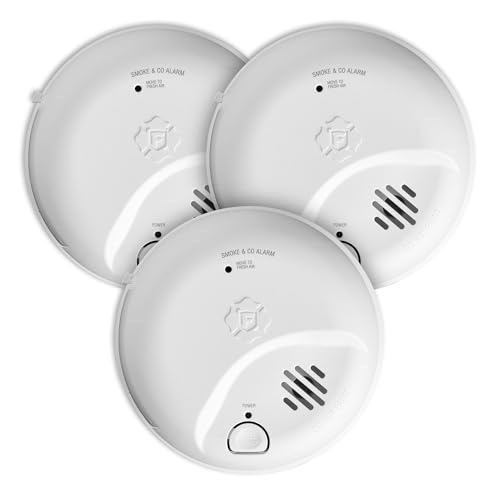
The best battery operated smoke and carbon monoxide detectors are the ones that work in the rooms that need them most: bedrooms, hallways, and rentals where nobody ran alarm wiring. A battery combo alarm detects two different threats with one unit on the ceiling. Smoke from a fire and carbon monoxide from a faulty furnace, a blocked flue, or a gas appliance are both silent killers, and a single alarm that covers both is the simplest protection a home can have.
This guide compares six battery-operated combo detectors, all verified against the site’s own product lookup with the brand and model checked against each listing. Three come from First Alert, the best-known name in the category, covering the standard battery model, a slim-profile version, and a sealed 10-year battery model. Two come from X-Sense, with an LCD display model and a five-pack for whole-home coverage. One comes from Kidde, the other mainstream brand, with a sealed battery and LED status lights.
Battery alarms have one job that wired alarms cannot do: they go anywhere. No junction box, no electrician, no rewiring. That freedom is also their weakness, because a battery alarm only protects you if the battery is good and the alarm is tested. The picks below are ordered from the simplest battery model to the sealed-battery models that remove the battery problem entirely, and the guide explains where to put each one and how to keep it working.
In this guide
Quick picks: best battery operated smoke and carbon monoxide detectors
| # | Product | Where to buy |
|---|---|---|
| 1 | First Alert SMCO100 | Check on Amazon |
| 2 | First Alert SMCO200 | Check on Amazon |
| 3 | First Alert SMCO210 | Check on Amazon |
| 4 | X-Sense SC07 | Check on Amazon |
| 5 | X-Sense SC06 5-Pack | Check on Amazon |
| 6 | Kidde 30CUD10 | Check on Amazon |
How the picks were chosen
We started with the product lookup and kept only battery-operated combination detectors: units that detect smoke and carbon monoxide, and that run on batteries rather than house wiring. Hardwired models were left out, because the keyword is battery operated, and a hardwired alarm with a battery backup is a different product for a different installation. Smoke-only alarms and CO-only detectors were also left out, because a combo unit is what this keyword asks for.
Each candidate was checked by fetching its full listing title, which is how renewed or refurbished units are caught: the short search title can hide the word Renewed, but the full title shows it. No renewed units made the list. The six picks were then sorted by battery type and by coverage: replaceable-battery models for flexibility, sealed 10-year models for fit-and-forget protection, a display model for anyone who wants to see CO levels, and a five-pack for whole-home coverage.
We also checked that each pick is a genuine combination detector rather than a smoke alarm with a CO label slapped on, or a CO detector that happens to mention smoke. The listing titles name both sensors and the relevant certification, and the picks cover the three brands that dominate this category, so a reader can match the model in this guide to the unit on the shelf without confusion.
What a battery combo detector actually does
A combination detector has two sensors in one housing. The smoke sensor watches for the particles a fire produces, and the CO sensor watches for carbon monoxide, the colorless and odorless gas that faulty fuel-burning appliances can release. The alarm sounds the same loud tone for both threats, because the response is the same: get out, then call for help from outside.
Battery operated means the alarm runs entirely on its own power. Some models use replaceable batteries that you change once or twice a year. Others use a sealed lithium battery that lasts ten years and cannot be removed, so the alarm cannot be disabled by taking the battery out. Both types are battery operated; the sealed type simply removes the maintenance that people most often forget.
A battery combo detector is not the same as a wired interconnected system. In a wired system, one alarm going off triggers all the others, so a fire in the kitchen wakes the bedrooms upstairs. Battery alarms in this guide are standalone units: each one sounds on its own. That is a real limitation for large homes, and the guide covers how to place several standalone units to cover it.
What makes the best battery operated smoke and carbon monoxide detectors worth buying
First, the sensors must be certified. Look for UL 217 for smoke and UL 2034 for carbon monoxide on the listing: those are the standards that govern how quickly an alarm must respond and how it must behave. Every pick in this guide carries the relevant certification in its listing, and the X-Sense models name both standards explicitly.
Second, the battery decides how much attention the alarm needs. A sealed 10-year battery is the best choice for bedrooms and rentals, because it cannot be removed and never chirps at night. A replaceable-battery model costs less upfront and lets you keep the same alarm for years by changing cells, but only if you actually change them. Third, think about the extras that help in real use: an LCD that shows CO levels, LED lights that show the alarm is powered, and a slim housing that looks right on a visible ceiling.
Fourth, buy for the house you have, not the house you imagine. Count the bedrooms, the levels, and the fuel-burning appliances before you order, and buy the pack size that covers them all. A five-pack that covers the whole house costs less per unit than five separate single alarms, and it arrives in one box with one set of instructions.
Quick picks at a glance
| Product | Power | Sensors | Extras | Best for |
|---|---|---|---|---|
| First Alert SMCO100 | Replaceable batteries | Smoke + CO | None listed | Any room |
| First Alert SMCO200 | Replaceable batteries | Smoke + CO | Slim profile | Living spaces |
| First Alert SMCO210 | 10-year sealed battery | Smoke + CO | Slim profile | Bedrooms, rentals |
| X-Sense SC07 | 10-year sealed battery | Smoke + CO | LCD display | Single room |
| X-Sense SC06 | 10-year sealed battery | Smoke + CO | 5-pack | Whole home |
| Kidde 30CUD10 | 10-year battery | Smoke + CO | LED status lights | Single room |
The picks in detail
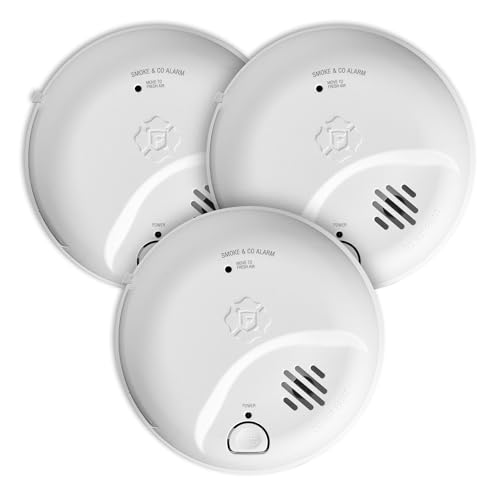
First Alert Battery Combination Smoke and Carbon Monoxide Alarm – SMCO100
The First Alert SMCO100 is the straightforward choice in this group: a battery-operated combination alarm that detects smoke and carbon monoxide in one unit, with no wiring and no electrician. You mount it on the ceiling or high on a wall, put the batteries in, and it protects the room from the two threats that kill silently in a home fire or a heating fault. First Alert is the best-known name in this category, and the SMCO100 is its standard battery combo model.
Because it runs on batteries, the SMCO100 goes anywhere a wired alarm cannot: a rented apartment, a bedroom with no ceiling wiring, a hallway, or a home office. There is no interconnect wire to run and no junction box to find. That freedom is the whole point of a battery-operated detector, and it is why this model suits renters and homeowners who need protection in a room that was never wired for an alarm.
The SMCO100 detects both smoke and carbon monoxide, which matters because the two threats need different sensors and most homes need both. A smoke-only alarm cannot warn you about CO from a faulty furnace or a blocked flue, and a CO-only alarm cannot warn you about a smoldering fire. One combo unit on the ceiling covers both, and it costs less than buying two separate alarms.
The SMCO100 is also the easiest alarm to replace. Because it is a standard First Alert model, a matching unit is available in most hardware stores, so a house fitted with SMCO100 alarms can be kept consistent for years. Consistency matters: one test routine, one battery type, and one set of instructions for the whole household.
Key specs:
- Battery-operated combination smoke and CO alarm
- Detects smoke and carbon monoxide in one unit
- Model SMCO100
Strengths:
- No wiring needed, so it fits any room
- One unit covers both smoke and CO
- First Alert is a widely available, established brand
Trade-offs:
- Batteries need regular replacement
- No sealed 10-year battery in this model
- No display showing CO levels
Renters and homeowners who need a simple battery alarm in a room with no wiring. It suits bedrooms, hallways, and home offices where a combo alarm is needed quickly and without an electrician.
Best for: a simple battery combo alarm anywhere Not suited for: whole-home coverage where interconnected alarms are required
Check price on Amazon: First Alert SMCO100

First Alert Battery Combination Smoke and Carbon Monoxide Alarm – SMCO200, Slim Profile
The First Alert SMCO200 is the slim-profile version of the battery combo alarm. It detects smoke and carbon monoxide on batteries, like the SMCO100, but in a lower-profile housing that sits closer to the ceiling. In a hallway or a bedroom with a low ceiling, that matters: a bulky alarm is the first thing your eye catches, while a slim one blends into the ceiling and stays out of the way.
The slim design also helps in rooms where the alarm mounts near a door frame, a beam, or a light fixture. A deep housing can clash with trim or cast a shadow; the SMCO200 keeps a clean line. The trade-off is the same as any battery alarm: you replace the batteries on schedule, and you test the alarm monthly with the test button.
Functionally, the SMCO200 is the same job as the SMCO100: one battery unit, two sensors, no wiring. Choose the SMCO200 when the alarm will be visible in a living space and you want it to sit discreetly. Choose the SMCO100 when the alarm will be tucked in a hallway or a utility room and the profile does not matter.
The slim housing also helps in rooms with ceiling fans or low-hanging lights, where a deep alarm can sit too close to moving blades or cast a shadow on the ceiling. A lower profile keeps the alarm clear of the fan sweep and out of the light, which is a small detail that matters every day you look at the ceiling.
Key specs:
- Battery-operated combination smoke and CO alarm
- Slim profile housing
- Model SMCO200
Strengths:
- Slim housing sits discreetly on the ceiling
- Battery powered, so no wiring is needed
- Covers smoke and CO in one unit
Trade-offs:
- Batteries need regular replacement
- No sealed 10-year battery in this model
- No display showing CO levels
Living rooms, bedrooms, and hallways where the alarm is visible and a low profile matters. It suits anyone who wants the protection of a combo alarm without a bulky box on the ceiling.
Best for: visible rooms where a slim alarm matters Not suited for: homes that need a sealed 10-year battery
Check price on Amazon: First Alert SMCO200
First Alert 10-Year Battery Combination Smoke and Carbon Monoxide Alarm – SMCO210
The First Alert SMCO210 solves the main weakness of battery alarms: the batteries. It uses a sealed 10-year battery, so there is no annual battery change and no low-battery chirp in the middle of the night. The alarm is designed to last a decade, and when the battery finally runs down, you replace the whole unit. That is a fair trade for ten years of never thinking about batteries.
The SMCO210 keeps the slim profile design, so it sits neatly on the ceiling, and it detects smoke and carbon monoxide in one unit. The sealed battery also removes the most common reason alarms get disabled: people take the batteries out to stop the chirp and forget to put them back. A sealed battery cannot be removed, so the alarm stays in service.
This is the pick for anyone who has been woken by a chirping alarm at 3 a.m. or who manages a rental and cannot rely on tenants to change batteries. The upfront cost is higher than a replaceable-battery model, but ten years without battery changes and without chirps is worth it for most households.
The sealed battery also changes the economics. Ten years of replaceable batteries, bought one set at a time, costs more than the difference between this model and a cheaper battery alarm, and that is before counting the nights a chirping alarm costs you sleep. Paying more once is cheaper than paying a little every year.
Key specs:
- 10-year sealed battery, no replacements
- Combination smoke and CO detection
- Slim profile design, model SMCO210
Strengths:
- Sealed 10-year battery ends battery changes
- No low-battery chirp to wake the house
- Slim profile suits visible ceilings
Trade-offs:
- The whole unit must be replaced after 10 years
- Higher upfront cost than replaceable-battery models
- No display showing CO levels
Bedrooms and rentals where a chirping alarm is a real problem. It suits anyone who wants to fit an alarm and forget about it for a decade, and landlords who need protection that tenants cannot disable by removing batteries.
Best for: fit-and-forget protection for 10 years Not suited for: anyone who prefers a replaceable-battery alarm
Check price on Amazon: First Alert SMCO210

X-Sense Smoke Detector Carbon Monoxide Detector Combo – SC07, 1-Pack
The X-Sense SC07 is a single battery combo detector with a 10-year sealed battery and an LCD display. The display is the feature that sets it apart from the First Alert picks: it shows real-time carbon monoxide levels and the battery status, so you can see what the alarm sees instead of guessing. A small CO reading that never reaches the alarm threshold still shows up, which is useful if you want to know whether a furnace or a heater is producing low levels of CO.
The SC07 is certified to UL 217 and UL 2034, the two standards that matter for smoke and CO alarms in the United States. It is not hardwired, so it mounts anywhere with screws and runs on its sealed battery for a decade. The 1-pack is the right size for a single room: a bedroom, a home office, or the hallway outside the bedrooms.
X-Sense has built its name on this kind of detector, and the SC07 is its standard combo model. The LCD, the sealed battery, and the dual certification make it the most informative single-room alarm in this group, and the 1-pack keeps the cost down when you only need one.
The display also helps after an alarm event. If the alarm has sounded and then stopped, the display shows the peak CO level it recorded, which tells the fire crew or the gas technician what happened. That reading can point to the appliance at fault and speed up the repair, instead of leaving everyone guessing.
Key specs:
- 10-year sealed battery, not hardwired
- LCD display with real-time CO and battery levels
- UL 217 and UL 2034 certified; model SC07; 1-pack
Strengths:
- LCD shows real-time CO levels
- Sealed 10-year battery, no replacements
- Dual UL certification for smoke and CO
Trade-offs:
- One pack covers one room only
- No wireless interconnect to other alarms
- The display is small and needs a close look
A single bedroom or home office where you want to see CO levels as well as hear the alarm. It suits anyone with a gas furnace, a gas water heater, or a fireplace who wants early warning of low CO levels.
Best for: one room with a visible CO display Not suited for: whole-home coverage from a single purchase
Check price on Amazon: X-Sense SC07

X-Sense Smoke and Carbon Monoxide Alarm – SC06, 5-Pack
The X-Sense SC06 5-pack is the whole-home version of the battery combo detector. Five units with 10-year sealed batteries cover the bedrooms, the hallway, the living room, and the room with the furnace, so the whole house gets smoke and CO protection in one purchase. Each unit is certified to UL 217 and UL 2034, and each runs on its own sealed battery, so there is no wiring and no battery change for a decade.
Buying a 5-pack also solves the coverage problem that single alarms miss. A single alarm in the hallway cannot protect a bedroom with the door closed, and a CO alarm on the ground floor cannot protect a bedroom upstairs. Five units let you place one alarm in each sleeping area and one near the fuel-burning appliance, which is the layout safety guidance recommends.
The SC06 does not have the SC07 display, which is the trade-off for the lower per-unit cost of a multi-pack. If you want a display in the bedroom, pair one SC07 with this pack. For the rest of the house, the SC06 gives the same sensors and the same sealed battery at a better price per unit.
The five-pack also keeps the house consistent. One model, one battery type, one test routine, and one replacement date ten years out. When the time comes to replace them, you buy one more five-pack and do the whole house in an afternoon, instead of tracking five different alarms bought at different times.
Key specs:
- 10-year sealed battery, not hardwired
- 5-pack of smoke and CO alarms
- UL 217 and UL 2034 certified; model SC06
Strengths:
- Five units cover a whole home in one purchase
- Sealed 10-year batteries, no replacements
- Same dual certification as the single-pack models
Trade-offs:
- No LCD display on this model
- No wireless interconnect between units
- Five units to mount and test instead of one
A house or large apartment that needs several alarms at once. It suits new homeowners, landlords fitting out a rental, and anyone replacing a set of old alarms in one go.
Best for: whole-home coverage in one box Not suited for: a single room, where a 1-pack costs less
Check price on Amazon: X-Sense SC06 5-Pack

Kidde Smoke and Carbon Monoxide Detector – 30CUD10, 1 Pack
The Kidde 30CUD10 is a 10-year battery smoke and CO detector in a single pack, with LED status lights and a loud 85-decibel alarm. Kidde is the other big name in this category alongside First Alert, and the 30CUD10 is its sealed-battery combo model. The 10-year battery means no replacements and no low-battery chirps for a decade, and the LED lights show at a glance whether the unit is working.
The 30CUD10 detects smoke and CO together, so one unit on the ceiling covers both threats. The LED status lights are a small but useful detail: a glance from the doorway tells you the alarm is powered and monitoring, without climbing a ladder to press the test button. The 1-pack suits a single room, and the model is easy to find in stores if you need a matching second unit later.
Kidde alarms are widely stocked, which matters when you need a replacement quickly or want the same model throughout the house. The 30CUD10 is the safe, mainstream choice in this group: a known brand, a sealed battery, and a clear set of lights that tell you the alarm is doing its job.
The LED lights also help during the monthly test. A green light means the unit is powered and monitoring, so a glance from the floor tells you the alarm is alive without climbing a ladder. That small convenience is what turns a monthly test from a chore into a habit that actually happens.
Key specs:
- 10-year battery, no replacements
- Smoke and CO detection with LED status lights
- Model 30CUD10, 1 pack; loud 85 dB alarm
Strengths:
- Sealed 10-year battery, no chirps
- LED lights show status at a glance
- Kidde is widely stocked and easy to match
Trade-offs:
- No LCD display for CO levels
- One pack covers one room only
- No wireless interconnect to other alarms
A single bedroom, hallway, or apartment that needs a reliable sealed-battery combo alarm from a mainstream brand. It suits anyone who wants the simplest possible choice: fit it, test it, and forget it for ten years.
Best for: a mainstream sealed-battery combo alarm Not suited for: homes that need interconnected alarms
Check price on Amazon: Kidde 30CUD10
Buying guide: choosing the right battery combo detector
Sealed battery or replaceable batteries
A sealed 10-year battery is the best choice for most people. It removes the two most common failures of battery alarms: dead batteries and batteries removed to stop a chirp. The alarm is designed to be replaced as a whole unit after ten years, which is also when safety guidance says to replace smoke alarms anyway.
A replaceable-battery model makes sense when the budget is tight or when you already keep a stock of the right cells and test alarms on a schedule. It also lets you keep an alarm you like for longer than ten years by swapping cells, although the sensor itself ages and should still be replaced on schedule.
How many alarms, and where
Safety guidance says to put a smoke alarm inside every bedroom, outside each sleeping area, and on every level of the home, including the basement. CO alarms belong near sleeping areas and near fuel-burning appliances such as furnaces, water heaters, and fireplaces. A combo alarm placed outside the bedrooms covers both jobs at once.
A single alarm cannot protect a house. Smoke and CO do not travel well through closed doors, so a bedroom with the door shut needs its own alarm. The five-pack in this guide exists for exactly that reason: one purchase covers the bedrooms, the hallway, and the room with the furnace.
Display, lights, and interconnect
An LCD display is worth having in at least one alarm, ideally the one nearest the furnace or the bedrooms. It shows low CO levels that never reach the alarm threshold, which can reveal a developing problem with a heater or a flue before it becomes dangerous.
LED status lights are a smaller help, but a useful one: a glance from the doorway shows the alarm is powered. Interconnect is the feature these battery models lack, and it matters in larger homes. If your home has several floors, consider a wired or wireless interconnected system as well, and use battery combo alarms to fill the gaps.
What to check before you buy
Check the battery type in the listing before ordering: sealed 10-year or replaceable. Check the pack size: a 1-pack covers one room, and a 5-pack covers a home. Check the certifications, UL 217 and UL 2034, and check the listing for the word Renewed, which marks a used or refurbished unit that should not be trusted for life safety.
Also check the date. Smoke and CO alarms have a rated life, usually ten years from manufacture, and an alarm that has sat in a warehouse for years has less life left. Buy from a listing that moves stock, and write the installation date on the alarm when you mount it.
Using and caring for your detectors
Testing every month
Press the test button once a month and listen for the alarm. A monthly test takes ten seconds and is the only way to know the alarm works. If the alarm does not sound, replace the batteries if they are replaceable, and replace the unit if it still does not sound.
Test after any long absence, after a power cut, and after any work on the heating system. A detector that has never been tested is a decoration, not protection.
Batteries and replacement dates
For replaceable-battery models, change the batteries at least once a year, and immediately if the alarm chirps. Use the battery type the maker specifies: the wrong cell can leak or fail early. For sealed-battery models, there is nothing to change, but write the replacement date on the unit when you install it and replace the whole alarm when that date arrives.
Smoke alarms should be replaced every ten years, even if they still test well, because the sensor degrades with age. CO sensors age too, and many makers rate them for seven to ten years. The sealed-battery models in this guide are built around that ten-year life.
Keeping the alarm clean
Dust is the enemy of a smoke sensor. Vacuum the alarm gently with a soft brush attachment every few months, and wipe the outside with a dry cloth. Never paint over an alarm, never cover it, and never spray cleaner or insect spray near it: any of those can block the sensor or trigger a false alarm.
Keep the alarm away from steam and cooking fumes where possible, because both cause nuisance alarms. A detector in a bathroom or directly above a stove will cry wolf, and a household that ignores its alarms is worse off than one with fewer alarms that it trusts.
Common mistakes to avoid
Mounting the alarm in the wrong place
The most common mistake is putting the alarm where it cannot sense danger: in a corner, behind a door, or in the dead-air space where the wall meets the ceiling. Mount smoke alarms on the ceiling, at least a short distance from the wall, or high on a wall if the ceiling is not an option. Follow the spacing in the instructions that come with the alarm.
Removing the battery to stop a chirp
A chirping alarm is telling you the battery is low, not that the alarm is broken. Replacing the battery takes a minute. Taking the battery out and forgetting it leaves the room unprotected, and that is how most alarm failures happen. A sealed-battery alarm removes this temptation entirely.
Relying on a single alarm for a whole house
One alarm in the hallway cannot protect a bedroom with the door closed, and it cannot detect CO from a basement furnace before the gas reaches the upper floors. Count the sleeping areas and the levels of your home, and buy enough units to cover them. A five-pack is cheaper than five separate purchases for a reason.
Ignoring a CO alarm
A carbon monoxide alarm is not a nuisance alarm. If it sounds, get everyone outside into fresh air first, then call emergency services or the gas company from outside. Do not open windows and wait, do not look for the source yourself, and do not silence the alarm and go back to bed. CO is odorless, and symptoms can come on without warning.
Final recommendation
For most homes, the best battery operated smoke and carbon monoxide detectors in this guide are the sealed-battery models, and the First Alert SMCO210 is the simplest choice: a slim profile, a ten-year sealed battery, and no maintenance beyond a monthly test. If you want to see CO levels as well as hear the alarm, add the X-Sense SC07 with its LCD display in the bedroom or near the furnace.
If you need to protect a whole house at once, the X-Sense SC06 five-pack is the value buy: five sealed-battery combo alarms in one box, enough for the bedrooms, the hallway, and the room with the heating equipment. Whatever you choose, mount one alarm in every sleeping area, test it monthly, and replace it on schedule. A detector only saves lives if it is fitted, powered, and working.
Do not put this off. A smoke and CO alarm is the cheapest life-safety device in a home, and the alarms in this guide can be fitted in an afternoon with a drill and a screwdriver. Order the pack that covers your house, mount the alarms this weekend, and write the test date on your calendar. The alarm you fit today is the one that wakes you tonight.
Related reading on Reviewstook: see our guides to hardwire smoke detectors, residential smoke detectors, where to hang smoke detectors for more on this topic.
Frequently asked questions
How many battery combo detectors does a home need?
Safety guidance recommends a smoke alarm inside every bedroom, outside each sleeping area, and on every level of the home. CO alarms belong near sleeping areas and near fuel-burning appliances. A combo alarm outside the bedrooms covers both jobs, but a single alarm cannot protect a whole house, so count the rooms and buy enough units.
Are battery operated detectors as safe as hardwired ones?
A battery alarm with a good battery and a monthly test protects just as well as a wired one in the room where it is fitted. The advantage of wired systems is interconnect: one alarm triggers all of them. Battery alarms are standalone, so a large home needs several of them, one in each sleeping area.
How long does a sealed 10-year battery detector last?
The sealed battery is designed to last the rated life of the alarm, usually ten years. When the battery runs down, the whole unit is replaced. Smoke sensors also degrade with age, so replacing the alarm every ten years matches the sensor life as well as the battery life.
Where should I put a carbon monoxide detector?
Put CO alarms near sleeping areas so they wake you at night, and near fuel-burning appliances such as furnaces, water heaters, and fireplaces. Do not put one directly above a stove or in a steamy bathroom, where fumes cause false alarms. Follow the spacing in the instructions that come with the alarm.
What should I do if the carbon monoxide alarm sounds?
Get everyone outside into fresh air immediately, then call emergency services or the gas company from outside. Do not open windows and wait, do not search for the source yourself, and do not silence the alarm and go back to bed. CO is odorless and symptoms can come on without warning.
Do battery combo detectors need Wi-Fi or an app?
No. The detectors in this guide are standalone alarms: they sense smoke and CO, sound their own alarm, and need no Wi-Fi, no app, and no hub. Smart detectors with app alerts exist, but they are a different product, and a basic battery alarm protects a room just as well without any connection at all.