Choosing a lens is the decision that shapes a Fujifilm kit more than any body upgrade. The X mount has been built around one APS-C sensor format since the beginning, so a lens bought for an older X-T body still mounts on a current X-T5, X-H2 or X-S20, and the six lenses in this guide cover the focal lengths most photographers actually reach for: a wide prime for street and travel, a standard prime for everyday scenes, a fast portrait prime, a premium kit zoom, and two constant-aperture standard zooms from Sigma and Tamron that mount natively on X. Every pick is a native X-mount lens, with no adapter involved anywhere in the list.
This guide may earn an affiliate commission when readers buy through retailer links, and that commission supports the site without changing which lenses appear here. The selections and the order rest on published manufacturer specifications, official lens catalogues and documented optical designs — research and buying guidance only, with no claim of laboratory measurement. Prices move constantly, so each pick closes with a prompt to check the current figure at the retailer rather than a number printed here that would age within weeks.
One piece of arithmetic runs through everything below. Fujifilm X sensors are APS-C, so focal lengths are multiplied by a crop factor of about 1.5x to find the full-frame equivalent view. A 23mm lens on X frames a scene much like a 35mm lens on full frame, a 35mm behaves like a standard lens of roughly 53mm, and a 56mm becomes a short telephoto near 85mm. Equivalents are stated beside every focal length in this guide so that readers arriving from full-frame systems, or from a phone, can translate without doing the multiplication each time.
The guide is organised to be read in layers. A short section on how X-mount lenses differ comes first, followed by a comparison table, a detailed buying guide, the six picks in full, and then kit-building advice for readers combining two or three lenses. Readers who already know their focal length can jump straight to the relevant pick; readers starting from a kit zoom and wondering what a prime would change should begin with the buying guide, where the prime-versus-zoom trade is explained in plain terms.
How the X-mount lens system works
Fujifilm divides its own lenses into two lines. XF lenses are the main line, built with metal barrels, aperture rings on most models and, in many cases, weather resistance. XC lenses are lighter, mostly plastic and positioned as affordable companions to entry-level bodies. Below, five of the six picks are XF designs or their third-party equivalents in intent; the Sigma and Tamron zooms compete directly with XF standard zooms on aperture and range. Sigma and Tamron both build dedicated X-mount versions of their APS-C lenses, with the mount, electronic contacts and firmware designed for Fujifilm bodies, so autofocus and aperture control work through the camera exactly as they do with a Fujinon lens.
Learning to read a Fujinon name repays the effort, because the name is a compressed specification. XF states the line, the number states the focal length or range, the f-number states the widest aperture, and the trailing letters state the features: R for an aperture ring, WR for weather resistance, LM for a linear autofocus motor and OIS for optical stabilisation in the lens. The Sigma and Tamron names follow their own makers’ codes — DC DN marks Sigma’s APS-C mirrorless line, while Tamron’s Di III-A marks its APS-C mirrorless designs, VC its stabilisation and RXD its stepping-motor drive — and the model code B070 identifies the Tamron pick exactly. A buyer who can decode those strings can also spot a mislabelled listing at a glance, which is a genuinely useful skill in a system where one letter separates two different products.
Two letters in Fujinon names carry practical weight. R means the lens has an aperture ring, which matters to photographers who set exposure by hand and prefer a physical dial for each control. WR means weather resistant: seals at the mount and barrel joints that resist dust and moisture during ordinary outdoor shooting. WR is not a promise of waterproofing, and no lens in this guide should be treated as safe to submerge or to leave unprotected in driving rain for hours. Paired with a weather-resistant body, a WR lens simply removes the need to stop at the first sign of drizzle.
Stabilisation is split across the system. Some Fujifilm bodies carry in-body image stabilisation, and some lenses add optical stabilisation of their own. Of the six picks, the Fujinon 18-55mm carries OIS in the lens and the Tamron 17-70mm carries Tamron VC; the primes and the Sigma zoom have no lens stabilisation and lean on the body. Owners of bodies without in-body stabilisation should weigh that difference carefully, because it decides how slow a shutter speed stays usable at dusk.
best fujifilm mirrorless cameras
That body question is covered in depth by the companion guide to Fujifilm camera bodies on this site, which walks through the current X-series range; this article stays on glass. It is also worth stating what is out of scope: the X100 series has a fixed lens and cannot take any pick here, and GFX medium-format lenses use a different mount entirely and do not fit X bodies.
In this guide
The six picks at a glance
| Lens | Type | Equivalent view | Widest aperture | Stabilisation | Weather resistance | Best suited to |
|---|---|---|---|---|---|---|
| Fujinon XF 23mm f/2 R WR | Prime | 35mm | f/2 | None in lens | Yes | Street, travel, everyday wide |
| Fujinon XF 35mm f/2 R WR | Prime | 53mm | f/2 | None in lens | Yes | Everyday, family, low light |
| Fujinon XF 56mm f/1.2 R WR | Prime | 85mm | f/1.2 | None in lens | Yes | Portraits, weddings, subject isolation |
| Fujinon XF 18-55mm f/2.8-4 R LM OIS | Zoom | 27-84mm | f/2.8-4 | OIS in lens | No | One-lens travel, kit upgrade |
| Sigma 18-50mm f/2.8 DC DN Contemporary | Zoom | 27-75mm | f/2.8 constant | None in lens | Mount gasket | Lightweight bright zoom, video |
| Tamron 17-70mm f/2.8 Di III-A VC RXD | Zoom | 25.5-105mm | f/2.8 constant | VC in lens | Moisture resistant | Widest and longest one-lens range |
The table compresses; it does not decide. Aperture figures, for example, mean different things on a prime that holds f/2 at one focal length and a zoom whose widest setting narrows as it zooms. The buying guide below unpacks each column before the individual reviews apply it.
What to look for in a Fujifilm X-mount lens
Focal length, translated through the 1.5x crop factor
Every focal length printed on an X-mount lens describes the lens, not the view. Multiply by roughly 1.5 to get the view: 18mm at the wide end of a zoom behaves like 27mm, wide enough for interiors and architecture without the extreme stretch of an ultra-wide; 23mm behaves like 35mm, the classic documentary framing; 35mm behaves like a standard lens; 50mm and beyond move into portrait territory. Photographers who think in phone terms can anchor on the fact that a main phone camera sits near the 24-26mm equivalent zone, so even the wide end of the zooms here will feel familiar, while the 23mm prime feels like a deliberate step tighter and calmer.
Aperture and what it buys
A wider maximum aperture does two jobs. It admits more light, which keeps shutter speeds up and ISO down indoors and after sunset. It also narrows depth of field, separating a subject from its background. The f/1.2 portrait prime is the extreme in this list, the f/2 primes balance light gathering against size, and the zooms trade a step or two of aperture for framing flexibility. A constant f/2.8 zoom holds that aperture across its whole range, which simplifies exposure and keeps depth of field consistent while zooming; a variable-aperture zoom such as the 18-55mm starts at f/2.8 and reaches f/4 at the long end, a modest and honest compromise for its size.
Depth of field and the equivalence question
Equivalence cuts both ways, and honest buying advice says so. The same crop factor that translates focal length also means an f/2 prime on X produces depth of field resembling a lens stopped down somewhat further on full frame at the same framing. Portrait photographers chasing the thinnest possible depth of field therefore gravitate to the fastest glass in the system, which is exactly why the f/1.2 pick holds its place here, while photographers who value generous depth of field — landscape, street and documentary shooters who want a scene readable front to back — often find the APS-C behaviour a quiet advantage. Neither effect changes exposure: f/2 gathers f/2 light on any format. Separating those two ideas, light gathering and depth of field, prevents the most common misunderstanding in X-system lens shopping.
Prime versus zoom
A prime fixes the framing and asks the photographer to move. In exchange it is smaller, lighter and usually faster than a zoom covering the same focal length, and many photographers find that one fixed view simplifies decisions on a walk. A zoom trades that purity for coverage: one lens frames a street scene, a group and a detail in sequence. Neither is the correct answer in the abstract. The pattern that recurs in Fujifilm kits is a small prime for daily carry plus a zoom for travel and events, which is why this guide mixes three of each.
Stabilisation, in the lens or in the body
Optical stabilisation in a lens and in-body stabilisation in a camera solve the same problem from different ends, and the two can work together on many Fujifilm bodies. For stills at slow shutter speeds and for handheld video, stabilisation is the difference between a usable frame and a blurred one once light drops. Prime shooters on stabilised bodies lose little; prime shooters on unstabilised bodies should treat shutter speed discipline as part of the craft. Video shooters should note that lens-based stabilisation such as the Tamron VC or the Fujinon OIS tends to smooth handheld footage in a way that pairs naturally with a gimbal-free, documentary style.
Weather resistance, stated honestly
WR on a Fujinon lens and the moisture-resistant construction on the Tamron indicate seals against dust and splashes, not immersion. The practical reading is confidence in light rain and dusty streets, plus a lens that tolerates being wiped down and carried on. The Sigma zoom carries a gasket at the mount rather than full sealing, a smaller promise that still keeps dust out of the body joint. Readers whose work involves sustained rain should plan on covers regardless of which pick they choose.
Autofocus motors and quiet operation
Fujifilm marks linear-motor lenses LM, and those designs move focus groups quickly and quietly, which matters for video soundtracks and for tracking moving subjects. Stepping motors in the compact f/2 primes are also quiet and well suited to video on a small scale, while older screw-driven designs are absent from this list entirely. The Sigma uses a stepping motor and the Tamron its RXD stepping-motor unit; both makers publish firmware through Fujifilm-compatible update routes, so checking for lens firmware updates is part of ownership with third-party glass, just as body firmware is with Fujifilm lenses.
Aperture rings and the Fujifilm way of shooting
A physical aperture ring is part of the Fujifilm experience for many owners, and the four Fujinon picks all provide one. The Sigma and Tamron zooms omit the ring, so aperture is set from a body dial instead. That is a genuine ergonomic difference, not a defect: some photographers never touch the ring, while others build their whole exposure habit around it. Handling preference here is a legitimate deciding factor between the native zooms and the third-party pair.
Size, weight and filter threads
The compact primes weigh between 170g and 180g and share a 43mm filter thread, so one polariser serves both. The portrait prime is a more substantial 445g with a 67mm thread. Among the zooms, the Sigma is the featherweight at about 285g with a 55mm thread, the Fujinon 18-55mm sits near 310g with a 58mm thread, and the Tamron is the heavyweight near 530g with a 67mm thread. On small bodies such as the X-S20 or X-T30 line, front-heavy lenses change the handling balance, and the table weights deserve as much attention as the optical figures.
Resolution and the 40-megapixel sensors
The newest X bodies resolve 40 megapixels, which asks more of a lens than the 26-megapixel generation did. All six picks are modern designs documented by their makers as suitable for current high-resolution X sensors, but the practical advice is simple: readers pairing a lens with an X-T5 or X-H2 for large prints should favour the newer optical designs in this list and should not expect any lens to hide poor technique at that pixel density. Focus accuracy and shutter discipline show up first at 40 megapixels.
Video considerations
Hybrid shooters should weigh three traits: quiet autofocus, minimal focus breathing and stabilisation. The two constant f/2.8 zooms are the natural video picks here, the Tamron adding in-lens stabilisation and the Sigma adding the smallest footprint for gimbal work. The primes remain excellent for controlled, tripod-led or deliberate handheld video where their aperture is the point. Focus breathing figures are published by the makers for the newer designs and are worth checking against the specific body and firmware in use.
Close focusing and magnification
Minimum focus distance quietly decides how versatile a lens feels on a trip. A wide prime that focuses to 22cm can frame a plate of food, a market detail or a child’s hands at work without stepping back, while a zoom whose close focus only applies at its wide end asks for a small dance of zooming and repositioning. The Sigma’s roughly 12cm wide-end minimum is the extreme in this list and borders on macro territory for casual detail work, though none of these six is a true macro lens; Fujifilm’s dedicated macro designs sit elsewhere in the catalogue for readers whose main subject is small. Checking the minimum focus figure, and the magnification it produces, prevents the common disappointment of a lens that cannot get close enough to the subjects its owner photographs most.
Buying used and reading a listing carefully
The X mount’s long history means a healthy used market, and it also means names repeat across generations. The 56mm f/1.2 exists in an older R form and the current R WR form; the 23mm focal length exists at f/2 and at f/1.4; the third-party zooms exist in several mounts that share one product name. A listing title is therefore evidence, not proof. Confirm the mount, the exact aperture and the letter suffixes against the maker’s product page before paying, check that a used copy includes its hood and caps, and treat any listing that cannot state the mount plainly as a listing to walk away from. That discipline matters even more with the Sigma and Tamron picks, where the same barrel is manufactured for three or four systems.
The six picks in detail

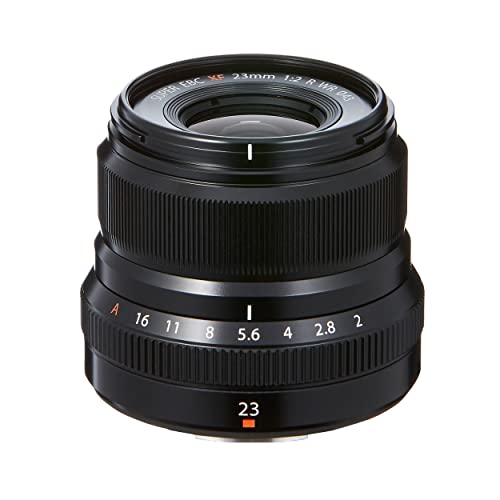
Fujinon XF 23mm f/2 R WR
The 23mm f/2 is the lens that turns a Fujifilm body into a dedicated everyday camera. Its 35mm-equivalent view is the framing generations of documentary photographers settled on: wide enough to hold a person and their surroundings in one frame, tight enough that the surroundings do not swamp the subject. On the street it captures a market stall, a crossing or a café table without forcing the photographer backwards into traffic, and in travel work it handles the great majority of scenes a day produces, from a station concourse in the morning to a restaurant table at night.
Fujifilm documents the design as ten elements in six groups with two aspherical elements, an inner-focus system driven by a stepping motor, a minimum focus distance of 22cm and a weight of 180g on a 43mm filter thread. The close minimum focus is more useful than it sounds: food, details on a desk, flowers and the small artefacts of a trip all sit comfortably within reach, which stretches a single fixed focal length further than its specification suggests. Weather resistance seals the barrel, and the aperture ring is knurled metal in the same style as the other compact f/2 primes, so a kit built from this family handles identically from lens to lens.
On a small body the combination stays discreet enough for documentary work where a large camera changes the room. The aperture ring encourages the classic Fujifilm rhythm of setting aperture on the lens and shutter on the body dial, and the modest front element takes small filters and a compact hood, so the whole outfit fits a coat pocket or the corner of a day bag. For night street work, f/2 on a modern X sensor keeps shutter speeds practical under sodium and neon light, and the 35mm-equivalent framing includes the signs, reflections and passers-by that give night scenes their context rather than isolating a single lit subject.
Strengths
- The 35mm-equivalent view suits street, travel and environmental portraiture without distortion drama.
- At 180g with weather resistance, it stays on the camera all day in any conditions short of a downpour.
- Close focusing to 22cm adds detail and food photography to a walk-around lens.
- It shares the 43mm filter thread with the 35mm f/2, so filters carry across a two-prime kit.
Trade-offs
- f/2 gathers a stop less light than the f/1.4 designs in the wider catalogue, so very dark interiors lean harder on ISO.
- The fixed wide view cannot tighten on distant subjects; portraits taken close will show wide-angle perspective on faces.
- No stabilisation in the lens, so unstabilised bodies need shutter-speed care at dusk.
Who it suits
Street photographers, travellers limited to one lens and Fujifilm owners who want the fixed-camera feel of the X100 concept with the freedom to change lenses later will find this the most natural starting point in the entire X catalogue. It is also the prime most likely to stay mounted for months at a time, which is the real measure of an everyday lens, so street and travel shooters who want one small weather-sealed prime as their default should check price on Amazon.


Fujinon XF 35mm f/2 R WR
If the 23mm is the storyteller, the 35mm f/2 is the observer. The roughly 53mm-equivalent view approximates the perspective of ordinary vision, which makes it the least mannered lens in this guide: family gatherings, a child at a kitchen table, a colleague across a desk and a still life on a windowsill all render without the stretch of a wide lens or the compression of a telephoto. It is the focal length many photographers choose when a photograph should look like the moment felt rather than like a technique.
The documented design is nine elements in six groups including two aspherical elements, with inner focus, a stepping motor, autofocus Fujifilm rates at 0.08 seconds on compatible bodies, a minimum focus of 35cm and a weight of just 170g — the smallest diameter in the compact prime line. Weather resistance and the metal aperture ring match the 23mm, and the shared 43mm filter thread means the two primes form a deliberately matched pair. At f/2 the lens separates a subject from a background at conversational distances while keeping enough depth of field that a face stays in focus from nose to ear, a forgiving balance for candid work.
There is also a teaching quality to this focal length. Because the view neither exaggerates nor compresses, composition lessons learned on a 35mm transfer directly to every other lens: subject placement, background awareness and distance discipline all show their effects honestly. For video, the quiet stepping motor and the standard framing suit talking-head and family footage without drawing attention to the equipment, and the small size leaves room in the bag for the microphone and accessories that video actually requires. Owners of the X-E and X-T30 lines in particular will find that the lens preserves the balance those bodies were designed around, rather than turning them into a grip for a front-heavy barrel.
Strengths
- The natural standard view flatters everyday subjects and needs no explanation or correction.
- At 170g it is the lightest pick here, balancing beautifully on the smallest X bodies.
- Fast, quiet stepping-motor autofocus suits both stills and unobtrusive video.
- Weather resistance at this size is rare and makes it a genuine all-conditions daily lens.
Trade-offs
- The standard view can feel plain to photographers who prefer the drama of wider or longer lenses.
- Minimum focus of 35cm is ordinary, so close detail work belongs to the 23mm instead.
- f/2 is bright for a compact prime but not a low-light specialist beside f/1.4 alternatives.
Who it suits
Parents recording family life, photographers learning composition on one honest focal length and anyone whose camera must disappear into a jacket pocket or a small sling will get more frames from this lens than from any specialist. Paired with the 23mm it forms the classic two-prime Fujifilm kit, and as a first prime after a kit zoom it teaches the most, so everyday photographers ready to move beyond a zoom should check price on Amazon.


Fujinon XF 56mm f/1.2 R WR
The 56mm f/1.2 exists for one purpose and performs it without compromise: portraits with a subject rendered sharply against a background dissolved into softness. The 85mm-equivalent view is the classic portrait framing, far enough from the sitter to flatter facial proportions and close enough to direct the session conversationally. At f/1.2, depth of field is measured in centimetres, eyelashes separate from the eye behind them, and evening portraits keep working long after slower lenses have forced a flash or a surrender to noise.
Fujifilm documents thirteen elements in eight groups, including aspherical and extra-low dispersion glass, an eleven-blade rounded aperture diaphragm that keeps out-of-focus highlights circular as the lens stops down, a minimum focus distance of 55cm, weather resistance throughout the barrel and a weight of 445g on a 67mm filter thread. This R WR version is the current design; the earlier 56mm f/1.2 R without weather resistance is a different, older product, and the distinction matters when comparing listings. The aperture ring, focus ring and barrel are built to the standard expected of a lens that wedding and portrait professionals mount as their primary tool.
In a working session the lens pairs naturally with the face- and eye-detection autofocus of current X bodies, which carries much of the burden that f/1.2 focusing once placed on the photographer. The sensible technique is to let the body track the nearer eye, shoot in short bursts at wide apertures and reserve f/1.2 for the frames where separation is the point, stopping down a little for pairs and groups. Working distance deserves a thought as well: at 85mm equivalent the photographer stands far enough away that subjects relax, yet close enough that a quiet direction is heard without raising a voice across a venue.
Strengths
- f/1.2 delivers the strongest subject separation and low-light reach of any pick in this guide.
- The 85mm-equivalent framing is the portrait standard, flattering and easy to direct from.
- Eleven rounded blades keep background highlights smooth at portrait apertures.
- Weather resistance lets outdoor sessions continue through changeable conditions.
Trade-offs
- At 445g it is more than twice the weight of the f/2 primes and changes a small kit’s balance.
- Depth of field at f/1.2 is unforgiving; missed focus is obvious, and group portraits need smaller apertures.
- It is a specialist: the tight view is the wrong tool for interiors, groups in small rooms and general travel.
Who it suits
Portrait photographers, wedding shooters building an X-system kit and anyone whose favourite frames are faces will treat this as the centrepiece lens around which other purchases orbit. It is a deliberate, single-purpose investment rather than an all-rounder, and it rewards photographers who shoot people deliberately and often, so portrait specialists who want the definitive Fujifilm lens for their craft should check price on Amazon.

Fujinon XF 18-55mm f/2.8-4 R LM OIS
The 18-55mm is the lens that taught a generation of Fujifilm owners that a kit zoom need not be a placeholder. Covering a 27-84mm equivalent range, it frames wide interiors, standard street scenes and short-telephoto portraits from one barrel, and it does so at f/2.8 at the wide end — a full stop faster than typical kit zooms — narrowing gradually to f/4 at 55mm. For a photographer travelling with one lens and one body, that range plus optical stabilisation is a complete working kit.
Fujifilm documents fourteen elements in ten groups, including aspherical and extra-low dispersion elements, a linear motor for fast and quiet autofocus, optical image stabilisation rated by the maker for several stops of compensation, a minimum focus distance that runs from 30cm at the wide end in normal use, and a weight of about 310g on a 58mm filter thread. The aperture ring carries an automatic position, so the lens can hand aperture control to the body when the photographer prefers it. Construction is a step above basic kit glass, with a metal mount and a zoom action that has earned a long service record since the earliest X bodies.
A typical travel day shows the design at its best: a wide frame of a square at 18mm in the morning, a standard view of companions at lunch, a tighter frame of a detail or a face at 55mm in the afternoon, all without opening the bag. The stabilisation earns its keep in museums, churches and evening streets where tripods are impractical or unwelcome, and the linear motor keeps autofocus decisive when children or animals supply the action. Because so many Fujifilm bodies were sold with this lens, hoods, filters and spare parts are easy to find, and its behaviour is documented across a decade of bodies, which makes troubleshooting and technique advice unusually plentiful.
Strengths
- The 27-84mm equivalent range covers the majority of travel and family photography in one lens.
- Built-in OIS stabilisation helps every body, including models without in-body stabilisation.
- f/2.8 at the wide end gives a genuine low-light and depth-of-field advantage over basic kit zooms.
- Linear-motor autofocus is quick and quiet for video and for moving children or animals.
Trade-offs
- The aperture narrows to f/4 at the long end, so the constant-aperture zooms below hold exposure more simply.
- No weather resistance, which makes it the pick to protect first when conditions turn.
- At 55mm it cannot match the 56mm prime for portrait background separation.
Who it suits
New Fujifilm owners upgrading from a basic kit zoom, travellers who refuse to change lenses in the field and families who need one lens to do everything reasonably well will find this the most forgiving purchase in the guide. It is also the natural partner to a single fast prime: zoom for the day, prime for the evening, so one-lens travellers who still want stabilisation and an aperture ring should check price on Amazon.

Sigma 18-50mm f/2.8 DC DN Contemporary, X Mount
Sigma’s 18-50mm answers a specific complaint about constant-aperture zooms: they are usually too big to carry everywhere. This one holds f/2.8 from 18mm to 50mm — a 27-75mm equivalent range — while weighing about 285g in its X-mount version and measuring barely longer than the compact primes. On a small Fujifilm body it preserves the system’s founding promise, a camera that goes anywhere, while still delivering the exposure consistency and background separation of a bright zoom.
Sigma documents thirteen elements in ten groups for the X-mount version, a stepping-motor autofocus system, a remarkably short minimum focus distance of about 12cm at the wide end for detail and tabletop work, a 55mm filter thread and a dust- and splash-resistant mount gasket. There is no aperture ring and no lens stabilisation, two omissions that keep the barrel small; aperture is set from the camera body, and stabilisation, where needed, comes from the body’s in-body system. The X-mount version is a distinct product from the Sony E and L-mount versions, with the correct mount and Fujifilm-compatible electronics, and that version distinction is the single most important detail to confirm when ordering.
The close-focus party trick deserves a second mention because it changes what a standard zoom can attempt. At the wide end, focusing down to roughly a hand’s span from the front element lets the lens frame a coffee cup, a product on a desk or a flower with genuine background blur at f/2.8, work that usually sends photographers back to the bag for a macro or a fast prime. For creators filming at a desk, that same close focus plus the compact barrel makes the Sigma a natural vlogging and tutorial lens, and its modest diameter keeps a gimbal’s motors working well within their comfortable range. Sigma supports the X-mount version with firmware delivered through the camera body, so keeping the lens updated is a menu operation rather than a service visit.
Strengths
- Constant f/2.8 across the range in the smallest and lightest package of its class.
- Very close minimum focus at the wide end opens up detail, food and product frames.
- Compact dimensions suit gimbals and small bags, making it a natural hybrid video lens.
- Native X-mount electronics keep autofocus and aperture control fully integrated with the body.
Trade-offs
- No aperture ring, which Fujifilm traditionalists may miss more than any specification.
- No stabilisation in the lens, so unstabilised bodies lose the handheld safety net at dusk.
- The range ends at 50mm, shorter than both the Fujinon zoom and the Tamron below.
Who it suits
Hybrid shooters who alternate stills and video, travellers counting every gram and owners of small X bodies who found standard zooms front-heavy will appreciate how completely this lens disappears into a kit. It is the zoom for photographers who would otherwise carry only a prime and accept the framing limits, so weight-conscious shooters who want constant f/2.8 without the bulk should check price on Amazon.

Tamron 17-70mm f/2.8 Di III-A VC RXD, X Mount (B070)
The Tamron 17-70mm is the maximalist answer: the widest start, the longest reach and the only constant f/2.8 zoom here with stabilisation built in. Its range runs from a 25.5mm equivalent at the wide end — noticeably broader than the 27mm of the other zooms, and genuinely useful in tight interiors — to a 105mm equivalent at the long end, deep into portrait territory, while holding f/2.8 the whole way. One lens frames the room, the people in it and a face across it.
Tamron documents the B070 design with its RXD stepping-motor autofocus, VC vibration compensation in the lens, a minimum focus distance of 19cm at the wide end, moisture-resistant construction, a 67mm filter thread and a weight of about 525g in X-mount form. The VC system is the deciding feature for owners of bodies without in-body stabilisation and for handheld video shooters, because the lens steadies the frame on its own. Size is the counterweight: this is the largest and heaviest pick in the guide, and on the smallest bodies it shifts the handling balance firmly to the front hand.
Consider a school concert or a family celebration to see the range logic at work. From a fixed seat, the wide end holds the whole stage or room, the middle frames a small group, and 70mm isolates one performer or face at f/2.8 with a pleasantly soft background, while VC steadies the frame through all of it. The same span serves a landscape day, where 17mm takes the valley and 70mm picks out the ridge detail, and a city break, where the wide end answers narrow streets that defeat 18mm zooms. The price of that span is paid in the bag and on the strap, which is why the honest comparison in this guide is not Tamron versus Sigma on specifications, but reach and stabilisation against weight carried all day.
Strengths
- The 25.5-105mm equivalent range is the broadest here, at a constant f/2.8 throughout.
- Built-in VC stabilisation benefits stills and handheld video on any X body.
- Close wide-end focusing and the long reach make it a genuine one-lens event and travel solution.
- Moisture-resistant construction suits outdoor work in changeable weather.
Trade-offs
- At about 525g it is nearly twice the Sigma’s weight and changes a small kit’s character.
- No aperture ring, so exposure control follows the body-dial route.
- The 67mm filter thread is larger and filters cost more than the compact picks’ shared sizes.
Who it suits
Event photographers, parents who cannot change lenses mid-occasion and travellers who want one lens to cover a whole trip without a second thought will accept the weight as the price of never missing a framing. For owners of unstabilised bodies it is also the only constant-aperture zoom here that steadies itself, so one-lens shooters who value reach and stabilisation over compactness should check price on Amazon.
Matching these lenses to specific Fujifilm bodies
On the 40-megapixel bodies, the X-T5 and X-H2, all six picks resolve the sensor’s demands as modern designs, and the choice turns on handling and stabilisation rather than sharpness anxiety. The X-H2’s larger grip carries the Tamron and the 56mm prime comfortably, while the X-T5’s compact body feels most itself under the f/2 primes and the Sigma. Both bodies offer in-body stabilisation, which frees the unstabilised picks from their main compromise and makes the prime trio a fully practical low-light kit.
On the video-led X-S20 and the earlier X-S10, in-body stabilisation again covers the primes and the Sigma, and the Sigma’s small footprint suits the gimbal work these bodies are often bought for. On smaller rangefinder-style and entry bodies — the X-E series and the X-T30 line — balance argues for the compact primes first, with the Fujinon 18-55mm as the largest comfortable zoom. On older bodies without in-body stabilisation, the calculus changes most: the stabilised Fujinon zoom and the VC Tamron protect slow-shutter work, while the primes ask for faster shutter speeds and a steadier hand after dark.
One compatibility point applies across every generation: all six lenses mount on every X-series body ever made, because the mount and its electronic protocol have remained consistent. Firmware is the only maintenance the pairing asks for. Makers publish lens firmware that refines autofocus behaviour on newer bodies, and Fujifilm publishes body firmware that recognises newer lenses, so a five-minute update on both sides of the mount is the cheapest performance improvement available to any kit in this guide.
Renting or borrowing before buying deserves a mention for the two most specialised picks. A weekend with the 56mm portrait prime or the large Tamron zoom settles questions about weight, working distance and depth of field that no specification table can answer, and it costs a fraction of a purchase made on hope.
Building a kit from these six
Most Fujifilm kits settle at two or three lenses, and the six picks combine in predictable ways. The classic pairing is the 23mm and 35mm f/2 primes: two small weather-resistant lenses, one shared filter size, a wide view for places and a standard view for people, covering the great majority of daily photography at a combined weight under 400g. Adding the 56mm f/1.2 to that pair completes a prime trio in the tradition of rangefinder kits, wide, standard and portrait, with nothing overlapping and every aperture fast.
Zoom-led kits start from a different logic. The Fujinon 18-55mm plus one f/2 prime is the pragmatic traveller’s answer, the zoom working the day and the prime taking over after dark. The Sigma replaces the Fujinon when weight is the dominant concern or a gimbal is involved, while the Tamron stands alone as the one-lens solution for photographers who would rather carry mass than make decisions in the field. In every combination, one discipline protects the budget: buy the lens for the photographs currently being missed, not for a hypothetical future genre.
A three-lens travel kit drawn from this list covers almost any itinerary: one zoom for the day — Fujinon for stabilisation, Sigma for lightness, Tamron for reach — plus the 23mm prime for evenings and street work, plus either the 35mm for a calmer standard view or the 56mm when the trip is built around people. The discipline is to notice that the third lens is a choice between two different trips, not an obligation. Photographers who pack by asking what each day will actually contain rarely carry a lens home unused, and the compact end of this guide exists precisely so that a full kit can stay under the weight of a single full-frame zoom.
A final practical note concerns the camera that is always present. Many Fujifilm owners also shoot daily life on a phone, and the site’s guide to compact Android smartphones covers the pocket side of that partnership; the honest division of labour is that the phone handles the incidental frame, while the X body and the lenses above handle the photographs worth planning. Choosing glass with that division in mind keeps a kit small, because no lens here needs to justify itself against a device that lives in a pocket.
Filters, hoods and caring for these lenses
The filter threads in this guide run from 43mm on the compact primes to 67mm on the portrait prime and the Tamron, and that spread shapes accessory spending. A photographer building the two-prime kit buys one set of 43mm filters and shares them; a photographer mixing the Tamron and the f/2 primes either buys two sets or standardises on the largest thread and adapts smaller lenses upward with step-up rings, the cheaper and tidier route. A clear protective filter is a matter of taste, but a circular polariser earns its place for travel and landscape work on any of the six, deepening skies and cutting reflections off water and glass in ways no processing fully reproduces.
Hoods deserve more respect than they usually get. Every pick ships with one, and the hood is flare protection and front-element protection in a single part; shooting without it to save a few centimetres of bag space trades away both. Care itself is simple and mostly about restraint: a blower before a cloth, a microfibre cloth rather than a sleeve, caps on when a lens leaves the body, and storage somewhere dry rather than in a damp bag. Weather-resistant lenses tolerate weather, not neglect, and a lens wiped down and dried after a wet outing will outlast a sealed lens left damp in a closed bag for a week.
What this shortlist leaves out, and when to look beyond it
Six picks cannot cover a system, and naming the gaps helps readers place this guide. Ultra-wide zooms and primes wider than 18mm serve architecture and landscape specialists and sit outside a general shortlist. Telephoto zooms beyond 70mm serve wildlife, sports and compressed landscape work, and they form a second purchase for many owners rather than a first. Dedicated macro lenses, tilt specialists and the very fast f/1.4 prime line each answer a narrower brief than the everyday and portrait work this guide targets. Fujifilm’s XC line, meanwhile, offers lighter and more affordable versions of some focal lengths for owners whose priority is cost and carry weight over aperture rings and weather sealing.
Readers arriving from another system sometimes ask about adapting existing lenses onto an X body. Simple adapters exist, and adapted lenses generally lose autofocus, electronic aperture control and EXIF communication unless a specialised electronic adapter is involved. For a photographer with a large investment elsewhere, adapting can be a bridge; for anyone building a Fujifilm kit from the start, native glass such as the six picks here is the sound foundation, because every feature of the body works as designed. The same logic applies to cinema and specialty glass: interesting, occasionally inspiring, and no substitute for a native everyday lens.
The budget question deserves a direct word, since this guide prints no prices. The six picks span a wide spread, from the compact primes at the accessible end to the portrait prime and the big Tamron at the committed end, and the used market narrows that spread further. The ordering principle that protects a budget is sequence: the lens that removes the most missed photographs comes first, the lens that refines a genre comes second, and the lens bought for a single annual occasion should usually be rented or borrowed instead. Judged that way, most readers will find their first purchase among the first, second and fourth picks, and their second purchase in the portrait prime or a constant-aperture zoom.
Frequently asked questions
Do Sigma and Tamron lenses autofocus properly on Fujifilm bodies?
Yes, in their X-mount versions. Both makers build dedicated Fujifilm X versions with native mounts and compatible electronics, so autofocus, aperture control and EXIF data work through the body as they do with a Fujinon lens. The version matters more than the brand: an E-mount or L-mount copy of the same lens will not mount at all, which is why the pick names above specify the X-mount variant of each third-party zoom explicitly.
What does the 1.5x crop factor mean in practice?
Multiply the printed focal length by about 1.5 to find the full-frame equivalent view. A 23mm prime frames like a 35mm lens, a 35mm like a standard lens near 53mm, and the Tamron zoom’s 70mm long end like roughly 105mm. The physical properties of the lens do not change; only the field of view narrows because the APS-C sensor records the centre of the image circle. Depth of field at a given aperture also reads about a stop deeper than the same framing on full frame, which is one reason the f/1.2 and constant f/2.8 picks matter for portrait work.
Is weather resistance the same as waterproof?
No. WR Fujinon lenses and the moisture-resistant Tamron carry seals that resist dust and splashes during ordinary outdoor shooting, and they pair with weather-resistant bodies to keep working through light rain. None of the picks is rated for immersion, and sustained heavy rain calls for a cover regardless of the markings on the barrel. Treat the seals as confidence for changeable weather, not as permission to ignore it.
Which single lens should a new Fujifilm owner buy first?
It depends on the starting point. An owner whose camera arrived with a basic kit zoom gains most from a fast prime, and the 35mm f/2 is the gentlest introduction to prime shooting, while the 23mm f/2 serves street and travel instincts better. An owner with a body only, and no lens at all, is better served by a zoom first — the Fujinon 18-55mm for its stabilisation and aperture ring, or the Sigma for its size — because coverage teaches framing faster than any single focal length can.
Do these lenses work on the 40-megapixel X-T5 and X-H2?
All six are current designs that their makers document for use across the X system, including the high-resolution bodies, and each mounts and functions fully on those cameras. Higher resolution does reward care: focus accuracy, shutter speed and lens cleanliness all show up more clearly at 40 megapixels. Readers planning very large prints should also confirm lens firmware is current, since makers occasionally refine autofocus and correction profiles for newer bodies through updates.
Every Fujifilm kit eventually becomes a personal answer to one question — which view of the world feels like home — and the six lenses above are simply the clearest places in the X system to go looking for it.