As an Amazon Associate, this site may earn an affiliate commission when you buy through links on this page, at no extra cost to you. That arrangement never decides which antennas appear here, and it never softens what we say about the ones that disappoint.
Free over-the-air television is one of the last genuinely good deals in home entertainment. The major networks, PBS, and dozens of local subchannels broadcast in high definition, uncompressed in a way streaming services rarely match, and the only hardware standing between you and all of it is a piece of metal and plastic that costs less than two months of a cable bill. The problem is not the technology. The problem is the shopping. Antenna marketing is some of the most inflated in all of consumer electronics: boxes promise absurd reception distances, invented channel counts, and reception miracles that physics does not allow. A reader who buys on those claims ends up with a flimsy panel taped to a wall, half the channels they expected, and a lingering suspicion that antennas simply do not work.
They do work, when the antenna matches the home. So this guide takes a different approach from the usual roundup. Instead of repeating manufacturer claims, every antenna below is judged by the standards an independent testing lab would apply: by the gap between advertised range and real-world reception, by measured-style criteria like gain across both UHF and VHF bands, by build quality that survives actual weather, and by how forgiving the design is when your living room is not in the perfect spot. Six antennas survived that filter. They are not the six with the biggest numbers on the box. They are the six we would hand to a friend, a parent, or a neighbor who asked which antenna to buy and expected an honest answer.
How we judged these antennas
Before the picks themselves, it helps to know the yardsticks, because the same yardsticks will help you evaluate any antenna we did not include. The first is honesty about distance. Broadcast signals travel in straight lines and weaken with distance, terrain, and obstruction; the curvature of the earth alone puts a practical ceiling on reception somewhere around seventy miles for a rooftop antenna, and less for anything indoors. When a box claims reception at two or three times that distance, it is not describing a better antenna. It is describing a number chosen to win a search result. Throughout this guide we talk about realistic working ranges, the distances at which an antenna performs reliably in ordinary conditions, and we treat advertised mileage the way a careful reviewer should: as a marketing figure to be discounted, not a specification to be trusted.
The second yardstick is band coverage. Nearly all digital television now lives in the UHF band, but a meaningful number of stations still broadcast on VHF, especially the high-VHF channels that carry some network affiliates. An antenna tuned only for UHF can leave those stations flickering or absent entirely, and the omission rarely appears in the product description. We favored designs that handle both bands with some competence, or that are at least honest about being UHF specialists, and we note in each review which situation you are in.
The third yardstick is durability, because an outdoor antenna lives a hard life. It bakes in summer sun, flexes in wind, sheds ice, and sits in rain for years. Ultraviolet light turns cheap plastic brittle; thin stamped elements bend; poor seals let water into the balun, the small matching component where the cable connects, and reception quietly dies a season later. We weighed construction materials, element thickness, mounting hardware, and weather sealing heavily, because the best-performing antenna in a laboratory is worthless if it becomes scrap after two winters on a chimney.
The fourth yardstick is forgiveness. Most homes cannot place an antenna in the theoretically perfect position. There are landlords, homeowners’ associations, spouses with opinions about rooftop hardware, and rooms whose only window faces away from the towers. An antenna that only works when aimed with surveyor precision is a bad recommendation for most people. We gave credit to designs with wider reception patterns, sensible mounting options, and performance that degrades gracefully instead of collapsing when conditions are imperfect.
A note on method, because readers deserve to know what stands behind judgments like these. The honest way to evaluate an antenna is comparative and empirical: install it where a real viewer would install it, run channel scans at different times of day, note which stations lock reliably and which hover at the edge, then repeat with the next antenna in the same position. Reception varies with weather, season, and even the time of day, so a single scan on a single afternoon proves little. This guide applies that same skepticism from the published record — manufacturer specifications, independent measurements, and the long public history of installer and owner experience with these well-known models. We weighted sustained, repeatable reception over lucky one-time catches, and we treated manufacturer-supplied range figures as claims to be checked rather than data to be repeated. Where our assessments draw on the accumulated testing culture around these well-known models, including the long public record of installer and reviewer experience, we say so by framing conclusions around design and physics rather than pretending to laboratory precision we cannot offer. The result is a guide built the way a careful consumer publication builds one: skeptical of marketing, loyal to the reader, and explicit about uncertainty.
In this guide
The mileage myth: advertised range versus real reception
Spend ten minutes browsing antennas and you will see reception claims of one hundred miles, one hundred and fifty, sometimes more, attached to antennas that cost less than a pizza. It is worth understanding exactly why those numbers cannot be true, because once you see the trick, you will never be fooled by it again, and you will understand what actually determines your reception.
Television signals travel in straight lines from the transmitter, and the earth curves. A transmitter on a tall tower and an antenna on a two-story roof can see each other, in the geometric sense, across roughly sixty to seventy-five miles depending on heights and terrain; beyond that horizon, the signal passes over your roof no matter how good your antenna is. Tropospheric conditions occasionally bend signals farther, which is why distant stations sometimes appear mysteriously on summer mornings, but weather is not a specification. Any claim of routine reception well past the horizon is not a description of the antenna. It is a description of the seller’s willingness to print numbers.
The second trick is quieter. Some mileage figures are calculated from the amplifier’s gain rather than the antenna’s, as if amplification created reception, which it does not. Others assume a laboratory environment with no trees, no buildings, no interference, and a perfectly quiet radio landscape that no real home enjoys. And some are simply invented, copied from competitor to competitor in an arms race of fiction. The practical consequence for you is simple: ignore the number entirely. A well-designed antenna from a reputable maker, installed high and aimed well, will deliver everything physics permits at your address. A fictional number on a box will deliver a return shipment.
What actually predicts your results is a short list of unglamorous variables: your true distance to the towers, the terrain and obstacles between, the height of your antenna, its gain in the directions you need, and the noise and interference in your local environment. Every pick in this guide was chosen because its design serves those variables honestly, and every range figure we quote is the conservative, real-world version, the distance at which you should expect reliable everyday reception rather than a best-day miracle.
What to look for in a TV antenna
Start with your distance to the towers, not with a product
The single most useful step in antenna shopping happens before you look at a single product: find out where your broadcast towers are and how far away they sit. Free online tools will map the transmitters serving your address, show the direction of each tower cluster, and estimate signal strength at your home. Most viewers find their stations grouped in one or two directions, often on a hill or a downtown mast shared by several networks. If your towers are within about twenty miles, an indoor antenna is a realistic choice. Between twenty and fifty miles, an attic or small outdoor antenna becomes the sensible default. Beyond fifty, you are in rooftop territory with a larger antenna, a mast, and possibly a preamplifier, and no indoor panel will change that arithmetic no matter what its packaging says.
Direction matters as much as distance. If all your stations sit in one direction, a directional antenna aimed at them will outperform a larger omnidirectional model, because directionality concentrates the antenna’s sensitivity where the signals actually are. If your towers surround you in different directions, you face a genuine trade-off: an omnidirectional antenna with weaker reach in every direction, a rotor that turns a directional antenna, or two antennas combined. Knowing your map first prevents the most common buying mistake, which is purchasing raw size when what you needed was the right pattern.
Understand gain, and why it is not the same as range
Antenna performance is properly described by gain, measured in decibels, and gain describes how effectively an antenna concentrates reception in a direction compared with a reference antenna. Higher gain in one direction generally means lower sensitivity in others; that is the fundamental trade, and it is why no antenna is best at everything. Advertised range, by contrast, is not a regulated measurement at all. Nothing stops a manufacturer from printing any distance it likes, which is why two antennas with nearly identical internal designs can carry wildly different mileage claims. When you compare products, treat gain figures and element design as information and mileage figures as decoration.
Amplification complicates this picture, and we deal with it in its own section below, but the short version is this: an amplifier can strengthen a weak signal that the antenna has already captured, and it cannot create a signal the antenna never received. Gain happens at the antenna. Amplification happens after. Confusing the two is the root of most disappointed purchases.
UHF, VHF, and the stations people forget
After the digital transition and the later spectrum repack, most stations broadcast on UHF channels, and many antennas are now UHF-only designs for that reason. But “most” is not “all.” A significant minority of stations, including some ABC and other network affiliates in major markets, transmit on high-VHF, and a handful remain on low-VHF. VHF wavelengths are much longer than UHF, which means receiving them well requires physically larger elements. This is why compact flat panels, whatever their other virtues, are structurally poor at VHF: the physics of the wavelength does not fit in a sheet of plastic. Check your station map for the real channel numbers, not just the displayed ones, and if any must-have station is on VHF, let that fact steer you toward a design with genuine VHF elements.
Build quality: what separates a five-year antenna from a one-season antenna
For outdoor models, examine the construction the way you would examine any tool meant to live outside. Elements should be real aluminum of meaningful thickness, not foil-thin stampings that bend in a stiff breeze. The housing and insulators should be UV-resistant plastic; ordinary plastic chalks, cracks, and fails. The balun and cable connection deserve a weather boot or sealed housing, because water ingress at that single point is the most common cause of an antenna that worked last year and does not work now. Mounting hardware should be stainless or properly coated steel. None of this is visible in a product photo, which is exactly why it is worth seeking out in specifications and reviews, and why we call it out in every outdoor pick below.
Indoor antennas live gentler lives, but build quality still matters in a different way: cable quality, connector solidity, and whether the amplifier, if present, is a well-made component or the cheapest possible circuit in a glossy shell. A flimsy coaxial cable with a loose connector can cost you the marginal channels you bought the antenna to get.
Cable runs and splitters quietly decide your results
Every foot of coaxial cable between the antenna and the television loses a little signal, and every splitter divides what remains. A long run from a rooftop antenna through a four-way splitter to distant rooms can easily consume the entire advantage of a good antenna. Shorter runs, quality cable, and the fewest possible splits are free performance. If you must split the signal to several televisions, that is a legitimate reason to add amplification, applied thoughtfully and as close to the antenna as practical, rather than a reason to buy a bigger antenna and hope.
Indoor, attic, or rooftop: choosing your mounting tier
Every antenna decision is secretly a mounting decision, so it pays to think in tiers. The indoor tier is the simplest: a flat panel or small antenna inside the room with the television. It costs the least, installs in minutes, and involves no ladders, no drilling, and no landlord negotiations. Its ceiling is set by your walls. If your towers are close and your building is wood or brick without metal reinforcement in the signal path, indoor reception can be genuinely excellent. If you are thirty miles out behind a hill, no indoor antenna will rescue you, and money spent upgrading within this tier is money spent rearranging the same limitation.
The attic tier is the great compromise of antenna installation, and for many suburban homes it is the sweet spot. An attic antenna sits protected from weather, invisible from the street, and high enough to clear most neighborhood obstructions, while staying accessible enough that aiming adjustments do not require roof work. The costs are real but manageable: roofing materials absorb some signal, metal components in the attic, from ductwork to radiant barriers, can block or reflect it, and summer attic heat makes installation a job for a cool morning. Viewers twenty to fifty miles out who cannot or will not mount on the roof should start here, with a compact outdoor-rated antenna like several of the picks below, which tolerate attic duty perfectly well.
The rooftop tier is where reception goes to be maximized. Height clears obstacles, open sky removes attenuation, and a proper mast lets a directional antenna do its best work. This is the tier for the fifty-mile viewer, for terrain-challenged homes, and for anyone who wants to install once and forget the question for a decade. Its costs are effort and exposure: ladders, weatherproofing, grounding, and hardware that must survive years of weather, which is why the durability yardstick in this guide weighs heaviest for rooftop picks. The honest rule across all three tiers is to choose the highest tier your home and circumstances allow, because height and openness buy more reception than any feature printed on a box.
The six best TV antennas
Each review below follows the same structure: what the antenna is, where it shines, where it falls short, and who should buy it. Mileage figures, where mentioned, are realistic working ranges in typical conditions, not box claims. Prices change constantly in this category, so each pick ends with the same advice rather than a number that would be stale by the time you read it.
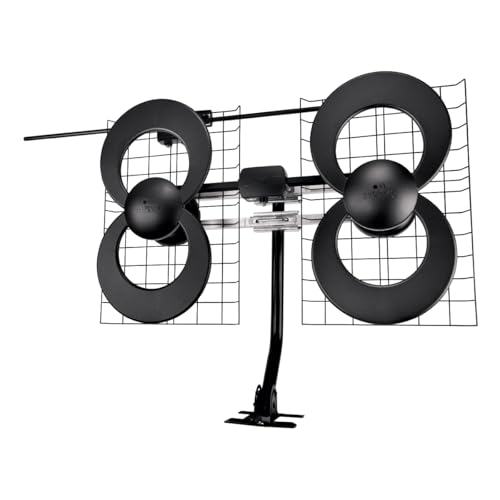
Antennas Direct ClearStream 4V: the honest long-range benchmark
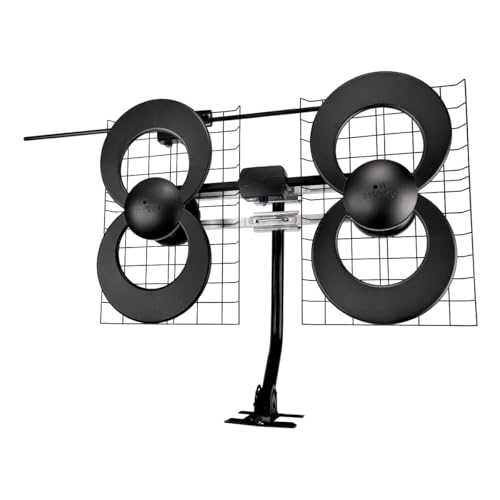
The ClearStream 4V is what an antenna looks like when a company designs for physics instead of packaging. Its distinctive loop-and-reflector design is a UHF antenna first, with a dedicated VHF dipole element added for the high-VHF stations, and it makes no theatrical claims about impossible distances. What it offers instead is genuinely strong UHF gain in a relatively compact frame, a reflector that rejects interference from behind, and construction that has earned it a long reputation among installers who put antennas on roofs and expect them to stay there.
Strengths. The UHF performance is the headline: for viewers forty to sixty miles from the towers, this is one of the most effective antennas of its size, and its directional pattern squeezes usable signal out of distances where flat panels give up entirely. The tapered loop elements are sturdily built, the reflector grid is solid rather than mesh-thin, and the whole assembly shrugs off weather that destroys cheaper antennas; the plastic parts are properly UV-resistant, and the hardware is made for years outdoors. The included VHF dipole covers the high-VHF band that UHF-only designs miss. Assembly is logical, the instructions are written by people who appear to have assembled one, and the mount accommodates both mast and J-mount installations.
Trade-offs. It is unmistakably an antenna, and its industrial look will not charm anyone hoping for something invisible; this belongs on a roof or in an attic, not in a living room. The VHF element handles high-VHF well but is no substitute for a full-size VHF antenna if your key station is a distant low-VHF holdout. It is directional, so stations in genuinely different directions require a rotor or a second antenna. And it sits at the higher end of the category’s pricing, which is the honest cost of the construction quality.
Who it suits. The suburban or rural viewer thirty to sixty miles out who wants one antenna, installed once, that simply works for a decade. If your station map shows a single tower direction and at least one high-VHF station you care about, this is the default recommendation against which everything else in this guide is measured. When you are ready, compare the current listing against your tower map and check price on Amazon.
One more practical note on living with the 4V: because it is a roof antenna, plan the installation as a permanent one. Use a proper mast, stainless or coated hardware, and a sealed connection at the balun, and this antenna will repay the care by simply disappearing from your life, which is the highest compliment reception equipment can earn. Owners who treat the install casually, with a loose mount and an unsealed connector, are the ones who meet the antenna again in two years, on a ladder, wondering what changed. Nothing about the antenna changed. The installation did.

Antennas Direct DB8e: multi-directional reach for split tower maps
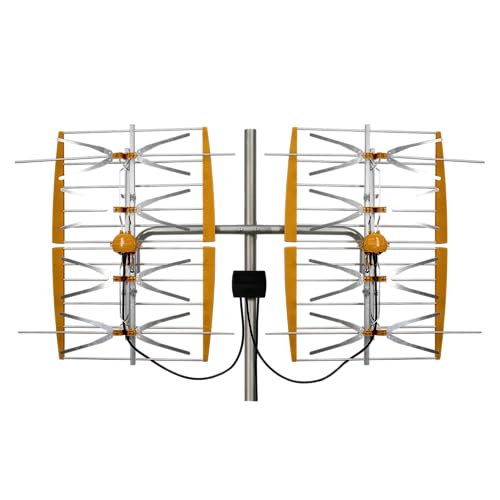
Most antennas assume your stations live in one direction. The DB8e exists for the large minority of viewers whose towers do not cooperate. Its eight-element bowtie design is built as two four-element panels that can be locked together as a single directional array, or angled independently to pull from two directions at once, covering tower clusters spread far apart without a rotor. Antennas Direct has built its reputation on exactly this kind of engineering-first design, and the DB8e treats reception as a physics problem rather than a styling exercise.
Strengths. The split-panel flexibility is genuinely useful and not a gimmick: in markets where one network cluster sits northeast and another sits south, a single DB8e can hold both where a conventional directional antenna forces a choice. UHF gain is strong in each panel’s direction, and combined and aimed together the array reaches respectably far — this is one of the strongest UHF designs in its class. Construction is serious, with solid elements and hardware intended for permanent outdoor installation, and the design accepts a preamplifier gracefully for fringe viewers who need one.
Trade-offs. Size is the obvious cost; this is a substantial piece of rooftop hardware that needs a real mast and a real installation effort, and it is entirely unsuited to indoor or balcony use. It is also a UHF-only design, so viewers with critical VHF stations should look at the ClearStream or the Yagi designs in this guide, which carry proper VHF elements. The two-panel aiming also rewards patience during setup: expect to adjust, scan, and adjust again rather than bolting it up blind.
Who it suits. The viewer whose station map shows two distinct tower directions and who refuses to choose between them. It is also a strong pick for the committed cord-cutter who wants maximum UHF flexibility from a single installation and is willing to spend an afternoon on the roof getting the aim right. If that is your situation, review the panel dimensions against your mounting space and check price on Amazon.
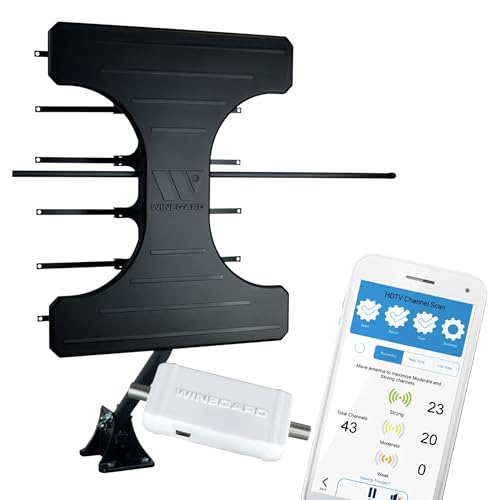
Winegard Elite Pro BW-2000: the smart-amplified outdoor all-rounder
Winegard’s Elite Pro BW-2000 approaches the problem from the signal-processing side. It pairs a directional outdoor antenna with TwinAmp amplification for both VHF and UHF, a smart signal meter that helps you aim by showing signal strength as you adjust, and filtering designed to keep cellular interference from LTE and 5G transmitters out of your picture. It is also built for the NextGen TV broadcast standard, so it is ready for the newest over-the-air signals as stations roll them out. The engineering restraint here is the story: the amplification is designed to help where amplification actually helps.
Strengths. The amplification is genuinely low-noise, rated at about a decibel of noise, which matters more than raw amplification numbers; a quiet amplifier preserves marginal channels that a noisy one destroys. The signal meter turns aiming from guesswork into a guided process. The cellular filtering is a modern necessity that most competitors ignore, and viewers with mysterious interference on a few channels may find it solves a problem they could not name. TwinAmp treatment means VHF stations get the same careful handling as UHF.
Trade-offs. Amplification is a tool, not a virtue, and if your signals are already strong, this antenna’s amplifier can be unnecessary; very strong nearby signals can overload any amplified system, so tower-close urban viewers should consider the unamplified picks instead. It is a directional outdoor design, so it commits you to one tower direction and a proper mast or mount, and it is not an indoor answer. The price reflects the electronics and the meter, so buyers who do not need amplification are paying for features they will not use.
Who it suits. The suburban or rural viewer twenty to fifty miles out who can mount outdoors, is fighting cellular interference, or is splitting the signal to a second television where a little well-mannered amplification earns its keep. For a household that wants modern signal hygiene and guided aiming, look over the mounting options and check price on Amazon.

Mohu Blade Premium: the slim bar antenna for rooms and eaves
The indoor antenna category is the most abused in television reception, sold with the most extravagant claims and the least regard for physics. The Mohu Blade Premium is the version we can recommend with a clear conscience, because it replaces the flimsy flat panel with a slim bar, twenty-four inches wide, that works indoors on a tabletop or wall and can also mount outdoors under an eave. Mohu rates it at sixty miles; read that the way this guide reads every box figure, as optimism, and judge it instead on its multi-directional UHF and VHF design, its sixteen feet of cable, and the mounting hardware included in the box.
Strengths. Within the real limits of the format, this is about as livable as reception gets. The bar is thin and tidy; it sits on a tabletop, mounts to a wall, or tucks under an eave outside. The long included cable gives real freedom in placement, which matters enormously, because moving an antenna a few feet can matter more than the antenna itself. The amplifier is powered over USB, which keeps the setup clean. For apartments, dorms, and renters, it solves the actual problem, which is getting solid reception from nearby towers without a permanent installation.
Trade-offs. Physics still collects its debts: a compact multi-directional bar cannot match a directional rooftop array, and a must-have distant VHF station may come in weakly or not at all. Its honest territory is the near-to-moderate ring around the towers, whatever larger number the marketing suggests, and beyond that ring results become luck rather than engineering. And like all indoor antennas, it lives at the mercy of your building’s materials, with metal siding, foil-backed insulation, and stucco mesh all capable of humbling it.
Who it suits. The urban and near-suburban viewer at close-to-moderate range who cannot or will not install a full outdoor array. Renters, apartment dwellers, and anyone outfitting a second room will find it the most livable antenna in this guide. If your tower map shows strong signals and no critical distant VHF station, confirm your distance first, then check price on Amazon.

RCA ANT751E: the compact Yagi that punches above its size
The Yagi is the oldest serious antenna architecture in television, a directional design of elements along a boom that has been pulling in distant stations since the analog era. RCA’s ANT751E shrinks that architecture into a compact, pre-assembled package that folds out rather than bolting together, and it has quietly become a favorite of installers for a reason: it delivers real directional UHF and high-VHF performance at a size and price that undercut the big arrays, without feeling like a toy.
Strengths. The pre-assembled design is a genuine practical advantage; the elements fold into place, the mount is straightforward, and the whole installation can be finished quickly by one person. Reception performance per dollar is excellent, with honest directional gain that serves the thirty-to-fifty-mile viewer well, and the high-VHF capability is real rather than nominal, which makes it a smart answer for markets with a VHF network affiliate. Its compact boom also presents less wind load than larger antennas, a durability point that matters on masts and chimneys. The construction, while not luxurious, is honest metal and sensible hardware throughout.
Trade-offs. Compactness caps its ceiling; the deepest fringe, beyond fifty miles or behind serious terrain, wants a larger antenna and a taller mast than this. It is directional in the strict sense, so it commits you to one tower direction. The finish and fittings are workmanlike rather than premium, and in the harshest coastal or mountain environments the bigger ClearStream’s construction is the safer long-term bet. It also arrives with minimal hand-holding, so first-time installers should expect to consult the general guidance in this guide rather than a lavish manual.
Who it suits. The value-minded viewer at moderate distance who wants genuine outdoor performance without a giant array or a giant bill. It is particularly well matched to attic installations where space is tight and to markets where one important station rides on high-VHF. If a single tower direction covers your channels, measure your attic or mast space and check price on Amazon.

GE Pro Outdoor/Attic Mount: the budget workhorse with a wide net
Not every viewer needs maximum reach. Plenty of households sit in that comfortable middle ground, fifteen to forty miles from towers that arrive from a couple of directions, and need an antenna that is affordable, uncomplicated, and reasonably capable in several directions at once. The GE Pro outdoor and attic antenna is built for exactly that household. Its design spreads sensitivity across a broad arc rather than concentrating it in one bearing, and it does so at a price that makes it the natural first antenna for people testing whether free television fits their lives.
Strengths. The wide reception pattern is the point: it forgives approximate aiming and gathers stations from a broad spread of directions, which suits the many markets where towers are not neatly clustered. It mounts outdoors or in an attic with equal ease, the assembly is simple, and the size is manageable for a solo installer. For its class, the build is respectable, with weather-appropriate materials that hold up fine in ordinary conditions. As a first step into cord-cutting it is an easy recommendation, because its cost of experimentation is low and its performance in the middle distances is honestly adequate.
Trade-offs. A wide net catches less at the edges: fringe viewers will find its reach limited compared with the directional picks, and weak distant stations are simply beyond it. VHF performance is serviceable rather than strong. The hardware and finish are a tier below the premium picks, so in severe climates expect a shorter service life. And its forgiving pattern also gathers interference from more directions, which in dense signal environments can occasionally mean a troublesome channel that a directional antenna would reject.
Who it suits. The budget-conscious household at close-to-moderate range with towers in more than one direction, and anyone mounting in an attic who values easy setup over ultimate reach. It is the sensible starter antenna: good enough to prove the concept, cheap enough to upgrade later without regret. If your signals are moderate and your directions are scattered, review the mounting hardware included and check price on Amazon.
How the six compare
The table below summarizes the honest differences. Range figures are realistic working distances for reliable reception in typical conditions, deliberately lower than box claims, and they assume sensible placement: outdoors or in an attic for the outdoor models, and a good window or wall position for the indoor one.
| Antenna | Type | Realistic range | Direction | VHF ability | Best for |
|---|---|---|---|---|---|
| Antennas Direct ClearStream 4V | Outdoor, directional | Up to about 60 miles | One direction | Good high-VHF | Long-range single-direction homes |
| Antennas Direct DB8e | Outdoor, dual panel bowtie | Up to about 55 miles per panel | One or two directions | UHF only | Split tower maps |
| Winegard Elite Pro BW-2000 | Outdoor, amplified directional | Up to about 55 miles | One direction | Amplified VHF and UHF | Fringe installs and interference problems |
| Mohu Blade Premium | Indoor/outdoor bar | Up to about 40 miles | Multi-directional | UHF and VHF | Apartments, renters and eave mounts |
| RCA ANT751E | Outdoor/attic Yagi | Up to about 50 miles | One direction | Good high-VHF | Value outdoor performance |
| GE Pro Outdoor/Attic | Outdoor/attic, wide pattern | Up to about 40 miles | Wide arc | Serviceable | Budget multi-direction homes |
Read the table as a matching exercise rather than a ranking. The right antenna is the one whose pattern matches your tower map, whose band coverage matches your stations, and whose mounting matches your home. A smaller antenna in the right place beats a flagship in the wrong one every single time, which is why the placement section below matters as much as any pick in this guide.
If you want the decision compressed into a path, walk it in order. Start with your tower map. If every station you care about sits within about twenty-five miles and one general direction, and you cannot mount outdoors, start with the Mohu Blade Premium and spend your effort on placement. If you can use an attic and live at moderate range, choose between the RCA ANT751E for value and single-direction strength, the Winegard Elite Pro if you can mount outdoors and interference or a second television argues for its smart amplification, and the GE Pro if your towers sprawl across directions and the budget leads. If you can mount on a roof, the ClearStream 4V is the default for one-direction homes at any serious distance, and the DB8e is the answer when the map shows two directions and both matter. Notice what never appears in that path: the advertised mileage on any box. That is deliberate, and it is the whole philosophy of this guide in one habit. Decide by map, band, mounting, and build, and the reception takes care of itself.
Amplifiers: when they help, when they hurt
No topic in antenna shopping generates more confusion than amplification, so it deserves a plain explanation. There are two kinds. A preamplifier mounts at the antenna and boosts the signal before it travels down the cable; its job is to overcome the losses of a long cable run and splitters, and it is the right tool for fringe viewers with long runs. A distribution amplifier sits indoors and boosts the signal for multiple televisions. Both share the same limitation, and it is absolute: amplification strengthens everything the antenna delivered, including noise and interference, and it cannot recover a channel the antenna failed to capture in the first place.
Amplification can also hurt. If you live close to the towers, your signals are already strong, and adding gain can overload the television’s tuner, producing the paradoxical result that an amplified antenna receives fewer channels than the same antenna unamplified. This is why honest amplification design matters: the Mohu Blade Premium powers its amplifier over USB, so amplification stays a choice rather than a fixture, and indiscriminate built-in amplification on bargain antennas earns no such credit. The working rules are simple. Far from the towers with a long cable run: a quality low-noise preamplifier is a legitimate tool. Close to the towers: skip amplification entirely. In between: try without first, and add amplification only to solve a specific, observed problem, such as a channel that arrives at one television but is lost after a splitter.
Placement and installation: the free performance most people skip
Height is the closest thing to magic in antenna reception. Signals obstructed by terrain, trees, and neighboring buildings clear those obstacles as the antenna rises, which is why a modest antenna on a roof routinely outperforms a premium antenna in a ground-floor room. Outdoors beats the attic, and the attic beats the living room, for the same reason: every layer of roofing, insulation, and wall material between the antenna and the sky costs signal, and some materials, like metal roofing and foil-backed insulation, cost a great deal. If you install in an attic, keep the antenna away from metal ductwork and try several positions before committing.
Aiming deserves the same patience. Use your station map’s compass bearings, aim the antenna’s front, which on most directional designs is the narrower or element side, toward the tower cluster, then run a channel scan. Small adjustments of a few degrees, followed by rescans, are how real installations converge; the difference between a good aim and a careless one is often three or four channels. Indoors, the equivalent ritual is trying the antenna on different walls and windows, high rather than low, rescanning each time. It is tedious for twenty minutes and valuable for years.
Finally, ground an outdoor installation properly and use a drip loop where the cable enters the house. These are unglamorous details, but they protect both the equipment and the home, and local electrical codes have opinions about them. An antenna is a tall metal object connected by wire to your television; treat it with the respect that combination deserves.
One last placement truth deserves emphasis because it contradicts most buyers’ instincts: a smaller antenna mounted higher will beat a larger antenna mounted lower almost every time. Height buys line of sight, and line of sight is the currency of reception. So when the budget forces a choice between a bigger antenna and a taller mast, choose the mast. When it forces a choice between amplifier power and a better position, choose the position. Hardware can be upgraded later; a bad location quietly taxes every component downstream of it, every day, for as long as the installation stands.
Keeping an outdoor antenna alive: a short maintenance ritual
An outdoor antenna asks for almost nothing, but the little it asks for matters, because the failures that kill reception are nearly all slow, silent, and preventable. Once a year, ideally in mild weather, give the installation a few minutes. Look at the mount first: a mast that has loosened in its bracket lets the antenna wander off aim a degree at a time, and the symptom is a channel or two that used to be solid becoming temperamental. Tighten what needs tightening, and confirm the antenna still points where your tower map says it should.
Next, inspect the connection where the cable meets the antenna, because this is the single most failure-prone point in the entire system. The weather boot should be seated and uncracked; the connector should be snug and free of the green-white corrosion that announces water has been visiting. If the boot has perished, replace it, and consider a wrap of quality self-sealing tape as insurance. Water inside a coaxial cable does not announce itself dramatically. It migrates, corrodes, and quietly eats signal for months before the picture degrades enough to investigate, by which point the cable run itself may need replacing rather than the antenna.
Check the cable’s path as well. The drip loop where the cable enters the house should still droop below the entry point so rain runs off instead of in. Cable chafed against a roof edge or crushed under a later project should be rerouted or replaced. Look at the antenna itself with the durability yardstick in mind: elements should be straight, the plastic housings uncracked, and nothing nesting where nothing should nest. A bent element is worth gently straightening; a cracked housing on a bargain antenna is usually the beginning of the end, and it is one more reason the construction quality of the picks in this guide was weighted so heavily.
Finish the ritual at the television with a fresh channel scan, which both refreshes the channel list and serves as a health check on the whole chain. If a station you know should be there is missing, the methodical order of suspicion is aim, connections, cable, and only then the antenna itself. Followed once a year, this small routine is the difference between an antenna that serves for a decade and one that becomes a roof ornament by its third winter.
Common buying mistakes, and how to avoid them
The first mistake is buying range you cannot use. A viewer twelve miles from the towers who purchases the largest fringe antenna has not bought better television; they have bought a more directional antenna that may actually complicate aiming, plus a bigger wind load for the roof. Match the antenna to your map, not to your anxiety. The second mistake is the mirror image: buying a decorative indoor panel for a fifty-mile problem because the box promised it could. When the installation fails, the buyer blames antennas in general, when the actual failure was a mismatch between claim and physics that this guide exists to prevent.
The third mistake is ignoring VHF until after the purchase. Viewers scan their new antenna, find most channels, and only later realize the missing one is the network affiliate they watch most, sitting quietly on a high-VHF channel their UHF-only panel cannot hold. Check the real channel numbers on your station map before ordering, every time. The fourth mistake is strangling a good antenna with bad infrastructure: bargain-bin coaxial cable, a splitter feeding rooms nobody watches, corroded outdoor connectors. Signal lost in the walls cannot be recovered at the television, and these quiet losses explain a large share of disappointing installations blamed on antennas.
The fifth mistake is skipping the rescan ritual. Televisions only show the channels found in their last scan, stations occasionally change frequencies, and an antenna nudged by wind or a curious hand can drift off aim. Rescanning after installation, after adjustment, and after any station in your market announces a change is free and solves problems that look like hardware failures. The sixth and final mistake is expecting the first position to be the best position. Reception rewards iteration. Twenty minutes of methodical trying, moving, and rescanning will teach you more about your home’s reception than any specification sheet, and it is the difference between viewers who love their antennas and viewers who return them.
Frequently asked questions
Why do antenna boxes claim such impossible distances?
Because nothing regulates the claim. Reception distance is not a standardized measurement with a test procedure behind it, so manufacturers are free to print theoretical numbers derived from perfect conditions that do not exist in the real world: no terrain, no weather, no buildings, and a laboratory-quiet radio environment. The curvature of the earth alone limits practical reception to roughly seventy miles for a high rooftop antenna. Judge antennas by design, gain, and reputation instead, and treat any mileage figure far beyond that ceiling as a confession about the marketing rather than information about the antenna.
Will an antenna get me cable channels like ESPN or HBO?
No, and any product implying otherwise is misleading you. An antenna receives the free broadcast signals transmitted by local stations: the major networks, PBS, and their subchannels, which include a surprising amount of sports, news, movies, and classic programming. Cable networks are not broadcast over the air and no antenna can receive them. What surprises most new cord-cutters is how much of their actual viewing the broadcast channels cover, especially paired with one modest streaming service for the rest.
How many channels should I expect?
It depends entirely on your market, which is why channel-count claims on packaging are meaningless; no antenna can receive stations that do not exist in your area. Most metropolitan viewers receive somewhere between thirty and seventy channels and subchannels, while rural viewers may receive a dozen or fewer. Your station map, checked before buying, will tell you the realistic count for your address, the networks included, and the directions involved. That five-minute check is worth more than any feature list.
My picture freezes or pixelates on a few channels. What is wrong?
Pixelation is the digital cliff making itself visible: the signal is hovering at the edge of what the tuner can decode. The causes are usually mundane. The antenna may be slightly misaimed, a connection may be loose or corroded, a splitter may be starving that run, or interference, including from LED lighting and nearby cellular transmitters, may be nibbling at one band. Work through it methodically: check connections, rescan after small aiming adjustments, remove splitters temporarily to isolate the problem, and consider whether one of the interference-filtering or repositioning steps in this guide applies. Marginal channels are usually fixable, and the fix is rarely a new antenna.
Can one antenna serve every television in the house?
Usually, yes, with planning. A single well-placed outdoor antenna can feed several televisions through splitters, but each split divides the signal, so the plan matters: keep cable runs short, use only the splits you need, and consider a distribution amplifier or a preamplifier when the runs are long or the sets are many. Viewers close to the towers often feed three or four televisions from one antenna with no amplification at all. Fringe viewers feeding many sets should expect to amplify thoughtfully, and everyone should rescan each television after the installation settles, since tuners differ in sensitivity.
The bottom line
Antenna shopping rewards skepticism and a five-minute homework assignment. Map your towers, be honest about your distance and directions, and buy the design that matches your situation rather than the one with the largest number printed on the box. The ClearStream 4V is our benchmark for long-range reliability, the DB8e solves the split-direction problem nothing else here touches, the Elite Pro brings intelligent amplification and a signal meter to outdoor installs, the Blade Premium makes indoor and eave-mounted reception as good as physics allows, the ANT751E delivers real Yagi value, and the GE Pro covers the budget middle ground with a forgiving wide net.
how to light a streaming setup
best cameras for recording slow motion
Buy the antenna your tower map asks for, mount it as high as your home allows, aim it with patience, and the reward is the rarest thing in modern media: television that arrives free, in sharp high definition, month after month, asking nothing of you but a clear view of the sky.