As an Amazon Associate, this site may earn an affiliate commission from qualifying purchases made through links on this page, at no extra cost to you.
The best long range TV antennas at a glance
Cutting the cable only works if the antenna on your roof can actually reach the towers. A long range TV antenna is built for exactly that job: pulling in broadcast signals from towers that sit far beyond the horizon of a typical indoor flat panel. The six antennas in this guide were chosen because they cover the full spread of what a distant viewer needs, from a compact directional Yagi for a single cluster of towers to a large multi-bay bowtie that can sweep up stations from two directions at once. Every one of them is an outdoor or attic design, because that is where range lives. A flat indoor panel can be a fine answer at fifteen miles, but at sixty or more it is the wrong tool, and no amount of amplifier marketing changes that.
Range figures on boxes deserve a healthy dose of skepticism. A manufacturer that prints a round number on the packaging is describing a best case measured on flat ground, with a clear line of sight, at the top of a mast, on a calm day. Your house is not that laboratory. Hills, trees, buildings, the height of your mast, the quality of your coaxial cable and the noise floor of your neighbourhood all take their cut. The antennas below are ordered by what they are genuinely good at, and the honest numbers in this guide are the distances real viewers report, not the numbers printed in bold on the box.
Before you buy anything, one step matters more than any product choice: check where your towers actually are. A free online signal report for your address tells you the distance, direction and band of every station in your area. If all of your towers sit in one direction, a narrow directional Yagi will outperform a wide multi-directional design. If they split into two clusters sixty degrees apart, a wider bowtie or a rotor makes more sense. If your target stations include low-band VHF channels, you need long elements built for that band, not a compact UHF-only panel. Buy the antenna that matches your map, not the one with the biggest number on the box.
| Antenna | Design | Bands | Best for | Character |
|---|---|---|---|---|
| Televes 108381 8-Bay BOSS Mix | Amplified 8-bay bowtie, dual panel | UHF and high VHF | Distant stations in one or two directions | Automatic gain, built-in preamp |
| Winegard Elite Pro BW-2000 | Amplified directional outdoor antenna, 70+ mile rated | UHF and high VHF | Rural homes with long cable runs | Built-in amplification, easy mount |
| Antennas Direct 8-Element Bowtie | Multi-bay bowtie | UHF | Two tower clusters, UHF-heavy markets | Wide beam, strong UHF gain |
| RCA Outdoor Yagi | Classic long Yagi | UHF and VHF | Budget long-range builds | Simple, proven, forgiving |
| GE Pro Outdoor | Compact Yagi with amplifier | UHF and high VHF | Smaller roofs and attics | Light, compact, amplified |
| Five Star Outdoor HDTV Antenna | Large Yagi with rotator mount | UHF and VHF | Stations in several directions | Big footprint, rotor friendly |
In this guide
What to look for in a long range TV antenna
Shopping for range is mostly a matter of matching the antenna to the physics of your location. The features below are the ones that actually move the needle, in the order that matters most for a distant viewer.
True range versus the number on the box
Every long range antenna advertises a distance, and nearly every one of those distances is optimistic. Treat the printed number as a ranking tool rather than a promise: an antenna advertised for a longer distance usually does have more gain than one advertised for a shorter distance, but the absolute figure depends on terrain and installation. What matters is the gain pattern, the size of the antenna and the cleanliness of the signal path. A well-placed antenna with modest gain will beat a high-gain antenna mounted low behind a ridge. When you read reviews, look for reports from viewers at your distance, in terrain like yours, rather than the headline range claim.
One more honest point: distance alone is not the whole story. A station sixty miles away on flat prairie is an easier catch than a station thirty miles away behind a mountain. Water, forests and the curvature of the earth all absorb and scatter signal. The signal report for your address usually lists a noise margin for each station, and that number is a better predictor than mileage. A positive margin means the signal is theoretically receivable; the larger the margin, the more forgiving the catch. Pick an antenna whose gain comfortably exceeds the shortfall on your weakest wanted station, and you will have a setup that holds up in bad weather rather than one that works only on clear evenings.
UHF and VHF coverage
Broadcast television lives on two bands. UHF carries most modern digital channels, and VHF carries a smaller number of stations, including some major network affiliates that never moved to UHF. The catch is that the two bands need very different antenna elements. UHF elements are short, so a compact panel can do a fine job on UHF. VHF elements are long, especially for the low VHF channels, so an antenna that claims VHF coverage needs long rods to back the claim up. Look at the physical antenna before you trust the label: if it has no long elements, it is a UHF antenna whatever the box says.
Check your signal report for the real channel numbers, not the virtual channel numbers you see on screen. A station that displays as channel 4 may actually broadcast on real channel 9, which is high VHF, or on real channel 28, which is UHF. Buy for the real channels. If your market has a low VHF station, you need an antenna with genuinely long elements or a separate VHF add-on, and you should expect a bigger antenna. If every station you want is UHF, a compact high-gain UHF design will be lighter, smaller and often better.
Directional gain and beamwidth
Long range antennas earn their reach by focusing. A directional antenna concentrates its sensitivity in a narrow cone aimed at the towers, and the narrower the cone, the more gain it delivers. That focus is a trade-off. A very narrow Yagi can pull in a weak station from far away, but if your towers are spread across a wide arc, the same narrow beam will miss some of them. A wider bowtie design gives up some peak gain in exchange for covering a broader arc, which suits markets where the towers sit in two clusters.
The practical test is the spread of your towers. If the compass bearings in your signal report fall within about twenty degrees of each other, a narrow high-gain Yagi is the right call. If they span forty degrees or more, look at a wider design or plan on a rotator. A rotator is a reasonable addition for a long range setup, since it lets one strong antenna serve several directions, but it adds moving parts, wiring and a control box, and it is one more thing to maintain on the roof.
Built-in preamplifiers and signal noise
A preamplifier sits at the antenna and boosts the signal before it travels down a long cable, which protects it from the loss that happens along the run. For a long range installation with a mast on a tall roof and a long cable to the television, a preamp is often the difference between a stable picture and one that breaks up. But an amplifier is not free gain. It amplifies noise along with signal, and in an area with strong nearby stations it can overload, creating interference that a passive antenna would never produce. The rule is simple: if your cable run is long or you are splitting the signal to several televisions, a preamp helps; if your wanted stations are already strong, it can hurt.
Some antennas in this guide include a preamp, and some leave the choice to you. If you add one separately, choose a model with a low noise figure, mount it at the antenna rather than at the television, and power it through the coaxial cable with the supplied inserter. Avoid stacking a preamp on top of a distribution amplifier unless you know what you are doing; two amplifiers in series usually create more problems than they solve.
Mounting height and placement
Height is the single most effective upgrade in long range reception, and it costs nothing but a taller mast. Raising an antenna by a few metres can clear a tree line or a neighbouring roof that was blocking the signal path, and the improvement is often larger than any difference between two antennas. The ideal mount is the highest point of your roof, on a sturdy mast, with the antenna clear of metal objects, vents and chimneys. An attic mount is a compromise: it protects the antenna from weather, but the roofing material and any foil-backed insulation absorb a meaningful share of the signal, which matters more at long range than it does in town.
Grounding is not optional for an outdoor antenna. A proper ground protects your house and your television from lightning-induced surges, and it is required by electrical codes in most places. Use a grounding block on the coaxial cable where it enters the house, bond the mast to the house ground, and keep the ground wire short and straight. If you are uncomfortable working on a roof or with grounding, hire a local installer; a professional mount that lasts twenty years is cheaper than a do-it-yourself mount that comes down in the first storm.
Reading a signal report before you buy
The single most useful document in long range reception is the signal report for your address, and it is free. It lists every station that reaches your location, with its real channel, its distance, its compass bearing and a noise margin that predicts how hard it will be to receive. The noise margin is the number to study. A station with a margin of thirty decibels is an easy catch for almost any outdoor antenna. A station with a margin of five decibels needs a good antenna, a high mount and clean cable. A station with a negative margin is theoretically beyond reach, and while a large antenna sometimes pulls one in, it should not be the station your whole purchase depends on.
Use the report to build a shortlist before you shop. Note the bearing of each wanted station and the spread between them, note which bands the real channels fall in, and note the weakest station you actually care about. That weakest station sets the gain you need, the bearing spread sets the beamwidth, and the bands set the element size. An antenna chosen this way is rarely the wrong one. An antenna chosen from a box claim alone often is. Revisit the report if you move house or if a local station changes its transmitter; the map is the ground truth, and it changes more often than most viewers expect.
Build quality and weather resistance
A long range antenna lives outdoors, year round, in wind, rain, ice and sun. The difference between a good one and a cheap one often shows up in the second winter, when plastic brackets crack, elements loosen and the balun corrodes. Look for solid metal elements, a weather-sealed balun housing, and mounting hardware that is actually sized for the antenna. Aluminium elements resist corrosion well; plastic parts should be UV resistant rather than brittle. A heavier antenna is not a drawback here, it is a sign that the manufacturer used real metal, provided your mast and mount are rated for the weight and wind load.
Pay attention to the wind rating and the turning radius if you are adding a rotator. A large Yagi presents a substantial sail area to the wind, and a mast that is fine for a small panel may flex or fail under a big directional antenna in a storm. Use a mast of proper diameter, brace it if the height demands it, and check the mount after the first serious storm of the season.
Cable, splitters and signal loss
The best antenna in the world is wasted if the signal dies in the cable. Use RG-6 coaxial cable, keep runs as short as practical, and avoid unnecessary splitters. Every splitter costs signal, and a four-way splitter costs more than a two-way. If you are feeding several televisions from one antenna, a distribution amplifier at the split point is usually a better answer than a passive splitter, because it compensates for the loss at the point where it happens. Use compression connectors rather than crimp connectors, keep connections dry and weather-sealed outdoors, and replace old RG-59 cable, which loses far more signal per metre than RG-6.
The best long range TV antennas, reviewed
Each antenna below was judged on the same terms: real reach for its design, band coverage, build quality, ease of mounting, and how honestly it behaves at the edge of its range. Prices move constantly in this category, so instead of printing figures that will be stale within weeks, each review ends with a prompt to check price on Amazon, where current pricing and availability are shown. What follows is the part that does not change: how each antenna performs, what it demands from your installation, and who should, and should not, bring it home.

Top pick
1. Televes 108381 8-Bay BOSS Mix: the amplified bowtie with a brain
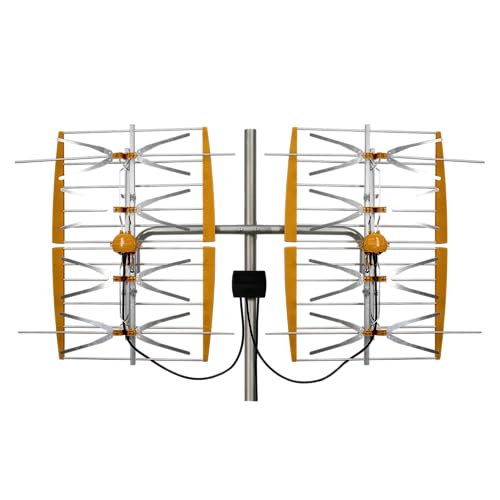
The Televes 108381 is the archetype of a modern long range antenna: an 8-bay bowtie that earns its reach from smart electronics as much as from size. Its two panels rotate independently, so they can be aimed together at one distant tower cluster for maximum gain, or split to sweep up stations from two directions at once. Televes, a Spanish maker with decades in broadcast reception, builds the amplification into the antenna itself: the BOSS system pairs a built-in TForce preamplifier with automatic gain control that strengthens weak signals while holding strong ones in check, and LTE and 5G filtering keeps phone-band interference out of the picture. It covers high VHF alongside UHF and is rated for up to 70 miles. This is the antenna to buy when your signal report shows distant stations you want held steadily, and you would rather have the gain managed at the antenna than buy, power and weatherproof a separate preamp box.
In practice the 108381 behaves like the thinking viewer’s bowtie. The automatic gain is the quiet hero: on marginal stations it lifts the signal toward the lock threshold, and when a strong local station would overload a fixed-gain preamplifier, it backs off instead of drowning the tuner in noise. The dual-panel aiming gives it a flexibility no fixed Yagi can match — one panel on the distant cluster, one swung toward a nearer town — though each split costs some gain in both directions, so single-cluster viewers should still aim both panels together and take the full benefit. The construction is weather-sealed and compact for an 8-bay design, which makes it a realistic attic candidate as well as a mast antenna.
Strengths: Very strong amplified reach for distant UHF and high VHF stations; automatic gain control that adapts instead of overloading; rotating dual panels that can serve one cluster or two directions; built-in LTE and 5G filtering; weather-sealed construction from a long-established broadcast specialist.
Trade-offs: The amplification needs power, so the power supply and inserter become part of the install; the rated range assumes the amplifier is doing its work, and truly extreme distances still favour a large passive Yagi; aiming two panels takes more patience than pointing a single boom; it sits above the passive designs here in positioning.
Who it suits: Choose the Televes 108381 if your towers are distant, your stations sit in one cluster or two, and you want the antenna itself to manage gain rather than bolting on a separate preamplifier. It is an especially good fit for rural viewers whose nearest towers are well beyond the range of compact antennas, and for anyone who has already tried a smaller antenna and found it wanting. If your towers are spread across a very wide arc, or you want a purely passive install with nothing to power, look at a wider or simpler design instead. For current availability in the configuration you want, check price on Amazon.
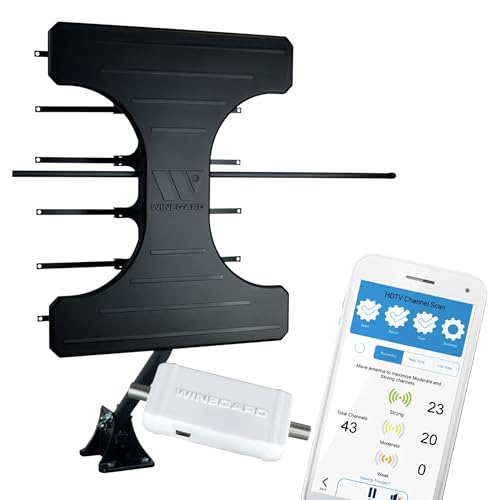
2. Winegard Elite Pro BW-2000: the amplified all-rounder for long cable runs
The Winegard Elite Pro BW-2000 takes a different approach to the same problem. Rather than being the biggest antenna in the guide, it is an amplified directional outdoor design rated for reception at 70+ miles, which makes it particularly well suited to houses where the cable run from the roof to the television is long, or where the signal is split to several rooms. Winegard is another long-established name in antennas, and the Elite Pro BW-2000 reflects that experience in the details: the elements are well finished, the amplification is integrated cleanly into the design, the housing is rated for outdoor life, and the mounting hardware is straightforward. It is the antenna for the viewer who wants long range performance without the bulk of a full-size Yagi.
Where the Elite Pro BW-2000 earns its keep is in the marginal middle ground, the houses that are too far for a compact indoor antenna but do not need the largest Yagi on the market. Its TwinAmp technology amplifies the VHF and UHF bands separately, applying up to 10x amplification where each band needs it instead of pushing both through a single stage, and Clear Circuit technology with a very low 1dB noise figure keeps that amplification clean rather than noisy. The built-in amplification compensates for cable loss, so the signal that arrives at the television is cleaner than it would be from a passive antenna of the same size on the same long run. That matters in practice, because many reception problems blamed on the antenna are really cable problems. The amplifier also makes the Elite Pro BW-2000 a good choice for a split feed, since it helps overcome the loss of a two-way or four-way splitter. A smart signal meter built into the design helps during setup too, giving you feedback while you aim instead of leaving you to guess from a frozen picture.
Strengths: TwinAmp amplification treats VHF and UHF separately for cleaner gain on both bands; rated 70+ mile range in a directional outdoor design that is still manageable on a smaller roof; very low 1dB noise figure protects weak signals on long cable runs; smart signal meter makes aiming and fine-tuning far easier; covers UHF and high VHF; NextGen TV ready, with clean, durable, outdoor-rated construction; performs well when the signal is split to multiple televisions.
Trade-offs: The amplification can overload in areas with strong nearby stations, so it is not ideal everywhere; peak passive gain is lower than a large passive Yagi; it needs power through the coaxial cable, which adds a power inserter to the install; the amplifier is a component that can eventually fail and need replacement.
Who it suits: Choose the Elite Pro BW-2000 if your roof is not suited to a very large antenna, your cable run is long or split, and your towers are distant but not at the extreme edge of reception. It suits rural homes with a single television a long way from the mast, and households that want one antenna feeding several rooms. If your towers are extremely far or your area has very strong local stations that could overload an amplifier, a large passive Yagi is the better choice. To see the current listing and full specifications, check price on Amazon.

3. Antennas Direct 8-Element Bowtie: the wide-beam UHF workhorse
The 8-Element Bowtie from Antennas Direct is the antenna for viewers whose towers are not all in one place. Its multi-bay bowtie design trades the narrow focus of a Yagi for a much wider beam, so it can receive stations from two clusters spread across a broad arc without a rotator. That makes it a natural fit for markets where the broadcast towers sit on different hills, or where a city has transmitters in two directions. It is a UHF specialist, and within that band it is one of the strongest performers available, with a large reflector that gives it real gain across the whole UHF range.
In use, the bowtie behaves like a patient generalist. It does not demand the precise aiming of a narrow Yagi, which makes installation more forgiving, and it holds stations across a wide arc that would need a rotator on a directional design. The trade is that it is a UHF-only antenna, so it will not help with VHF stations, and its peak gain on any single bearing is lower than a large Yagi pointed straight at the tower. For a UHF-heavy market, neither of those limits matters much. For a market with an important VHF affiliate, the bowtie needs a VHF add-on or a different antenna entirely, and that is a decision to make before buying rather than after.
Strengths: Wide beam covers towers spread across a broad arc without a rotator; very strong UHF gain from the multi-bay design and reflector; forgiving to aim compared with a narrow Yagi; well-built and weather resistant; a proven design with a long track record in fringe markets.
Trade-offs: UHF only, so VHF stations need a separate add-on; large flat profile catches wind and needs a solid mount; peak gain on a single bearing is lower than a large Yagi; the reflector makes it bulkier to handle on a roof than a slim Yagi.
Who it suits: Choose the 8-Element Bowtie if your towers fall into two clusters or a wide arc, and your wanted stations are mostly UHF. It is an especially good fit for viewers on the edge of a metro area whose towers sit on different ridges, and for anyone who wants strong UHF reception without the complication of a rotator. If you need VHF, pair it with a VHF add-on or choose a combined design. For the latest availability on the model with its reflector and mounting hardware, check price on Amazon.

4. RCA Outdoor Yagi: the budget classic that still earns its place
The RCA Outdoor Yagi is the least expensive antenna in this guide, and it is here because it works. It is a classic long Yagi in the traditional style: a long boom, many elements, and coverage of both UHF and VHF. There is nothing fashionable about it, and that is the point. The design has been refined over decades, the parts are simple, and the performance at long range is honest. For a viewer who wants to try long range reception without spending much, or for a second antenna on a cabin or workshop, it is the sensible starting point.
What you give up at this price is mostly refinement. The elements are lighter than on the premium antennas, the mounting hardware is basic, and the balun housing is adequate rather than generous. None of that stops it working. Aimed properly and mounted at a decent height, the RCA Yagi pulls in distant stations that a compact antenna cannot touch, and its VHF coverage is genuinely useful in markets with a VHF affiliate. The main practical advice is to take the assembly seriously: tighten every element properly, seal the connections, and use a mast that is sturdy enough for the antenna’s length. A budget antenna installed well beats a premium antenna installed carelessly, and the RCA rewards a careful install more than most.
Strengths: Very good value for genuine long range performance; covers both UHF and VHF; simple proven design with few parts to fail; light enough for modest masts and attic installs; widely available with familiar mounting hardware.
Trade-offs: Lighter construction than premium Yagis, so it needs care in high wind; no preamplifier included; assembly is fiddly, with many elements to attach; the balun and hardware are basic and benefit from extra weatherproofing.
Who it suits: Choose the RCA Outdoor Yagi if you want to test long range reception on a budget, or if you need a capable second antenna for a cabin, garage or workshop. It suits viewers whose towers are distant but not extreme, and who are happy to spend an afternoon on a careful install. If you live in a high-wind area or want the strongest possible construction, spend more on a heavier Yagi. For today’s stock and the current bundled hardware, check price on Amazon.

5. GE Pro Outdoor: the compact amplified option for smaller roofs
The GE Pro Outdoor is the smallest antenna in this guide, and it earns its place by solving a different problem: not every house can take a large Yagi. A small roof, a strict homeowners association, a short mast or an attic install all favour a compact antenna, and the GE Pro pairs a compact Yagi with a built-in amplifier to make the most of its size. It is a practical compromise, and like all compromises it works best when the buyer understands what it can and cannot do. At moderate long range, with a clear path to the towers, it performs well beyond what its size suggests. At extreme range, size still wins, and no compact antenna can change that.
The amplifier is the heart of this design. It boosts the signal at the antenna, which helps on the long cable runs that often come with a small roof mount, and it gives the compact elements a fighting chance against the losses of an attic install. The antenna is also light and easy to handle on a roof, which matters more than it sounds when you are working at height. The limitation to respect is overload: in an area with strong nearby stations, the amplifier can create interference, and in that case the amplifier should be switched off or the antenna used passively if the design allows it.
Strengths: Compact and light, so it fits small roofs and attics; built-in amplifier helps on long cable runs; covers UHF and high VHF; simple to mount and aim; a sensible price for the performance it delivers.
Trade-offs: Peak gain is limited by its size, so extreme range is out of reach; the amplifier can overload near strong stations; small elements mean less VHF capability than a large Yagi; plastic parts need checking after harsh winters.
Who it suits: Choose the GE Pro Outdoor if your roof or mounting options rule out a large antenna, or if you want a discreet attic install and your towers are at moderate long range. It suits suburban fringe viewers, renters with limited mounting options, and anyone who wants an amplified antenna without the bulk of a full-size Yagi. If your towers are very far away, step up to a larger design. To review the current configuration and included amplifier, check price on Amazon.
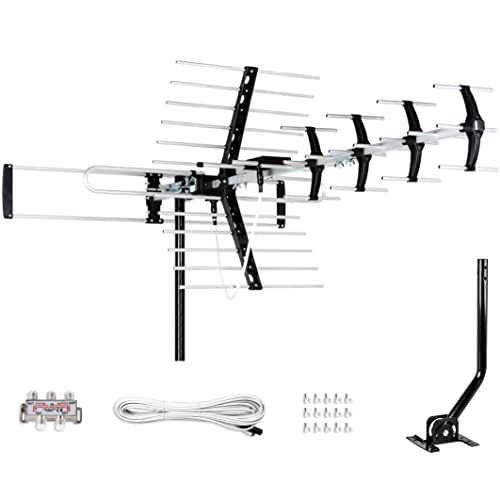
6. Five Star Outdoor HDTV Antenna: the big rotor-friendly Yagi
The Five Star Outdoor HDTV Antenna is the largest antenna in this guide, a long Yagi with a wide element set covering both UHF and VHF, built to be paired with a rotator. It is for the viewer whose towers are scattered in several directions and who wants one strong antenna that can be turned to face whichever cluster is wanted at the time. The size is the point: long elements for VHF, many elements for UHF gain, and a solid boom to hold it all together. It is not a subtle antenna, and it is not trying to be. It is a maximum-effort design for viewers who are serious about pulling in everything their area offers.
With a rotator, the Five Star becomes the most flexible antenna in this guide. A single strong antenna can serve towers to the north in the evening and towers to the south in the morning, which no fixed antenna can do. The trade is complexity. A rotator needs a control cable and a control box, the mast needs to be strong enough for the antenna’s wind load, and the whole assembly needs to be balanced so the rotator does not strain. Without a rotator, the Five Star still works as a fixed directional antenna, but much of its value is in the turning, and a buyer who never rotates it is carrying size they do not use.
Strengths: Large design with strong gain on both UHF and VHF; ideal partner for a rotator, covering towers in several directions; solid construction for its size; good choice for viewers who want to receive everything in their area; straightforward to aim once the rotator is set up.
Trade-offs: Big and heavy, needing a strong mast and mount; needs a rotator to realise its full value, which adds cost and complexity; assembly takes time, with many elements; wind load is significant, so storm country needs a careful install.
Who it suits: Choose the Five Star if your towers are spread in several directions, you are willing to add a rotator, and you want one antenna to cover your whole region. It suits dedicated cord-cutters in rural areas, viewers who chase distant stations as a hobby, and houses where a single fixed antenna cannot cover all the wanted clusters. If you want a simple fixed install, a smaller directional antenna is the better call. For the latest listing, including the rotator-ready mount, check price on Amazon.
How these six made the cut
Every antenna in this guide is an outdoor or attic design from a maker with a track record, and every one was judged on the same question: does it genuinely help a distant viewer, or does it just claim to? The selection covers the real shapes of the problem. The Televes is the amplified reach for distant stations, its twin panels aimed together at one cluster or split between two. The Winegard Elite Pro and the GE cover the amplified middle ground for long cable runs and smaller roofs. The Antennas Direct bowtie covers wide tower spreads on UHF. The RCA proves that a budget Yagi can still do the job. The Five Star covers the multi-direction case with a rotator. Between them, they map to the signal reports of most distant viewers.
What was left out matters too. Indoor flat panels were excluded, because they are not long range antennas whatever the packaging claims. Antennas with only a printed range claim and no real gain to back it up were excluded. So were designs that bundle a weak antenna with a powerful amplifier and call the combination long range; an amplifier cannot create signal that the elements never captured. The six here all earn their reach from their elements first, with amplification as a supporting player where it genuinely helps.
Attic versus rooftop: the real trade-off
Many viewers would rather hide the antenna in the attic than look at it on the roof, and the trade is worth understanding honestly. An attic mount protects the antenna from wind, ice and sun, and it avoids any argument with a homeowners association. It also costs signal. Roofing materials absorb broadcast energy, and the loss is larger than most buyers expect: a few decibels on UHF, which at long range is often the margin between a stable picture and a frozen one. Foil-backed insulation is worse, and in some modern houses it effectively turns the attic into a shielded box. A metal roof is worse still, and an antenna under a metal roof is close to no antenna at all.
The decision comes down to how much margin your signal report gives you. If your weakest wanted station has a healthy positive margin, an attic mount with a large antenna can work well, and the protection from weather is a real benefit. If your weakest station is already marginal, the attic will probably cost you that station, and the roof is the right call. There is a middle path that suits many houses: mount the antenna on a short mast at the gable end, just above the roofline, where it clears the roof material but stays low and discreet. It is not as good as a tall rooftop mast, but it is far better than an attic, and it keeps the antenna out of the worst of the wind.
One more consideration is heat. An attic in summer can be extremely hot, and while antennas tolerate heat well, preamplifiers and plastic parts age faster in it. If you mount in the attic, keep the amplifier out of the hottest part of the space if the design allows it, and check the mounting hardware once a year. On the roof, the enemy is weather rather than heat, and a good mount with proper grounding will outlast either.
Setting up a long range antenna: a care guide
Installation decides more than the purchase does, so it is worth doing properly. Start with the signal report for your address, note the compass bearing and real channel of each wanted station, and choose the antenna that matches that map. Mount the antenna as high as practical on a sturdy mast, clear of metal objects and at least a few feet above the roofline. Aim it with a compass rather than by eye, then fine-tune using the signal meter on your television or a signal meter app, moving in small steps and waiting for the reading to settle at each one.
Run RG-6 cable, keep the run short and direct, and use compression connectors. Add a preamplifier at the antenna if your run is long or split, and a distribution amplifier at the split point if you feed several televisions. Ground the mast and the cable properly where it enters the house. Then scan for channels on each television, and rescan after any change to the install, because a television only finds what the antenna was delivering at the moment of the scan. If a station is missing, check the aim and the connections before blaming the antenna; a loose connector costs more signal than a cheaper antenna ever would.
Seasonal changes are normal. Trees in leaf absorb more signal than bare branches, so a station that is solid in winter may waver in summer. That is a reason to buy a little more gain than your winter signal report suggests you need, and a reason to aim for the weakest wanted station rather than the strongest. A setup that holds its weakest station in August will hold everything in January.
After the install, keep a simple maintenance habit. Once a year, check the mount and the mast for looseness, look at the coaxial connectors for corrosion or water entry, and confirm the grounding is still intact. After a serious storm, check that the antenna has not shifted on the mast, because a few degrees of movement is enough to lose a marginal station, and the paint mark you made during aiming will tell you at a glance whether it moved. If a station disappears suddenly, work through the cheap causes first: a loose connector, a power inserter that has been unplugged, a splitter that has failed, or a television that needs a rescan after a station changed its transmitter. Most long range problems turn out to be one of those, and a systematic check takes less time than shopping for a new antenna.
Mistakes long range viewers make
The most common mistake is buying for the printed range number instead of the signal report. The second is mounting the antenna too low, often in the attic, and then blaming the antenna for the roof’s attenuation. The third is over-amplifying: adding a preamp and a distribution amplifier and a boosted splitter, then wondering why the picture is worse. Amplifiers help when there is signal to protect and loss to overcome; they cannot create signal and they can overload. The fourth is pointing the antenna by guesswork. A compass and a signal meter take ten minutes and are worth more than any upgrade. The fifth is using old or cheap cable. RG-59 and bargain connectors quietly eat the signal you paid for an antenna to catch.
A quieter mistake is ignoring the VHF question. A viewer who buys a UHF-only antenna and then discovers that a favourite network affiliate broadcasts on high VHF has bought the wrong tool, and no amount of amplification fixes it. Check the real channels first, buy the antenna that covers them, and the rest of the install becomes straightforward.
Rotator or a second antenna?
When towers sit in two directions, there are two honest answers: turn one antenna, or install two. A rotator is the cheaper and simpler of the two for most houses. One strong antenna, one mast, one cable, and a control box by the television. The cost is the rotator itself and the wait while it turns, plus one more moving part on the roof. A rotator also means the antenna is only ever aimed at one cluster at a time, so a recording on a station in the other direction needs the antenna turned first, which a simple timer recording cannot do.
A second antenna suits households that record from two directions, or where two viewers watch different stations at once. The two antennas feed a combiner, and both clusters are available all the time. The cost is a second antenna, a second mast position, and the care needed to combine two signals without them interfering with each other. Combining works best when the two antennas point at genuinely different clusters and each is filtered to the channels it is meant to catch; without filtering, the same station arriving from two antennas can interfere with itself. For most viewers, the rotator is the right first step, and the second antenna is the upgrade for a household that genuinely watches in two directions at once.
There is also a third option that suits some markets: a wide-beam antenna like the bowtie in this guide, which covers a broad arc without moving parts. It gives up peak gain against a narrow Yagi, but it covers two clusters at once with no rotator, no combiner and no waiting. If your tower spread fits inside its beam, it is the simplest answer of all, and simplicity on a roof is worth a great deal over twenty years.
Frequently asked questions
How far can a long range TV antenna really reach?
Under good conditions, with a tall mast, clear terrain and a strong transmitter, a large outdoor antenna can receive stations well beyond sixty miles, and in flat country with favourable conditions, considerably farther. But distance is only one factor. Terrain, trees, buildings and the power of the transmitter matter as much as mileage, and a station thirty miles away behind a hill can be harder to catch than a station sixty miles away across open ground. Use the signal report for your address and the noise margin it lists for each station; that is a far better predictor than any mileage claim on a box.
Do I need a preamplifier for long range reception?
It depends on your cable run. A preamplifier helps when the cable from the antenna to the television is long, or when the signal is split to several televisions, because it boosts the signal before the cable can eat it. If your cable run is short and you feed one television, a preamp adds little and can even hurt if nearby strong stations overload it. The best test is practical: try the antenna without a preamp first, and add one only if stations break up or the signal meter shows a weak reading that improves with amplification at the antenna end.
Can I mount a long range antenna in the attic?
You can, but you will lose signal doing it. Roofing material, plywood, shingles and especially foil-backed insulation absorb part of the broadcast signal, and at long range that loss can be the difference between a stable picture and none at all. An attic mount is a reasonable compromise when an outdoor mount is impossible, and a larger antenna in the attic will outperform a smaller one outdoors in some cases, but the same antenna mounted outside, above the roofline, will almost always do better. If you must use the attic, choose the largest antenna your space allows and keep it clear of metal ducting and wiring.
What is the difference between UHF and VHF, and why does it matter?
UHF and VHF are two bands of the broadcast spectrum, and they need different antenna elements. Most modern digital channels are on UHF, which uses short elements, while some stations remain on VHF, which needs long elements, especially for the low VHF channels. It matters because an antenna that is UHF only cannot receive a VHF station no matter how much amplification you add. Check the real channel numbers in your signal report, not the virtual numbers on screen, and buy an antenna that covers the bands your wanted stations actually use.
How do I aim a directional antenna correctly?
Start with the compass bearing from your signal report, not with guesswork. Stand at the mast with a compass, or use a compass app on your phone held away from metal, and point the antenna at the bearing of your main tower cluster. The front of a Yagi is the end with the shortest elements, and the front of a bowtie is the side opposite the reflector screen, so check the maker’s diagram before you climb. Once the antenna is roughly aimed, fine-tune with the signal meter on your television: move the antenna in small steps of a few degrees, wait for the reading to settle at each step, and note the bearing that gives the strongest reading on your weakest station rather than your strongest one.
Aim for the weak station on purpose. The strong stations will come in across a wide range of bearings, so aiming at them tells you nothing. The weak station is the honest test, and the bearing that holds it steadily is the bearing to keep. If two clusters matter and you have no rotator, aim between them and check whether both hold; a wide-beam antenna forgives this, a narrow Yagi does not. Mark the final position on the mast with a paint pen so you can return to it after any storm or maintenance, and tighten the clamp properly once the aiming is done.
Why do some channels disappear in summer?
Trees in leaf absorb broadcast signal, and a station that is solid in winter can waver once the leaves come out, particularly on UHF. Heavy rain and temperature inversions can also change reception from day to day. This is normal, and it is why a long range setup should be bought with margin: an antenna that only just receives a station on a clear winter evening will lose it in August. Aim for your weakest wanted station, mount as high as practical, and accept that a few marginal stations may always be weather dependent.
best outdoor tv enclosures
best indoor tv antennas
The bottom line
A long range antenna is a tool for a specific geography, and the best one is the one that matches your map: a narrow Yagi for one distant cluster, a wide bowtie for a broad arc, an amplified compact for a long cable run, a big rotor-friendly design for towers in every direction. Check your signal report, mount high, use good cable, ground properly, and buy enough gain to hold your weakest station through the summer leaves. Do that, and the towers that looked out of reach will be on your screen every evening.