reviewstook.com is reader-supported. When you buy through links on our site, we may earn an affiliate commission.
Where to buy
Yes, the search term drops a letter: the best digitl cameras under 300 is how thousands of people actually type the question, usually on a phone, usually in a hurry, and the missing vowel changes nothing about the honest answer. This guide reads the query as it was meant — capable digital cameras beneath a three-hundred budget line — and then makes a deliberate choice about how to spend that money. Our neighbouring guide to this budget covers brand-new stills cameras and the photographs they make. This one takes the other road: hybrid machines that shoot video as seriously as stills, plus the used market, where yesterday’s enthusiast models wait at prices their launch reviews never imagined.
The boundary matters, so here it is plainly. If you want a new camera purely for photographs, the stills-first guide serves you better. Stay on this page if your camera must film a child’s recital after photographing the birthday cake, if a vlog or a training video shares the memory card with family portraits, or if you are willing to buy second-hand and want to learn how professionals inspect a used body before paying for it. Hybrid duty and used buying are the twin spines of everything below.
Six picks follow, all drawn from our verified pool and linked normally. They lean toward compact and action formats because, beneath this budget, those are the shapes that genuinely shoot both media well. Interchangeable-lens bargains exist in this territory only on the used shelf, so the guide treats used mirrorless and advanced compacts as a strategy woven through the buying advice rather than as named picks we cannot link honestly.
One promise about money: no product below carries a printed price, because prices at this level swing with seasons, bundles and refurbished stock. The budget in the keyword is a ceiling for your shopping, not a figure we freeze onto a camera that may cost less next month or vanish from shelves entirely. Check current pricing at the retailer, and treat the ceiling as a discipline, not a target to spend up to automatically.
Key Takeaways
- This guide covers hybrid video-and-stills shooting plus used buying; a sibling guide covers new stills cameras at this budget.
- Compact and action cameras dominate honest hybrid choices beneath this ceiling.
- A used enthusiast model often out-shoots a new budget camera, provided the shutter count and sensor check out.
- Budget for a card, a spare battery and a case inside the same ceiling, not after it.
- Video features to verify are a microphone input, clean continuous recording and stabilisation that works while walking.
- Every pick is linked from the verified pool; used-market advice names classes of camera, not invented listings.
In this guide
Quick Picks
| Camera | Badge | Why it is here |
|---|---|---|
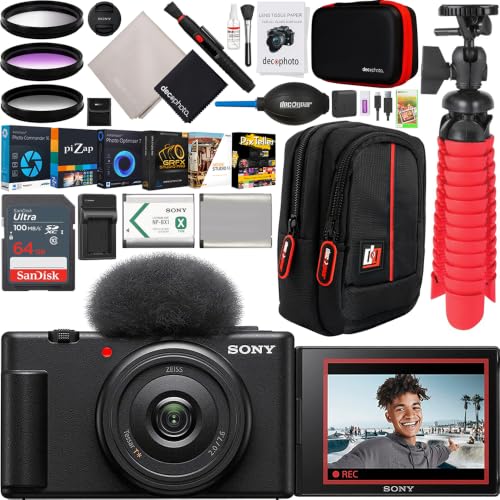
| Sony ZV-1F | Best hybrid compact | A vlogging-bred compact whose stills are far better than its video-first badge suggests. |
| GoPro HERO | Best tiny hybrid | The smallest GoPro shoots honest stills and rugged video in one pocketable block. |
| DJI Osmo Action 3 | Best value action hybrid | A previous-generation action camera whose price fell faster than its ability. |
| AKASO Brave 7 LE | Best budget all-rounder | Dual screens, waterproofing and a generous accessory bundle for cautious money. |
| Insta360 GO 3S | Best wearable hybrid | A thumb-sized camera for hands-free clips and candid stills nobody notices being taken. |
| AKASO EK7000 | Best first camera money | The long-running entry point for buyers who want to learn before they spend. |
How did we split hybrid ability from stills-only talent at this budget?
Each candidate faced a two-media audition. For video, we asked whether the camera records respectable footage while moving, whether its stabilisation survives a walking shot, whether audio can be improved beyond the built-in microphones, and whether recording limits interrupt an ordinary school play or training session. For stills, we asked the unfashionable questions: does the camera focus quickly on a face, does its lens stay sharp at the edges, and would you print its best frame at a modest size without apology?
Most budget cameras pass one audition and stumble through the other. Stills-led compacts often film as an afterthought, with hesitant autofocus and wobbling stabilisation. Video-led action cameras historically treated photographs as frame grabs with better marketing. The six survivors are the machines whose second medium is a genuine skill rather than a menu entry, and the reviews below grade both halves of each personality separately, because hybrid buyers deserve to know which half leads.
The used-market strand followed a different discipline. We cannot link a specific second-hand camera, since every used body is a unique object with its own history, so the guide teaches the inspection method instead: shutter counts, sensor checks, mount health and seller questions. That method appears throughout the buying sections, ready to apply to whichever last-generation model your local market offers this week.

Sony ZV-1F — Best hybrid compact
Sony built the ZV-1F to court vloggers, then quietly gave it the stills manners of a proper compact camera. The one-inch sensor gathers light that phone-sized sensors cannot, the fixed wide lens suits arms-length filming and group photographs equally, and the colour science flatters skin in both media without a grading session. Hybrid buyers beneath this budget rarely find a single device that respects both halves of the brief; this one was designed for video and refuses to embarrass itself at photography.
Follow it through a family Saturday. Morning football gets filmed from the touchline with the product-showcase gimmicks ignored and the simple virtues working: quick autofocus on a moving child, stabilisation that forgives a cold parent’s shiver, audio that survives a light breeze. Afternoon becomes stills, the same camera producing birthday portraits with genuinely soft backgrounds, because the sensor and lens combination can separate a face from a kitchen in a way no action camera manages.
The fixed lens draws the honest boundary. Wide is wonderful for rooms, vlogs and landscapes, and limiting for wildlife, school stages and anything distant enough to need reach. Hybrid shooters whose subjects live far away should read the used-market sections below with special care, because a second-hand zoom compact or mirrorless body answers the distance question this camera politely declines.
Handling favours the video half, with a vari-angle screen that flips for self-recording and a grip shaped for one-handed filming. Stills photographers will miss a viewfinder on glaring days and will learn to shade the screen with a hand. Battery stamina covers a casual day rather than an event marathon, so the spare-battery line in the budget advice applies to this pick with full force.
As the hybrid anchor of this guide, the ZV-1F sets the standard the action cameras are measured against: real photographic depth, honest video, pocketable size. Buyers who film people and photograph people, in rooms and gardens and holiday streets, will find it the most camera-shaped answer beneath the ceiling.
- Class: Fixed-lens compact, one-inch sensor
- Hybrid signature: 4K video with stills that print respectably
- Lens: Wide fixed prime, ideal for vlogging and groups
- Screen: Vari-angle touchscreen for self-recording
- Carry: Jacket-pocket size, everyday-carry friendly
Strengths
- Sensor size lifts stills beyond action-camera class
- Face and eye autofocus serve both media
- Colours flatter people straight from the camera
Trade-offs
- Fixed wide lens cannot reach distant subjects
- No viewfinder for bright-day stills work
- Battery suits casual days, not marathons
Best for: families and creators filming and photographing people at close range
Not suited for: wildlife, stage shows or any subject that stays far away
Turn off the showcase and background-blur shortcuts for a week and learn the plain camera underneath. Owners who master its ordinary modes discover the special features are garnish; the sensor and lens were the meal all along.

GoPro HERO — Best tiny hybrid
GoPro’s smallest HERO strips the flagship formula down to a block that vanishes into a coin pocket, then surprises everyone by remaining a real hybrid. Video is the headline, as always with this badge, but the stills deserve their sentence: twelve-megapixel photographs from a camera this size, waterproof and mountable anywhere, cover the holiday moments when a phone stays in a dry bag and a bigger camera stays at the apartment.
Its natural habitat is water. Snorkelling mornings, kayak afternoons, pool games with children who treat every device as a diving toy — the little HERO goes where the hybrid compact above cannot follow without a housing and a prayer. Stills from the surface and just beneath it carry the wide, immersive look that defines action photography, and the video stabilisation keeps boat footage watchable rather than merely survivable.
Compromises arrive with the size. The fixed battery ends the swap-and-continue rhythm of larger models, so a power bank becomes part of the kit on long days. The rear screen is small, menus are minimal, and photographic control stays deliberately shallow: this camera believes in pointing, pressing and trusting its processing. Stills purists will chafe; holiday realists will not care.
Within a hybrid budget, its role is the second camera that behaves like a first. Pair it mentally with the used-market strategy: a second-hand stills-led body for deliberate photography, this tiny block for everything wet, mounted or risky. Together they cover more honest ground than one mid-priced compromise, and each can be replaced without replacing the other.
Buy it when your filming and photographing happen in motion, in weather, in water. The HERO’s gift is presence: a camera actually there, on the helmet, the board, the child’s bicycle, beats a superior camera dried off and left behind.
- Class: Ultra-compact action camera
- Hybrid signature: 4K video plus 12MP stills in a waterproof block
- Battery: Built-in; plan power-bank support for long days
- Mounting: Full GoPro ecosystem of mounts and grips
- Control style: Deliberately simple, point-and-trust
Strengths
- Smallest route into genuine GoPro stabilisation
- Waterproof without a housing for casual depths
- Stills good enough for holiday albums and posts
Trade-offs
- Fixed battery limits long recording days
- Minimal manual control for stills
- Small screen makes careful framing harder
Best for: swimmers, paddlers and travellers who shoot in motion
Not suited for: deliberate photographers who live in manual settings
Charge it every night like a phone and the fixed battery stops being a limitation worth discussing. The owners who struggle are the ones who treat it like a swappable-battery camera and discover the difference mid-lake.

DJI Osmo Action 3 — Best value action hybrid
Yesterday’s flagship is today’s bargain, and the Osmo Action 3 is the cleanest example in this guide. Two generations of successors have pushed its price down while its abilities stayed exactly where they were: strong 4K video, stabilisation that handles mountain bikes and ski slopes, dual touchscreens and a mounting system that clicks on and off with magnetic speed. Hybrid buyers shopping value should always interrogate the previous generation first, and this is the interrogation’s happiest result.
Photographs from the Action 3 benefit from the same virtues as its video: a capable sensor for the class, honest colours and a lens that keeps the wide world sharp. Trail cameras shots, summit portraits and campsite stills all land comfortably in album territory. The front screen transforms self-timer group photographs from a sprint-and-hope ritual into a composed exercise, a small feature that family photographers end up treasuring.
Cold-weather stamina became this model’s quiet legend, with batteries that keep working on ski lifts where rivals nap. Battery swapping follows the traditional pattern, spares are plentiful, and the quick-release mounts make the camera a citizen of helmets, chest straps and handlebars within seconds. For hybrid use across seasons, that ecosystem maturity matters as much as any specification.
The honest caveats are generational. Newer DJI models see better in low light and offer larger sensors; evening city filming shows the gap. Firmware attention has moved to the newer children, so buyers should expect the camera to remain as bought rather than grow. Neither point dents the value case, because the price already reflects both.
Choose the Action 3 when the budget must stretch across camera, mounts and media without breaking. It is the pick for buyers who understand that last year’s excellent is a better purchase than this year’s adequate, an argument the used-market sections below generalise to every category of camera.
- Class: Previous-generation action camera
- Hybrid signature: Stabilised 4K video, capable wide stills
- Screens: Front and rear touchscreens
- Battery: Swappable, noted cold-weather stamina
- Mounting: Magnetic quick-release system
Strengths
- Flagship-era ability at a fallen price
- Front screen perfects self-timed group stills
- Mature mount and battery ecosystem
Trade-offs
- Low-light video trails newer DJI models
- Firmware development has moved on
- Wide lens only; no optical reach
Best for: outdoor families wanting one rugged hybrid for all seasons
Not suited for: night-city videographers chasing the cleanest shadows
Buy the spare battery and the protective frame in the same order as the camera. Previous-generation accessories quietly disappear from shelves a season before the camera itself does.

AKASO Brave 7 LE — Best budget all-rounder
AKASO’s Brave 7 LE argues that a cautious budget deserves abundance rather than apology. The box typically arrives with mounts, a remote and the small accessories other brands sell separately, the camera itself brings dual screens and waterproofing to a respectable depth, and the whole proposition leaves room inside the ceiling for the card and case every camera needs. For a first hybrid bought with careful money, that completeness is a feature no specification table captures.
Video quality sits a clear class below the GoPro and DJI picks, and pretending otherwise would insult the reader. What the Brave offers instead is adequacy with stabilisation: family footage that plays smoothly, holiday clips that look bright and cheerful, stills that fill a phone screen and a modest print without embarrassment. Buyers upgrading from an ageing phone, or buying a first camera for a teenager, experience the step up as dramatic even if spec-sheet comparisons call it modest.
The dual-screen arrangement deserves its praise. A front display at this price was once unheard of, and vloggers filming themselves outdoors use it constantly. Touch response and menus lag the premium brands in polish, the app experience is functional rather than delightful, and low-light footage softens quickly. Every one of those sentences is the sound of money being saved in the right places for this buyer.
Waterproofing without a separate housing simplifies beach and pool duty, though the usual rule applies: rinse after salt water, respect the depth rating, and check the door seals before every swim. The included remote earns its keep on tripods and handlebars, starting recordings that would otherwise demand a walk back to the camera.
As an all-rounder beneath a strict ceiling, the Brave 7 LE is the pick that leaves the buyer equipped rather than merely camera-owning. Mounts on the helmet, remote on the wrist, card in the slot, money still in the bank for the trip itself — that is a coherent purchase, and coherence is what budgets are for.
- Class: Budget action camera, dual screens
- Hybrid signature: Stabilised video and stills for family use
- Waterproofing: Body rated for shallow diving without housing
- Bundle: Mounts and remote commonly included
- Control style: Touch menus plus wrist remote
Strengths
- Accessory bundle stretches a careful budget
- Front screen serves vloggers and selfies
- Waterproof body simplifies beach days
Trade-offs
- Image quality a class below premium rivals
- Low-light footage softens quickly
- App and menus lack flagship polish
Best for: first-time buyers and teenagers learning hybrid shooting
Not suited for: creators whose audience watches on large televisions
Spend one evening learning its menus at the kitchen table rather than on the boat. Budget cameras reward familiarity exactly as much as expensive ones, and the Brave’s quirks are all learnable in an hour.

Insta360 GO 3S — Best wearable hybrid
The GO 3S weighs about as much as a thumb because it is roughly the size of one, and that absurdity is its hybrid philosophy. Clipped to a cap, hung from a pendant or magnetised to a fridge door, it records 4K point-of-view video and candid stills from angles no held camera reaches, while its flip-screen pod handles the conventional filming and reviewing. Two devices in one purchase: a wearable spy and a small ordinary camera, sharing a battery and a memory.
Candid photography is where this pick quietly shines. People behave differently around a visible camera; a thumb-sized lens on a shirt changes the room far less, and the stills that result — cooking hands, a dog’s-eye view of the garden, a child’s perspective at the market — have a documentary freshness that posed photography cannot fake. Hybrid buyers who value moments over monuments will understand the appeal instantly.
Limits scale with size. Recording runs in shorter bursts than full-size cameras, the internal storage is fixed at purchase so capacity must be chosen carefully, and image quality in dim rooms trails the larger-sensored picks. The pod extends battery life and adds the screen, which means the tiniest mode is always a compromise between invisibility and endurance.
Stabilisation, remarkably, is not a compromise. Insta360’s smoothing keeps walking and cycling footage calm, and the horizon lock rescues clips filmed at drunken angles. For creators filming processes — baking, building, repairing, training a dog — the hands-free viewpoint is not a gimmick but the entire production method, and no other pick in this guide can wear the job.
Buy the GO 3S when your hybrid life is lived with both hands busy. It will not replace a deliberate camera for portraits or landscapes, and the guide’s used-market advice can supply that partner cheaply. As the wearable half of a two-camera strategy beneath one ceiling, nothing else comes close.
- Class: Wearable micro camera with flip-screen pod
- Hybrid signature: 4K POV video, candid stills, horizon lock
- Storage: Internal, fixed at purchase — choose capacity carefully
- Mounting: Magnetic pendant, clip and adhesive mounts
- Recording style: Shorter clips, hands-free viewpoints
Strengths
- Viewpoints no other pick can physically reach
- Candid stills with genuine documentary freshness
- Pod adds screen, battery and ordinary filming
Trade-offs
- Fixed internal storage cannot grow later
- Short recording bursts in tiny mode
- Dim-room quality trails larger sensors
Best for: makers, cooks, trainers and parents filming with busy hands
Not suited for: long ceremonies or deliberate landscape photography
Decide the storage size by imagining your longest day away from a computer, then buy that size. With internal memory, optimism at checkout becomes regret at the trailhead.

AKASO EK7000 — Best first camera money
Some products become institutions. The EK7000 has introduced more beginners to action and hybrid shooting than any camera in this guide, surviving year after year because its bargain is honest: a waterproof case, a wrist remote, mounts in the box, 4K video of modest ambition and stills that document a holiday perfectly well. It is the camera parents buy for the family trip, schools buy for the field course, and beginners buy to discover whether they enjoy filming at all.
Expectations must be set with care, because this is the oldest design here. Stabilisation belongs to an earlier generation, low light is a negotiation, and the waterproofing lives in a housing rather than the body, adding a step before every swim. Within those truths, the EK7000 remains astonishingly serviceable, and its enormous user community means every question a new owner types has been answered a hundred times.
Its hybrid stills work best as documentation: the catch, the summit, the finished project, the dog mid-leap. Nobody will print them large, and nobody buying at this level expects to. What the camera teaches is composition, timing and the habit of carrying a camera at all — skills that transfer intact to whatever replaces it in two years.
Strategically, the EK7000 is the budget’s pressure valve. A buyer who spends this little on the action half can direct the rest of the ceiling toward a used stills camera with a real lens, building the two-device hybrid strategy this guide keeps recommending. Few picks in any category multiply the value of their companions; this one does it by costing so little to begin.
Buy it without embarrassment and use it without mercy. Cameras at this level are for learning in the rain, on the boat, at the skate park — places where a precious device would stay zipped away. The best first camera is the one that goes everywhere, and going everywhere is this old campaigner’s entire talent.
- Class: Entry action camera with waterproof housing
- Hybrid signature: Modest 4K video, documentary stills
- Bundle: Housing, remote and mounts typically included
- Waterproofing: Via housing — check seals before swims
- Community: Enormous owner base and accessory supply
Strengths
- Lowest-cost route into hybrid shooting
- Bundle includes the essentials to start
- Perfect camera for risky, wet learning
Trade-offs
- Stabilisation belongs to an older generation
- Housing required before any water contact
- Stills are documentation, not exhibition prints
Best for: beginners, schools and families buying a first hybrid
Not suited for: creators publishing polished video for an audience
Keep the housing’s seal ritual sacred: inspect the gasket, close the case empty, dip it in a sink, then trust it with the camera. Thirty seconds of theatre prevents the only failure this camera cannot survive.
How do you inspect a used camera before money changes hands?
Begin with the shutter count, the odometer of the camera world. Most bodies record total actuations in the file metadata of a recent photograph, readable with free tools. A consumer body with a low count has lived gently; a professional body with a huge count may still be honest value, but the price should confess the mileage. Sellers who refuse a sample file for checking are telling you something, and it is not something good.
Next, photograph a plain bright surface — a white wall, a clear sky — at a small aperture. Dust on the sensor appears as soft grey blobs, fungus as branching shadows, and either finding reprices the conversation. Check the lens mount for looseness, the contacts for corrosion, every dial for gritty hesitation, and the screen for dead patches. Fire the flash if fitted, run a short video, and listen for sounds a healthy camera does not make.
Finally, test the boring systems that repairs make expensive: battery doors, card doors, port covers, Wi-Fi pairing and the charger actually charging. Cosmetic scuffs on the body are harmless autobiography. A swollen battery, a bent mount or a sensor that needs professional cleaning is a bill wearing a bargain’s coat, and the ceiling in this guide has no room for surprise bills.
Which used models deserve a hunt at this ceiling?
Previous-generation enthusiast compacts lead the list, because their owners upgrade often and their sensors remain excellent. A few seasons old, a one-inch compact with a zoom lens delivers stills that embarrass new budget cameras and video that serves family and travel purposes well. Mirrorless bodies from two generations back form the second hunting ground: pair one with its kit zoom and the hybrid shooter gains interchangeable lenses, a viewfinder and manual control for the price of a new compact.
Premium action cameras of two seasons ago deserve attention too, as the Osmo Action 3 pick above demonstrates in new-old-stock form. Used flagship action models bring better stabilisation and low-light manners than new budget rivals, with mounts and batteries shared across generations. The inspection rules simplify here: check the lens cover for scratches, the doors for seal damage, and the battery for swelling.
Avoid used bargains whose ecosystems have closed. Cameras needing discontinued batteries, proprietary cards or abandoned apps convert a saving into a scavenger hunt. The best used buy is a boring, popular model whose parts, batteries and advice remain everywhere, because ownership costs continue long after the purchase price is forgotten.
What should hybrid shooters demand from video at this level?
Stabilisation that works while walking separates usable footage from souvenirs of motion sickness. Electronic systems crop slightly and prefer daylight; optical systems in compacts behave better at dusk. Either is acceptable, but test the walking shot before judging a camera by its static sharpness, because hybrid life is lived in motion.
Audio decides more family videos than resolution ever will. Wind handling, a microphone input where the format allows it, and honest built-in microphones for quiet rooms form the ladder of ambition. A camera that films a school play beautifully but records the dialogue as mush has failed the hybrid audition at its final question.
Recording continuity matters for events. Learn any time limits, thermal behaviours and file-splitting habits before the purchase, and prefer cameras whose limits exceed your longest real scene. A recital, a match half, a training session — measure your life in those units, not in the brochure’s favourite clip length.
How should the rest of the ceiling be spent?
Reserve a slice for the unglamorous kit that decides whether the camera gets used: a fast card from a reputable maker, a spare battery for anything with a swappable design, a case that fits the camera as actually carried, and a strap or mount matched to your activities. Cameras die of empty batteries and full cards far more often than of inadequate specifications.
Used buyers should add a sensor-cleaning kit and a replacement battery to the same list, because second-hand cameras arrive with second-hand consumables. Photographers planning prints should keep a little back for a proper edit on decent paper; a modest photograph printed well teaches more than a folder of files admired on a phone.
Resist the accessory avalanche. Filters, tripods and lights all have their season, and that season is after the camera has revealed which photographs you actually take. The ceiling spent slowly, in response to real habits, outperforms the ceiling spent completely on day one.
What does a hybrid day actually look like with one of these cameras?
Morning begins with stills because the light is kind and the family is slow: a dog portrait in the garden, the market’s colours, a grandparent laughing before they notice the lens. The hybrid camera rides in a jacket pocket rather than a dedicated bag, which is the whole reason these photographs exist. Dedicated cameras left at home have never once taken a picture, and the sub-ceiling compacts and action models in this guide share the supreme virtue of being present.
Midday turns to motion. The same device films the boat trip, the cycle ride, the first dive of a snorkel mask — subjects where a stills-first camera would sit in a dry bag and where a phone would risk a watery retirement. Stabilisation earns its keep here, and the hybrid buyer learns to shoot short, deliberate clips rather than unbroken chronicles, because editing generosity begins with restraint at the record button.
Evening is where the format shows its character. The footage and photographs land on the same card, in the same folders, telling one continuous story of the day, and the hybrid shooter reviews both on the same screen while dinner cooks. That continuity is the quiet luxury this budget buys: not the finest stills, not the finest video, but a single faithful witness to a whole day, small enough to have actually witnessed it.
How do you buy a used camera safely online without holding it first?
Distance buying replaces the hands-on inspection with evidence, and good sellers provide it gladly. Ask for a photograph of a plain bright surface taken at a small aperture, which reveals the sensor’s dust and damage; ask for a recent photograph whose file data carries the shutter count; ask for pictures of the mount, the battery compartment and every port cover, shot in honest light rather than the listing’s flattering angles.
Read the description for temperament as much as specification. Sellers who list faults unprompted — a scuff here, a sticky dial there — are describing a camera they have actually lived with, and their honesty about small things predicts honesty about large ones. Descriptions written in pure superlatives, with stock photographs and reluctance to answer questions, describe a transaction to walk away from regardless of price.
Platform protections do real work when used deliberately. Pay through the channel that carries buyer protection rather than a private transfer offered at a discount, keep the conversation inside the platform, and photograph the unboxing when the parcel arrives. A used camera that survives evidence-based buying and arrives as described has effectively passed a longer inspection than most shop purchases ever receive.
Finally, hold back a contingency slice of the ceiling for the discoveries only ownership makes: a battery weaker than promised, a charger that needs replacing, a card the seller forgot to mention was not included. A used purchase budgeted to the last coin is a fragile purchase; one with a small reserve absorbs its surprises and settles into service.
Which hybrid features are marketing, and which change real photographs?
Headline resolution flatters video specifications while changing little in a family’s living room. Footage is watched on phones and televisions at distances where stabilisation, colour and sound dominate the impression, and a smooth, clear, well-exposed clip at a modest resolution defeats a shimmering, muffled one at a fashionable number every single screening. Buy the legs of the tripod — steadiness, exposure, audio — before the number on the box.
Slow motion, by contrast, genuinely transforms certain subjects. A dog clearing a stream, a child on a swing at the arc’s top, a wave breaking over a rock pool: these are the moments hybrid cameras at this budget can render magical, and buyers whose lives contain such moments should weight the feature heavily. Buyers whose lives contain meetings and monuments can ignore it entirely without loss.
Connectivity sits between the two. Quick transfer to a phone changes whether footage gets shared while the day is still warm, and for social storytellers that is a core feature rather than a garnish. Photographers who edit on computers at weekends will find the same feature nearly worthless. The honest question is never whether a feature is good; it is whether your Tuesdays contain the moment the feature serves.
Scene modes and creative filters deserve a beginner’s temporary respect and a growing photographer’s farewell. They teach what contrast, saturation and warmth do to a scene by exaggeration, and then they should be switched off in favour of the camera’s honest rendering and your own developing eye. Every pick in this guide rewards that graduation.
How should a beginner divide practice between stills and video in the first month?
Alternate days rather than mixing hours. A stills day teaches seeing: one subject, many angles, patience for light. A video day teaches time: holding a shot three breaths longer than instinct, moving the camera like a guest rather than a burglar, listening to the room while filming it. Skills learned in blocks transfer between the media; skills grabbed in fragments mostly transfer confusion.
Set one small project per medium each week. Photograph the same street corner at three different hours. Film a two-minute portrait of a process — bread being made, a bicycle being repaired, a dog being groomed — with a beginning, a middle and an end. Projects give the hybrid camera a curriculum, and a curriculum converts a purchase into a practice before the novelty fades.
Review ruthlessly and kindly. Delete the bottom half of every outing without ceremony, keep the top three frames and the top clip, and write one sentence about why they survived. That sentence, repeated across a month, is a personal style announcing itself — and it is worth more than any upgrade the next budget cycle will offer.
By the month’s end, the hybrid question answers itself for each owner. Some discover they are photographers who occasionally film; others, filmmakers who occasionally photograph. The camera does not mind which. Knowing which one you are simply tells you where the next purchase — a used lens, a microphone, a light — should aim.
How do you stretch a hybrid camera’s battery and storage across a full trip?
Power discipline begins with the screen, the hungriest component on any compact or action camera. Lower its brightness to the level the day’s light actually requires, shorten the idle-off timer until it feels slightly impatient, and review footage in the evening rather than at the scene, when every replay competes with the next photograph. Hybrid shooters who adopt those three habits routinely double the useful day they get from the same battery.
Spares deserve strategy rather than hope. A second battery for a swappable design weighs less than the anxiety it replaces, while fixed-battery models like the tiny GoPro in this guide turn a pocket power bank into the spare. Charge everything every night from the same cable kit, in the same bag pocket, so the morning ritual never becomes a treasure hunt across hotel drawers.
Storage follows the same rhythm as the recorder world’s discipline, scaled for holidays. Offload each evening to a phone, a tablet or a small drive, confirm the files open, and only then format the card in the camera. A card formatted on faith is a story told once; a card verified before formatting is an archive. Two smaller cards rotated daily beat one giant card hoarding the whole trip, for exactly the risk-spreading reasons this site’s storage guide preaches.
Cold and heat both tax the plan. Batteries sulk in ski weather and recover in an inside pocket; cards and cameras bake in a parked car’s glovebox and age quietly. Treat the hybrid kit like the film cameras of an earlier holiday era — shaded, dry, and brought indoors at night — and it will repay the courtesy across the whole trip.
What separates a good hybrid photograph from a lucky snapshot?
Intention about light. The hybrid shooter who turns a subject’s face toward soft shade, or waits ninety seconds for a cloud to finish crossing the sun, produces portraits that look commissioned rather than captured. Every camera in this guide has the resolution for a fine photograph; what they cannot supply is the patience, and patience is free at every budget.
Distance discipline follows. Compacts and action cameras wear wide lenses that shrink subjects and swell backgrounds, so the hybrid craft is largely the craft of walking closer: closer to the child, the dog, the market stall, until the subject owns the frame and the background becomes context instead of competition. Photographs taken from where the photographer happened to be standing rarely survive the month’s-end cull.
For video, the equivalent discipline is the held shot. Beginners wave the camera like a torch; hybrid shooters plant their feet, frame deliberately, and let the subject move inside a still frame for a count of ten. The resulting clips cut together into watchable sequences, while waved footage can only ever be watched once, apologetically, with the sound down.
Finally, editing is half the hybrid art and the half nobody budgets time for. The same evening review that protects the files also performs the first cull, while memory can still caption faces and places. A hybrid camera’s real output is not the card’s contents; it is the fifty frames and five clips that survive a kind editor with a delete key.
How do the six hybrid picks compare at a glance?
| Camera | Leads with | Stills character | Water story | Best habitat |
|---|---|---|---|---|
| Sony ZV-1F | Balanced hybrid | Strongest of the six | Not waterproof | Rooms, streets, family life |
| GoPro HERO | Video in motion | Holiday-grade stills | Waterproof body | Water and helmets |
| DJI Osmo Action 3 | Value video | Confident wide stills | Waterproof body | Trails and seasons outdoors |
| AKASO Brave 7 LE | Budget completeness | Cheerful documentation | Waterproof body | Beach and family trips |
| Insta360 GO 3S | Wearable video | Candid documentary stills | Splash-resistant camera unit | Hands-busy activities |
| AKASO EK7000 | Learning value | Snapshot documentation | Housing required | First cameras and schools |
The table’s lesson is that hybrid is a direction, not a destination. The Sony leans toward photography’s quality, the action models lean toward motion’s freedom, and the wearable leans toward presence. A used stills body can stand behind any of them as the deliberate-photography partner, which is why this guide treats the second-hand shelf as a seventh, invisible pick.
Which mistakes do budget hybrid buyers repeat most?
Spending the entire ceiling on the camera body leads the list. The machine arrives, the card is borrowed and slow, the battery dies at the party’s midpoint, and the buyer concludes the camera disappoints. Cameras are systems; fund the system.
Chasing resolution while ignoring stabilisation and audio comes next. A shaky, muffled clip at a fashionable resolution loses to a smooth, clear clip at a modest one in every living room where both are watched. Hybrid quality is the weakest of its three legs: picture, motion, sound.
Third, buying used on photographs alone. A handsome listing can hide a tired shutter, a dusty sensor and a battery that swells by summer. The inspection routine in this guide takes ten minutes and is the entire difference between the used market as a goldmine and as a casino.
Finally, ignoring the two-camera strategy. Buyers force one new camera to serve every purpose, then resent its compromises. A rugged action pick plus a used stills body, together beneath the ceiling, quietly outperforms the forced marriage — and each half can be upgraded on its own schedule.
How does a hybrid camera change family occasions and school events?
The school play is the hybrid camera’s examination hall, and it should be revised for honestly. Distance is the enemy, light is theatrical rather than photographic, and the seat you get is the seat you keep. Arrive early enough to sit near the front, set the camera before the lights fall, and accept the wide view as the record of the evening rather than fighting for close-ups the lens cannot deliver. The ZV-1F’s sensor earns its place here; the action cameras serve better from a seat near the stage’s edge, mounted small and unobtrusive where school rules allow.
Family occasions reward the opposite virtues. A birthday at home is close, warm and chaotic, and every pick in this guide is suddenly adequate — which is why the wearable GO 3S and the tiny GoPro produce the day’s most-loved footage from angles no one else occupied. The hybrid lesson generalises: events divide into those where you may move and those where you may not, and the camera to carry is the one whose strengths match your freedom.
Sound decides the keepsakes. The recital’s song and the birthday’s singing survive or perish on audio more than on any visual quality, so sit nearer the sound than vanity suggests, shield the camera from hall echo by choosing a seat away from bare walls where possible, and let the stills carry the moments the microphones missed. A hybrid album is a duet between the two media; each covers the other’s weakest hour.
What is the kindest way to hand a hybrid camera to a child or a grandparent?
Set it up completely before the handover: charged, formatted, in its simplest automatic mode, with one button identified as the only one that matters. Then teach exactly two skills — hold it level, and hold it still for a breath after pressing — and let the recipient’s eye do the rest. Beginners of every age produce startlingly good hybrid work when the machine’s complexity is hidden by somebody who loves them, and the EK7000 and Brave 7 LE in this guide forgive more beginner handling than any other picks here. Resist correcting the first outing’s results in detail; praise the three frames that worked, name why they worked, and let enthusiasm schedule the second lesson by itself.
Final Recommendation
For most hybrid buyers beneath this ceiling, the Sony ZV-1F is the safest single purchase: real photographic quality, friendly video and a size that guarantees the camera travels. Outdoor and water lives belong to the DJI Osmo Action 3 for value or the tiny GoPro HERO for presence, while careful budgets stretch furthest with the Brave 7 LE’s bundle and beginners learn cheapest on the EK7000. The Insta360 GO 3S stands alone for hands-free viewpoints. Then take the guide’s second road seriously: whatever remains of the ceiling, spend an afternoon hunting a used enthusiast body with the inspection checklist in hand. Hybrid shooting rewards the buyer who thinks in pairs and systems, and this budget, spent that way, buys far more camera than its number suggests.
Frequently Asked Questions
Is a used camera risky for a beginner?
Less than folklore claims, provided the inspection routine is followed and the model remains popular enough for batteries and advice to be plentiful. Buy from sellers who accept questions, provide a sample photograph for the shutter count, and describe faults plainly; that temperament is the real warranty.
Can these cameras replace a phone entirely?
For deliberate filming and photographing, yes, and the results will usually look richer. Phones still win at instant sharing and computational night tricks. Many hybrid owners use both: the camera for occasions, the phone for accidents of timing.
What shutter count is too high on a used body?
Context decides. A consumer body approaching six figures deserves caution and a discount; a professional body is built for multiples of that. Treat the count as mileage on a car: it informs price and expectations rather than delivering a verdict alone.
Why does this guide skip new interchangeable-lens cameras?
Because beneath this ceiling, new mirrorless kits squeeze the lens, card and battery budget until the system starves. The used shelf offers the same idea fully fed. Buyers determined to buy new should raise the ceiling or choose the compact route honestly.
Which pick films a school play best?
From a parent’s seat, the ZV-1F’s sensor and autofocus serve best, though its wide lens favours closer seats. Distance is the enemy at this budget; arrive early, sit nearer, and let the camera’s quality do the rest.
How do I know a used lens is healthy?
Shine a phone light through it at an angle. Haze, fungus threads and heavy internal dust all announce themselves, while a few specks are cosmetic. Focus and zoom rings should turn smoothly, and the aperture blades should snap without oil on their surfaces.
Related Guides
Continue the budget conversation with best digital cameras for beginners for first-camera fundamentals, best action cameras under 300 when motion matters more than stills, and best disks for SLR digital cameras for the memory cards every hybrid kit depends on.


