reviewstook.com is reader-supported. When you buy through links on our site, we may earn an affiliate commission.
Where to buy
At close range, the world changes its mind about scale. A dewdrop becomes a lens, a coin’s milling becomes a mountain range, and a watch movement reveals itself as a city of brass. The best digital cameras for close up shots are the ones that serve that changed world honestly: lenses that focus near enough to matter, magnification that turns millimetres into frames, focus stacking that defeats the tissue-thin depth of field, and handling steady enough to work where a tremor is an earthquake. This guide ranks six cameras by exactly those close-range virtues.
A vocabulary note before the names, because close-up photography is plagued by loose words. True macro means the subject is recorded at life size or larger on the sensor — a magnification of 1:1 or beyond. Close-up is the wider country around it: flowers filling frames, products detailed, faces at portrait distance. The picks below span both territories, from a compact whose microscope mode magnifies beyond what most macro lenses attempt, to system bodies that accept dedicated macro optics and stack focus like laboratory instruments.
- OM SYSTEM Olympus Tough TG-7: linked pick, waterproof compact whose microscope mode magnifies tiny subjects dramatically
- Canon EOS R6 Mark III: linked pick, full-frame body for dedicated macro lenses, stacking workflows and print-scale detail
- Sony Alpha 7 IV: linked pick, full-frame Sony with macro lenses at every price and endless adapted options
- Panasonic LUMIX S5IIX: linked pick, full-frame body for close-up filming — watchmaking, cooking detail, craft process
- Nikon Z50 II with Two Lenses: linked pick, kit whose longer zoom teaches close framing from a distance, with macro growth ahead
- DJI Osmo Pocket 3: linked pick, gimbal camera with fast close focusing for detail diaries and product stories
Light is the close world’s second physics. Near a subject, apertures close down for depth, working distances shrink until the camera shadows its own subject, and every exposure becomes a negotiation among steadiness, sensitivity and illumination. Each review below therefore treats lighting as part of the camera’s character — what its screens, its flash options and its high-sensitivity files allow a photographer to do at the distance where a ring light and a reflector card are as much equipment as the lens itself.
Key Takeaways
- Magnification is the honest number: 1:1 is true macro, and anything beyond it enters microscope country.
- Depth of field at close range is measured in millimetres — focus stacking is the modern answer.
- Working distance decides whether your subject is lit or shadowed, calm or fled.
- A tripod, a rail and patience outperform any camera upgrade at close range.
- The TG-7’s microscope mode out-magnifies most dedicated macro lenses at a fraction of the fuss.
- All six picks are linked from our verified pool, each checkable at its listing.
In this guide
Quick Picks
| Pick | Badge | Why it earns its place |
|---|---|---|
| OM SYSTEM Olympus Tough TG-7 | Microscope-mode marvel | Microscope mode with in-camera focus stacking brings laboratory magnification to a pocket camera. |
| Canon EOS R6 Mark III | System macro flagship | High resolution for cropped close-ups, in-body focus bracketing and Canon’s macro glass. |
| Sony Alpha 7 IV | Adaptable close-up all-rounder | Focus bracketing support via its system, third-party macro glass and eye focus for close portraits. |
| Panasonic LUMIX S5IIX | Video-macro and detail films | Focus tools, stabilisation and video depth for close work that moves as well as stills. |
| Nikon Z50 II with Two Lenses | Learning close-up on a budget of patience | Telephoto close-ups from across the flower bed, subject detection for pets’ faces, and a mount to grow into. |
| DJI Osmo Pocket 3 | Close-focus pocket storyteller | Fast, confident close focusing and a stabilised frame for handheld detail work and reveals. |
How did we judge cameras for work at the distance of a hand?
Magnification and minimum focus came first, measured as a photographer experiences them: how large can this subject be made in the frame, and how near must the lens go to do it? A camera that reaches true 1:1 with room to breathe outranks one that crops its way to the same framing, because cropping spends resolution the close-up photographer was saving for the print. Focus stacking — the camera automatically shooting a bracket of focus planes for merging — was scored as a headline feature, not a footnote, because at macro distances it is the difference between a sharp ridge and a sharp landscape.
Working distance formed the second court. The gap between lens front and subject decides whether light can enter, whether a living subject tolerates the apparatus, and whether the photographer’s own shadow ruins the exposure. Long working distances flatter insects, jewellery on a model’s hand and anything that flees or bites; short ones suit the controlled tabletop where light is arranged by hand. Picks were ranked with their natural distances named, so a reader can match the tool to the subject’s temperament.
Steadiness and light made the third court. At high magnification, camera shake multiplies with the subject, so stabilisation, tripod manners, remote and timer options, and the quality of the magnified live view for manual focus all decided places. We also weighed each system’s macro ecosystem — the dedicated lenses, extension tubes, ring lights and rails that close-up work accumulates — because a macro camera is a platform for small, precise accessories in a way no other genre quite matches.

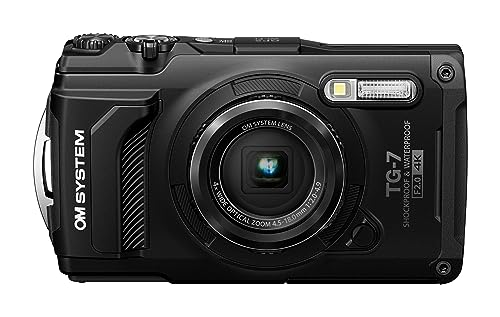
OM SYSTEM Olympus Tough TG-7 — Microscope-mode marvel
Begin with the wonder, because the TG-7 earns it. Its microscope mode focuses a centimetre from the lens and magnifies subjects to a degree that dedicated macro lenses — costing several times the camera — do not attempt: the individual scales of a butterfly’s wing, the crystalline teeth of a frost feather, the engineering of a watch’s smallest screw, rendered across the whole frame. For the close-up photographer whose subjects are truly tiny, this little armoured compact is not the budget option. It is, at its specific game, the strongest instrument in the guide.
Focus stacking, built into the camera, completes the marvel. At microscope distances, depth of field collapses to a sliver no aperture can rescue, so the TG-7 automatically captures a sequence of focus planes and merges them into a single frame sharp from front to back. The merged photograph of a beetle’s head — every facet, every hair, in focus at once — looks like the work of a laboratory rig, and it was made by a camera hanging from a gardener’s belt, in the garden, before breakfast.
The supporting details read like a macro photographer’s wish list dictated to an engineer. A dedicated accessory system offers a ring light and a light-guide that wraps illumination around the lens for shadowless tiny subjects; the built-in sensors log the conditions; the body is waterproof, so the pond’s edge and the rock pool — close-up paradises both — are working territory rather than viewing platforms. Underwater macro, a genre that normally demands housings worth a car, begins here with a camera that simply swims.
Honesty about the frame’s other end: the sensor is small, so at ordinary distances its files are a compact’s files, and in dim rooms the grain arrives early. The microscope kingdom, however, is lit by its own ring light and governed by its own rules, and there the small sensor’s deep native depth of field is an advantage disguised as a specification. Judge the TG-7 inside its kingdom and it is a monarch; judge it as a general camera and it is merely very good, which this guide counts as a splendid bargain.
For teachers, naturalists, jewellers documenting their bench and parents of children who collect small wonders, the TG-7 collapses the distance between curiosity and evidence to almost nothing. No lens to buy, no rail to align, no housing to seal — the tiny world, photographed at breakfast-table distance from the impulse to look closer. That immediacy is a photographic virtue the laboratory rigs cannot buy at any price.
- Class: Waterproof compact with microscope mode
- Magnification: Beyond typical 1:1 macro lenses
- Stacking: In-camera focus bracketing and merging
- Lighting: Ring-light and light-guide accessories
- Element: Underwater macro without a housing
Strengths
- Magnification rivals laboratory instruments
- Stacking built in, not bolted on
- Tiny subjects lit by dedicated accessories
Trade-offs
- Small sensor limits ordinary-distance files
- Dim-room grain arrives early
- Microscope working distance is very close
Best for: insects, frost, pond life and bench-top miniatures
Not suited for: large-format product photography in studios
Start with frost on a window or a feather on the path, subjects that hold still while you learn the mode’s manners. Within a week the TG-7 will have shown you three photographs you could not have imagined taking, which is the precise definition of a close-up camera doing its job — and the reason this unlikely little armour-plated compact leads a guide full of giants.

Canon EOS R6 Mark III — System macro flagship
Where the TG-7 is a microscope that travels, the R6 Mark III is the platform on which a serious close-up practice is built. Its higher-resolution full-frame sensor records a 1:1 macro frame with enough detail to crop into the subject’s portrait — the spider’s face from the spider’s full length — and still print the crop large. Canon’s RF macro lenses, including designs that reach beyond life size, mount natively, and the body’s focus-bracketing sequences fire automatically for stacking at the desk.
The workflow deserves describing because it is the modern macro method in miniature. The subject — a sleeping moth, a coin, a ring on black glass — is lit and composed; the camera walks its focus from the nearest point to the farthest in fine steps, capturing each plane; software at the desk merges the planes into a frame of impossible depth. The Mark III’s resolution makes the merged file a print rather than a post, and its colour science keeps gemstones, petals and skin honest through the process.
Handheld close work, the genre’s other half, is served by stabilisation and tracking that earlier macro generations lacked. A butterfly that will not pose can be followed at respectful distance with a longer macro lens, the focus held on its eye while the wings do their slow semaphore. Purists will note that true macro depth still defeats any single frame — and the camera answers with its bracketing, fired fast enough to stack even a living subject’s quieter moments.
The body’s general excellence compounds in the studio corner. Tethered shooting to a laptop, a fully articulating screen for the low angle under a mushroom, focus peaking that paints the sharp plane in colour for manual lenses — the apparatus of deliberate close photography is all present, and all mature. This is the camera for the photographer whose close-up work is becoming their work, with a portfolio, a print shelf or a shopfront attached.
The bill is the system’s bill, and the guide repeats its standing advice: name the macro lens in the same budget breath as the body. A flagship behind a general zoom is a close-up camera in potential only; paired with its macro optic, a rail and a modest light, the Mark III is the most complete close-up instrument in this guide for subjects from a centimetre upward.
- Class: Full-frame mirrorless, higher-resolution class
- Magnification path: RF macro lenses, some beyond 1:1
- Stacking: Automatic focus bracketing for desk merging
- Studio manners: Tethering, articulating screen, focus peaking
- Files: Croppable macro frames for large prints
Strengths
- Print-scale detail from macro frames
- A complete stacking workflow in-body
- Macro glass among the finest available
Trade-offs
- System cost climbs with lens and rail
- Desk merging step suits deliberate work
- Size dwarfs the tabletop subjects’ world
Best for: serious macro, product and print photographers
Not suited for: pocket naturalists wanting zero apparatus
Buy the rail the same month as the lens. The Mark III’s stacking reaches its full authority when focus steps are mechanical rather than hopeful, and the rail turns bracketing from a feature into a ritual: compose, light, step, merge. Photographers who build that ritual find their close-up work acquiring a finish that viewers describe as professional, because it is — the word simply means the ritual, kept.

Sony Alpha 7 IV — Adaptable close-up all-rounder
The a7 IV’s close-up case rests on abundance. Sony’s E mount hosts macro lenses from Sony itself and from a crowd of third-party makers at prices from the modest to the magnificent, and the vintage macro glass of every dead mount adapts to it happily through simple rings — meaning the close-up photographer can begin with a borrowed classic and climb by evidence. A genre that lives on specialised optics rewards the mount with the deepest optics shelf, and that shelf is this camera’s home.
Its focus tools suit the close world’s mixed methods. Focus peaking paints the razor-thin sharp plane in a chosen colour on the magnified view, so manual macro — still the connoisseur’s method on a rail — becomes a visual craft rather than a guessing game. Eye autofocus, meanwhile, serves the other end of the close-up country: the tight portrait, the pet’s face filling the frame, where the sharpness must live on the eye and the camera finds it there unbidden.
Resolution sits in the genre’s sweet spot. Thirty-three megapixels crop a flower’s heart into its own photograph and hold a product’s texture honestly for a shop page, without the file sizes that make stacking sequences a storage negotiation. Colour depth forgives the mixed lighting of tabletops — window plus lamp plus the ring light’s contribution — and the files emerge from editing with their subjects’ materials intact: brass brassy, petal petal, crumb crumb.
The honest gap is automation. Sony’s bracketing support has historically asked more of third-party software and patience than Canon’s in-body generosity, so the stacking devotee should test the workflow before committing a portfolio to it. Handheld and single-frame close work, by contrast, is effortless, and the stabilisation plus a fast macro prime makes a garden kit that travels in one hand and a pocketful of intention.
Choose the a7 IV when close-up is one province of a wide photographic kingdom — portraits on Tuesday, the garden’s macro on Saturday, the product table when the shop demands it — and when the lens shelf’s depth matters more than any single feature. It is the all-rounder of this guide’s close country, and all-rounders with this one’s files and focus rarely disappoint the photographers who feed them subjects.
- Class: Full-frame mirrorless, 33-megapixel class
- Magnification path: Macro glass at every price, easy adapting
- Focus tools: Peaking for manual macro, eye focus for portraits
- Files: Cropping headroom without storage drama
- Character: One body for close and general work
Strengths
- The deepest macro lens shelf in the guide
- Manual-focus aids of professional quality
- Close portraits served by eye detection
Trade-offs
- Stacking workflow leans on software
- Menus reward an evening of setup
- Best macro glass still costs real money
Best for: all-rounders whose close work spans garden to studio
Not suited for: stacking purists wanting everything in-body
Borrow or adapt one vintage macro lens before buying anything new. The a7 IV’s mount makes the experiment nearly free, and a month with a classic manual macro — peaking glowing, rail turning — will teach the photographer exactly which modern lens their habits are asking for. Close-up photography rewards that kind of evidence more than any other genre, because its tools are bought for decades, not seasons.

Panasonic LUMIX S5IIX — Video-macro and detail films
Close-up filming is its own craft — the watchmaker’s hands, the sauce at the exact simmer, the solder joint blooming — and the S5IIX is this guide’s instrument for it. Its video armoury, from fine recording formats to focus aids designed for deliberate work, serves the detail film the way its sibling serves the evening still; and its stills, from the same 24-megapixel sensor and phase hybrid focus, lose nothing that a product table or a garden frame could ask. Blogs, shops and teachers who publish moving close-ups should start their shortlist here.
Stabilisation changes what handheld close filming can attempt. A slow push-in toward a plated dish, a walk around a restoration engine, the reveal of a ring from its box — movements that once demanded a slider and a free afternoon now happen at handheld scale, steadied by the body, at distances where a tripod’s legs would crowd the subject out of its own light. The X’s focus breathing manners and peaking keep the moving frame’s sharpness where the story put it.
For stills, the close-up story is the L-mount’s growing macro shelf plus the body’s bracketing for stacking, rendered in files whose colour holds materials honestly under workshop light. The watchmaker documenting a restoration — stills for the client, film for the channel — works one camera across both deliverables, and the consistency of its rendering across modes gives the whole project a single visual signature, a virtue clients notice without naming.
Its size and seriousness are the trade. This is a working instrument, heavier in the bag than the compacts and priced for photographers whose close work earns or teaches. The hobbyist photographing snowflakes for the joy of it should take the TG-7 and its microscope; the craftsperson whose close-ups are a livelihood — or a channel with an audience’s expectations — will find the X’s depth repaid weekly.
Heat and endurance, the filming virtues nobody photographs, close the case. Long detail sessions — the full build, the whole recipe, the complete restoration stage — record without the anxiety that consumer bodies attach to duration, and the fan-cooled philosophy of its line means the camera’s stamina outlasts most subjects’. Close-up filming is a genre of patience; its camera should be the most patient object on the bench.
- Class: Full-frame mirrorless, video-forward
- Close signature: Detail filming with focus aids
- Stabilisation: Handheld push-ins at table scale
- Stills: Bracketing for stacking, honest colour
- Endurance: Built for long recording sessions
Strengths
- Close-up film and stills from one body
- Handheld detail moves without a slider
- Session stamina for builds and recipes
Trade-offs
- A working instrument’s size and price
- Stills-only shooters pay for video depth
- Macro shelf still growing beside Sony’s
Best for: craft channels, watchmakers, cooking detail films
Not suited for: joy-only snowflake hobbyists
Light one small scene three ways before the first real session — window, lamp, ring — and save the files as the project’s reference set. The S5IIX’s close filming rewards a litmus scene learned in advance, because on the day the solder must flow or the sauce must turn, the camera should already be a solved problem. Solved cameras disappear; subjects, at last, get the attention.

Nikon Z50 II with Two Lenses — Learning close-up on a budget of patience
Not all close-ups are macro, and the beginner in the close country should learn its geography on forgiving ground. The Z50 II kit’s longer zoom, at its telephoto end and closest focus, fills frames with flowers, pets’ faces and garden visitors from a step back — close-up photography with training wheels of distance, where the subject is unhurried, the light is plentiful and the photographer’s shadow stays out of the picture. Many beloved close photographs are exactly this, and the kit teaches their making without a single specialised purchase.
Subject detection earns a second mention in this context, because the close portrait of an animal — the dog’s face at frame-filling range, the cat mid-yawn — lives or dies on eye focus at shallow depth. The Z50 II finds the eye and holds it while the beginner composes, and the resulting portraits teach the genre’s first law viscerally: at close range, sharpness is a place, and the place is the eye. No lecture installs that law like a week of pet portraits reviewed at full size.
The growth path is the kit’s deeper argument. Nikon’s Z mount offers a dedicated macro lens when the student’s appetite graduates from close-up to true macro, plus extension tubes that convert the kit zooms into nearer-focusing instruments for the price of a modest dinner. The camera bought for the family’s general photography becomes, accessory by accessory, a macro platform — which is how most real macro practices actually begin, whatever the catalogues pretend.
In the hand, the small body suits the garden and the tabletop equally: light enough to hold low over a flower bed for the bee’s-eye view, steady enough with its screen tilted for the overhead product shot. Its files crop kindly for the shop page and the club competition, and its colour presets give a beginner’s close work a consistent signature while the technique catches up with the taste.
Name its ceiling plainly: without the macro lens or tubes, true 1:1 stays over the horizon, and its kit zooms’ closest focus is a close-up distance rather than a microscope’s embrace. For the photographer who knows that ceiling and is content to learn beneath it for a season, the kit is the wisest first address in the close country — with the macro lens waiting, priced and patient, at the end of the street.
- Class: APS-C mirrorless, two-lens kit
- Close style: Telephoto close-ups from a step back
- Detection: Animal eye focus for pet portraits
- Growth: Tubes now, dedicated macro lens later
- Files: Croppable for shop pages and clubs
Strengths
- Close-up learning without specialised purchases
- Pet portraits teach sharpness placement
- A staged, affordable road to true macro
Trade-offs
- True 1:1 needs the macro lens or tubes
- Kit zoom close focus is modest
- Dim macro work trails full-frame files
Best for: beginners entering close-up through gardens and pets
Not suited for: committed 1:1 macro from the first day
Spend the first close-up month at the long end of the kit zoom, photographing one flower bed across its whole season. The constraint teaches working distance, background choice and patience — the genre’s true fundamentals — and by the month the bed fades, the photographer’s eye will have outgrown the constraint so completely that the macro lens, when it comes, feels like a promotion already earned.

DJI Osmo Pocket 3 — Close-focus pocket storyteller
The Pocket 3 closes this guide by shrinking the close-up camera to the size of the subject’s own world. Its fast focusing snaps onto near subjects — the pastry’s layers, the plant’s new leaf, the gadget’s telling detail — with a confidence that makes handheld detail photography feel like pointing at things and having them understood. For the diarist and the small seller, whose close-ups are spontaneous rather than staged, that speed of understanding is worth more than a laboratory’s magnification.
The gimbal contributes a close-range trick no stills body here can imitate: the smooth, slow orbit. Circle a ring, a cake or a restored radio at close distance and the frame glides like a dolly shot, turning a product’s presentation into a small ceremony. Stills from the same device, locked off, carry its one-inch sensor’s honest quality, so the orbit’s poster frame and the detail photographs share one colour signature across the post or the listing.
Working distance is intimate — this is a camera that leans in — and its screen shows the near world large and bright while the photographer composes at arm’s length. Face tracking at close range serves the presenter reviewing a product to their audience, holding focus on the person while the object passes between hands, a small choreography that sellers and teachers perform daily and that this little camera was plainly designed by people who had watched them do it.
Its limits are the microscope’s opposite: magnification is modest, and the true macro world of 1:1 belongs to the system bodies and the TG-7 above. The Pocket’s close-up is the storyteller’s close-up — nearer than conversation, farther than science — and within that band it is nearly frictionless. Photographers should choose it for the band it owns rather than forgive it for the bands it declines.
As a second camera it may be the guide’s easiest recommendation: the system photographer adds it for the orbit and the diary, the TG-7 naturalist for the camp-table review, the seller for the listing that moves. Close-up work, more than any genre, accumulates instruments the way a bench accumulates tools — and this one earns its drawer by doing two jobs, the moving reveal and the quick detail, that no other pick performs in quite its pocketable way.
- Class: Gimbal camera, one-inch class sensor
- Close style: Fast near focusing, handheld detail
- Signature move: The slow orbit around small subjects
- Tracking: Faces held during product presentation
- Carry: Pocket-sized beside any main camera
Strengths
- Detail photography at the speed of pointing
- Orbit reveals no stills body can match
- One colour signature across film and stills
Trade-offs
- Magnification is storytelling, not science
- True macro belongs to other picks
- Gimbal care between outings
Best for: sellers, diarists and product storytellers
Not suited for: 1:1 macro and microscope subjects
Practise the orbit on a coffee cup until the glide is invisible, because the move is this camera’s handwriting and viewers read it before they read the subject. Once the hand is trained, every small subject the photographer meets — the ring, the seedling, the repaired hinge — receives the same quiet ceremony, and a body of close work acquires a signature no specification can confer.
What is the difference between close-up, macro and micro photography?
The three words describe one road travelled at three speeds. Close-up is the country where subjects fill the frame from a comfortable distance — the flower head, the product, the face at portrait range — and any camera with a willing lens can visit. Macro begins at the border marked 1:1, where the subject is recorded life-size on the sensor: a bee occupies the frame the way a person occupies a doorway, and the technical demands — depth, light, steadiness — multiply accordingly.
Micro, in the working photographer’s sense, is what lies beyond: magnifications of two, five, ten times life size, where the TG-7’s microscope mode and laboratory optics operate and where a snowflake’s arm becomes a landscape. Each speed along the road asks more of light and stability and returns more wonder per millimetre, and the wise beginner travels it in order, because the skills compound — the flower teaches focus placement, the bee teaches light, and only then does the snowflake’s brief life find a photographer ready for it.
Equipment follows the same geography. Close-up asks a lens that focuses nearer than usual or a zoom that frames tightly; macro asks a dedicated optic or tubes and, soon after, a rail and a stacking habit; micro asks for illumination that wraps the subject and a patience that borders on the devotional. The six picks in this guide are stationed along that road deliberately, so a reader can board at their own distance and ride as far as their curiosity is currently funded.
Why does depth of field vanish at close range, and what can be done?
Depth of field — the zone of acceptable sharpness — shrinks as magnification grows, because the geometry of focus tightens around the plane of sharpest focus. At portrait distance that zone may be a hand’s breadth; at 1:1 it can be thinner than the bee. Closing the aperture buys depth back at a brutal exchange rate: diffraction softens the whole frame, shutter speeds sag, and the light that was scarce becomes a rumour. Every macro photographer lives inside this triangle of sorrow, and the genre’s techniques are its negotiated settlements.
Focus stacking is the modern settlement, and it is a genuinely new chapter in the genre’s history. By photographing the subject in slices — focus stepped from front to back — and merging the sharp band of each slice, stacking delivers depth that optics alone cannot, at apertures where diffraction has not yet begun its softening. The cameras here that bracket automatically turn a laboratory procedure into an afternoon’s habit, and the merged results have quietly redefined what close-up photographs are expected to look like.
The older settlements remain honourable. Choose the plane with intent — the eye, the petal’s edge, the hallmark on the silver — and let the rest fall into a blur that reads as atmosphere rather than error. Tilt the camera so the subject’s own plane aligns with the focus plane, a flower’s face or a coin’s surface surrendering its whole extent to one exposure. Stacking is power; plane-craft is wisdom, and the close-up photographers whose work lasts tend to carry both.
How should you light a subject smaller than your hand?
Begin by removing the camera’s own shadow, the beginner’s first close-range discovery: at macro distances the lens and body eclipse the very light the subject needs. The solutions arrange themselves by budget. A window to the side, with the subject turned to it, costs nothing and flatters flowers and food. A small LED panel on a flexible arm buys direction and consistency for the tabletop. A ring light, wrapping the lens in its own illumination, serves the microscope world and the product bench with shadowless honesty — the TG-7’s light-guide accessory exists for exactly this geometry.
Diffusion is the second lesson, because small subjects live under hard light the way faces live under noon sun: specular, glaring, unkind. A sheet of tracing paper, a shower cap over the light, a white card bouncing the window — any of these enlarges the light source relative to the subject, and relative size is softness. The dewdrop that was a white spark becomes a window-shaped jewel; the beetle’s armour gains modelling instead of glare. Close-up lighting is mostly this single idea, practised at smaller and smaller scales.
Colour closes the lesson. Mixed light at a tabletop — daylight, tungsten, the ring’s LEDs — argues inside a frame too small to forgive it, so choose one light and silence the others, or correct deliberately in the file. The cameras’ raw formats, where offered, are the close photographer’s insurance here, because a petal’s true colour is the photograph’s whole testimony, and testimony should not be left to a hallway lamp’s opinion.
How do you keep a living subject still, sharp and unharmed?
Work at the subject’s own hours. Insects in the cool of early morning move at a photographer’s pace, dew still beading their wings; the same meadow at noon is a gymnasium. Garden spiders keep their webs and their dignity when approached slowly, from below their alarm’s geometry, with the camera’s shadow announced gradually rather than dropped. Patience is not a virtue in this genre so much as a focusing aid, and the photographers who master it return with portraits the hurried never see because their subjects left.
Never trade the subject’s welfare for the frame. The chilled insect, the relocated frog, the flower picked for a convenient background — these shortcuts stain a genre whose entire premise is attention to small lives, and experienced communities recognise and remember them. Photograph in place, return everything, and let the missed frame stand as tuition. The close world’s inhabitants are the photographer’s collaborators, and collaborators who are honoured keep collaborating.
Technically, let the camera do the stillness you cannot ask of the subject. Fast shutter bursts for the swaying flower, continuous focus for the bee’s approach, pre-focusing on the landing petal and waiting for the arrival — the methods differ by subject, and the picks here divide them by design: detection and bursts from the system bodies, stacked patience from the TG-7, the orbit’s calm from the little DJI. Match the method to the temperament — the subject’s first, then your own.
What does a sensible close-up kit look like beyond the camera?
A tripod that goes low, because the close world lives near the ground and a tripod that stops at waist height is furniture. A focusing rail when stacking becomes a habit, turning focus steps into machinery. A remote release or the camera’s timer, because at macro magnification the finger that fires the shutter is an earthquake with a name. A kneeling pad, a headtorch for dawn work, and a grey card for the tabletop’s colour honesty — the whole supporting cast costs less than any lens in this guide and decides more photographs.
Light joins the kit in stages: the reflector card first, the small panel second, the ring when the subjects shrink below a centimetre. Backgrounds accumulate as offcuts — black velvet for the laboratory look, coloured card for the product bench, a printed blur for the flower portrait — each weighing nothing and changing everything. Close-up photography is the most prop-friendly of genres, and its practitioners’ bags look like a theatre’s small-properties store for excellent reasons.
Finally, a notebook, paper or otherwise, kept with the kit. Magnifications, distances, light recipes and the stacking settings that worked are the genre’s real intellectual property, and they evaporate between sessions with scientific reliability. The close-up photographers whose archives compound are the ones whose notebooks do; the camera records the subject, but the notebook records the photographer, and the second record is the one that improves.
How do you photograph products and small objects for a shop or portfolio?
Consistency is the commercial virtue: one background, one light direction, one camera position, so a shop’s page reads as a single maker’s testimony rather than a flea market’s rumour. The system bodies here, tethered and bracketed, serve that consistency at scale, while the Pocket 3’s orbit adds the moving presentation that listings increasingly reward. Shoot the set in one session, in the order the customer will meet it — whole, detail, scale, in hand — and let the camera’s settings stay untouched between frames like a promise.
Scale must be told honestly. A hand in one frame, a coin beside the miniature, dimensions in the caption that the photographs do not contradict — small-object photography tempts exaggeration because magnification is its native language, and a shop’s reputation is the interest paid on resisting it. The close-up camera shows texture beautifully; let it also show truth, and the customers who arrive will be the kind who stay.
Finish with the detail that proves the making: the maker’s mark, the seam, the brushstroke in the glaze. Buyers of handmade things are buying evidence of a hand, and close-up photography is that evidence’s native form. The cameras in this guide, from the microscope’s marvel to the flagship’s stacked precision, all serve that single commercial sacrament — proof, beautifully lit, at the distance of a hand.
How do you build a close-up practice across the seasons?
The small world keeps a calendar stricter than the large one. Frost owns the winter mornings and demands a photographer dressed for stillness; spring belongs to buds, beetles and the first bees working at half speed in the cool; summer is the insect gymnasium, fast and bright; autumn delivers fungi, seed heads and the dew-heavy webs that are macro photography’s stained glass. A close-up practice that follows that calendar never lacks subjects, and the cameras in this guide divide the year between them like tenants who have agreed the schedule in advance.
Keep a phenology notebook — the gardener’s word for the diary of first appearances — beside the camera kit. The first frost flower on the same window, the first bee on the same crocus, the web rebuilt in the same corner of the fence: recorded across years, these repetitions become a body of work no single expedition can buy, and they teach the deepest close-up skill of all, which is returning. Most photographers visit the small world; the ones who matter to it are residents.
Let the archive set each season’s small ambition. One subject studied properly — the life of a single garden spider, a coin’s portrait in twelve lights, the snowflake typology of one cold snap — outweighs a hundred subjects glanced at. The microscope mode, the stacking flagship and the patient kit zoom all serve that ambition equally, because ambition in this genre is measured in returns per subject, and returns are a calendar habit, not a camera feature.
How do the six close-up cameras compare at working distance?
Read the table by subject size, the genre’s true organising principle. Subjects smaller than a coin belong to the microscope and the stacked flagship; subjects the size of a hand belong to everyone; subjects that move belong to whichever camera is already in yours. The right row is the one whose magnification, distance and light match the small world you actually visit.
| Pick | Badge | Choose it when | Think twice when |
|---|---|---|---|
| OM SYSTEM Olympus Tough TG-7 | Microscope-mode marvel | insects, frost, pond life and bench-top miniatures | large-format product photography in studios |
| Canon EOS R6 Mark III | System macro flagship | serious macro, product and print photographers | pocket naturalists wanting zero apparatus |
| Sony Alpha 7 IV | Adaptable close-up all-rounder | all-rounders whose close work spans garden to studio | stacking purists wanting everything in-body |
| Panasonic LUMIX S5IIX | Video-macro and detail films | craft channels, watchmakers, cooking detail films | joy-only snowflake hobbyists |
| Nikon Z50 II with Two Lenses | Learning close-up on a budget of patience | beginners entering close-up through gardens and pets | committed 1:1 macro from the first day |
| DJI Osmo Pocket 3 | Close-focus pocket storyteller | sellers, diarists and product storytellers | 1:1 macro and microscope subjects |
Which mistakes do close-up beginners make at the distance of a hand?
Judging sharpness at arm’s length on the camera screen leads the list: at macro magnification, a frame that looks crisp on a three-inch display can be a breath of blur at full size. Zoom the review fully, every session, without exception. Second comes the camera’s shadow, discovered after a morning’s shooting rather than before its first frame. Third is the aperture reflex — closing to the smallest number for depth and receiving diffraction’s softness as a mysterious curse on the lens.
Fourth is neglecting the background at the one distance where it cannot be ignored: at close range, a centimetre of shift replaces a clean blur with a distracting stem, and the time to see it is before the exposure, in the magnified view. Fifth is stacking without stillness — bracketing a swaying flower and merging its ghosts into a watercolour — when the honest cure was an earlier hour, a sheltered corner or a single, well-chosen plane. Close-up photography forgives beginners almost everything except haste, which it punishes in millimetres.
Final Recommendation
Let subject size sign the cheque. The truly tiny — frost, pond life, the bench’s smallest screws — belong to the TG-7 and its microscope, the guide’s easiest first recommendation. Print-scale macro and product work belong to the Canon flagship’s stacked resolution, with Sony’s all-rounder and its endless lens shelf beside it; moving close work belongs to the Panasonic; the learning curve belongs to Nikon’s kit; and the storyteller’s near world belongs to the little DJI and its orbit. Every one of them will show you something at the distance of a hand that you have walked past ten thousand times.
Then slow down, because the genre’s final secret is tempo. Set the tripod low, light the small thing kindly, choose the plane like it matters — because at this distance it is the whole photograph — and let the subject keep its dignity and its life. The best digital cameras for close up shots are not finally the ones with the largest magnification figures in this guide. They are the ones that teach their owners to kneel, to wait and to look again at a world that was never small at all — only unexamined, waiting at the end of your own hand for someone to finally lean in.
Frequently Asked Questions
What magnification do I need for insects and flowers?
Flowers flatter at close-up range, a quarter to half life size, which most kit zooms and compacts reach happily. Insects portraiture begins at true 1:1, where a bee fills the frame, and goes beyond for eyes and wing scales — the territory of the Canon’s macro lenses and the TG-7’s microscope mode. Start with flowers, graduate to bees, and let the subjects themselves set your magnification budget.
Can I do macro with extension tubes instead of a macro lens?
Yes — tubes move a standard lens closer by extending its mount, and they are the classic inexpensive door into true macro on the system bodies here. The costs are light, working distance and some electronic convenience, all manageable at a tabletop. Many macro photographers keep tubes forever as the portable option, even after the dedicated lens arrives, because a set of tubes weighs nothing in a walking bag.
Why are my close-ups sharp in the middle and soft at the edges of the subject?
Because depth of field at close range is a plane, not a volume, and your subject has depth the plane cannot hold. Either align the subject with the plane — the coin flat, the flower’s face square — or stack a bracket of planes and merge them, as the Canon and TG-7 automate. A smaller aperture helps a little and then diffraction taxes the whole frame; plane-craft and stacking are the real cures.
What light is best for photographing jewellery and coins?
A single large, diffused source for the shape, plus small bright cards or a ring light for the sparkle that proves metal and stone. Jewellery photographs are negotiations between reflection and detail: too soft and the gems sleep, too hard and the metal glares. Shoot tethered or review at full size between adjustments, and let one variable move at a time — the method the S5IIX and Canon setups here are built to support.
Is a compact like the TG-7 really better than a big camera for tiny subjects?
At the smallest subjects, often yes. Its microscope mode magnifies beyond most macro lenses, its small sensor keeps more of the tiny scene in focus natively, its stacking is built in, and it swims to the pond subjects the big cameras watch from the bank. The system bodies reclaim the crown as subjects grow toward the size of a hand and prints grow toward the size of a wall — which is why this guide stations them along one road rather than crowning one king.
How close can the DJI Pocket 3 focus for product shots?
Near enough for the storyteller’s band: a pastry, a plant, a gadget’s detail at conversational distance, rendered from its one-inch sensor with fast, confident focusing. It is not a macro instrument and does not pretend to the 1:1 world; its close-up gift is the smooth orbit and the quick detail inside a post or listing. Pair it with any macro pick here and the two bands — story and science — are both covered.
Related Guides
The small world connects to several neighbouring crafts on this site, most closely the best cameras for macro photography the best digital cameras for product photography the best compact cameras for nature details.


