reviewstook.com is reader-supported. When you buy through links on our site, we may earn an affiliate commission.
Where to buy
Four hundred dollars is where the camera market stops apologising. A hundred less and every purchase is a negotiation with compromise; at four hundred, the best cameras under 400 dollars include genuine flagships of their categories — action cameras with large sensors and dual touchscreens, a pocket camera’s worth of webcam intelligence, and stabilisation that used to headline professional launches. The catch, and there is always a catch, is that the money buys excellence in specific shapes rather than in general: no conventional mirrorless body lives here new, so this guide is a contest among action cameras, one remarkable webcam and one tiny wearable — the shapes in which four hundred dollars currently buys the most camera.
- DJI Osmo Action 4: check price on Amazon
- GoPro HERO12 Black: check price on Amazon
- DJI Osmo Action 3: check price on Amazon
- AKASO Brave 7 LE: check price on Amazon
- OBSBOT Tiny 2: check price on Amazon
- Insta360 GO 3S: check price on Amazon
Balance is this budget’s theme, and it cuts two ways. Buyers here typically film both photographs and video — the family archivist, the travelling creator, the small-business owner — and they need a camera that refuses to be terrible at either. Action cameras have quietly become that camera: their stills are respectable, their video is superb, and their toughness forgives the life a general-purpose camera actually leads. The two non-action picks, the tracking webcam and the wearable, exist for buyers whose balance tips toward the desk or toward demonstration angles no conventional camera reaches.
Pricing honesty, briefly, because this tier blurs: the flagship action picks move in and out of this budget with bundles and seasons, and the guide treats the four-hundred line as the centre of a neighbourhood rather than a wall. Each review notes where its pick tends to sit. What will not happen here is a pick being described as a bargain at a price it has never met — check the current figure, and let the rankings, which are about capability, survive the arithmetic either way.
Stills deserve a promise before the reviews begin, because action cameras carry an unfair reputation as video-only toys. Every action pick below shoots stills that print happily at family sizes and shine on screens, with burst and interval modes that turn them into surprisingly capable little sports and travel cameras. They will not replace a dedicated stills body for a photographer — nothing at this price does — but for the hybrid buyer this guide serves, they close the question rather than leaving it open.
Key Takeaways
- DJI’s Osmo Action 4 is the tier’s flagship: a large sensor, dual touchscreens and low-light footage the others chase.
- GoPro’s HERO12 counters with ecosystem depth, a tall sensor for vertical crops and the reference stabilisation.
- The Osmo Action 3 delivers most of the DJI experience for less, especially in its accessory bundles.
- AKASO’s Brave 7 LE keeps the honest budget flame: dual screens and sealing with money left for mounts.
- OBSBOT’s Tiny 2 is the desk’s champion — a 4K webcam that pans, tilts and tracks you around the room.
- Insta360’s GO 3S is the angle hunter: a thumb-sized camera whose flip-screen pod monitors shots from anywhere.
In this guide
Quick Picks
| Camera | Badge | Why it is here |
|---|---|---|
| DJI Osmo Action 4 | Best overall at the tier | Large-sensor image quality, front touchscreen and endurance for serious creators. |
| GoPro HERO12 Black | Best ecosystem pick | Stabilisation, tall-sensor flexibility and every mount ever made. |
| DJI Osmo Action 3 | Best DJI value | The previous flagship’s manners at a friendlier figure, bundles included. |
| AKASO Brave 7 LE | Best budget guardian | Front screen and weather sealing that leave the budget breathing. |
| OBSBOT Tiny 2 | Best for desks and streaming | A motorised 4K webcam that follows you like a cameraman. |
| Insta360 GO 3S | Best for impossible angles | Wearable, mountable anywhere, with a flip touchscreen in its pod. |
How do you balance stills and video at this price?
Start from the ratio in your real life. A buyer whose output is eighty percent video should let video specifications rule and treat stills as the bonus they have become in modern action cameras — good enough for the album, the listing photo and the family wall. A buyer nearer fifty-fifty should weigh stills handling more heavily: how fast the camera wakes, whether its photo modes are citizens or afterthoughts, and whether its files carry enough resolution to crop a composition that action filming rarely perfects in the moment.
Sensors tell the balance story in miniature. The larger units in the DJI picks serve both masters — cleaner video in low light, stills with genuine dynamic range — while the smaller, wider systems in the GoPro serve video’s stabilisation and cropping needs first. Neither philosophy is a flaw; they are the same engineering budget spent at different counters, and the reviews name which counter each pick chose.
Handling is the third leg of balance, and the least specifiable. A hybrid camera must switch personalities in seconds — from filming a descent to photographing the summit — and the picks below were judged on that transition: mode access, screen legibility in glare, controls that work with the gloves or wet hands of the actual day. Cameras that bury their photo mode in menus fail hybrid buyers in the field regardless of their sensors.
Finally, balance includes the desk. A growing share of hybrid buyers also present, teach or stream, and a camera that moonlights as a high-quality webcam — as several picks here do — effectively refunds part of its price by retiring a second device. Versatility across the week, not just across the trail, is the true measure of this tier.

DJI Osmo Action 4 — Best overall at the tier
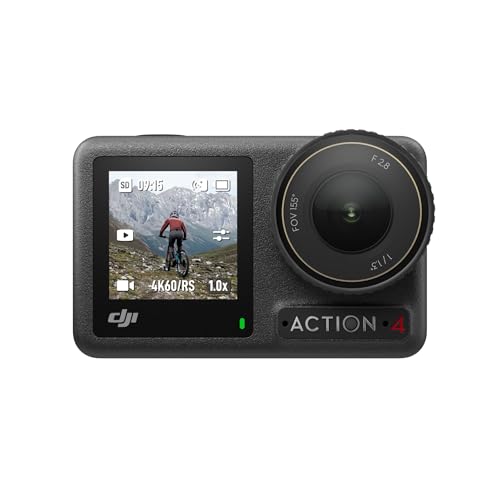
The Action 4 is what four hundred dollars buys when a flagship decides to visit: a large 1/1.3-inch sensor in an armoured, waterproof body, with touchscreens front and back and stabilisation that treats chaos as a rounding error. Its arrival reset the action category’s low-light expectations — dusk trails, forest shade and indoor walls stopped being footage graveyards — and at this budget it remains the image-quality benchmark every other pick is measured against.
Low light is the headline because it extends the filming day at both ends, and filming days are where memories concentrate: dawn starts, evening rides, the pub garden after the walk. The Action 4’s sensor gathers those hours cleanly, with colour that holds together instead of dissolving into noise, and its exposure behaviour stays calm through the tunnel exits and tree lines that panic lesser cameras.
Operation is thoroughly considered for the solo creator. The front touchscreen runs settings from the presenter’s side; the magnetic quick-release mount moves the camera between helmet, chest and tripod in a second, in either orientation; and the menus respond with a phone-like directness that respects cold fingers and short fuses. Friction is the tax on every one-person production, and DJI has engineered this camera to collect as little of it as physics allows.
Stills, the balance question, are served properly: the large sensor produces photographs with genuine depth and clean shadows, and the camera’s photo modes are quick to reach and quick to fire. It will not replace a photographer’s dedicated body, but the travelling hybrid who carries only this will come home with a stills archive that needs no apology — the precise promise this tier exists to keep.
Endurance and charging suit long days: strong battery life, fast top-ups, and a build that shrugs off the water and knocks of its intended life without a housing. Against the GoPro below, the trade is ecosystem breadth and tall-sensor cropping against sensor size and front-screen control; against everything else here, the Action 4 simply has the fewest weaknesses to manage.
Buy it if your four hundred is meant to settle the action camera question for years. It is the most complete camera in this guide, and the one whose footage will still look current when the next two generations have had their launches.
Creators who grade their footage will find one more professional courtesy: colour profiles that hold up in an editor, giving the Action 4 a post-production life beyond the share-it-now defaults. A camera whose files reward skill is a camera that grows with its owner, and growth is what a multi-year purchase at this tier should promise.
- Sensor: 1/1.3-inch, strong in low light
- Screens: dual touchscreens
- Mount: magnetic quick-release
- Video: 4K high frame-rate capable
Strengths
- Finest image quality in the guide, day and dusk
- Front touchscreen built for solo creators
- Mounting speed that multiplies angles
Trade-offs
- Ecosystem younger than GoPro’s
- Premium within the tier; bundles vary
- Stills still trail a dedicated camera
Best for: serious action and travel creators wanting one flagship. Not suited for: buyers who need a conventional stills body.

GoPro HERO12 Black — Best ecosystem pick
Choosing the HERO12 is choosing an infrastructure. The camera itself is excellent — tall sensor, reference stabilisation, high-resolution video with slow-motion headroom — but the purchase really buys the deepest accessory catalogue, the most mature app, the rental-and-resale ubiquity and the guarantee that whatever mount, case or workflow you need next year already exists with this camera’s name on it. At a four-hundred budget, that certainty is a feature as real as any sensor.
The tall sensor deserves its own paragraph because it solves the modern creator’s geometry problem. One take can yield a horizontal master and a vertical crop of genuine quality, feeding the long-form platform and the short-form feed from a single ride. For creators whose income or audience spans both orientations, that flexibility is not a gimmick; it is half a second camera, included in the first one’s price.
Stabilisation remains the brand’s signature and the benchmark the category quotes. Running, riding and boating footage emerges with a steadiness that viewers now simply expect, and the HERO12’s generation matured the endurance story too — longer runtimes that respect a filming day, with the professional habit of spare batteries still advised for screen-heavy work.
Stills balance is respectable and improving: the sensor’s resolution serves cropping, the photo modes include the bursts and intervals action photographers lean on, and the colour is the crowd-pleasing profile that needs no editor for family purposes. Photographers will still reach for a dedicated body for deliberate work; hybrids will find the HERO12’s stills one less reason to carry one.
The front display, bright and armoured, serves self-framing without touch — settings live on the rear screen — and the body is waterproof as it stands. Against the DJI above, you trade front control and low-light sensor size for ecosystem, orientation flexibility and the stabilisation crown. It is a fair trade in both directions, which is why these two have shared the category’s summit for years.
Buy the HERO12 when your filming life is an ecosystem life — mounts for every sport, a channel across orientations, a camera your collaborators also own. Interchangeability is a professional virtue, and nobody’s cameras interchange like these.
Second-hand depth completes the ecosystem argument: because the world owns these, the world sells them, and a careful buyer can enter the system below this budget entirely or sell out of it without loss drama. Liquidity is an unglamorous spec, and at four hundred dollars it is worth real money.
- Sensor: tall format for dual-orientation crops
- Screens: front display plus rear touchscreen
- Stabilisation: category reference standard
- Body: waterproof without housing
Strengths
- Ecosystem and accessory depth unmatched
- One take serves horizontal and vertical platforms
- Stabilisation viewers now expect as standard
Trade-offs
- Front screen lacks touch control
- Low light trails the DJI’s larger sensor
- Best features reward app engagement
Best for: multi-platform creators and mount-heavy sports. Not suited for: low-light-led filming or hinge seekers.

DJI Osmo Action 3 — Best DJI value
Every flagship generation creates a value shadow, and the Action 3 lives in the Action 4’s: the same design language, dual touchscreens and mounting system, with the previous sensor, at a figure that bundles — like the outdoor combo listed here, with chest and backpack straps — keep pulling into this budget’s heart. For buyers whose filming happens in daylight and whose platforms forgive the last degree of low-light polish, it is the DJI experience with the flagship tax removed.
The bundle arithmetic deserves attention because it is how this pick wins. A camera alone is a down payment on a kit; a camera with the straps a hiker or rider will actually use is a finished purchase. Price the Action 4, then price the mounts it still needs, and the Action 3 combo’s total often tells a story the headline figures hide — this guide counts whole kits, and by whole kits the Action 3 is the value champion of the DJI line.
Performance remains thoroughly flagship-adjacent: stabilisation that holds a descent together, dual screens that make solo operation civilised, waterproofing without a housing, and battery behaviour — with notably fast charging — that suits long outdoor days. Cold-weather reliability built this generation a following among skiers and winter riders, whose testimony about batteries that keep their promises at altitude is the kind of review no laboratory issues.
Where the newer model pulls away is the sensor: dusk and indoor footage from the Action 4 is visibly cleaner, and creators whose signature hours are the day’s edges should pay the difference gladly. Daylight creators, sports filmers and travellers will struggle to find the gap in their own footage, which is precisely the definition of a value pick — the compromise lives where you do not.
Stills serve the hybrid brief adequately, with the same quick photo manners as its sibling and files that share happily. The camera’s maturity is itself a feature: firmware settled, accessories everywhere, a used market forming for the next bargain hunter. Buying the previous flagship is the oldest smart move in consumer electronics, and the Action 3 is its current action-camera edition.
Choose it when the budget must cover the whole kit, or when your filming is a daylight art. It leaves money for the card, the case and the second battery — the unglamorous trio that decides whether a camera’s second year is as good as its first.
Multi-camera creators have a further use for it: as the B-angle to an Action 4 main camera, matched in colour, menus and mounts. Two angles transform event and travel edits, and the matched previous generation is the cheapest way to buy the second angle without buying a colour-matching headache.
- Screens: dual touchscreens
- Bundle: outdoor combo with chest and backpack straps
- Battery: fast charging, cold-weather reputation
- Position: previous flagship value
Strengths
- Flagship manners at a bundle-friendly figure
- Kit completeness in a single purchase
- Proven endurance in cold conditions
Trade-offs
- Low light visibly behind the Action 4
- Previous-generation sensor refinements missing
- Value depends on bundle pricing of the week
Best for: daylight creators and whole-kit buyers. Not suited for: dusk-led filming or newest-only shoppers.

AKASO Brave 7 LE — Best budget guardian
Not every four-hundred budget wants to spend four hundred. The Brave 7 LE guards the lower ground of this tier — dual screens, weather sealing, 4K recording — at a figure that leaves a serious remainder for mounts, cards, a case and the trip itself. In a guide of flagships, it is the voice of the buyer who knows that cameras do not make memories unaccompanied, and that the best accessory is a destination.
Its front screen remains the budget’s most consequential feature: solo creators frame themselves without the walk-back ritual, divers compose underwater self-portraits in the housing, and teachers verify their demonstrations before performing them. Paired with the rear touchscreen, the arrangement delivers the two-screen workflow the flagships charge their premiums for, at a price that treats the workflow as a right rather than a luxury.
Image quality is the honest midfield: bright, stable, pleasing footage in the daylight conditions most owners film in, with stabilisation that smooths walking and cycling into watchability. Dusk exposes the sensor’s budget, and side-by-side with the DJI picks the difference is visible — shown alone, on the screens its owners publish to, the Brave 7 LE’s footage simply looks like a good holiday, which is what it was bought to record.
Weather sealing on the body handles rain and splashes as daily wear, with the housing extending the camera’s life to real diving depth. Owners who respect that boundary — stated plainly here as in our other guides — get an all-weather companion; the camera’s durability reputation among rental fleets and school kits suggests most do.
The remainder it preserves is not an abstraction. Priced against the flagships, the Brave 7 LE’s savings buy the spare battery its filming days appreciate, the quality card its footage deserves and the mount for the owner’s actual sport — a completed kit against a bare flagship, which is the comparison this tier’s buyers should insist on making.
Choose it when the budget is a system budget, when the camera will live dangerously, or when the filming is joyful rather than commercial. It is the pick that keeps four hundred dollars honest.
Families splitting one camera among several filmers find another virtue here: the Brave 7 LE is simple enough to hand over and cheap enough to survive the handing. A flagship guarded like an heirloom films less of family life than a capable camera that circulates freely, and circulation is where family archives come from.
- Screens: front display plus rear touchscreen
- Video: 4K30 with electronic stabilisation
- Body: weather sealed; housing for depth
- Position: leaves a real remainder in the budget
Strengths
- Two-screen workflow at a guardian price
- Savings complete the kit around it
- Tough enough to circulate and to risk
Trade-offs
- Dusk and low light trail the flagship sensors
- Front screen is a monitor, not touch
- App and polish a step behind the leaders
Best for: families, travellers and whole-kit budgets. Not suited for: low-light creators or spec-led buyers.

OBSBOT Tiny 2 — Best for desks and streaming
One pick in this guide never leaves the room, and it may be the most futuristic object here: a 4K webcam on a motorised head, with AI tracking that pans and tilts to follow its owner around a desk, a classroom or a studio corner. The Tiny 2 answers the hybrid buyer’s indoor half — the calls, classes, streams and product demonstrations that fill more filming hours than any trail — with a camera that operates itself.
Tracking changes the grammar of desk video. Presenters can stand, move, demonstrate and teach without shrinking into a corner of a fixed frame; the camera follows with a smoothness that reads as a human operator, and gesture and voice controls let the performer run the show from inside it. For teachers and demonstrators, this is the difference between a lecture filmed and a lesson taught, and it is available at a figure this budget treats as normal.
Image quality is the other half of the proposition: a sensor large by webcam standards produces 4K footage with a depth and low-light calm that laptop cameras and ordinary webcams cannot approach. In the soft light of real rooms — the streamer at dusk, the tutor under a ceiling lamp — the Tiny 2 looks like a production where its rivals look like a call, and audiences feel the difference before they can name it.
Its limits are the limits of its parish: it is a tethered USB device that belongs on a desk or a tripod in a known room, not in a backpack or a rainstorm. Buyers whose filming is mobile should let the action picks have this slot in their hearts. Buyers whose filming is a room — increasingly, the professional majority — should recognise that this camera solves their actual problem while the action flagships solve somebody else’s.
Hybrid households make the neatest case: the Tiny 2 covers the working week, and its price leaves room in the same budget conversation for a budget action camera to cover the weekends. Versatility across a life, rather than within a single device, is a legitimate reading of this tier’s balance brief.
Choose the Tiny 2 if your camera hours are indoor hours and your movement within them is the content — teaching, presenting, demonstrating, streaming. It is the only pick here that watches you back, attentively, and that attention is worth a flagship’s price to the people whose work it transforms.
Creators filming reviews and unboxings have adopted it for a specific trick: the tracking head as a second, self-operating angle that follows the presenter between desk and demonstration area, cutting the two-camera look into a one-camera budget. Production value, at this tier, is often just a second angle that never sleeps.
- Type: 4K PTZ webcam with AI tracking
- Control: gesture and voice commands
- Sensor: large for the webcam class
- Setup: USB, fixed room or tripod
Strengths
- Tracking that replaces a camera operator
- Desk image quality far beyond ordinary webcams
- Hands-free control while presenting
Trade-offs
- Tethered and indoor by design
- No use as a travel or action camera
- Wants a clear view of its stage
Best for: teachers, presenters, streamers and demonstrators. Not suited for: outdoor or mobile filming of any kind.

Insta360 GO 3S — Best for impossible angles
The smallest camera in this guide makes the largest claim on a creator’s imagination: a thumb-sized, magnetic 4K camera that mounts on chests, caps, fridge doors, instruments and pets, monitored and controlled through the flip touchscreen of its Action Pod. The GO 3S is the balance pick for buyers whose stills-and-video life happens at demonstration distance — the cook’s hands, the mechanic’s bolt, the climber’s hold — where conventional cameras, however excellent, physically cannot stand.
Point-of-view is its native language. Worn on the body, it films the world as the wearer meets it, with stabilisation that turns a run, a ride or a recipe into smooth first-person footage. That perspective is the fastest-growing dialect of online video, and the GO 3S speaks it with a fluency no other pick here attempts — the flagships can be chest-mounted too, at several times the weight and with a great deal more of the wearer’s attention.
The pod completes the instrument: docked, the pair is a small conventional camera with a flip screen for self-framing and overhead checks; undocked, the pod is a remote viewfinder while the camera works inside the scene. Stills from the little sensor are bright and shareable in good light, and the whole system slips into a pocket that the flagships’ cases would fill alone.
Honesty about scale applies as always: the sensor is small, the pebble’s own battery is sized for sorties rather than days, and evening footage works visibly harder than the Action 4’s. The GO 3S is a specialist that generalists love as a second camera and that POV-first creators can genuinely build a channel on — the distinction matters, and this guide states it rather than selling the pebble as a flagship in disguise.
Within a four-hundred budget, its role is often the most creative allocation available: paired with a phone or an existing camera, it adds the angles that make content look produced. Channels are remembered for their signature shots, and signature shots, disproportionately, come from cameras small enough to go where the story is.
Choose the GO 3S if your filming life is hands, processes and first-person motion. It is the pick most likely to change what your footage looks like, which at any budget is the highest compliment a camera can earn.
Parents have discovered a gentler application: mounted at a child’s eye level or on the family dog’s harness at the park, it records the world’s small-scale version with a charm no adult-height camera achieves. Versatility that spans the workshop and the playground is rare at any price, and it is this camera’s natural habitat.
- Camera: thumb-sized, magnetic mounting
- Screen: flip touchscreen on Action Pod
- Video: 4K with flow-state stabilisation
- Role: POV and demonstration specialist
Strengths
- Angles and perspectives no rival reaches
- Pod screen doubles as remote viewfinder
- Pocketable system, wearable all day
Trade-offs
- Small sensor labours in dim light
- Short solo battery; pod refills between takes
- Specialist first, generalist second
Best for: POV creators, demonstrators and second-camera hunters. Not suited for: buyers wanting one flagship for everything.
How do the six compare in one view?
| Camera | Shape | Signature strength | Watch out for |
|---|---|---|---|
| DJI Osmo Action 4 | Action flagship | Sensor and low light | Younger ecosystem |
| GoPro HERO12 Black | Action flagship | Ecosystem and dual-orientation crops | Front screen not touch |
| DJI Osmo Action 3 | Action, prior gen | Bundle value and cold endurance | Dusk footage behind sibling |
| AKASO Brave 7 LE | Action, budget | Dual screens, remainder preserved | Midfield image quality |
| OBSBOT Tiny 2 | Tracking webcam | Self-operating desk production | Indoor and tethered only |
| Insta360 GO 3S | Wearable miniature | Impossible angles, POV fluency | Small sensor, sortie battery |
What should the rest of the four hundred buy?
Treat the camera as roughly three-quarters of the budget and the remainder as its working clothes. Storage first: a genuine, fast, generously sized card, because flagship data rates punish small and counterfeit cards identically. Power second: the spare battery or charging arrangement your longest filming day demands, tested before the day rather than during it. Third, the single mount that matches your actual dominant activity — not the drawer of aspirational mounts for sports you admire on television.
Desk buyers invert the list: the Tiny 2’s remainder belongs to light and audio, the two upgrades its audience will feel on every call. A soft lamp and a modest microphone turn a tracking webcam into a broadcast corner, and together they cost less than the difference between this tier and the next — the most efficient money in the entire article.
Protection closes the allocation. Action cameras are tough and their screens are not immortal; a case that fits the camera with its favourite mount attached is the difference between a camera that travels and a camera that is travelled with, carefully, in a padded anxiety. Buy the case in the same order as the camera, while the intention is fresh.
How does this tier handle a year of real use?
Better than any tier below it, because the flagships here are built for the professional-adjacent life: sealed bodies, mature firmware, batteries and accessories that remain on sale, and manufacturers who answer for their products. A year of weekends is nothing to the Action 4 or HERO12; a year of daily teaching is the Tiny 2’s design brief; even the little GO 3S, treated as the precision instrument it is, serves for years of sorties.
What ages fastest at this tier is not hardware but ecosystems: apps evolve, mounts standardise, platforms change their favourite aspect ratios. The picks were chosen partly for their manufacturers’ habit of maintaining old products — firmware attention, accessory continuity — because a four-hundred camera is a multi-year commitment and should be bought from a company that behaves like it knows that.
Resale tells the same story from the other side: flagship action cameras and the Tiny 2 hold value in a used market full of creators upgrading within the same ecosystems. Buyers who keep boxes and receipts, and who protect screens from day one, routinely recover a meaningful share of this tier’s price toward the next one.
What are this tier’s characteristic mistakes?
Buying the flagship for a life the budget pick would have served leads — the Action 4 purchased for annual holiday filming that the Brave 7 LE would have recorded identically, with the difference funding the holiday’s best day. Second is the reverse snobbery: buying the budget pick for commercial work whose clients can see the dusk gap, and paying the difference later in reshoots. The tier rewards honesty about which filming is paid and which is loved.
Third is shape blindness: forcing one device to cover desk, trail and demonstration when the budget, split intelligently between a specialist pair — the Tiny 2 and a budget action camera, say — covers all three better. Balance at four hundred dollars sometimes means one balanced camera, and sometimes means two specialists shaking hands, and the buyer’s week, examined honestly, knows which.
How do the picks divide a typical creator’s week?
Imagine the week whole, because cameras are bought for weeks, not for moments. Monday to Friday, the modern hybrid’s camera hours are dominated by the desk — calls, classes, recordings, the business of being seen — and there the Tiny 2 is not a compromise but the professional instrument, its tracking quietly making its owner the best-produced person in every meeting. The action flagships can serve desk duty as webcams, and do it well, but they serve it as guests; the Tiny 2 lives there.
The weekend reverses the polarity entirely. Trails, water, children, dogs and weather take over, and the desk camera is a paperweight while the action picks earn their armour. The creator whose week truly splits this way is the buyer the split purchase was invented for — and this tier, uniquely, funds credible versions of both halves, which is a large part of why four hundred dollars feels like the market’s moment of generosity.
Evenings belong to the sensors. The family meal, the night market, the gig in the small venue — the hours when life is most filmable and light is least cooperative — are where the Action 4’s large sensor separates itself from every cheaper camera its owner has ever had, and where the GO 3S, valiantly, asks its owner to add light or accept grain as an aesthetic. Knowing which hours your memories live in is the most predictive question in this entire guide.
What does stabilisation actually buy a hybrid shooter?
Freedom from the tripod in daylight life. Modern stabilisation in the action picks turns walking footage into a dolly shot’s cousin, cycling footage into a broadcast insert, and handheld stills into sharp files at shutter speeds that would have been bravado a decade ago. For the hybrid buyer — who is, by definition, not carrying a gimbal, a tripod and a crew — stabilisation is the feature that decides whether spontaneous filming looks intentional.
Its limits deserve the same clarity. Stabilisation smooths rotation and shake; it does not levitate, and running footage still bounces in the vertical axis no algorithm fully forgives. It also crops and computes, which is why the largest-sensor picks, stabilising with more image to spare, hold their quality best at the frame’s edges. Judge stabilisation by the walking test in a shop or a rental, not by a manufacturer’s reel — your stride is the specification that matters.
For stills, stabilisation’s gift is quieter: sharp handheld frames in museums, churches and evening streets where tripods are forbidden and flash is vandalism. The hybrid buyer who travels will find those frames among their favourites, and they were bought entirely by the stabilisation line of the spec sheet.
How should parents and pet owners read this list?
By reflexes and by water. Children and animals share a filming profile: fast, close, unpredictable, frequently wet, and allergic to posing. The action picks were born for it — wide lenses that forgive aim, stabilisation that forgives pursuit, bodies that forgive the paddling pool. The front-screen Brave 7 LE and the flagships all serve; the choice among them is the household’s budget honesty, not the subjects’ demands, which are identical.
The GO 3S has a special parental dossier: worn by the child, it films the world at their height; mounted in the garden, it catches the pet’s own cinema. Families report these perspectives becoming the archive’s treasures, precisely because no adult with a camera would have thought to stand where the pebble stood. Sentiment aside, durability decides family cameras, and every pick here except the desk-bound Tiny 2 was built to be dropped by the people it films.
One caution completes the parental brief: screens and small parts age with the household, and the camera that circulates freely should be the camera whose loss is a shrug. That is the Brave 7 LE’s deepest argument, and many families sensibly run it as the shared camera while a flagship stays in the photographer’s own bag.
When does the tier above start calling?
The honest answer is: when a specific, nameable wall appears. The photographer who needs shallow depth of field and interchangeable lenses for paid portraits; the filmmaker who needs recording depth and rigging for client delivery; the wildlife shooter who needs reach no action camera’s fixed lens pretends to. Those walls are real, and the guides in our related section map the territory beyond them. What is not a wall is a vague feeling that four hundred dollars cannot be serious — this tier’s flagships embarrass that feeling daily, in footage their owners sell.
Upgrade timing matters as much as upgrade direction. A camera bought at this tier and used hard for two years teaches its owner exactly which wall is theirs — knowledge no amount of pre-purchase research fully substitutes. The tier’s strong resale then funds a meaningful share of the climb. Bought in that spirit, the four-hundred camera is not a compromise on the way to a real camera; it is the tuition that makes the real camera, when it comes, the right one.
And many owners never climb at all, because the wall never appears: their filming life — travel, family, channel, classroom — is served completely by the picks above, and the money the tier saved them compounds into trips and time. The best camera budget is the one matched to a life, and for a great many lives, this is the matched budget.
How do you choose between the two DJI generations?
By your hours and by the bundle on the day. The Action 4’s sensor is the difference, and it speaks in the day’s dim chapters — dawn, dusk, forest, interior — so creators whose signatures live there should pay for it without a backward glance. Creators whose filming is a daylight art, and whose money must also stretch to straps, cards and cases, will find the Action 3’s combo arithmetic unbeatable on most weeks of the year, and its footage indistinguishable in the conditions they actually shoot.
There is also a portfolio answer: the pair together, bought across a season — the Action 3 first as the whole-kit purchase, the Action 4 later as the main camera it graduates into — gives a creator two matched angles, matched colour and a backup body for less than many single flagship systems. Multi-angle editing is the fastest visible upgrade a solo creator can make, and this tier’s DJI ladder is the cheapest respectable way to climb into it.
Whichever rung you start on, the mounting system and menus carry across, so the learning compounds instead of resetting. Ecosystems reward loyalty in the currency of muscle memory, and at this budget that currency is worth protecting from the first purchase.
What should a small business buy at this tier?
Businesses film unglamorous, revenue-shaped things: the property walkthrough, the product demonstration, the training clip, the testimonial in the corner of the workshop. Their camera should be bought like equipment — for reliability, for the employee who will actually operate it, and for the platform the customers actually watch. The Tiny 2 owns the testimonial and the training clip, operating itself while the business gets on with business. The action picks own the walkthrough and the demonstration, stabilised and wide, in buildings and weather that punish delicate gear.
Total cost is the business lens: a camera that needs a specialist operator costs more than its price every week it is used, while the self-operating and forgiving picks above return their price in staff hours. Add the business’s real accessories — a tripod that lives in the corner, a microphone for the testimonial chair, cards that are replaced on schedule rather than on failure — and this tier furnishes a complete, insurable little production department.
Consistency finishes the brief. A business’s footage should look like one business across a year of postings, and that argues for choosing one pick and standardising: same camera, same settings card taped inside the case, same corner of the workshop. The best business camera at this budget is the one the whole team can operate identically, which is a virtue the simple and the self-operating picks share.
Final Recommendation
Most buyers should start at the top of this list and argue their way down only with reasons — written reasons, ideally, naming the filming the cheaper pick will serve identically and the use the savings will be put to, because a downgrade argued that clearly is a decision, while a downgrade argued by vibes is how flagship money becomes budget regret. The Osmo Action 4 is the tier’s complete camera — sensor, screens, mounting and endurance in one armoured body — and the HERO12 is its equal and opposite for ecosystem loyalists and dual-orientation creators. Step down to the Action 3 when bundles make the whole kit cheaper, or to the Brave 7 LE when the budget must also buy the trip, the mounts and the peace of mind. Let the Tiny 2 take the slot entirely if your filming life is a room with an audience, and let the GO 3S take it if your footage’s signature is the angle nobody else can reach. Four hundred dollars, aimed by an honest account of your week, buys a camera you will still be pleased with in three years — which is the only definition of value this tier recognises, and the standard every pick above was chosen to meet before it was allowed anywhere near this page.
Related guides
Frequently Asked Questions
Why is there no mirrorless camera in this guide?
Because the mainstream makers do not currently sell a new mirrorless body at this price that we can verify and recommend — the tier belongs to action cameras and specialists, and pretending otherwise would mean recommending old stock, grey imports or listings whose specifications dissolve under scrutiny, none of which this site will put its name to. Buyers set on interchangeable lenses should look at the used market with a reputable dealer, or save toward the next tier, rather than buying the grey-market remnants that haunt this price.
Which pick is best for a travelling family?
The Action 4 if one camera must do everything beautifully, the Brave 7 LE if the budget must also survive contact with the holiday itself — and between those two honest poles, most families should choose by asking which failure they would rather explain at the airport: slightly grainier evening footage, or a slightly emptier wallet. Both are waterproof, stabilised and simple enough to hand around; the DJI’s low-light advantage shows at evening meals and markets, the AKASO’s price advantage shows everywhere else.
Can these action cameras really take good still photos?
Yes, within their design’s honesty: bright, sharp, well-stabilised stills that print at family sizes and excel on screens, with burst modes that catch action a phone would miss and interval modes that turn them into patient little timelapse and star-trail machines on a tripod. They will not match a dedicated stills camera for depth control, low-light purity or lens choice — and at this price, nothing does. Hybrid buyers get stills that close the question; photographers get a very capable second camera.
What memory card and battery setup does this tier need?
A genuine branded card with the speed class the camera’s highest mode demands, sized for your longest day rather than your average one — and bought from a seller whose returns desk you would trust, because the card market’s counterfeits are indistinguishable until the day they eat a wedding — and a charging rhythm — spare battery for the action picks, pod top-ups for the GO 3S, a power bank for long desk sessions — that you rehearse before the filming day that matters. Data and power are the two ways good cameras produce bad days, and both are solved cheaply at purchase time and expensively at any other time.
Is the tracking webcam worth it over a normal webcam?
For anyone who stands, moves or demonstrates on camera, decisively yes — the Tiny 2’s tracking converts a static call window into a taught lesson or a presented product, and its 4K sensor gives streamers and course creators footage that survives editing, cropping and republication long after the live moment has passed. For seated, stationary callers, a good conventional webcam and a lamp deliver most of the benefit for less, and the savings belong to audio.
Should I split the budget between two cheaper cameras instead?
Sometimes, and this guide has argued the case in both directions: a tracking webcam plus a budget action camera covers desk and weekend better than any single device, while a single flagship covers either world better than either half of the split. There is a third pattern worth naming — one flagship now, one specialist later, bought when the first has revealed which world your filming actually inhabits — and for uncertain buyers it is usually the wisest sequence of all. Decide by your week’s true shape — if one world dominates your filming hours, buy its flagship; if the week genuinely splits, split the money and accept each specialist’s limits with the savings as consolation.
How many years of service should you expect at this tier?
Three to five years comfortably. The flagships here sit near the top of mature categories whose progress has slowed to refinement, and their makers support them accordingly. Buy for the filming you will do across that span, not for the launch you might envy next spring. Owners who protect screens, rotate batteries and keep firmware current routinely stretch that span further — longevity at this tier is partly a specification and partly a habit, and the habit is free — a fact worth remembering whenever a launch tries to sell you longevity as a feature.
How can I test a pick’s stills and video balance in its first weekend?
Give the camera one route at midday and at dusk, filming and photographing whatever catches your eye. Note how quickly it wakes and switches between the two personalities, whether the photo mode feels ready or buried, and how much fiddling each change demands with cold hands. That evening, judge both sets of files on your largest screen rather than the camera’s display, where everything looks forgiving. If the stills disappoint in good light or the dusk footage falls apart, the balance is wrong for your week, and the return window is the moment to act.
Related Guides
Readers trimming the budget should compare the best cameras under 300 cnet shortlist, which covers the tier below across the same species, while those whose priority is the screen itself will find the criterion isolated in the best cameras under 300 with flip screen guide. For the step up into full-frame ambition, the best cameras under 2k roundup maps the ceiling this tier aspires to.


