reviewstook.com is reader-supported. When you buy through links on our site, we may earn an affiliate commission.
Where to buy
There is a particular shot that defines modern vlogging: the creator walking toward the viewer, talking without breaking stride, the street unspooling behind them while their face stays calm, framed and perfectly exposed. That shot is almost never made with a camera alone. It is made with a camera at the end of a stick — a selfie pole, an extension grip, a gimbal handle — held at the distance that turns a lens into a conversation partner. The best cameras for vlogging and stick work are therefore judged as partnerships: how a body behaves at arm’s length plus a metre, how it tolerates being waved, tilted and pocketed forty times a day, and whether its weight lets the person holding the stick forget the stick exists.
- DJI Osmo Pocket 3: check price on Amazon
- Insta360 X4: check price on Amazon
- GoPro HERO13 Black: check price on Amazon
- DJI Osmo Action 5 Pro: check price on Amazon
- Sony ZV-1F: check price on Amazon
- Insta360 GO 3S: check price on Amazon
Weight is the unglamorous king of this category. A vlogging rig is held at the end of an extended arm, which multiplies every gram into leverage against a wrist, and it is held there while the creator is also walking, thinking and performing. Cameras that look modest on a spec sheet can become unbearable at full stick extension by the third location of the day. Every pick below was weighed in the hand as much as in the laboratory, and the ordering reflects a simple truth of the format: the camera still being held comfortably at sunset is the camera whose footage fills the vlog.
The stick itself is treated throughout as part of the camera system rather than an accessory afterthought — its length, its grip, its tripod feet, its behaviour in wind. Several sections below are devoted to stick craft, because in this corner of vlogging the difference between amateur and professional footage is rarely the sensor. It is the metre of carbon fibre between the hand and the lens, and what the creator has learned to do with it.
Key Takeaways
- DJI’s Osmo Pocket 3 is the stick-vlogger’s reference: a gimbal that makes the pole almost unnecessary.
- Insta360’s X4 erases its own selfie stick from the picture, enabling shots no held camera can frame.
- GoPro’s HERO13 is the rugged stick companion for travel, sport and weather.
- DJI’s Action 5 Pro answers with endurance and low-light composure for long vlogging days.
- Sony’s ZV-1F on a short grip gives seated and café vloggers the most polished face quality here.
- Insta360’s GO 3S leaves the stick behind entirely for clips where hands must stay free.
In this guide
Quick Picks
| Camera | Badge | Why it is here |
|---|---|---|
| DJI Osmo Pocket 3 | Best overall for stick vlogging | Mechanical stabilisation and face tracking that keep walking talks effortless. |
| Insta360 X4 | Best for invisible-stick shots | 360 capture hides the pole and lets you reframe the vlog after the walk. |
| GoPro HERO13 Black | Best rugged travel pick | Waterproof, mountable on any pole and calm under abuse. |
| DJI Osmo Action 5 Pro | Best for long days and evenings | Strong battery life and steadier low-light footage for full-day vlogs. |
| Sony ZV-1F | Best face quality on a grip | A wide vlogging lens and presenter focus for café and desk segments. |
| Insta360 GO 3S | Best stick-free alternative | Worn or magnet-mounted clips when the pole must stay home. |
Why does the stick change which camera is best?
Distance rewrites the vlogging brief. Handheld at close range, a camera’s job is mostly focus and exposure; at the end of a metre of pole, it must also survive leverage, wind and the constant small rotations of a walking human arm. Stabilisation stops being a convenience and becomes the frame itself, because a stick amplifies every tremor the way a lever amplifies force. The cameras that lead this list all answer that physics differently — a motorised gimbal, a 360 reframing trick, class-leading electronic correction — and the sections below treat those answers as the main event rather than as features in a list.
Framing changes with distance too. A stick places the lens far enough away to include shoulders, gesture and a meaningful slice of place, which is why stick vlogs feel social while desk vlogs feel confessional. But that distance also removes the screen from easy reading and the controls from easy reach, so a stick camera must be trustworthy on autopilot: face tracking that does not wander, exposure that does not panic at a shop doorway’s shade, a record button that can be found by thumb memory. The vlogger’s attention belongs to the street and the sentence, never to the far end of the pole.
Finally, the stick is a social instrument. A camera on a pole announces filming to a whole pavement, where a handheld compact whispers it to nobody. Creators working in markets, stations and other people’s workplaces learn quickly that the stick’s height and extension are diplomatic choices — shorter and lower in crowds, fully extended in open country — and that the best stick cameras are the ones that can shrink their presence without being put away. Portability, quick collapse and pocketability therefore appear throughout these reviews as first-class virtues, not conveniences.

DJI Osmo Pocket 3 — Best overall for stick vlogging
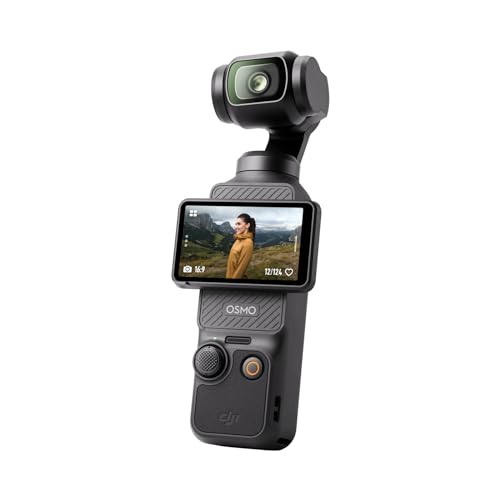
The Pocket 3 commits a small act of category treason: it makes the stick dramatically less necessary, and then becomes the best thing to put on one anyway. Its three-axis gimbal absorbs the bounce and sway that a pole transmits, its tracking keeps a walking presenter’s face centred without a second pair of hands, and its one-inch-class sensor delivers the low-light composure that evening vlogs demand. Held in the hand it is already a complete walking studio. Mounted on a short extension rod, it gains the framing distance that turns a monologue into a scene — presenter, street and sky in one composed breath.
Stick technique with this camera is a pleasure to learn because the gimbal forgives the syllabus. The classic beginner errors — gripping too tightly, bobbing at walking pace, swinging the pole to pan — are all ironed by the motors into something watchable while the creator’s technique catches up. Within weeks, most owners develop the loose, low carry that makes footage float, and the Pocket 3 rewards that growth with shots that genuinely resemble a small crew’s work: tracking backward ahead of a friend, orbiting a market stall, tilting up a cathedral facade without a judder.
Its rotating screen answers the vertical question that now shadows every vlogger. Turn the screen and the camera reframes for the short-form cut natively, so a day’s walk produces both the long vlog and its vertical companions from the same footsteps and the same light. Stick vloggers live on that efficiency, because the platforms increasingly introduce a creator through the short and keep the audience through the long. A camera that treats both formats as citizens, rather than one as a crop of the other, saves its owner an edit-suite argument every single day.
Audio is where many stick setups quietly collapse — the microphone sits a metre from the mouth, across wind — and the Pocket ecosystem’s wireless microphone pairing is therefore a headline feature in this context, whatever the brochures emphasise. A tiny transmitter on the presenter’s collar restores the voice to studio closeness while the camera floats at stick distance. That combination, distant cinematic framing with intimate sound, is the precise signature of professional travel vlogging, and no other pick in this guide achieves it so completely in so little luggage.
Honest boundaries: the lens is fixed, the gimbal is a mechanism that deserves a case rather than a jacket pocket full of keys, and a full day’s heavy filming will want spare power in the bag. None of these trouble its intended owner for long. As a system for one person walking and talking through the world, it is the most considered instrument on this page.
On a stick specifically, keep the extension modest. The gimbal does the stabilising, so the pole’s job is only framing distance; a short rod that places the camera a forearm beyond your hand yields the natural conversational shot without the leverage fatigue of a full selfie pole. Save the long extensions for the two shots that need them — the high reveal over a crowd and the low tracking glide — and the Pocket 3 will feel weightless all day.
- Format: gimbal camera, 1-inch-class sensor
- Stabilisation: three-axis mechanical, face tracking
- Screen: rotating, native vertical framing
- Audio: wireless microphone pairing for stick distance
Strengths
- Walking footage that looks crewed
- Voice stays close while framing goes wide
- Long and vertical formats from one walk
Trade-offs
- Fixed lens, no optical reach
- Gimbal deserves careful carrying
- Heavy days need spare power
Best for: walking-and-talking vloggers who want the polished travel look from a pocketable rig. Not suited for: creators who need interchangeable lenses or long telephoto reach.

Insta360 X4 — Best for invisible-stick shots
The X4 performs the one magic trick this category had been promising for a decade: the stick disappears. Because its two lenses capture the entire sphere, the pole held beneath the camera falls into the blind seam and vanishes from the footage, leaving a presenter who appears to be filmed by a floating companion. For stick vlogging this is not a gimmick but a new grammar. The camera can drift ahead of the creator, rise above a crowd, swing around to show the view the creator is describing — all from one extended pole, all decided afterwards in the edit.
Reframing after the fact changes the vlogger’s whole relationship with the walk. Instead of performing for a lens whose framing must be monitored, the creator simply walks the route with the pole extended and talks to the world; the choices — face shot, over-shoulder, scenic wide, the moment the dog photobombed — are made later, from the same recording, at a desk. Solo creators who struggle to divide attention between performing and operating find this liberating in a way no incremental improvement to a conventional camera can match. The vlog becomes a walk first and a production second.
That freedom carries an editing tax, and honesty requires itemising it. Reframing takes time — less with the app’s tracking assistance, more on days when the walk was long and the moments many. Files are large, because the sphere must be captured whole to offer its choices. And the image, once reframed to a conventional flat view, spends its resolution across the sphere first, so fine detail at distance is not the equal of the dedicated cameras here. The X4’s owners accept those taxes gladly because what they purchase — impossible shots, alone, on a stick — is unavailable at any price elsewhere in this guide.
As a conventional action camera it is also formidable: a single-lens mode films wide 4K for the segments where 360 is unnecessary, waterproofing suits the travel vlog’s weather, and the stick ecosystem includes poles long enough to fake a drone’s rise over a viewpoint. That last shot — the slow vertical reveal as the pole extends, the landscape opening beneath a tiny presenter — has become a signature of travel channels precisely because this camera family made it a one-person, one-pole manoeuvre.
Crowds deserve a word of guidance. The invisible stick invites filming in busy places, and the same etiquette that governs any pole applies doubly to one that can rise above heads: keep extensions modest in stations and markets, be visibly a person filming rather than a device surveying, and put the rig away where photography itself is unwelcome. The camera’s magic does not exempt its owner from the social contract of public space; if anything, a disappearing stick obliges extra courtesy, because bystanders cannot see what is filming them.
Choose the X4 when your vlog’s identity is movement through remarkable places and your scarcest resource is a camera operator. It converts a selfie stick from a framing compromise into a special-effects department.
- Format: 360 action camera, dual lenses
- Signature: selfie stick erased from footage
- Workflow: record everything, reframe in the edit
- Modes: 360 capture plus single-lens wide video
Strengths
- Floating-companion shots from one pole
- No framing decisions while walking
- Fake-drone reveals on extension poles
Trade-offs
- Reframing adds editing time
- Large files from full-sphere capture
- Flat-view detail trails dedicated cameras
Best for: travel vloggers filming solo in spectacular places who want shots no held camera can make. Not suited for: creators who publish fast with minimal editing.

GoPro HERO13 Black — Best rugged travel pick
Travel vlogging is an endurance sport disguised as a media format, and the HERO13 is built for the endurance half. It is waterproof without a case, unbothered by dust, drops and the inside of a beach bag, and supported by a mounting ecosystem so complete that any pole, grip or handlebar in any market town on earth can probably hold it. On a stick, it becomes the vlogging camera for itineraries that include boats, bikes, rain seasons and the occasional fall into a river — the trips, not coincidentally, that audiences most want to watch.
Its stabilisation, refined over generations of exactly this abuse, handles stick work with particular authority. A pole extended from a moving tuk-tuk, a hike’s worth of steps on a mountain path, a run to catch the sunset viewpoint — the footage emerges with that characteristic GoPro calm, wide and deep-focused, the presenter sharp inside a landscape that stays legible. For travel vloggers, that legibility matters: the place is a co-star, and a camera that keeps the place readable while the presenter talks is doing the format’s central job.
Lens options broaden its stick vocabulary. Interchangeable lens mods let the same body shoot an ultra-wide establishing glide, a less distorted presenter framing, or macro detail of the market’s produce, which means one small camera covers a travel day’s whole shot list. GPS and modern connectivity conveniences serve the creator who edits on the road, pulling clips to a phone in the evening and assembling the vlog while the journey still smells of the journey. Travel audiences can feel the difference between a vlog published from the road and one reconstructed at home months later; this camera supports the former habit.
Voice control earns an unusual prominence in stick work. With the camera a metre away on an extended pole, often beyond comfortable reach of its buttons, starting and stopping by voice or by the small remote keeps the performance unbroken. Presenters develop a rhythm — extend, call the command, talk, lower — that keeps the stick feeling like an instrument rather than an obstacle. Battery swapping is quick, media is standard, and the whole system tolerates being run by tired people in imperfect conditions, which is the honest description of travel production.
Its compromises are the action camera’s eternal ones. Low light is managed rather than enjoyed; evening street food scenes will lean on the market’s own lighting and look atmospheric rather than pristine. The fixed wide perspective flatters landscapes more than faces at close range, so seated, intimate segments belong to other picks in this guide. Audio from the body alone fights wind at stick distance, and a media mod or external solution joins the kit of any serious travel talker.
None of that dents its role. For the vlogger whose channel is a journey — wet, dusty, high and far — the HERO13 on a good pole is the camera most likely to come home with the footage, and in travel, footage that exists beats footage that would have been beautiful.
- Format: waterproof action camera
- Lenses: interchangeable mod system
- Stabilisation: mature electronic correction
- Control: voice commands for extended-pole work
Strengths
- Survives the itineraries audiences love
- Landscape stays readable behind the presenter
- Mounts to practically any pole anywhere
Trade-offs
- Evenings are atmospheric, not pristine
- Wide view is unkind to close faces
- Serious audio needs an add-on
Best for: adventure and journey vloggers whose stick work happens in weather, water and motion. Not suited for: intimate, low-light, face-led vlogging from cafés and rooms.

DJI Osmo Action 5 Pro — Best for long days and evenings
Where the GoPro’s legend was built on surviving the day, DJI’s Action 5 Pro makes its case by outlasting it. Battery endurance is this camera’s headline in stick terms, because a vlogging pole that must be collapsed every ninety minutes for a battery ceremony breaks the rhythm of a walking day. The Action 5 Pro stretches that rhythm — longer continuous filming, more clips between charges — and pairs it with a sensor generation whose evening footage holds together noticeably better than action cameras of even two years ago. Street-food tours, night markets, the blue hour on a harbour wall: the parts of a travel vlog audiences remember most warmly happen in exactly that light.
Subject tracking, borrowed from DJI’s wider camera thinking, gives its stick work a trick the traditional action camera lacks. Keep the presenter centred in the frame’s composition while the pole moves, and the camera assists in holding that composition rather than merely recording wherever the pole happened to point. For a creator filming a companion — the friend whose reactions carry the vlog, the guide whose explanations are the content — that assistance converts a waving pole into something resembling a cameraman.
Dual screens serve the stick workflow concretely. The front display lets a presenter at pole distance confirm framing and recording status at a glance, which matters more the longer the pole: nobody wants to retract a full extension to discover the last three minutes were framed on a forehead. Touch operation on both faces of the camera suits gloves-off adjustments in the cold and quick mode changes at a viewpoint where the light is leaving by the minute.
Colour consistency with DJI’s other cameras is a system argument hiding inside a single product. A creator who flies a DJI drone, walks with a Pocket 3 and sticks an Action 5 Pro into the dangerous angles is building a three-camera travel unit whose footage grades as one family. Travel channels increasingly run exactly that mixed fleet, and the Action 5 Pro’s place in it — the rugged, long-winded member — is clearly drawn. Its waterproofing and build invite the same abuse as its GoPro rival, so the choice between them often comes down to ecosystem and evening light rather than toughness.
Weaknesses, fairly stated: its mounting and accessory world, while strong, is not yet the universal standard its rival enjoys in remote rental counters; and the action-camera form still asks a presenter to accept a wide view of the world as the house style. Evening performance, while improved, remains action-camera evening performance — atmospheric, not cinematic.
For the full-day vlogger — dawn market to night market on one pole — this is the stick camera whose battery and dusk footage are least likely to end the day early, and days that end on the creator’s terms rather than the battery’s are where channels are built.
- Format: waterproof action camera, dual screens
- Endurance: extended recording time per charge
- Tracking: subject-centring assistance
- Low light: improved sensor generation for evenings
Strengths
- Long vlogging days without battery ceremonies
- Evening footage that stays presentable
- Front screen confirms framing at pole distance
Trade-offs
- Accessory world smaller than its chief rival’s
- Wide action perspective remains the house style
- Night footage is atmospheric rather than pristine
Best for: full-day travel and city vloggers who film from dawn to the night market. Not suited for: seated creators who prioritise face rendering over endurance.

Sony ZV-1F — Best face quality on a grip
Not every stick vlog is a hike. A huge share of the format is the café table, the market bench, the park wall — the creator sits or stands briefly, extends a short grip, and talks to the camera at conversational distance before moving on. For that rhythm, the ZV-1F on a compact grip is the most flattering instrument in this guide. Its wide fixed lens frames a presenter and their surroundings from a short pole without distortion drama, its face-first focus behaves like a attentive friend, and its colour arrives looking like the finished video rather than raw material awaiting rescue.
The product-showcase focus behaviour earns a specific place in stick vlogging, because stick vloggers are forever holding things up: the pastry, the ticket, the strange fruit, the phone showing the map. At grip distance, raising an object toward the lens and having focus step forward to meet it, then return to the face when the object lowers, is the difference between a demonstration and a blur with narration. Market and food vloggers build whole segments on that gesture, and this small Sony performs it as a native language.
Its directional microphone, aimed at the presenter, is the best built-in answer here to the stick’s audio problem — not a substitute for a wireless microphone at full pole extension, but at short-grip distances it captures the close, dry voice that viewers read as professional. Café ambience stays present as atmosphere rather than competition. Combined with the camera’s general air of having been designed by people who watch vlogs, the result is a seated-segment quality that the action cameras cannot approach and that even the gimbal pick must work to match in controlled light.
Grip discipline with this camera is its own small craft. Use the grip’s tripod feet for the table segments — the camera becomes a tiny studio on the café table, freeing both hands for the food, the notebook, the demonstration — then close the feet and walk with the grip as a short handle for the linking shots between locations. Stabilisation is electronic and happiest at walking’s gentler end; treat the moving shots as bridges and the seated shots as the substance, and the camera’s allocation of talents matches the vlog’s structure beautifully.
Boundaries are clear and were designed in, not discovered later. No optical zoom, so the distant detail stays a story you tell rather than a shot you take. Weather sealing is not its story, so rain sends it under a jacket while the action cameras keep filming. Battery life suits the café-to-café rhythm rather than the expedition day. Within the enormous territory of lifestyle, food, study and city vlogging, those boundaries rarely appear; at the territory’s wet and distant edges, other picks take over.
If your vlog’s centre of gravity is a person talking well in nice places, with objects held up and opinions delivered at arm’s length, this is the stick camera whose footage will make subscribers say the channel looks expensive — while the whole rig fits in a coat pocket.
- Format: compact vlogging camera, wide fixed lens
- Focus: face priority with product showcase behaviour
- Audio: directional built-in microphone
- Grip use: short handle plus table tripod in one
Strengths
- Most flattering faces at grip distance
- Held-up objects snap into focus
- Seated segments look like a tiny studio
Trade-offs
- No zoom for distant details
- Not built for rain or rough handling
- Electronic stabilisation prefers gentle movement
Best for: café, food, lifestyle and study vloggers filming seated segments linked by short walks. Not suited for: adventure itineraries or filming in serious weather.

Insta360 GO 3S — Best stick-free alternative
Every stick vlogger eventually meets the location where the pole must stay in the bag: the museum that forbids them, the crowded festival where a pole is a menace, the hands-busy activity — cooking, climbing, crafting, carrying a child — where holding anything is impossible. The GO 3S is this guide’s answer to those hours. Thumb-sized, worn on a cap or pendant or magneted to a handy surface, it keeps the vlog alive through the stick’s forbidden territories, gathering point-of-view and candid clips that cut into the main footage like a second crew member’s work.
Its vlogging value is precisely that it changes the shot vocabulary. Stick footage, however polished, is always the presenter seen from outside; GO 3S footage is the world seen through the presenter. A travel vlog that alternates the two — the floating stick shot arriving at the bakery, then the wearer’s own view of the baker handing over the bread — acquires a grammar of approach and experience that feels like memory itself. Editors prize that alternation, and audiences feel it as immersion without ever naming it.
The two-part design keeps it practical for creators rather than merely tiny. The camera lives in a pod with a flip screen for framing, charging and review, then pops out alone for the worn shots. A creator can check a morning’s clips over coffee in the pod’s screen, then wear the bare camera for the afternoon’s market run. Stabilisation smooths the head-worn micro-movements that would otherwise make point-of-view footage unwatchable, turning a nod or a glance into a deliberate-looking pan.
Socially, it is the least theatrical camera in this guide, and that is a vlogging asset of the first order. Companions forget it within minutes; shopkeepers and grandparents behave like themselves; the candid texture that stick rigs can never gather — because a pole announces a production — accumulates effortlessly. Many lifestyle channels quietly build their most-loved segments from exactly this unperformed material, intercut with the polished stick footage that carries the narration.
Its limits define it as a partner rather than a protagonist. Recording runs are shorter, low light is not its friend, and a channel still needs a principal camera for the presented segments — which is why it closes this list as the alternative, not the answer. Judged as the second instrument in a stick vlogger’s pocket, though, it has no substitute here: it films the hours the stick cannot, from the viewpoint the stick never occupies.
Buy it when your vlog keeps hitting the pole’s limits — the forbidden venue, the busy hands, the companions who freeze when production appears. It keeps the story rolling through all three, invisibly.
- Format: miniature 4K camera with screened pod
- Mounting: magnetic, cap and pendant options
- Viewpoint: presenter’s own point of view
- Role: second camera for stick-free hours
Strengths
- Films where poles are banned or impossible
- People behave naturally around it
- Point-of-view cuts enrich stick footage
Trade-offs
- Shorter recording runs
- Prefers decent light
- Partners a main camera rather than replacing it
Best for: vloggers needing candid, hands-free and point-of-view material alongside a stick rig. Not suited for: carrying a channel’s main presented segments alone.
How do you choose a stick or grip for the camera you picked?
Match the pole to the camera’s weight and the shot’s ambition, in that order. A heavy rig on a long, thin pole is a wrist injury with a recording light; the leverage at full extension multiplies the camera’s grams into a torque your forearm will report by midday. For the gimbal and compact picks, a short extension grip — forearm length, with tripod feet for table work — covers ninety percent of vlogging shots, because their stabilisation and tracking do the cinematic work and the pole merely provides distance. Reserve metre-plus poles for the 360 and action cameras, whose signature shots — the floating follow, the rising reveal — are bought precisely with that extension.
Grip quality is felt in the details nobody photographs. A handle that stays grippy with sunscreen or rain on your hands, a locking mechanism that cannot creep shorter mid-shot, a wrist strap that you will actually wear — these decide whether the pole is trusted at a cliff viewpoint or over a canal. Twist locks are quick and can slip if grit gets in; flip locks are bulkier and more honest. Carbon fibre buys lightness at a price; aluminium buys durability at a weight. Choose for the trips you actually take, not the expedition you describe at parties.
Finally, rehearse the collapse. A vlogging pole is extended and shortened a hundred times a day — entering shops, boarding buses, sitting down to eat — and the rig that takes ten seconds and two hands to stow will be left extended, knocked against doorframes and resented by companions. Time your own stow-and-deploy at home. Under three seconds, one-handed, without looking: that is the professional standard, and it is a property of the pole-and-camera pairing, so test them together before the trip, not at the first ticket barrier.
How do you walk so the footage does not bounce?
Soften the machine that carries the camera — your body. Walking bounce is born in the heel strike and travels up an arm held too rigidly; the countermeasures are a slight bend in the knees, steps that roll rather than stamp, and a grip held low near the hip with the elbow acting as a hinge rather than a strut. Gimbal owners get most of this forgiven by their motors, but even the Pocket 3’s calm has limits at a jog, and electronic stabilisation on the action cameras crops harder the more violence it must hide. The smoothest stick footage always begins as smooth walking that the technology merely polishes.
Pace is a creative dial. A slow, deliberate walk reads as confidence and lets scenery register; a brisk walk reads as purpose and suits transitions between segments; the mistake is the unconscious middle speed that reads as nothing at all. Decide the pace per shot the way you decide the words per sentence. When filming a companion walking ahead — the classic stick follow — match their pace exactly and hold the distance constant, because a camera that surges and falls behind in waves makes viewers seasick in a way they blame on the channel, not on the geometry.
Turns deserve choreography. Swinging a pole through a corner sweeps the frame across the world at a speed no stabilisation can make graceful; instead, slow before the turn, let the camera’s tracking or your own wrist lead the rotation gently, and accelerate out once the new direction is framed. Doorways are turns in disguise — pause, tilt to the new light for a breath while exposure settles, then enter. These small patiences, multiplied across a vlog, are the difference between footage that feels filmed and footage that feels captured by a machine that happened to be there.
How does vertical filming change stick technique?
Vertical video reframes the pole’s geometry. The horizontal vlog wants the presenter offset with the place spread beside them; the vertical frame wants the presenter stacked — face in the upper third, hands and held objects in the middle, the street or table surface anchoring the bottom. A stick held at the same height and distance produces a different composition in each orientation, so creators who publish both should rehearse the vertical carry separately: slightly lower, slightly closer, with more headroom surrendered to the scene above the face — the signage, the tower, the menu board — that vertical audiences read as context.
The cameras divide on how gracefully they serve the dual-format day. The Pocket 3’s rotating screen makes vertical a native posture rather than a crop, which is why it keeps appearing in this guide’s answers. The 360 camera defers the decision entirely, extracting either orientation from the same sphere at the cost of editing time. The action cameras and the Sony ask the creator to commit per shot — film the moment twice, once in each orientation, or accept the crop. Committing per shot sounds like a burden and is actually a discipline: the creators who film deliberate verticals, framed for the format rather than amputated from horizontals, produce shorts that look authored, and authored shorts are the ones the platforms reward with a channel’s next thousand subscribers.
Captions and hands complete the vertical craft. Hold objects lower and more centrally than instinct suggests, because the vertical frame’s edges are where platform interfaces live; keep gestures inside the middle band for the same reason. The stick itself should be steadier than in horizontal work, since the narrow frame magnifies sway into a pendulum effect. A few deliberate verticals per location, filmed slowly with the interface in mind, outperform an hour of horizontal footage cropped in hope.
How do you film companions and strangers fairly on a stick rig?
The pole makes filming public, so let it make consent public too. Companions should know which parts of the day are vlog and which are merely life; the healthiest travel channels run on a simple household rule — the stick is up, we are filming; the stick is down, we are not — that everyone in the party can invoke without negotiation. Friends who can lower the stick with a word appear relaxed on camera for years; friends who cannot, quietly stop appearing, and the channel loses its cast.
Strangers deserve the pole’s courtesy at its most deliberate. Frame the place rather than the person wherever the story allows; when a stranger becomes a subject — the vendor whose craft is the segment, the guide whose knowledge is the content — ask, accept refusal with visible good humour, and offer to share the result. Markets and workshops around the world have learned to read a vlogger’s manners within thirty seconds, and access follows manners more reliably than it follows equipment. The small cameras in this guide help: a GO 3S or a lowered Pocket 3 reads as a hobbyist’s toy where a raised pole with a mirrorless body reads as a news crew, and doors open accordingly.
Children, ceremonies and other people’s workplaces sit at the far end of the courtesy scale, where the answer is to ask first or not film at all. No shot in a vlog is worth a community’s memory of the creator as the person who filmed without asking — a memory that now travels, ironically, at the speed of the platforms themselves. Build the channel’s reputation as carefully as its footage; in stick vlogging the two are literally carried in the same hand.
What should a stick vlogger carry besides the camera and pole?
A kit measured in grams and in rescues. The wireless microphone already discussed is the first citizen of the bag. Behind it come the small mercies: a microfibre cloth, because stick footage lives outdoors where a single fingerprint on the lens fogs an afternoon; spare media and one more battery than the day’s plan requires; a mini tripod adapter so the pole can become a static camera for the meal, the interview or the sunset timelapse; and a short cable that lets the camera drink from a pocket power bank during a long static segment. Rain earns a clear cover for the camera that lacks sealing and a dry bag for the one that has it, because wet accessories fail as surely as wet cameras.
What to leave behind matters equally. The second pole, the decorative mount, the just-in-case lens for a camera that takes none — every gram of theatre in the bag is subtracted from the forearm holding the rig at hour six. Audit the bag after each trip by a single question: did this item appear in the footage or rescue a moment that did? Two consecutive trips answering no retires the item to a drawer, and the kit converges, season by season, on the handful of objects a professional actually carries.
Comparison Table
| Camera | Stick role | Strongest suit | Watch out for |
|---|---|---|---|
| DJI Osmo Pocket 3 | Short-rod walking studio | Gimbal calm plus close wireless voice | Fixed lens, careful carrying |
| Insta360 X4 | Long-pole effects department | Invisible stick, reframe later | Editing time and file size |
| GoPro HERO13 Black | Rugged travel pole | Survives weather and journeys | Evening light and close faces |
| DJI Osmo Action 5 Pro | All-day pole companion | Battery life and dusk footage | Smaller accessory universe |
| Sony ZV-1F | Short grip for seated segments | Flattering faces and product focus | No weather sealing or zoom |
| Insta360 GO 3S | No stick at all | Hands-free point of view | Short runs, partner role |
What stick mistakes mark a vlog as amateur?
Extending the pole to maximum for every shot is the first tell: the presenter shrinks into the scenery, the voice thins into the wind, and every clip acquires the same drone-ish sameness. Distance is a spice, not a staple — most talking belongs at the conversational range a short grip provides. The second tell is the unconsidered background swing, where a cheerful presenter rotates in place and the frame whips across traffic, strangers and signage at dizzying speed; turn slowly, or cut. Third is forgetting the people the pole inconveniences — the pavement blocked, the queue filmed at head height, the museum guard approaching. A vlog’s charm never survives its creator being asked to leave, and the audience can always tell.
Final Recommendation
Decide what your stick is for. If it exists to make walking conversation look effortless, the Osmo Pocket 3 on a short rod is the finest answer in this guide, with the wireless microphone completing the illusion of a crew. If the pole is an effects tool — floating follows, rising reveals, shots reframed at leisure — the Insta360 X4 stands alone. Journey vloggers in real weather split between the GoPro’s universality and the Action 5 Pro’s endurance and evenings, while seated, face-led creators should put the Sony ZV-1F on a small grip and spend the savings on cafés with good light. Add the GO 3S when the story keeps entering places poles cannot go. Above all, buy the shortest, lightest rig that makes your actual shots — because in stick vlogging, the equipment still in your hand at the day’s last location is the equipment that made the vlog.
Frequently Asked Questions
How long should a vlogging stick be?
For most presenters, forearm-to-arm length is the working range: enough to frame head, shoulders and place, short enough to hold all day and use in a crowd. Longer poles earn their place for the 360 camera’s floating shots and for deliberate high reveals. If a pole’s collapsed length does not fit your day bag, it will be left at home on exactly the days it was bought for.
Is a gimbal better than a plain stick?
For walking conversation, yes — a gimbal like the Pocket 3’s removes the bounce and sway that a plain pole transmits, and adds tracking a pole cannot offer. A plain stick still wins on price, simplicity and indestructibility, and pairs happily with the action cameras’ electronic stabilisation. The choice is between the gimbal’s polish and the pole’s toughness, and many travel creators eventually own both for different days.
How do I record good audio at stick distance?
Move the microphone, not the camera. A small wireless transmitter clipped to the presenter restores the voice to close-up quality while the camera floats at framing distance — the single most professional upgrade a stick vlogger can make. At short grip distances, a directional built-in microphone like the Sony’s can suffice in calm conditions. What never works is shouting across a metre of windy street at a camera’s built-in microphones.
Are selfie sticks allowed where I want to film?
Rules vary sharply: many museums, theme parks, stadiums and transit systems restrict or ban extended poles, and some cities regulate them in crowded areas. Check the venue’s policy before the visit, keep extensions modest in crowds regardless of rules, and carry a stick-free alternative — the GO 3S exists in this guide partly for those venues. Courtesy travels further than any permit: lower the pole when asked, every time, without debate.
Can I vlog with just an action camera on a stick?
Entire successful travel channels do exactly that, because the format rewards movement, places and endurance over facial nuance. The honest costs are evening quality and close-up intimacy. If your vlog’s heart is the journey, an action camera on a good pole is a complete answer; if its heart is conversation, add a face-friendly camera for the seated segments.
Why does my stick footage still look shaky?
Usually because the pole is amplifying a rigid arm and a heel-heavy walk. Soften the knees, hold the grip low with a hinged elbow, shorten the extension, and slow down. Then check the unglamorous culprits: a loose mount, stabilisation switched off after a mode change, or a pole whose lock creeps under load. Technique first, settings second, new equipment a distant third.
One last stick habit separates the seasoned from the lucky: the return shot. Before leaving any location, extend the pole once more and film ten quiet seconds of the place with nobody performing — the stall, the platform, the harbour light — from the height the day’s footage has taught you the place deserves. Editors reach for those seconds constantly, under narration, beneath titles, at the ends of segments, and they cannot be recreated after the journey moves on. The cameras in this guide all make that habit cheap; the discipline to perform it at every stop is the creator’s own, and it is worth more than the next accessory on the list.
Treat that audit as a creative act rather than tidying. A lighter bag lengthens the filming day, a longer day gathers the unplanned minutes, and unplanned minutes are where vlogs stop sounding produced and start sounding lived — the quality every subscriber is actually following the channel to feel.
And if the audit leaves you choosing between two finalist cameras of similar talent, take both for a walk around the block on the same borrowed pole, film the same corner shop conversation with each, and buy the one your arm forgot sooner. Forearms are honest reviewers; they have never once been impressed by a specification sheet.
That walk test, humble as it sounds, predicts a year of ownership better than a month of reviews — including, the authors of this guide freely admit, this one.
Reviews can rank sensors; only your own street, your own stride and your own voice can rank the partnership between a camera, a pole and the person holding both.
Choose that partnership well, and the stick disappears from your attention long before any software erases it from the frame.
Related Guides
The stick, in the end, is a promise the creator makes to the viewer: come with me, at walking pace, and I will show you the world at the distance of a conversation. Keep that promise with the lightest rig that honours it, and the channel will feel like company rather than content.
Related reading: best cameras for vlogging, best cameras for youtube videos and best cameras for travel.


