reviewstook.com is reader-supported. When you buy through links on our site, we may earn an affiliate commission.
Where to buy
Skateboarding invented its own cinematography decades ago and has never apologised for it: low, wide, close, moving at the skater’s speed and close enough to hear the wheels. The best cameras for skate filming respect that grammar. They are wide enough to keep a moving skater in frame from a rolling follow position, tough enough to survive being dropped, kicked and occasionally landed on, and light enough that the filmer — who is also skating — can hold them in one hand while pushing with the other foot and watching for traffic with both eyes.
- GoPro HERO12 Black: check price on Amazon
- DJI Osmo Action 4: check price on Amazon
- Insta360 X4: check price on Amazon
- Insta360 GO 3S: check price on Amazon
- AKASO EK7000: check price on Amazon
- Sony ZV-1F: check price on Amazon
Five of these are action cameras, and that is not a failure of imagination — it is the shape of the sport. Skate filming happens at ankle height at twenty miles an hour, and the cameras that live there are small, sealed and wide. The sixth, Sony’s little ZV-1F, represents the other tradition: the considered shot, the tripod at the spot, the line filmed like a short film rather than a chase.
Durability is the first specification and honesty demands it be said plainly: a skate camera will be dropped. The question is whether the drop ends the session, the month or merely the take. Every pick below was chosen with a concrete floor in mind.
Key Takeaways
- The GoPro HERO12 Black is the skate filmer’s default: the widest usable views, endless mounts and footage every editor recognises.
- The DJI Osmo Action 4 is the low-light and colour pick, for evening sessions and covered parks.
- The Insta360 X4 lets a solo skater film themselves — set it down, skate the line, reframe afterwards.
- The Insta360 GO 3S clips to a shoe-adjacent world of angles: board mounts, chest views, the filmer’s own perspective.
- The AKASO EK7000 is the budget camera a beginner can drop without grief.
- The Sony ZV-1F serves the planned shot — the spot filmed properly, with a filmer standing still.
In this guide
Quick Picks
| Camera | Badge | Why it is here |
|---|---|---|
| GoPro HERO12 Black | Best for skate filming overall | Ultra-wide views, proven toughness and the follow-filmer’s standard tool. |
| DJI Osmo Action 4 | Best for low light | A big sensor for its class keeps evening and indoor-park footage clean. |
| Insta360 X4 | Best for solo skaters | 360 capture means the camera never misses the trick you finally land. |
| Insta360 GO 3S | Best for creative angles | Thumb-sized and mountable anywhere a skater can imagine. |
| AKASO EK7000 | Best budget drop-insurance | Films a session competently at a price that forgives the learning curve. |
| Sony ZV-1F | Best for planned shots | One-inch quality for the spot filmed like cinema, filmer standing still. |
How did we judge cameras for a sport filmed from another skateboard?
By the follow shot, because everything in skate filming descends from it. The filmer rides behind or beside the skater, camera low in one hand, and the footage must stay smooth, wide and framed while both parties dodge the same cracks. We weighted electronic stabilisation that understands this particular shake — the push, the roll, the occasional panic — and fields of view wide enough that framing is a suggestion rather than a precision task.
Second, the floor test. Not a laboratory drop but a session’s reality: the camera set down on concrete, knocked off a ledge, handed to a beginner, rained on at a covered park’s edge. Sealed bodies, replaceable lens covers and honest toughness scored; exposed mechanisms and delicate screens were marked down without sentiment.
Third, the edit. Skate footage lives as short clips and full parts, cut fast, often on a phone at the spot. Cameras whose files transfer easily, whose colour cuts together between brands at the same session, and whose slow motion holds up for the one trick that deserves it, earned their places. A skate camera is judged at the spot, in the edit and on the rewatch in ten years — in that order.

GoPro HERO12 Black — Best for skate filming overall
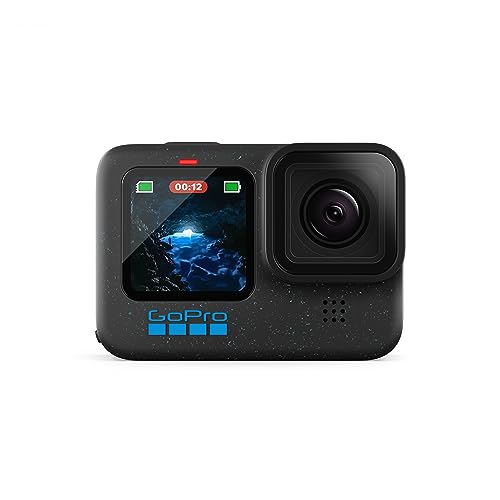
The HERO12 is what the follow filmer reaches for, and the reasons are physical before they are technical. The ultra-wide views keep a skater framed from a rolling crouch without the filmer watching a screen — you aim the camera the way you aim your board, by feel — and the stabilisation irons the push-and-roll rhythm into the gliding footage the genre is built on. Its tall sensor options suit both the classic landscape part and the vertical clip the group chat demands, from the same session’s files.
Toughness is a lived fact with this camera: it is the one that has been dropped at every famous spot on earth and kept filming, with a replaceable lens cover for the day the drop lands face-first. Battery life across a session is honest, the mounts fit every handle, grip and board bracket the skate world has improvised, and the footage’s look is the genre’s common language — your clips will cut with everyone’s.
It is not the low-light champion here, and its owner learns to chase the good light or accept the grain of the evening session. As the default instrument of skate filming, though, it has no serious rival on this page.
- Format: waterproof action camera
- View: ultra-wide fields of view, tall-sensor options
- Stabilisation: reference-grade electronic smoothing
- Lens cover: replaceable after hard drops
Strengths
- The follow shot’s native camera
- Survives the session’s physics
- Footage cuts with every other filmer’s
Trade-offs
- Evening footage grains sooner than the DJI’s
- Best settings live in menus worth learning
- Everyone’s footage looks like yours
Best for: filmers, crews and skaters who document the session. Not suited for: candlelit indoor work or telephoto anything.

DJI Osmo Action 4 — Best for low light
Half of skateboarding’s real life happens in the light the HERO12 tolerates and the Action 4 enjoys: the evening session under the bridge, the covered park in November, the indoor warehouse with its sodium glow. The DJI’s larger sensor holds those scenes together — cleaner shadows, colour that stays truthful under mixed lamps, and slow motion that does not dissolve when the light falls. For skaters whose sessions start when work ends, that is not a luxury; it is the whole schedule.
The magnetic quick-release mounting is the other quiet revolution: the camera snaps between the chest mount, the handle and the static ledge position in a second, one-handed, without the screw-fumbling that costs tricks at dusk. The colour depth rewards skaters who grade their parts, and the stabilisation, while tuned a shade more conservatively than GoPro’s, keeps the follow shot honest.
Choose it when your skating lives in the year’s darker half or the city’s covered corners. The Action 4 is the camera that extends the session past the light the others need.
- Format: waterproof action camera, 1/1.3-inch sensor
- Mounts: magnetic quick-release system
- Colour: 10-bit options for graded parts
- Low light: the class’s stronger performer
Strengths
- Evening and indoor footage stays clean
- Mount changes at the speed of the session
- Colour that grades like a bigger camera’s
Trade-offs
- Accessory world younger than GoPro’s
- Field of view a touch narrower at extremes
- Fewer filmers to borrow parts from
Best for: after-work skaters, indoor parks, colour-conscious filmers. Not suited for: crews standardised on GoPro mounts.

Insta360 X4 — Best for solo skaters
Most skaters, most days, have no filmer. The X4 is the answer the industry built for them: stand it on its mini tripod at the spot, or raise it on a pole, and skate. It records everything in every direction, so the line you finally land on the fourteenth attempt is in frame — and afterwards, at the desk, you pan the virtual camera around inside the footage, following yourself like a filmer who never blinked.
The reframed results can be uncanny: a follow shot with no follower, a dolly past the ledge with no dolly. The 8K sphere keeps those crops respectable, and the invisible-pole effect puts the camera in places a handheld cannot go mid-trick. For progression documentation — the trick’s two-month journey from sketchy to stomped — nothing here serves the solo skater better.
The costs are the ones 360 always charges: big files, an editing step between skating and sharing, and exposed lenses that demand guards at a spot full of boards and concrete. Solo skaters who accept the workflow gain a filmer who never gets tired, never misses and never wants a turn on the ledge.
- Format: waterproof 360 action camera
- Video: 8K 360, reframed in the app
- Effect: invisible selfie stick
- Modes: conventional single-lens mode included
Strengths
- Impossible to miss your own trick
- Follow shots with no filmer
- Progression archives that direct themselves
Trade-offs
- Editing stands between you and the clip
- Lenses need guards at the spot
- Files are heavy for a phone workflow
Best for: solo skaters, progression projects, creative filmers. Not suited for: instant same-spot sharing.

Insta360 GO 3S — Best for creative angles
The GO 3S is the camera that goes where the trick happens: clipped under a cap brim for the skater’s-eye view, magnetised to a rail’s underside, stuck to the board itself for the wheel’s-eye rolling shot that makes viewers seasick in the best way. At a few dozen grams it changes nothing about the skating, which is precisely its power — the footage is of the trick as performed, not the trick as performed around a camera.
Its stabilised 4K is honestly good, and the pod — screen, charger, remote — turns it into a static camera for the ledge session between its adventures. Runtime is its leash: it films in bursts, lives in the pod between them, and rewards the skater who thinks in clips rather than hours.
As a second camera in a filmer’s kit it is pure mischief, and as a beginner’s only camera it is a toy in the honourable sense — the instrument you experiment with because breaking the rules costs nothing. Every crew should own one and argue about whose turn it is.
- Format: thumb-sized modular camera
- Video: 4K stabilised in a featherweight body
- Mounting: magnetic, anywhere metal or clipped
- Pod: screen, charger and remote in one
Strengths
- Angles no other camera here can take
- Never changes how the skating feels
- The board’s-eye view, finally easy
Trade-offs
- Runtime suits clips, not sessions
- Tiny body, big loss potential
- Low light is not its shift
Best for: creative angles, second-camera mischief, POV experiments. Not suited for: main-camera session coverage.

AKASO EK7000 — Best budget drop-insurance
There is a stage in every filmer’s life when the camera’s price is the risk: the beginner is learning to follow on a board, and the floor is undefeated. The EK7000 exists for that stage. It films a competent, stabilised-enough 4K picture, ships with the mounts and waterproof case a starter needs, and costs the kind of money that turns a catastrophic drop from a season-ender into a story.
Set expectations with the honesty this guide owes you: the stabilisation is a step behind the leaders, the low light is two steps, and the footage will not be mistaken for the HERO12’s at a glance. What it will be is present — at the session, in the hand, rolling — while its owner learns the follow shot’s geometry, the spot’s etiquette and the edit’s rhythm. Those lessons are the expensive part of skate filming; the EK7000 makes the tuition cheap.
Many filmers keep it afterwards as the loaner and the beater — the camera handed to the youngest skater, mounted where the good camera should not go. A tool that survives its own obsolescence has earned its place.
- Format: action camera with case and mounts included
- Video: 4K with basic stabilisation
- Kit: starter accessory bundle in the box
- Role: the learn-and-drop budget option
Strengths
- Drops are stories, not disasters
- Everything a beginner needs is included
- The perfect loaner and beater camera
Trade-offs
- Stabilisation and low light trail the field
- Footage quality is a clear class below
- Menus and app are basic
Best for: beginners, young skaters, risky mounts. Not suited for: parts intended for sponsors.

Sony ZV-1F — Best for planned shots
Not every skate film is a chase. The ZV-1F represents the other discipline: the spot studied, the camera placed, the line rehearsed and then filmed like a scene — with the one-inch sensor’s depth, colour that flatters the skater and the setting sun, and audio that catches the wheels, the pop and the roll-away’s applause of one pair of hands. On a small tripod or a steady hand at the spot’s edge, it makes the footage that opens the part.
Its wide fixed lens is the classic skate focal length wearing a photographer’s manners, and its face-and-product autofocus — designed for creators — translates happily to keeping a skater tracked across a static frame. What it will not do is follow at speed from another board, survive a direct hit, or pretend to be an action camera; the verdict is not a criticism but a job description.
Crews with one good camera often find the division writes itself: the action cameras chase, the ZV-1F composes. If your filming ambitions lean toward the crafted clip and the portrait at the spot, this is your instrument.
- Format: compact, one-inch sensor
- Lens: fixed wide-angle, bright aperture
- Focus: face-priority autofocus
- Role: static and planned filming at the spot
Strengths
- The best picture quality per gram here
- Colour and depth for crafted clips
- Audio that respects the session’s sound
Trade-offs
- Not a follow camera, not a drop survivor
- Fixed lens frames from one distance
- Needs the filmer to stand still and think
Best for: crafted clips, portraits at the spot, mixed crews. Not suited for: follow filming or rough sessions.
What is the follow filmer’s actual job?
To be invisible at speed. The filmer reads the line before the skater does — the crack to avoid, the pedestrian to miss, the moment the trick will happen — while holding a camera steady at knee height and pushing hard enough to keep pace. It is a skilled position that skaters undervalue until they try it, which is why good filmers are crew royalty. The cameras in this guide were judged as instruments of that job: light in the hand, wide enough to aim by instinct, and tough enough that the filmer thinks about the line rather than the landing.
How do you film at a busy skatepark without ruining the session?
Learn the park’s traffic before you film its skating. Every park has a rotation — who drops in when, which lines cross — and the filmer who stands in the bowl’s run-out with a camera is a hazard wearing a hobby. Skate a few laps, ask the locals where the lines finish, and take the positions the session itself suggests: the deck above the bowl, the side of the ledge, the roll-in’s shoulder. The GO 3S mounted at the coping and the X4 on its pole at the park’s edge collect footage without occupying the concrete everyone else is using.
Why does the long lens have no home in skate filming?
Because distance is the genre’s enemy in both directions. A telephoto flattens the trick, severs the skater from the spot, and turns the filmer into a spectator with equipment. Skateboarding’s visual contract — set by the fisheye era and honoured by every action camera here — is proximity: the board large in frame, the spot wrapped around it, the speed you can hear. The one exception is the contest or demo filmed for a crowd, where the long shot establishes the stage. For the session, the street and the part, stay close or stay home.
How do you film a trick’s progression honestly?
Keep the failures in the file. The progression edit — first roll-up, first commit, the slam, the make — is the most truthful film skating produces, and it needs a camera that was rolling for the attempts nobody applauded. The X4 placed at the spot is the progression machine: it never tires, never misses, and its archive lets the skater watch their own commitment grow across weeks. Resist cutting the story to the make alone; in ten years the attempts will be the part you rewatch, because they are the part that was actually your life.
What makes a skate spot photogenic?
Texture, backdrop and a line the light crosses. Smooth ground photographs as silence; worn concrete, painted curbs, a wall with history give the frame its grain. The best spots put architecture behind the trick — the bank against the office glass, the ledge with the city behind it — so the still or clip says where this happened. Filmers scout spots the way skaters do, by rolling past slowly and looking. The cameras cannot manufacture a spot’s character; they can only be ready, wide and low when the character performs.
How do you handle filming strangers at a public spot?
Ask with your presence before you ask with your mouth. Skate a while, be part of the session, and the camera becomes furniture; produce it cold at a stranger’s best trick and you are press. Most skaters are delighted to be filmed once the filmer is a person rather than an audience — and the footage improves when the skater knows the camera’s habits and plays to them. Credit filmers and skaters when clips travel; the scene’s whole economy runs on names attached to work, and the camera operator is part of the work.
Why do skate videos open with the push?
Because the push is the genre’s establishing shot: the sound, the speed, the city arriving. A part that begins with rolling feet tells the viewer the rules — this happened in the street, at this pace, with this effort — before a single trick appears. Filmers keep a camera ready for the journey between spots for exactly this reason, which is another argument for the small cameras: the GO 3S clipped on for the push between spots catches the connective footage that makes a collection of tricks into a film about a day.
How do you film in the rain, or the session after it?
Wet ground ends most sessions and starts the beautiful ones. The covered spot, the parking garage, the underpass — skating migrates to shelter, and the light there is the Action 4’s home turf. For the camera, the sealed action bodies shrug off the drizzle at the shelter’s edge; keep a cloth for the lens, because a single droplet on the front element becomes the footage’s permanent moon. Film the reflections on the wet concrete outside the shelter while the session regroups: it is the establishing shot the edit will want.
What is the death lens, and does it still matter?
The extreme fisheye — nicknamed for how close it must get to the action — defined an era of skate video: the camera at the bottom of the stairs, the skater passing overhead, the world curved like a bowl. Its lesson survives every camera in this guide: the drama is in the distance, or rather in its absence. The action cameras’ widest modes are the death lens’s descendants, safer and sharper; the filmer’s part of the bargain is unchanged. Get close enough that the trick could hit the camera, and accept that one day it might — which is why the lens cover is replaceable.
How do you film a contest or a demo differently?
For the crowd, not the crew. Contest filming needs the establishing geography — the course, the audience, the scoreboard’s tension — intercut with the tricks, because the viewer was not there and the stakes must be built. Positions are assigned rather than found, the light is whatever the venue owns, and the camera that survives the day is the one whose batteries and cards were planned like a broadcast’s. The HERO12’s ecosystem and the DJI’s low-light discipline divide the work; the filmer’s art is in the cutting, where a run becomes a story with a score.
What should a beginner filmer practise first?
The follow at walking pace, then at pushing pace, then at the skater’s. Film a friend rolling a flat line until the framing is muscle memory — skater centred by feel, horizon steady, speed matched before the action starts. Then add one trick at the line’s end. The progression is unglamorous and total: every professional filmer’s reel rests on ten thousand metres of unremarkable rolling footage that taught their hands the job. The EK7000 exists so those metres cost as little as possible while they are being learned.
How do you keep a camera safe at the spot?
Never on the ground where boards land, never on the ledge being skated, never in the roll-away. The spot has a geography of impact that locals know by heart; ask, watch a few attempts, and put the camera — and yourself — in the places the skating has already declared safe. A small tripod at the spot’s edge beats a camera in the hand of a filmer standing in the line. The X4’s whole value is that it can be left in those safe places and still see everything; use the safety as creatively as the angle.
Why does vertical video belong in a skate guide?
Because that is where the audience now lives, and the genre has always followed its audience. The tall frame suits skating better than most subjects — a skater is a vertical event, and the ledge line reads beautifully in portrait. The HERO12’s tall-sensor options let a filmer take both orientations from one session’s files rather than choosing at the spot. Purists may mourn the part’s widescreen grammar, but the skater who landed it wants the clip tonight, in the format their friends will actually watch. Serve both; the cameras make it cheap to do so.
How do you film a night session at a lit spot?
Chase the pools of light and let the dark be the frame’s edge. A lit spot at night — the plaza’s lamps, the underpass’s strips — composes itself into islands; the trick happens in the island, the roll-up crosses the dark, and the rhythm is the edit’s for free. The Action 4’s sensor is the tool here, with the HERO12 close behind if the light is generous. Expose for the lit concrete and resist lifting the shadows in post; night skating looks like night, and the grain is the price the genre has always paid gladly.
What is the filmer’s cut, and why does it matter?
The filmer’s cut is the version of the session edited by the person who was rolling beside the tricks — and it matters because the filmer knows which make was the real one, which attempt broke the skater’s heart, and where the session’s story turned. Skaters should ask for it and credit it; filmers should keep their own archive rather than surrendering every file at the spot. The cameras’ easy transfer makes generosity simple, but the scene’s memory lives in its filmers’ drives. Respect the cut and you respect the second skater in every clip — the one holding the camera.
How do you mount a camera to a board, honestly?
Briefly, bravely and with the cheap camera. A board-mounted shot — the GO 3S magnetised or taped with a proper mount near the truck — gives the rolling, turning, ground-rushing view that defines the trick’s geography, and it survives about as long as the board avoids a primo landing. Use the EK7000 or the GO 3S, keep the mount low-profile, and treat the footage as a spice: three seconds of board-view inside a follow shot’s sentence. The mount that survives is the one that was expected to die; price your courage accordingly.
What does a handle or grip actually do for filming?
It turns a camera into a tool your hand already understands. A simple grip under the action camera gives the filmer a pistol hold — steadier than pinching the body, quicker to raise, and kinder over a long session — while a small gimbal grip goes further for the static and slow work. The accessory ecosystems behind the HERO12 and the Action 4 are full of them because the need is universal. Judge any grip by one test: can you catch a falling camera, push, and hold a coffee in the same hour without putting it down? The right handle disappears; the wrong one becomes the session’s third protagonist.
How do you film vert or bowl skating?
From the deck, with the coping as your tripod and the wide lens as your net. Bowl skating moves in three dimensions — the skater is below you, above the coping, and across the flat bottom in one run — and the camera that works is the one whose field of view forgives the geometry while the filmer stays in one safe place. The X4 above the bowl sees the whole run; the HERO12 at the deck’s edge catches the airs at their peak as they pass. Keep yourself out of the drop-in rotation and your shadow out of the deep end, and the bowl will do the cinematography.
Why do skaters film each other instead of hiring filmers?
Because the session’s trust is the footage’s quality. A filmer who skates the spot knows when the make is coming — feels it in the roll-up’s speed — and a skater performs differently for a friend than for a contractor: the attempts are braver, the celebrations real. Each pick on this page is priced and sized for that economy; the whole crew can own the means of documentation between them. The professional filmer still exists for the sponsored part and the brand film, but the everyday archive of skating is, and should remain, skaters filming skaters.
How do you edit a session at the spot?
Ruthlessly and immediately, while the light’s memory is fresh. The spot edit is a social object — the makes in order, the best slam with the skater’s permission, the line that finally went — assembled on a phone before the drive home. The cameras’ apps and quick transfers exist for this ritual; the discipline is in the cull, because an unedited dump helps nobody and the clip that travels is the one cut while the session’s story was obvious. Save the artistry for the part. The spot edit is journalism, and its deadline is dinner.
What is the sound of a landing, and why do filmers chase it?
The difference between a make and a sketchy make is audible: the clean roll-away hums, the sketchy one rattles, toes drag, wheels protest. Skaters reviewing footage listen as much as they watch, which is why this guide keeps returning to the cameras’ microphones and the filmer’s distance. Keep the camera close, keep the wind off the microphone, and do not let the edit’s music start until the landing has had its say. In skate filming, the soundtrack is evidence.
How do you film a first drop-in, a child’s first push, a beginner’s day?
Like it matters, because it does — more, in memory’s economy, than the thousandth kickflip. Get low, stay close, and let the small camera be unthreatening: the GO 3S on a parent’s chest, the EK7000 in a friend’s hand. Film the fear and the grin in the same frame by standing where both are visible, and keep rolling through the celebration. These are the clips families keep for decades, and they ask nothing of the equipment except presence — the one specification every camera in this guide, at every price, can honestly claim.
What separates a skate part from a pile of clips?
Intention about order. A part has a first trick that declares the skater, a middle that builds a world of spots, a hardest section that earns its slow motion, and an ender that the whole film has been promising. The cameras cannot supply that architecture, but they decide whether the raw material survives to be arranged: the sessions all filmed, the makes all kept, the archive backed up. Film everything like it might be the ender’s day, organise it like a librarian, and the part assembles itself in the winter edit.
How do you back up footage when the session ends at midnight?
Before the drive, not after the sleep. The card comes out at the spot or in the car, the day’s makes go to the phone or the small drive, and the originals stay untouched until they exist twice. Skate footage is unusually irreplaceable — the make may not recur for a month, the spot may be fenced by morning — and it is lost with unusual ease, because sessions end in tiredness, darkness and celebration. The thirty-second ritual at the car is the cheapest insurance in this entire guide, and the filmers with archives are simply the ones who never skipped it.
What is the last trick of the day, photographically?
The one the light leaves for. As the session thins and the sun drops, the spot changes character — long shadows, lit concrete, the skaters silhouetted against the city’s evening — and the filmer who saved a battery owns the day’s best-looking footage for free. The Action 4 was chosen for this hour; the others manage it with their sensitivities raised and their expectations honest. Stay for it. The last trick of the day, filmed in the last light, is the clip that opens the edit and closes the argument about which camera to buy.
How do you film a manual, a flatground session, the quiet disciplines?
Flatground is skateboarding’s chamber music — no stairs, no speed, just balance and invention at walking pace — and it films best like chamber music: close, still and attentive. The static camera at ankle height, the ZV-1F composing the space, the GO 3S at the board’s level for the wheel-work’s detail. Because the speeds are low, the footage can be beautiful in ways the stair set never allows: evening light, long takes, the skater’s concentration unbroken. Do not mistake the quiet disciplines for lesser content; in the edit they are the breathing spaces that make the violence legible.
Why do filmers shoot the spot empty first?
For the edit’s grammar. An empty establishing shot — the stairs without the skater, the ledge in morning light — tells the viewer the stage before the actor arrives, and it costs ninety seconds at the session’s start when nobody is warmed up anyway. It also serves the filmer’s safety: walking the spot with a camera is how you learn where the landings finish and the cracks live. The habit separates filmers from camera-owners in every genre in this series; in skating it has the extra virtue of honouring the spot, which the scene regards as a character in its own right.
How do you handle a security guard, a complaint, a moved-on session?
With the camera down and the manners up. The session’s footage is never improved by an argument, and the filmer who keeps rolling through a confrontation has misunderstood both the law’s local mood and the scene’s ethics. Pack, thank, leave — and film the walk to the next spot, because the moved-on journey is part of skating’s documentary truth and the next spot may be better. The small cameras help here too: a crew that can vanish in thirty seconds with its footage intact has lost nothing but a location, and locations, unlike afternoons, are replaceable.
What does a filmer owe a skater who slams?
A stopped camera and a free hand, in that order of urgency — the hand first, actually. The slam is the session’s serious moment, and the filmer’s job reverts instantly to crew member: board cleared, skater checked, camera forgotten. Whether the slam footage is ever used belongs to the skater, asked later, in daylight, with deletion offered without offence. The scene’s trust — the thing that lets filmers stand a board’s length from flying timber — is built from these moments far more than from any clip. Film like a friend and you will be allowed to film like a professional.
How do you choose a camera for a young skater?
By the drop it can survive and the lesson it teaches. The EK7000 is the honest answer for most: cheap enough to be theirs, competent enough to show them their own skating clearly, and bundled with the mounts that turn filming into play. The GO 3S tempts with its magic and should be weighed against a young owner’s talent for losing small expensive things. What matters is that the camera arrives before the self-consciousness does — a child who has watched their own progression since the first push owns a relationship with the sport that no coaching can buy.
What is the archive a skate crew should keep?
Everything, organised by spot and by skater, with the makes and the near-makes in separate folders and the whole thing existing in two places. Crews dissolve, spots get demolished, skaters move away and come back at thirty with children — and the archive is what survives of the world they shared. The cameras in this guide produce the raw material in formats that will open for decades; the crew’s job is the unglamorous librarianship. In twenty years the archive will be the most valuable thing the session produced, worth more than every board broken in it.
How do you film in a multistorey car park, skating’s winter home?
Embrace the concrete cathedral. The car park gives flat ground, dry shelter, pillars for lines and a light that never changes — the Action 4’s and the ZV-1F’s shared home. Mind the actual cars, the actual rules and the closing hours, keep the noise neighbourly, and use the ramps’ geometry for the follow shots the street would charge you traffic for. Some of the most loved footage in skating’s history was made in these grey palaces, because the skating there is pure: no spot tourism, no audience, just the session and its echo.
What is the filmer’s warm-up?
The same as the skater’s, plus the camera’s. Roll the spot slowly with the camera in hand, no recording — learning the ground through your wheels while your hand learns the framing. Check the lens for the last session’s fingerprints, the card for space, the battery for honesty. Then film the first mellow lines as calibration, the way skaters take their first runs at half speed. The filmer who warms up makes the day’s first keeper earlier; the one who starts cold spends the first hour producing the footage the edit will delete, and occasionally producing the drop the budget will remember.
How do you film a hill bomb or a fast street line?
With respect, rehearsal and the best stabilisation you own. Speed multiplies everything — the filmer’s wobble, the skater’s commitment, the consequences of a pebble — so the line gets walked, then rolled slowly, then filmed at pace only when both parties know every crack by name. The HERO12’s stabilisation and the filmer’s low crouch are the technology; the rest is nerve management. Some lines should be filmed from static positions cut together rather than followed, and knowing which is the difference between a filmer and a casualty. The footage is never worth the ambulance; the scene’s oldest rule outranks every camera in this guide.
What do you do with footage of a spot that no longer exists?
Keep it like scripture. Spots die — demolished, skate-stopped, redeveloped into plazas where the ledges are armrested — and the footage becomes the only place the spot still stands. This is the deepest argument for the archive habits this guide keeps repeating: the session you backed up carelessly in 2026 is the documentary evidence of a world in 2046. Skaters have always known their geography is temporary; the camera is how the temporary gets to testify. Film the spot empty one last time if you hear the fences are coming. Future sessions will thank you at a distance you cannot imagine.
How does a filmer improve across a season?
By reviewing like an athlete. Watch the session’s footage the same night with the skater, both of you naming what the framing did to the trick — where the board left the frame, where the horizon tilted, where the follow lagged the pop. Keep a notebook of the spot’s lessons if the season is serious. The improvement curve is steep at first, because the follow shot is a physical skill with honest feedback, and the cameras here all record that feedback in unforgiving detail. A season of reviewed sessions will do more for a filmer than any upgrade on this page — which is, the guide admits cheerfully, an argument for buying the EK7000 and spending the difference on time.
Comparison: all six picks at a glance
| Camera | Form | Character | Choose it if… |
|---|---|---|---|
| GoPro HERO12 Black | Action camera | The standard | You film others from a board |
| DJI Osmo Action 4 | Action camera | The night session | Your skating starts at dusk |
| Insta360 X4 | 360 camera | The invisible filmer | You skate alone and land it eventually |
| Insta360 GO 3S | Mini camera | The angle thief | You want the board’s-eye view |
| AKASO EK7000 | Action camera | The tuition | You are learning and the floor is near |
| Sony ZV-1F | Compact | The composer | Your shots are planned, not chased |
What are the most common mistakes in skate filming?
Filming from too far away
The beginner films from the bench; the footage shows a small skater in a large park, and the trick — the whole point — is a rumour in the middle distance. Skate filming is a contact sport: the camera belongs a board’s length from the action, low, wide and moving. The wide lenses across this list exist so you can be close without cropping the skater’s head or board; the stabilisation exists so the closeness is watchable. Move in until it feels too close, then take one step nearer.
Standing still with a moving subject
A static camera and a moving skater produce security footage. The genre’s energy comes from shared motion — the filmer rolling with the skater, the background streaming, the trick arriving at the lens. If you cannot roll the line yourself, walk it, run the short ones, or place the camera where the trick comes to it and let the skater supply the movement. The X4’s reframing can manufacture some of this motion afterwards; nothing manufactures it like a filmer who skates.
Ignoring the sound of skating
Wheels on concrete, the pop of the tail, the slide’s screech, the landing’s verdict — skateboarding has a soundtrack, and footage without it feels dubbed. Keep the camera close enough to hear the session, shield the microphone from the wind your own motion makes, and resist burying every clip under music in the edit. The action cameras’ microphones are adequate at follow distance; the ZV-1F, static at the spot, captures the full acoustic picture. A part that sounds like skating will be rewatched; one that only looks like it will not.
Final Recommendation
Start where the sport starts: with the follow shot. The GoPro HERO12 Black remains the filmer’s standard because it was practically designed by the genre — wide, tough, smooth and understood by everyone. Skaters whose sessions live in the evening should take the DJI Osmo Action 4’s bigger sensor and quick mounts; solo skaters should let the Insta360 X4 be the filmer they do not have; and every crew should add a GO 3S for the angles and an EK7000 for the beginners and the brave mounts. Bring the ZV-1F when the spot deserves composition. Then go and film close, low and moving — the cameras are ready when your pushing foot is.
Related guides
- Best Digital Cameras for Toddlers: Safe, Drop-Proof First Cameras for Ages 1–4
- Best Canon Cameras for Action Shots: Tracking, Burst Speed and Sideline Proof
- Best Cameras for Surfing Photography: Waterproof Action Cams and a Shore Telephoto Plan
Frequently Asked Questions
Do I need a fisheye lens for skate filming?
The classic fisheye look — ultra-wide, curved at the edges — is the genre’s heritage, and the modern action cameras’ widest views are its heirs: close, encompassing and forgiving of framing. A true fisheye on a bigger camera remains a stylistic choice for dedicated filmers, but for the cameras in this guide, the wide modes deliver the grammar — proximity, context, the trick whole in frame — without the extra glass. Shoot wide and close first; the look follows the distance more than the lens.
How do I film a line without a filmer?
Give the job to the X4: place it where the line passes, skate, and reframe the follow shot in the edit — or mount the GO 3S and take the skater’s-eye record. Static cameras reward lines that pass the lens closely, so choose the spot’s geography accordingly: the ledge the line crosses, the bank it finishes on. Multiple placements across attempts can be cut into a sequence that feels covered by a crew. Solo filming is an editing discipline as much as a skating one.
What frame rate is best for skateboarding?
Your delivery rate for the session’s flow — the follow shots and lines that should feel real — and a higher rate reserved for the trick that earns slow motion: the flip into the bank, the slide that needs its frames savoured. Slow motion is punctuation; a part filmed entirely at high speed feels like it is buffering. The cameras here all offer the fast modes, and the discipline is in rationing them to the moments the rewatch will slow down anyway.
Can these cameras survive being run over or landed on?
Survival is a spectrum the guide has tried to price honestly. The sealed action cameras shrug off drops, kicks and weather that would retire a conventional camera, and replaceable lens covers turn the worst face-first landing into a small parts order. The GO 3S’s size makes it a hard target; the EK7000’s price makes it a soft loss. The ZV-1F is a camera, not a puck — keep it off the floor’s firing line. No camera is promised against a direct board strike; placement is the real insurance.
How do I keep a follow shot smooth?
Bend your knees, hold the camera low and loose, and match the skater’s speed before they start the trick — a filmer accelerating mid-line is a camera panning wildly. Let the stabilisation do the fine work while your legs do the coarse work, keep the skater in the same part of the frame by feel rather than by screen, and practise the filmer’s line without filming until it is as rehearsed as the skater’s. The follow shot is a duet; both halves rehearse.
Related Guides
Keep exploring with our companion reading: best cameras for pov shooting, best action cameras for sports and best cameras for recording slow motion.


