reviewstook.com is reader-supported. When you buy through links on our site, we may earn an affiliate commission.
Where to buy
Skiing refuses to be photographed from a warm place. The light is blinding and flat by turns, the cold taxes batteries and fingers alike, and your subject — who is also your friend, your child or your instructor — is moving away from you downhill at the speed of traffic. The best cameras for shooting skiing divide into two honest camps: the small armoured cameras that ride on a helmet, a chest or a pole and film the run as it felt, and the stills cameras that wait on the piste’s edge for the carve, the spray and the grin. This guide covers both, because a ski holiday produces two kinds of evidence and you will want each.
- DJI Osmo Action 5 Pro: check price on Amazon
- GoPro HERO13 Black: check price on Amazon
- Insta360 X4: check price on Amazon
- Insta360 GO 3S: check price on Amazon
- OM SYSTEM Tough TG-7: check price on Amazon
- Nikon Z50 II: check price on Amazon
Cold is the silent specification in every choice below. Lithium batteries surrender capacity as the temperature falls, touchscreens sulk under gloves, and a camera that spends the day in an outside pocket lives a harder life than its spec sheet imagines. Each verdict therefore speaks plainly about winter behaviour — warm-pocket strategies, glove-friendly controls, and which bodies are actually rated to keep working when the piste turns blue with evening cold.
Snow itself is the other examiner. It is a giant reflector that fools meters into grey, a glare field that punishes cheap optics, and a soft landing that forgives a dropped camera exactly once. Judge these picks by how they handle brightness, weather and the occasional burial in powder, and the rest is composition.
Key Takeaways
- For follow-filming and POV, the DJI Osmo Action 5 Pro’s cold stamina and colour depth make it the skier’s first choice here.
- The Insta360 X4 changes the job entirely: film everything in 360 degrees, choose the frame later, never miss the fall or the view.
- The tiny Insta360 GO 3S disappears onto a helmet or goggle strap for the lightest ride-along footage.
- For stills, the freeze-proof OM SYSTEM Tough TG-7 lives in a ski jacket pocket without fear.
- The Nikon Z50 II is the piste-side photographer’s camera — real bursts and tracking for a partner posted below the pitch.
- Whatever you buy, batteries ride against your body, not in the pack: warmth is runtime.
In this guide
Quick Picks
| Camera | Badge | Why it is here |
|---|---|---|
| DJI Osmo Action 5 Pro | Best for skiing overall | Long cold-weather runtime, superb stabilisation and colour that handles snow glare. |
| GoPro HERO13 Black | Best for mounts and accessories | Every ski mount ever made fits it, and the footage cuts with everyone’s. |
| Insta360 X4 | Best for never missing the shot | 360 capture on a pole makes the selfie-stick vanish and the framing a desk job. |
| Insta360 GO 3S | Best featherweight ride-along | Thumb-sized 4K that clips to a strap and forgets it is there. |
| OM SYSTEM Tough TG-7 | Best pocket stills camera | Freeze-proof, crushproof and happy in a jacket pocket all week. |
| Nikon Z50 II | Best piste-side stills | Tracking autofocus and bursts for the photographer planted below the pitch. |
How did we judge cameras for a mountain in winter?
By three winter tests. The first is thermal honesty: a camera for skiing spends its day cycling between a warm lift, a freezing ridge wind and the inside of a glove, and its battery gauge must not collapse the first time the temperature drops below the point where the piste map freezes to the board. We favoured cameras with larger batteries, honest cold ratings and the option to keep spares warm and swap them fast with numb hands.
The second test is operability in the uniform of the sport. Ski gloves are clumsy by design, goggles narrow your world, and nobody removes a mitt at altitude to poke a touchscreen. Big buttons, voice control, glove-tolerant dials and mounts you can trust without looking at them all scored; fiddly micro-controls and exposed ports that pack with snow lost marks they could not recover.
The third is the snow itself: exposure behaviour on a white mountainside, dynamic range when the piste runs from glare into tree shade, and stabilisation that can tell the difference between a carved turn and a juddering ice traverse. A ski camera’s footage should look like the holiday felt — bright, fast and slightly smug.

DJI Osmo Action 5 Pro — Best for skiing overall
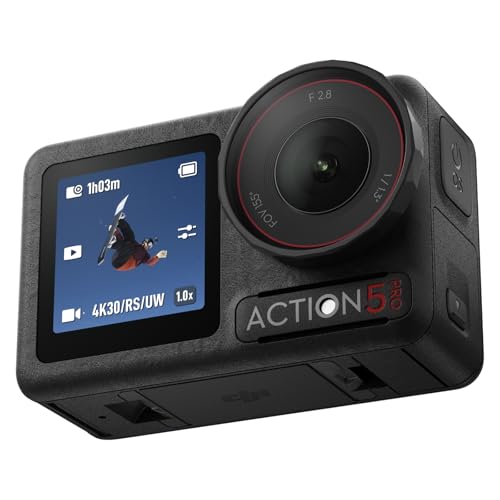
DJI built this camera like it had read skiers’ complaint letters. The battery is the headline: a large cell with genuine cold-weather stamina, so the camera that starts the first lift is still alive for the last run’s golden traverse instead of dying politely at lunch. On a mountain, runtime is not a convenience — it is the difference between filming the day and filming the morning.
The footage suits the subject. Stabilisation irons out the chatter of an icy piste without turning carved turns into drone shots, the colour depth holds detail in snow that lesser cameras clip to white paper, and the dynamic range copes when a run dives from open glare into shadowed trees. Subject tracking helps the follow-cam job: mount it on a partner’s chest or your own pole, and the framing stays kinder than a fixed wide lens has any right to be.
Controls respect gloves — proper buttons, a screen that stays responsive, and a body sealed against the spray a snowboarder’s edge throws up. As the single camera to carry up a mountain for a week of skiing, this is the one the rest of the list is measured against.
- Format: waterproof action camera, 1/1.3-inch sensor
- Battery: large cell rated for extended cold use
- Video: 4K at high frame rates with stabilisation
- Mounts: magnetic quick-release system
Strengths
- Cold-weather runtime that outlasts the ski day
- Snow highlights keep their texture
- Glove-honest buttons and quick mounts
Trade-offs
- Accessory shelves are thinner than GoPro’s
- Best colour modes ask a little editing care
- No interchangeable lens for true telephoto stills
Best for: skiers filming whole days, follow-cam partners and POV regulars. Not suited for: photographers who mainly want framed stills from the piste edge.

GoPro HERO13 Black — Best for mounts and accessories
The HERO13’s argument is not any single specification; it is the ecosystem standing behind it. Chest mounts, helmet mounts, pole mounts, bite mounts, mounts for the dog — if a skier has ever strapped a camera to it, there is a HERO fitting for the job, and every hire shop and ski buddy on the mountain can lend you one. For a group trip where cameras get shared, borrowed and occasionally buried, that universality is a feature no spec sheet captures.
The camera itself is thoroughly sorted: high-resolution video, stabilisation that has become the industry’s reference, and swappable lens mods that widen the view for tight tree runs or correct it for a flatter, more natural look. Burst stills from a pole mount give you the spray shot without carrying a second camera, and the whole thing shrugs off the crashes that are, let us be honest, part of the footage’s charm.
Cold behaviour is good rather than class-leading — carry the spare battery in an inside pocket and swap at the lift, a ten-second ritual with practice. What you get in return is the camera the whole mountain already understands.
- Format: waterproof action camera
- Video: 5.3K with reference-grade stabilisation
- Lenses: interchangeable lens mods
- Ecosystem: the deepest mount and accessory range
Strengths
- A mount exists for every idea you will have
- Footage matches every other skier’s camera
- Tough enough for the learning curve
Trade-offs
- Battery fades faster in deep cold than the DJI
- Menus reward a phone app for deep settings
- Everyone’s footage looks like yours — for better and worse
Best for: group trips, mount collectors and skiers who borrow and lend gear. Not suited for: minimalists who resent accessory ecosystems.

Insta360 X4 — Best for never missing the shot
The X4 abolishes the ski videographer’s oldest anxiety: pointing the camera the wrong way. Mounted on a pole, it records the entire sphere — you, the mountain, the friend who just fell, the view you were too busy surviving to see — and the editing app lets you pan around inside the footage afterwards, choosing frames at a warm desk. The pole itself disappears from the shot, which produces the floating, drone-chased look that makes ski edits look expensive.
For follow-filming it is close to magic. Ski behind a friend with the X4 raised, think only about your own turns, and reframe their best carve in the edit; if they fall, the fall is in frame too, from whichever angle is funniest. The 8K capture means those reframed crops stay sharp enough to share, and the flow-state stabilisation keeps the sphere steady while you concentrate on not becoming content yourself.
The costs are workflow and care: 360 files are big, editing is a second job after the ski day, and the twin bulging lenses demand their guards on a mountain full of edges and lift bars. Skiers who accept those terms get the most forgiving camera ever taken up a chairlift.
- Format: waterproof 360 action camera
- Video: 8K 360 capture, reframed in the app
- Effect: invisible selfie stick as standard
- Modes: single-lens action camera mode included
Strengths
- Impossible to point it the wrong way
- Follow-filming without framing duties
- The floating third-person look, no drone needed
Trade-offs
- Editing time after every ski day
- Exposed lenses need guards and respect
- Large files eat cards and storage
Best for: skiers who film friends, instructors making review footage, edit-lovers. Not suited for: anyone who wants finished clips straight off the camera.

Insta360 GO 3S — Best featherweight ride-along
The GO 3S is the camera for skiers who hate carrying cameras. It is the size of a thumb, weighs almost nothing, and magnetises or clips to a goggle strap, a helmet brim, a jacket zip — places a normal action camera would announce itself with every turn. Clip it on at the top of the lift and genuinely forget it; the footage, stabilised 4K from your own eye line, is the closest thing to filming the run as you actually saw it.
Its little charging pod doubles as a remote screen and tripod, which makes it a sneaky second camera off the snow too — lodge table time-lapses, boot-room tune-ups, the après-ski evidence. On the mountain its limits are battery and ambition: record in runs rather than marathons, keep the pod warm in an inside pocket, and treat it as the always-with-you camera rather than the expedition one.
Children, it turns out, are its secret constituency: a GO 3S on a small skier’s helmet produces footage of a first parallel turn that no parent filming from below can match, and the camera is too light to change how the helmet sits. For family ski films, that alone justifies its place in the pocket.
- Format: thumb-sized modular action camera
- Video: 4K in a body of a few dozen grams
- Mounting: magnetic, clips to straps and clothing
- Pod: charging case with screen and remote control
Strengths
- So light it never changes how you ski
- True eye-line POV from a goggle strap
- Pod makes it a table camera off the snow
Trade-offs
- Runtime suits runs, not whole days
- Tiny body is easy to misplace in a lodge
- Image quality sits below the bigger action cams at dusk
Best for: POV purists, parents filming children, weight-obsessed tourers. Not suited for: all-day recording or storm-day heroics.

OM SYSTEM Tough TG-7 — Best pocket stills camera
Every ski jacket has a pocket, and the TG-7 is the camera that pocket deserves. It is freeze-proof to temperatures that empty a piste, waterproof, crushproof and drop-tested — a camera you can fall on, sit on and dig out of a snowdrift without a flicker of concern. For the skier who wants real photographs rather than video, it is the lowest-stress instrument on this page.
The photographs are better than its toughness suggests. The lens is bright for its class, the macro mode turns frost feathers on a lift cable and ice crystals on a glove into genuine subjects during lift queues, and the raw files give the snow’s exposure a second chance at home. It will not track a racer like the Nikon, but for the summit panorama, the group shot against the weather station and the lunchtime terrace scene, it is instant, honest and always present.
Presence is the point. Cameras left in the lodge take no photographs; the TG-7 rides in the pocket that also holds the lift pass, comes out with gloves half-on, and goes back before your hands get cold. A week of that produces an album. A week of intending to carry the big camera produces intentions.
- Format: rugged compact, freeze-proof rated
- Lens: bright zoom with macro and microscope modes
- Files: raw capture for snow-exposure rescue
- Body: waterproof, crushproof, dustproof
Strengths
- Survives falls that end ski holidays
- Always in the pocket, therefore always used
- Macro turns lift queues into photo walks
Trade-offs
- Small sensor limits dusk and night shots
- No viewfinder — screen only in bright glare
- Video is a sideline, not a headline
Best for: stills-first skiers, families, storm-day photography. Not suited for: filmmakers building a ski edit.

Nikon Z50 II — Best piste-side stills
Somebody in every ski group becomes the photographer, and this is their camera. Posted below a pitch with the Z50 II, you get real interchangeable-lens photography: subject-detection autofocus that finds the skier against a white world, bursts that cover the whole carved sequence, and a telephoto’s compression that makes a blue run look like a poster. The crop sensor stretches your lens, so a modest zoom reaches further down the piste than it has any right to.
The body asks for respect in return. It is weather-sealed in the way mirrorless cameras are — fine in falling snow for a session, happier with a cover in a storm — and its battery prefers a warm pocket between runs. Gloves come off for the fiddly work, so set the camera up at the lift station: tracking on, burst ready, exposure compensation dialled for snow, then shoot with the dials you can feel.
What it returns is the photograph the action cameras cannot take: your partner mid-carve, edges biting, snow streaming, the valley behind. One such frame, printed, outweighs an hour of POV. Groups that rotate the photographer’s duty will find the Z50 II makes volunteers of people who arrived as subjects.
- Format: APS-C mirrorless, body only
- Autofocus: subject detection with tracking
- Burst: fast continuous for carve sequences
- Reach: crop sensor extends telephoto lenses
Strengths
- The only true sports-stills tool here
- Tracking holds skiers against white backgrounds
- Grows with better lenses season after season
Trade-offs
- Needs a lens budget beyond the body
- Not a ride-along camera — it watches, it does not ride
- Cold and weather ask for basic care
Best for: the group’s designated photographer, ski clubs, proud parents at race training. Not suited for: POV filming or pocket carry.
How do you film a friend when you are the weaker skier?
Let the camera close the skill gap. You do not need to match their line — you need to be predictable: agree the pitch, the side you will film from and the stopping point, then ski your own comfortable line with the X4 raised or the chest-mounted DJI rolling. A steady camera on a modest line beats a heroic chase that ends in a yard sale, and the reframing of a 360 camera forgives the distance your caution keeps. Instructors film this way professionally; the secret is the briefing at the top, not the skiing.
What is the blue-hour run, and how do you film it?
The last run of the day, when the lifts slow and the piste empties, is lit like a film set: low sun, long shadows, snow turning apricot and then violet. It is also when batteries are tiredest and light falls fastest, so plan for it — swap in the warm spare at the last lift, choose the camera with the biggest sensor you own, and accept higher sensitivity as the price of the hour. The Action 5 Pro and the TG-7’s bright lens both earn their keep here; footage from the blue-hour run is what friends will actually watch in July.
How do you keep a camera alive on a storm day?
Storm days sort the prepared from the optimistic. The camera rides inside your shell until the moment of use, comes out for the run and returns to warmth at the lift; snow is brushed, never blown on, because breath is fog waiting to happen. Sealed action cameras shrug off the spindrift that would send a mirrorless body into a dry bag — which is why the wise storm-day kit is an action camera outside and the Nikon resting in the lodge, ready for the clearing that often follows the front.
Why do ski films look better in the trees?
Contrast and reference. On an open white piste the camera has nothing to measure speed against, but a tree run gives the frame edges, shadows and near objects that stream past — suddenly the viewer feels the velocity. Tree shade also rescues exposure: the snow stops clipping, faces under helmets gain modelling, and the footage acquires the depth that open bowls flatten away. Choose the gladed run for the camera’s sake even when the open bowl skis better; your edit will thank you in February.
How do you photograph a skier from below the pitch?
Plant yourself early, off the fall line, where the skier will turn toward you rather than away. Pre-focus on the turning zone, set the burst, and shoot the carve as it crosses your frame rather than chasing it down the hill — the Z50 II’s tracking does the following once you have given it a subject at a sensible distance. Mind the etiquette of the spot: visible, predictable, never in the landing of a roller or the exit of a gully, and ready to wave the next skier past your little studio.
What does flat light do, and how do you fight it?
Flat light is the overcast day when the piste’s surface vanishes — no shadows, no texture, and skiers reduced to cut-outs on paper. Cameras suffer with their owners: autofocus contrast falls, footage looks washed, and stills lose the carve’s evidence. Fight it by seeking edges — tree lines, piste markers, the shadow side of a ridge — and by exposing for faces and jackets rather than the general whiteness. The TG-7’s contrast handling and a touch of exposure discipline will salvage the day; the edit’s warmth slider can finish the job.
How should a family divide the filming?
Rotate the burden before it becomes one. The GO 3S belongs on the children’s helmets, where its footage of their own view is the holiday’s gold; a parent carries the chest-mounted action camera for the follow shots; the TG-7 lives in whoever’s pocket is nearest the moment. Agree that nobody films every run — some descents are for the family, not the archive — and the cameras stop taxing the holiday they were bought to celebrate. The best ski album is the one that leaves gaps where you were busy skiing.
What is the case for slow motion on snow?
Snow is slow motion’s natural subject: a carved turn throws a plume that hangs, sculptural, for a second, and a small jump’s landing writes itself in spray. The high frame rates on the DJI and GoPro picks turn those moments into the edit’s punctuation — used twice in a film, they feel like cinema; used throughout, they feel like a screensaver buffering. Shoot your slow motion deliberately at the day’s photogenic pitch, in the best light, rather than leaving the camera in the mode and wondering why the ordinary runs look dreamy and vague.
How do you film in a whiteout without filming nothing?
Stay close and shoot relationships. In a whiteout the mountain disappears, so the camera’s subject becomes the group itself: the huddle at the piste map, goggles rimed, the leader’s pole pointing into the murk, laughter at the absurdity of it. Distances shrink to a few metres, which suits the little GO 3S and the TG-7 perfectly. Whiteout footage, used honestly, is often a ski film’s most truthful minute — the day the weather won, remembered fondly because everyone in it is grinning.
Why does the lift ride belong in your footage?
Because the lift is where the day is narrated. Boots dangling over the valley, the map consulted, the last run planned, the summit arriving — chairlift shots give a ski film its chapters and its geography, and they cost nothing but a camera already on your chest. The X4 earns a special mention here: raised on its pole as the chair climbs, it captures the whole cirque turning below you, a shot that sells the scale of the place better than any summit panorama taken in a gale.
How do you protect a 360 camera’s lenses on snow?
With paranoia and guards. The X4’s twin domes are its eyes and its vulnerability — a ski edge, a lift bar or a dropped pole can scar them, and a scar appears in every frame thereafter. Fit the lens guards on the mountain even though they cost a whisper of clarity, carry the camera in its pouch rather than loose in the pack, and never set it down dome-first on a café table. Treated this way it will survive the week; treated casually, it becomes an expensive lesson in optics.
What settings tame a bright piste?
Start by limiting the camera’s enthusiasm: cap the ISO low in daylight, let the shutter run fast, and use the action cameras’ colour profiles that hold highlights rather than dramatise them. For stills on the Nikon and TG-7, a polarising filter is the mountain photographer’s oldest friend — it deepens the sky, cuts the glare off the snow’s crust and restores the colour the brightness bleached. Check the first run’s playback at the lift; snow exposure errors compound all day if the morning’s settings go unexamined.
How do you film a lesson so it teaches afterwards?
Shoot from the student’s eye level and the instructor’s side. The X4 behind the group catches the demonstration and the attempts in one unbroken record; the piste-side Nikon isolates the one movement the lesson is about — the hands, the edges, the moment the turn releases. Afterwards, the student watches their own skiing at a screen’s leisure, which is worth a dozen verbal corrections. Instructors who film this way are not gadget enthusiasts; they are using the camera as the mirror the mountain never provides.
What is the après-ski test for a ski camera?
Whether it is still working, charged and welcome at the table. The camera that filmed the last run, survived the walk through the village and now sits on the café table for the group portrait has passed the only review that matters. The GO 3S’s pod makes it a table camera; the TG-7 is unbothered by spilled anything; the action cameras need their day’s footage rescued to a phone before the evening blurs priorities. Choose the camera whose whole day — not just its best run — fits your holiday’s rhythm.
How do you shoot the summit photograph properly?
Walk twenty metres from the lift station. The summit cross or sign is where everyone stands, which is why everyone’s photograph is identical; the ridge a short walk away gives you the same panorama with nobody’s selfie stick in it and the weather station’s cables out of frame. Expose for the snow, put the group where the valley opens behind them, and take the TG-7’s burst of three — somebody is always blinking into the wind. Then put the camera away and look at the view with the apparatus you were born with.
Why do gloves decide your camera shortlist?
Because at minus ten, the interface is the product. A touchscreen-only workflow in ski gloves is a promise to remove a glove a hundred times a day, and cold fingers make their own decisions about how long a shot is worth. The picks that survived this guide all offer a physical path — the action cameras’ chunky buttons and voice control, the TG-7’s dials, the Nikon’s proper controls — and the ones you are reading about elsewhere that rely on delicate taps did not survive the mountain. Test any camera wearing your actual ski gloves before the trip, in the shop, without embarrassment.
How do you handle a camera after a fall?
Brush the snow off before it melts into the seams, check the lens before the next shot rather than after the day, and resist warming a frozen camera quickly against a radiator, which invites condensation inside the optics. Let it come back to room temperature slowly in its bag. The action cameras and the TG-7 treat a fall as a rounding error; the mirrorless body deserves the slower kindness. And check the mount, not just the camera — a cracked chest plate fails on the next run, not the one that cracked it.
What does a ski camera owe the environment it films in?
Discretion and stamina. It should not demand a drone’s noise, a gimbal’s choreography or a film crew’s footprint on a crowded piste; it should ride quietly, film the consenting, and leave the mountain’s soundscape to the skis. The small cameras in this guide pass that test by design. There is also a courtesy to other skiers: a pole-mounted camera is a pole, and it is wielded with the same awareness — lowered in lift queues, stowed in crowds, never swung across a stranger’s line for the sake of a shot.
How do you make ski footage of children that respects them?
Film the achievement, not just the adorable. The GO 3S on a child’s helmet records the mountain from their height — the lift that towers, the instructor who looms kindly, the run that feels enormous — and that perspective, kept, becomes family history rather than content. Ask older children before the camera rolls, let them review and veto, and remember that the child who hates being filmed skis worse for the audience. The camera serves the holiday; on a mountain full of families, that ordering is the whole ethic.
What is the one accessory every ski camera needs?
A leash. Not a mount, not a case — a simple tether between the camera and you, because the mountain’s lost-property offices hold a archaeology of action cameras that parted from helmets, poles and gloves at speed. A short cord costs almost nothing, weighs less, and converts a catastrophe into a dangle. After the leash, a warm spare battery; after that, a cloth that lives in the same pocket as the camera. Everything else in the accessory catalogues is refinement of a kit that those three humble items already made reliable.
How do you choose between filming and skiing well?
Alternate, deliberately. Filming asks for a fraction of your attention that skiing at your limit cannot spare, so the honest rhythm is to film the runs you would enjoy at eighty percent and ski the serious ones camera-free — or hand the camera to the day’s photographer and be the subject. Groups that rotate the role get both the skiing and the film; the skier who tries to be cinematographer on every descent gets neither, and occasionally gets a tree. The cameras here are light enough that the choice is about attention, not burden.
Why does snowboarding change the filming, even in a skiing guide?
Because the stance turns the camera’s world sideways. A boarder’s chest mount faces across the fall line rather than down it, follow-filming means matching a heel-to-toe rhythm that is not your own, and the spray comes off a single wide edge in sheets that find every lens. Mixed groups — most real groups — should know the chest view will favour the skiers’ perspective, and that the X4’s sphere solves the geometry for everyone, which is part of why it keeps appearing in these answers like a refrain.
How do you end a ski film?
With the mountain, not the people. The last run’s footage, the lift cables emptying, the piste-basher’s lights beginning their night shift on the darkening slope — an ending that returns the place to itself gives the film its proportion. Practically, this is one more argument for the camera that is still alive at dusk: the Action 5 Pro’s battery, hoarded through the afternoon, buys you the closing shot. Save a little charge, a little card and a little light, and the holiday gets the ending it deserves.
What should a beginner’s first ski-camera season teach?
That position beats equipment on snow as everywhere else. The beginner who learns to stop in the right places — below the pitch for the carve, beside the tree line for the contrast, at the lift exit for the reunion — will out-film the expert chasing specs from the wrong side of the mountain. Start with one camera from this page, learn the mountain’s light across a week, and let the second season’s purchase be informed by the first season’s footage. The mountain is patient; so is the camera market.
How do you keep footage safe across a ski week?
Assume the camera’s day ends badly at least once — a lost mount, a full card, a swim in a fondue of slush — and make the evening transfer a ritual: footage to the phone or a small drive at the lodge, cards rotated, batteries on charge in the warm. Ten unglamorous minutes protect the whole week’s memories, and the ritual has a social pleasure of its own: the day’s best fall, reviewed at the table, is the après-ski’s first entertainment. Backup is not paranoia at altitude; it is hospitality to your future self.
How do you film a ski tour, where weight is measured in grams?
Touring rewrites the arithmetic: every gram climbs a thousand vertical metres on your back before it films anything. This is the GO 3S’s home terrain — a camera that adds less weight than the sandwich — backed by the discipline of filming the skin track’s highlights and the descent, not the whole day. The Action 5 Pro is the heaviest camera a tourer should consider, and it earns its grams only if the descent is the day’s point. Photographers on a tour should say so at the trailhead; the group’s pace plan deserves to know about your summit panorama ambitions.
What is the photographer’s job at a ski race?
To be furniture with a memory. Race training and junior competitions need the shot at the gate where the line is chosen, taken from a position agreed with the coach, repeated identically run after run so the athlete can compare. The Z50 II’s burst and tracking were made for this anonymity: same corner, same framing, forty racers, no surprises. Parents should note the ethic as well as the technique — photograph the start list, share with the whole team, and your camera becomes infrastructure rather than a private advantage.
How do you get sharp stills of a skier moving at speed?
Pan with the subject and let the shutter sit in the honest middle: fast enough to hold the skier, slow enough to let the background admit the speed. A hundredth-range shutter with a smooth swing beats a frozen thousandth that could be a shop mannequin on a white stage. The Nikon’s viewfinder and the TG-7’s burst both support the attempt; expect to delete freely, because panning on snow — with your own body planted on a slope, turning at the hips — is a physical skill that a weekend introduces and a season makes reliable.
Why do ski jackets have so many pockets in this guide?
Because the pocket system is the camera system. Lift pass in one, camera in another, warm battery in the innermost, cloth with the camera, phone deep and safe — a skier who has assigned the pockets has solved half the problems this guide describes. Cameras die of logistics more often than of defects: the battery that was in the pack, the cloth that was in the lodge, the card that was in the other jacket. Dress like a system and the equipment, whatever you chose from this page, performs like one.
How do you film night skiing and torchlit descents?
Night skiing inverts the day’s problems: now there is too little light and it arrives in pools. The camera with the largest sensor wins again — the Action 5 Pro’s low-light discipline — and the technique is to ski the lit corridors rather than the dark between them, exposing for the piste under the lamps and letting the night be night at the frame’s edges. A torchlit descent is a gift: film from a stationary position as the river of flame passes, with the TG-7 or Nikon on a mini-tripod, and let the mountain do the moving.
What is the honest difference between the DJI and the GoPro on snow?
Temperament. The GoPro is the mountain’s lingua franca — every mount, every buddy’s spare battery, every rental shop’s familiarity — while the DJI is the considered choice: longer cold runtime, deeper colour, a slightly more deliberate way of working. Skiers embedded in a GoPro group should not underestimate the social specification; skiers buying fresh for long cold days should not underestimate the battery. Both film the same carve; they differ in what the day around the carve feels like, which is why this guide keeps both and refuses to pretend the question has one answer.
How do you shoot a panorama that does the Alps justice?
Stop trying to fit them in. The wide shot of a huge range flattens into a postcard; the photographs that hold scale give the mountains a foreground with a job — a cornice’s curve, a tiny lift station, a skier the size of an ant crossing a face. The TG-7 and Nikon both stitch panoramas in-camera, but the composed single frame with a human punctuation mark beats the sweep. Shoot the range at the day’s edges, when shadows model the ridges, and let one small figure prove how large the rest is.
What do you do with a camera at altitude when you feel awful?
Put it away. Altitude dulls judgement before it dulls anything else, and the fiddly, cold, frustrating camera session at a high col is how mounts get dropped and tempers get lost. The mountain will be there tomorrow; the photograph you force while headachy and breathless will show it. This guide’s enthusiasm has a limit, and it is the same as the ski patrol’s: the best camera work on a mountain happens inside the envelope of a good day, and recognising a bad one early is a skill the equipment cannot supply.
How does a ski film find its music?
Afterwards, from the footage’s own rhythm. A day’s skiing has a tempo — lift drones, piste rushes, café pauses — and the edit that respects it needs less music than the one fighting it. Practically: film a few seconds of pure mountain sound at each location, the lift cables and the wind and the edges on snow, because those beds of real audio are what separate a film from a slideshow. The cameras’ microphones are adequate for this if you shield them from wind; a furry cover on the action camera is the smallest upgrade with the largest audible return.
What is the last check before the first lift?
Card in, battery warm, lens clean, mount tight, leash on. Thirty seconds at the boot room door that prevent the day’s saddest sentence — the one that begins at the summit. Photographers in every genre in this series have their version of the ritual, but skiing adds the cold’s deadline: checks done indoors, with warm hands and good light, are checks done properly. Then zip the pocket, clip the leash, and go and be a skier who happens to be filming, which is the correct order of identities on a mountain.
How do you photograph falling snow itself?
Falling snow is the mountain’s confetti and its camouflage: against a dark background of trees or a shadowed face, a backlit snowfall turns an ordinary group shot into weather made visible. Seek the contrast — the dark gully behind your subjects, the low sun through the flakes — and use a burst, because snow composes itself differently in every frame and the best arrangement is luck you can multiply. The TG-7’s flash, used sparingly at close range in the dusk, lights the nearest flakes into a private snow globe; use it once, laugh, and put it away before it becomes a style.
Comparison: all six picks at a glance
| Camera | Form | Character | Choose it if… |
|---|---|---|---|
| DJI Osmo Action 5 Pro | Action camera | The all-day filmer | Cold runtime decides your day |
| GoPro HERO13 Black | Action camera | The universal mount | Your group shares GoPro everything |
| Insta360 X4 | 360 camera | The second chance | You would rather frame at a desk |
| Insta360 GO 3S | Mini action camera | The ghost | Weight is your first enemy |
| OM SYSTEM Tough TG-7 | Rugged compact | The pocket survivor | Stills, storms and zero anxiety |
| Nikon Z50 II | Mirrorless | The piste-side artist | You shoot the group, not yourself |
What are the most common mistakes in ski photography?
Trusting the meter on a white mountain
Snow is the exposure trap that catches everyone once: the camera sees a bright world and dutifully darkens it to grey, so your holiday comes home looking like it happened in a coal mine. Dial in positive exposure compensation for piste scenes, check the histogram rather than the glary screen, and shoot raw on the TG-7 and Nikon so the snow can be lifted back to white at home. The action cameras’ snow-aware tuning helps, but a glance at the playback after the first run is still the professional habit.
Keeping batteries in the outside pocket
Cold does not kill batteries permanently — it persuades them to hide their charge until they warm up, which is why a camera can die at the ridge and resurrect in the lodge. The fix is body heat: spares in an inside pocket, the camera itself under your shell between runs on the worst days, and a rotation that brings a warm battery to the camera for the last, best-lit hour. Every verdict in this guide assumed you would do this; no camera defeats physics on your behalf.
Filming only yourself
A week of solo POV is a week of the same shot: tips, poles, piste, repeat. The footage that survives the edit swaps viewpoints — follow a friend with the X4, hand the GO 3S to the child, plant the photographer below the pitch with the Nikon, take the TG-7’s stills of everyone else. Skiing is a social sport wearing a solitary costume; film it socially and the holiday album becomes a story instead of a screensaver.
Final Recommendation
Buy for the job you actually do on the mountain. If you film your own skiing all day, the DJI Osmo Action 5 Pro’s cold stamina and snow-wise colour make it the default; groups already speaking GoPro should take the HERO13 and its universe of mounts. The X4 is the creative’s choice — follow-filming without framing — and the GO 3S is the camera that will actually be on you for the unplanned moments. Stills belong to the TG-7 in the pocket and the Z50 II in the photographer’s hands below the pitch. Keep the batteries warm, forgive the meter its grey snow, and swap the camera between friends. The mountain provides the light; your job is simply to still be recording when it turns gold.
Related guides
- Best Canon Cameras for Action Shots: Tracking, Burst Speed and Sideline Proof
- Best Cameras Under 300: An Independent Shortlist for Action, Desk and Everyday Filming
- Best Cameras for Surfing Photography: Waterproof Action Cams and a Shore Telephoto Plan
Frequently Asked Questions
Why do my ski photos come out grey and dull?
Your meter is being polite to a liar. Snow reflects so much light that the camera assumes the scene is brighter than it is and underexposes, turning white slopes grey. Add exposure compensation — often a full stop or more — when the frame is mostly snow, and prefer raw files on cameras that offer them so the correction can be refined later. A skier in a dark jacket against the slope will also pull the meter around; expose for the snow and let the jacket be dramatic.
Can I use my phone instead of these cameras?
For a terrace panorama, happily. For a ski day, the phone fights you: gloves defeat its screen, cold empties its battery fastest of all, and a fall onto a hard piste is an expensive sound. The action cameras exist precisely for this environment — sealed, buttoned, mountable and comparatively cheap to endanger. Keep the phone warm and dry for maps, messages and the emergency it is genuinely best at.
Which mount is best for skiing footage?
The chest mount gives the most honest skiing view — arms, tips and terrain in frame, stable through turns — while the helmet mount sits higher and smoother but can feel detached, floating above the action. A pole mount with the X4 produces the famous invisible-stick third-person shot. Start with the chest; it teaches framing because it shows your own technique, which is either a bonus or a reckoning.
How do I stop my lens fogging on the mountain?
Fog is a temperature story: warm moist air meeting cold glass, usually when you step from a steamy lodge onto a freezing lift. Let the camera acclimatise in an outside pocket before you need it, avoid breathing on the lens while clearing snow, and wipe with a dry cloth rather than a gloved thumb, which mostly moves the fog around. Anti-fog inserts help action cameras in their housings; patience helps everything else.
Is 360 video worth the editing effort for a holiday?
If you film other people, yes — the X4’s reframe-later freedom means a beginner can follow-film like a professional, because the camera never misses. If you film only yourself and want clips on your phone by dinner, a conventional action camera’s ready-made framing will make you happier. The honest test is whether you enjoy editing; the mountain has already done the hard part either way.
Related Guides
Keep exploring with our companion reading: best cameras for snowboard photography, best action cameras for winter sports and best cameras for extreme cold.


