reviewstook.com is reader-supported. When you buy through links on our site, we may earn an affiliate commission.
Where to buy
Five of the six cameras below carry links to their Amazon listings; the rugged Pentax-class camera at the end is discussed without a link because it sits outside the pool verified for this article, and outdoor retailers stock it. Cold-weather kit should be bought and tested in the warm, because every weakness in this category, the battery that fades, the screen that sulks, the control your gloves cannot find, is discoverable in a freezer-and-garden rehearsal at home and miserable to discover on a summit. Buy early, put the camera in the cold for an afternoon with the gloves you actually wear, and let the rehearsal write your shopping list for spare batteries and a chest harness before the trip does.
The rehearsal deserves one more sentence, because it is the cheapest insurance in this entire guide: a camera left running on a frosty garden table for an afternoon, operated hourly with the trip’s gloves, brought back indoors by the bag drill and inspected the next morning, will confess every weakness the expedition would otherwise be charged for discovering. Owners who have done it describe the same surprise, that the camera was rarely the problem and the system around it always was, which is precisely the discovery the rehearsal exists to make cheap.
- OM SYSTEM Olympus Tough TG-7: check price on Amazon
- GoPro HERO13 Black: check price on Amazon
- DJI Osmo Action 5 Pro: check price on Amazon
- Insta360 Ace Pro 2: check price on Amazon
- Insta360 X4: check price on Amazon
- Ricoh WG-series rugged camera: available from outdoor retailers (prose-only pick in this guide)
Cold is not one condition but a conspiracy of them, and the best cameras for extreme cold are the ones that answer the whole conspiracy. Batteries lose their nerve and report empty at half their summer life. Screens slow and smear. Lubricants thicken, fingers inside gloves turn to clubs, and every breath the photographer exhales near the camera becomes frost on the lens and the viewfinder. Then, at the end of the day, comes the assassin nobody warns beginners about: condensation, when the frozen camera walks into a warm hut and the moisture in the air finds every cold surface, including the ones inside the lens. Add wind, which strips heat from everything it touches, and altitude, which thins the photographer’s own judgement along with the air, and the cold camera’s specification sheet becomes a survival document rather than a shopping list. A camera for serious cold is therefore judged on a different sheet from every other camera in this series: operating temperament, battery behaviour, gloved handling, sealing, and how gracefully it makes the journey back into the warm. Nothing on that sheet is glamorous, and everything on it is decisive, which is the cold’s way of teaching photographers what actually matters about their tools, their preparation and their respect for conditions that do not negotiate with anyone, however expensive their equipment or however tight their schedule happens to be today.
The uses divide by tribe. Mountaineers and polar travellers need a camera that works at temperatures where phones resign. Skiers, snowboarders and snowmobilers need impact, immersion in powder, and controls that answer through mitts. Winter wildlife and landscape photographers need a body that will sit on a tripod at dawn in a wind that cuts, and keep its focus and its battery while they keep their patience. Ice fishers, aurora hunters, dog-sledders, cold-water workers: the cold professions and pastimes share one demand, that the camera be the most reliable object in the sled.
There is also a quieter cold readership this guide keeps in mind: the people who simply live where winter is long, whose children’s sport is played on frozen ground, whose work is outdoors in all weathers, and whose photography is the everyday kind this series has covered elsewhere, conducted at temperatures that make the ordinary rules insufficient. For them the cold camera is not expedition equipment but the family camera’s winter self, and the TG-7’s double life, beach camera in July, blizzard camera in January, is the most economical reading of the whole list.
A note on sources of confidence in a category full of folklore: cold performance is unusually polluted by anecdote, the camera that survived one man’s January against the same model that died on another woman’s, because the variables, battery age, wind, handling, the warm border crossing, swamp the equipment’s own contribution. This guide has therefore weighted designed ratings and professional adoption above individual survival stories, and where it relies on field reputation, as with the action cameras, it relies on the accumulated weight of a decade’s winters rather than on any single tale told in a hut.
Six cameras are ranked below, and honesty requires saying at the outset that they divide into the genuinely cold-rated, the tough cameras with manufacturer freeze-proofing at their core, and the action cameras whose cold endurance has been proven by a decade of winters on helmets and handlebars. Between them they cover every winter use from the backyard blizzard to the serious expedition, and the sections that follow are as much about the system around the camera, batteries worn warm, condensation discipline, glove craft, as about the cameras themselves.
Readers planning a single defining trip, the aurora week, the ski traverse, the polar cruise, should read the guide backwards: start with the how-to and the mistakes, because those sections will be open on the cabin table, and let them discipline the choice the rankings then make easy. Readers equipping a profession should start with the WG and TG-7 sections and the season-care pages, where the cold is not an adventure but a working condition that returns every year with the reliability of a roster.
Key Takeaways
- Batteries, not sensors, are cold’s first casualty; carry them warm.
- The TG-7 is the only pick here freeze-rated as its headline virtue.
- Condensation on re-entering warmth kills more cameras than cold itself.
- Controls your gloves cannot work are controls you do not have.
- Action cameras earn their winter place on helmets and handlebars.
- Rehearse in a home freezer’s weather before the expedition does it for you.
- Buy for the cold you honestly face, not the expedition in the brochure.
- Dress the camera for storms: harness under the shell, blower before cloth.
- The winter archive belongs to the cameras that were still working.
- Price the whole winter kit, batteries, harness, bags, not the body alone.
- One rated camera carried beats two unrated cameras left behind in the warm.
In this guide
Quick Picks
| Camera | Badge | Why it is here |
|---|---|---|
| OM SYSTEM Olympus Tough TG-7 | Best True Cold-Rated Camera | Freeze-proof by design, with macro for ice and frost. |
| GoPro HERO13 Black | Best for Winter Sports Filming | The helmet standard, with cold-weather battery options. |
| DJI Osmo Action 5 Pro | Best Cold Endurance | Long-running battery behaviour when temperatures fall. |
| Insta360 Ace Pro 2 | Best for Low Winter Light | A larger sensor for dawn patrols and aurora edges. |
| Insta360 X4 | Best for 360 Winter Scenes | The whole white world in one frame, reframed later. |
| Ricoh WG-Series | Best Workhorse Rugged Pick | The cold-site and cold-water professional’s compact. |
How did we judge cameras for extreme cold?
Judging began with the manufacturers’ own cold claims, treated with the respect and suspicion they deserve: a freeze-proof rating is a designed, tested promise about a class of conditions, while the absence of one means the camera’s winter reputation rests on field evidence, of which the action cameras here have accumulated a great deal. Each candidate was assessed on operating behaviour as temperatures fall, how the battery reports and recovers, whether the screen remains a usable instrument, and whether the controls can be worked in the gloves its likely owner actually wears, which for most winter pursuits means liner gloves for fine work and mitts for everything else.
Sealing and shock came second, because winter drops its cameras onto ice and buries them in powder as a matter of routine, and a camera that survives immersion in snowmelt has answered a question summer cameras never meet. Third came the return journey: how the camera’s design and its maker’s guidance handle the condensation passage from deep cold to warm interior, the transition this guide treats as part of the specification. Finally, the images themselves, judged in winter’s own light, the blue dawn, the flat white noon, the long amber evening, because a camera that merely survives the cold but renders it as grey porridge has only done half the job.
The judging also priced the whole system honestly, because cold cameras are bought in kits whether their owners admit it or not: the spare batteries in their rotation, the harness, the bags and packets, the external power for the static work, and in the action cameras’ case the mounts that the sport demands. A cheaper camera with an expensive entourage may cost the winter more than the premium pick whose endurance halves the battery count, and the recommendations below are made on the expedition’s total bill rather than the body’s ticket.
The picks in detail

OM SYSTEM Olympus Tough TG-7 — Best True Cold-Rated Camera
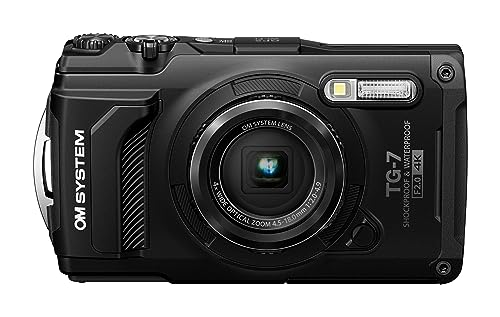
The TG-7 is the only camera in this guide whose cold credentials are printed on its character rather than inferred from anecdotes: the Tough line is freeze-proof rated to temperatures that stop ordinary cameras, alongside its waterproofing, crushproofing and dust sealing, and that combination makes it the default recommendation for the traveller, researcher or worker whose camera must simply work at the cold end of the map. It rides outside the pack where other cameras hide, it starts with gloves on, and its controls are the chunky, findable kind that winter hands require.
Its photographic personality suits the cold world specifically. The macro modes that this guide praised for jewellery in another context here turn to frost feathers on a tent window, ice crystals in a crevasse wall, the lichen on a polar rock, the small frozen world that big landscapes overlook. Its underwater housing heritage means snow immersion is a non-event, and its scene intelligence handles the exposure trap of snowfields, which fool lesser meters into grey, with more grace than most. For the expedition diary, the ski tour record, the researcher’s field documentation, it is the camera that removes equipment anxiety from the list of things the cold can attack.
The limits are the familiar Tough ones: a small sensor that will not match the action cameras’ video or the mirrorless class’s low light, and files sized for records and sharing rather than exhibition. In deep cold those are acceptable trades, because the first law of winter photography is that the working camera at the summit takes the photograph, and the TG-7 is engineered, above everything else, to be working.
- Form: rugged compact, freeze-proof rated
- Sealing: waterproof, dustproof, crush-resistant
- Macro: frost, ice and small-world detail
- Controls: glove-findable, expedition simple
- Role: polar, mountain and field-work record
Strengths
- Cold rating is designed, not hoped for.
- Rides outside the pack, ready always.
- Snow immersion and drops are non-events.
Trade-offs
- Small sensor, modest video ambitions.
- Files for records, not gallery walls.
- No viewfinder for whiteout composing.
Best for: expeditions, field work and ski touring records. Not suited for: cinematic winter video as the main camera.

GoPro HERO13 Black — Best for Winter Sports Filming
The HERO13’s winter case rests on incumbency earned the hard way: more cold-weather footage has been shot on this camera’s line than on everything else in this guide combined, on helmets in blizzards, on chest mounts in powder, on poles above cornices, and the ecosystem around it, mounts, cases, and the cold-weather battery options the line has developed, is a winter infrastructure no rival matches. Its stabilisation in the rough motion of skiing and riding is the benchmark the others chase, and its voice and button operation through gloves and mitts has been refined by exactly the users this section addresses.
Cold behaviour is the honest discussion, and it goes like this: like every lithium-powered camera, it loses endurance as temperatures fall, and the winter craft is management, batteries rotated from an inside pocket, the camera kept under a layer until the run, runtimes planned in bursts rather than in the continuous recording summer allows. Within that craft, the current generation and its endurance-oriented battery options perform respectably, and the camera’s sheer toughness, waterproof, impact-happy, makes the mountain’s other assaults irrelevant. The footage, wide, bright and stabilised, remains the visual language of winter sport itself.
Choose it when the winter is a sport and the camera is part of the equipment, mounted and forgotten until the lift. Its small sensor’s low-light ceiling matters less on snowfields, which are among the brightest stages on earth, and its limitations appear mainly at the aurora and the dawn, where the Ace Pro below takes its turn.
- Form: waterproof action camera
- Ecosystem: mounts and cold battery options
- Stabilisation: benchmark for snow sports
- Operation: voice and mitt-friendly controls
- Role: helmet, chest and pole filming
Strengths
- Winter-proven beyond any rival here.
- Mounts for every sport and angle.
- Footage is the language of the slopes.
Trade-offs
- Endurance needs warm-battery rotation.
- Dawn and aurora stretch its sensor.
- Continuous recording shortens in deep cold.
Best for: skiers, riders and snowmobilers filming action. Not suited for: unattended all-day cold recording.

DJI Osmo Action 5 Pro — Best Cold Endurance
DJI built the Action 5 Pro’s reputation on battery behaviour, and in the cold that reputation becomes the headline: its endurance in ordinary conditions is the class’s longest, which gives it the largest margin when winter taxes every battery, and its low-temperature performance is a designed feature that winter reviewers have made its signature. For the user whose cold work is long, the ice-fishing day, the sled expedition’s riding hours, the time-lapse of a storm’s whole passage, that margin is the difference between a camera that finishes the job and a camera that becomes a story about nearly finishing it.
The rest of the package suits the same long cold: a bright front screen for the self-filmed expedition update, subject tracking for the moving work, waterproofing that treats meltwater and sleet as weather rather than threat, and an image whose low-light manners, helped by its larger sensor class, cover the winter day’s dim ends better than the traditional action camera. Mounted on a snowmobile, a dog sled’s handlebar or a tripod at a fishing hole, it simply runs, which in deep cold is the most luxurious specification of all.
Its ecosystem is younger than GoPro’s, so the exotic mount for the unusual sport may take more ingenuity, and like every camera here it still wants its batteries managed with sense rather than optimism. As the cold-endurance pick, for the user whose first question is will it still be running at the end, it is the answer this guide gives first.
- Form: waterproof action camera
- Battery: class-leading endurance, cold-aware
- Screens: bright front display for self-filming
- Sensor: larger class, kinder winter dusk
- Role: long cold days and expedition filming
Strengths
- Still running when rivals have rested.
- Front screen serves solo expedition updates.
- Handles the dim ends of winter days.
Trade-offs
- Mount ecosystem younger than GoPro’s.
- Batteries still reward warm rotation.
- Premium tier of the action class.
Best for: sled, ice and expedition days measured in hours. Not suited for: buyers needing the widest mount catalogue today.

Insta360 Ace Pro 2 — Best for Low Winter Light
Winter’s most beautiful hours are its darkest: the blue dawn on the mountain, the aurora’s first green rumor, the village lights in the long evening, and the Ace Pro 2’s larger sensor and low-light engineering make it this guide’s pick for those hours among the action cameras. Its image holds together where smaller sensors smear, its flip screen composes the self-filmed aurora update without a frozen phone as intermediary, and its Leica-badged lens lineage shows in the way it renders the cold world’s contrast, ice glare against shadowed rock, without surrendering either.
As a cold tool it follows the action class’s pattern, tough, waterproof, mountable everywhere, with battery behaviour to be managed by the usual warm-rotation craft, and it adds the low-light headroom that turns management into photographs. Aurora hunters in particular should note the combination: a camera that can be mounted, left to its interval and time-lapse modes at the tripod’s foot, and trusted to gather the sky while its owner watches with the naked eye, which is the correct division of labour under a sky like that.
Its premium pricing and its younger mount ecosystem are the standing notes, and its stills remain action-camera stills. For the winter traveller whose itinerary is written around the dark, the dawn patrol, the northern lights tour, the ice hotel’s blue hour, it is the action camera that sees the way the traveller came to see.
- Form: waterproof action camera, flip screen
- Sensor: larger class for low light
- Modes: interval and time-lapse for aurora
- Mounting: full action ecosystem
- Role: dawn, dusk and northern lights
Strengths
- Low light beyond the action class norm.
- Flip screen composes without a phone.
- Aurora time-lapses from a tripod’s foot.
Trade-offs
- Premium pricing in its class.
- Mount shelf still growing.
- Battery craft still required.
Best for: aurora tours and winter’s dark edges. Not suited for: bright-slope filming on a tight budget.

Insta360 X4 — Best for 360 Winter Scenes
Some winter scenes refuse a frame: the summit panorama with weather on every side, the dog sled’s whole world rushing past, the whiteout’s interior, the ski descent where the mountain is above, below and behind at once. The X4’s answer is to record everything, two lenses, all directions, and let the framing happen later in the warm, which in cold conditions is more than a creative choice; it is an ergonomic one, because a camera that needs no aiming needs no bare hands, no composing screen, no decision at the moment of coldest exposure. Mount it, press the one big button through a mitt, and ski.
The reframing workflow turns one descent into several films, the forward chase, the rider’s face, the mountain’s reveal, and the invisible-selfie-stick effect gives winter sports their now-classic drone-that-wasn’t shot. Its cold behaviour follows the action pattern, endurance managed by rotation and by the camera’s own placement out of the wind where the mount allows, and its waterproofing treats powder burial as a Tuesday.
The costs are workflow and delicacy: the two protruding lenses are the most vulnerable optics in this guide and want their guards in the sled bag’s chaos, and 360 footage is an editing commitment that stills-minded travellers may not want. For the winter storyteller whose scenes are larger than a frame, it captures what nothing else here can, the whole white world, kept.
- Form: waterproof 360 action camera
- Capture: everything, framed later indoors
- Operation: one mitt-friendly button
- Effect: invisible stick, drone-like angles
- Role: summits, sleds and whole-scene descents
Strengths
- No aiming, no bare hands, no missed side.
- One descent becomes several films.
- Ski footage with impossible angles.
Trade-offs
- Exposed lenses need guards and care.
- Editing commitment is real.
- Battery rotation still applies.
Best for: whole-scene winter storytelling. Not suited for: travellers who will not edit 360 footage.
Ricoh WG-Series — Best Workhorse Rugged Pick
The WG line is the Tough idea wearing overalls: rugged compacts, waterproof, shockproof and freeze-resistant in the same designed way, that have become standard issue in cold-water work, construction in winter, fisheries, utilities and the other professions whose cameras live outdoors in January. Discussed here without a link as the class sits outside this article’s verified pool, the WG cameras earn their section on professional adoption: when an industry that bills by the working day standardises on a camera for its cold sites, that is a field trial no review can replicate.
Their working features are a professional’s list: a ring light of LEDs around the lens for close work in dark plant rooms and under ice, microscope-style close modes for inspection detail, GPS and logging on the models built for survey and site records, and bodies designed to be operated by gloved hands and cleaned under a tap. The photographs are records first and art second, which in their world is the correct priority, and their cold manners are a specification their buyers check the way other buyers check resolution.
Choose the WG over the TG-7 when the work is inspection, site documentation or cold-water profession, and the TG-7 when it is travel and expedition; the two rugged lines divide the cold world between the diary and the clipboard, and both honour the same first law, that in extreme cold the camera that works is the camera that matters.
- Form: rugged compact, freeze-resistant
- Light: LED ring for close inspection work
- Logging: GPS and site-record models
- Build: gloved operation, washable body
- Role: cold industry, fisheries and site work
Strengths
- Professionally adopted for cold sites.
- Close-work lighting built around lens.
- Records and logs as designed duties.
Trade-offs
- Records first, art second, by design.
- Video modest beside action cameras.
- Range varies; check the exact model’s rating.
Best for: cold-water and winter site professionals. Not suited for: cinematic travel filming.
Comparison table
| Camera | Cold character | Best winter ground | Battery story | Watch out for |
|---|---|---|---|---|
| OM SYSTEM TG-7 | Freeze-proof by design | Expeditions and field records | Standard, rotation applies | Small sensor video |
| GoPro HERO13 | Winter-proven ecosystem | Slopes and snow sports | Cold options, managed bursts | Dawn light ceiling |
| DJI Action 5 Pro | Endurance-led design | Long sled and ice days | Longest margin in class | Younger mount shelf |
| Insta360 Ace Pro 2 | Low-light action tool | Aurora and dawn patrol | Rotation craft required | Premium class pricing |
| Insta360 X4 | Whole-scene recorder | Summits and descents | Rotation, wind sheltering | Lens guards, editing |
| Ricoh WG-Series | Industrial freeze resistance | Cold sites and fisheries | Shift-length records | Artistic ambitions modest |
How do you keep a camera alive in extreme cold?
Wear the batteries, not the camera
The foundational winter craft is thermal triage: the camera can be cold, within its rating, but the batteries must be warm, carried in an inside pocket against the body, rotated so that the working battery is always the warmest one, and rested back into the warmth when its charge sags, because a cold-soaked battery that reports empty will often recover a useful fraction of its charge when warmed. Plan the day on the summer rating’s pessimistic fraction, carry at least twice the batteries a summer shoot would suggest, and treat every manufacturer’s endurance figure as a mild-weather promise.
Manage the return to warmth like a border crossing
Condensation is the cold camera’s true enemy, and the defence is a plastic bag: before entering the hut, the tent’s warm vestibule or the vehicle, seal the cold camera inside a bag, ideally with the day’s moisture-absorbing packet, and let it warm slowly inside its sealed microclimate, so the room’s moisture condenses on the bag rather than on and in the camera. Resist opening, lens-changing and card-swapping until the camera has reached room temperature, and never breathe on a cold lens to clear it, which merely donates frost.
Work with the gloves you have
Set the camera before the cold sets you: the mode, the quality, the stabilisation, decided indoors, so the day’s operation is reduced to the big controls. Liner gloves under shell mitts are the photographer’s winter hands, the mitt off for the thirty seconds of fine work, the liner never off at all in serious cold, and cameras should be chosen, as this guide has chosen them, for buttons that a liner can find and a mitt can sometimes press. A lanyard or harness is not an accessory in this weather; it is the difference between a fumbled camera caught and a fumbled camera in a crevasse.
What should you check before buying a camera for cold use?
Start with the rating’s exact words and the temperature they promise, and distinguish the designed freeze-proofing of the rugged picks from the hopeful silence of ordinary cameras, because in this category the specification is the product. Check the battery system next: how many spares the day will eat, whether endurance-oriented options exist for the model, and whether the camera can run from an external power source for the static work, the aurora watch and the time-lapse, where a cabled supply solves the cold problem by moving it indoors. Then the handling, tested with your own gloves in the shop or at home within the returns window, because a button you cannot find at minus twenty is a feature you did not buy.
Finally, check the unglamorous seals and doors: battery compartments that open with gloves, port covers that seat positively, lens surfaces that can be cleared with a soft cloth without ceremony. Winter rewards the camera whose every daily interaction was designed by someone who has been cold, and the picks above earned their places on exactly that evidence.
What mistakes do photographers make in extreme cold?
Bringing the camera inside bare
The warm hut feels like rescue and functions like a rain shower inside the lens. The sealed-bag border crossing in this guide’s how-to is thirty seconds of discipline that has saved more winter cameras than any other single habit, and skipping it is the classic beginner’s loss.
Trusting the battery gauge’s summer meaning
A battery that falls from full to empty in an hour at deep cold has not failed; it has reported its temperature. Photographers who do not know this abandon cameras that would have recovered in a warm pocket, and photographers who do know it plan the rotation and finish the day with frames to spare.
Taking gloves off for the camera
Bare skin in serious cold is a countdown, and metal camera bodies collect their toll from it. The answer is never toughness; it is a camera whose controls fit the gloves, liner discipline, and the humility to let a shot go when the alternative is frostnip. No photograph in this guide’s world is worth a fingertip.
Changing lenses in the weather
Every lens change in wind and spindrift is an invitation to snow on the sensor and frost in the mount. Winter photographers zoom with their feet, choose the one lens indoors, or work with fixed-lens cameras like most of this guide’s picks, whose sealed simplicity is a cold-weather feature in itself.
Final Recommendation
For the traveller, researcher and ski tourer who need one camera that is cold-rated by design, the TG-7 is the answer and the anchor of this guide. Winter sports filming belongs to the HERO13’s ecosystem, long cold endurance to the Action 5 Pro, and the dark beautiful hours to the Ace Pro 2. The X4 owns the whole-scene winter story, and the WG serves the cold professions. Whichever you choose, build the system around it before the trip: batteries to rotate from an inside pocket, the sealed bag for the warm border crossing, controls rehearsed in gloves, and a home rehearsal in the coldest weather your garden offers. In extreme cold, preparation is not an accessory to the camera; it is most of the camera.
One more word for the buyer standing between the two philosophies in this guide, the rated stills camera and the action camera, because many winter travellers honestly need to choose one. If your winter produces photographs you intend to keep, print and file, the expedition record, the frost detail, the portrait at the pole of your own world, take the rated camera and its disciplines. If your winter produces films of motion, descents, journeys, weather endured at speed, take the action camera whose light and endurance match your days. The two philosophies divide the winter cleanly, and the only bad outcome is the camera bought for the other traveller’s winter, carried resentfully and used against its grain until it is left, working perfectly, in the warm.
Frequently Asked Questions
How cold is too cold for a camera?
It depends on the design, which is why this category begins with ratings: the freeze-proof picks here are built and tested for temperatures well below the point where ordinary cameras and phones stop, while unrated cameras may work below freezing for a while on battery warmth and luck. Treat any unrated use in deep cold as borrowed time, keep the camera under a layer between shots, and let the rated picks carry the work when the temperature is the story.
Why does my battery die so fast in winter?
Cold slows the chemistry that batteries run on, so their available charge falls and their voltage sags under load, which the camera reads as emptiness. Much of that charge is not gone but waiting: warm the battery and a useful part returns, which is the entire basis of the rotation craft described in this guide. Plan on a fraction of summer endurance and the day will hold no surprises.
Can I use my phone instead in the cold?
As a backup and a communicator, kept warm inside your layers and used briefly, yes; as the expedition’s camera, its touchscreen, its unrated battery and its glass-slab handling in gloves all argue otherwise, and its habit of shutting down unannounced at altitude in winter is the stuff of travel folklore because it keeps happening. The picks here exist because the cold professions tested the phone first.
How do I photograph the northern lights with these cameras?
Mount the camera still, the Ace Pro 2 is this guide’s low-light pick for the purpose, set its night or time-lapse mode before the cold deepens, power it externally if the watch will be long, and then stand back and watch with your eyes while it works. Check the first frames for focus and exposure, adjust once with liner gloves, and let the sky perform without further negotiation.
How do I stop my breath and fingers ruining the shot?
Breathe away from the camera, down and to the side, and let the wind take it, because exhaled air on a cold lens or viewfinder is instant frost exactly where your eye needs to be. A balaclava that directs breath downward is a photographic accessory in this weather. For the hands, the discipline is the liner-and-mitt system from this guide’s how-to, with one addition the veterans swear by: rehearse the camera’s three essential operations, on, mode, review, with the exact gloves at home, until they are motor memory, because at temperature the mind you have for learning new sequences is the first thing the cold spends.
What about snow blindness for the sensor, all that white?
Snowfields reflect so much light that cameras underexpose them into grey unless corrected, so expect to add exposure compensation for the bright scene, and judge the result by the snow’s texture rather than its brightness. The rugged and action picks here handle the trap better than most, but the photographer’s eye, checking the first frames of the day, remains the instrument that settles it.
How do winter’s different cold worlds divide the picks?
The high mountain is the TG-7’s and the WG’s country, where the camera is a record instrument and survival outranks cinema, and where the action cameras attend as the summit-day filmers, warm-rotated and briefly deployed. The resort and the backcountry run are the HERO13’s home ground, with the X4 for the rider who wants the whole descent and the Action 5 Pro for the guide filming all day. The frozen lake, the fishing hole, the sled trail and the aurora camp belong to the endurance and low-light picks, the Action 5 Pro running the hours and the Ace Pro 2 gathering the dark. Read your own winter honestly, its temperature, its duration and its light, and the ranking resolves into a single name, which is how a good guide should end.
What does a winter with a cold camera teach?
It teaches that reliability is a photographic quality, as real as sharpness and more decisive: the winter archive belongs entirely to the cameras that worked, and its gaps are a museum of the ones that did not. It teaches thermal humility, the battery in the pocket, the bag at the border, the gloves kept on, until the disciplines become invisible and the photographer is free to see the cold world rather than negotiate with it. And it teaches that the cold world’s beauty, the blue hour that lasts all afternoon, the frost’s calligraphy, the aurora’s patience, rewards exactly the virtues the season demands, preparation and endurance, which is a fairness the summer never quite manages.
How do you photograph wildlife and landscape in deep cold?
The tripod disciplines of winter, the dawn wait for wildlife, the long landscape exposure, test a different part of the kit: the camera must sit in the cold for hours, not minutes, and the failure mode shifts from the operator’s hands to the machine’s slow chill. External power becomes the professional answer where the work is static, a cabled supply in a warm bag solving the battery problem by exile, and the camera’s job reduces to holding its settings and its focus through the wait. The action picks serve this work as time-lapse and interval instruments surprisingly well, small, weatherproof and patient, while the rugged compacts serve the walk between stands, the record of the day that the big frames do not tell.
The wildlife itself behaves differently in the cold and rewards the prepared: animals move at the day’s warm edges, their breath and frost make the portrait, and sound carries so far over snow that the photographer’s approach must be a winter craft of its own, quiet clothing, slow movement, the wind read like a text. None of that is the camera’s doing, but the camera that is still working at the end of the wait is the one that was chosen, powered and bagged as this guide describes, and in winter more than any season, the photograph belongs to the prepared.
What about working on and under the ice?
Ice fishing, cold-water diving, under-ice research and the winter swimming clubs share a border country where the camera crosses between air far below freezing and water just above it, a thermal shock and a condensation gauntlet in a single step. The waterproof picks here cross it as a matter of design, and their users learn the mirror of the hut discipline: acclimatise the camera to the water’s temperature gradually where the work allows, keep the housing and ports scrupulously maintained, and let the camera return to the air’s cold in its own time rather than in a warm vehicle. The WG line’s professional adoption in cold-water work and the TG-7’s expedition record both rest on surviving exactly this border, repeatedly, without drama.
The images on the far side of the ice repay the discipline out of proportion: a world of blue light and suspended quiet that few audiences have seen, where the camera’s reliability is the entire admission price. Divers and researchers who work there describe the same hierarchy this guide has used throughout, sealing first, battery second, handling third, and artistry a grateful fourth.
How do you dress the camera for a storm?
A winter storm adds wind to cold, and wind rewrites the handling rules: it finds every loose strap and turns it into a flail, it drives spindrift into every upward-facing seam, and it makes the tripod a sail that must be weighted, lowered and sheltered behind the photographer’s own body. The storm kit is therefore a dressing ritual, the camera on its harness under the shell layer until the moment of use, the lens cleared with a blower rather than a cloth that grinds ice crystals, the spare batteries in their warm rotation, and the photographer’s plan shortened to the frames the storm is actually offering, the drift’s sculpture, the whiteout’s abstraction, the shelter’s lit window, rather than the panorama the map promised.
Action cameras earn a special mention in storms, because mounted and running they ask nothing of the photographer at all: the HERO13 on a pole or a pack strap films the storm’s interior while its owner simply travels through it, which is the only way some of the finest winter footage in existence has ever been gathered. Choose the storm’s camera by how little it asks, and it will give the most.
What should a winter expedition’s camera kit list look like?
One rated stills camera, the TG-7 or the WG by the expedition’s character, carried outside the pack and answered for daily. One filming camera from the action picks, chosen by the expedition’s light and duration, with its mounts pared to the two the plan actually uses. Batteries at twice the summer count, in a marked rotation, with the charger and the external power option for the static camps. The sealed bags, one per camera, with their absorbent packets, treated as consumables as essential as fuel. A blower, a cloth, a harness per camera, and the written card, settings, rotation order, condensation drill, that a tired team member at the end of a cold day can follow without invention.
That list is deliberately unglamorous, and it has carried cameras to both poles’ neighbourhoods and back with their archives intact. Expeditions fail photographically at the level of the list, not the level of the lens, and the time to discover that your battery count was a hope rather than a plan is at home, in the rehearsal this guide prescribed at the beginning.
How do you care for a cold camera across a whole season?
The season’s care is a rhythm of small attentions: seals inspected and cleaned of the grit that winter roads and sled decks grind into them, because a seal is a promise that dirt can quietly cancel; batteries cycled and retired when their cold behaviour degrades, since a tired battery in winter is a liar that reports full and delivers minutes; firmware and settings reviewed in the autumn, not at the trailhead; and the camera stored, between expeditions, cool and dry and unbagged, with its season’s archive copied twice before the bag is unpacked, because the photographs are the point and the camera is only their vehicle.
Owners who keep that rhythm find their cold cameras becoming old retainers, the TG that has done five winters, the GoPro whose mounts are worn smooth, and the trust that accumulates is itself a specification, the known quantity that an expedition leader writes into a plan without a second thought. Buy for that trust, maintain for it, and the cold will keep its side of the bargain.
How cold is the cold you actually face?
Buy for the honest number, not the expedition fantasy. The school-run and dog-walk cold of a northern winter, a few degrees below freezing with wind, is a test every pick here passes without noticing, and the choice there can be made on other grounds entirely, the filming, the 360, the macro. The mountain and maritime cold of a serious winter, well below freezing for whole days, is where ratings begin to matter and the rugged picks justify themselves. The expedition cold, the polar and high-altitude world where the air itself is an adversary, belongs to the rated cameras and the full discipline of this guide, and the buyer headed there should treat every unrated device in the sled, however beloved, as a fair-weather passenger.
There is no shame in the first category and no shortcut through the third, and the guide’s rankings have been written to keep the three apart, because the commonest cold-camera mistake is buying the fantasy’s equipment for the school run and then leaving it home for its weight, while the rarest and most expensive is the reverse. Match the camera to your thermometer’s real life and it will be carried, which in winter, as in every other season this series has covered, is the specification that decides the archive.
What do cold cameras teach about equipment in general?
That specifications are promises about conditions, and the wise buyer reads them as such: the frame rate promises a temperature, the battery life promises a season, the waterproofing promises a maintenance ritual, and the whole art of choosing well is matching the promise to the reality it will meet. Extreme cold merely makes the matching impossible to postpone, because its verdicts arrive in hours rather than in years. The photographers formed by winter carry that literacy into every other purchase they make, which is why the cold sections of camera shops are staffed, disproportionately, by people whose advice is worth taking about everything else too.
How do you photograph people in extreme cold without cruelty or blur?
Portraits in serious cold are a negotiation with exposure, the subject’s rather than the camera’s: a face can be bared for a minute, not for a session, so the portrait must be composed, focused and exposed before the hood comes down, and the camera that serves it is the one whose autofocus and auto-exposure can be trusted to finish the job in three frames. The rugged compacts, pre-set and raised at the moment, are the expedition portrait instruments for exactly this reason, and their files, faces rimed and lit by the low sun, are the images that carry a journey’s humanity home.
Motion is the second cruelty to design out: cold subjects shiver, and shivering at portrait distances is blur, so work fast, work at the day’s sheltered moments, and let the action cameras’ video gather the living record from which a still can be chosen later. The ethics are the equipment’s ethics too, that no frame in this guide is worth a subject’s frostnip, and the photographer’s discipline of preparation is what makes the portrait both kind and sharp.
Related Guides
For the wider winter kit, see our roundup of cameras for adventure travel, and for the mountain craft, our alpine photography guide. Also relevant: our guide to cameras for skiing and snowboarding, the rugged camera comparison and our introduction to photographing the northern lights.


